Cell Biology: Types, Characteristics, and Evolution
Explore the fascinating world of cells, the fundamental units of life. Learn about the discovery of cells, types of cells - unicellular and multicellular, characteristics of cells, and the significance of cell theory in biology. Understand how cells function and the essential role they play in living organisms. Discover the various organelles within cells and their unique functions, shedding light on the complexity of cellular structure and function. Delve into the history and evolution of cell biology, from Robert Hooke's initial observations to modern electron microscopy techniques. Enhance your knowledge of cell biology and appreciate the remarkable intricacies of life at the cellular level.

Download Presentation

Please find below an Image/Link to download the presentation.
The content on the website is provided AS IS for your information and personal use only. It may not be sold, licensed, or shared on other websites without obtaining consent from the author. If you encounter any issues during the download, it is possible that the publisher has removed the file from their server.
You are allowed to download the files provided on this website for personal or commercial use, subject to the condition that they are used lawfully. All files are the property of their respective owners.
The content on the website is provided AS IS for your information and personal use only. It may not be sold, licensed, or shared on other websites without obtaining consent from the author.
E N D
Presentation Transcript
StudyMafia.Org Cell Submitted To: Submitted By: Studymafia.org Studymafia.org
Table Contents Definition Introduction Types of Cell Characterstics of Cell Structure of Cell Conclusion 2
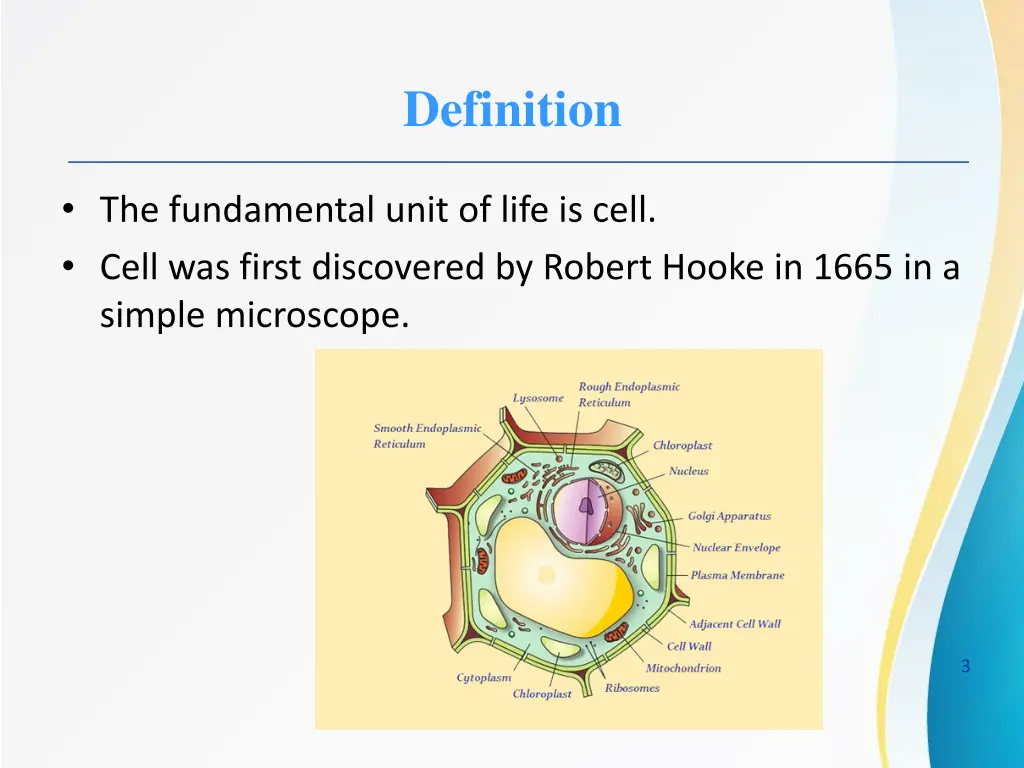
Definition The fundamental unit of life is cell. Cell was first discovered by Robert Hooke in 1665 in a simple microscope. 3
Introduction In 1674, Leeuwenhoek, with the help of developed microscope, discovered the free living cells in pond water. In 1831, Robert Brown had discovered the nucleus in the cell. In 1839, Purkinje used the term protoplasm for the fluid substance found in the cell. The cell theory was proposed by Schleiden (1838) and Schwann (1839). 4
Introduction According to the cell theory, all the plants and animals are composed of cells and that the cell is the basic unit of life. In 1855, Virchow further expanded the cell theory and suggested that all cells arise from pre-existing cells. In 1940, the discovery of electron microscope made possible to observe and understand the complex structure of the cell. 5
Types of Cell Unicellular Organisms The single cellular organisms, such as Amoeba, Chlamydomonas, Paramoecium, and bacteria, are known as unicellular organisms. Multicellular Organisms The organisms consisting of many cells are known as multicellular organisms. E.g. human being, animals, birds, etc. 7
Characterstics of Cell Each living cell has the aptitude to perform certain basic functions that are characteristic of all living forms. Each such cell has certain specific components within it known as cell organelles. These organelles collectively constitute the basic unit of life known as cell. 8
Characterstics of Cell Different types of cells have different function and each cell organelle performs a special function. All cells are found to have the same organelles, irrespective of their different functions and the organism they found in. 9
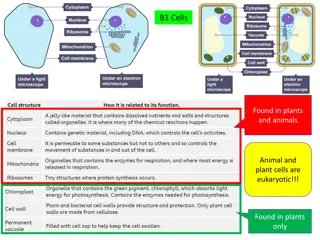
Structure of Cell Plasma Membrane/Cell Membrane Plasma membrane is the outermost covering layer of the cell Plasma membrane allows certain materials to enter inside the cell and come out from the cell; therefore, it is known as selectively permeable membrane. 10
Structure of Cell Nucleus Nucleus or nuculeus is a Latin term and its meaning is kernel or seed. The nucleus has a double layered covering, which is known as nuclear membrane. The nuclear membrane has some pores, which allow certain materials come inside (in nucleus) and go outside (in the cytoplasm). The most significant feature of nucleus is it contains chromosomes. 11
Structure of Cell Cell wall (Protective wall): Plants cells, in addition to the plasma membrane have another rigid outer covering called cell wall. The cell wall lies outside the plasma membrane. The plant cell wall is mainly composed of cellulose. It is a complex substance and provides structural strength to plant cells. 12
Structure of Cell Prokaryotic Cells: In some organisms like bacteria, the nuclear material is not enclosed by nuclear membrane and membrane bound cell organelle are absent. Such nucleus is called nucleoid and such cells are known as prokaryotic cell. Such cells have single chromosome. 13
Structure of Cell Eukaryotic Cells: Cells having well defined nucleus and having membrane bound cell organelle is termed as eukaryotic cell. Such cells have more than one chromosomes. 14
Structure of Cell Cytoplasm: The cytoplasm is the fluid content inside the plasma membrane. It also contains many specialised cell organelles. Cell Organelles: Every cell has a membrane around it to keep its content separate from the external environment. The different components of cell perform different function and these components are called cell organelles. 15
Structure of Cell Endoplasmic Reticulum (ER) (Channels, Network for transport): The ER is a large network of membrane-bound tubes and sheets. It looks like long tubules or round or oblong bags. There are two types of ER-Rough endoplasmic reticulum [RER] and smooth endoplasmic reticulum [SER]. 16
Structure of Cell Golgi Apparatus (Packaging): The golgi apparatus, first described by Camillo Golgi, consists of a system of membrane-bound vesicles arranged approximately, parallel to each other in stacks called cisterns. The material synthesised near the ER is packaged and dispatched to various targets inside and outside the cell through the Golgi apparatus. 17
Structure of Cell Lysosomes [Suicide bags] (Cleanliness of cell): Lysosomes are a kind of waste dispatch and disposal system of the cell. Lysosome help to keep the cell clean by digesting any foreign material as well as worn-out cell organelles. Foreign materials entering the cells such as bacteria or food, as well as old organelles, end up in the lysosome, which break them up into small pieces. 18
Structure of Cell Mitochondria (Powerhouse, Energy provider): Mitochondria are known as powerhouses of the cell. The energy required for various chemical activities needed for life is released by mitochondria in the form of ATP [Adenosine Triphosphate] molecules. ATP is known as energy currency of the cell. Mitochondria have two membrane coverings instead of just one. 19
Structure of Cell Plastids: Plastids are present only in plant cells. There are two types of plastids chromoplasts and leucoplasts. Chromoplasts are the coloured plastids present in leaves, flowers and fruits. Plastids containing the pigment chlorophyll are known as chloroplasts. They are important for photosynthesis in plants. Chloroplasts also contain various yellow or orange pigments in addition to chlorophyll. 20
Structure of Cell Vacuoles (Storage): Vacuoles are storage sacs for solid or liquid contents. Vacuoles are small-sized in animal cells while plant cells have very large vacuoles [50% to 90% cell volume]. In Amoeba, the food vacuole contain the food items that is consumed by it and contractile vacuoles expels excess water and some wastes from the cell. 21
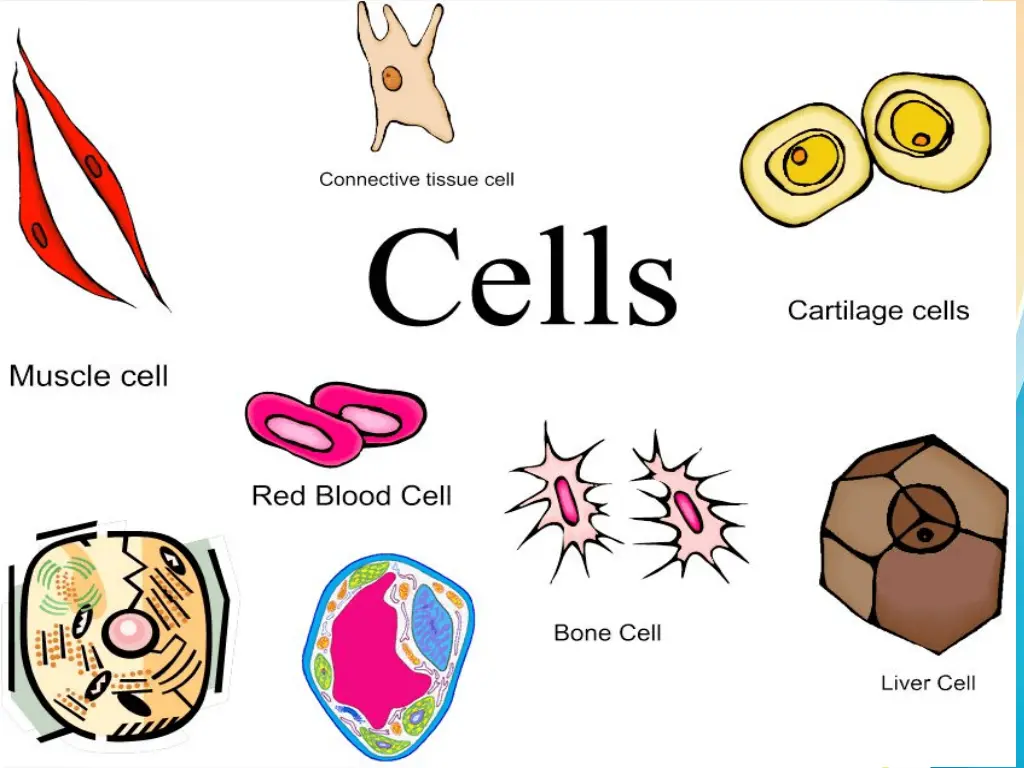
Conclusion A cell is the smallest and basic unit of life. A cell is not visible to the naked eye because of its minute size. A cell can have different shapes and sizes within the same organism. Every organism possesses different types of cells. 22
Thanks To StudyMafia.org