CETA: A New Model for Regulatory Cooperation
Professor Debra Steger discusses the CETA agreement and its impact on regulatory cooperation, transparency, and coherence. It explores the inclusion of regulatory chapters, reasons behind their incorporation, and the framework for cooperation established by CETA without harmonization.

Download Presentation

Please find below an Image/Link to download the presentation.
The content on the website is provided AS IS for your information and personal use only. It may not be sold, licensed, or shared on other websites without obtaining consent from the author.If you encounter any issues during the download, it is possible that the publisher has removed the file from their server.
You are allowed to download the files provided on this website for personal or commercial use, subject to the condition that they are used lawfully. All files are the property of their respective owners.
The content on the website is provided AS IS for your information and personal use only. It may not be sold, licensed, or shared on other websites without obtaining consent from the author.
E N D
Presentation Transcript
CETA A New Model for Regulatory Cooperation, Transparency and Coherence? Presentation by: Professor Debra Steger University of Victoria European Union Centre of Excellence May 6, 2014 Facult de droit | Faculty of Law uOttawa.ca uOttawa.ca uOttawa.ca
2 CETA A New Generation International Economic Agreement Traditional FTAs - trade in goods, trade in services, investment and trade-related intellectual property Newer FTAs - provisions that are WTO-plus or even WTO-X CETA includes regulatory subjects not included in NAFTA , previous Canadian FTAs or WTO Obligations that will reduce regulatory barriers and increase coherence? Or agreement to cooperate in future? Provisions derived from EU agreements? Or responses to civil society and stakeholders? uOttawa.ca
Is CETA a model? It has chapters reaching into regulatory areas: TBT goes beyond NAFTA and WTO SPS goes beyond NAFTA and WTO Labour Mobility goes beyond NAFTA First chapter on Regulatory Cooperation First chapter on Sustainable Development First chapter on Environment in FTA itself First chapter on Labour in FTA itself First subsidies obligations in an FTA First investment chapter in an FTA for EU uOttawa.ca
Why are these regulatory chapters in CETA? Stiglitz/some economists: FTAs should be about trade and not reach into regulatory areas; if they do, it will be a race to the bottom ; harmonization lowest common denominator; governments regulatory autonomy will be restricted Reason why? NTBs since Tokyo Round 1970s have been major barriers to trade FTAs/WTO eliminate/reduce tariffs, NTBs and regulatory differences are the barriers; inspections and approvals, certifications, discriminatory regulations, etc. uOttawa.ca
What does CETA do? No harmonization Incorporates WTO obligations TBT, SPS, subsidies Establishes frameworks for cooperation and dialogue by agencies and government officials in a host of regulatory areas Mutual recognition for test results and product certification by certain conformity assessment bodies Procedures for requesting mutual recognition of technical regulations Framework for negotiating mutual recognition agreements for professional qualifications uOttawa.ca
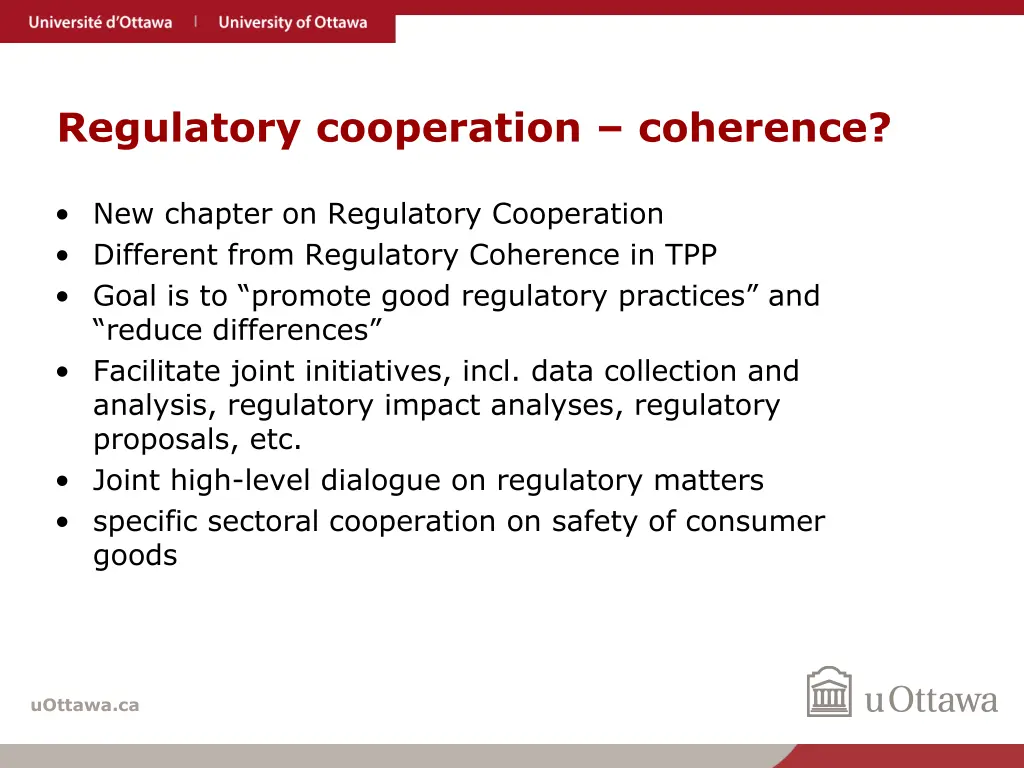
Regulatory cooperation coherence? New chapter on Regulatory Cooperation Different from Regulatory Coherence in TPP Goal is to promote good regulatory practices and reduce differences Facilitate joint initiatives, incl. data collection and analysis, regulatory impact analyses, regulatory proposals, etc. Joint high-level dialogue on regulatory matters specific sectoral cooperation on safety of consumer goods uOttawa.ca
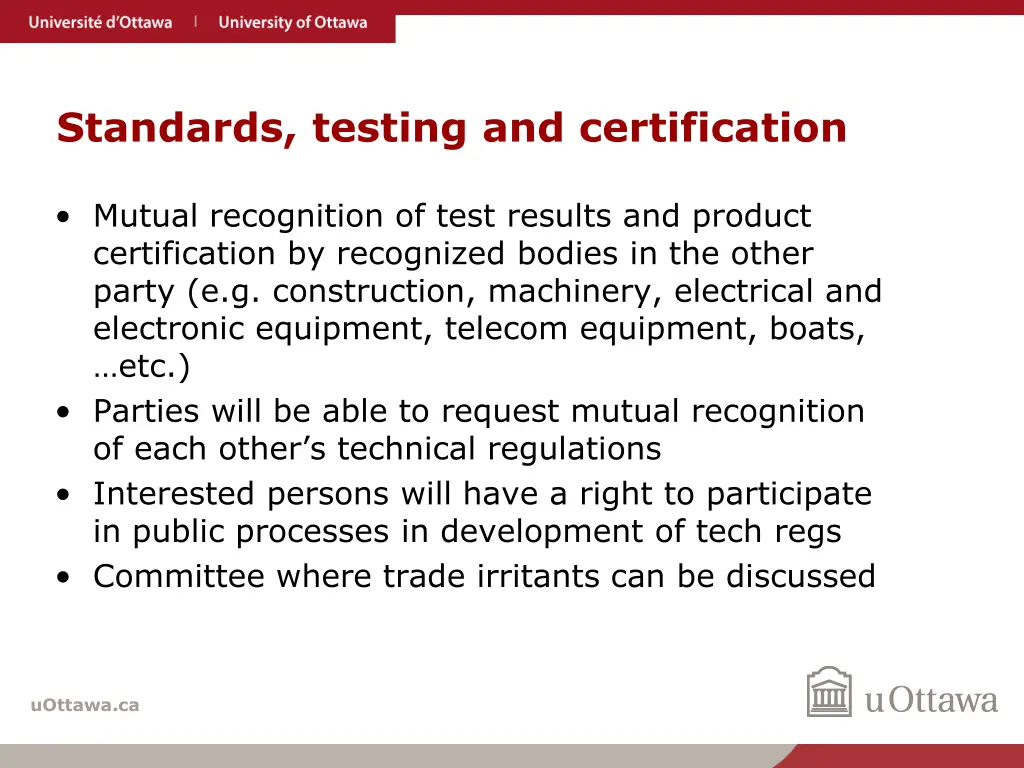
Standards, testing and certification Mutual recognition of test results and product certification by recognized bodies in the other party (e.g. construction, machinery, electrical and electronic equipment, telecom equipment, boats, etc.) Parties will be able to request mutual recognition of each other s technical regulations Interested persons will have a right to participate in public processes in development of tech regs Committee where trade irritants can be discussed uOttawa.ca
SPS Reaffirm and build upon WTO SPS Agreement Update Canada-EU Veterinary Agreement Framework for cooperation on full scope of animal health, plant health and food safety Proactively determine equivalency of each other s inspection and certification systems SPS Committee to discuss issues before they become problems uOttawa.ca
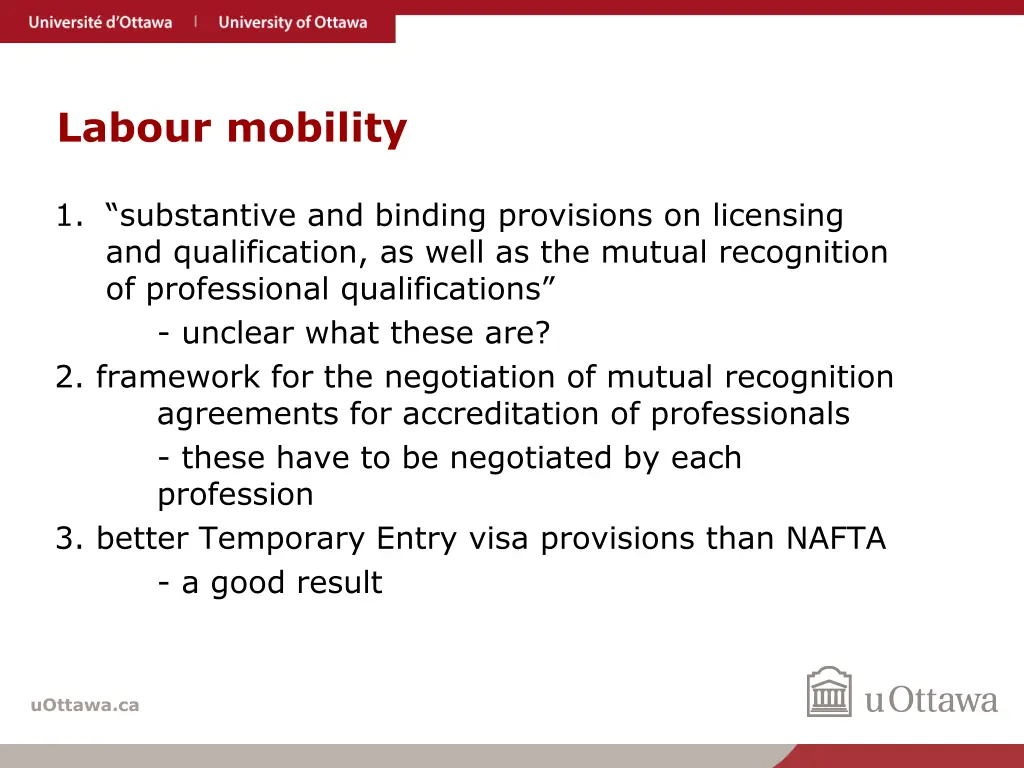
Labour mobility 1. substantive and binding provisions on licensing and qualification, as well as the mutual recognition of professional qualifications - unclear what these are? 2. framework for the negotiation of mutual recognition agreements for accreditation of professionals - these have to be negotiated by each profession 3. better Temporary Entry visa provisions than NAFTA - a good result uOttawa.ca
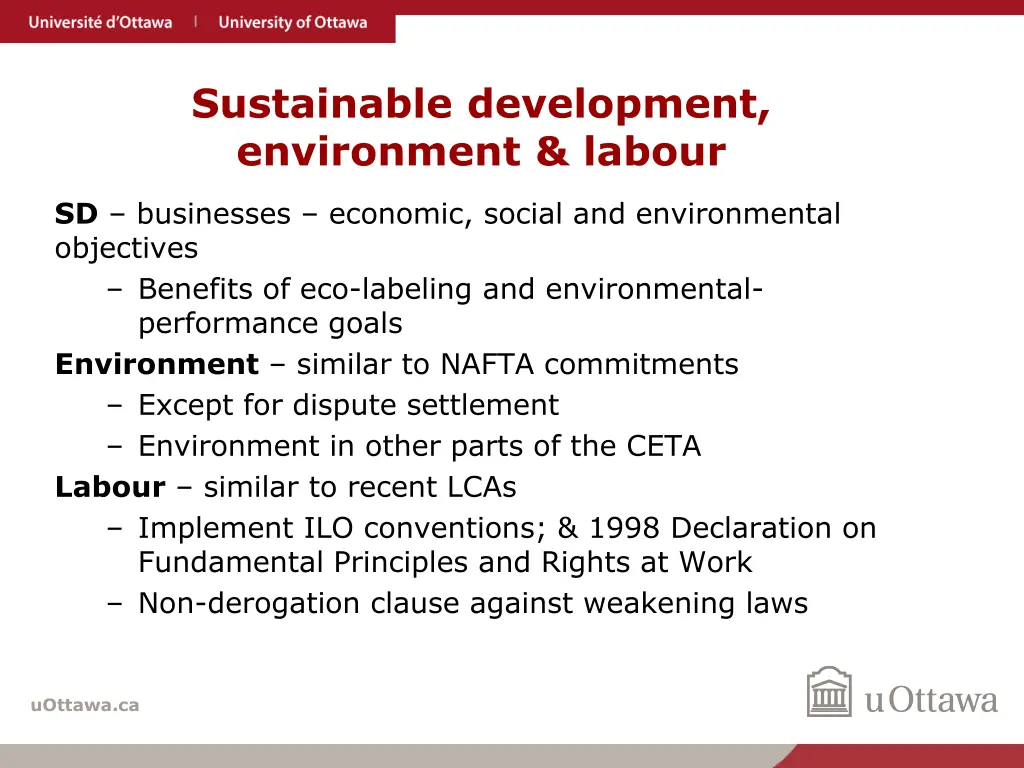
Sustainable development, environment & labour SD businesses economic, social and environmental objectives Benefits of eco-labeling and environmental- performance goals Environment similar to NAFTA commitments Except for dispute settlement Environment in other parts of the CETA Labour similar to recent LCAs Implement ILO conventions; & 1998 Declaration on Fundamental Principles and Rights at Work Non-derogation clause against weakening laws uOttawa.ca
Transparency Similar to NAFTA, Chapter 18: Publication of proposed and actual measures Reasonable opportunity to comment for interested persons and Parties on proposed measures Notification and provision of information with re actual and proposed measures Reasonable opportunity to be heard in administrative hearings Review and appeal procedures opportunity to be heard, right to a decision uOttawa.ca
Participation Commission, 3 Committees, several other committees and dialogues parties, provinces and MS s Committee to monitor environmental impact of CETA SD - civil society forum Labour civil society advisory groups - mechanism for public to raise concerns Dispute settlement Transparency Public hearings Amicus briefs Including for ISDS uOttawa.ca
CETA is a work in progress Some achievements: Mutual recognition of testing and certification bodies scope and number of bodies expanded Transparency, administrative procedures and appeals Civil society forums, participation in dispute settlement Procedures for requesting mutual recognition of tech regs and negotiating mutual recognition of professional qualifications uOttawa.ca
Implementation challenges Effective implementation will require continuing cooperation Sounds great on paper, but will it all work smoothly? Resources EU, Canada? NAFTA experience Committees EU other agreements, negotiations, including TTIP After the negotiations are over, the CETA is ratified, will the momentum continue? uOttawa.ca
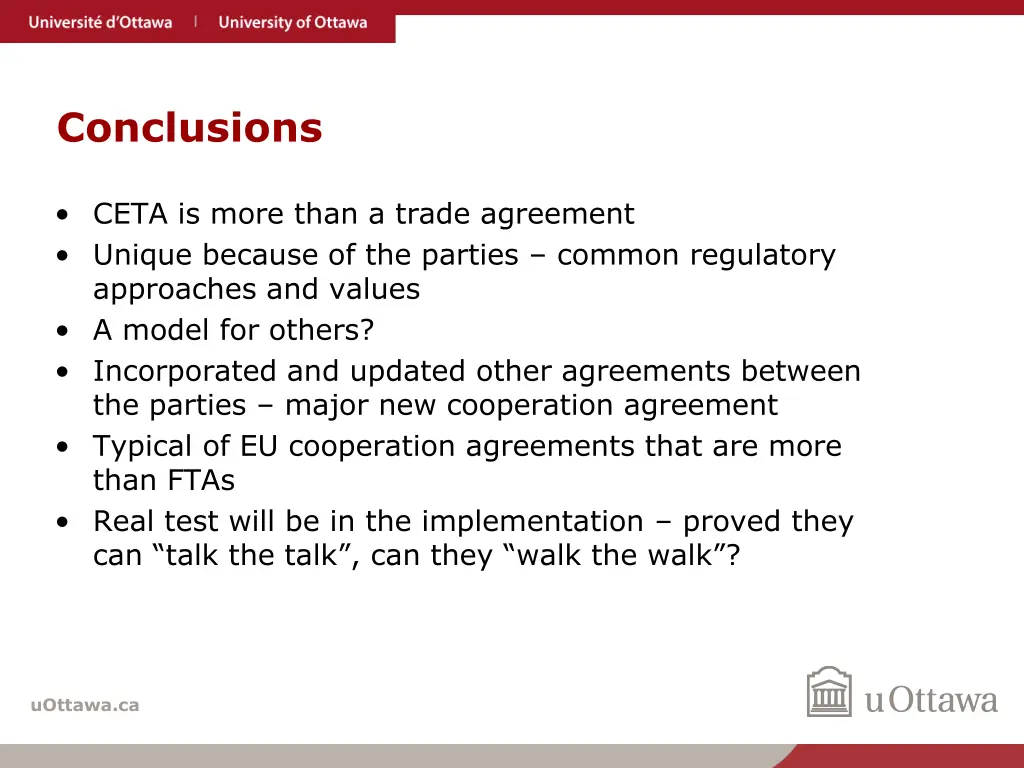
Conclusions CETA is more than a trade agreement Unique because of the parties common regulatory approaches and values A model for others? Incorporated and updated other agreements between the parties major new cooperation agreement Typical of EU cooperation agreements that are more than FTAs Real test will be in the implementation proved they can talk the talk , can they walk the walk ? uOttawa.ca