Challenges and Solutions in Regionalizing Rural Water Infrastructure
Explore the contextual challenges faced in regionalizing rural water infrastructure, emphasizing the need for collaboration, administrative support, and a tailored approach. Learn how project success hinges on understanding local context and involving stakeholders in decision-making processes.

Uploaded on | 0 Views
Download Presentation

Please find below an Image/Link to download the presentation.
The content on the website is provided AS IS for your information and personal use only. It may not be sold, licensed, or shared on other websites without obtaining consent from the author. If you encounter any issues during the download, it is possible that the publisher has removed the file from their server.
You are allowed to download the files provided on this website for personal or commercial use, subject to the condition that they are used lawfully. All files are the property of their respective owners.
The content on the website is provided AS IS for your information and personal use only. It may not be sold, licensed, or shared on other websites without obtaining consent from the author.
E N D
Presentation Transcript
Contextual Challenges of Regionalizing Rural Water Infrastructure Ann-Perry Witmer Senior Research Scientist 4 November 2022 UNIVERSITY OF ILLINOIS AT URBANA-CHAMPAIGN
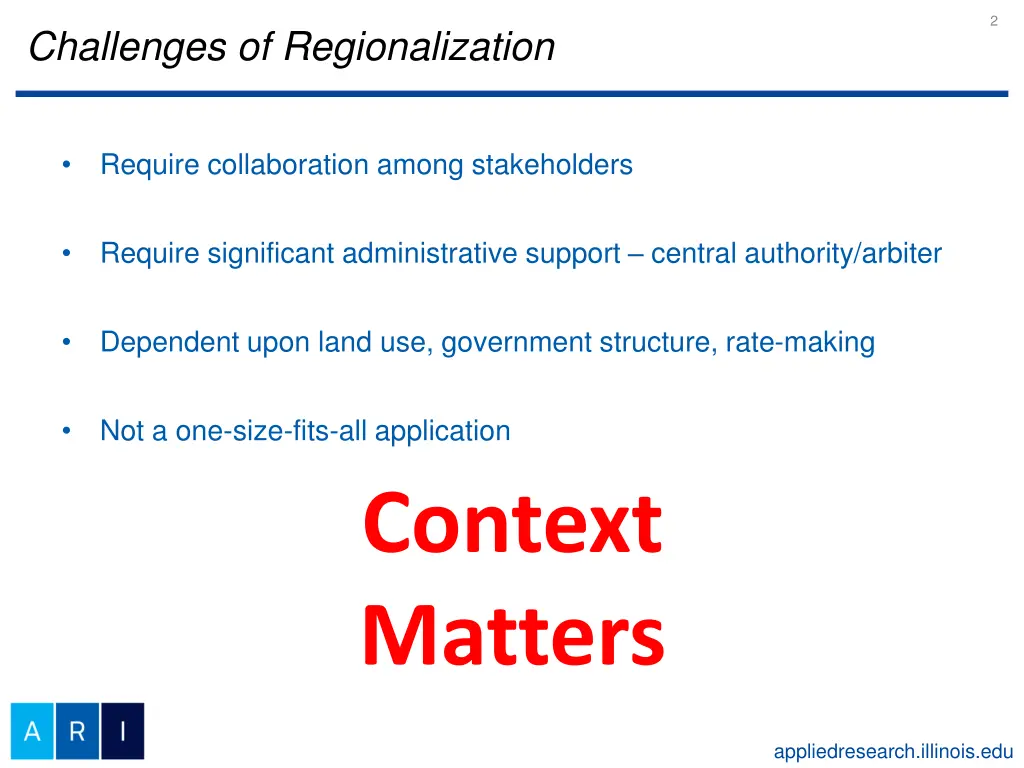
2 Challenges of Regionalization Require collaboration among stakeholders Require significant administrative support central authority/arbiter Dependent upon land use, government structure, rate-making Not a one-size-fits-all application Context Matters appliedresearch.illinois.edu
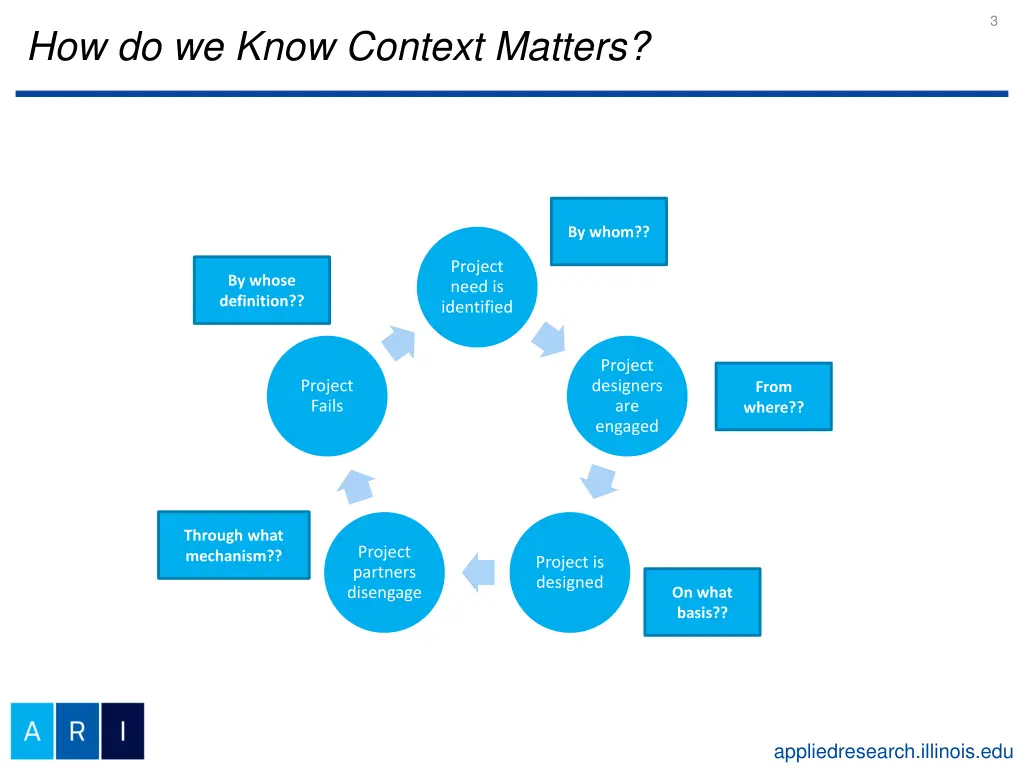
3 How do we Know Context Matters? By whom?? Project need is identified By whose definition?? Project designers are engaged Project Fails From where?? Through what mechanism?? Project partners disengage Project is designed On what basis?? appliedresearch.illinois.edu
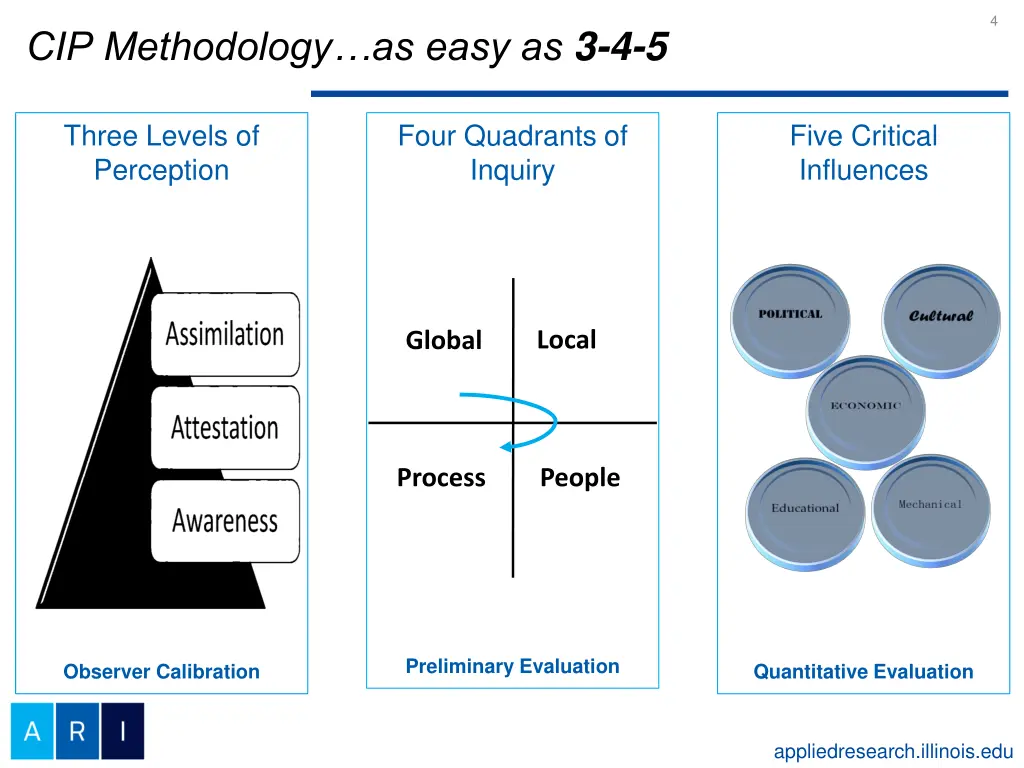
4 CIP Methodology as easy as 3-4-5 Three Levels of Perception Four Quadrants of Inquiry Five Critical Influences Local Global Process People Preliminary Evaluation Observer Calibration Quantitative Evaluation appliedresearch.illinois.edu
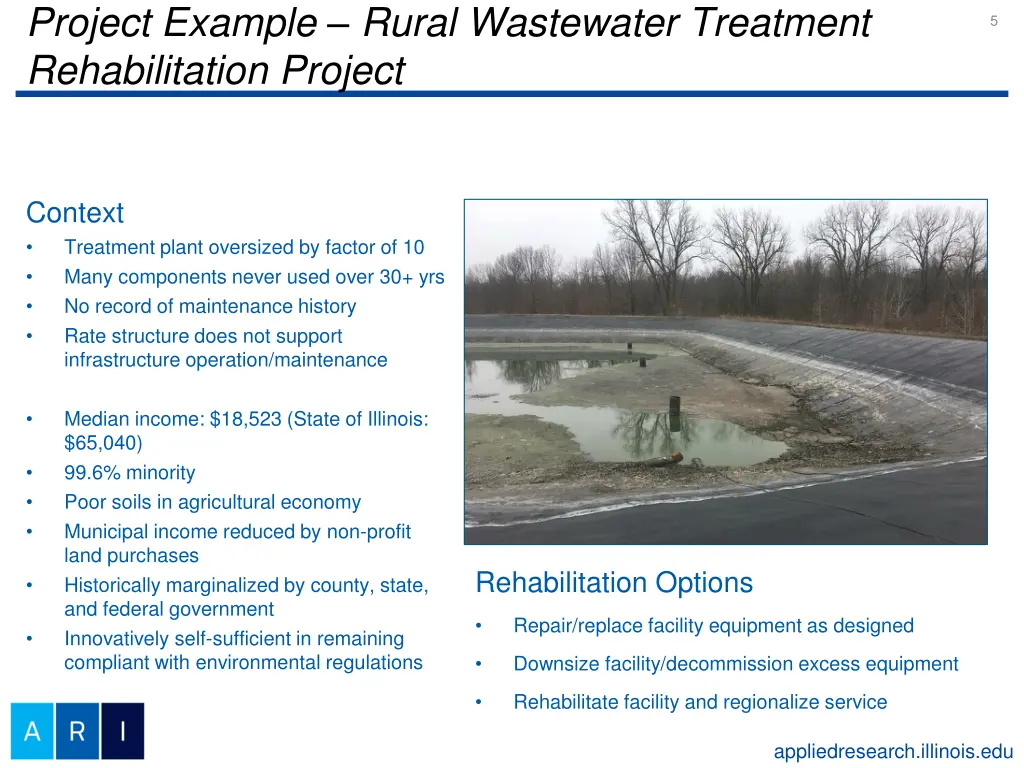
Project Example Rural Wastewater Treatment Rehabilitation Project 5 Context Treatment plant oversized by factor of 10 Many components never used over 30+ yrs No record of maintenance history Rate structure does not support infrastructure operation/maintenance Median income: $18,523 (State of Illinois: $65,040) 99.6% minority Poor soils in agricultural economy Municipal income reduced by non-profit land purchases Historically marginalized by county, state, and federal government Innovatively self-sufficient in remaining compliant with environmental regulations Rehabilitation Options Repair/replace facility equipment as designed Downsize facility/decommission excess equipment Rehabilitate facility and regionalize service appliedresearch.illinois.edu
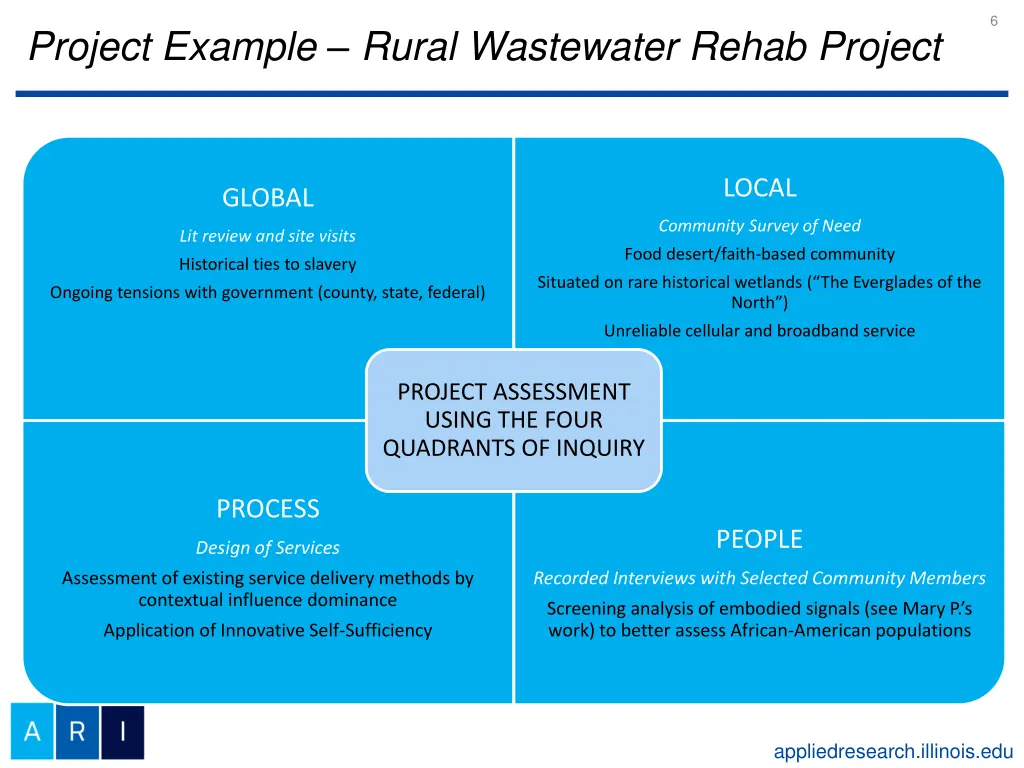
6 Project Example Rural Wastewater Rehab Project LOCAL GLOBAL Community Survey of Need Lit review and site visits Food desert/faith-based community Historical ties to slavery Situated on rare historical wetlands ( The Everglades of the North ) Ongoing tensions with government (county, state, federal) Unreliable cellular and broadband service PROJECT ASSESSMENT USING THE FOUR QUADRANTS OF INQUIRY PROCESS PEOPLE Design of Services Assessment of existing service delivery methods by contextual influence dominance Recorded Interviews with Selected Community Members Screening analysis of embodied signals (see Mary P. s work) to better assess African-American populations Application of Innovative Self-Sufficiency appliedresearch.illinois.edu
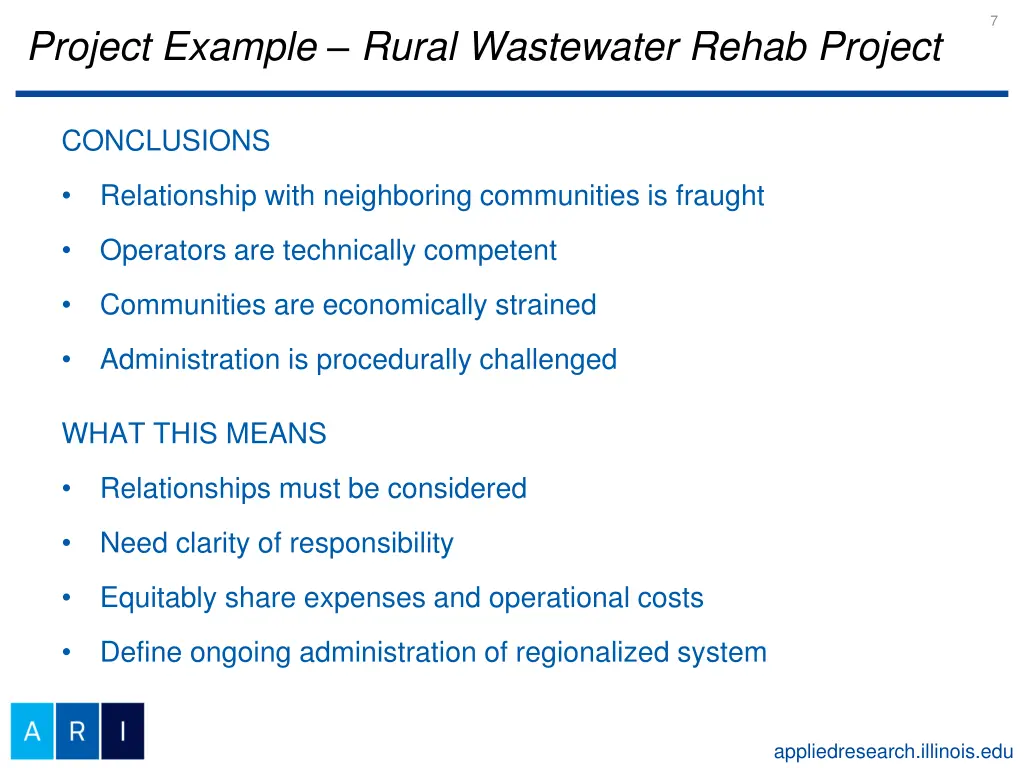
7 Project Example Rural Wastewater Rehab Project CONCLUSIONS Relationship with neighboring communities is fraught Operators are technically competent Communities are economically strained Administration is procedurally challenged WHAT THIS MEANS Relationships must be considered Need clarity of responsibility Equitably share expenses and operational costs Define ongoing administration of regionalized system appliedresearch.illinois.edu
8 Thank You Ann-Perry Witmer, PhD, PE awitmer@Illinois.edu 217-244-7805 appliedresearch.illinois.edu