Challenges Faced by Latina Doctoral Students in Higher Education
Explore the unique challenges experienced by Latina doctoral students, focusing on themes like imposter syndrome, cultural incongruity, and navigating higher education systems. This study highlights the importance of providing support and mentorship to help these students succeed in academia.

Download Presentation

Please find below an Image/Link to download the presentation.
The content on the website is provided AS IS for your information and personal use only. It may not be sold, licensed, or shared on other websites without obtaining consent from the author. If you encounter any issues during the download, it is possible that the publisher has removed the file from their server.
You are allowed to download the files provided on this website for personal or commercial use, subject to the condition that they are used lawfully. All files are the property of their respective owners.
The content on the website is provided AS IS for your information and personal use only. It may not be sold, licensed, or shared on other websites without obtaining consent from the author.
E N D
Presentation Transcript
No Soy Intrusa: Testimonios from Latina Doctoral Students 11thAnnual National Symposium on Spanish as Heritage Language San Antonio Texas February 22-24, 2024
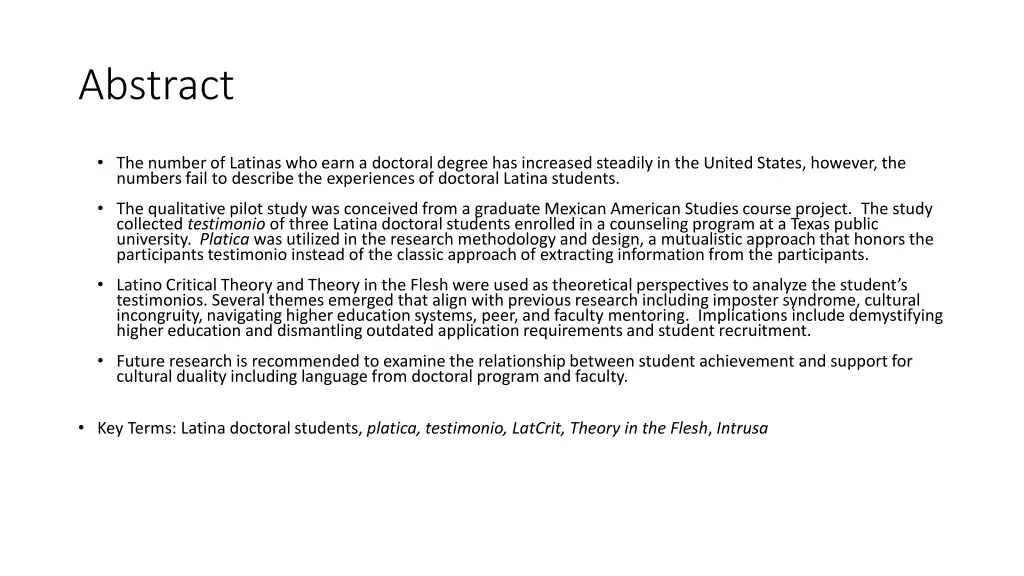
Abstract The number of Latinas who earn a doctoral degree has increased steadily in the United States, however, the numbers fail to describe the experiences of doctoral Latina students. The qualitative pilot study was conceived from a graduate Mexican American Studies course project. The study collected testimonio of three Latina doctoral students enrolled in a counseling program at a Texas public university. Platica was utilized in the research methodology and design, a mutualistic approach that honors the participants testimonio instead of the classic approach of extracting information from the participants. Latino Critical Theory and Theory in the Flesh were used as theoretical perspectives to analyze the student s testimonios. Several themes emerged that align with previous research including imposter syndrome, cultural incongruity, navigating higher education systems, peer, and faculty mentoring. Implications include demystifying higher education and dismantling outdated application requirements and student recruitment. Future research is recommended to examine the relationship between student achievement and support for cultural duality including language from doctoral program and faculty. Key Terms: Latina doctoral students, platica, testimonio, LatCrit, Theory in the Flesh, Intrusa
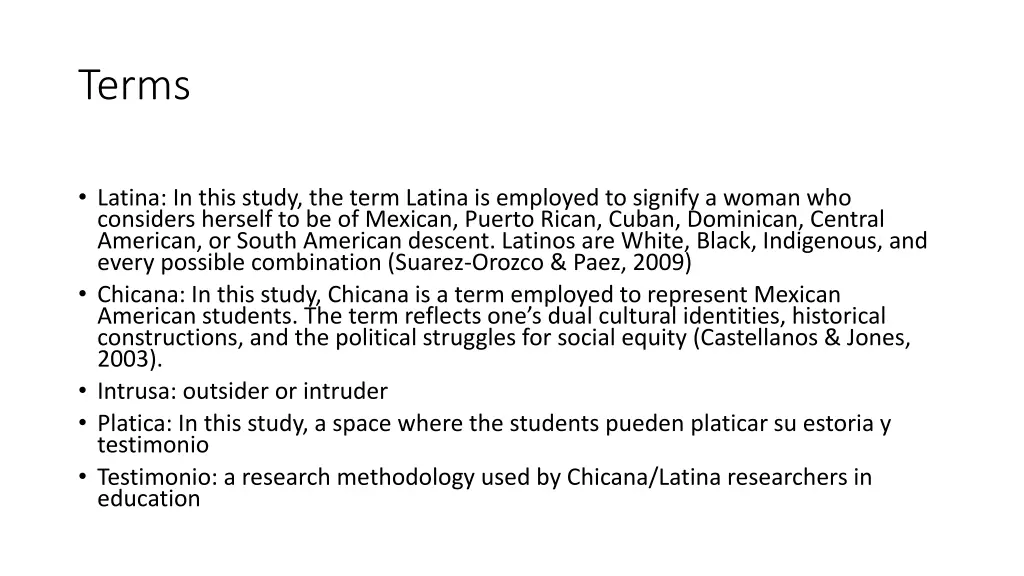
Terms Latina: In this study, the term Latina is employed to signify a woman who considers herself to be of Mexican, Puerto Rican, Cuban, Dominican, Central American, or South American descent. Latinos are White, Black, Indigenous, and every possible combination (Suarez-Orozco & Paez, 2009) Chicana: In this study, Chicana is a term employed to represent Mexican American students. The term reflects one s dual cultural identities, historical constructions, and the political struggles for social equity (Castellanos & Jones, 2003). Intrusa: outsider or intruder Platica: In this study, a space where the students pueden platicar su estoria y testimonio Testimonio: a research methodology used by Chicana/Latina researchers in education
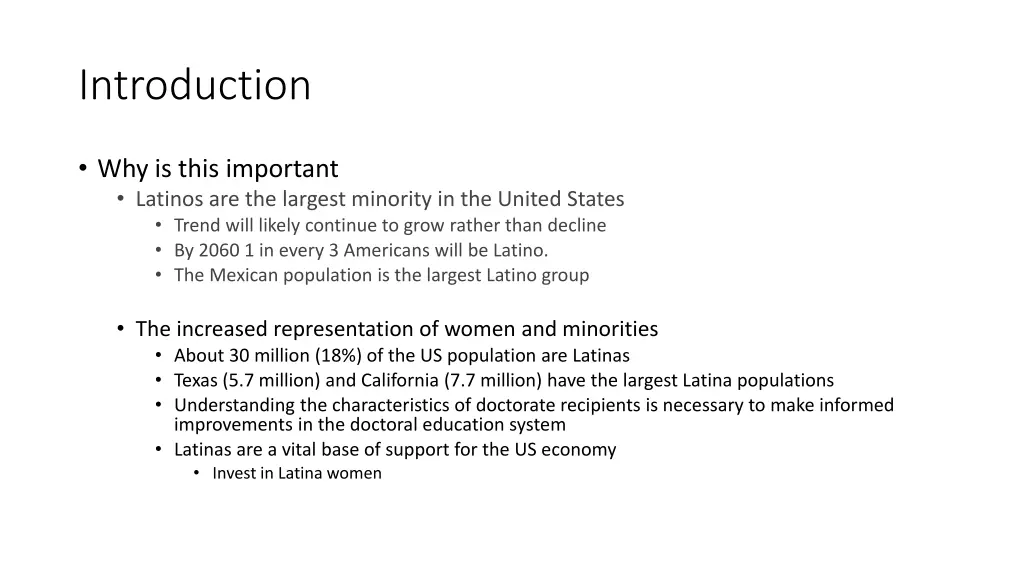
Introduction Why is this important Latinos are the largest minority in the United States Trend will likely continue to grow rather than decline By 2060 1 in every 3 Americans will be Latino. The Mexican population is the largest Latino group The increased representation of women and minorities About 30 million (18%) of the US population are Latinas Texas (5.7 million) and California (7.7 million) have the largest Latina populations Understanding the characteristics of doctorate recipients is necessary to make informed improvements in the doctoral education system Latinas are a vital base of support for the US economy Invest in Latina women
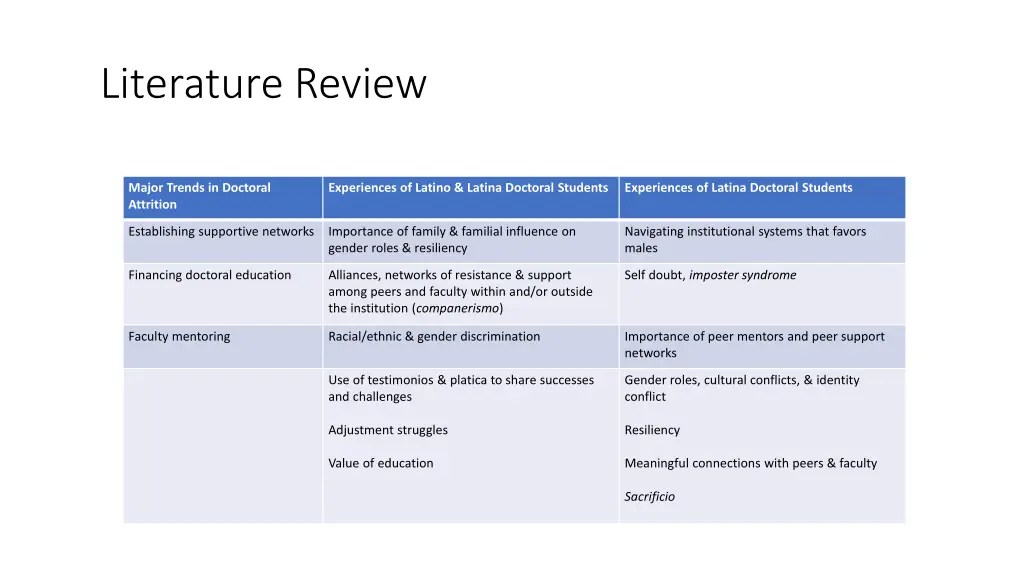
Literature Review Major Trends in Doctoral Attrition Experiences of Latino & Latina Doctoral Students Experiences of Latina Doctoral Students Establishing supportive networks Importance of family & familial influence on gender roles & resiliency Navigating institutional systems that favors males Financing doctoral education Alliances, networks of resistance & support among peers and faculty within and/or outside the institution (companerismo) Self doubt, imposter syndrome Faculty mentoring Racial/ethnic & gender discrimination Importance of peer mentors and peer support networks Use of testimonios & platica to share successes and challenges Gender roles, cultural conflicts, & identity conflict Adjustment struggles Resiliency Value of education Meaningful connections with peers & faculty Sacrificio
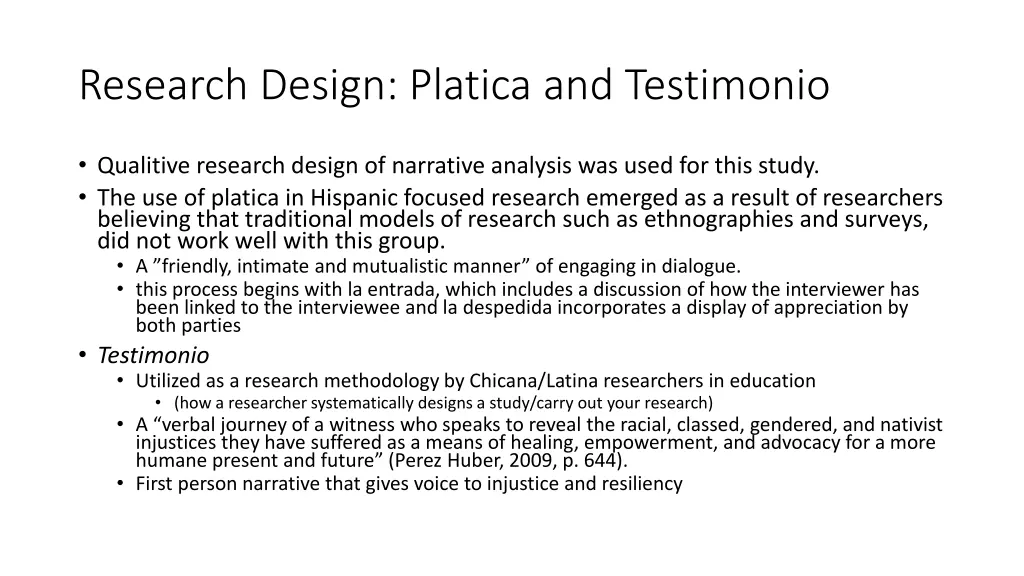
Research Design: Platica and Testimonio Qualitive research design of narrative analysis was used for this study. The use of platica in Hispanic focused research emerged as a result of researchers believing that traditional models of research such as ethnographies and surveys, did not work well with this group. A friendly, intimate and mutualistic manner of engaging in dialogue. this process begins with la entrada, which includes a discussion of how the interviewer has been linked to the interviewee and la despedida incorporates a display of appreciation by both parties Testimonio Utilized as a research methodology by Chicana/Latina researchers in education (how a researcher systematically designs a study/carry out your research) A verbal journey of a witness who speaks to reveal the racial, classed, gendered, and nativist injustices they have suffered as a means of healing, empowerment, and advocacy for a more humane present and future (Perez Huber, 2009, p. 644). First person narrative that gives voice to injustice and resiliency
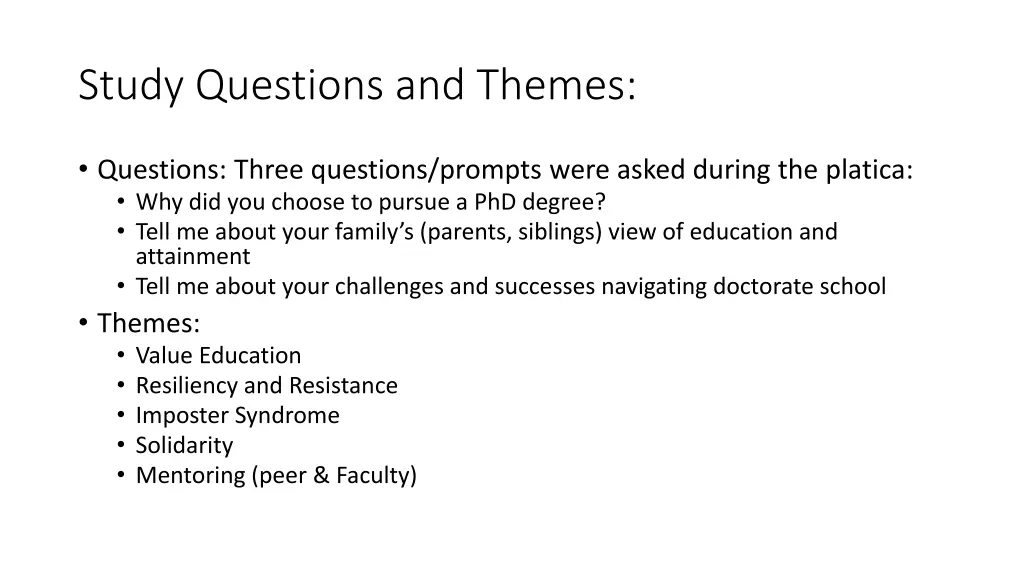
Study Questions and Themes: Questions: Three questions/prompts were asked during the platica: Why did you choose to pursue a PhD degree? Tell me about your family s (parents, siblings) view of education and attainment Tell me about your challenges and successes navigating doctorate school Themes: Value Education Resiliency and Resistance Imposter Syndrome Solidarity Mentoring (peer & Faculty)
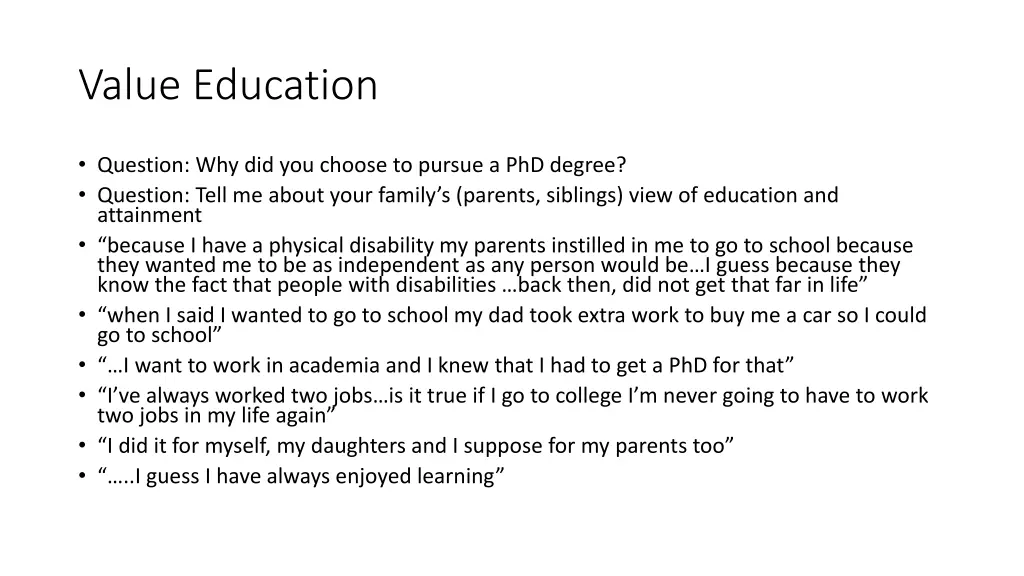
Value Education Question: Why did you choose to pursue a PhD degree? Question: Tell me about your family s (parents, siblings) view of education and attainment because I have a physical disability my parents instilled in me to go to school because they wanted me to be as independent as any person would be I guess because they know the fact that people with disabilities back then, did not get that far in life when I said I wanted to go to school my dad took extra work to buy me a car so I could go to school I want to work in academia and I knew that I had to get a PhD for that I ve always worked two jobs is it true if I go to college I m never going to have to work two jobs in my life again I did it for myself, my daughters and I suppose for my parents too ..I guess I have always enjoyed learning
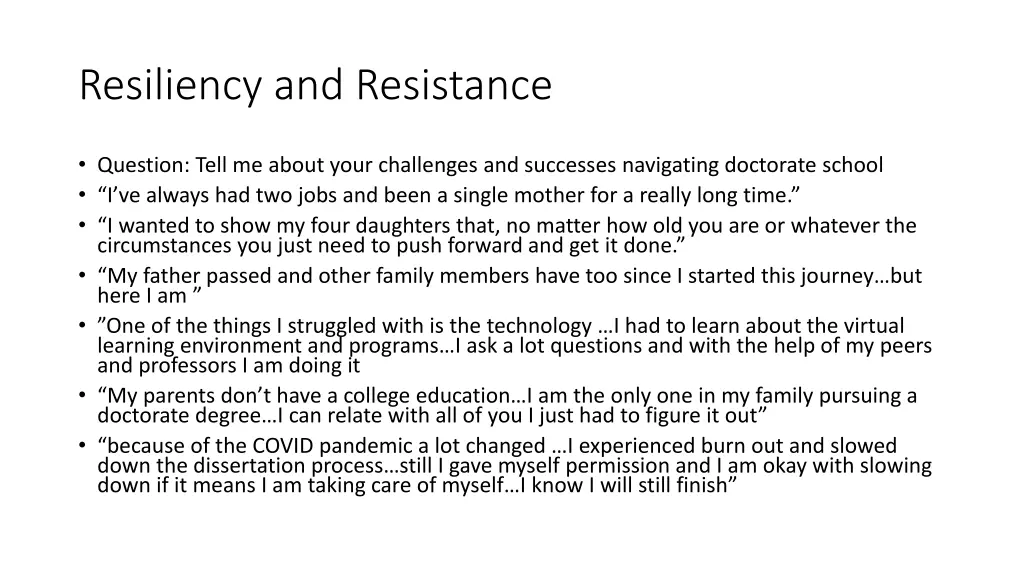
Resiliency and Resistance Question: Tell me about your challenges and successes navigating doctorate school I ve always had two jobs and been a single mother for a really long time. I wanted to show my four daughters that, no matter how old you are or whatever the circumstances you just need to push forward and get it done. My father passed and other family members have too since I started this journey but here I am One of the things I struggled with is the technology I had to learn about the virtual learning environment and programs I ask a lot questions and with the help of my peers and professors I am doing it My parents don t have a college education I am the only one in my family pursuing a doctorate degree I can relate with all of you I just had to figure it out because of the COVID pandemic a lot changed I experienced burn out and slowed down the dissertation process still I gave myself permission and I am okay with slowing down if it means I am taking care of myself I know I will still finish
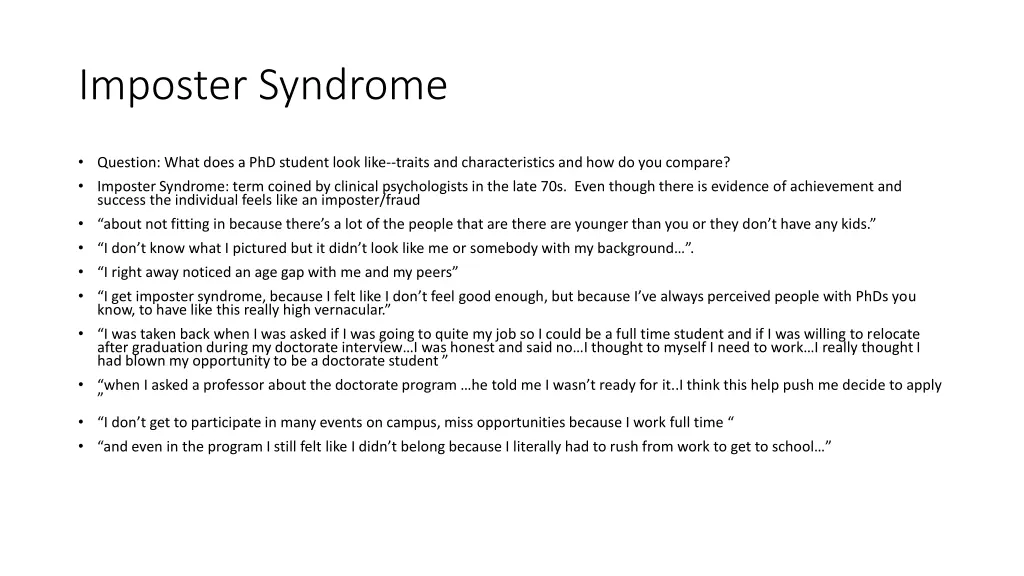
Imposter Syndrome Question: What does a PhD student look like--traits and characteristics and how do you compare? Imposter Syndrome: term coined by clinical psychologists in the late 70s. Even though there is evidence of achievement and success the individual feels like an imposter/fraud about not fitting in because there s a lot of the people that are there are younger than you or they don t have any kids. I don t know what I pictured but it didn t look like me or somebody with my background . I right away noticed an age gap with me and my peers I get imposter syndrome, because I felt like I don t feel good enough, but because I ve always perceived people with PhDs you know, to have like this really high vernacular. I was taken back when I was asked if I was going to quite my job so I could be a full time student and if I was willing to relocate after graduation during my doctorate interview I was honest and said no I thought to myself I need to work I really thought I had blown my opportunity to be a doctorate student when I asked a professor about the doctorate program he told me I wasn t ready for it..I think this help push me decide to apply I don t get to participate in many events on campus, miss opportunities because I work full time and even in the program I still felt like I didn t belong because I literally had to rush from work to get to school
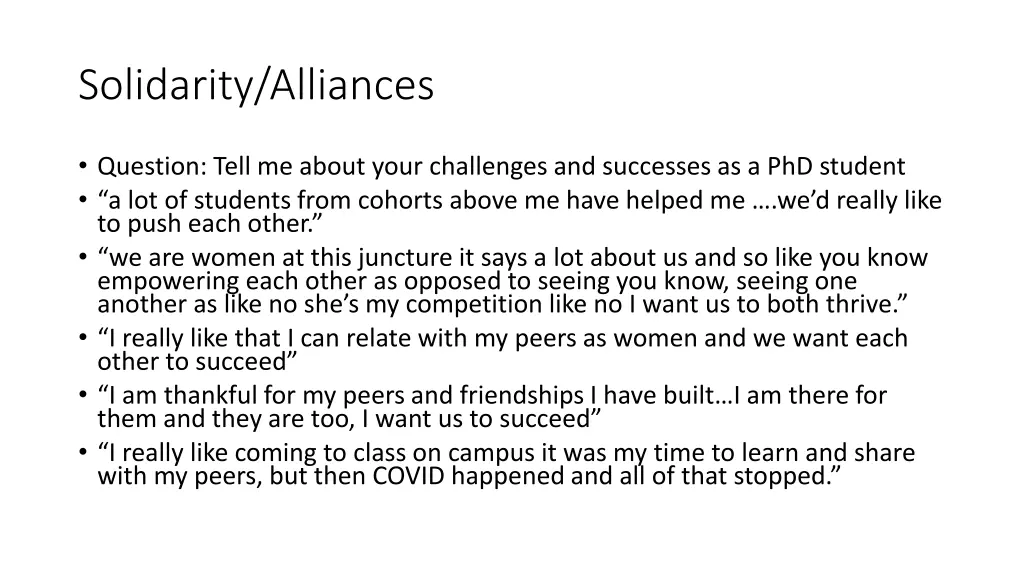
Solidarity/Alliances Question: Tell me about your challenges and successes as a PhD student a lot of students from cohorts above me have helped me .we d really like to push each other. we are women at this juncture it says a lot about us and so like you know empowering each other as opposed to seeing you know, seeing one another as like no she s my competition like no I want us to both thrive. I really like that I can relate with my peers as women and we want each other to succeed I am thankful for my peers and friendships I have built I am there for them and they are too, I want us to succeed I really like coming to class on campus it was my time to learn and share with my peers, but then COVID happened and all of that stopped.
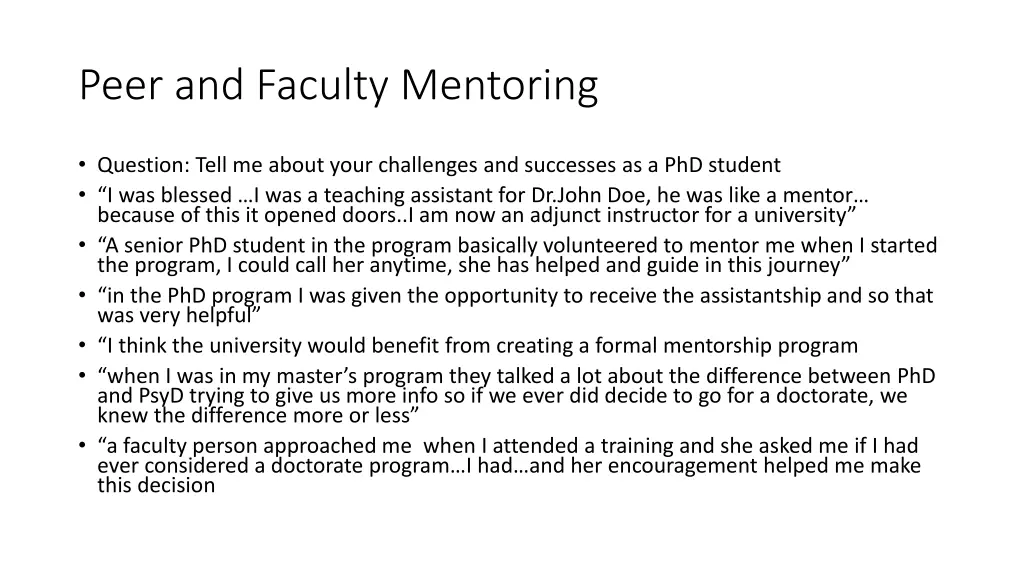
Peer and Faculty Mentoring Question: Tell me about your challenges and successes as a PhD student I was blessed I was a teaching assistant for Dr.John Doe, he was like a mentor because of this it opened doors..I am now an adjunct instructor for a university A senior PhD student in the program basically volunteered to mentor me when I started the program, I could call her anytime, she has helped and guide in this journey in the PhD program I was given the opportunity to receive the assistantship and so that was very helpful I think the university would benefit from creating a formal mentorship program when I was in my master s program they talked a lot about the difference between PhD and PsyD trying to give us more info so if we ever did decide to go for a doctorate, we knew the difference more or less a faculty person approached me when I attended a training and she asked me if I had ever considered a doctorate program I had and her encouragement helped me make this decision
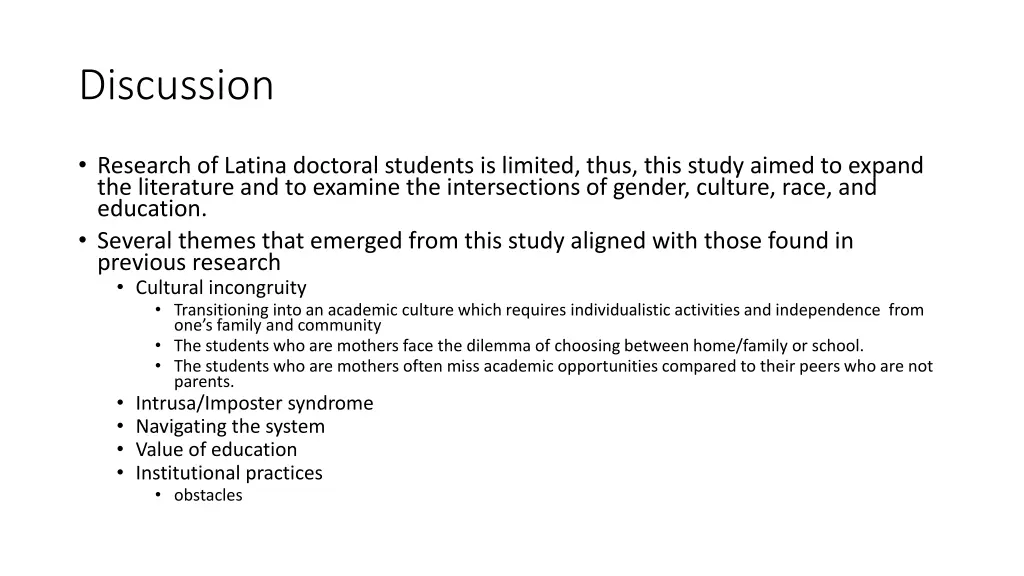
Discussion Research of Latina doctoral students is limited, thus, this study aimed to expand the literature and to examine the intersections of gender, culture, race, and education. Several themes that emerged from this study aligned with those found in previous research Cultural incongruity Transitioning into an academic culture which requires individualistic activities and independence from one s family and community The students who are mothers face the dilemma of choosing between home/family or school. The students who are mothers often miss academic opportunities compared to their peers who are not parents. Intrusa/Imposter syndrome Navigating the system Value of education Institutional practices obstacles
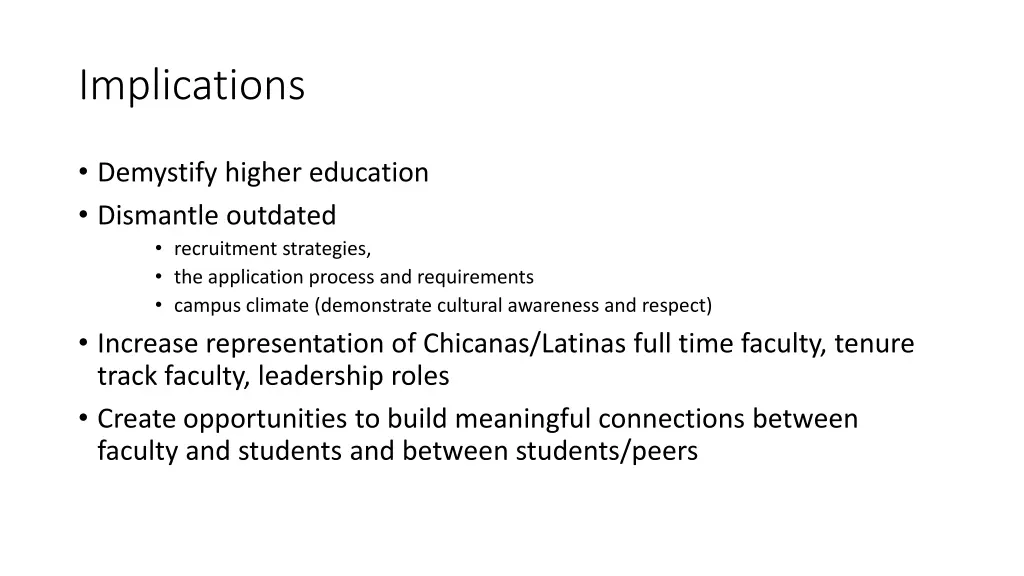
Implications Demystify higher education Dismantle outdated recruitment strategies, the application process and requirements campus climate (demonstrate cultural awareness and respect) Increase representation of Chicanas/Latinas full time faculty, tenure track faculty, leadership roles Create opportunities to build meaningful connections between faculty and students and between students/peers
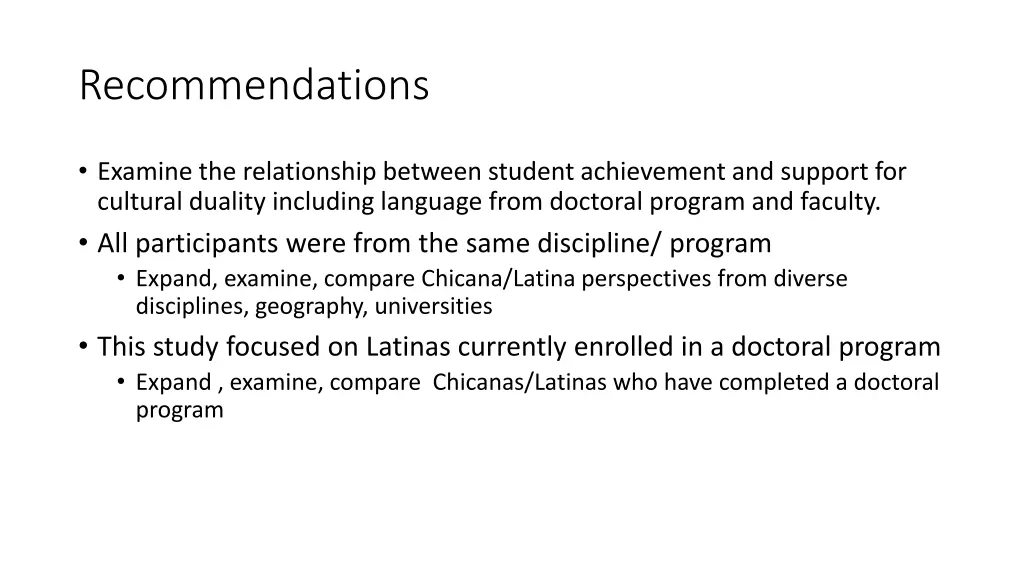
Recommendations Examine the relationship between student achievement and support for cultural duality including language from doctoral program and faculty. All participants were from the same discipline/ program Expand, examine, compare Chicana/Latina perspectives from diverse disciplines, geography, universities This study focused on Latinas currently enrolled in a doctoral program Expand , examine, compare Chicanas/Latinas who have completed a doctoral program
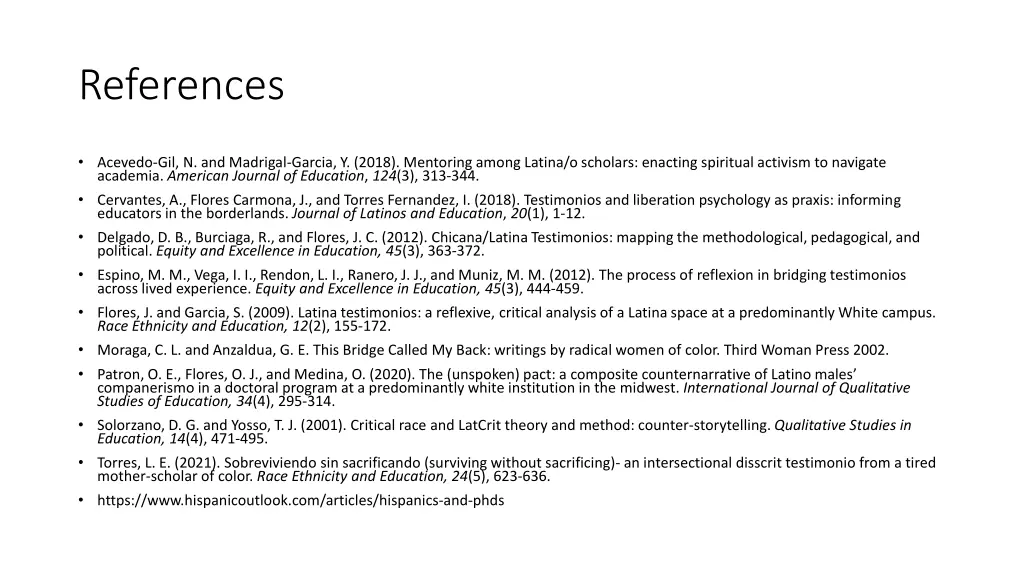
References Acevedo-Gil, N. and Madrigal-Garcia, Y. (2018). Mentoring among Latina/o scholars: enacting spiritual activism to navigate academia. American Journal of Education, 124(3), 313-344. Cervantes, A., Flores Carmona, J., and Torres Fernandez, I. (2018). Testimonios and liberation psychology as praxis: informing educators in the borderlands. Journal of Latinos and Education, 20(1), 1-12. Delgado, D. B., Burciaga, R., and Flores, J. C. (2012). Chicana/Latina Testimonios: mapping the methodological, pedagogical, and political. Equity and Excellence in Education, 45(3), 363-372. Espino, M. M., Vega, I. I., Rendon, L. I., Ranero, J. J., and Muniz, M. M. (2012). The process of reflexion in bridging testimonios across lived experience. Equity and Excellence in Education, 45(3), 444-459. Flores, J. and Garcia, S. (2009). Latina testimonios: a reflexive, critical analysis of a Latina space at a predominantly White campus. Race Ethnicity and Education, 12(2), 155-172. Moraga, C. L. and Anzaldua, G. E. This Bridge Called My Back: writings by radical women of color. Third Woman Press 2002. Patron, O. E., Flores, O. J., and Medina, O. (2020). The (unspoken) pact: a composite counternarrative of Latino males companerismo in a doctoral program at a predominantly white institution in the midwest. International Journal of Qualitative Studies of Education, 34(4), 295-314. Solorzano, D. G. and Yosso, T. J. (2001). Critical race and LatCrit theory and method: counter-storytelling. Qualitative Studies in Education, 14(4), 471-495. Torres, L. E. (2021). Sobreviviendo sin sacrificando (surviving without sacrificing)- an intersectional disscrit testimonio from a tired mother-scholar of color. Race Ethnicity and Education, 24(5), 623-636. https://www.hispanicoutlook.com/articles/hispanics-and-phds