Challenges in a Changing Sector: Staffing and Student Growth
This content delves into the challenges faced by an educational institution in a changing sector, focusing on staffing issues in Media, increasing student numbers, and shifting student expectations. It highlights the impact of a real terms reduction in staff, growing student enrollment, and varying student groups with distinct university expectations.

Download Presentation

Please find below an Image/Link to download the presentation.
The content on the website is provided AS IS for your information and personal use only. It may not be sold, licensed, or shared on other websites without obtaining consent from the author.If you encounter any issues during the download, it is possible that the publisher has removed the file from their server.
You are allowed to download the files provided on this website for personal or commercial use, subject to the condition that they are used lawfully. All files are the property of their respective owners.
The content on the website is provided AS IS for your information and personal use only. It may not be sold, licensed, or shared on other websites without obtaining consent from the author.
E N D
Presentation Transcript
Challenges in a Changing Sector Ben Little Middlesex University
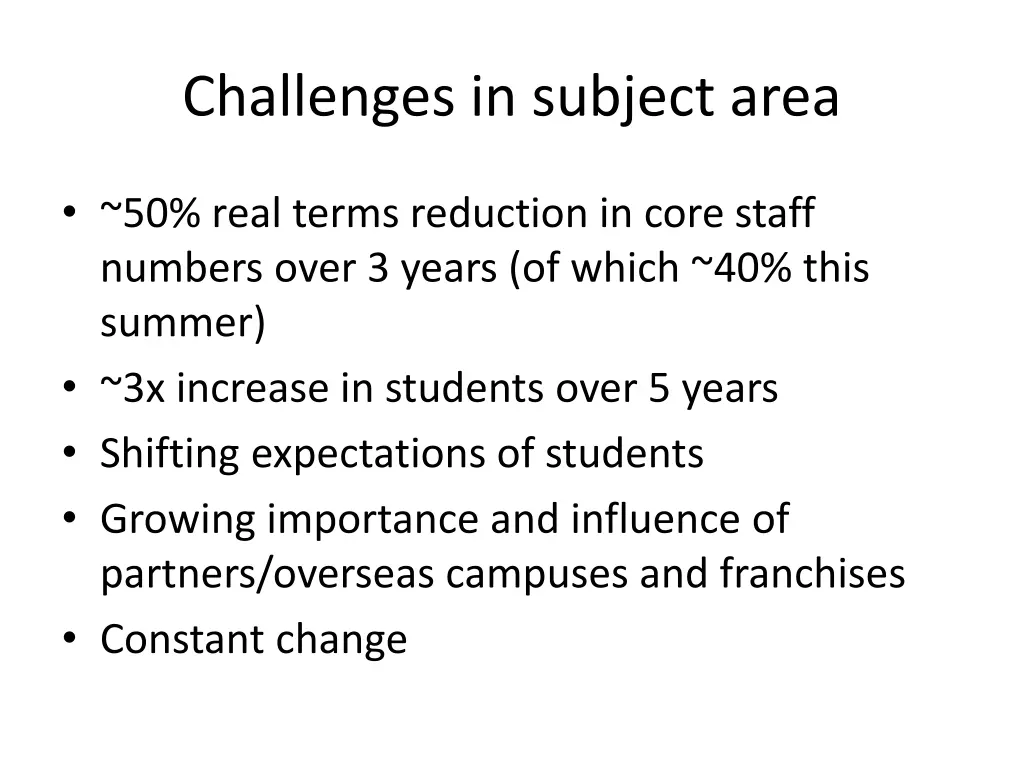
Challenges in subject area ~50% real terms reduction in core staff numbers over 3 years (of which ~40% this summer) ~3x increase in students over 5 years Shifting expectations of students Growing importance and influence of partners/overseas campuses and franchises Constant change
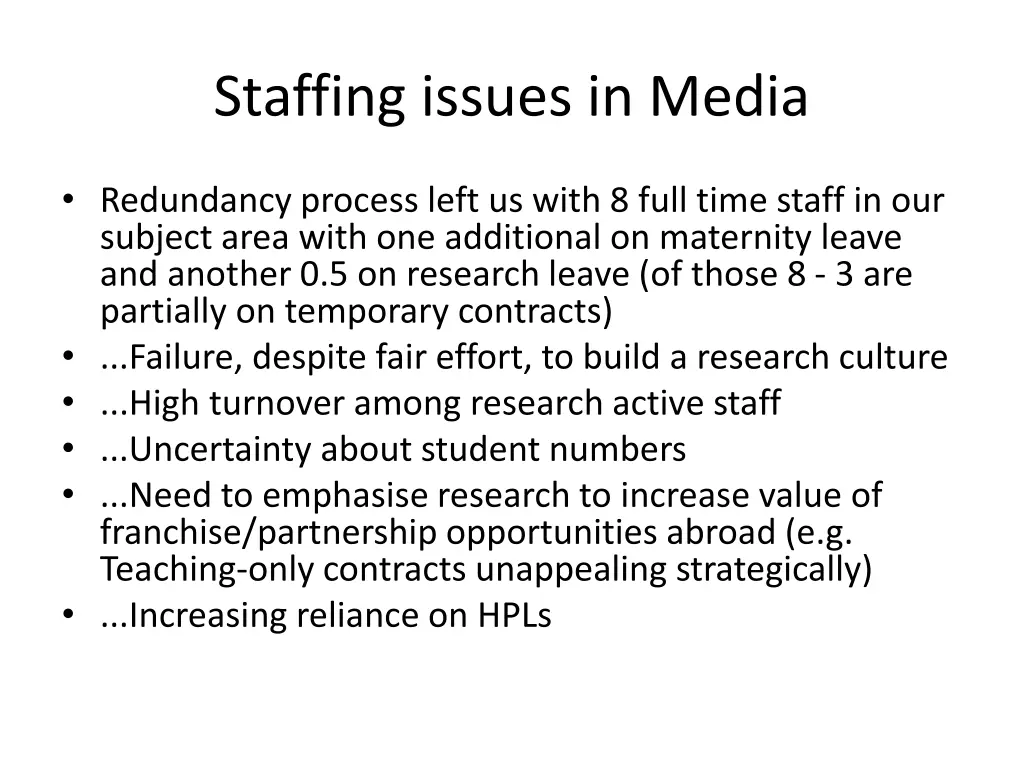
Staffing issues in Media Redundancy process left us with 8 full time staff in our subject area with one additional on maternity leave and another 0.5 on research leave (of those 8 - 3 are partially on temporary contracts) ...Failure, despite fair effort, to build a research culture ...High turnover among research active staff ...Uncertainty about student numbers ...Need to emphasise research to increase value of franchise/partnership opportunities abroad (e.g. Teaching-only contracts unappealing strategically) ...Increasing reliance on HPLs
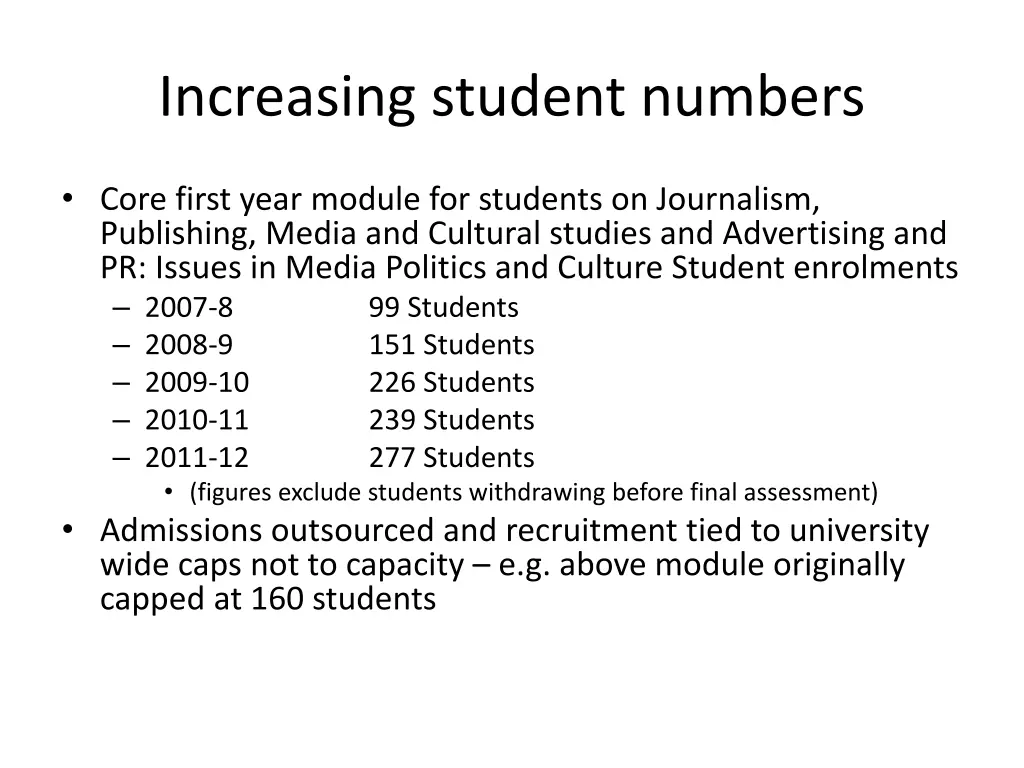
Increasing student numbers Core first year module for students on Journalism, Publishing, Media and Cultural studies and Advertising and PR: Issues in Media Politics and Culture Student enrolments 2007-8 99 Students 2008-9 151 Students 2009-10 226 Students 2010-11 239 Students 2011-12 277 Students (figures exclude students withdrawing before final assessment) Admissions outsourced and recruitment tied to university wide caps not to capacity e.g. above module originally capped at 160 students
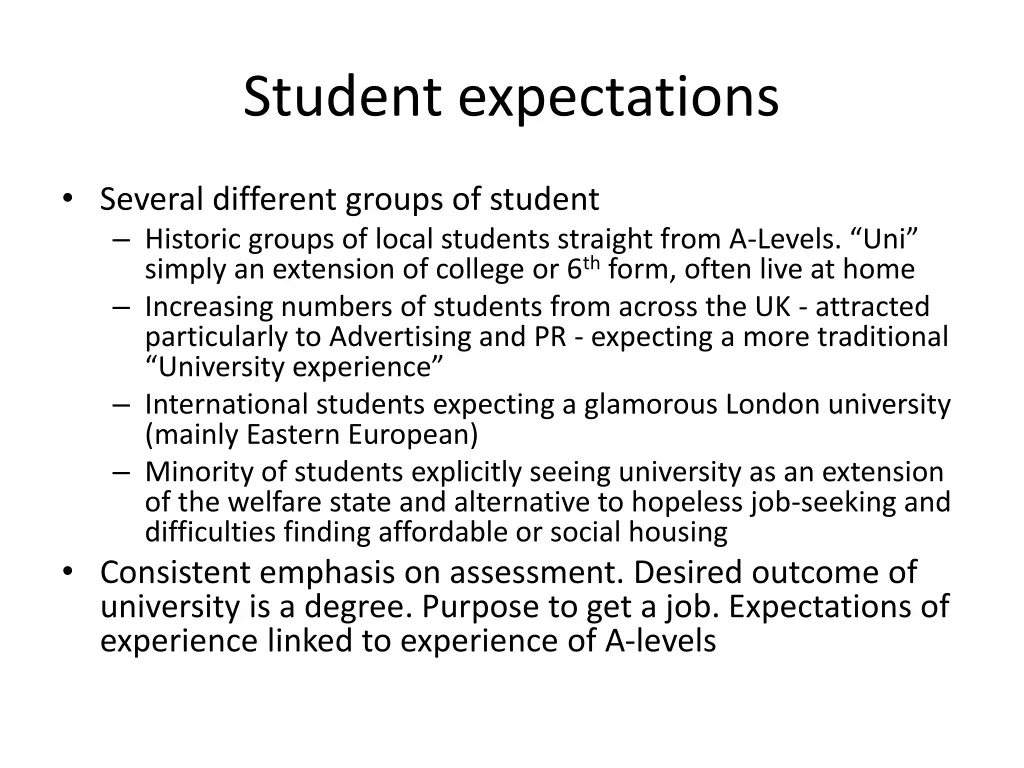
Student expectations Several different groups of student Historic groups of local students straight from A-Levels. Uni simply an extension of college or 6thform, often live at home Increasing numbers of students from across the UK - attracted particularly to Advertising and PR - expecting a more traditional University experience International students expecting a glamorous London university (mainly Eastern European) Minority of students explicitly seeing university as an extension of the welfare state and alternative to hopeless job-seeking and difficulties finding affordable or social housing Consistent emphasis on assessment. Desired outcome of university is a degree. Purpose to get a job. Expectations of experience linked to experience of A-levels
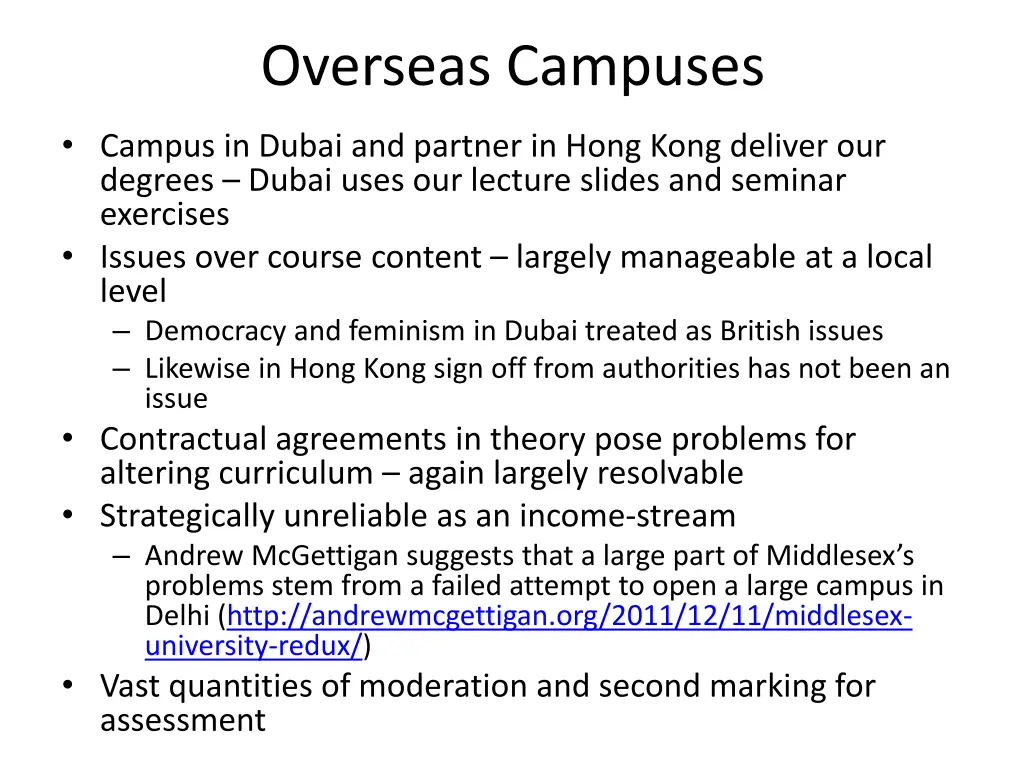
Overseas Campuses Campus in Dubai and partner in Hong Kong deliver our degrees Dubai uses our lecture slides and seminar exercises Issues over course content largely manageable at a local level Democracy and feminism in Dubai treated as British issues Likewise in Hong Kong sign off from authorities has not been an issue Contractual agreements in theory pose problems for altering curriculum again largely resolvable Strategically unreliable as an income-stream Andrew McGettigan suggests that a large part of Middlesex s problems stem from a failed attempt to open a large campus in Delhi (http://andrewmcgettigan.org/2011/12/11/middlesex- university-redux/) Vast quantities of moderation and second marking for assessment
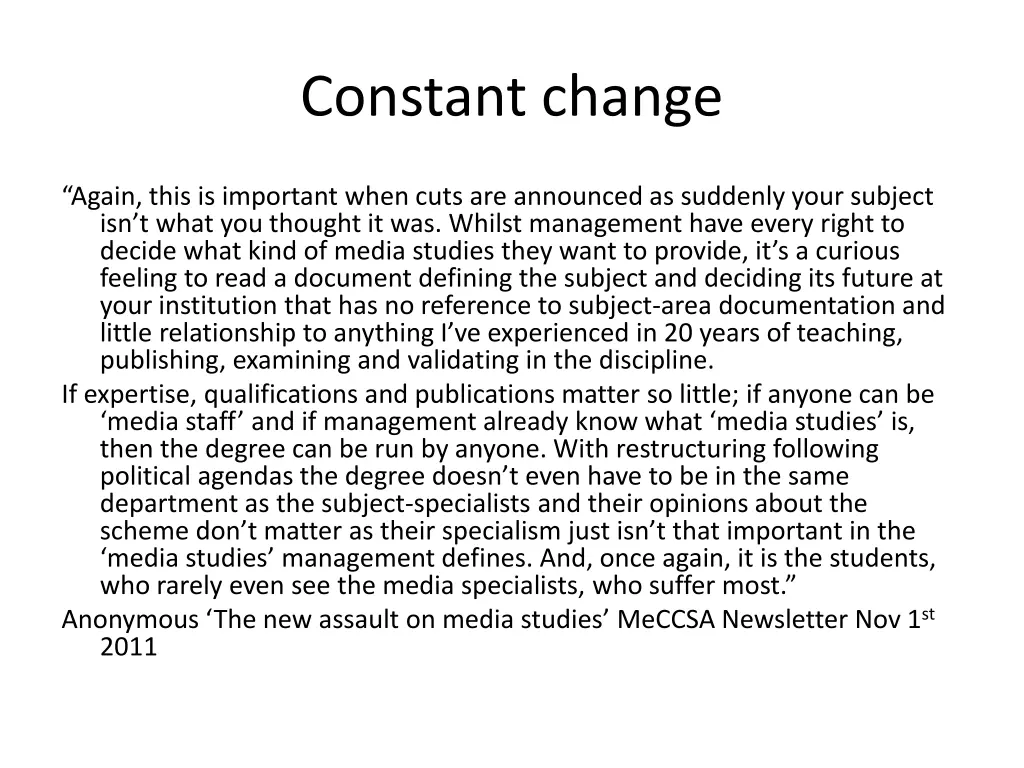
Constant change Again, this is important when cuts are announced as suddenly your subject isn t what you thought it was. Whilst management have every right to decide what kind of media studies they want to provide, it s a curious feeling to read a document defining the subject and deciding its future at your institution that has no reference to subject-area documentation and little relationship to anything I ve experienced in 20 years of teaching, publishing, examining and validating in the discipline. If expertise, qualifications and publications matter so little; if anyone can be media staff and if management already know what media studies is, then the degree can be run by anyone. With restructuring following political agendas the degree doesn t even have to be in the same department as the subject-specialists and their opinions about the scheme don t matter as their specialism just isn t that important in the media studies management defines. And, once again, it is the students, who rarely even see the media specialists, who suffer most. Anonymous The new assault on media studies MeCCSA Newsletter Nov 1st 2011
Constant change The management speciality is radical reorganisations: of teaching programmes, organisational structures and research priorities, all of which must be achieved at absurdly accelerated rates. Such revolutions are always justified as a necessary response to external conditions and to a future whose only certain quality is its uncertainty. Emergency is our everyday: it is always wartime. Rachel Malik Universities under Attack LRB 16 Dec 2011
Strategies for dealing with these challenges MCS1000 Issues in Media Politics and Culture a) Strategically reworked annually to react to changes in student numbers, often in the first week of teaching b) Rapidly establish staff-student relationship as one of partnership c) De-emphasise assessment (through assessment mode) in favour of collaboration and discussion d) Assessment framework linked to continuous reading and engagement in current affairs e) Use of digital tools as a way of coping operationally, but with pedagogic value f) Module used for student retention, attendance monitoring and feedback
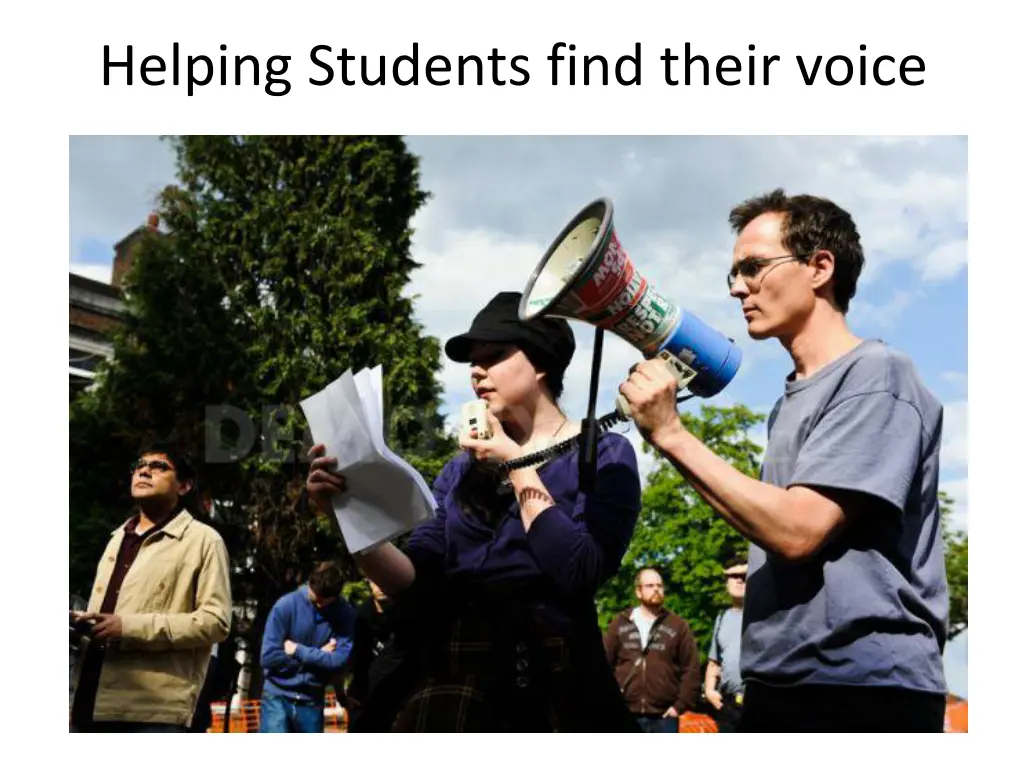
Establishing Staff-Student partnership: Semester 1 Radical Future ebook contextualises political and social issues as they relate to young people contributions by three members of teaching staff (follow up book Regeneration launches tonight in Foyles) Carefully chosen themes student protests, summer riots, phone hacking, MPs expenses are discussed in from a range of different perspectives and political viewpoints Student led discussion Student reading diaries produced before seminars (blogs private within each seminar group) provide a set of points on which to build seminar discussion following on from student discussion i.e. students express an opinion on reading before staff input Public, performative lecture that hands over central university area to students for exercise in participatory democracy (by surprise)
Campaigns: second semester Students campaign on a theme (e.g. Food), but can choose their aims as they wish Often chose to target the university The university encourages these activities through funding (until recently) and celebrating student success Students taught to identify who has authority in specific areas Successes never acknowledged directly, but improvements have been made following student campaigns Fair Trade status Improved recycling facilities Teaches students to set realistic achievable goals and to understand the counter-arguments Visiting speakers come in to deliver specialised content and communicate to students broader issues Staff take on an advisory and mentoring role rather than leading classroom sessions
Digital Pedagogy and Assessment Assessment becomes an after-thought easily completed if students have participated in the process Short essay extends weekly reading diaries Individual campaign report compiled using information from wikis Wikis enable students to self-monitor attendance by requiring weekly meeting minutes Hugely reduced administrative and assessment burden on teaching staff Encourages learning and collaboration outside and around the classroom
Examples of Student feedback Reality Check forms (week 9 of teaching) I am treated like an adult and shown that my opinion matters I didn t expect to be interested in this subject, but it s been really fascinating The university has recruited too many students Board of study I feel like I m in an education warehouse being processed I d like to us to build a stronger sense of community
Impacts on Students Retention has progressively improved Very few student complaints about teaching staff (as far as I know all are where students have been accused of plagiarism) Students are (generalising): Aware of the limits of the institution Sympathetic to the lecturing staff can make the connection between workloads and students experience Understand that changes are taking place across the sector More capable of working independently and collaboratively in a self managing manner Establishes a less formal environment where students are freer to disagree with staff, express dissatisfaction constructively and manage their own learning
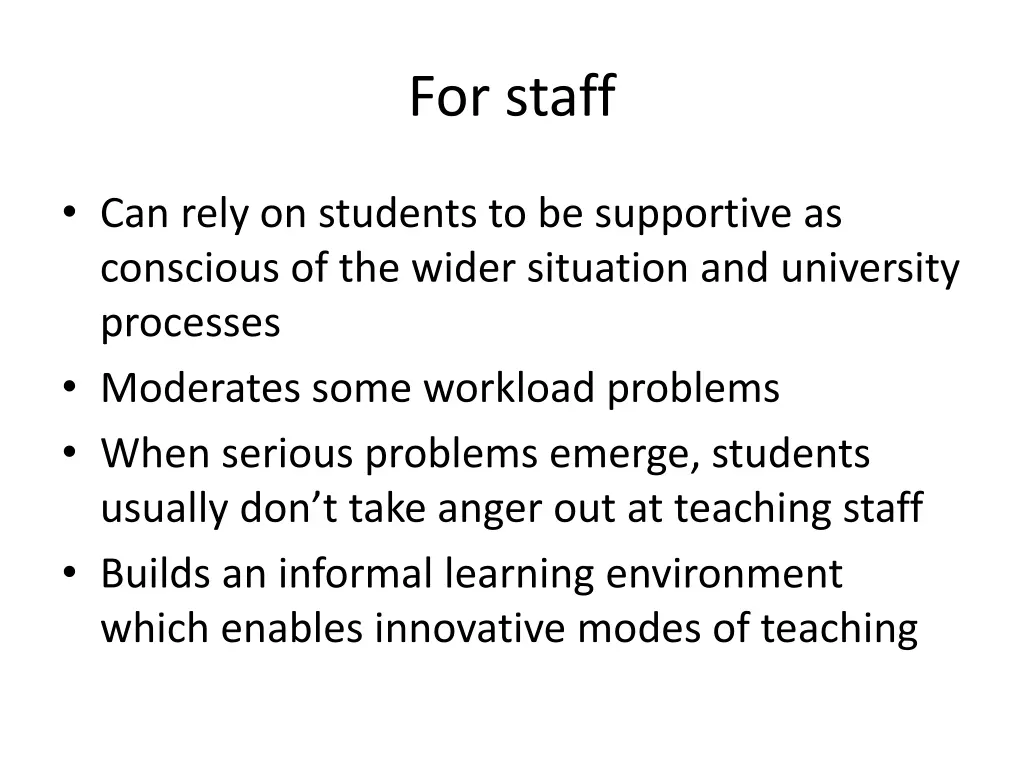
For staff Can rely on students to be supportive as conscious of the wider situation and university processes Moderates some workload problems When serious problems emerge, students usually don t take anger out at teaching staff Builds an informal learning environment which enables innovative modes of teaching
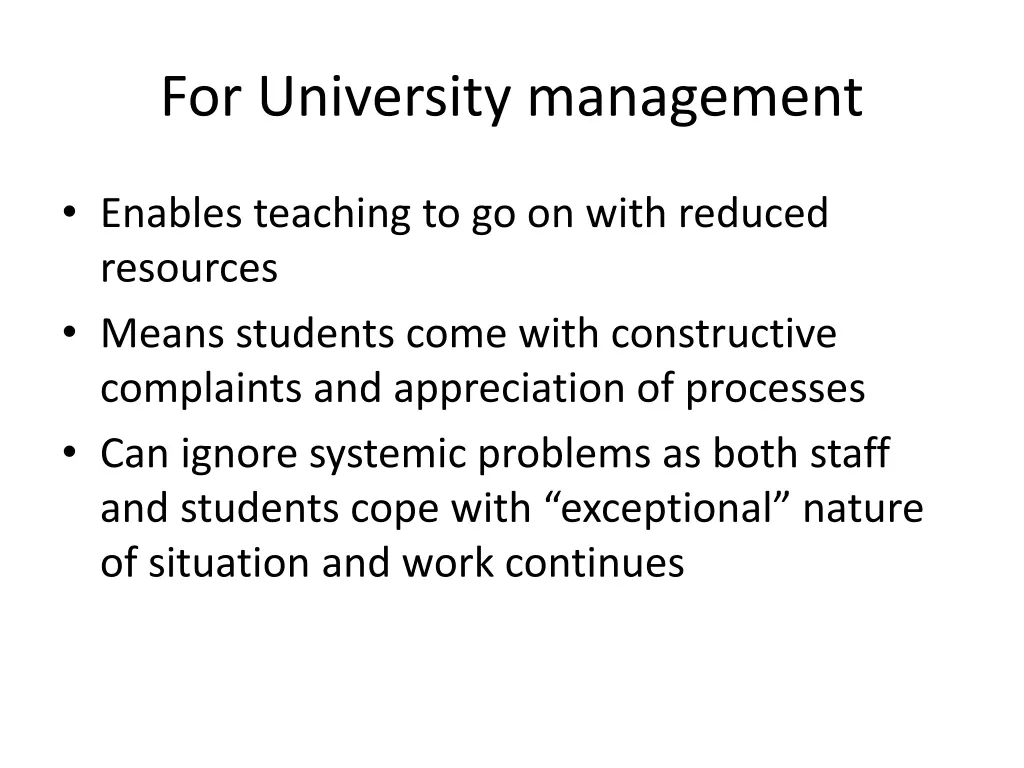
For University management Enables teaching to go on with reduced resources Means students come with constructive complaints and appreciation of processes Can ignore systemic problems as both staff and students cope with exceptional nature of situation and work continues
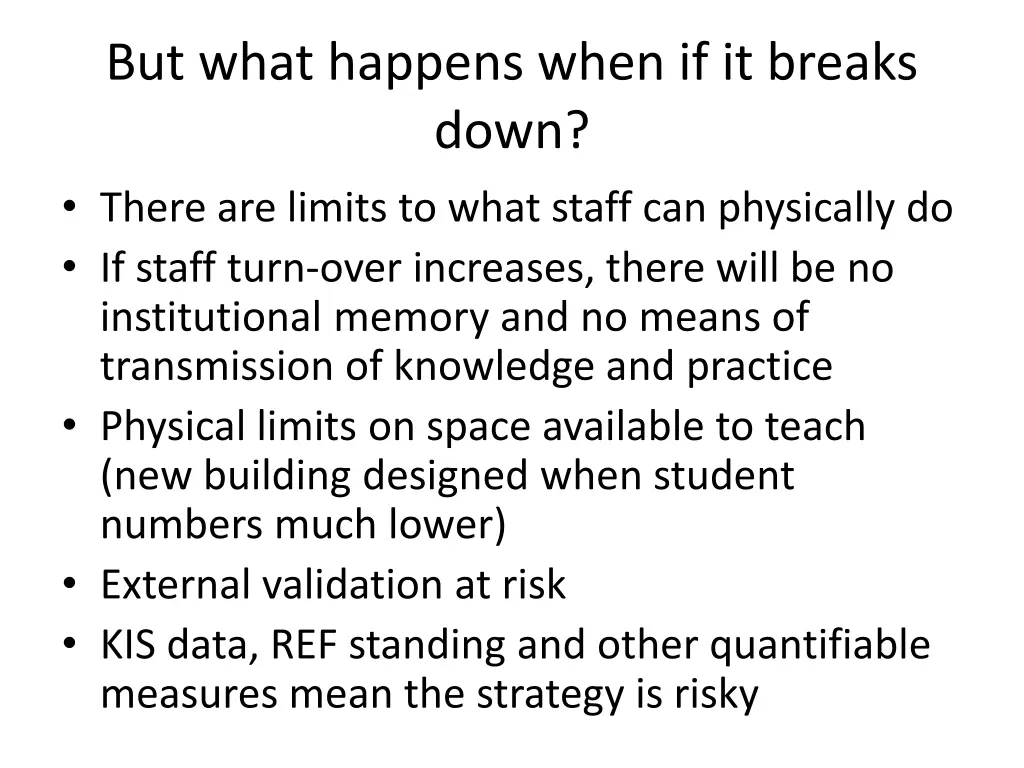
But what happens when if it breaks down? There are limits to what staff can physically do If staff turn-over increases, there will be no institutional memory and no means of transmission of knowledge and practice Physical limits on space available to teach (new building designed when student numbers much lower) External validation at risk KIS data, REF standing and other quantifiable measures mean the strategy is risky