Challenges in Government Training and Capability Gaps

Limited articles in high-quality journals highlight skill shortages in digital service delivery, complex contract management, and more. Governments face underinvestment, lack integration of formal and informal training, and struggle with identifying capability gaps.

Download Presentation

Please find below an Image/Link to download the presentation.
The content on the website is provided AS IS for your information and personal use only. It may not be sold, licensed, or shared on other websites without obtaining consent from the author.If you encounter any issues during the download, it is possible that the publisher has removed the file from their server.
You are allowed to download the files provided on this website for personal or commercial use, subject to the condition that they are used lawfully. All files are the property of their respective owners.
The content on the website is provided AS IS for your information and personal use only. It may not be sold, licensed, or shared on other websites without obtaining consent from the author.
E N D
Presentation Transcript
Desafios no campo da Administraao pblica: Ensino, profissionaliza ao e Pesquisa Encontro de Redes de Escolas de Governo Rio de Janeiro, 2017 Training for a present that cannot wait Salvador Parrado (UNED, Madrid) and Hertie School of Government, (Berlin, Germany) sparrado@poli.uned.es
The sources Very limited number of articles in high-quality peer reviewed journals: (Kroll & Moynihan 2015, Knassmuller & Veit 2015, Lee & Shu 2016, Mosher 2000, Yang & Wu 2012, Witesman & Wise 2012, Liesbeth & Pollitt 2010, Seidle, Fern ndez & Perry 2016) Good quality reviews of training and capability gaps in the United Kingdom by NAO (National Audit Office, UK) My experience as evaluator of civil service principles in 7 accession countries for the EU Commission; 5 neighbourhood countries for SIGMA-OECD and 7 OECD countries on the senior civil service.
The problem The present cannot wait because, governments have shortage of skills in digital service delivery complex contract management the management of multi-actor projects the capacity to customize services in order to meet diversity and many others that are context specific
The menu The government is challenged in training because there is Scarce knowledge of capability gaps Underinvestment in training No information of the impact of training Lack of integration of informal and formal training Rotation of staff with low consolidation of skills
Scarce knowledge of capability gaps Governments don t know Who has what skills and where Generic organizational capability gaps and specific skill needs for particular projects The capacity of the private sector to deliver missing skills In a state of urgency, governments may mandate capability gaps for particular projects (NAO, 2015, UK)
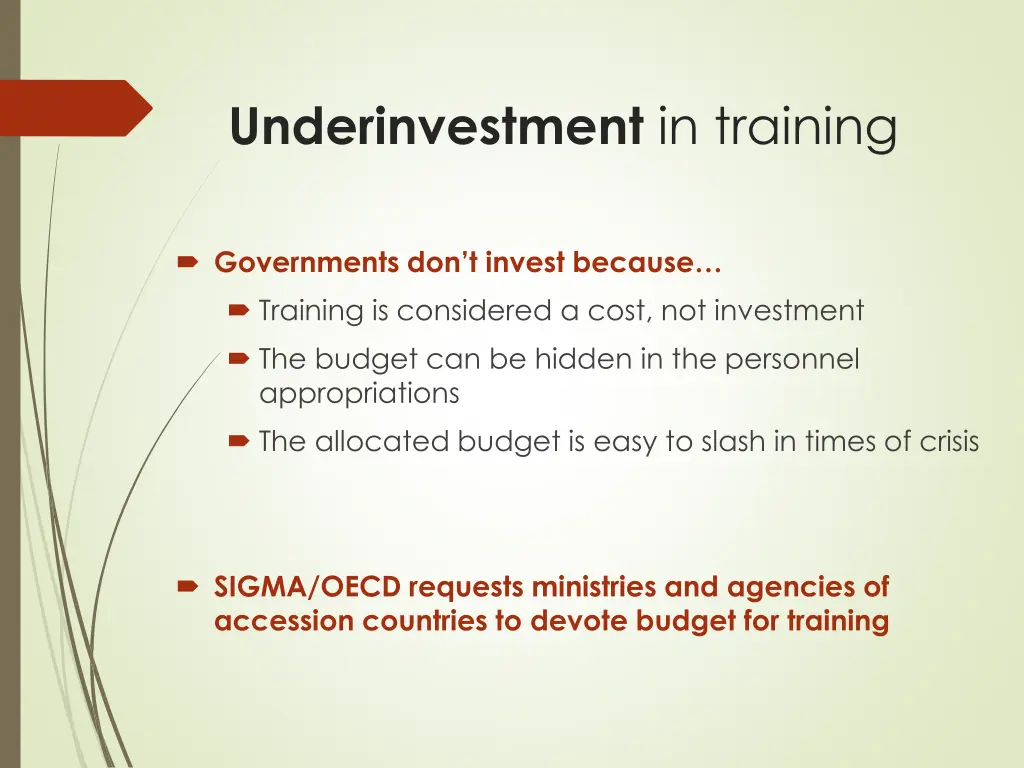
Underinvestment in training Governments don t invest because Training is considered a cost, not investment The budget can be hidden in the personnel appropriations The allocated budget is easy to slash in times of crisis SIGMA/OECD requests ministries and agencies of accession countries to devote budget for training
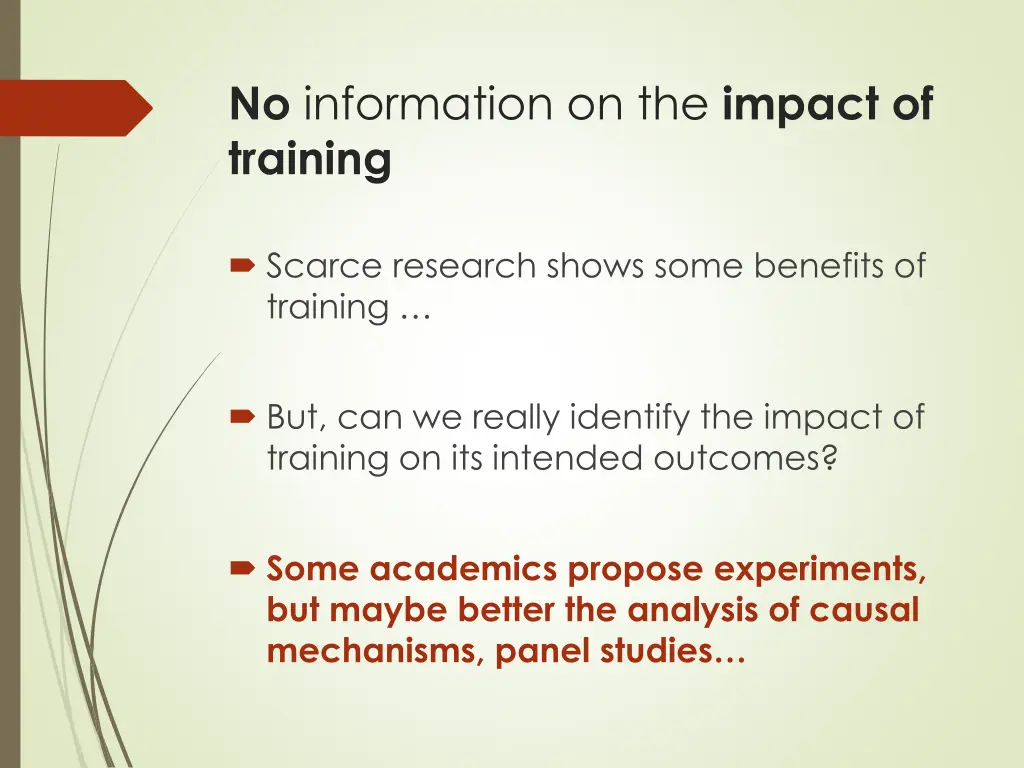
No information on the impact of training Scarce research shows some benefits of training But, can we really identify the impact of training on its intended outcomes? Some academics propose experiments, but maybe better the analysis of causal mechanisms, panel studies
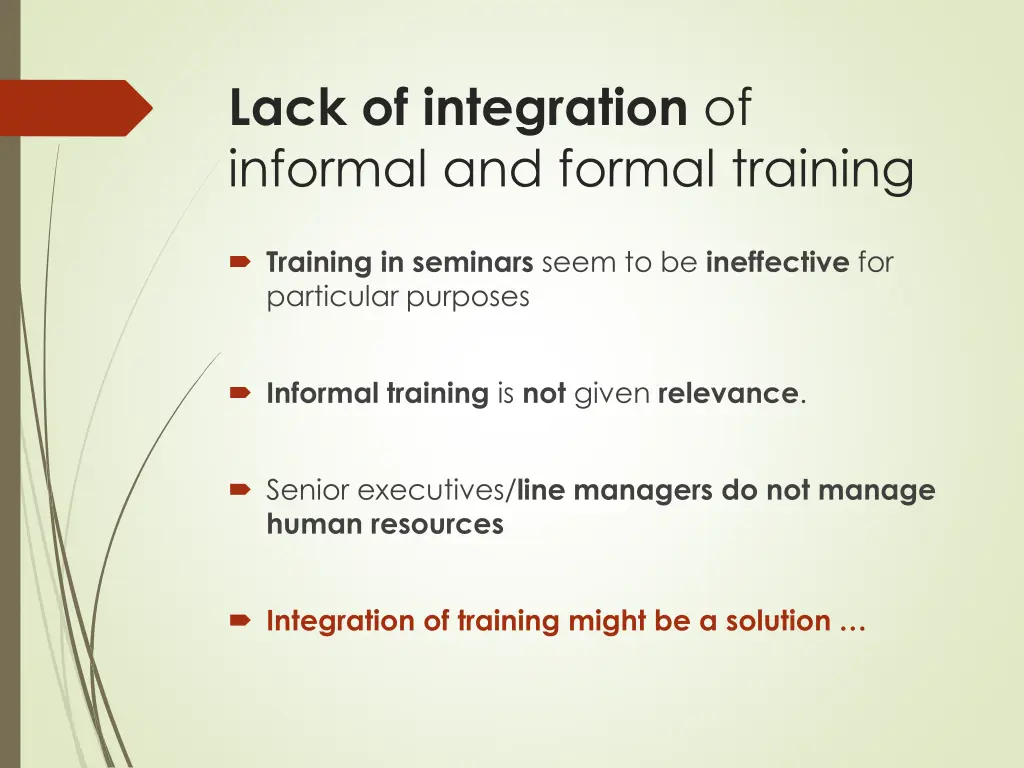
Lack of integration of informal and formal training Training in seminars seem to be ineffective for particular purposes Informal training is not given relevance. Senior executives/line managers do not manage human resources Integration of training might be a solution
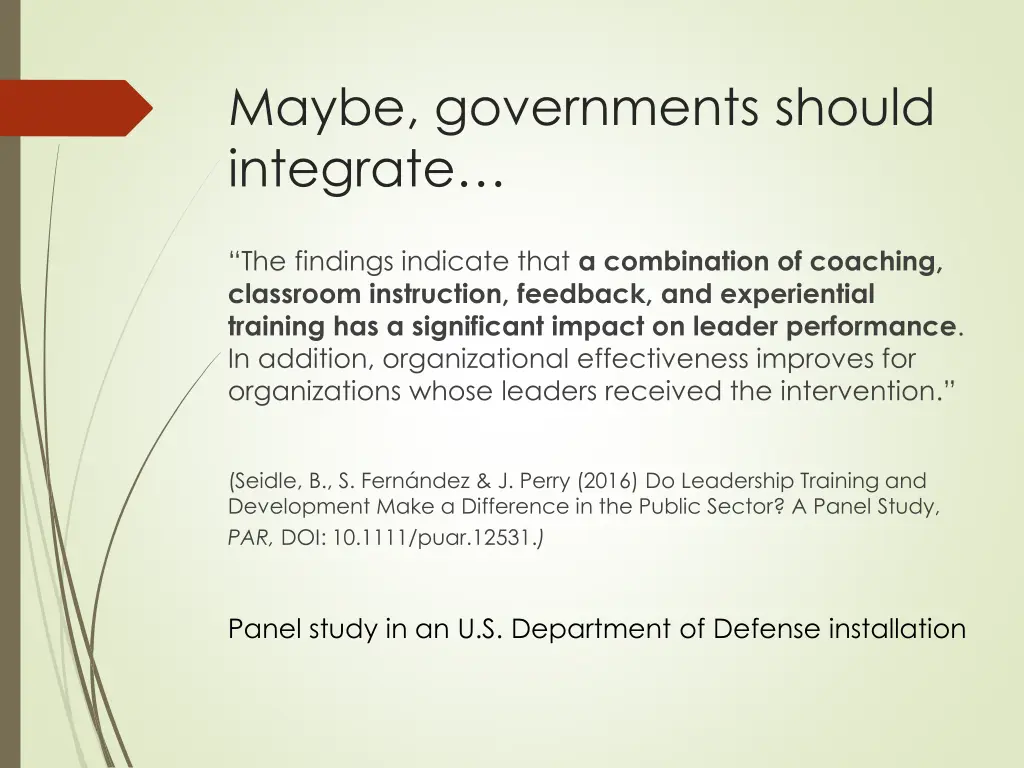
Maybe, governments should integrate The findings indicate that a combination of coaching, classroom instruction, feedback, and experiential training has a significant impact on leader performance. In addition, organizational effectiveness improves for organizations whose leaders received the intervention. (Seidle, B., S. Fern ndez & J. Perry (2016) Do Leadership Training and Development Make a Difference in the Public Sector? A Panel Study, PAR, DOI: 10.1111/puar.12531.) Panel study in an U.S. Department of Defense installation
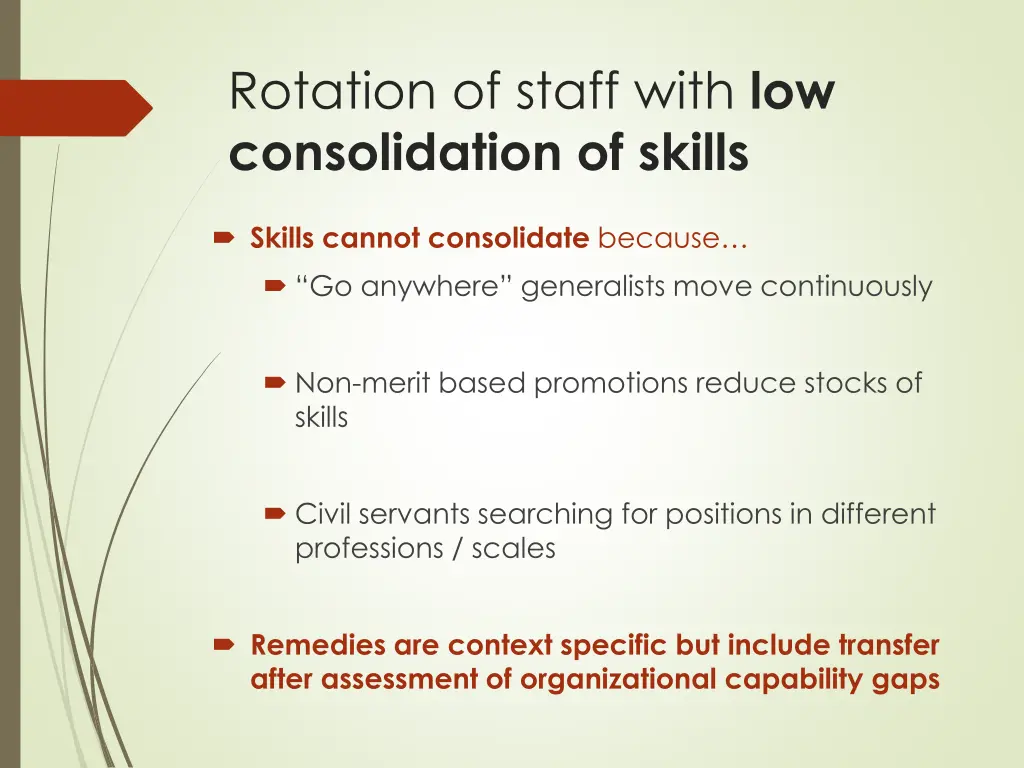
Rotation of staff with low consolidationof skills Skills cannot consolidate because Go anywhere generalists move continuously Non-merit based promotions reduce stocks of skills Civil servants searching for positions in different professions / scales Remedies are context specific but include transfer after assessment of organizational capability gaps
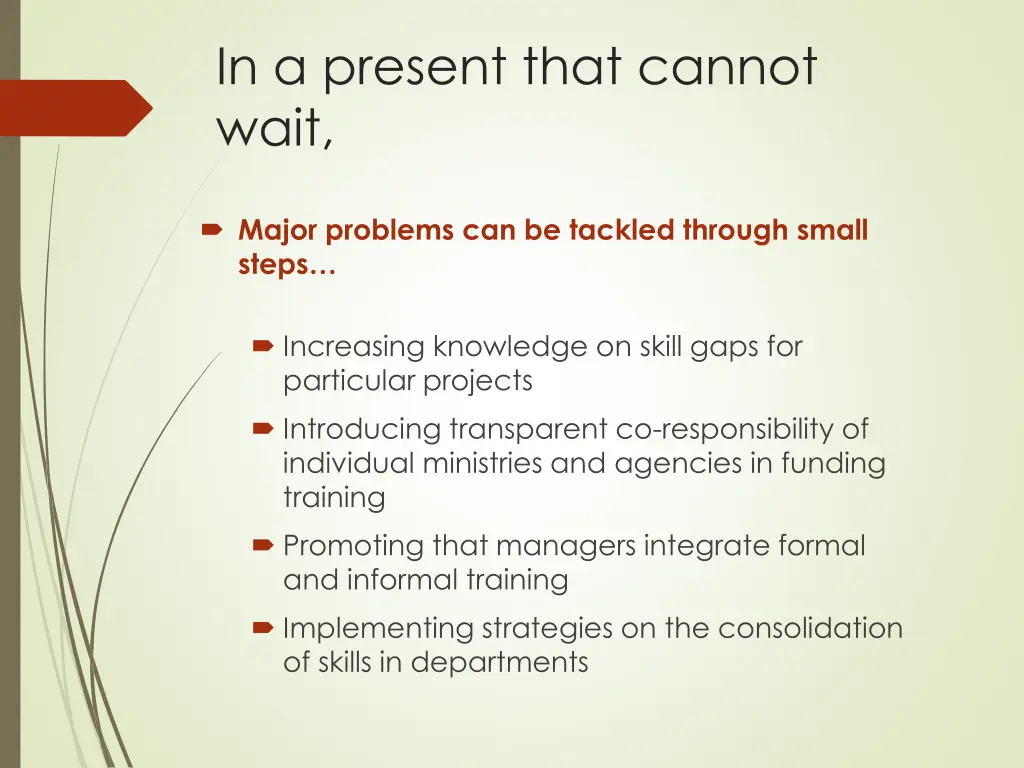
In a present that cannot wait, Major problems can be tackled through small steps Increasing knowledge on skill gaps for particular projects Introducing transparent co-responsibility of individual ministries and agencies in funding training Promoting that managers integrate formal and informal training Implementing strategies on the consolidation of skills in departments