Explore the challenges of globalized evaluation practices within the context of semi-peripheral and localized knowledge production, focusing on research quality factors, Croatian socio-political context, reduced investment effects, and research productivity in Croatia.
Please find below an Image/Link to download the presentation.
The content on the website is provided AS IS for your information and personal use only. It may not be sold, licensed, or shared on other websites without obtaining consent from the author. If you encounter any issues during the download, it is possible that the publisher has removed the file from their server.
You are allowed to download the files provided on this website for personal or commercial use, subject to the condition that they are used lawfully. All files are the property of their respective owners.
The content on the website is provided AS IS for your information and personal use only. It may not be sold, licensed, or shared on other websites without obtaining consent from the author.
E N D
Presentation Transcript
Challenges of globalized evaluation practices in the context of semi- peripheral and localized knowledge production MARIJA BRAJDI VUKOVI , DEPARTMENT OF SOCIOLOGY CENTRE FOR CROATIAN STUDIES, UNIVERSITY OF ZAGREB
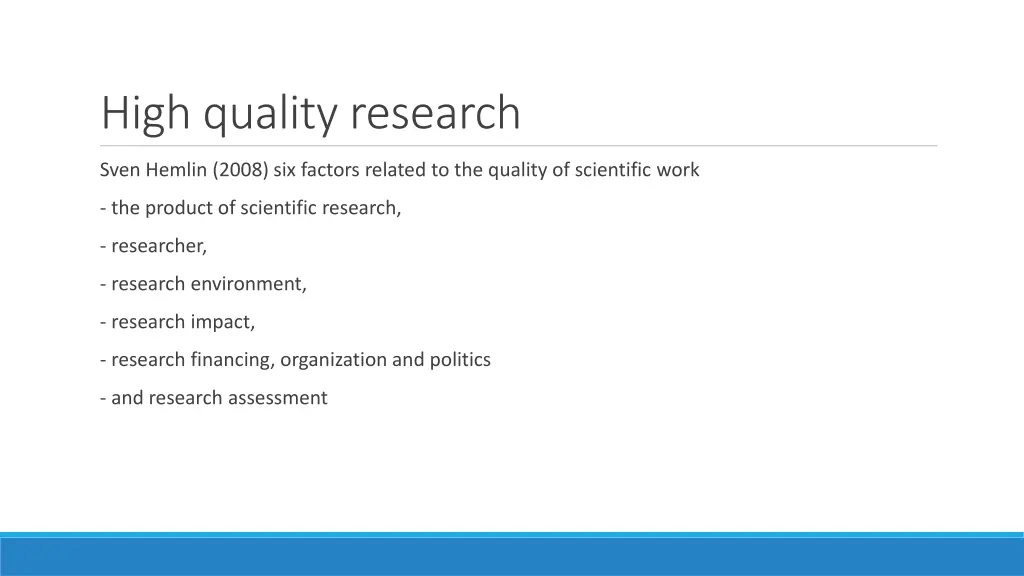
High quality research Sven Hemlin (2008) six factors related to the quality of scientific work - the product of scientific research, - researcher, - research environment, - research impact, - research financing, organization and politics - and research assessment
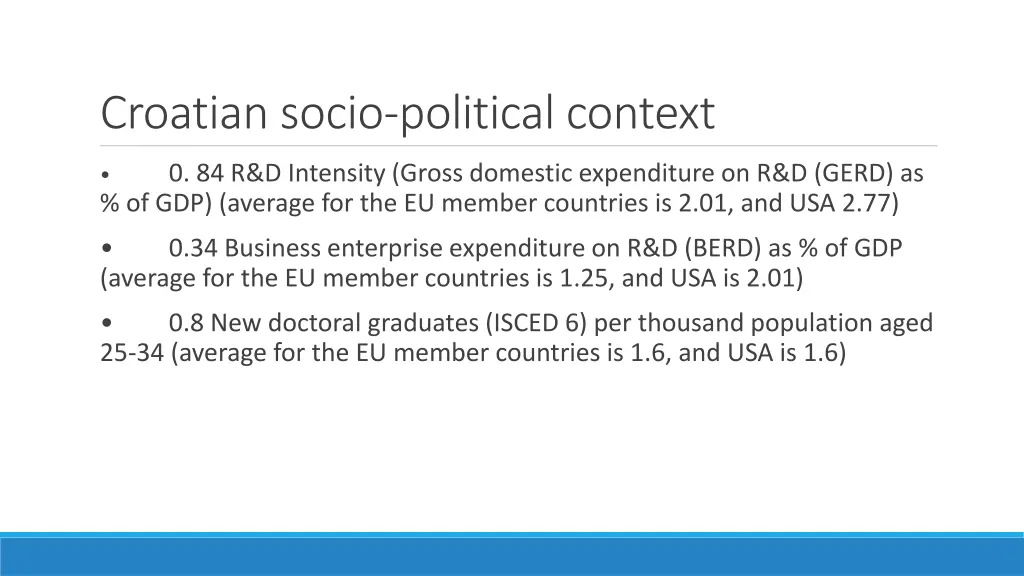
Croatian socio-political context 0. 84 R&D Intensity (Gross domestic expenditure on R&D (GERD) as % of GDP) (average for the EU member countries is 2.01, and USA 2.77) (average for the EU member countries is 1.25, and USA is 2.01) 0.34 Business enterprise expenditure on R&D (BERD) as % of GDP 25-34 (average for the EU member countries is 1.6, and USA is 1.6) 0.8 New doctoral graduates (ISCED 6) per thousand population aged
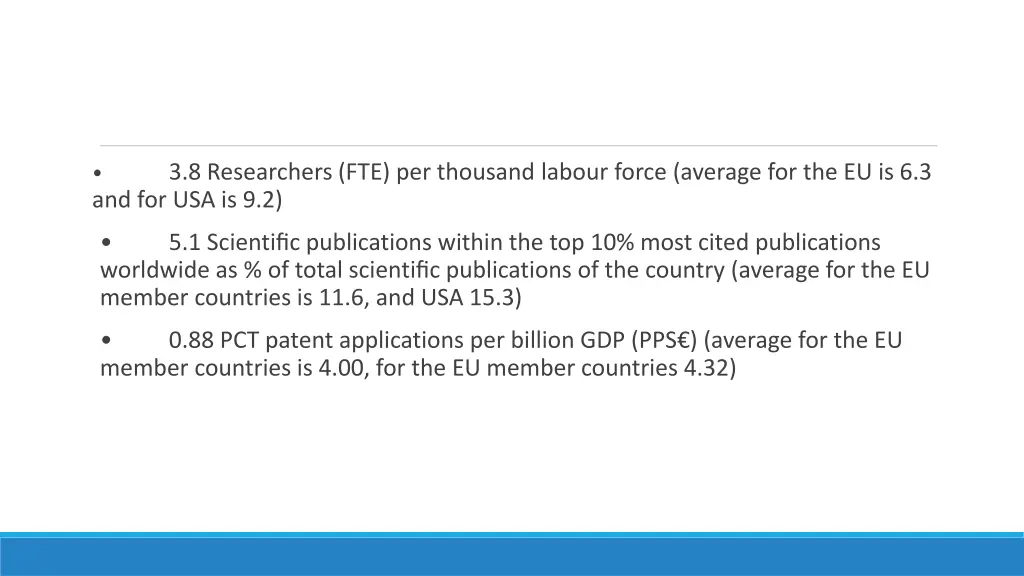
3.8 Researchers (FTE) per thousand labour force (average for the EU is 6.3 and for USA is 9.2) worldwide as % of total scientific publications of the country (average for the EU member countries is 11.6, and USA 15.3) 5.1 Scientific publications within the top 10% most cited publications member countries is 4.00, for the EU member countries 4.32) 0.88 PCT patent applications per billion GDP (PPS ) (average for the EU
The effect of this reduced investment and the crises: - most obvious in the continuous decrease in the number of researchers in Croatia. - most significant problem is the unfavourable age composition of the research community, whereby the system has been shrinking mostly in the cohorts of mid-career researchers (Golub & uljok, 2005: 135). - in the period from 2003 through 2012 research projects were mostly funded through the system of so-called Z- projects that has been mostly criticized for crumbling the funds into small research projects of almost no visibility or impact no matter scientific field that the public money is invested in (Vlahovi ek, 2014).
Research productivity - There has been steady increase related to the number of international publications and co-authorships in all scientific fields in Croatia since 90 s (Prpi 2004, Prpi i Brajdi Vukovi 2007). - This productivity remains low in terms of its international impact and visibility (Vlahovi ek, 2014) - Recent studies have shown perceived generational differences not just in attitudes related to research practices and the future of academic system in Croatia, but also in attitudes regarding patterns of productivity and research assessment (Brajdi Vukovi , 2012, 2013, 2014)
Debates and disputes Ministry has claimed that it wants to encourage new regulation of Croatian humanities and social sciences in order to increase the international visibility of the scholarly work in those scientific fields. In recent weeks, a significant portion of the scientific community - universities and institutes, professional associations and individuals, including members of the union - warned of the danger caused by privileging only one component of the scientific work: there will be a neglect of other, not less important, components .
In particular, we are warned of the consequences that the "international twist" will have for the Croatian society and culture, Croatian as a language of science, the Croatian scientific journals and publishers. The state of mind which gave birth to this ordinance, the implicit view that domestic science and home science audience should, as a priori inferior, lazy and corrupt, be disciplined by the model of purity and superiority existent "abroad" can be recognized as a textbook example of colonial consciousness. It is a complex anxiety of weaker before the stronger, of the willingness to give up our own in the hope that some among us - the best because they are the most adapted - could be let in the phantasmagoric circle of "selected and privileged." Academic Solidarity Union, 2013
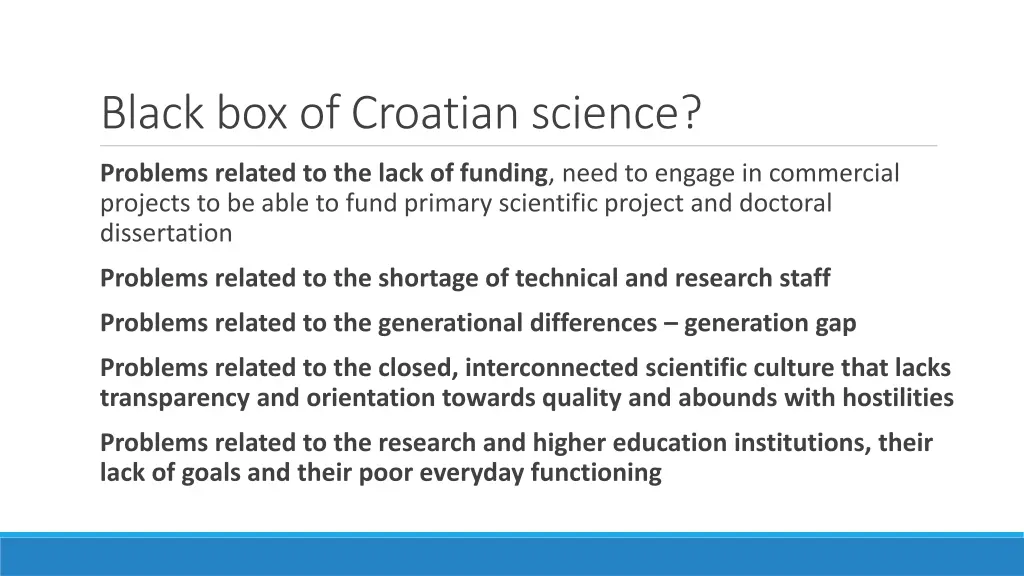
Black box of Croatian science? Problems related to the lack of funding, need to engage in commercial projects to be able to fund primary scientific project and doctoral dissertation Problems related to the shortage of technical and research staff Problems related to the generational differences generation gap Problems related to the closed, interconnected scientific culture that lacks transparency and orientation towards quality and abounds with hostilities Problems related to the research and higher education institutions, their lack of goals and their poor everyday functioning