Explore the evolution of farming and ranching in the American West over time, including the challenges faced, solutions implemented, and the consequences of these changes. From the impact of the Gold Rush to the conflicts between homesteaders and ranchers, discover how agriculture transformed in this iconic region.
Please find below an Image/Link to download the presentation.
The content on the website is provided AS IS for your information and personal use only. It may not be sold, licensed, or shared on other websites without obtaining consent from the author. If you encounter any issues during the download, it is possible that the publisher has removed the file from their server.
You are allowed to download the files provided on this website for personal or commercial use, subject to the condition that they are used lawfully. All files are the property of their respective owners.
The content on the website is provided AS IS for your information and personal use only. It may not be sold, licensed, or shared on other websites without obtaining consent from the author.
E N D
Presentation Transcript
American West Revision Thematic 6 How did Farming and Ranching change over time and what were the consequences?
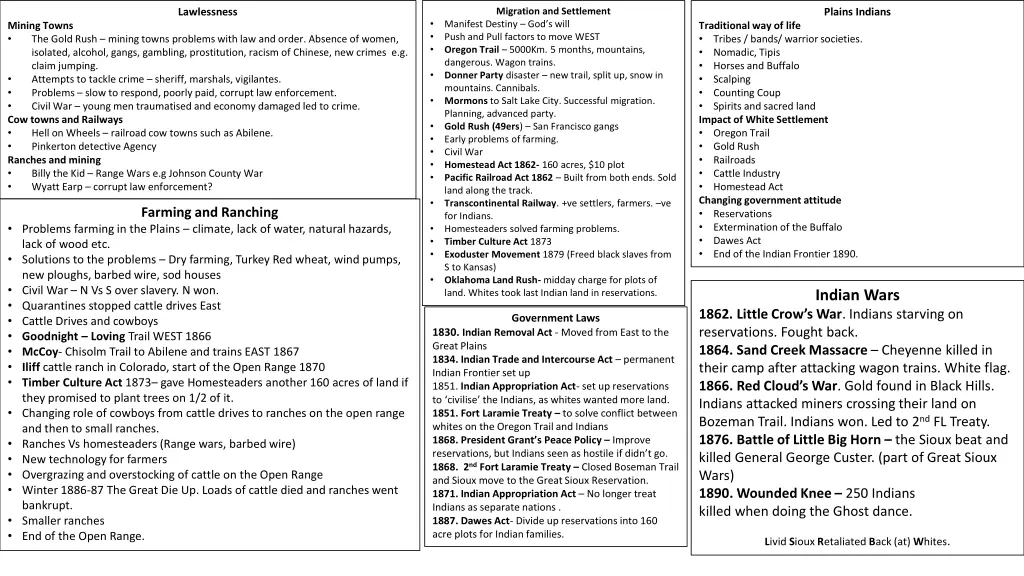
Migration and Settlement Manifest Destiny God s will Push and Pull factors to move WEST Oregon Trail 5000Km. 5 months, mountains, dangerous. Wagon trains. Donner Party disaster new trail, split up, snow in mountains. Cannibals. Mormons to Salt Lake City. Successful migration. Planning, advanced party. Gold Rush (49ers) San Francisco gangs Early problems of farming. Civil War Homestead Act 1862- 160 acres, $10 plot Pacific Railroad Act 1862 Built from both ends. Sold land along the track. Transcontinental Railway. +ve settlers, farmers. ve for Indians. Homesteaders solved farming problems. Timber Culture Act 1873 Exoduster Movement 1879 (Freed black slaves from S to Kansas) Oklahoma Land Rush- midday charge for plots of land. Whites took last Indian land in reservations. Lawlessness Plains Indians Mining Towns The Gold Rush mining towns problems with law and order. Absence of women, isolated, alcohol, gangs, gambling, prostitution, racism of Chinese, new crimes e.g. claim jumping. Attempts to tackle crime sheriff, marshals, vigilantes. Problems slow to respond, poorly paid, corrupt law enforcement. Civil War young men traumatised and economy damaged led to crime. Cow towns and Railways Hell on Wheels railroad cow towns such as Abilene. Pinkerton detective Agency Ranches and mining Billy the Kid Range Wars e.g Johnson County War Wyatt Earp corrupt law enforcement? Traditional way of life Tribes / bands/ warrior societies. Nomadic, Tipis Horses and Buffalo Scalping Counting Coup Spirits and sacred land Impact of White Settlement Oregon Trail Gold Rush Railroads Cattle Industry Homestead Act Changing government attitude Reservations Extermination of the Buffalo Dawes Act End of the Indian Frontier 1890. Farming and Ranching Problems farming in the Plains climate, lack of water, natural hazards, lack of wood etc. Solutions to the problems Dry farming, Turkey Red wheat, wind pumps, new ploughs, barbed wire, sod houses Civil War N Vs S over slavery. N won. Quarantines stopped cattle drives East Cattle Drives and cowboys Goodnight Loving Trail WEST 1866 McCoy- Chisolm Trail to Abilene and trains EAST 1867 Iliff cattle ranch in Colorado, start of the Open Range 1870 Timber Culture Act 1873 gave Homesteaders another 160 acres of land if they promised to plant trees on 1/2 of it. Changing role of cowboys from cattle drives to ranches on the open range and then to small ranches. Ranches Vs homesteaders (Range wars, barbed wire) New technology for farmers Overgrazing and overstocking of cattle on the Open Range Winter 1886-87 The Great Die Up. Loads of cattle died and ranches went bankrupt. Smaller ranches End of the Open Range. Indian Wars 1862. Little Crow s War. Indians starving on reservations. Fought back. 1864. Sand Creek Massacre Cheyenne killed in their camp after attacking wagon trains. White flag. 1866. Red Cloud s War. Gold found in Black Hills. Indians attacked miners crossing their land on Bozeman Trail. Indians won. Led to 2nd FL Treaty. 1876. Battle of Little Big Horn the Sioux beat and killed General George Custer. (part of Great Sioux Wars) 1890. Wounded Knee 250 Indians killed when doing the Ghost dance. Government Laws 1830. Indian Removal Act - Moved from East to the Great Plains 1834. Indian Trade and Intercourse Act permanent Indian Frontier set up 1851. Indian Appropriation Act- set up reservations to civilise the Indians, as whites wanted more land. 1851. Fort Laramie Treaty to solve conflict between whites on the Oregon Trail and Indians 1868. President Grant s Peace Policy Improve reservations, but Indians seen as hostile if didn t go. 1868. 2nd Fort Laramie Treaty Closed Boseman Trail and Sioux move to the Great Sioux Reservation. 1871. Indian Appropriation Act No longer treat Indians as separate nations . 1887. Dawes Act- Divide up reservations into 160 acre plots for Indian families. Livid Sioux Retaliated Back (at) Whites.
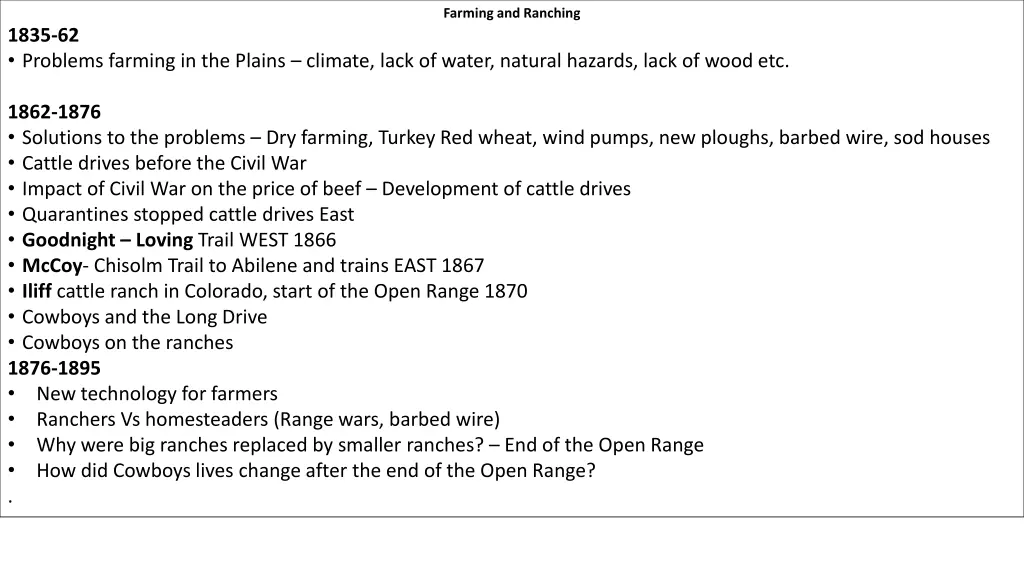
Farming and Ranching 1835-62 Problems farming in the Plains climate, lack of water, natural hazards, lack of wood etc. 1862-1876 Solutions to the problems Dry farming, Turkey Red wheat, wind pumps, new ploughs, barbed wire, sod houses Cattle drives before the Civil War Impact of Civil War on the price of beef Development of cattle drives Quarantines stopped cattle drives East Goodnight Loving Trail WEST 1866 McCoy- Chisolm Trail to Abilene and trains EAST 1867 Iliff cattle ranch in Colorado, start of the Open Range 1870 Cowboys and the Long Drive Cowboys on the ranches 1876-1895 New technology for farmers Ranchers Vs homesteaders (Range wars, barbed wire) Why were big ranches replaced by smaller ranches? End of the Open Range How did Cowboys lives change after the end of the Open Range? .
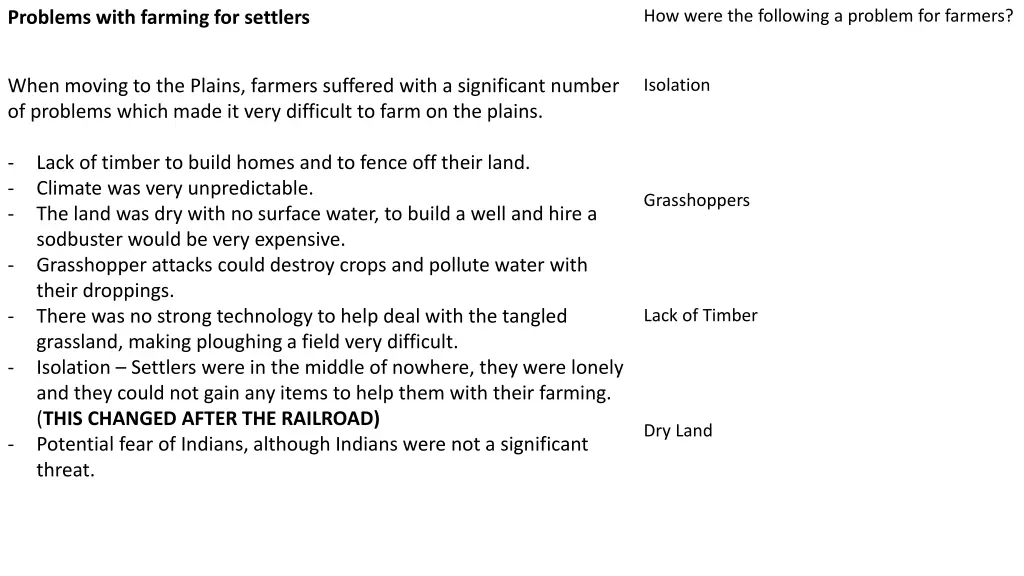
How were the following a problem for farmers? Problems with farming for settlers When moving to the Plains, farmers suffered with a significant number of problems which made it very difficult to farm on the plains. Isolation - - - Lack of timber to build homes and to fence off their land. Climate was very unpredictable. The land was dry with no surface water, to build a well and hire a sodbuster would be very expensive. Grasshopper attacks could destroy crops and pollute water with their droppings. There was no strong technology to help deal with the tangled grassland, making ploughing a field very difficult. Isolation Settlers were in the middle of nowhere, they were lonely and they could not gain any items to help them with their farming. (THIS CHANGED AFTER THE RAILROAD) Potential fear of Indians, although Indians were not a significant threat. Grasshoppers - - Lack of Timber - Dry Land -
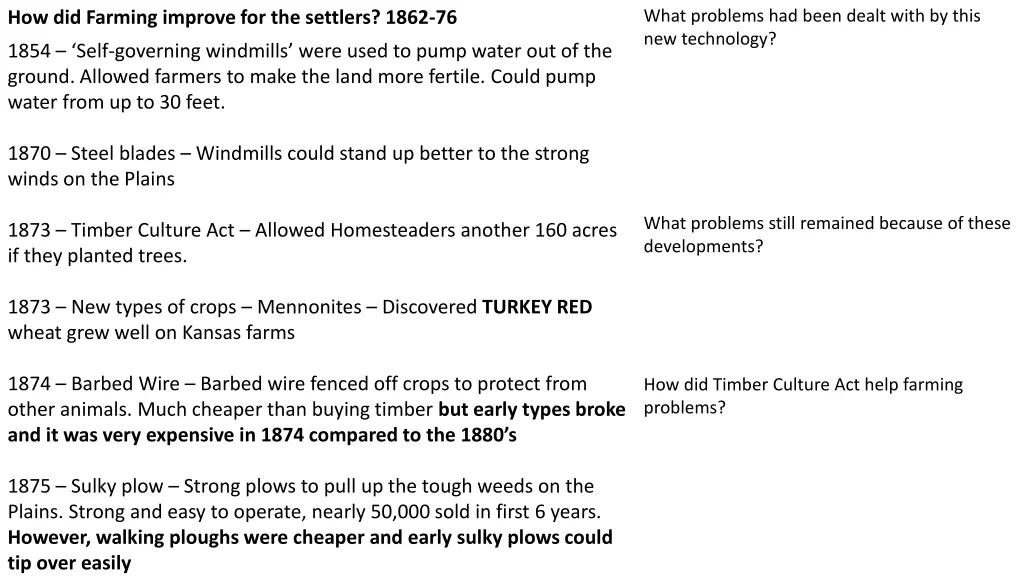
What problems had been dealt with by this new technology? How did Farming improve for the settlers? 1862-76 1854 Self-governing windmills were used to pump water out of the ground. Allowed farmers to make the land more fertile. Could pump water from up to 30 feet. 1870 Steel blades Windmills could stand up better to the strong winds on the Plains What problems still remained because of these developments? 1873 Timber Culture Act Allowed Homesteaders another 160 acres if they planted trees. 1873 New types of crops Mennonites Discovered TURKEY RED wheat grew well on Kansas farms 1874 Barbed Wire Barbed wire fenced off crops to protect from other animals. Much cheaper than buying timber but early types broke and it was very expensive in 1874 compared to the 1880 s How did Timber Culture Act help farming problems? 1875 Sulky plow Strong plows to pull up the tough weeds on the Plains. Strong and easy to operate, nearly 50,000 sold in first 6 years. However, walking ploughs were cheaper and early sulky plows could tip over easily
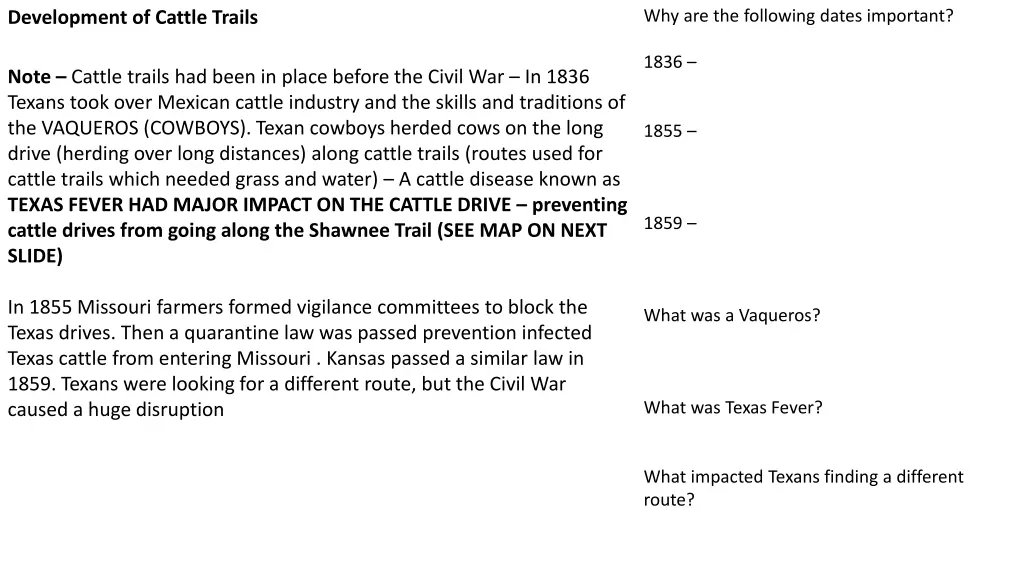
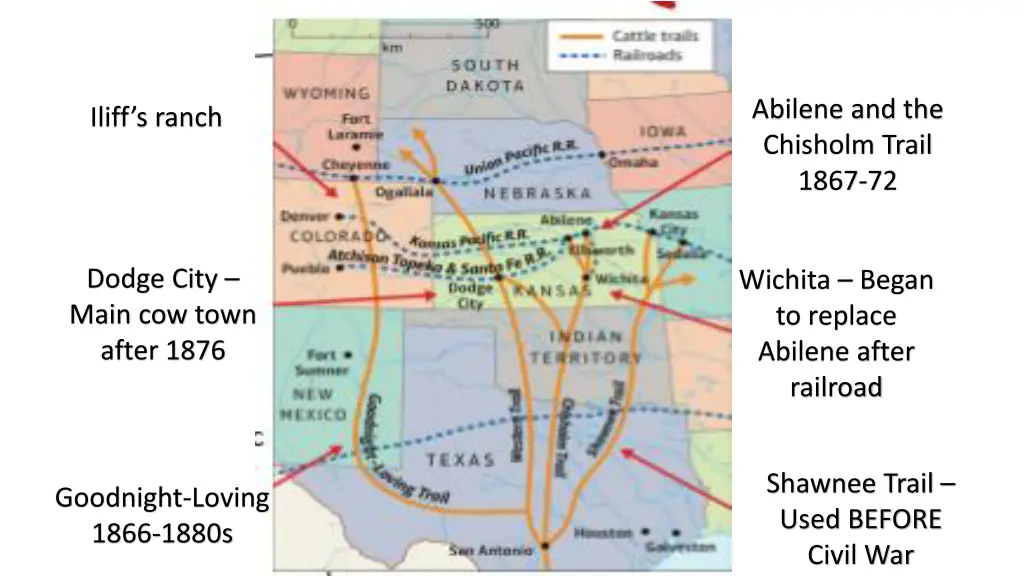
Why are the following dates important? Development of Cattle Trails 1836 Note Cattle trails had been in place before the Civil War In 1836 Texans took over Mexican cattle industry and the skills and traditions of the VAQUEROS (COWBOYS). Texan cowboys herded cows on the long drive (herding over long distances) along cattle trails (routes used for cattle trails which needed grass and water) A cattle disease known as TEXAS FEVER HAD MAJOR IMPACT ON THE CATTLE DRIVE preventing cattle drives from going along the Shawnee Trail (SEE MAP ON NEXT SLIDE) 1855 1859 In 1855 Missouri farmers formed vigilance committees to block the Texas drives. Then a quarantine law was passed prevention infected Texas cattle from entering Missouri . Kansas passed a similar law in 1859. Texans were looking for a different route, but the Civil War caused a huge disruption What was a Vaqueros? What was Texas Fever? What impacted Texans finding a different route?
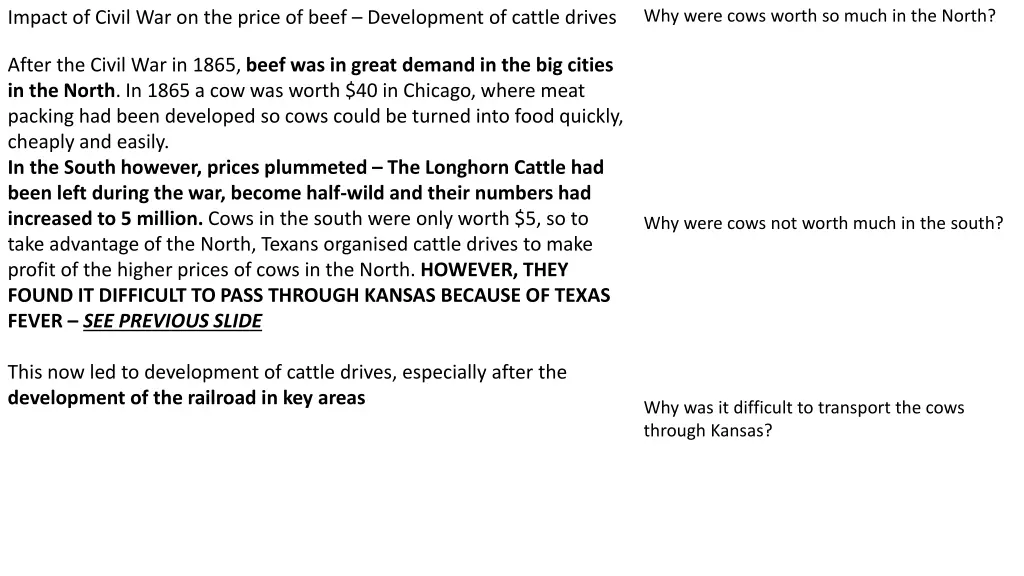
Why were cows worth so much in the North? Impact of Civil War on the price of beef Development of cattle drives After the Civil War in 1865, beef was in great demand in the big cities in the North. In 1865 a cow was worth $40 in Chicago, where meat packing had been developed so cows could be turned into food quickly, cheaply and easily. In the South however, prices plummeted The Longhorn Cattle had been left during the war, become half-wild and their numbers had increased to 5 million. Cows in the south were only worth $5, so to take advantage of the North, Texans organised cattle drives to make profit of the higher prices of cows in the North. HOWEVER, THEY FOUND IT DIFFICULT TO PASS THROUGH KANSAS BECAUSE OF TEXAS FEVER SEE PREVIOUS SLIDE Why were cows not worth much in the south? This now led to development of cattle drives, especially after the development of the railroad in key areas Why was it difficult to transport the cows through Kansas?
Abilene and the Chisholm Trail 1867-72 Iliff s ranch Dodge City Main cow town after 1876 Wichita Began to replace Abilene after railroad Shawnee Trail Used BEFORE Civil War Goodnight-Loving 1866-1880s
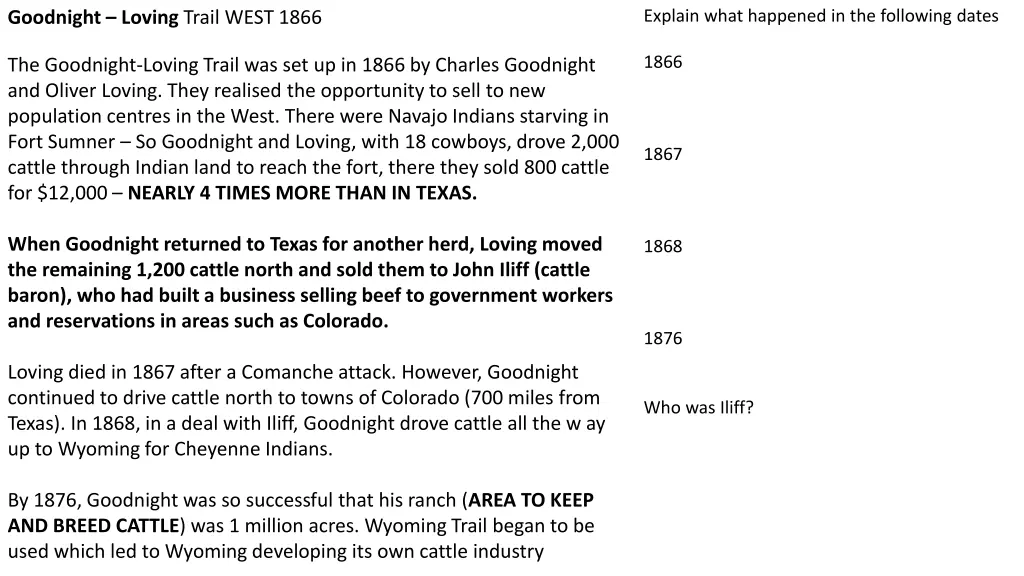
Explain what happened in the following dates Goodnight Loving Trail WEST 1866 1866 The Goodnight-Loving Trail was set up in 1866 by Charles Goodnight and Oliver Loving. They realised the opportunity to sell to new population centres in the West. There were Navajo Indians starving in Fort Sumner So Goodnight and Loving, with 18 cowboys, drove 2,000 cattle through Indian land to reach the fort, there they sold 800 cattle for $12,000 NEARLY 4 TIMES MORE THAN IN TEXAS. 1867 When Goodnight returned to Texas for another herd, Loving moved the remaining 1,200 cattle north and sold them to John Iliff (cattle baron), who had built a business selling beef to government workers and reservations in areas such as Colorado. 1868 1876 Loving died in 1867 after a Comanche attack. However, Goodnight continued to drive cattle north to towns of Colorado (700 miles from Texas). In 1868, in a deal with Iliff, Goodnight drove cattle all the w ay up to Wyoming for Cheyenne Indians. Who was Iliff? By 1876, Goodnight was so successful that his ranch (AREA TO KEEP AND BREED CATTLE) was 1 million acres. Wyoming Trail began to be used which led to Wyoming developing its own cattle industry
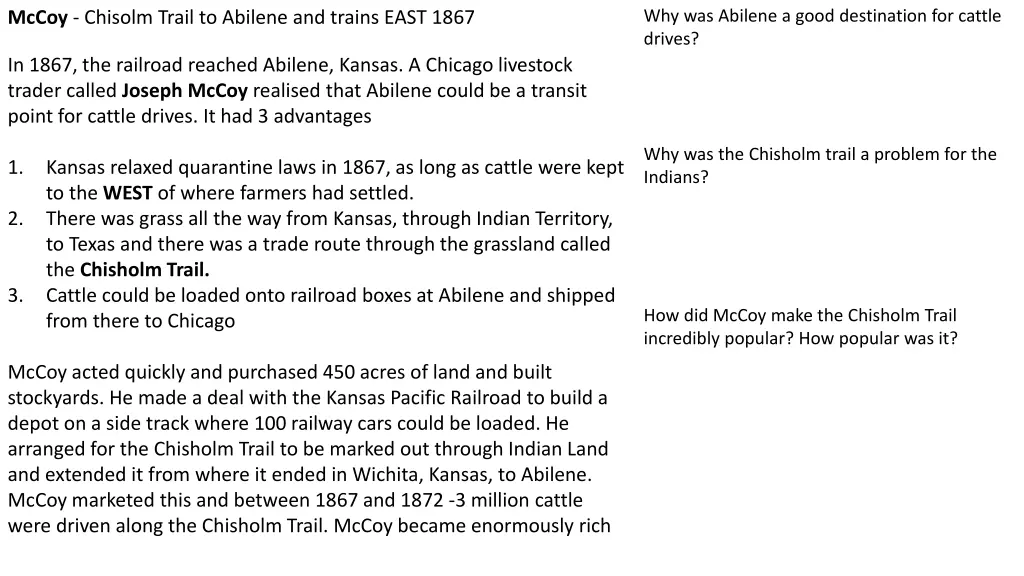
Why was Abilene a good destination for cattle drives? McCoy - Chisolm Trail to Abilene and trains EAST 1867 In 1867, the railroad reached Abilene, Kansas. A Chicago livestock trader called Joseph McCoy realised that Abilene could be a transit point for cattle drives. It had 3 advantages Why was the Chisholm trail a problem for the Indians? 1. Kansas relaxed quarantine laws in 1867, as long as cattle were kept to the WEST of where farmers had settled. There was grass all the way from Kansas, through Indian Territory, to Texas and there was a trade route through the grassland called the Chisholm Trail. Cattle could be loaded onto railroad boxes at Abilene and shipped from there to Chicago 2. 3. How did McCoy make the Chisholm Trail incredibly popular? How popular was it? McCoy acted quickly and purchased 450 acres of land and built stockyards. He made a deal with the Kansas Pacific Railroad to build a depot on a side track where 100 railway cars could be loaded. He arranged for the Chisholm Trail to be marked out through Indian Land and extended it from where it ended in Wichita, Kansas, to Abilene. McCoy marketed this and between 1867 and 1872 -3 million cattle were driven along the Chisholm Trail. McCoy became enormously rich
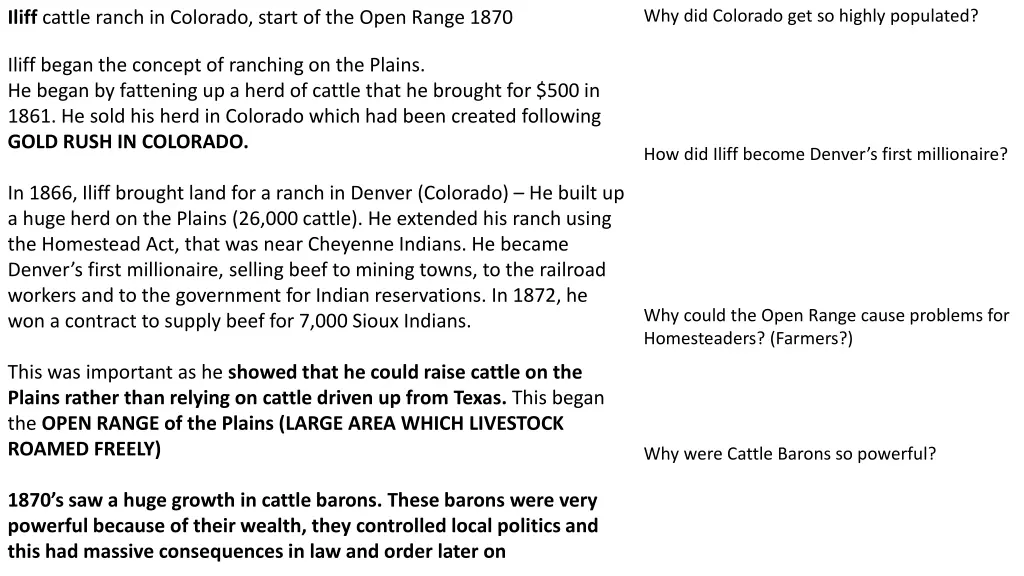
Why did Colorado get so highly populated? Iliff cattle ranch in Colorado, start of the Open Range 1870 Iliff began the concept of ranching on the Plains. He began by fattening up a herd of cattle that he brought for $500 in 1861. He sold his herd in Colorado which had been created following GOLD RUSH IN COLORADO. How did Iliff become Denver s first millionaire? In 1866, Iliff brought land for a ranch in Denver (Colorado) He built up a huge herd on the Plains (26,000 cattle). He extended his ranch using the Homestead Act, that was near Cheyenne Indians. He became Denver s first millionaire, selling beef to mining towns, to the railroad workers and to the government for Indian reservations. In 1872, he won a contract to supply beef for 7,000 Sioux Indians. Why could the Open Range cause problems for Homesteaders? (Farmers?) This was important as he showed that he could raise cattle on the Plains rather than relying on cattle driven up from Texas. This began the OPEN RANGE of the Plains (LARGE AREA WHICH LIVESTOCK ROAMED FREELY) Why were Cattle Barons so powerful? 1870 s saw a huge growth in cattle barons. These barons were very powerful because of their wealth, they controlled local politics and this had massive consequences in law and order later on
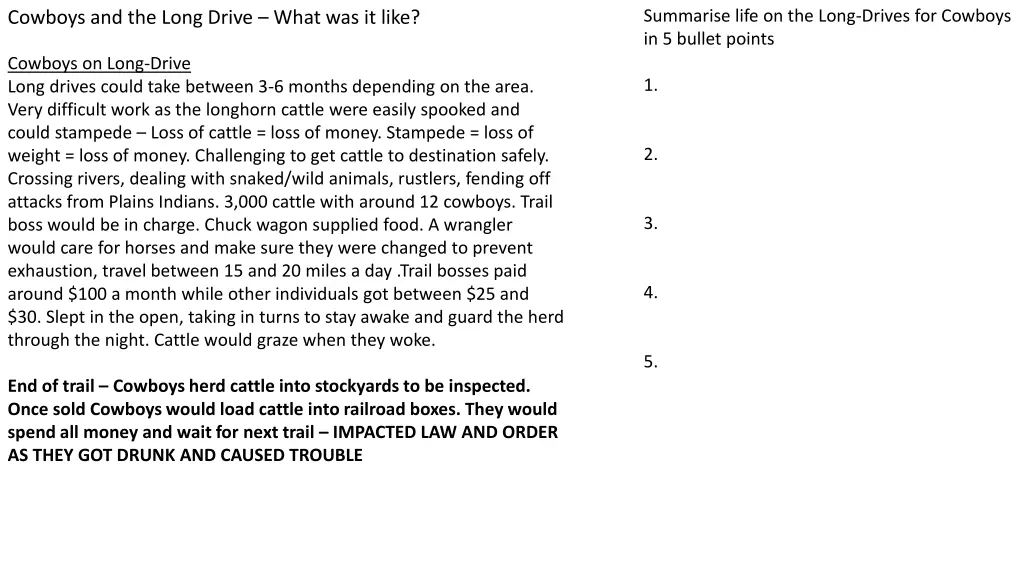
Summarise life on the Long-Drives for Cowboys in 5 bullet points Cowboys and the Long Drive What was it like? Cowboys on Long-Drive Long drives could take between 3-6 months depending on the area. Very difficult work as the longhorn cattle were easily spooked and could stampede Loss of cattle = loss of money. Stampede = loss of weight = loss of money. Challenging to get cattle to destination safely. Crossing rivers, dealing with snaked/wild animals, rustlers, fending off attacks from Plains Indians. 3,000 cattle with around 12 cowboys. Trail boss would be in charge. Chuck wagon supplied food. A wrangler would care for horses and make sure they were changed to prevent exhaustion, travel between 15 and 20 miles a day .Trail bosses paid around $100 a month while other individuals got between $25 and $30. Slept in the open, taking in turns to stay awake and guard the herd through the night. Cattle would graze when they woke. 1. 2. 3. 4. 5. End of trail Cowboys herd cattle into stockyards to be inspected. Once sold Cowboys would load cattle into railroad boxes. They would spend all money and wait for next trail IMPACTED LAW AND ORDER AS THEY GOT DRUNK AND CAUSED TROUBLE
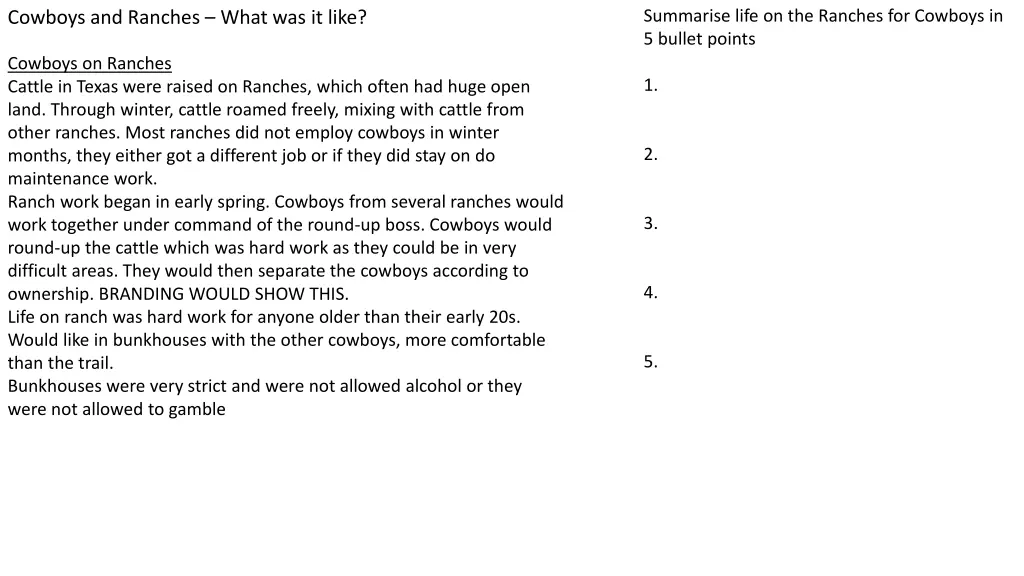
Summarise life on the Ranches for Cowboys in 5 bullet points Cowboys and Ranches What was it like? Cowboys on Ranches Cattle in Texas were raised on Ranches, which often had huge open land. Through winter, cattle roamed freely, mixing with cattle from other ranches. Most ranches did not employ cowboys in winter months, they either got a different job or if they did stay on do maintenance work. Ranch work began in early spring. Cowboys from several ranches would work together under command of the round-up boss. Cowboys would round-up the cattle which was hard work as they could be in very difficult areas. They would then separate the cowboys according to ownership. BRANDING WOULD SHOW THIS. Life on ranch was hard work for anyone older than their early 20s. Would like in bunkhouses with the other cowboys, more comfortable than the trail. Bunkhouses were very strict and were not allowed alcohol or they were not allowed to gamble 1. 2. 3. 4. 5.
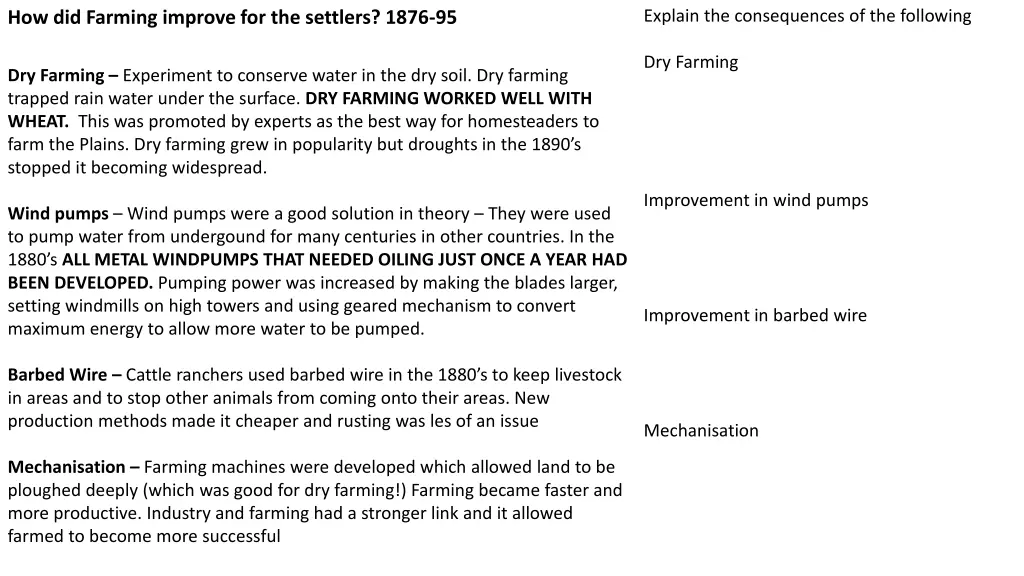
Explain the consequences of the following How did Farming improve for the settlers? 1876-95 Dry Farming Dry Farming Experiment to conserve water in the dry soil. Dry farming trapped rain water under the surface. DRY FARMING WORKED WELL WITH WHEAT. This was promoted by experts as the best way for homesteaders to farm the Plains. Dry farming grew in popularity but droughts in the 1890 s stopped it becoming widespread. Improvement in wind pumps Wind pumps Wind pumps were a good solution in theory They were used to pump water from undergound for many centuries in other countries. In the 1880 s ALL METAL WINDPUMPS THAT NEEDED OILING JUST ONCE A YEAR HAD BEEN DEVELOPED. Pumping power was increased by making the blades larger, setting windmills on high towers and using geared mechanism to convert maximum energy to allow more water to be pumped. Improvement in barbed wire Barbed Wire Cattle ranchers used barbed wire in the 1880 s to keep livestock in areas and to stop other animals from coming onto their areas. New production methods made it cheaper and rusting was les of an issue Mechanisation Mechanisation Farming machines were developed which allowed land to be ploughed deeply (which was good for dry farming!) Farming became faster and more productive. Industry and farming had a stronger link and it allowed farmed to become more successful
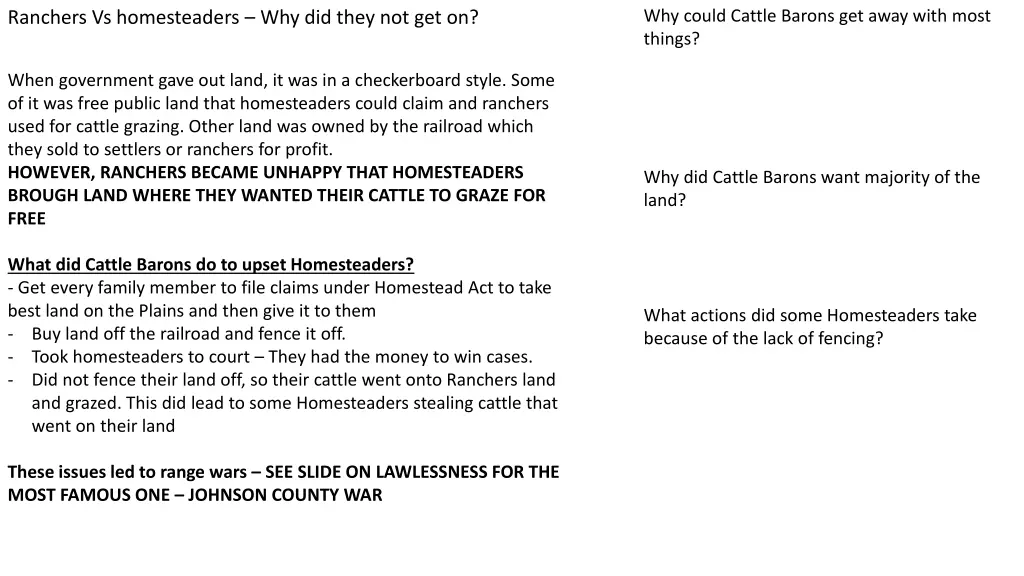
Why could Cattle Barons get away with most things? Ranchers Vs homesteaders Why did they not get on? When government gave out land, it was in a checkerboard style. Some of it was free public land that homesteaders could claim and ranchers used for cattle grazing. Other land was owned by the railroad which they sold to settlers or ranchers for profit. HOWEVER, RANCHERS BECAME UNHAPPY THAT HOMESTEADERS BROUGH LAND WHERE THEY WANTED THEIR CATTLE TO GRAZE FOR FREE Why did Cattle Barons want majority of the land? What did Cattle Barons do to upset Homesteaders? - Get every family member to file claims under Homestead Act to take best land on the Plains and then give it to them - Buy land off the railroad and fence it off. - Took homesteaders to court They had the money to win cases. - Did not fence their land off, so their cattle went onto Ranchers land and grazed. This did lead to some Homesteaders stealing cattle that went on their land What actions did some Homesteaders take because of the lack of fencing? These issues led to range wars SEE SLIDE ON LAWLESSNESS FOR THE MOST FAMOUS ONE JOHNSON COUNTY WAR
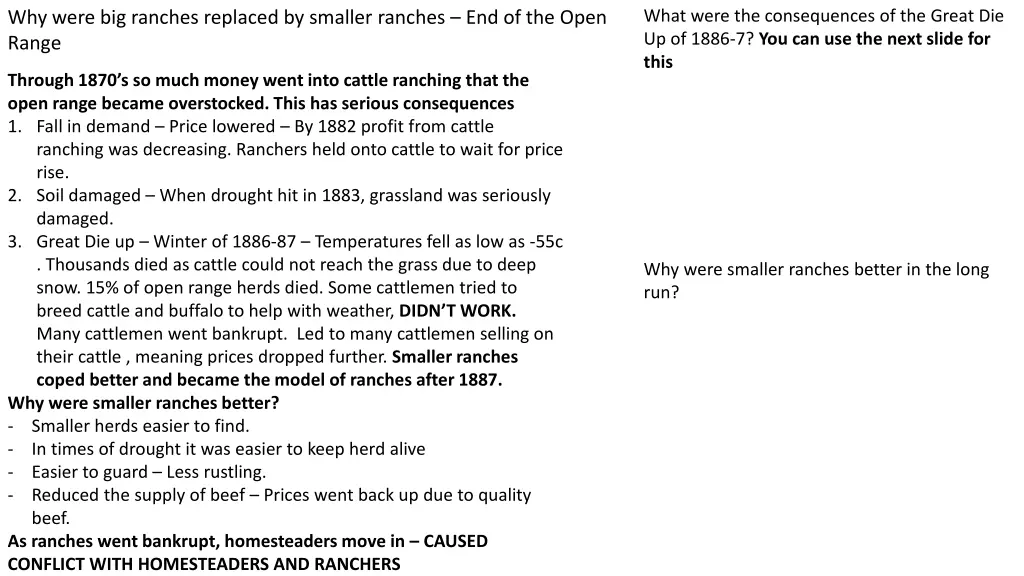
What were the consequences of the Great Die Up of 1886-7? You can use the next slide for this Why were big ranches replaced by smaller ranches End of the Open Range Through 1870 s so much money went into cattle ranching that the open range became overstocked. This has serious consequences 1. Fall in demand Price lowered By 1882 profit from cattle ranching was decreasing. Ranchers held onto cattle to wait for price rise. 2. Soil damaged When drought hit in 1883, grassland was seriously damaged. 3. Great Die up Winter of 1886-87 Temperatures fell as low as -55c . Thousands died as cattle could not reach the grass due to deep snow. 15% of open range herds died. Some cattlemen tried to breed cattle and buffalo to help with weather, DIDN T WORK. Many cattlemen went bankrupt. Led to many cattlemen selling on their cattle , meaning prices dropped further. Smaller ranches coped better and became the model of ranches after 1887. Why were smaller ranches better? - Smaller herds easier to find. - In times of drought it was easier to keep herd alive - Easier to guard Less rustling. - Reduced the supply of beef Prices went back up due to quality beef. As ranches went bankrupt, homesteaders move in CAUSED CONFLICT WITH HOMESTEADERS AND RANCHERS Why were smaller ranches better in the long run?
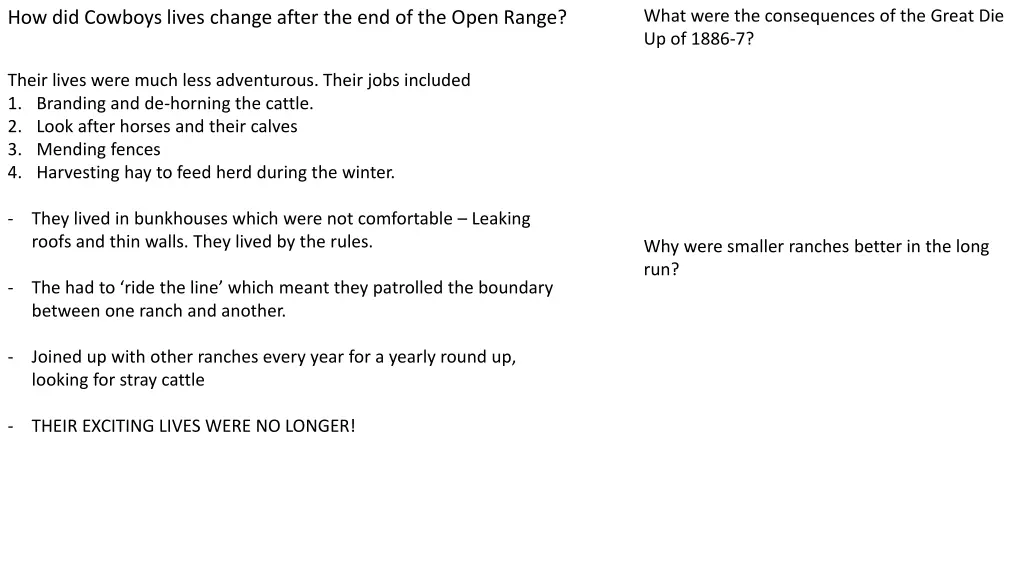
What were the consequences of the Great Die Up of 1886-7? How did Cowboys lives change after the end of the Open Range? Their lives were much less adventurous. Their jobs included 1. Branding and de-horning the cattle. 2. Look after horses and their calves 3. Mending fences 4. Harvesting hay to feed herd during the winter. - They lived in bunkhouses which were not comfortable Leaking roofs and thin walls. They lived by the rules. Why were smaller ranches better in the long run? - The had to ride the line which meant they patrolled the boundary between one ranch and another. - Joined up with other ranches every year for a yearly round up, looking for stray cattle - THEIR EXCITING LIVES WERE NO LONGER!