Cheboygan Area Schools 2023-2028 Strategic Plan Summary
The Cheboygan Area Schools Strategic Plan Summary for 2023-2028 outlines a vision of a thriving community with a collaborative culture empowering individuals to realize their full potential. Through inclusive strategic planning involving stakeholders, the plan emphasizes academic growth and student development to create a high-performing school district. Prioritizing engagement and alignment with internal and external stakeholders, the district aims to provide quality education in an inclusive and supportive environment. This living document sets the course for educational excellence and innovative possibilities in Cheboygan.

Download Presentation

Please find below an Image/Link to download the presentation.
The content on the website is provided AS IS for your information and personal use only. It may not be sold, licensed, or shared on other websites without obtaining consent from the author.If you encounter any issues during the download, it is possible that the publisher has removed the file from their server.
You are allowed to download the files provided on this website for personal or commercial use, subject to the condition that they are used lawfully. All files are the property of their respective owners.
The content on the website is provided AS IS for your information and personal use only. It may not be sold, licensed, or shared on other websites without obtaining consent from the author.
E N D
Presentation Transcript
Cheboygan Area Schools Strategic Plan Summary Document 2023-2028 Vision: A thriving community with a collaborative culture that empowers every individual to realize their full potential. MICHIGAN ASSOCIATION OF SCHOOL BOARDS
Letter from Board President and Superintendent Cheboygan Area Schools 2023-2028 Strategic Plan: Participants Help Shape the Vision and Goals for the Future of Cheboygan Area Schools. This document contains the 2023-2028 Cheboygan Area Schools Strategic Plan. We re excited about this plan and the possibilities it provides for our students, parents/guardians and community to improve education within our District. Seven community, parent/guardian and staff forums and an electronic survey resulted in 559 people providing input for the planning process. A Strategic Planning Team of 29 community members, parents/guardians, staff and students participated in an all-day planning retreat on October 28, 2023. Throughout the planning process the community expressed high expectations of Cheboygan Area Schools becoming a high-performing school district and giving students opportunities to develop and grow. Even though some of the goals are extremely high, they reflect the strong desire that has been expressed to embrace change and improve the school system. There were several clear and consistent themes that emerged from this process. Cheboygan Area Schools has tremendous school pride, a dedicated and caring staff, and a commitment to academic growth and developing students to become the best version of themselves. Investing in opportunities for students and staff to grow and learn in a safe and nurturing environment must be a top priority. As a district, we must prioritize engaging and aligning internal (students, parents/guardians, staff and the school board) and external (taxpayers, community organizations, businesses, non-profits, government agencies, elected officials) stakeholders around common goals and strategies to improve academic achievement and student success. We are thrilled to continue on our mission to provide a quality education in an inclusive and supportive environment while promoting excellence through innovative possibilities. Spencer Byrd, Superintendent Amber Hansen, Board of Education President MICHIGAN ASSOCIATION OF SCHOOL BOARDS
Introduction Strategic Planning is the process of determining where an organization wants to be at some point in the future, and how it will get there. In the current environment where schools are challenged to do more each year, planning for the future is more important than ever. An effective strategic planning process results in stakeholders focusing on critical priorities that will meet the mission of a quality educational program for all students. In March 2023 the Cheboygan Area Schools Superintendent and the Board of Education made a commitment to create a three to five-year strategic plan. The School Board created a partnership with the Michigan Association of School Boards to serve as facilitators for this project. The district, under the leadership of the Board of Education President and Superintendent, completed a process that was data-driven, inclusive of district stakeholders and focused on the priorities that will help the district succeed. There were several criteria relative to the strategic planning process established by the School Board and the leadership team: The process must be inclusive where all stakeholders have an opportunity to provide structured input. The School Board must be an integral part of the process, providing input, support, and commitment. There must be clarity in the respective roles of the School Board, administrators, staff, parents/guardians and community. There is alignment between the strategic planning process, current strategic initiatives, and critical issues facing the district. Timelines, responsibilities and reporting schedules must be built into the planning processes. There must be ongoing communication about the planning process with all internal and external stakeholders. This strategic plan is a living document. It will serve as a roadmap to future planning, resource allocation, staff development and decision-making over the next several years. As part of the planning process, the mission statement, and belief statements were developed. Based on qualitative and quantitative data and utilizing the mission and belief statements; strategic goals and objectives were developed. Regular monitoring of progress and renewal is critical to the plan s success. MICHIGAN ASSOCIATION OF SCHOOL BOARDS
The Strategic Plan Process This overview describes the planning process, including the survey, data analysis, planning team roles and responsibilities, and timelines. Stakeholder Input Input from students, parents/guardians, community and staff were gathered through a comprehensive electronic survey as well as a series of community, student and staff forums. The community engagement process was conducted to: Identify and assess strengths Gauge values and perceptions of the community Provide an opportunity for input Identify areas for improvement Gather data to use as a decision-making tool Develop communication plans and tools The response rate of 559 indicates that the school community cares about the future of the district and desires to engage in the process of creating the future (see Attachment 1 for summary). MICHIGAN ASSOCIATION OF SCHOOL BOARDS
Local Area and School Demographic Data An analysis of district demographics and quantitative data was completed. The analysis included demographic, enrollment, educational, financial and personnel trends over the previous five years, 2017-2021, as applicable, in comparison with districts selected by the Board and Administration and state averages, where available (see Attachment 2 for the data analysis summary). The reference districts used for Cheboygan Area Schools were Boyne City Public Schools, Crawford AuSable Schools, East Jordan Public Schools, Gaylord Community Schools, and Inland Lakes Schools. Strategic Planning Team A Strategic Planning Team was formed to take a primary role in developing the strategic plan. The team consisting of 29 parents/ guardians, community members, board members, students and staff members, were selected with input from the Board of Education and key stakeholder groups. The team participated in a retreat workshop as well as additional committee meetings to develop a mission statement, vision, beliefs, and strategic goals. During the retreat the team reviewed and discussed relevant quantitative and qualitative data as essential elements in the formation of goals and objectives contained in this document (see team members on page 7). Through this strategic planning process, the Cheboygan Area Schools Board of Education, Administration, Staff, and Community have illustrated a high level of care for the school, the community, and the students. Greg Janicki, MASB Facilitator MICHIGAN ASSOCIATION OF SCHOOL BOARDS
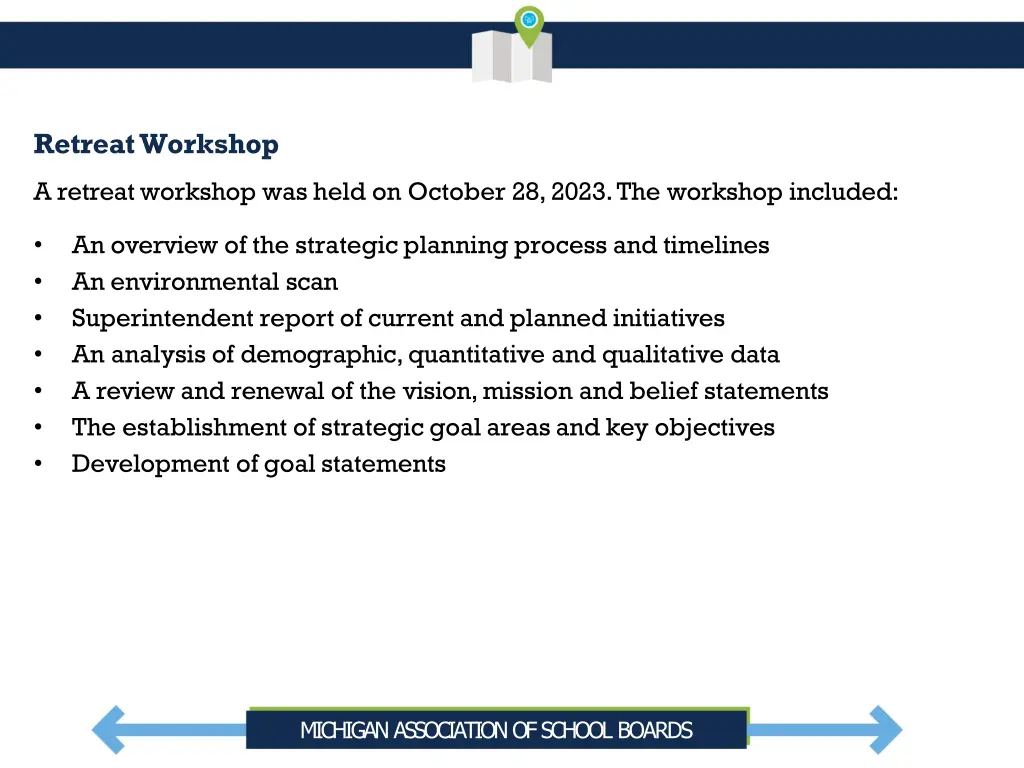
Retreat Workshop A retreat workshop was held on October 28, 2023. The workshop included: An overview of the strategic planning process and timelines An environmental scan Superintendent report of current and planned initiatives An analysis of demographic, quantitative and qualitative data A review and renewal of the vision, mission and belief statements The establishment of strategic goal areas and key objectives Development of goal statements MICHIGAN ASSOCIATION OF SCHOOL BOARDS
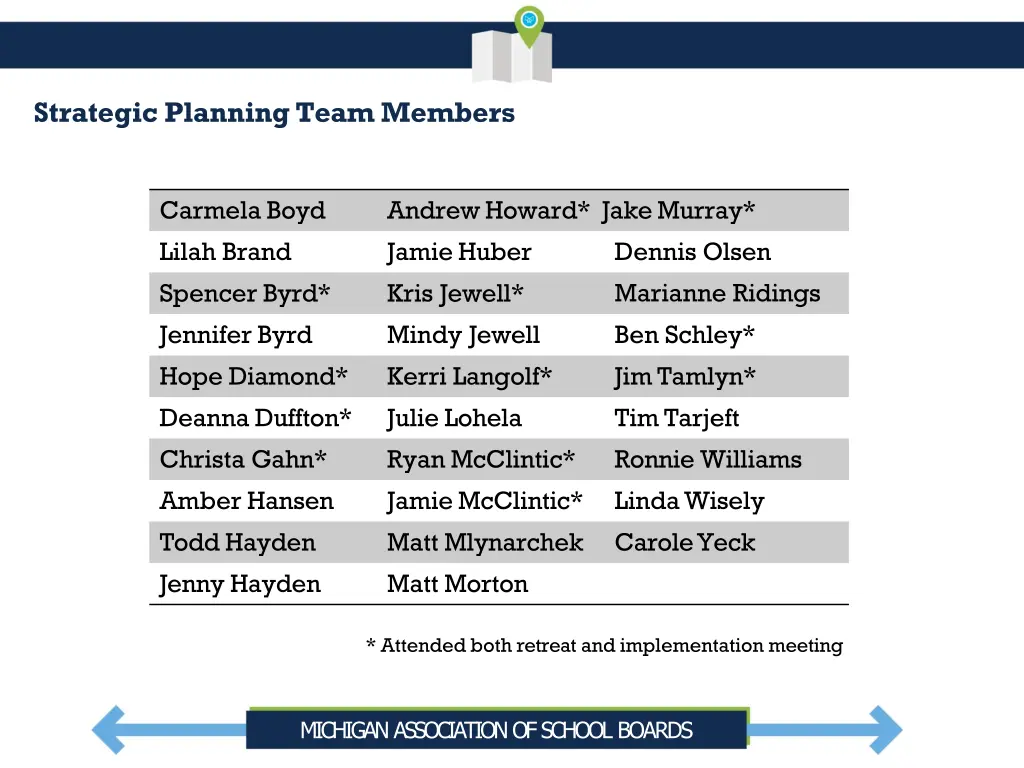
Strategic Planning Team Members Carmela Boyd Lilah Brand Spencer Byrd* Jennifer Byrd Hope Diamond* Deanna Duffton* Christa Gahn* Amber Hansen Todd Hayden Jenny Hayden Andrew Howard* JakeMurray* Jamie Huber Kris Jewell* Mindy Jewell Kerri Langolf* Julie Lohela Ryan McClintic* Jamie McClintic* Matt Mlynarchek Matt Morton Dennis Olsen Marianne Ridings Ben Schley* Jim Tamlyn* Tim Tarjeft Ronnie Williams Linda Wisely Carole Yeck * Attended both retreat and implementation meeting MICHIGAN ASSOCIATION OF SCHOOL BOARDS
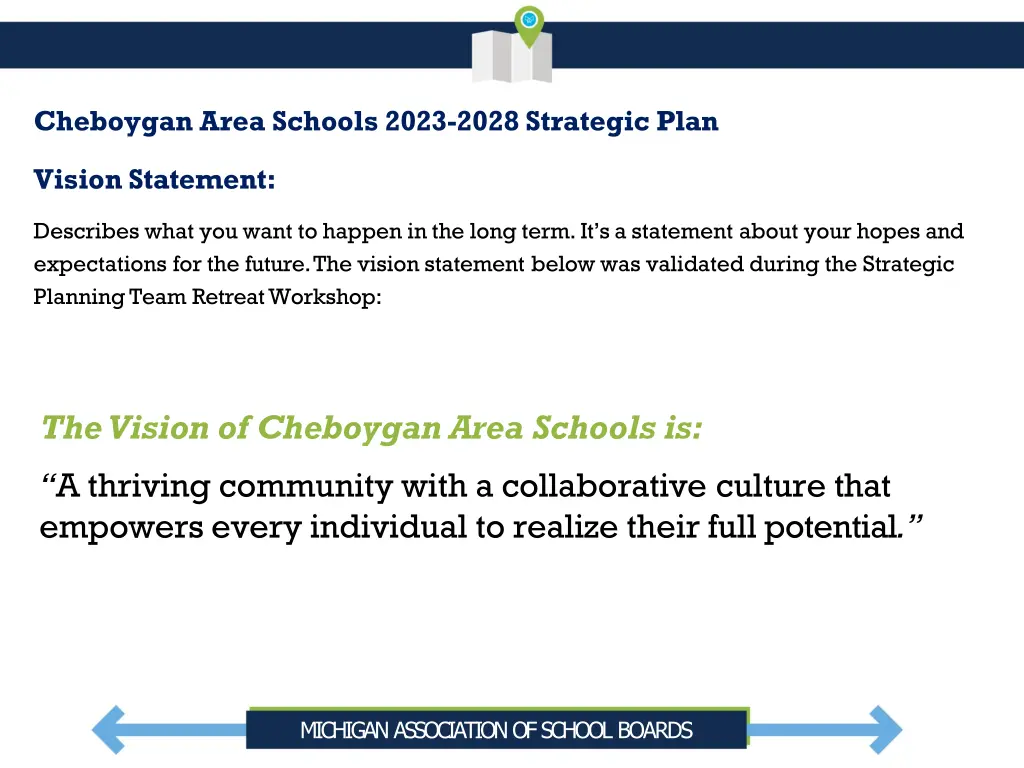
Cheboygan Area Schools 2023-2028 Strategic Plan Vision Statement: Describes what you want to happen in the long term. It s a statement about your hopes and expectations for the future. The vision statement below was validated during the Strategic Planning Team Retreat Workshop: The Vision of Cheboygan Area Schools is: A thriving community with a collaborative culture that empowers every individual to realize their full potential. MICHIGAN ASSOCIATION OF SCHOOL BOARDS
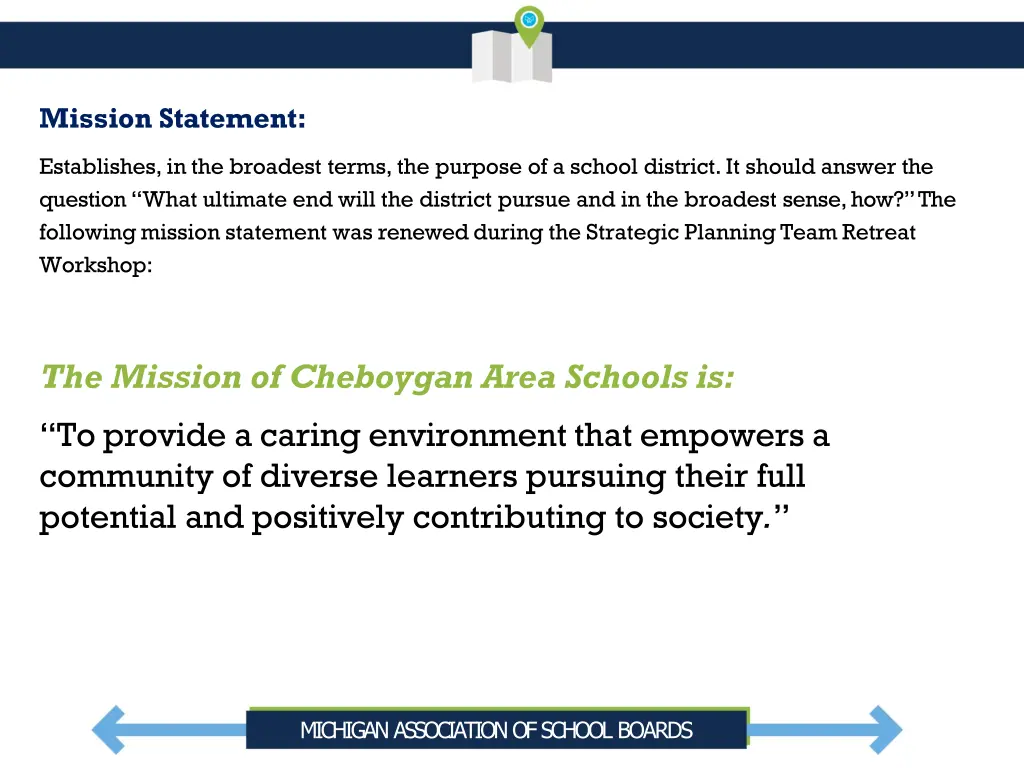
Mission Statement: Establishes, in the broadest terms, the purpose of a school district. It should answer the question What ultimate end will the district pursue and in the broadest sense, how? The following mission statement was renewed during the Strategic Planning Team Retreat Workshop: The Mission of Cheboygan Area Schools is: To provide a caring environment that empowers a community of diverse learners pursuing their full potential and positively contributing to society. MICHIGAN ASSOCIATION OF SCHOOL BOARDS
Beliefs: The basic beliefs/core values of the district those things that we believe of utmost importance, providing guidance for how we behave and relate to others. The following beliefs were developed during the Strategic Planning Team Retreat Workshop: We Believe: in a safe, inclusive, and collaborative environment that maximizes growth character development is an integral part of life-long success in fostering self pride in all achievements in making all students life ready through quality education MICHIGAN ASSOCIATION OF SCHOOL BOARDS
2023-2028 Strategic Goals Strategic Goals: Areas of priority importance in which the district will focus their work (1-5 years). Strategic goals achieve the organization s vision, mission and beliefs. Objectives are SMART Specific, Measurable, Achievable, Relevant and Timely The Strategic Planning Team, at the October 2023 retreat, developed goal statements and specific objectives. The goal areas are categorized below: 2023-2028 Goals Academics/Programs Learning Environment and Culture Communication and Community Engagement Personnel and Leadership Operations/Finance MICHIGAN ASSOCIATION OF SCHOOL BOARDS
Following the retreat, administrators were charged with developing specific objectives based on strategic goal areas identified by the team. Goal Area 1: ACADEMICS/PROGRAMS Strategic Goal Statement: Cheboygan Area Schools will offer a variety of constantly evolving and highly engaging educational opportunities that empower students. Priority Objectives: o Build academic leadership team (best practices, professional development, curriculum) o Create more opportunities for students through Early Middle College and dual enrollment o Pilot preschool program and partnerships MICHIGAN ASSOCIATION OF SCHOOL BOARDS
Goal Area 2: LEARNING ENVIRONMENT AND CULTURE Strategic Goal Statement: Cheboygan Area Schools will provide a welcoming and safe environment that includes innovative and enriching programs of all. Priority Objectives: o Add early intervention resources o Establish a plan to replace and update security technology o Essential components of MTSS in development stage at each building MICHIGAN ASSOCIATION OF SCHOOL BOARDS
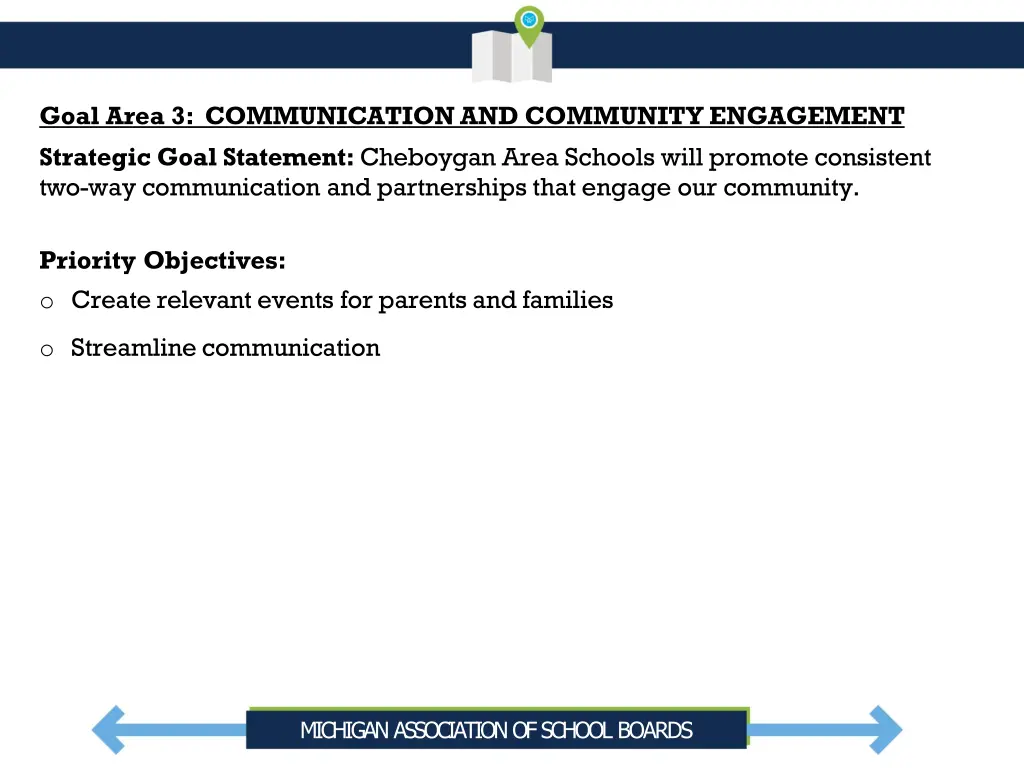
Goal Area 3: COMMUNICATION AND COMMUNITY ENGAGEMENT Strategic Goal Statement: Cheboygan Area Schools will promote consistent two-way communication and partnerships that engage our community. Priority Objectives: o Create relevant events for parents and families o Streamline communication MICHIGAN ASSOCIATION OF SCHOOL BOARDS
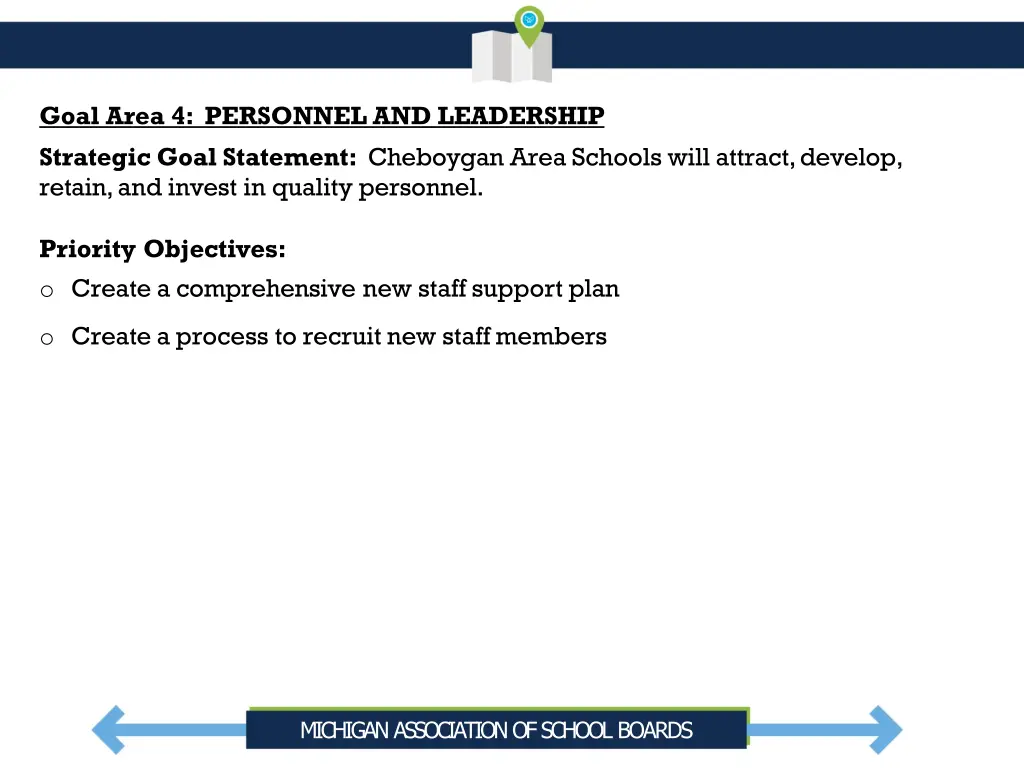
Goal Area 4: PERSONNEL AND LEADERSHIP Strategic Goal Statement: Cheboygan Area Schools will attract, develop, retain, and invest in quality personnel. Priority Objectives: o Create a comprehensive new staff support plan o Create a process to recruit new staff members MICHIGAN ASSOCIATION OF SCHOOL BOARDS
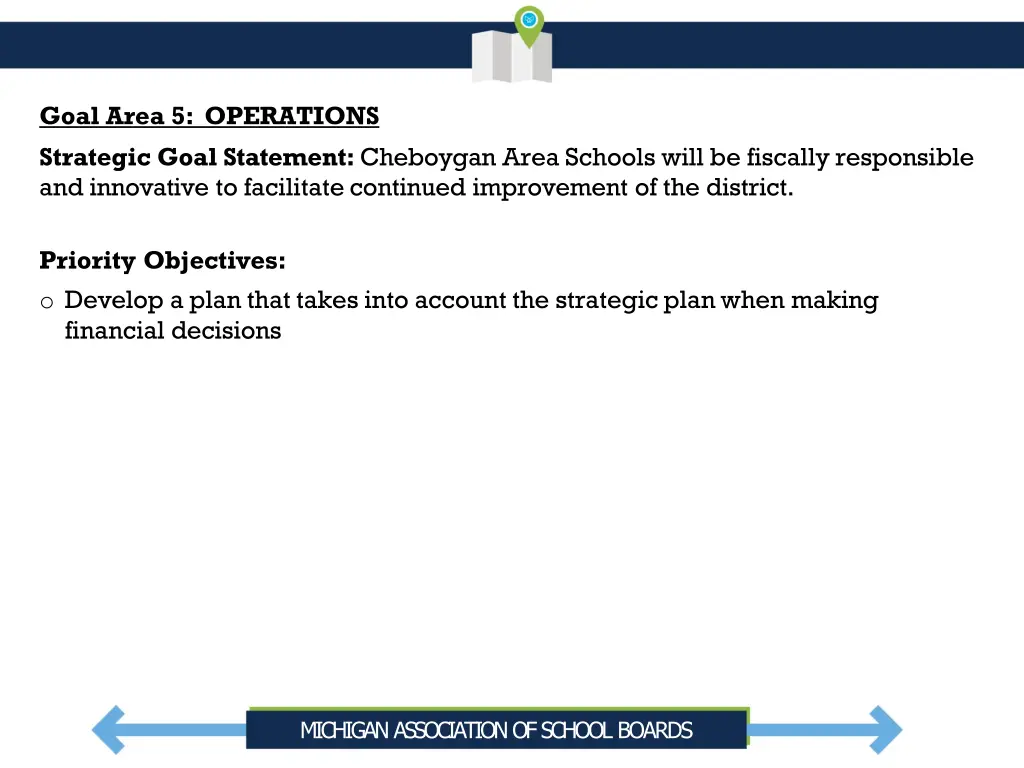
Goal Area 5: OPERATIONS Strategic Goal Statement: Cheboygan Area Schools will be fiscally responsible and innovative to facilitate continued improvement of the district. Priority Objectives: o Develop a plan that takes into account the strategic plan when making financial decisions MICHIGAN ASSOCIATION OF SCHOOL BOARDS
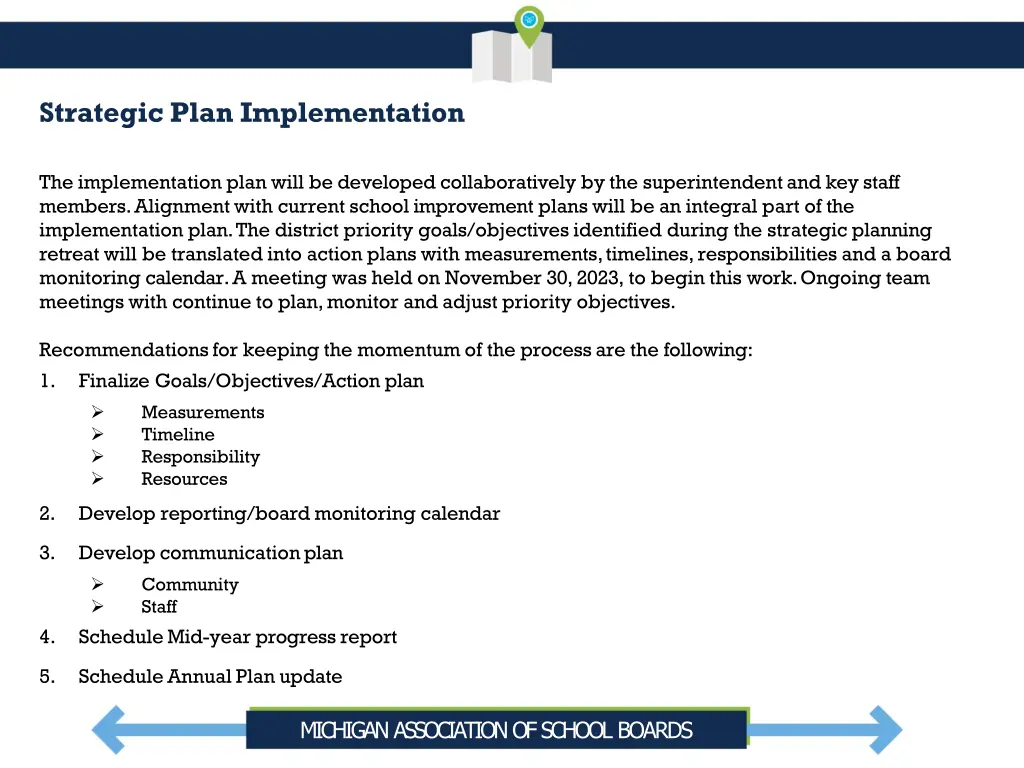
Strategic Plan Implementation The implementation plan will be developed collaboratively by the superintendent and key staff members. Alignment with current school improvement plans will be an integral part of the implementation plan. The district priority goals/objectives identified during the strategic planning retreat will be translated into action plans with measurements, timelines, responsibilities and a board monitoring calendar. A meeting was held on November 30, 2023, to begin this work. Ongoing team meetings with continue to plan, monitor and adjust priority objectives. Recommendations for keeping the momentum of the process are the following: 1. Finalize Goals/Objectives/Action plan Measurements Timeline Responsibility Resources 2. Develop reporting/board monitoring calendar 3. Develop communication plan Community Staff Schedule Mid-year progress report 4. 5. Schedule Annual Plan update MICHIGAN ASSOCIATION OF SCHOOL BOARDS
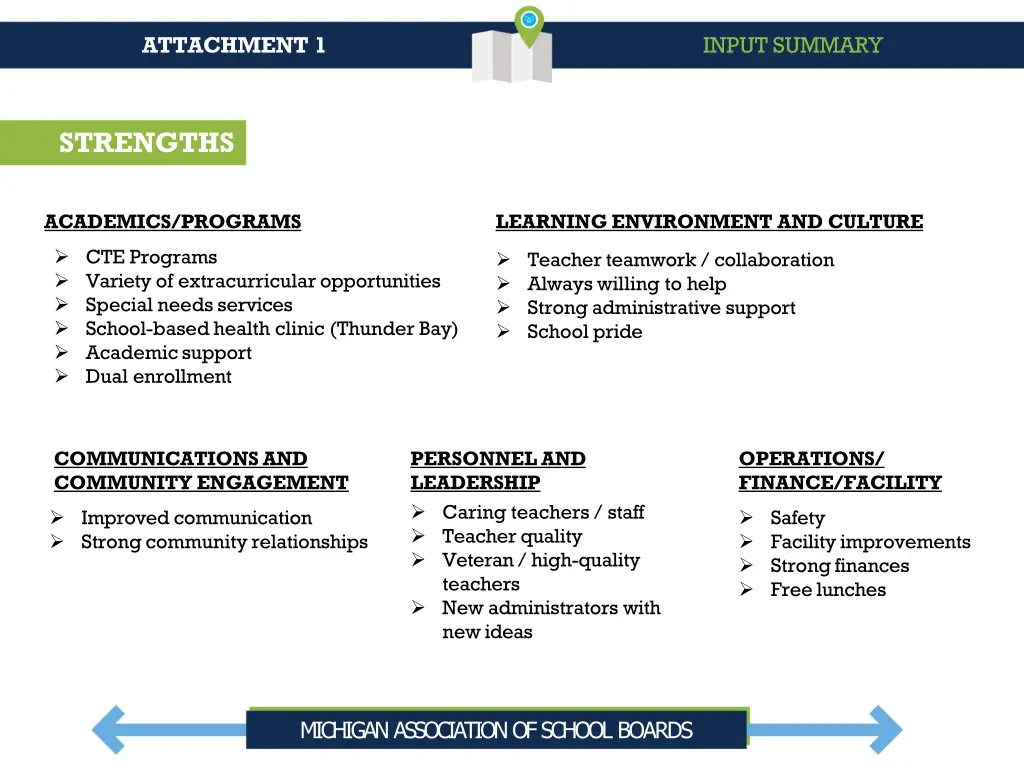
ATTACHMENT 1 INPUT SUMMARY STRENGTHS LEARNING ENVIRONMENT AND CULTURE ACADEMICS/PROGRAMS CTE Programs Variety of extracurricular opportunities Special needs services School-based health clinic (Thunder Bay) Academic support Dual enrollment Teacher teamwork / collaboration Always willing to help Strong administrative support School pride COMMUNICATIONS AND COMMUNITY ENGAGEMENT PERSONNEL AND LEADERSHIP Caring teachers / staff Teacher quality Veteran / high-quality teachers New administrators with new ideas OPERATIONS/ FINANCE/FACILITY Improved communication Strong community relationships Safety Facility improvements Strong finances Free lunches MICHIGAN ASSOCIATION OF SCHOOL BOARDS
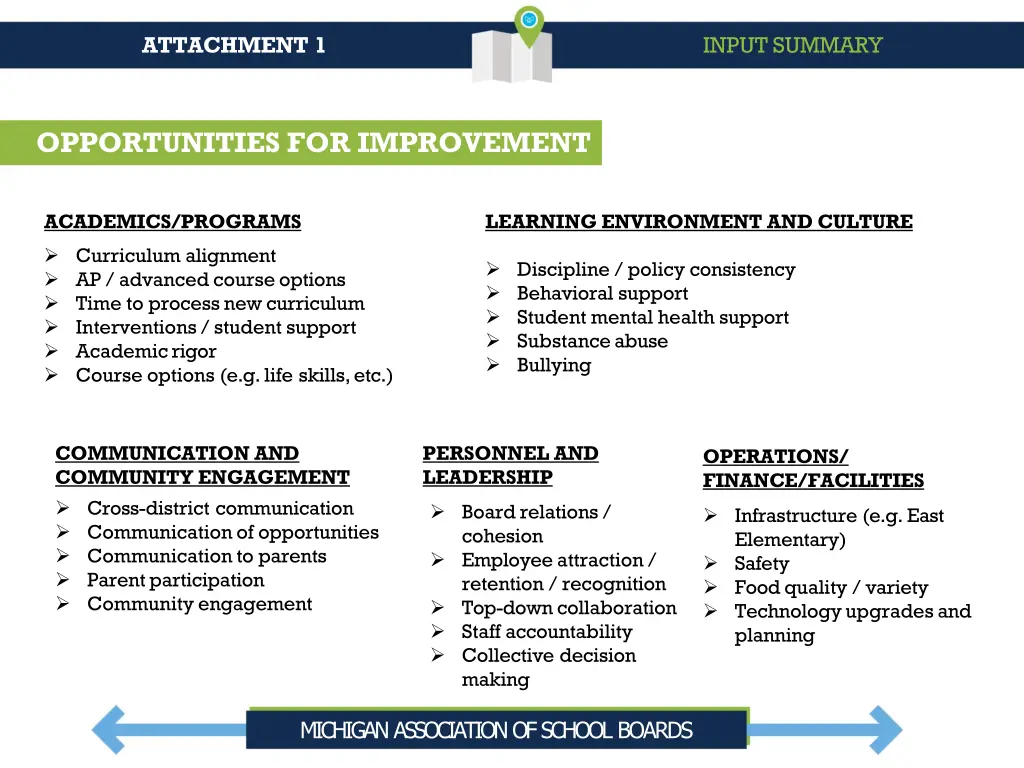
ATTACHMENT 1 INPUT SUMMARY OPPORTUNITIES FOR IMPROVEMENT ACADEMICS/PROGRAMS LEARNING ENVIRONMENT AND CULTURE Curriculum alignment AP / advanced course options Time to process new curriculum Interventions / student support Academic rigor Course options (e.g. life skills, etc.) Discipline / policy consistency Behavioral support Student mental health support Substance abuse Bullying COMMUNICATION AND COMMUNITY ENGAGEMENT Cross-district communication Communication of opportunities Communication to parents Parent participation Community engagement PERSONNEL AND LEADERSHIP OPERATIONS/ FINANCE/FACILITIES Board relations / cohesion Employee attraction / retention / recognition Top-down collaboration Staff accountability Collective decision making Infrastructure (e.g. East Elementary) Safety Food quality / variety Technology upgrades and planning MICHIGAN ASSOCIATION OF SCHOOL BOARDS
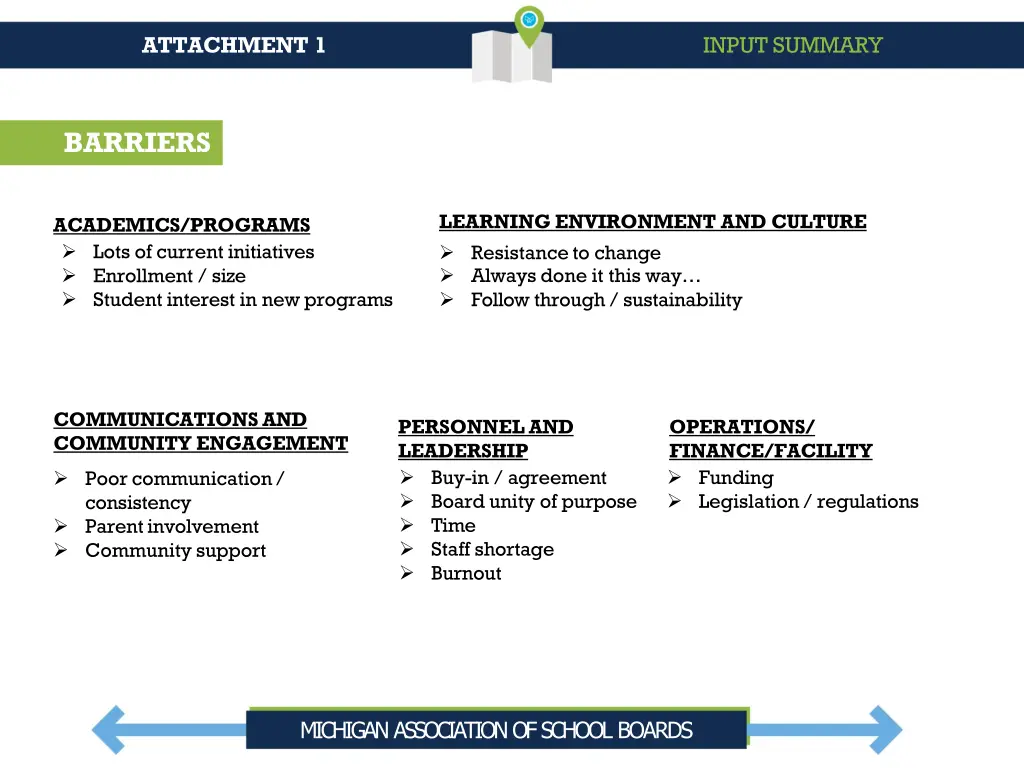
ATTACHMENT 1 INPUT SUMMARY BARRIERS LEARNING ENVIRONMENT AND CULTURE Resistance to change Always done it this way Follow through / sustainability ACADEMICS/PROGRAMS Lots of current initiatives Enrollment / size Student interest in new programs COMMUNICATIONS AND COMMUNITY ENGAGEMENT PERSONNEL AND LEADERSHIP Buy-in / agreement Board unity of purpose Time Staff shortage Burnout OPERATIONS/ FINANCE/FACILITY Funding Legislation / regulations Poor communication / consistency Parent involvement Community support MICHIGAN ASSOCIATION OF SCHOOL BOARDS
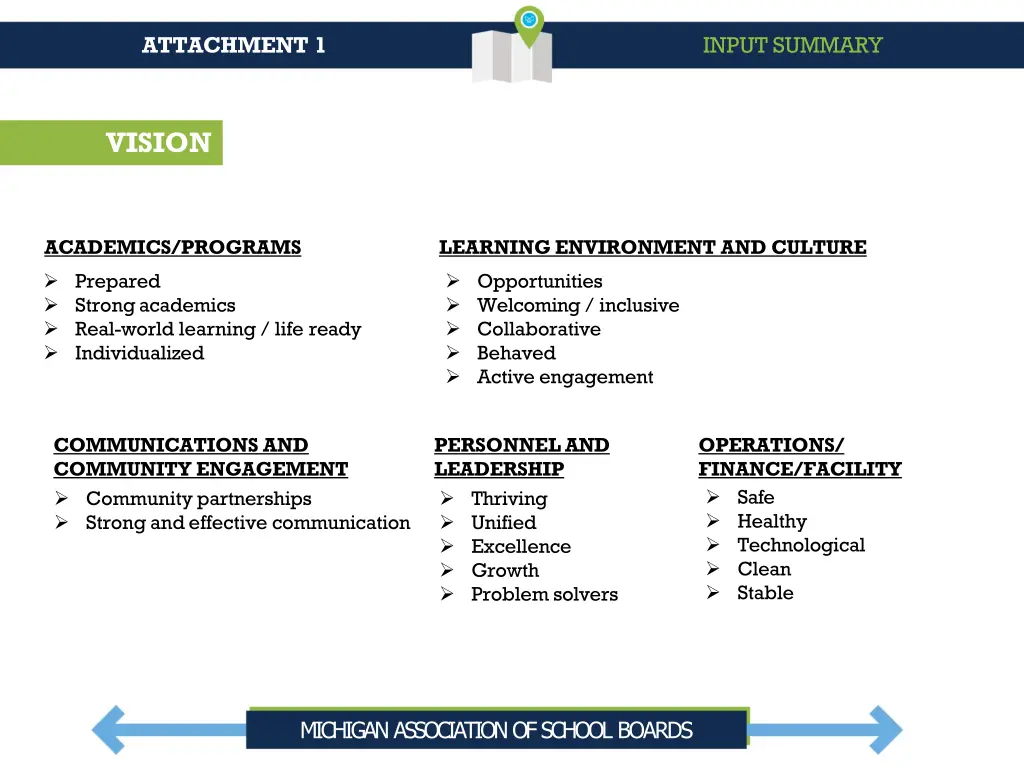
ATTACHMENT 1 INPUT SUMMARY VISION ACADEMICS/PROGRAMS LEARNING ENVIRONMENT AND CULTURE Prepared Strong academics Real-world learning / life ready Individualized Opportunities Welcoming / inclusive Collaborative Behaved Active engagement COMMUNICATIONS AND COMMUNITY ENGAGEMENT Community partnerships Strong and effective communication PERSONNEL AND LEADERSHIP Thriving Unified Excellence Growth Problem solvers OPERATIONS/ FINANCE/FACILITY Safe Healthy Technological Clean Stable MICHIGAN ASSOCIATION OF SCHOOL BOARDS
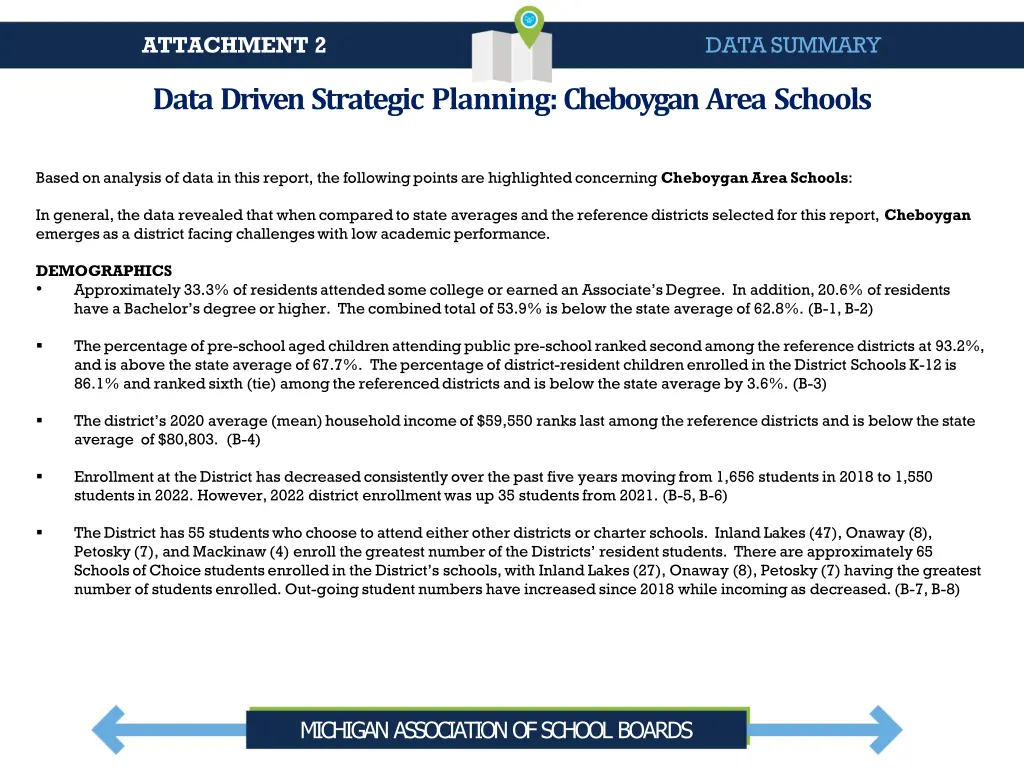
ATTACHMENT 2 DATA SUMMARY Data Driven Strategic Planning: Cheboygan Area Schools Based on analysis of data in this report, the following points are highlighted concerning Cheboygan Area Schools: In general, the data revealed that when compared to state averages and the reference districts selected for this report, Cheboygan emerges as a district facing challenges with low academic performance. DEMOGRAPHICS Approximately 33.3% of residents attended some college or earned an Associate s Degree. In addition, 20.6% of residents have a Bachelor s degree or higher. The combined total of 53.9% is below the state average of 62.8%. (B-1, B-2) The percentage of pre-school aged children attending public pre-school ranked second among the reference districts at 93.2%, and is above the state average of 67.7%. The percentage of district-resident children enrolled in the District Schools K-12 is 86.1% and ranked sixth (tie) among the referenced districts and is below the state average by 3.6%. (B-3) The district s 2020 average (mean) household income of $59,550 ranks last among the reference districts and is below the state average of $80,803. (B-4) Enrollment at the District has decreased consistently over the past five years moving from 1,656 students in 2018 to 1,550 students in 2022. However, 2022 district enrollment was up 35 students from 2021. (B-5, B-6) The District has 55 students who choose to attend either other districts or charter schools. Inland Lakes (47), Onaway (8), Petosky (7), and Mackinaw (4) enroll the greatest number of the Districts resident students. There are approximately 65 Schools of Choice students enrolled in the District s schools, with Inland Lakes (27), Onaway (8), Petosky (7) having the greatest number of students enrolled. Out-going student numbers have increased since 2018 while incoming as decreased. (B-7, B-8) MICHIGAN ASSOCIATION OF SCHOOL BOARDS
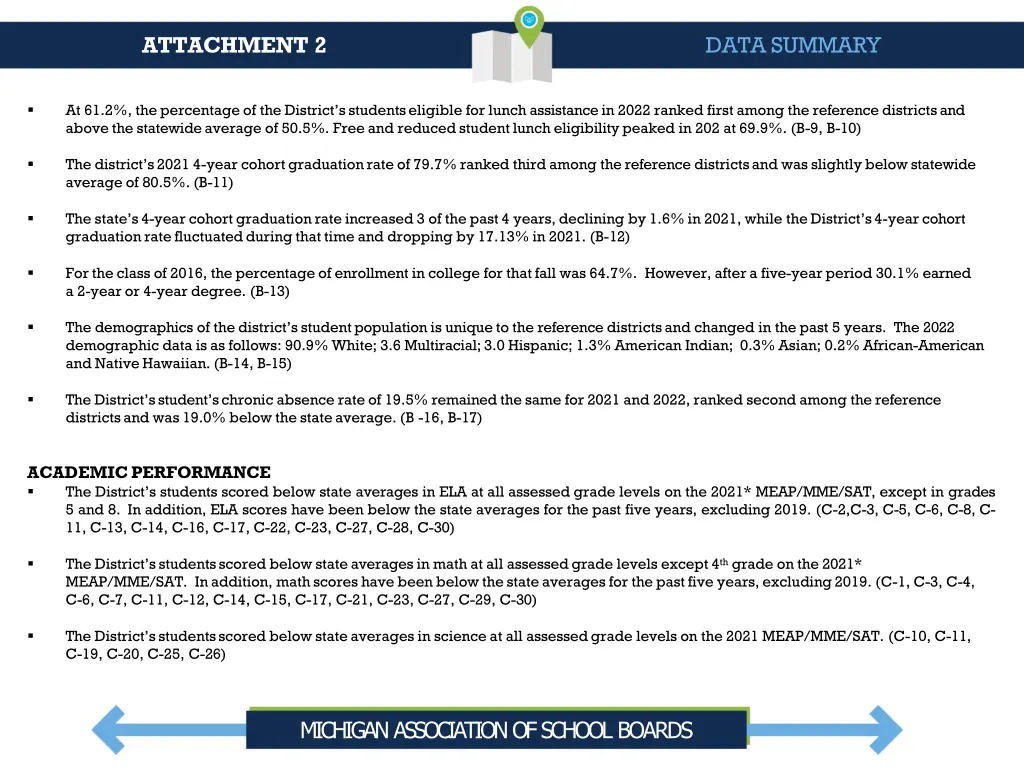
ATTACHMENT 2 DATA SUMMARY At 61.2%, the percentage of the District s students eligible for lunch assistance in 2022 ranked first among the reference districts and above the statewide average of 50.5%. Free and reduced student lunch eligibility peaked in 202 at 69.9%. (B-9, B-10) The district s 2021 4-year cohort graduation rate of 79.7% ranked third among the reference districts and was slightly below statewide average of 80.5%. (B-11) The state s 4-year cohort graduation rate increased 3 of the past 4 years, declining by 1.6% in 2021, while the District s 4-year cohort graduation rate fluctuated during that time and dropping by 17.13% in 2021. (B-12) For the class of 2016, the percentage of enrollment in college for that fall was 64.7%. However, after a five-year period 30.1% earned a 2-year or 4-year degree. (B-13) The demographics of the district s student population is unique to the reference districts and changed in the past 5 years. The 2022 demographic data is as follows: 90.9% White; 3.6 Multiracial; 3.0 Hispanic; 1.3% American Indian; 0.3% Asian; 0.2% African-American and Native Hawaiian. (B-14, B-15) The District sstudent s chronic absence rate of 19.5% remained the same for 2021 and 2022, ranked second among the reference districts and was 19.0% below the state average. (B -16, B-17) ACADEMIC PERFORMANCE The District s students scored below state averages in ELA at all assessed grade levels on the 2021* MEAP/MME/SAT, except in grades 5 and 8. In addition, ELA scores have been below the state averages for the past five years, excluding 2019. (C-2,C-3, C-5, C-6, C-8, C- 11, C-13, C-14, C-16, C-17, C-22, C-23, C-27, C-28, C-30) The District s students scored below state averages in math at all assessed grade levels except 4th grade on the 2021* MEAP/MME/SAT. In addition, math scores have been below the state averages for the past five years, excluding 2019. (C-1, C-3, C-4, C-6, C-7, C-11, C-12, C-14, C-15, C-17, C-21, C-23, C-27, C-29, C-30) The District s students scored below state averages in science at all assessed grade levels on the 2021 MEAP/MME/SAT. (C-10, C-11, C-19, C-20, C-25, C-26) MICHIGAN ASSOCIATION OF SCHOOL BOARDS
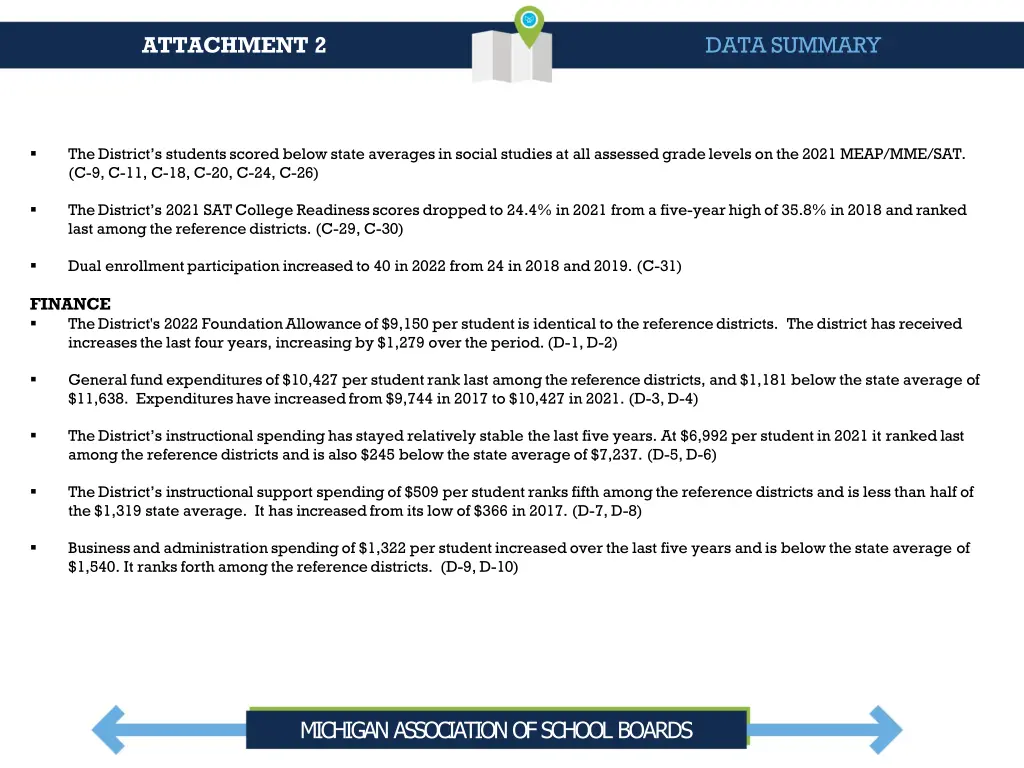
ATTACHMENT 2 DATA SUMMARY The District s students scored below state averages in social studies at all assessed grade levels on the 2021 MEAP/MME/SAT. (C-9, C-11, C-18, C-20, C-24, C-26) The District s 2021 SAT College Readiness scores dropped to 24.4% in 2021 from a five-year high of 35.8% in 2018 and ranked last among the reference districts. (C-29, C-30) Dual enrollment participation increased to 40 in 2022 from 24 in 2018 and 2019. (C-31) FINANCE The District's 2022 Foundation Allowance of $9,150 per student is identical to the reference districts. The district has received increases the last four years, increasing by $1,279 over the period. (D-1, D-2) General fund expenditures of $10,427 per student rank last among the reference districts, and $1,181 below the state average of $11,638. Expenditures have increased from $9,744 in 2017 to $10,427 in 2021. (D-3, D-4) The District s instructional spending has stayed relatively stable the last five years. At $6,992 per student in 2021 it ranked last among the reference districts and is also $245 below the state average of $7,237. (D-5, D-6) The District s instructional support spending of $509 per student ranks fifth among the reference districts and is less than half of the $1,319 state average. It has increased from its low of $366 in 2017. (D-7, D-8) Business and administration spending of $1,322 per student increased over the last five years and is below the state average of $1,540. It ranks forth among the reference districts. (D-9, D-10) MICHIGAN ASSOCIATION OF SCHOOL BOARDS
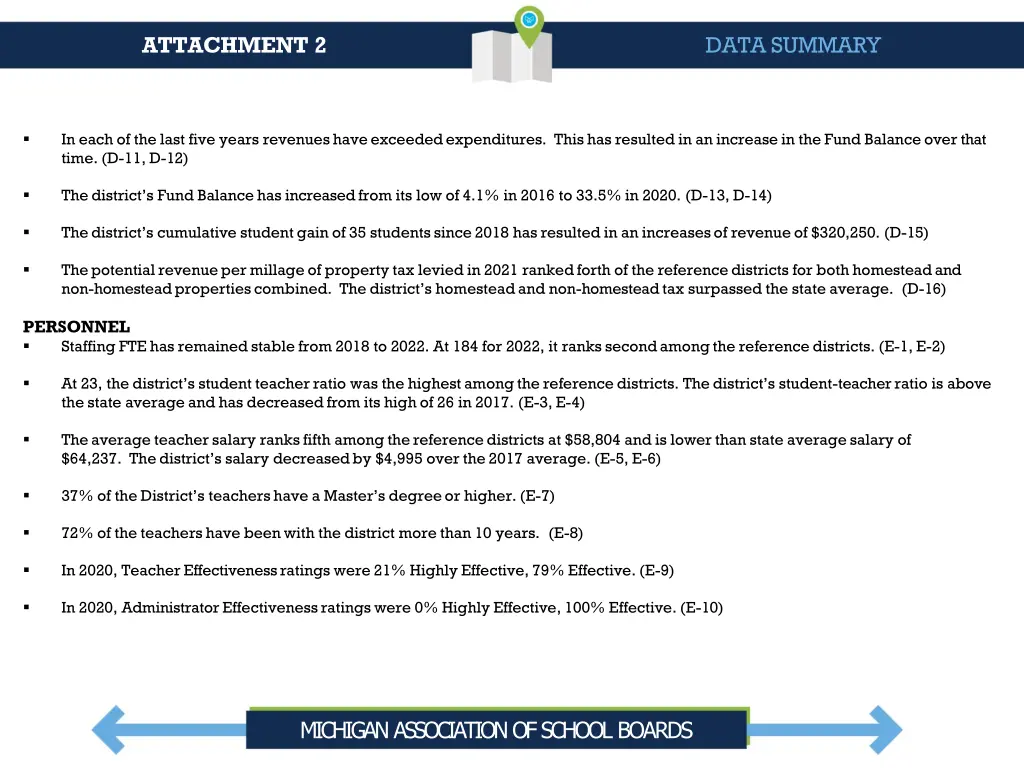
ATTACHMENT 2 DATA SUMMARY In each of the last five years revenues have exceeded expenditures. This has resulted in an increase in the Fund Balance over that time. (D-11, D-12) The district s Fund Balance has increased from its low of 4.1% in 2016 to 33.5% in 2020. (D-13, D-14) The district s cumulative student gain of 35 students since 2018 has resulted in an increases of revenue of $320,250. (D-15) The potential revenue per millage of property tax levied in 2021 ranked forth of the reference districts for both homestead and non-homestead properties combined. The district s homestead and non-homestead tax surpassed the state average. (D-16) PERSONNEL Staffing FTE has remained stable from 2018 to 2022. At 184 for 2022, it ranks second among the reference districts. (E-1, E-2) At 23, the district s student teacher ratio was the highest among the reference districts. The district s student-teacher ratio is above the state average and has decreased from its high of 26 in 2017. (E-3, E-4) The average teacher salary ranks fifth among the reference districts at $58,804 and is lower than state average salary of $64,237. The district s salary decreased by $4,995 over the 2017 average. (E-5, E-6) 37% of the District s teachers have a Master s degree or higher. (E-7) 72% of the teachers have been with the district more than 10 years. (E-8) In 2020, Teacher Effectiveness ratings were 21% Highly Effective, 79% Effective. (E-9) In 2020, Administrator Effectiveness ratings were 0% Highly Effective, 100% Effective. (E-10) MICHIGAN ASSOCIATION OF SCHOOL BOARDS
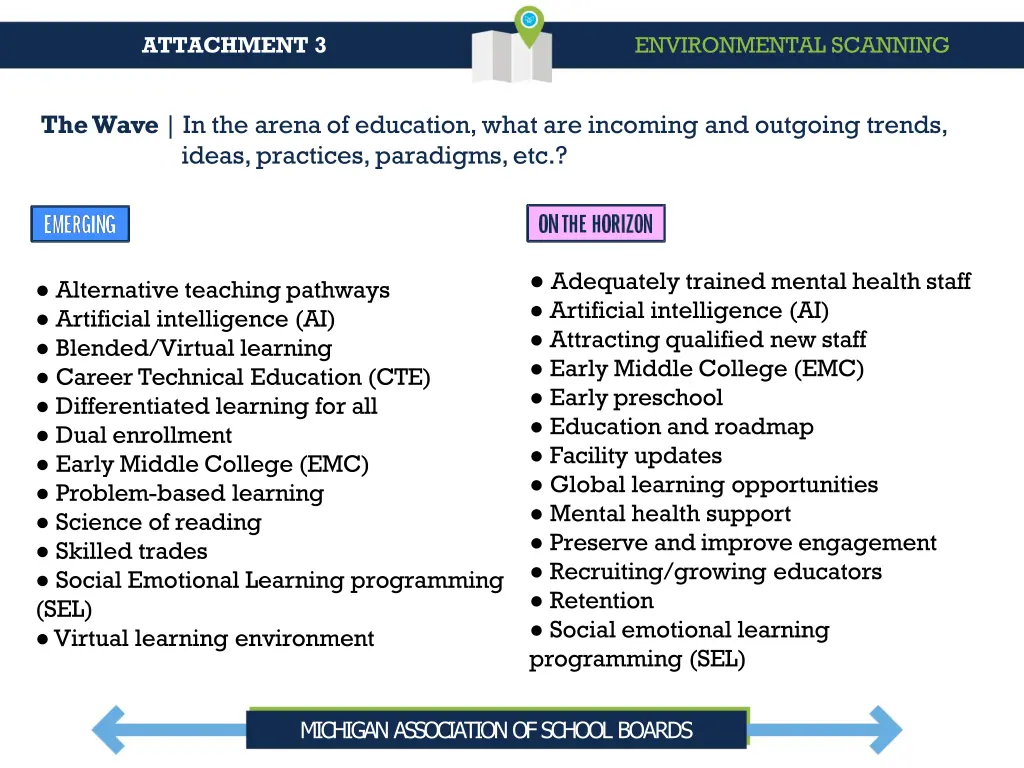
ATTACHMENT 3 ENVIRONMENTAL SCANNING The Wave | In the arena of education, what are incoming and outgoing trends, ideas, practices, paradigms, etc.? Adequately trained mental health staff Artificial intelligence (AI) Attracting qualified new staff Early Middle College (EMC) Early preschool Education and roadmap Facility updates Global learning opportunities Mental health support Preserve and improve engagement Recruiting/growing educators Retention Social emotional learning programming (SEL) Alternative teaching pathways Artificial intelligence (AI) Blended/Virtual learning Career Technical Education (CTE) Differentiated learning for all Dual enrollment Early Middle College (EMC) Problem-based learning Science of reading Skilled trades Social Emotional Learning programming (SEL) Virtual learning environment MICHIGAN ASSOCIATION OF SCHOOL BOARDS
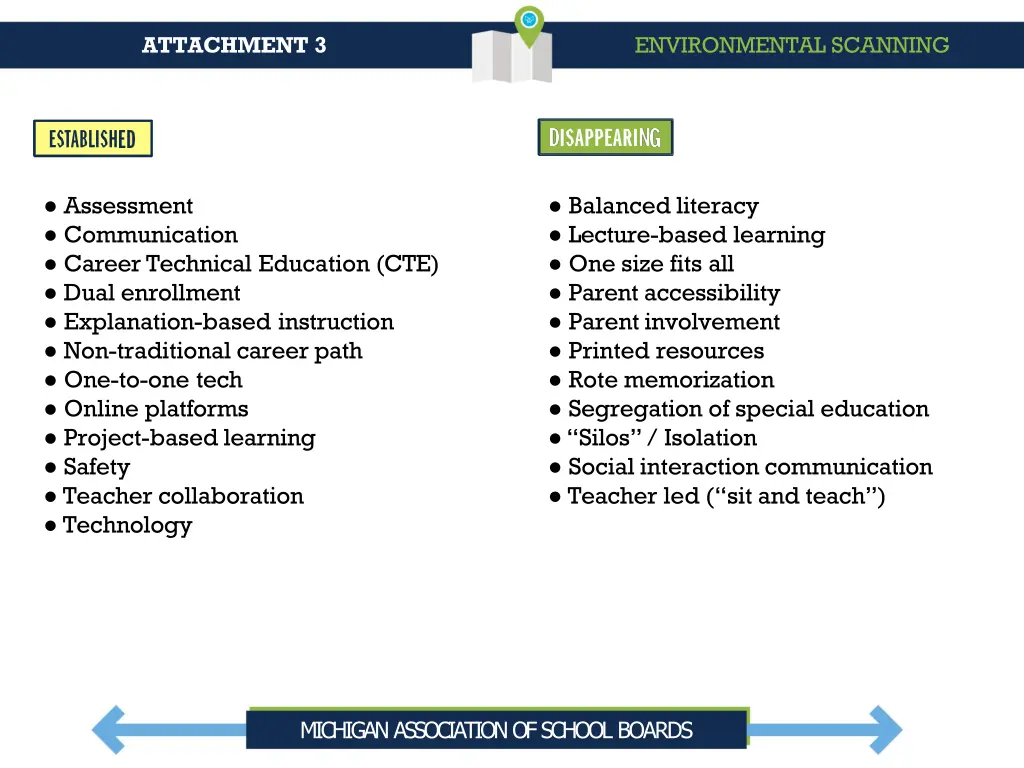
ATTACHMENT 3 ENVIRONMENTAL SCANNING Assessment Communication Career Technical Education (CTE) Dual enrollment Explanation-based instruction Non-traditional career path One-to-one tech Online platforms Project-based learning Safety Teacher collaboration Technology Balanced literacy Lecture-based learning One size fits all Parent accessibility Parent involvement Printed resources Rote memorization Segregation of special education Silos / Isolation Social interaction communication Teacher led ( sit and teach ) MICHIGAN ASSOCIATION OF SCHOOL BOARDS
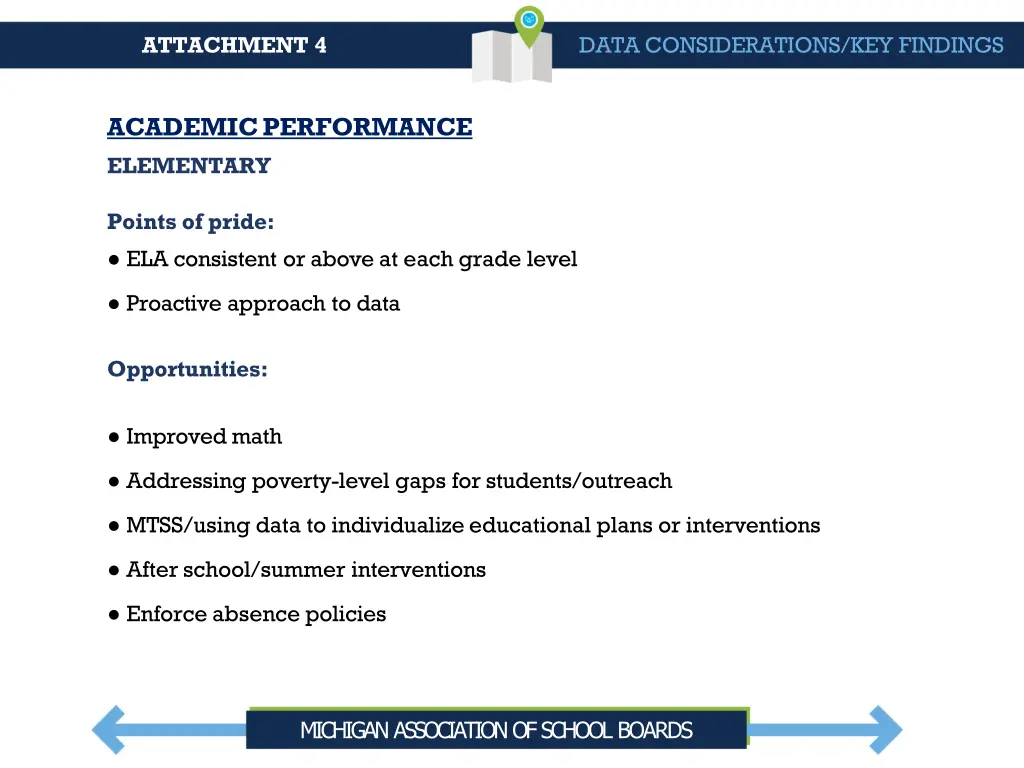
ATTACHMENT 4 DATA CONSIDERATIONS/KEY FINDINGS ACADEMIC PERFORMANCE ELEMENTARY Points of pride: ELA consistent or above at each grade level Proactive approach to data Opportunities: Improved math Addressing poverty-level gaps for students/outreach MTSS/using data to individualize educational plans or interventions After school/summer interventions Enforce absence policies MICHIGAN ASSOCIATION OF SCHOOL BOARDS
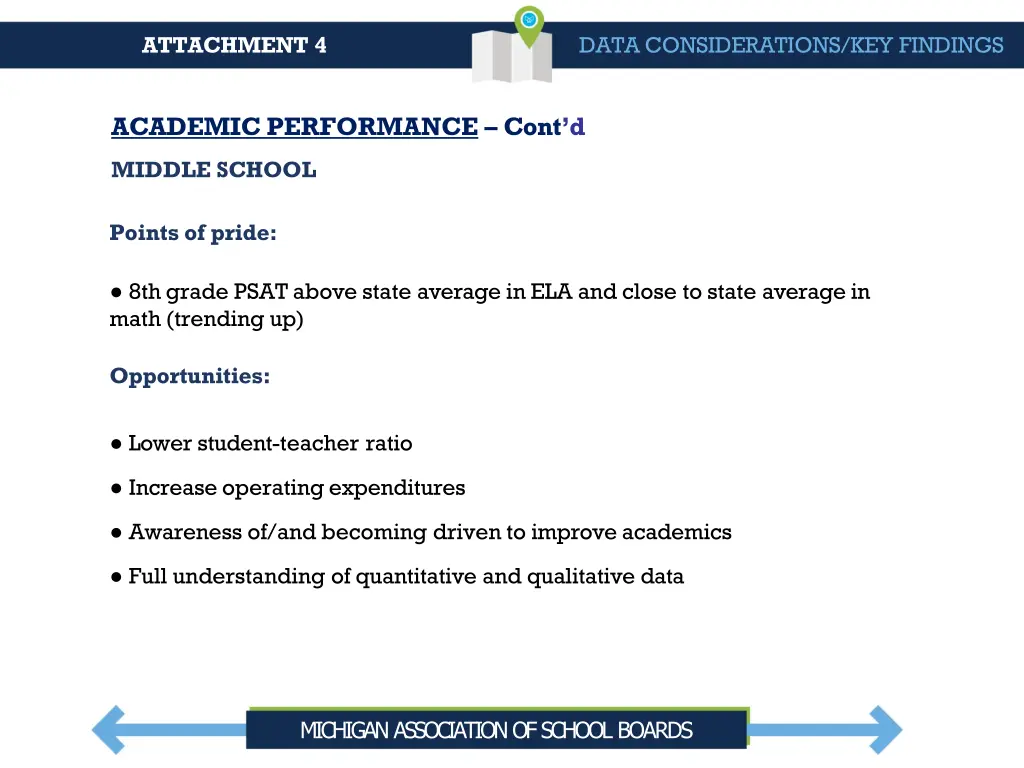
ATTACHMENT 4 DATA CONSIDERATIONS/KEY FINDINGS ACADEMIC PERFORMANCE Cont d MIDDLE SCHOOL Points of pride: 8th grade PSAT above state average in ELA and close to state average in math (trending up) Opportunities: Lower student-teacher ratio Increase operating expenditures Awareness of/and becoming driven to improve academics Full understanding of quantitative and qualitative data MICHIGAN ASSOCIATION OF SCHOOL BOARDS
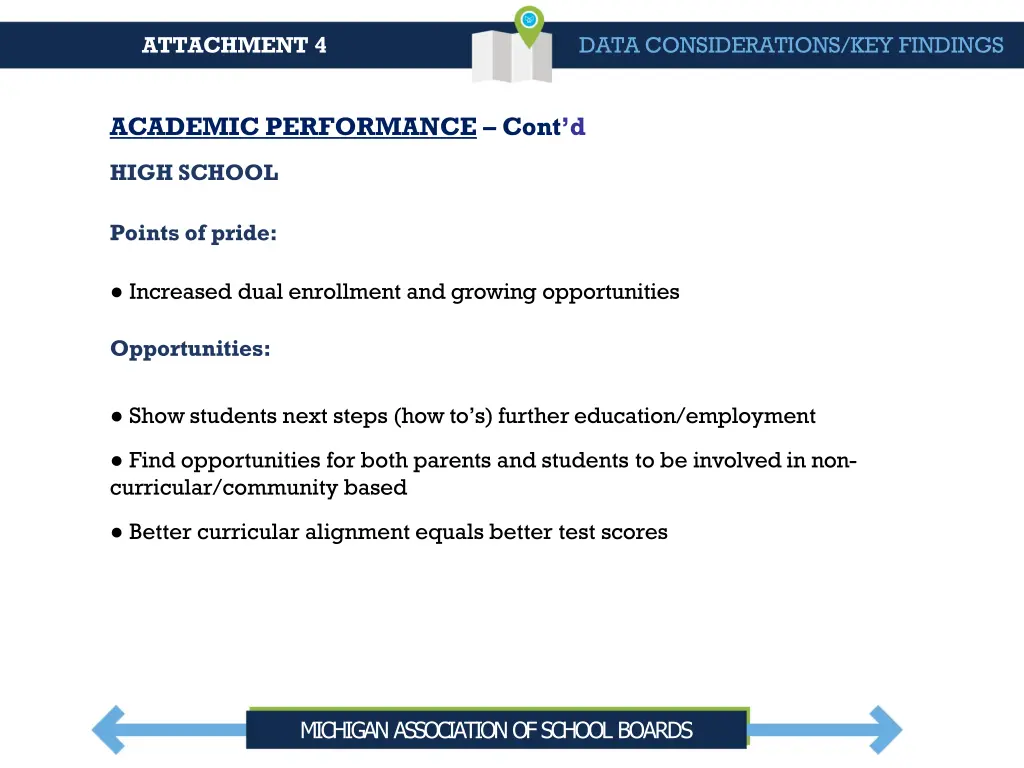
ATTACHMENT 4 DATA CONSIDERATIONS/KEY FINDINGS ACADEMIC PERFORMANCE Cont d HIGH SCHOOL Points of pride: Increased dual enrollment and growing opportunities Opportunities: Show students next steps (how to s) further education/employment Find opportunities for both parents and students to be involved in non- curricular/community based Better curricular alignment equals better test scores MICHIGAN ASSOCIATION OF SCHOOL BOARDS
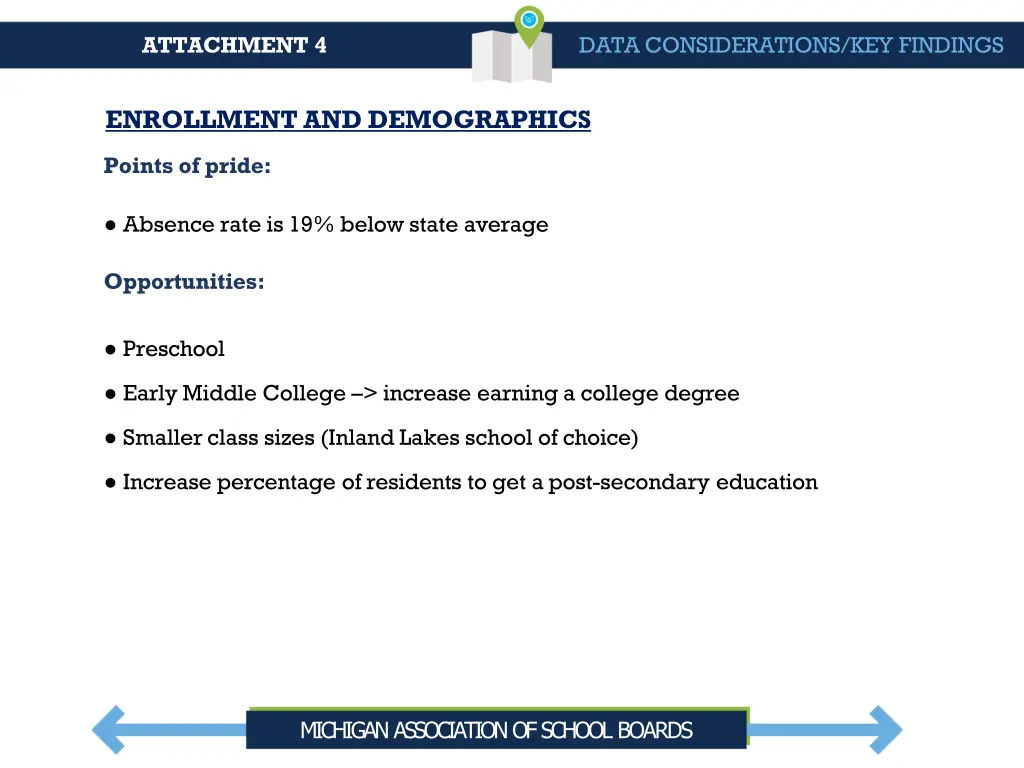
ATTACHMENT 4 DATA CONSIDERATIONS/KEY FINDINGS ENROLLMENT AND DEMOGRAPHICS Points of pride: Absence rate is 19% below state average Opportunities: Preschool Early Middle College > increase earning a college degree Smaller class sizes (Inland Lakes school of choice) Increase percentage of residents to get a post-secondary education MICHIGAN ASSOCIATION OF SCHOOL BOARDS
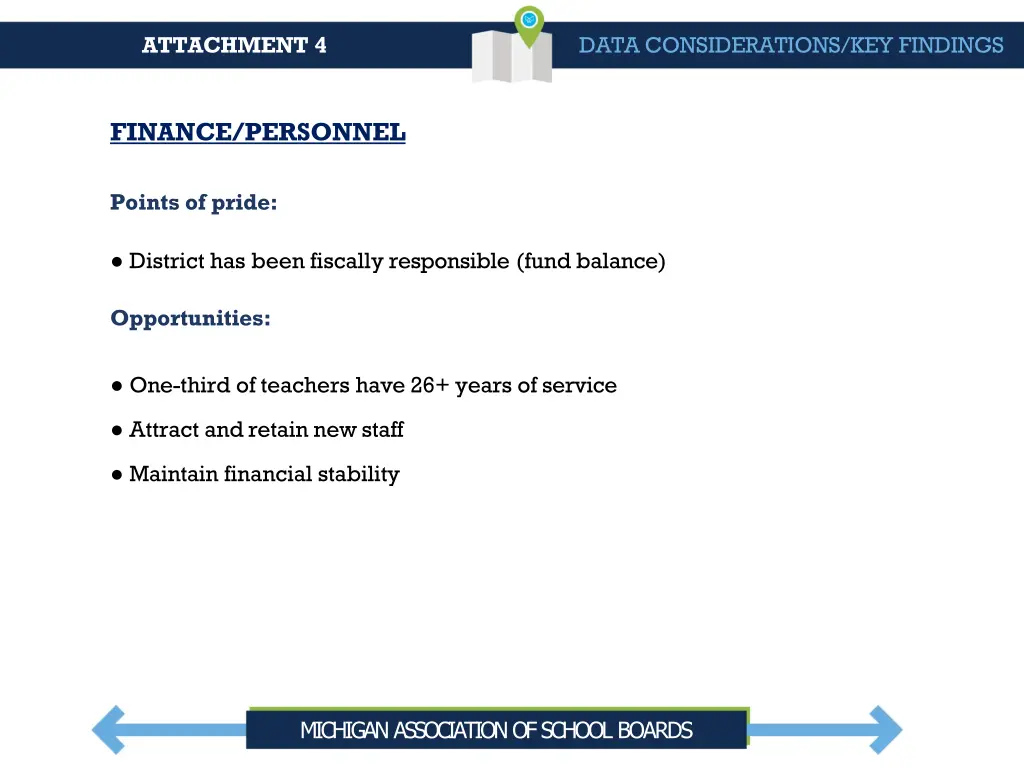
ATTACHMENT 4 DATA CONSIDERATIONS/KEY FINDINGS FINANCE/PERSONNEL Points of pride: District has been fiscally responsible (fund balance) Opportunities: One-third of teachers have 26+ years of service Attract and retain new staff Maintain financial stability MICHIGAN ASSOCIATION OF SCHOOL BOARDS
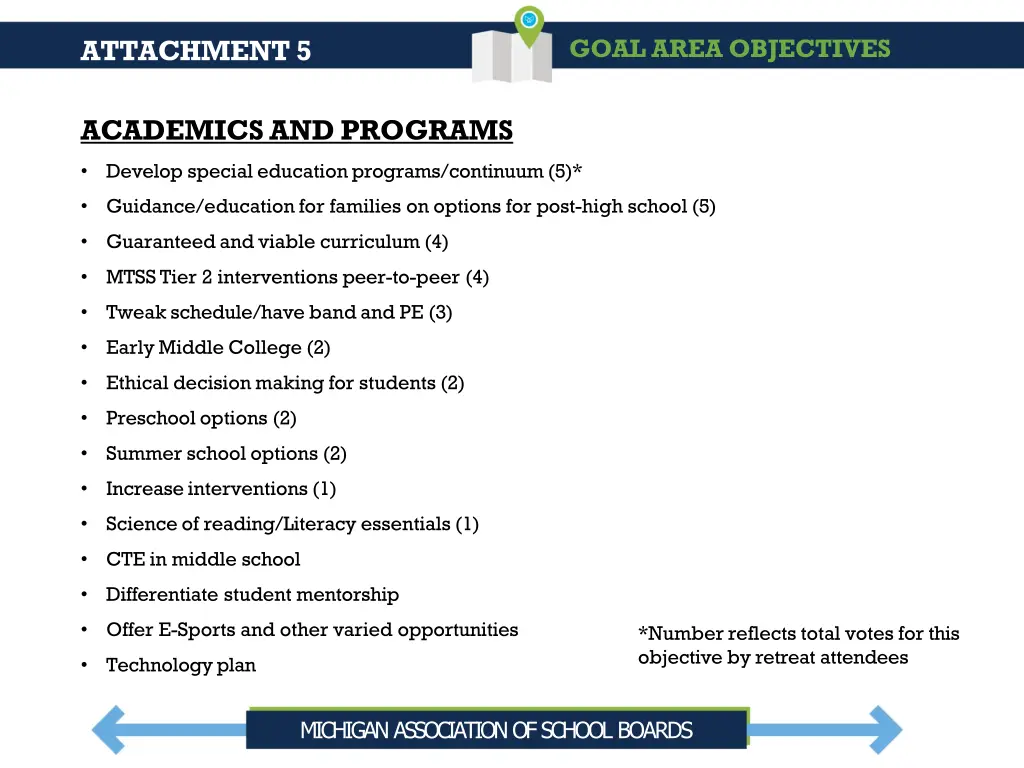
GOAL AREA OBJECTIVES ATTACHMENT 5 ACADEMICS AND PROGRAMS Develop special education programs/continuum (5)* Guidance/education for families on options for post-high school (5) Guaranteed and viable curriculum (4) MTSS Tier 2 interventions peer-to-peer (4) Tweak schedule/have band and PE (3) Early Middle College (2) Ethical decision making for students (2) Preschool options (2) Summer school options (2) Increase interventions (1) Science of reading/Literacy essentials (1) CTE in middle school Differentiate student mentorship Offer E-Sports and other varied opportunities *Number reflects total votes for this objective by retreat attendees Technology plan MICHIGAN ASSOCIATION OF SCHOOL BOARDS
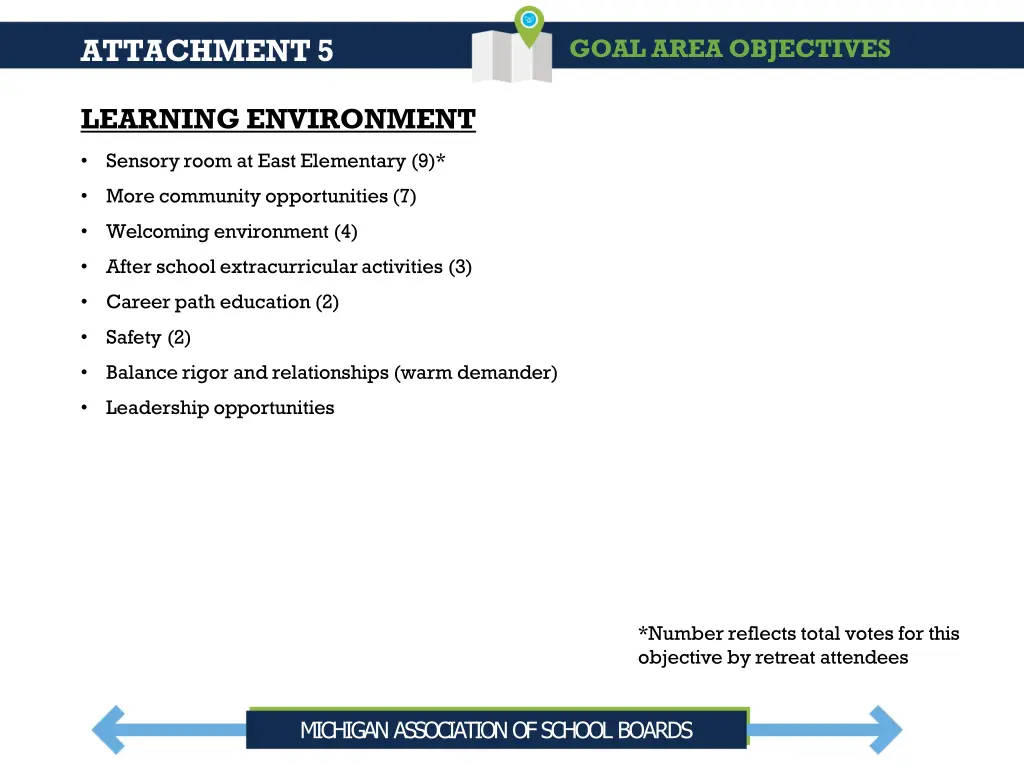
ATTACHMENT 5 GOAL AREA OBJECTIVES LEARNING ENVIRONMENT Sensory room at East Elementary (9)* More community opportunities (7) Welcoming environment (4) After school extracurricular activities (3) Career path education (2) Safety (2) Balance rigor and relationships (warm demander) Leadership opportunities *Number reflects total votes for this objective by retreat attendees MICHIGAN ASSOCIATION OF SCHOOL BOARDS
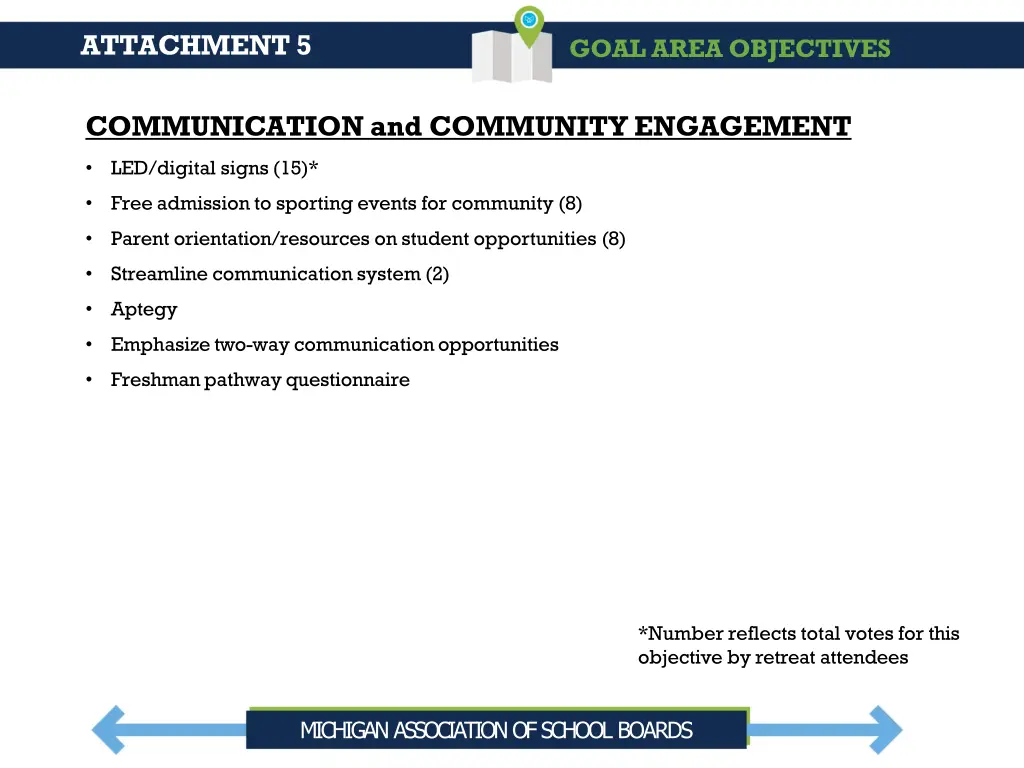
ATTACHMENT 5 GOAL AREA OBJECTIVES COMMUNICATION and COMMUNITY ENGAGEMENT LED/digital signs (15)* Free admission to sporting events for community (8) Parent orientation/resources on student opportunities (8) Streamline communication system (2) Aptegy Emphasize two-way communication opportunities Freshman pathway questionnaire *Number reflects total votes for this objective by retreat attendees MICHIGAN ASSOCIATION OF SCHOOL BOARDS
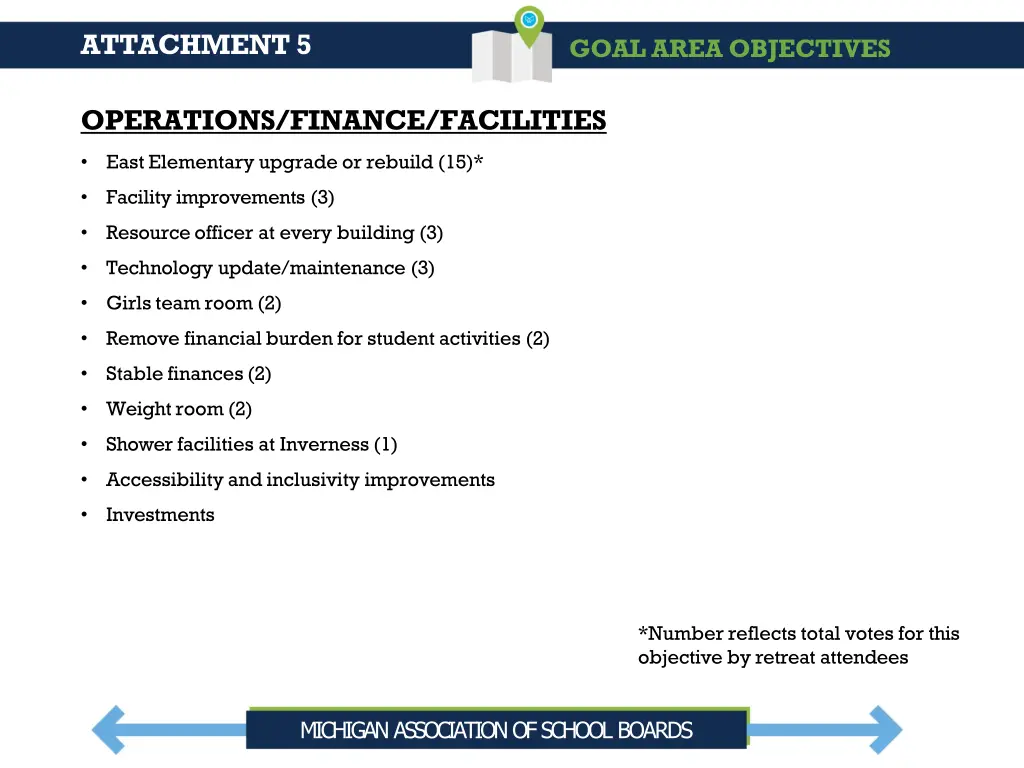
ATTACHMENT 5 GOAL AREA OBJECTIVES OPERATIONS/FINANCE/FACILITIES East Elementary upgrade or rebuild (15)* Facility improvements (3) Resource officer at every building (3) Technology update/maintenance (3) Girls team room (2) Remove financial burden for student activities (2) Stable finances (2) Weight room (2) Shower facilities at Inverness (1) Accessibility and inclusivity improvements Investments *Number reflects total votes for this objective by retreat attendees MICHIGAN ASSOCIATION OF SCHOOL BOARDS
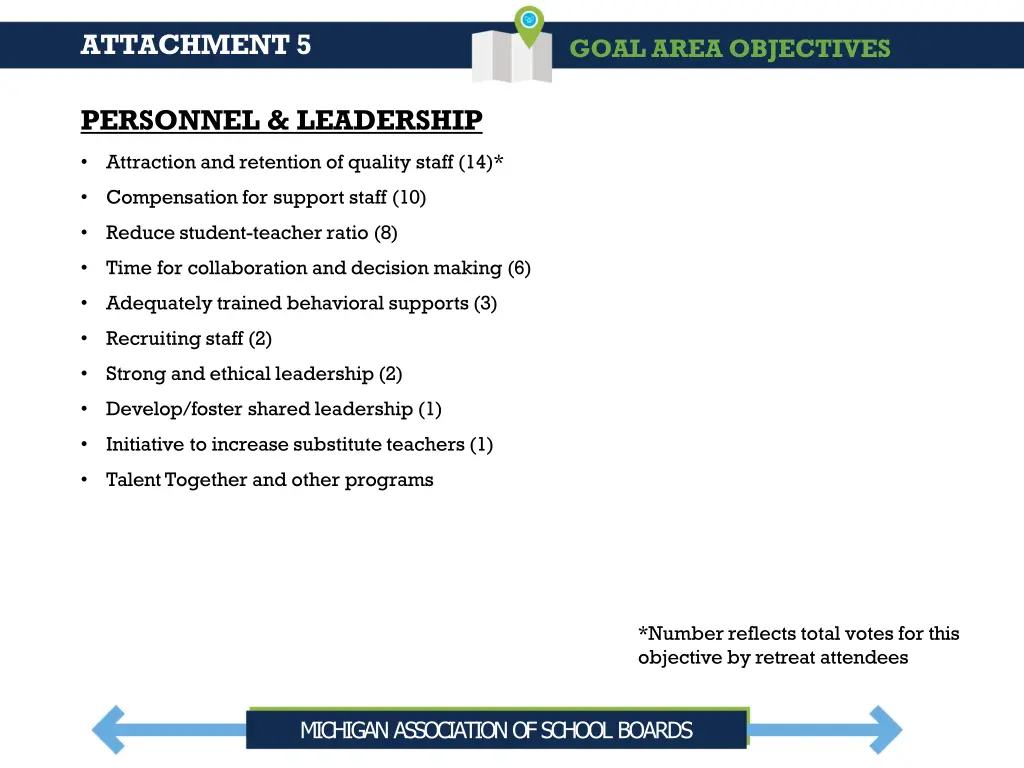
ATTACHMENT 5 GOAL AREA OBJECTIVES PERSONNEL & LEADERSHIP Attraction and retention of quality staff (14)* Compensation for support staff (10) Reduce student-teacher ratio (8) Time for collaboration and decision making (6) Adequately trained behavioral supports (3) Recruiting staff (2) Strong and ethical leadership (2) Develop/foster shared leadership (1) Initiative to increase substitute teachers (1) Talent Together and other programs *Number reflects total votes for this objective by retreat attendees MICHIGAN ASSOCIATION OF SCHOOL BOARDS