Get ready for your chemistry exam with a comprehensive review covering equilibrium, kinetics, and manipulation of reaction values. Find out essential advice for multiple-choice questions, calculations, and how to approach different question types effectively. Prepare for Exam #1 with a detailed breakdown of key topics and concepts to master for success.
Please find below an Image/Link to download the presentation.
The content on the website is provided AS IS for your information and personal use only. It may not be sold, licensed, or shared on other websites without obtaining consent from the author. If you encounter any issues during the download, it is possible that the publisher has removed the file from their server.
You are allowed to download the files provided on this website for personal or commercial use, subject to the condition that they are used lawfully. All files are the property of their respective owners.
The content on the website is provided AS IS for your information and personal use only. It may not be sold, licensed, or shared on other websites without obtaining consent from the author.
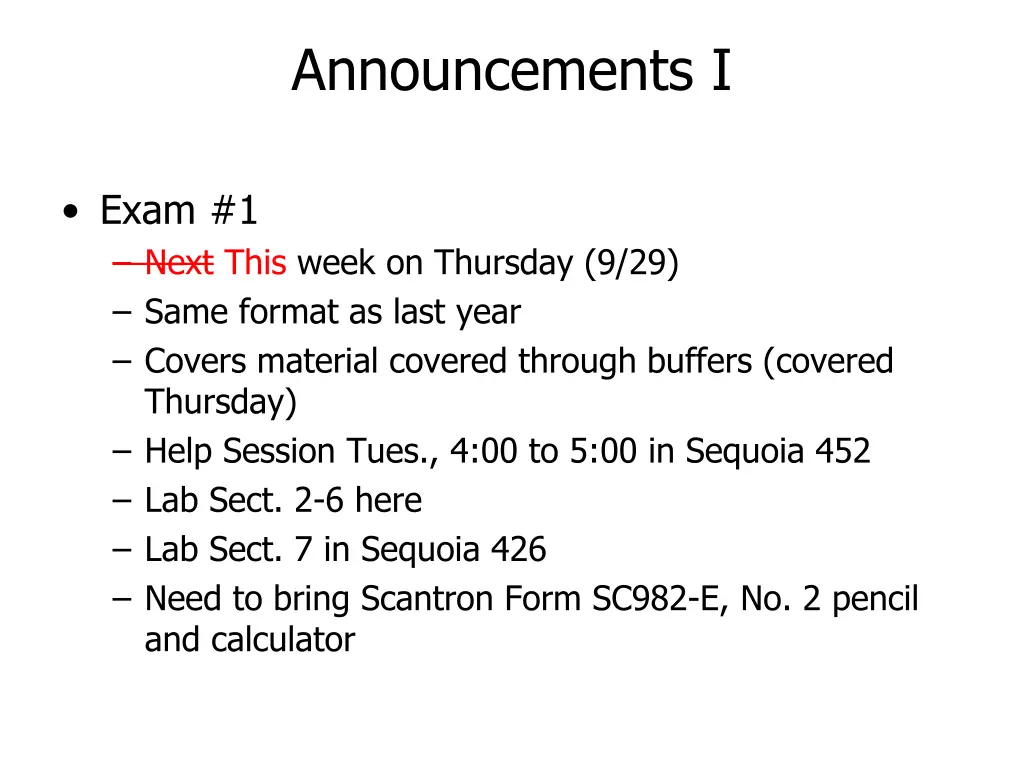
Announcements I Exam #1 Next This week on Thursday (9/29) Same format as last year Covers material covered through buffers (covered Thursday) Help Session Tues., 4:00 to 5:00 in Sequoia 452 Lab Sect. 2-6 here Lab Sect. 7 in Sequoia 426 Need to bring Scantron Form SC982-E, No. 2 pencil and calculator
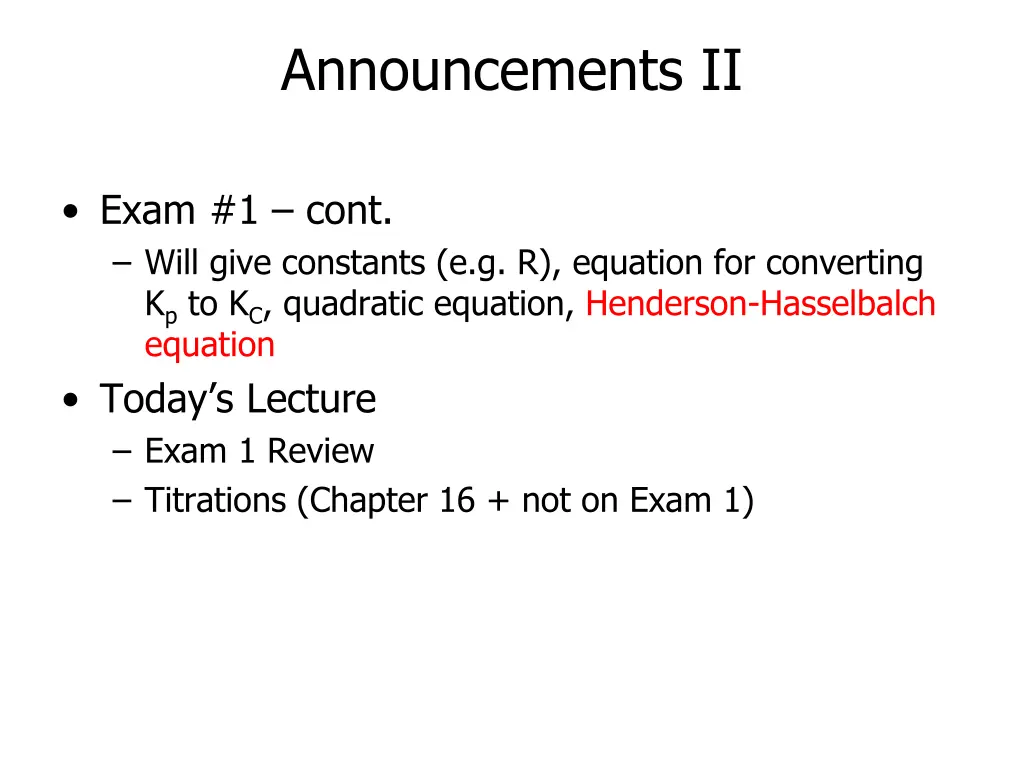
Announcements II Exam #1 cont. Will give constants (e.g. R), equation for converting Kpto KC, quadratic equation, Henderson-Hasselbalch equation Today s Lecture Exam 1 Review Titrations (Chapter 16 + not on Exam 1)
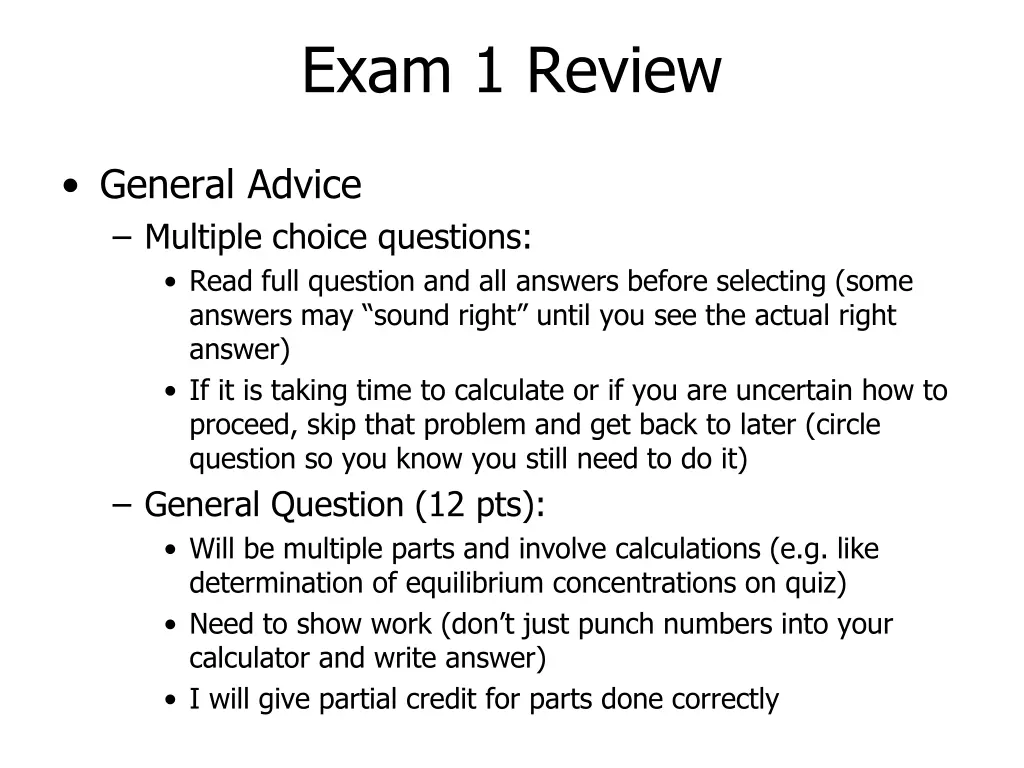
Exam 1 Review General Advice Multiple choice questions: Read full question and all answers before selecting (some answers may sound right until you see the actual right answer) If it is taking time to calculate or if you are uncertain how to proceed, skip that problem and get back to later (circle question so you know you still need to do it) General Question (12 pts): Will be multiple parts and involve calculations (e.g. like determination of equilibrium concentrations on quiz) Need to show work (don t just punch numbers into your calculator and write answer) I will give partial credit for parts done correctly
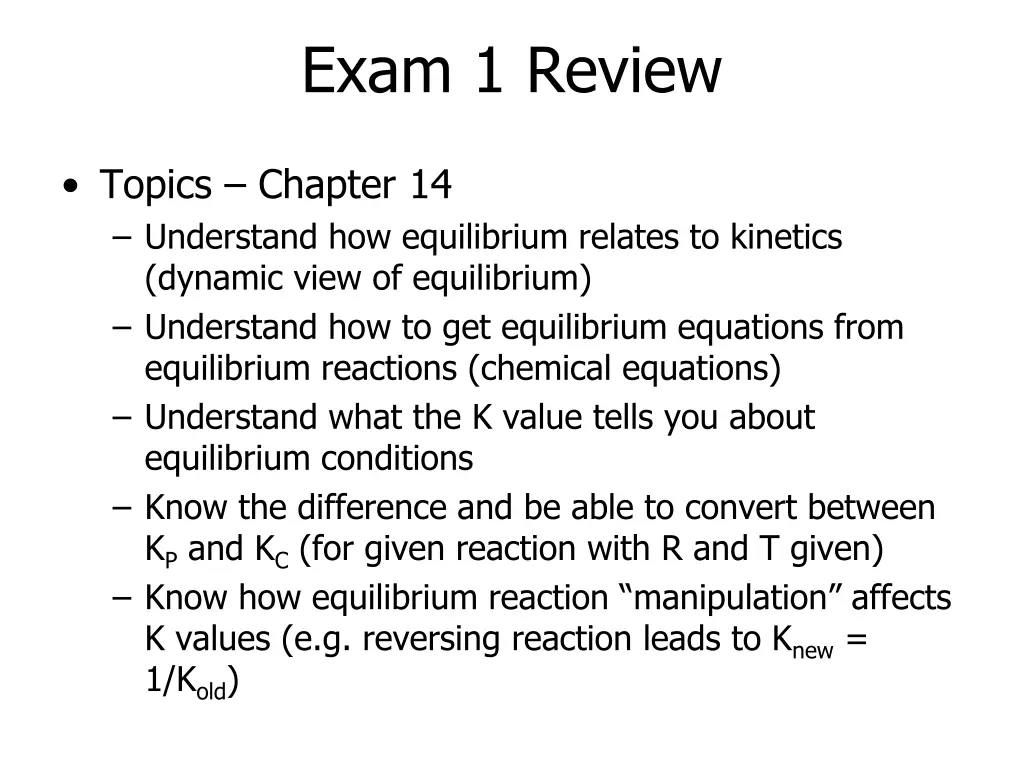
Exam 1 Review Topics Chapter 14 Understand how equilibrium relates to kinetics (dynamic view of equilibrium) Understand how to get equilibrium equations from equilibrium reactions (chemical equations) Understand what the K value tells you about equilibrium conditions Know the difference and be able to convert between KPand KC(for given reaction with R and T given) Know how equilibrium reaction manipulation affects K values (e.g. reversing reaction leads to Knew= 1/Kold)
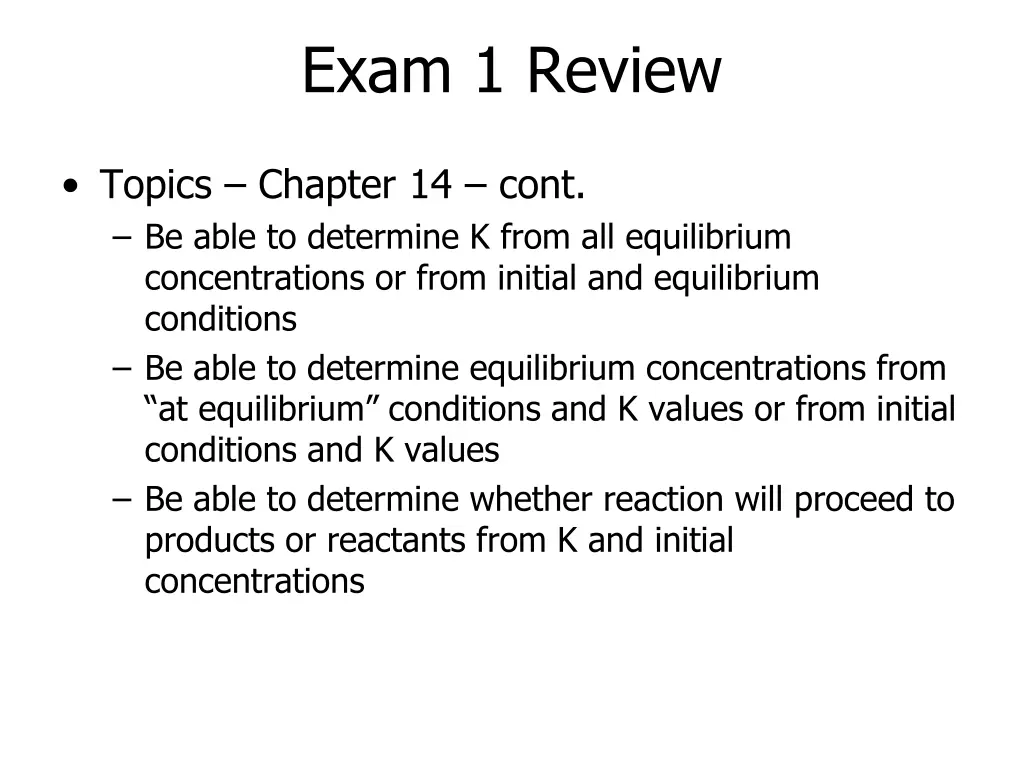
Exam 1 Review Topics Chapter 14 cont. Be able to determine K from all equilibrium concentrations or from initial and equilibrium conditions Be able to determine equilibrium concentrations from at equilibrium conditions and K values or from initial conditions and K values Be able to determine whether reaction will proceed to products or reactants from K and initial concentrations
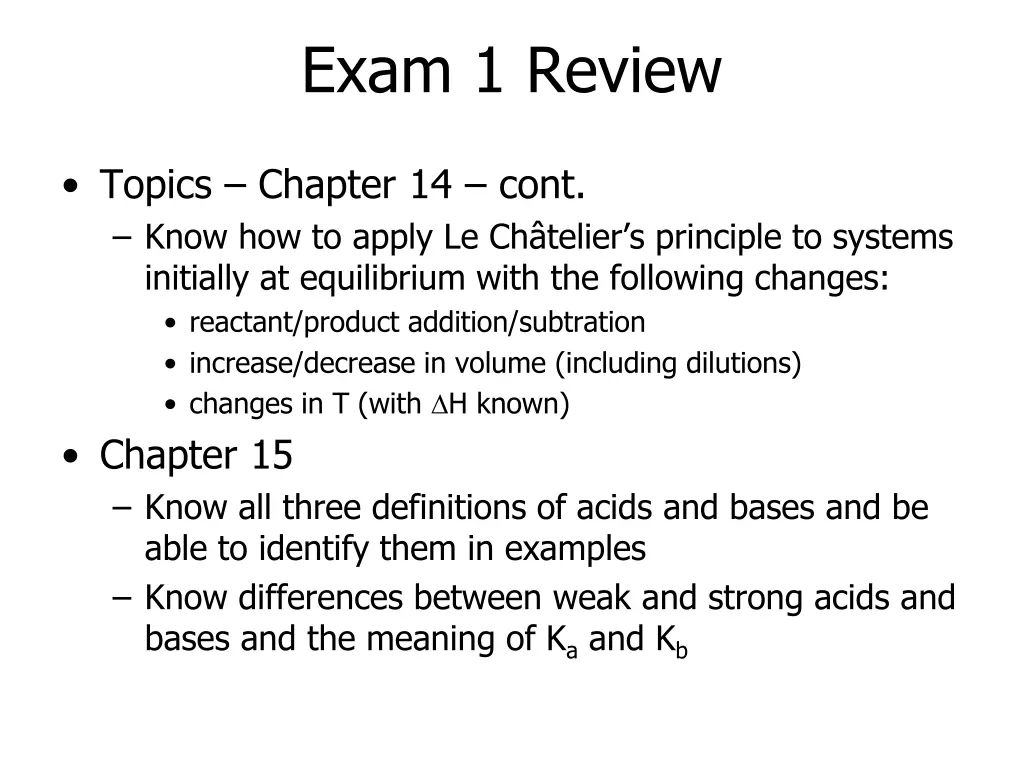
Exam 1 Review Topics Chapter 14 cont. Know how to apply Le Ch telier s principle to systems initially at equilibrium with the following changes: reactant/product addition/subtration increase/decrease in volume (including dilutions) changes in T (with H known) Chapter 15 Know all three definitions of acids and bases and be able to identify them in examples Know differences between weak and strong acids and bases and the meaning of Kaand Kb
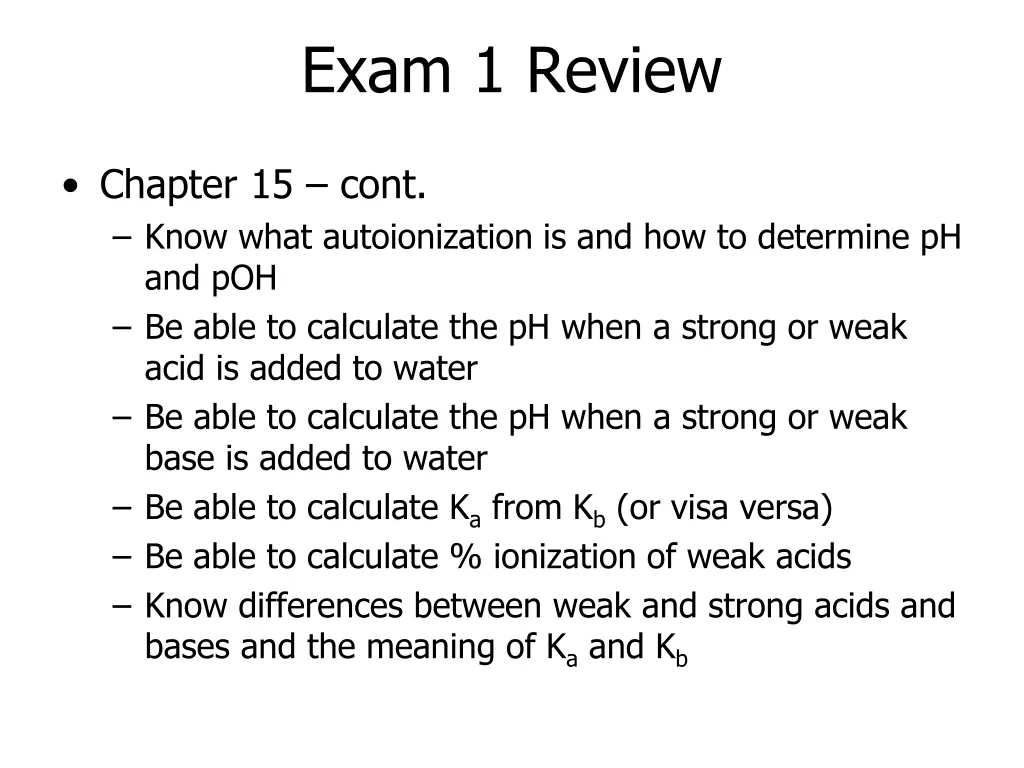
Exam 1 Review Chapter 15 cont. Know what autoionization is and how to determine pH and pOH Be able to calculate the pH when a strong or weak acid is added to water Be able to calculate the pH when a strong or weak base is added to water Be able to calculate Kafrom Kb(or visa versa) Be able to calculate % ionization of weak acids Know differences between weak and strong acids and bases and the meaning of Kaand Kb
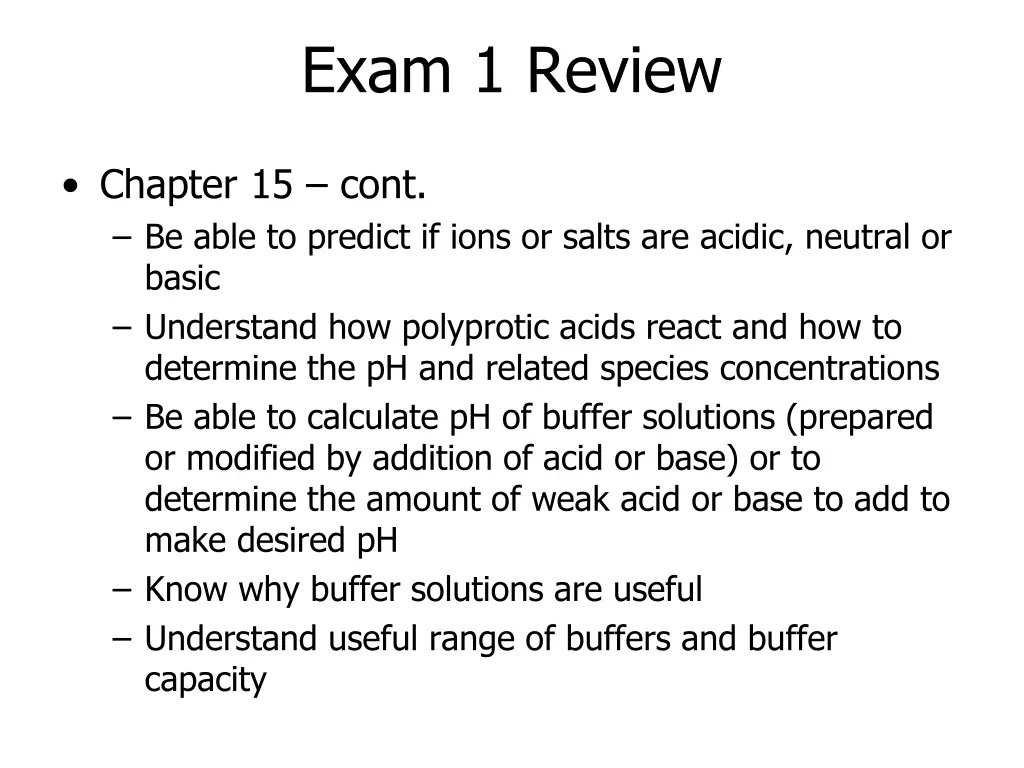
Exam 1 Review Chapter 15 cont. Be able to predict if ions or salts are acidic, neutral or basic Understand how polyprotic acids react and how to determine the pH and related species concentrations Be able to calculate pH of buffer solutions (prepared or modified by addition of acid or base) or to determine the amount of weak acid or base to add to make desired pH Know why buffer solutions are useful Understand useful range of buffers and buffer capacity
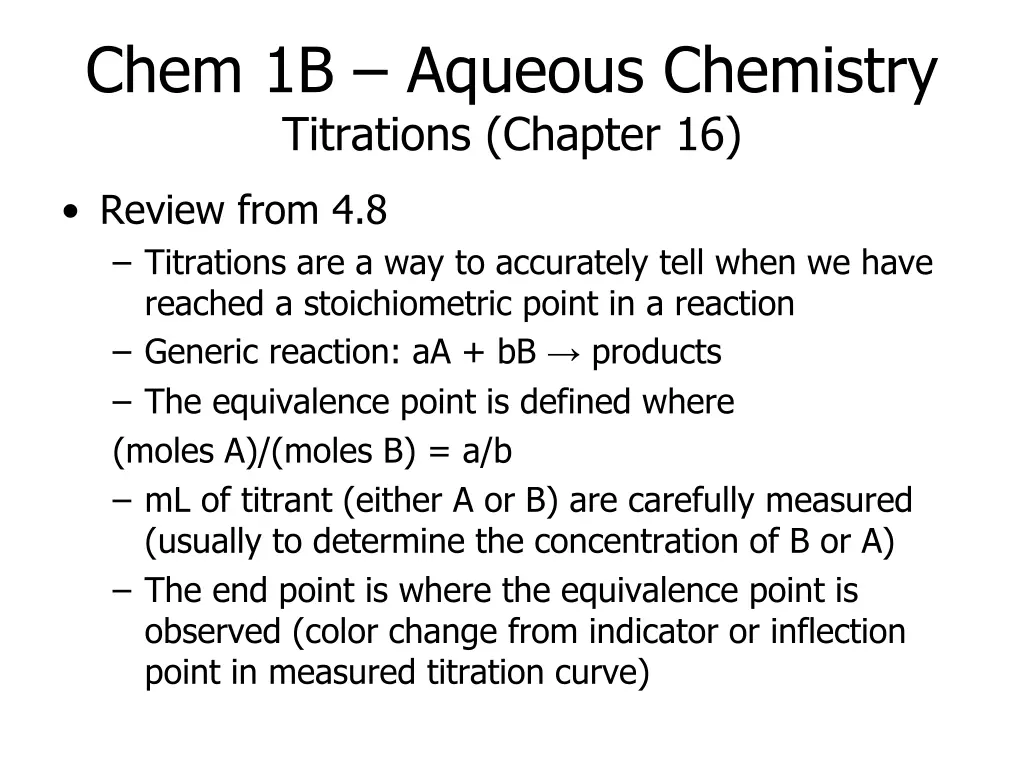
Chem 1B Aqueous Chemistry Titrations (Chapter 16) Review from 4.8 Titrations are a way to accurately tell when we have reached a stoichiometric point in a reaction Generic reaction: aA + bB products The equivalence point is defined where (moles A)/(moles B) = a/b mL of titrant (either A or B) are carefully measured (usually to determine the concentration of B or A) The end point is where the equivalence point is observed (color change from indicator or inflection point in measured titration curve)
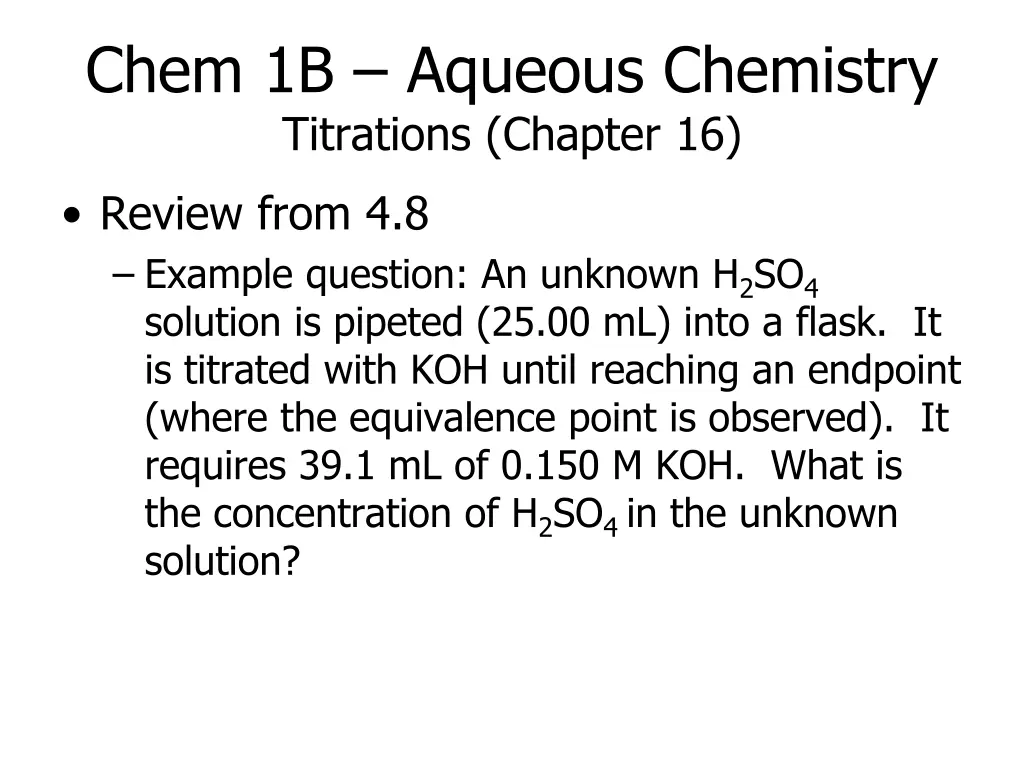
Chem 1B Aqueous Chemistry Titrations (Chapter 16) Review from 4.8 Example question: An unknown H2SO4 solution is pipeted (25.00 mL) into a flask. It is titrated with KOH until reaching an endpoint (where the equivalence point is observed). It requires 39.1 mL of 0.150 M KOH. What is the concentration of H2SO4 in the unknown solution?
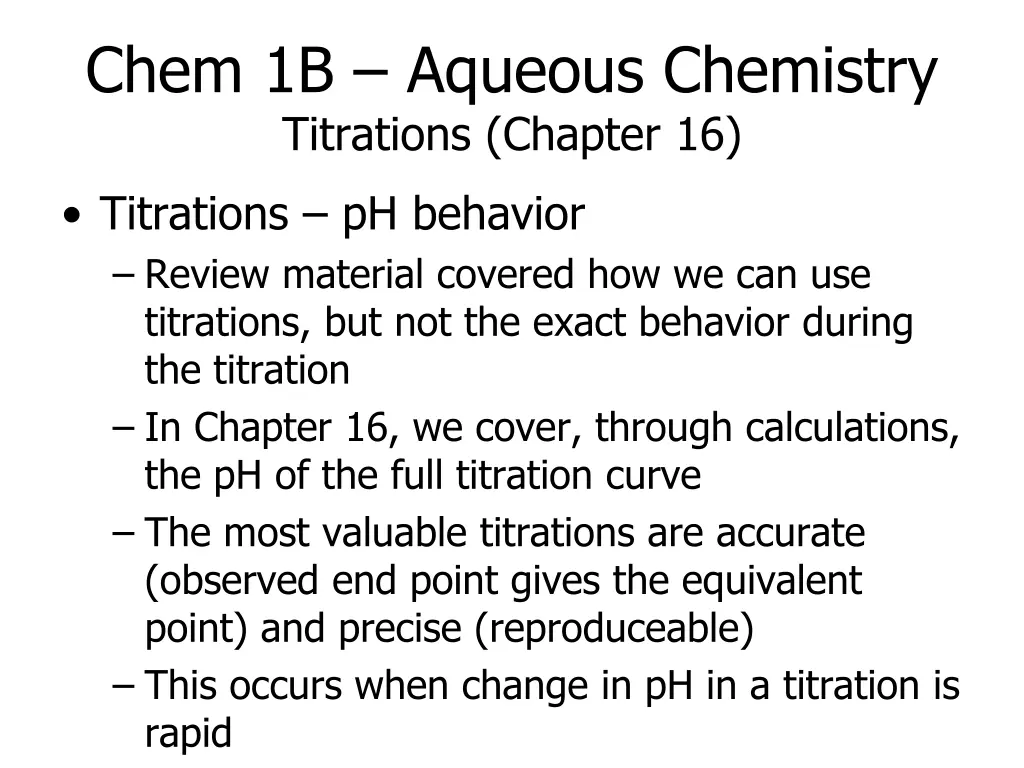
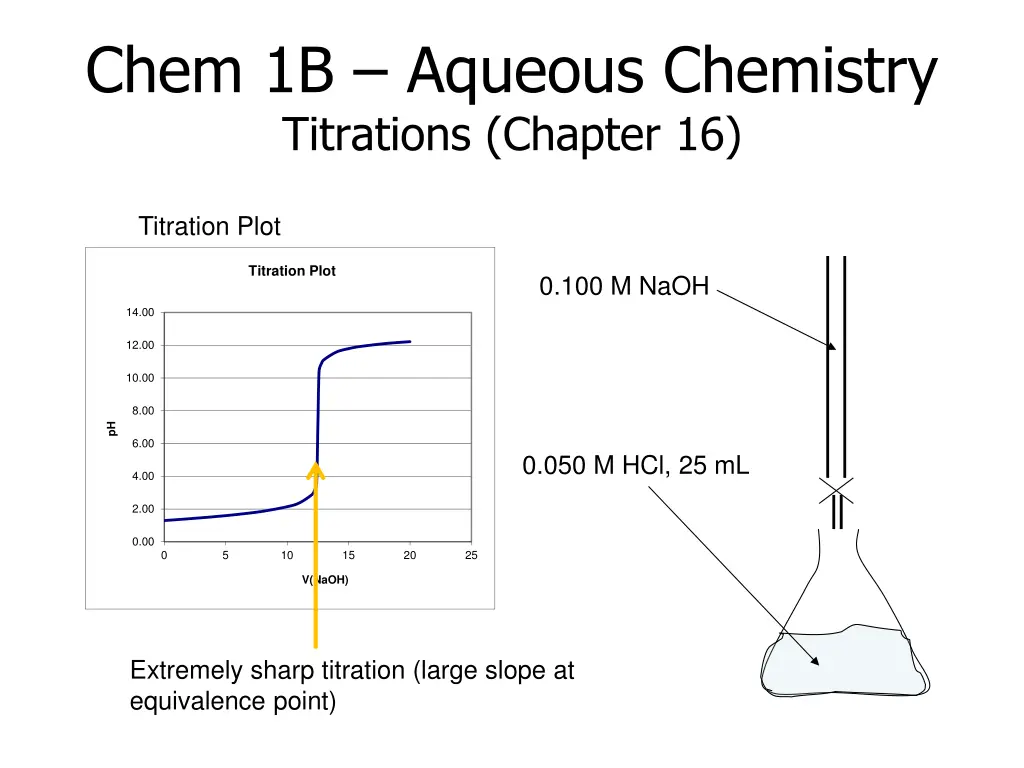
Chem 1B Aqueous Chemistry Titrations (Chapter 16) Titrations pH behavior Review material covered how we can use titrations, but not the exact behavior during the titration In Chapter 16, we cover, through calculations, the pH of the full titration curve The most valuable titrations are accurate (observed end point gives the equivalent point) and precise (reproduceable) This occurs when change in pH in a titration is rapid
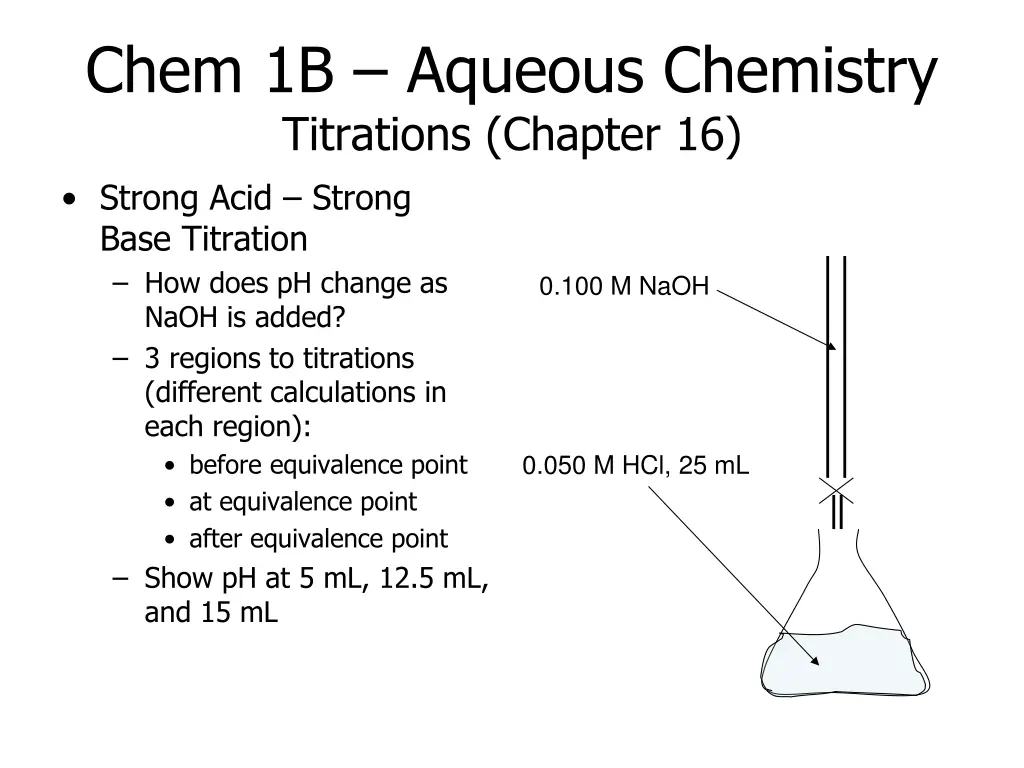
Chem 1B Aqueous Chemistry Titrations (Chapter 16) Strong Acid Strong Base Titration How does pH change as NaOH is added? 3 regions to titrations (different calculations in each region): before equivalence point at equivalence point after equivalence point Show pH at 5 mL, 12.5 mL, and 15 mL 0.100 M NaOH 0.050 M HCl, 25 mL
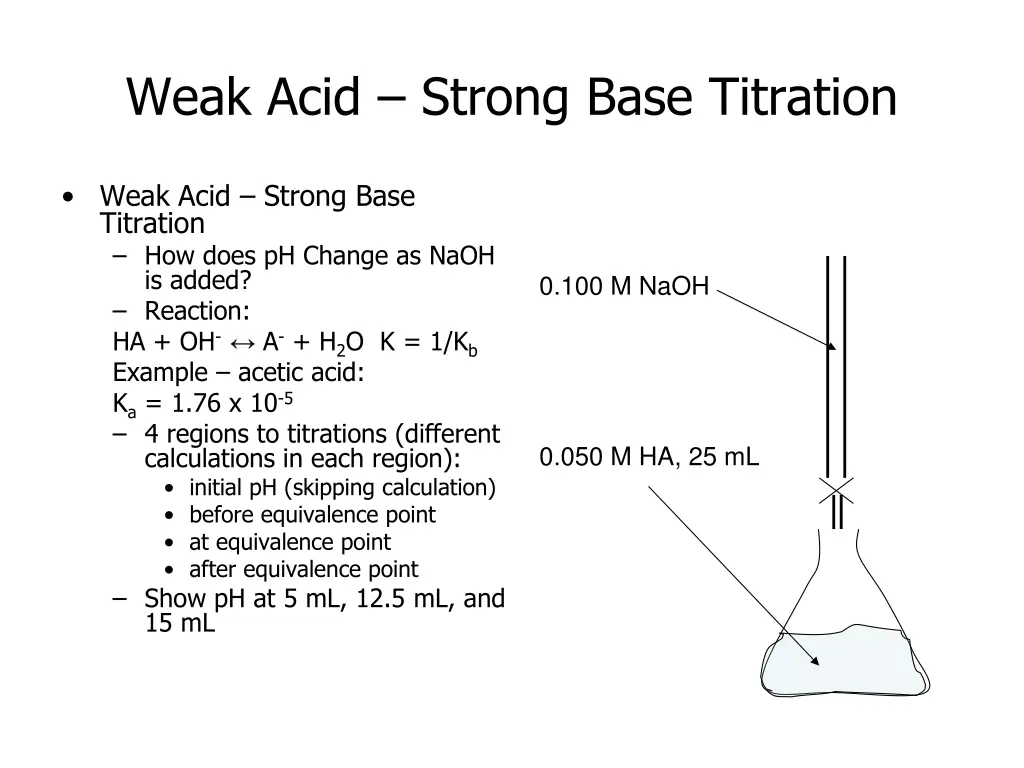
Weak Acid Strong Base Titration Weak Acid Strong Base Titration How does pH Change as NaOH is added? Reaction: HA + OH- A- + H2O K = 1/Kb Example acetic acid: Ka = 1.76 x 10⁻⁵ 4 regions to titrations (different calculations in each region): initial pH (skipping calculation) before equivalence point at equivalence point after equivalence point Show pH at 5 mL, 12.5 mL, and 15 mL 0.100 M NaOH 0.050 M HA, 25 mL