Chemistry Problem Solving Techniques
Explore a series of chemistry problems involving conversions, vapor pressure, boiling points, and intermolecular attractions. Learn how to convert units, determine vapor pressure, boiling points, and the order of liquids based on their intermolecular bonding. Enhance your understanding of key chemistry principles through practical problem-solving.

Uploaded on | 0 Views
Download Presentation

Please find below an Image/Link to download the presentation.
The content on the website is provided AS IS for your information and personal use only. It may not be sold, licensed, or shared on other websites without obtaining consent from the author. If you encounter any issues during the download, it is possible that the publisher has removed the file from their server.
You are allowed to download the files provided on this website for personal or commercial use, subject to the condition that they are used lawfully. All files are the property of their respective owners.
The content on the website is provided AS IS for your information and personal use only. It may not be sold, licensed, or shared on other websites without obtaining consent from the author.
E N D
Presentation Transcript
Phase Celebration Review Set Do all of these, or at least be sure you can do all of these correctly. Calculators and reference tables. DO ALL THE MATH.
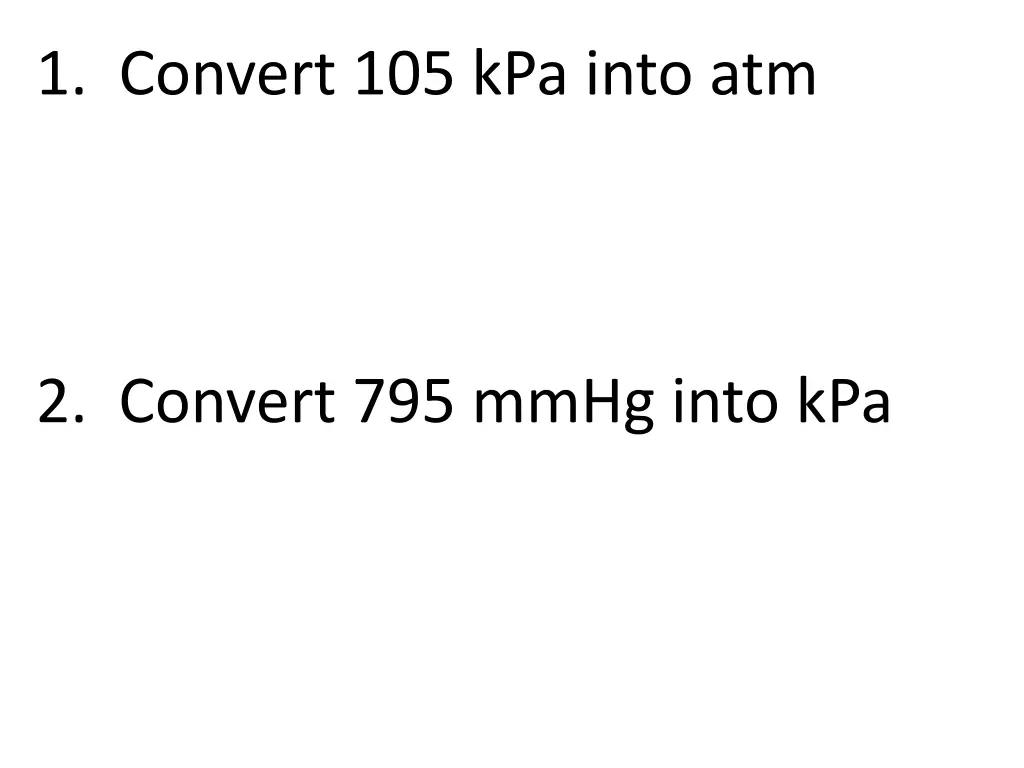
1. Convert 105 kPa into atm 2. Convert 795 mmHg into kPa
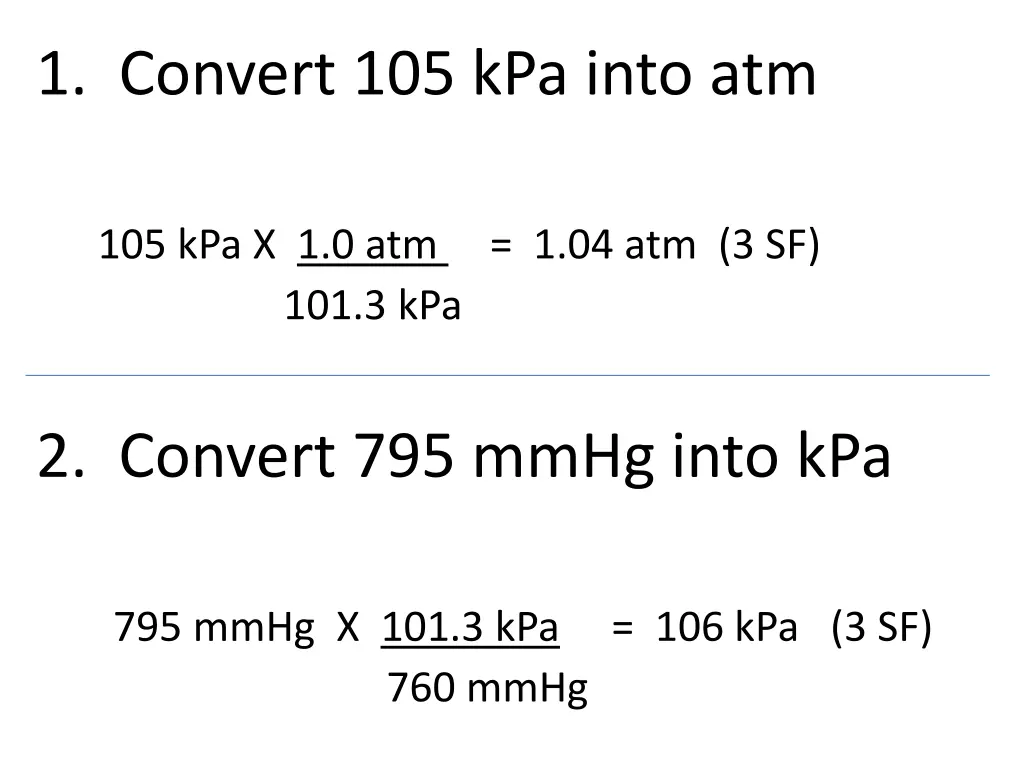
1. Convert 105 kPa into atm 105 kPa X 1.0 atm = 1.04 atm (3 SF) 101.3 kPa 2. Convert 795 mmHg into kPa 795 mmHg X 101.3 kPa = 106 kPa (3 SF) 760 mmHg
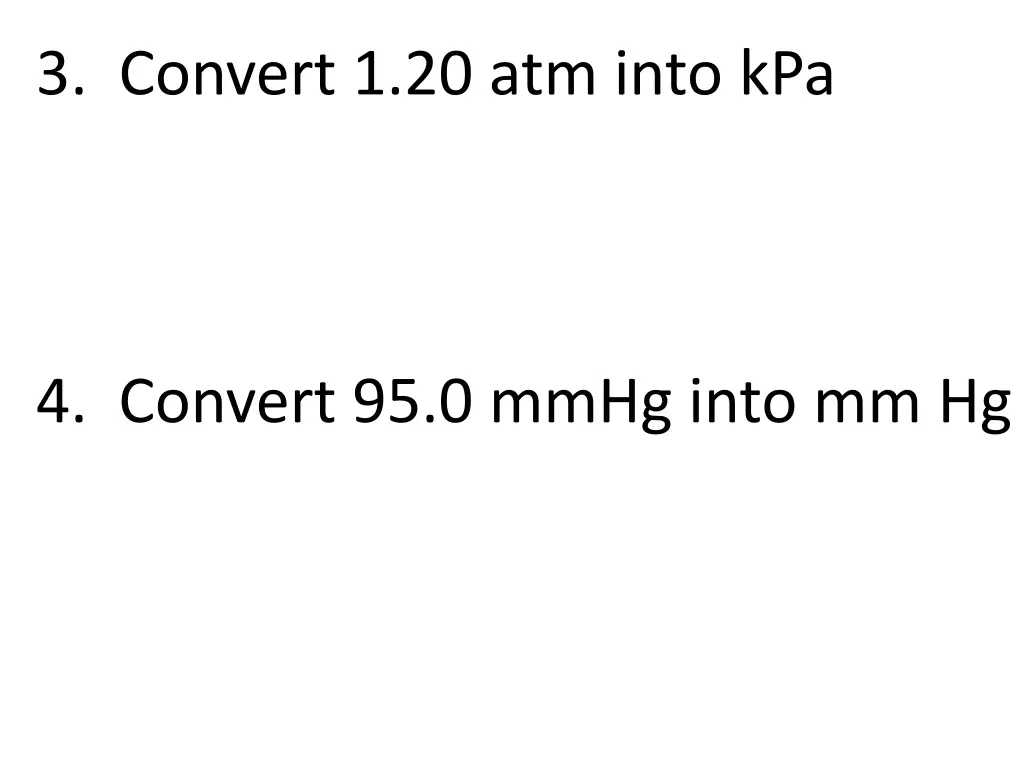
3. Convert 1.20 atm into kPa 4. Convert 95.0 mmHg into mm Hg
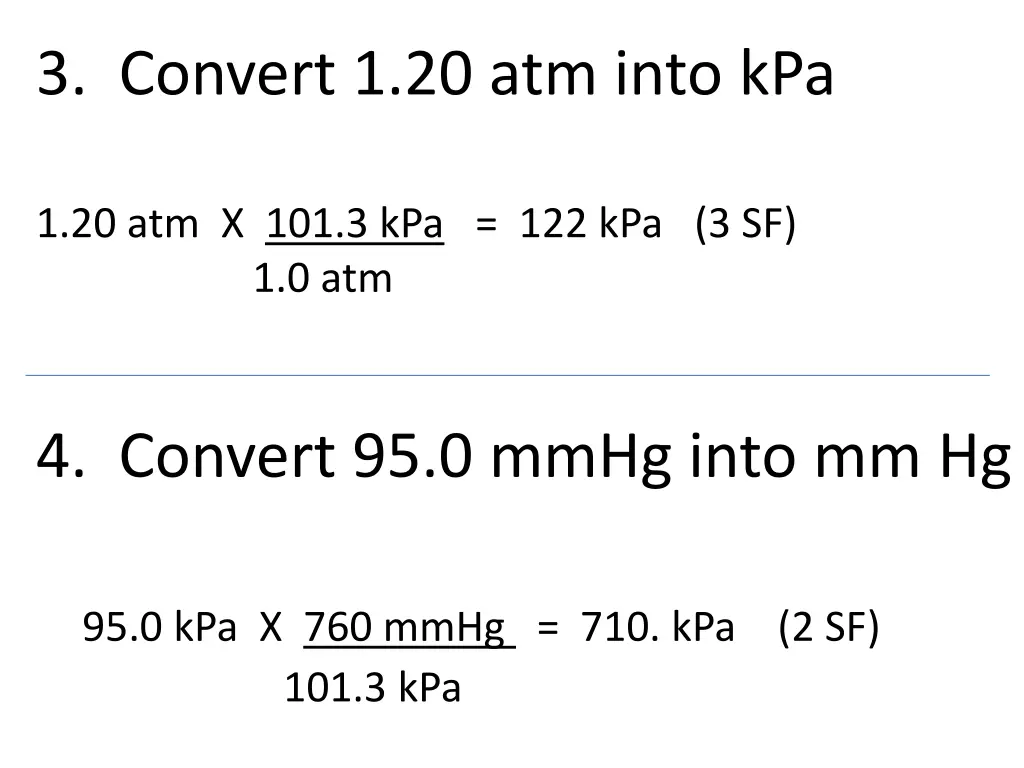
3. Convert 1.20 atm into kPa 1.20 atm X 101.3 kPa = 122 kPa (3 SF) 1.0 atm 4. Convert 95.0 mmHg into mm Hg 95.0 kPa X 760 mmHg = 710. kPa (2 SF) 101.3 kPa
5. What is the vapor pressure of ethanoic acid at 323 Kelvin? 6. What is the boiling point of propanone at 190 kPa?
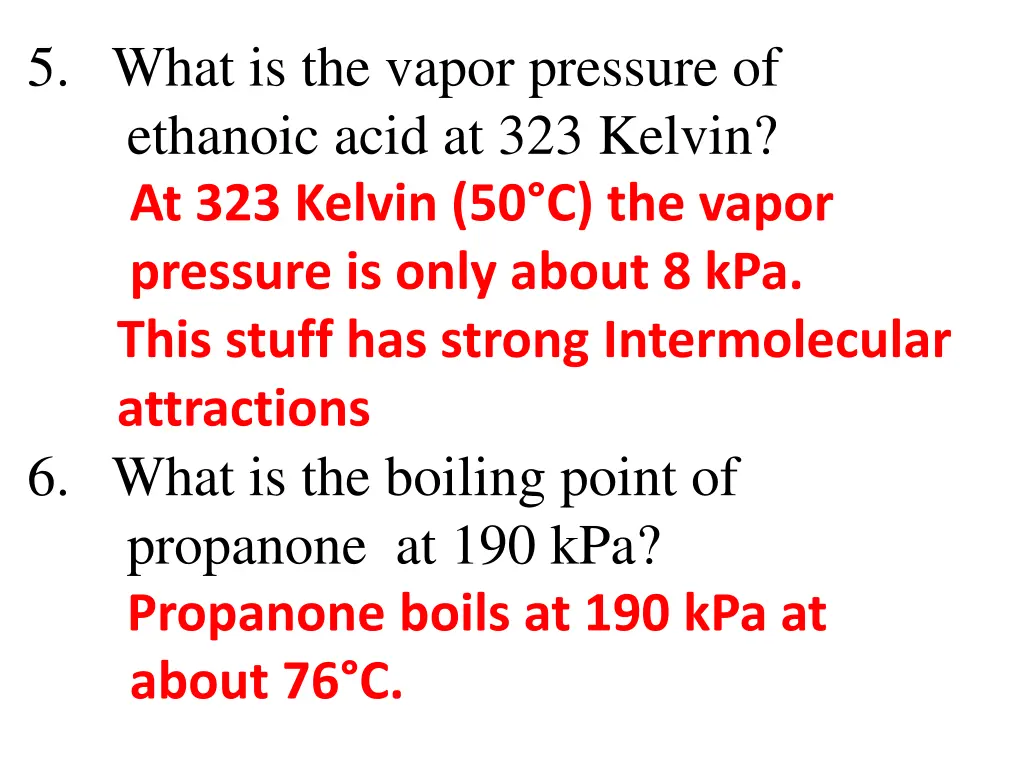
5. What is the vapor pressure of ethanoic acid at 323 Kelvin? At 323 Kelvin (50 C) the vapor pressure is only about 8 kPa. This stuff has strong Intermolecular attractions 6. What is the boiling point of propanone at 190 kPa? Propanone boils at 190 kPa at about 76 C.
7. At 40 kPa, what is the order of the liquids on table H with the lowest to the highest boiling point?
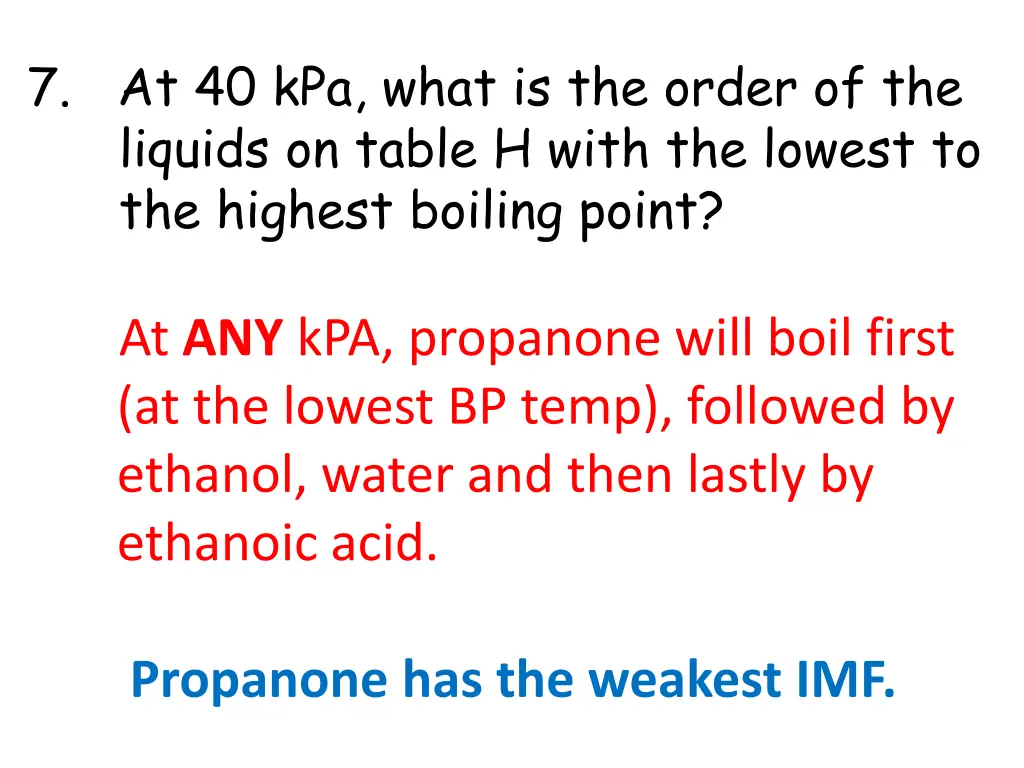
7. At 40 kPa, what is the order of the liquids on table H with the lowest to the highest boiling point? At ANY kPA, propanone will boil first (at the lowest BP temp), followed by ethanol, water and then lastly by ethanoic acid. Propanone has the weakest IMF.
8. At any pressure, which of these 4 table H liquids has the strongest intermolecular bonding? How can you tell that? 9. The normal boiling point for any liquid is at what pressure? (what is normal?)
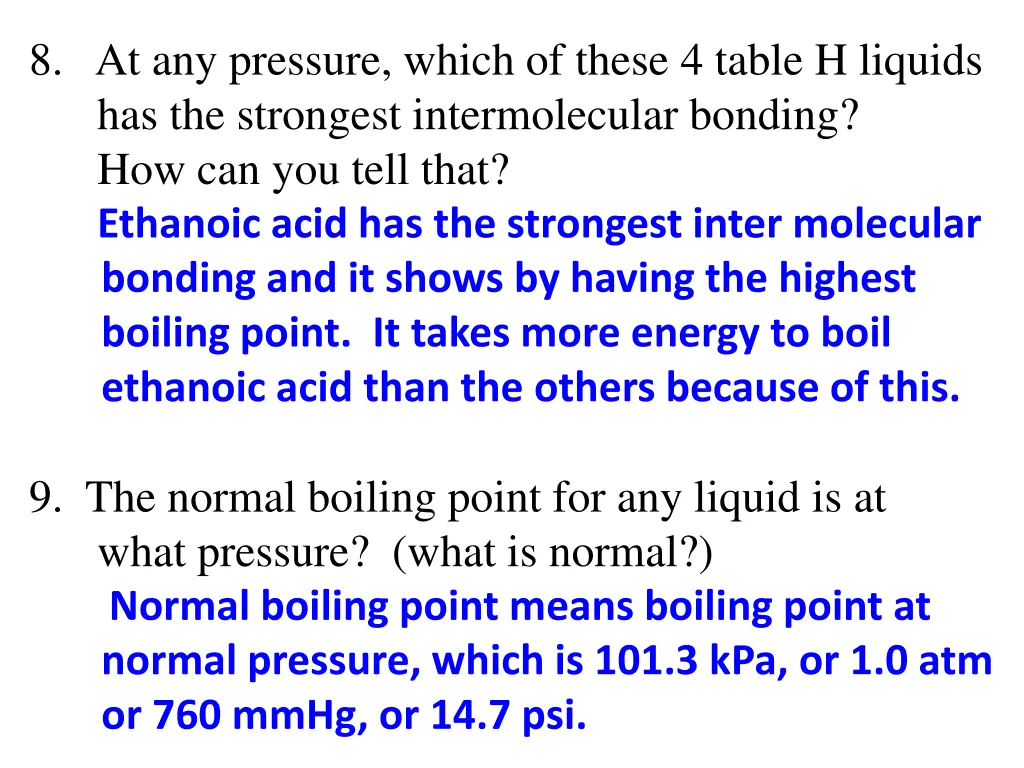
8. At any pressure, which of these 4 table H liquids has the strongest intermolecular bonding? How can you tell that? Ethanoic acid has the strongest inter molecular bonding and it shows by having the highest boiling point. It takes more energy to boil ethanoic acid than the others because of this. 9. The normal boiling point for any liquid is at what pressure? (what is normal?) Normal boiling point means boiling point at normal pressure, which is 101.3 kPa, or 1.0 atm or 760 mmHg, or 14.7 psi.
11. Which would have a higher melting point, an ionic compound or a molecular one? 12. What is the difference between an ionic and a molecular solids?
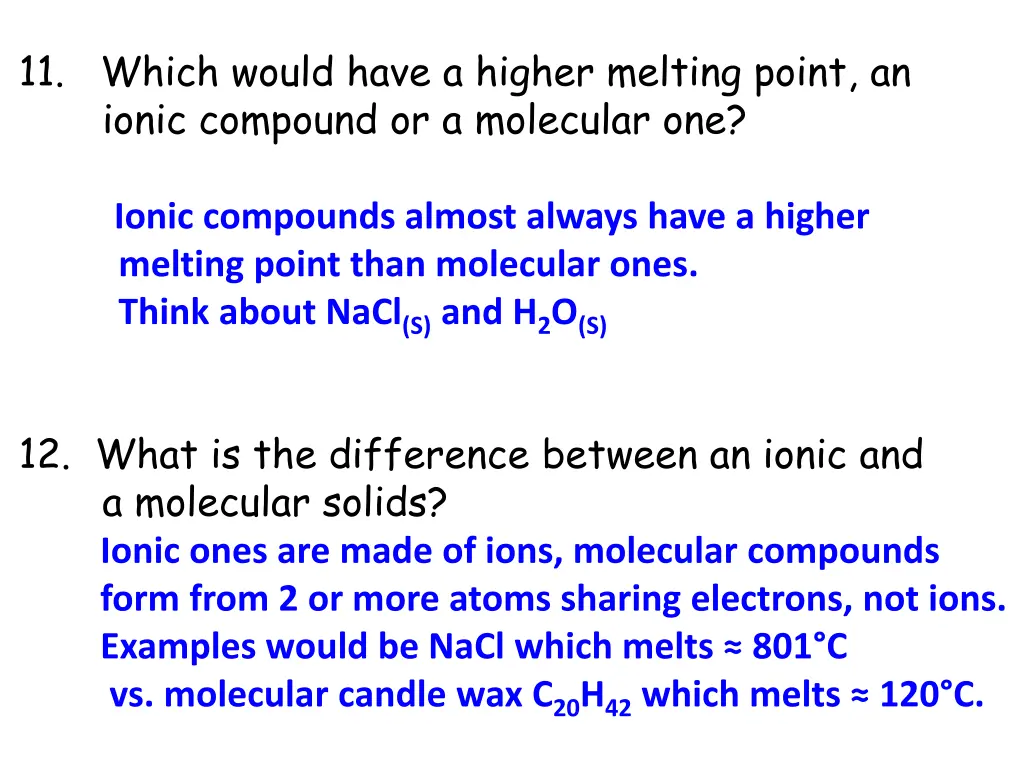
11. Which would have a higher melting point, an ionic compound or a molecular one? Ionic compounds almost always have a higher melting point than molecular ones. Think about NaCl(S) and H2O(S) 12. What is the difference between an ionic and a molecular solids? Ionic ones are made of ions, molecular compounds form from 2 or more atoms sharing electrons, not ions. Examples would be NaCl which melts 801 C vs. molecular candle wax C20H42 which melts 120 C.
14. Remind yourselves of the difference between solids, liquids and gases.
14. Remind yourselves of the difference between solids, liquids and gases. Gases have no definite shape or volume, they easily expand to fit into any container of any size. Liquids have definite volume, but fit into the bottom of any container. Solids have definite volume and definite shape, they do not conform to the container.
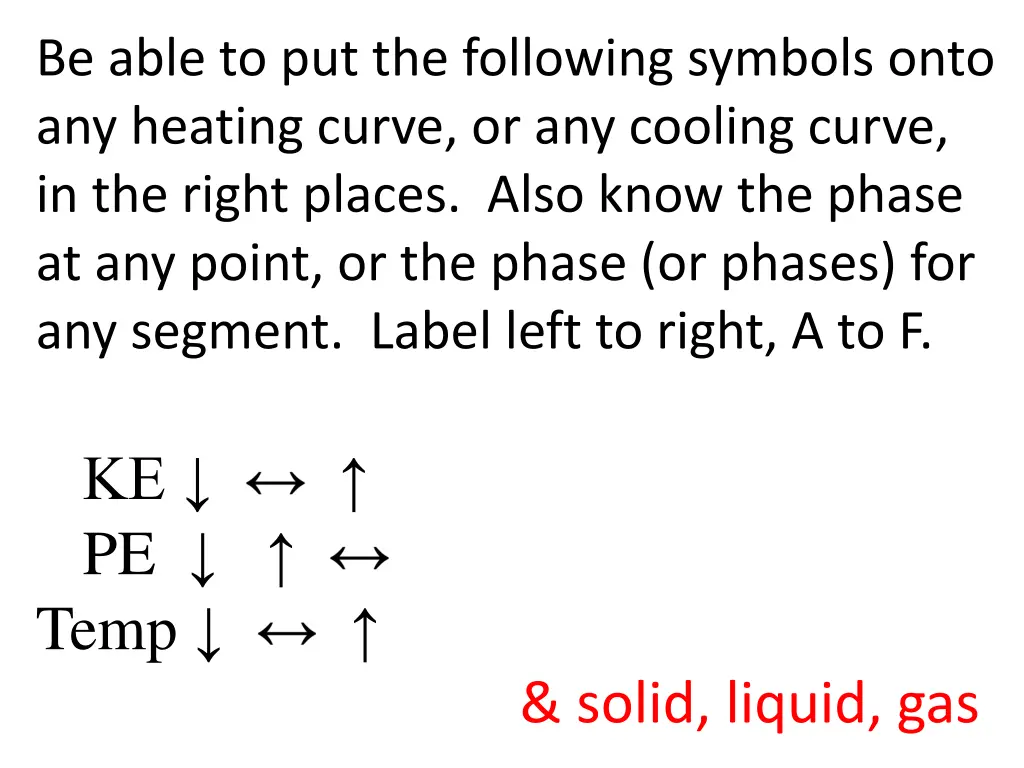
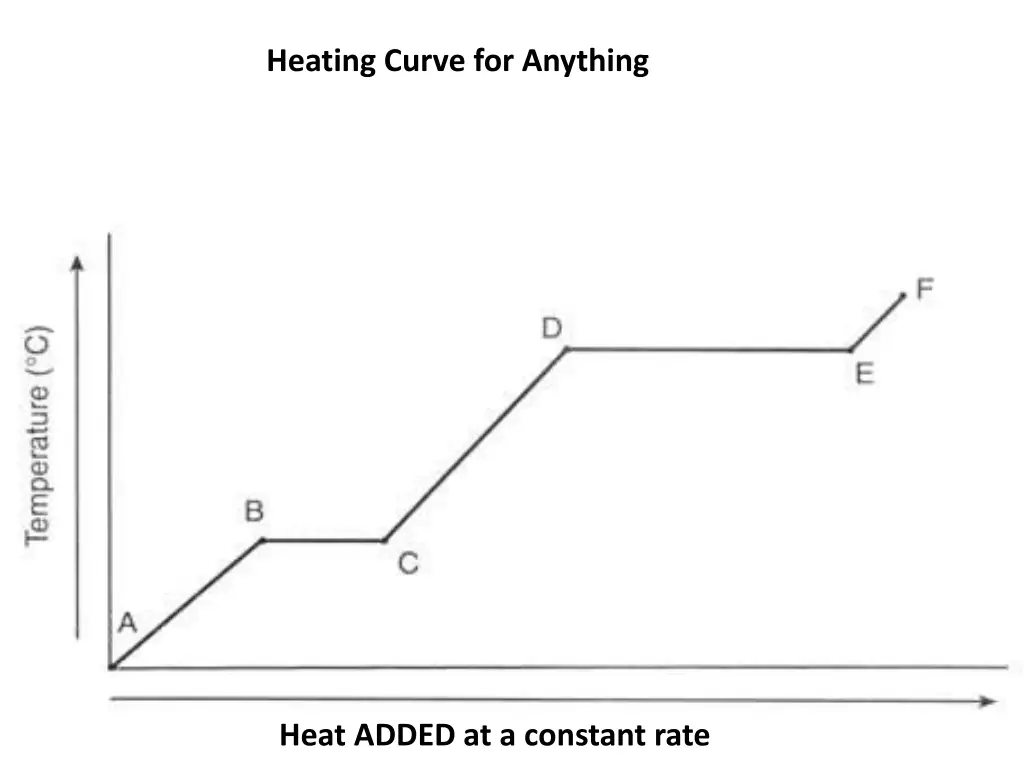
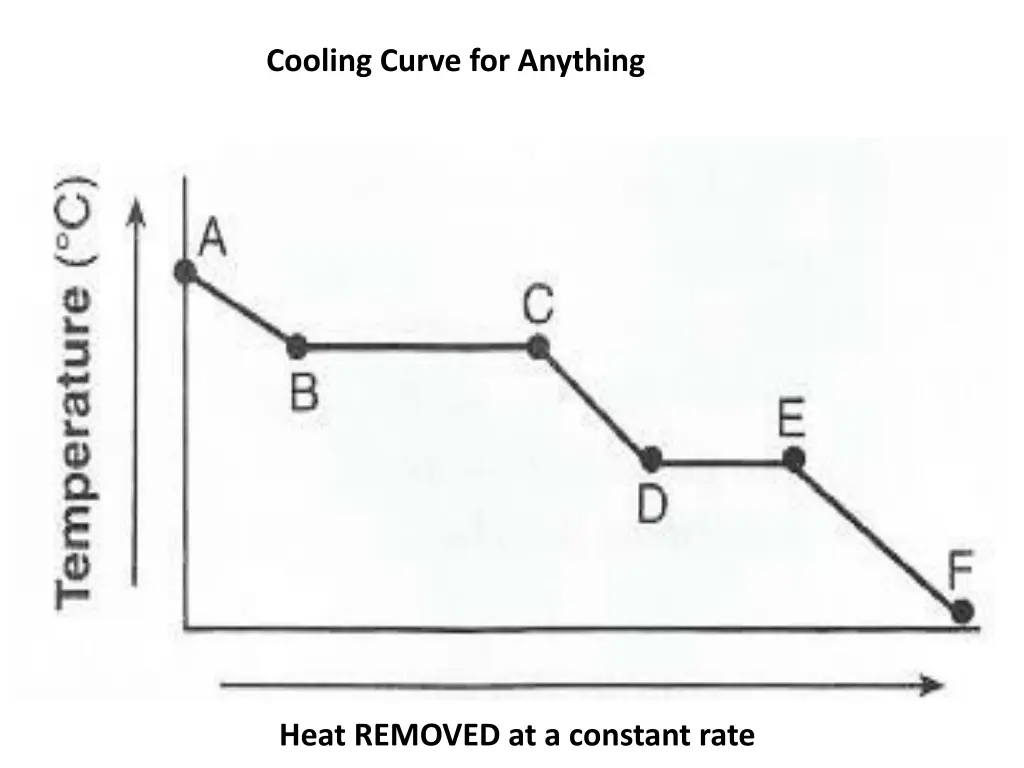
Be able to put the following symbols onto any heating curve, or any cooling curve, in the right places. Also know the phase at any point, or the phase (or phases) for any segment. Label left to right, A to F. KE PE Temp & solid, liquid, gas
Heating Curve for Anything Heat ADDED at a constant rate
Cooling Curve for Anything Heat REMOVED at a constant rate
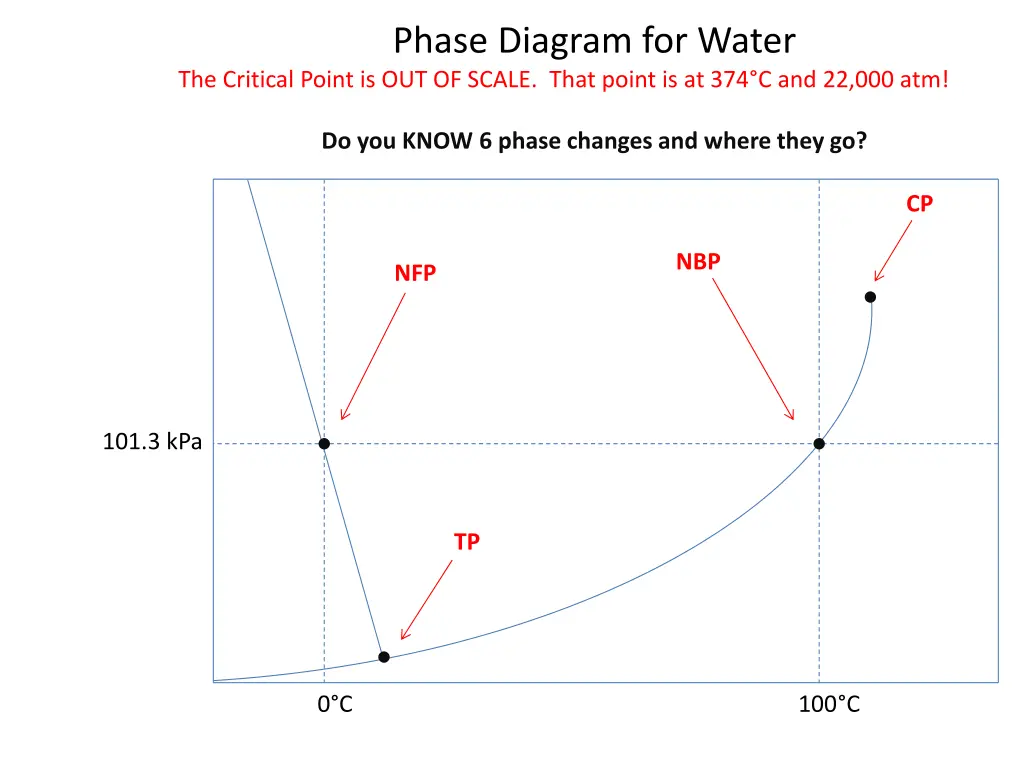
Phase Diagram for Water The Critical Point is OUT OF SCALE. That point is at 374 C and 22,000 atm! Do you KNOW 6 phase changes and where they go? CP NBP NFP 101.3 kPa TP 0 C 100 C