Explore the concept of civil rights and discrimination in the U.S., highlighting the importance of equal treatment, participation in the government, and historic struggles for equality among different groups. Learn about the evolution of civil rights, instances of discrimination, and the challenges faced by African Americans. Discover how laws and societal perceptions have shaped the landscape of civil rights in America.
Please find below an Image/Link to download the presentation.
The content on the website is provided AS IS for your information and personal use only. It may not be sold, licensed, or shared on other websites without obtaining consent from the author. If you encounter any issues during the download, it is possible that the publisher has removed the file from their server.
You are allowed to download the files provided on this website for personal or commercial use, subject to the condition that they are used lawfully. All files are the property of their respective owners.
The content on the website is provided AS IS for your information and personal use only. It may not be sold, licensed, or shared on other websites without obtaining consent from the author.
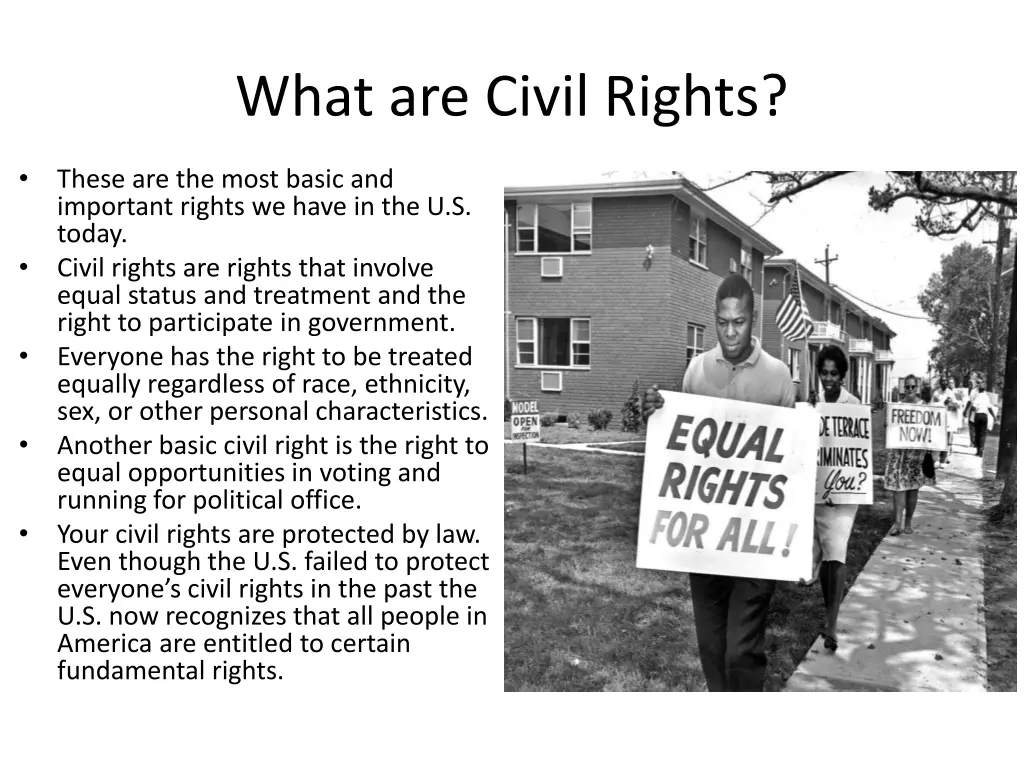
What are Civil Rights? These are the most basic and important rights we have in the U.S. today. Civil rights are rights that involve equal status and treatment and the right to participate in government. Everyone has the right to be treated equally regardless of race, ethnicity, sex, or other personal characteristics. Another basic civil right is the right to equal opportunities in voting and running for political office. Your civil rights are protected by law. Even though the U.S. failed to protect everyone s civil rights in the past the U.S. now recognizes that all people in America are entitled to certain fundamental rights. http://sacsconsulting.com/wp-content/uploads/2015/09/civil-rights.jpg
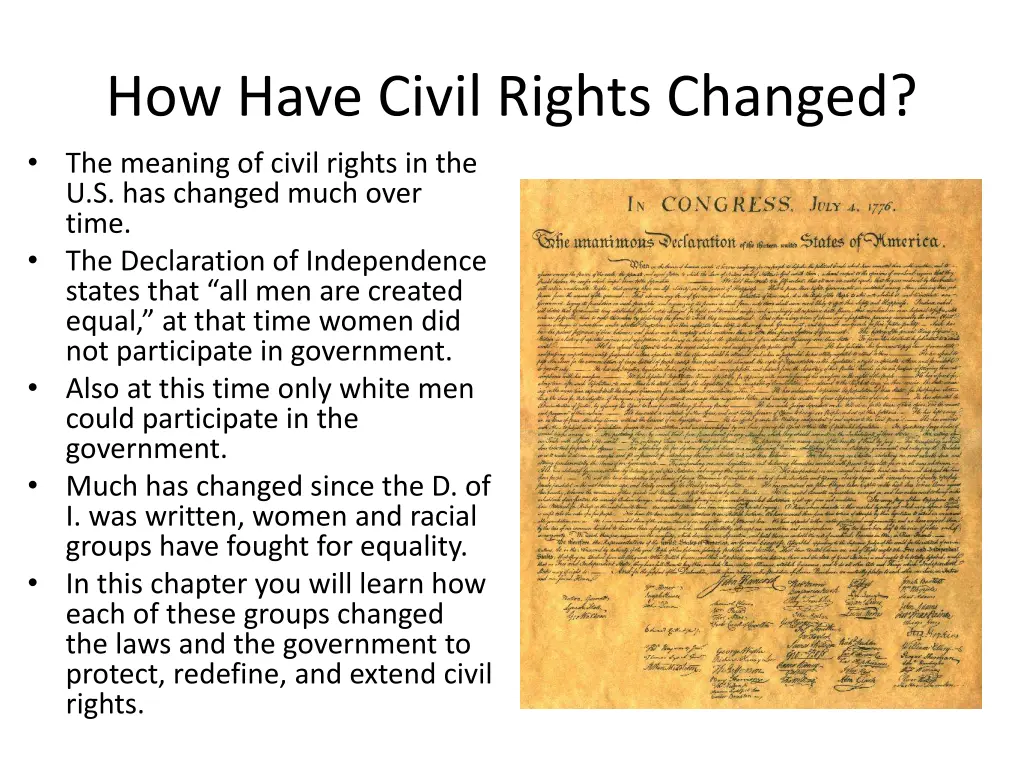
How Have Civil Rights Changed? The meaning of civil rights in the U.S. has changed much over time. The Declaration of Independence states that all men are created equal, at that time women did not participate in government. Also at this time only white men could participate in the government. Much has changed since the D. of I. was written, women and racial groups have fought for equality. In this chapter you will learn how each of these groups changed the laws and the government to protect, redefine, and extend civil rights. http://www.founding.com/repository/imgLib/20071018_declaration.jpg
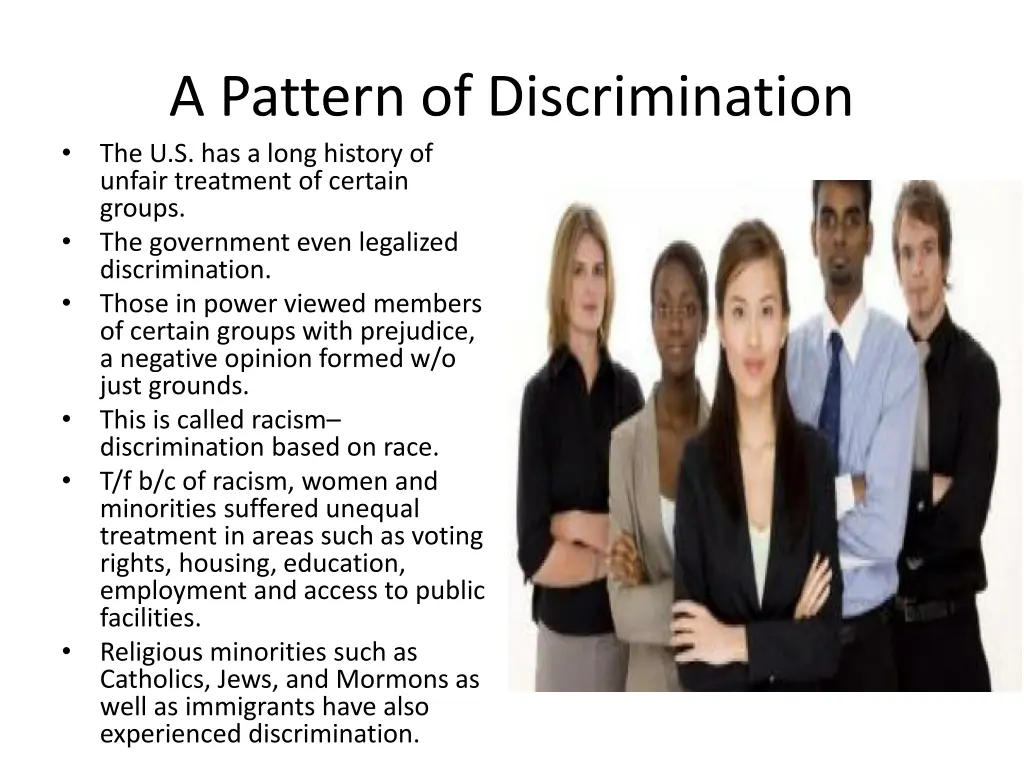
A Pattern of Discrimination The U.S. has a long history of unfair treatment of certain groups. The government even legalized discrimination. Those in power viewed members of certain groups with prejudice, a negative opinion formed w/o just grounds. This is called racism discrimination based on race. T/f b/c of racism, women and minorities suffered unequal treatment in areas such as voting rights, housing, education, employment and access to public facilities. Religious minorities such as Catholics, Jews, and Mormons as well as immigrants have also experienced discrimination. http://www.diversityemploymentservices.com/wp-content/themes/_arts-culture/timthumb.php?src=http%3A%2F%2Fwww.diversityemploymentservices.com%2Fwp-content%2Fuploads%2F2013%2F10%2FImage-for-Diversifiedemploymentservices-Minority-women.jpgq=90w=630h=350zc=1
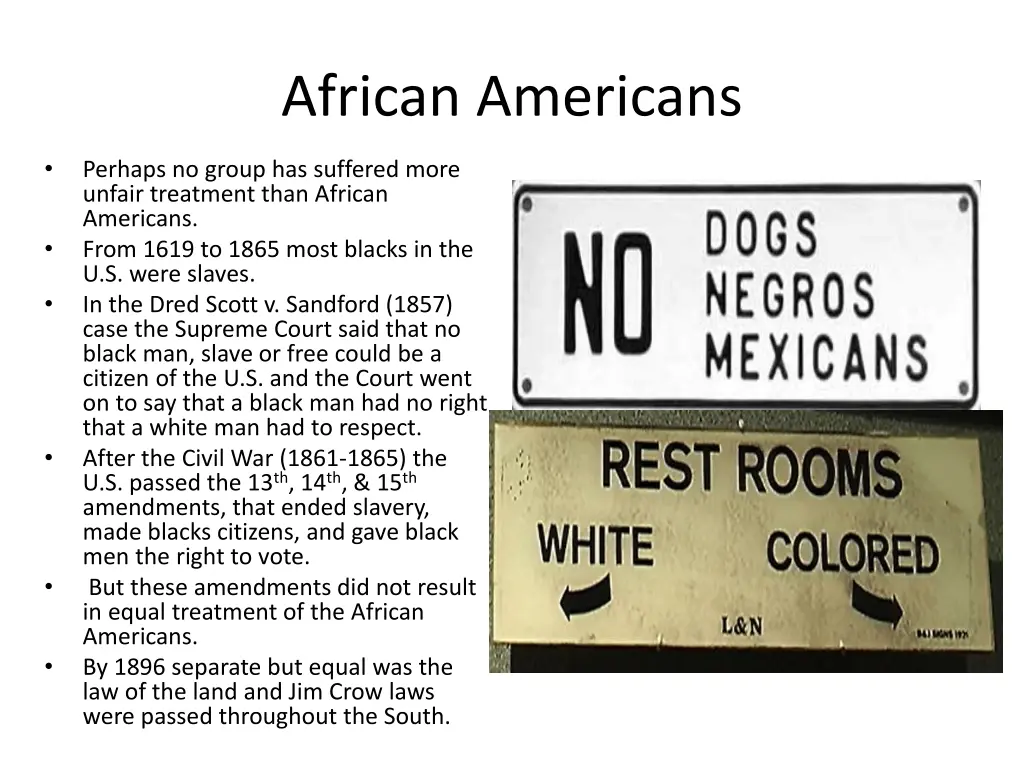
African Americans Perhaps no group has suffered more unfair treatment than African Americans. From 1619 to 1865 most blacks in the U.S. were slaves. In the Dred Scott v. Sandford (1857) case the Supreme Court said that no black man, slave or free could be a citizen of the U.S. and the Court went on to say that a black man had no right that a white man had to respect. After the Civil War (1861-1865) the U.S. passed the 13th, 14th, & 15th amendments, that ended slavery, made blacks citizens, and gave black men the right to vote. But these amendments did not result in equal treatment of the African Americans. By 1896 separate but equal was the law of the land and Jim Crow laws were passed throughout the South. http://www.sweetauburn.us/rings/jimCrow/signnoNegros.jpg https://206soph.wikispaces.com/file/view/restrooms.jpg/39343192/restrooms.jpg
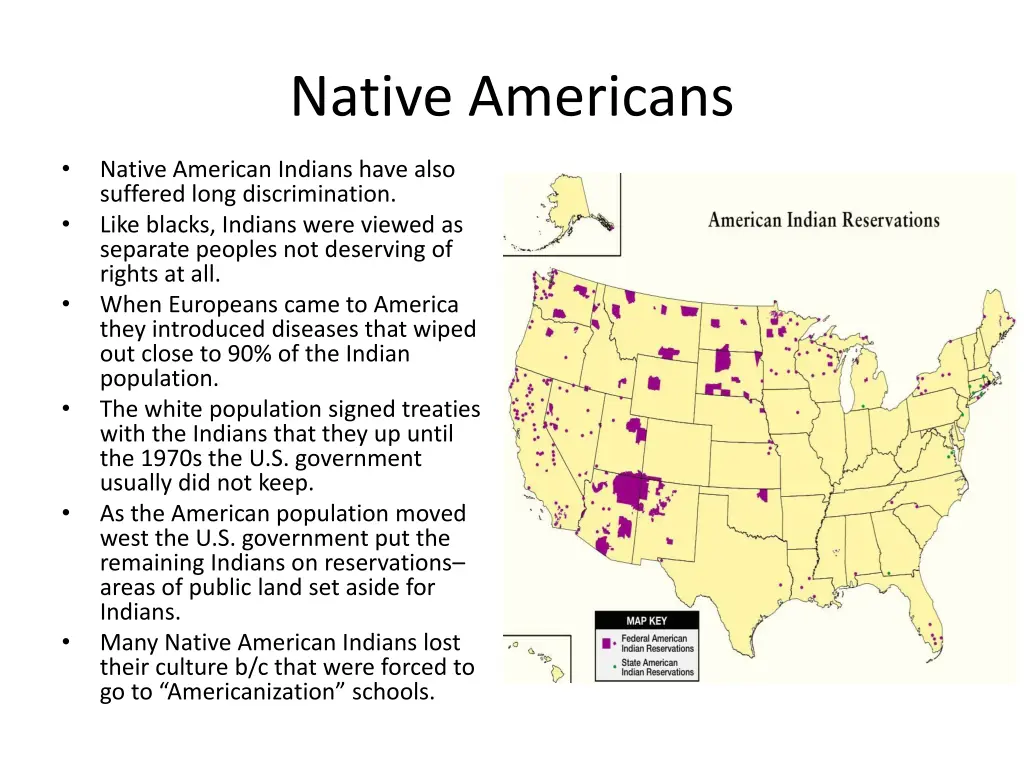
Native Americans Native American Indians have also suffered long discrimination. Like blacks, Indians were viewed as separate peoples not deserving of rights at all. When Europeans came to America they introduced diseases that wiped out close to 90% of the Indian population. The white population signed treaties with the Indians that they up until the 1970s the U.S. government usually did not keep. As the American population moved west the U.S. government put the remaining Indians on reservations areas of public land set aside for Indians. Many Native American Indians lost their culture b/c that were forced to go to Americanization schools. http://earthzine.org/wp-content/uploads/2015/04/image021.jpg
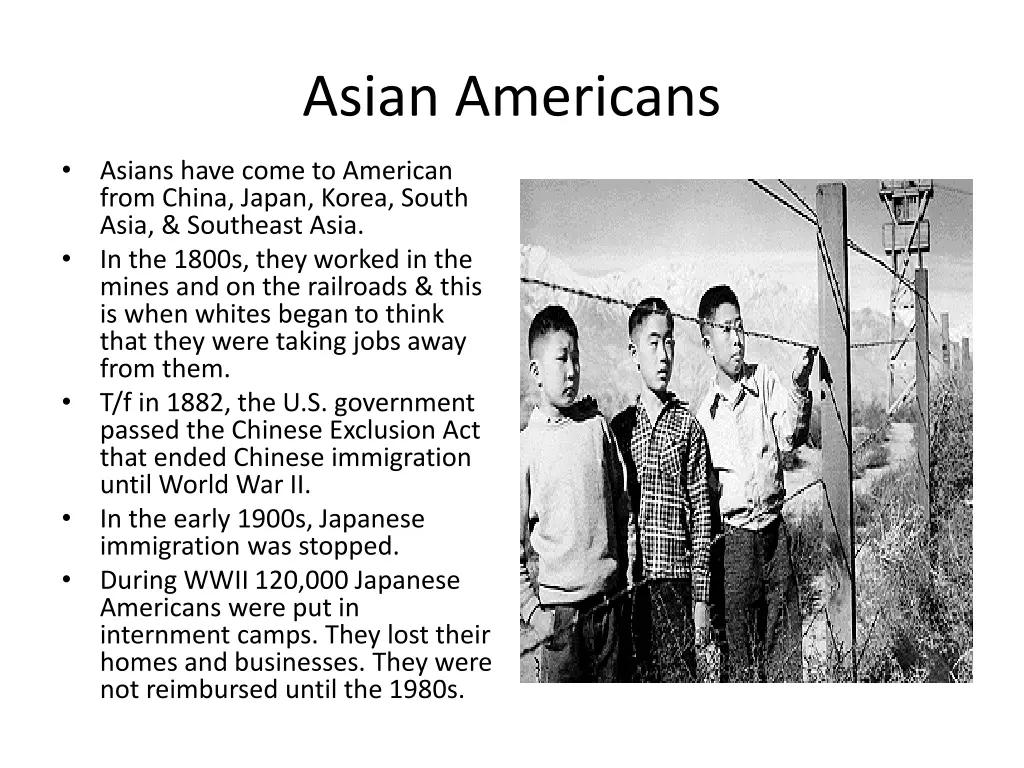
Asian Americans Asians have come to American from China, Japan, Korea, South Asia, & Southeast Asia. In the 1800s, they worked in the mines and on the railroads & this is when whites began to think that they were taking jobs away from them. T/f in 1882, the U.S. government passed the Chinese Exclusion Act that ended Chinese immigration until World War II. In the early 1900s, Japanese immigration was stopped. During WWII 120,000 Japanese Americans were put in internment camps. They lost their homes and businesses. They were not reimbursed until the 1980s. https://www.mtholyoke.edu/~matsu22k/classweb/images/famous.gif
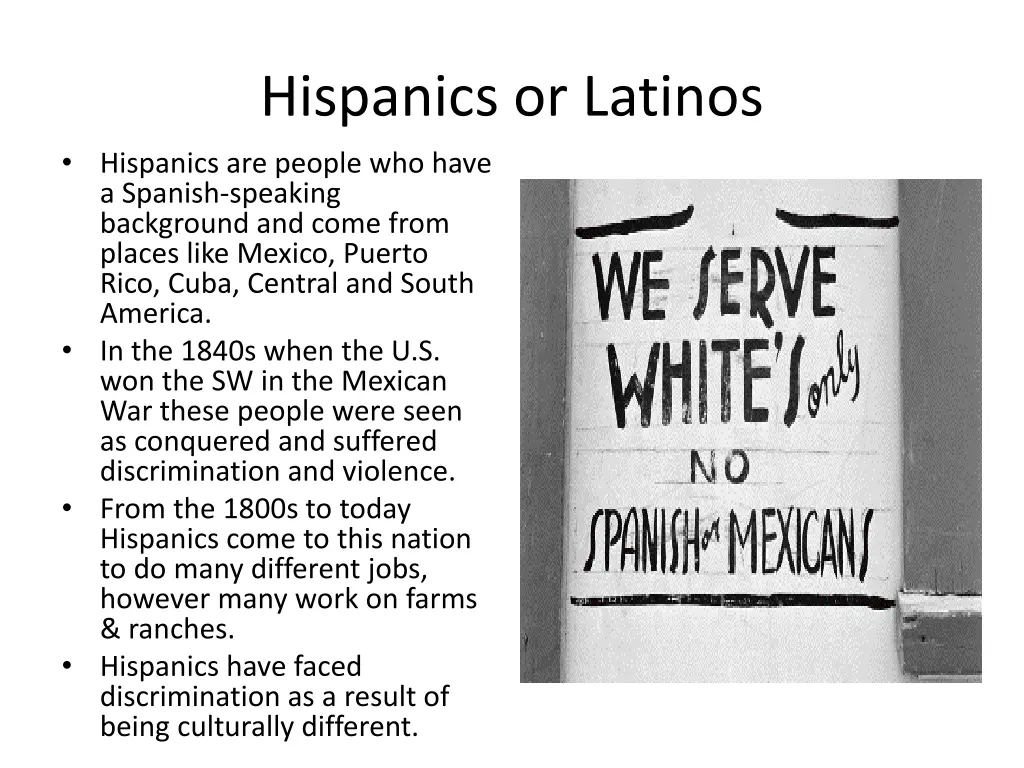
Hispanics or Latinos Hispanics are people who have a Spanish-speaking background and come from places like Mexico, Puerto Rico, Cuba, Central and South America. In the 1840s when the U.S. won the SW in the Mexican War these people were seen as conquered and suffered discrimination and violence. From the 1800s to today Hispanics come to this nation to do many different jobs, however many work on farms & ranches. Hispanics have faced discrimination as a result of being culturally different. https://ionenewsone.files.wordpress.com/2010/07/jim-crow-laws1.gif
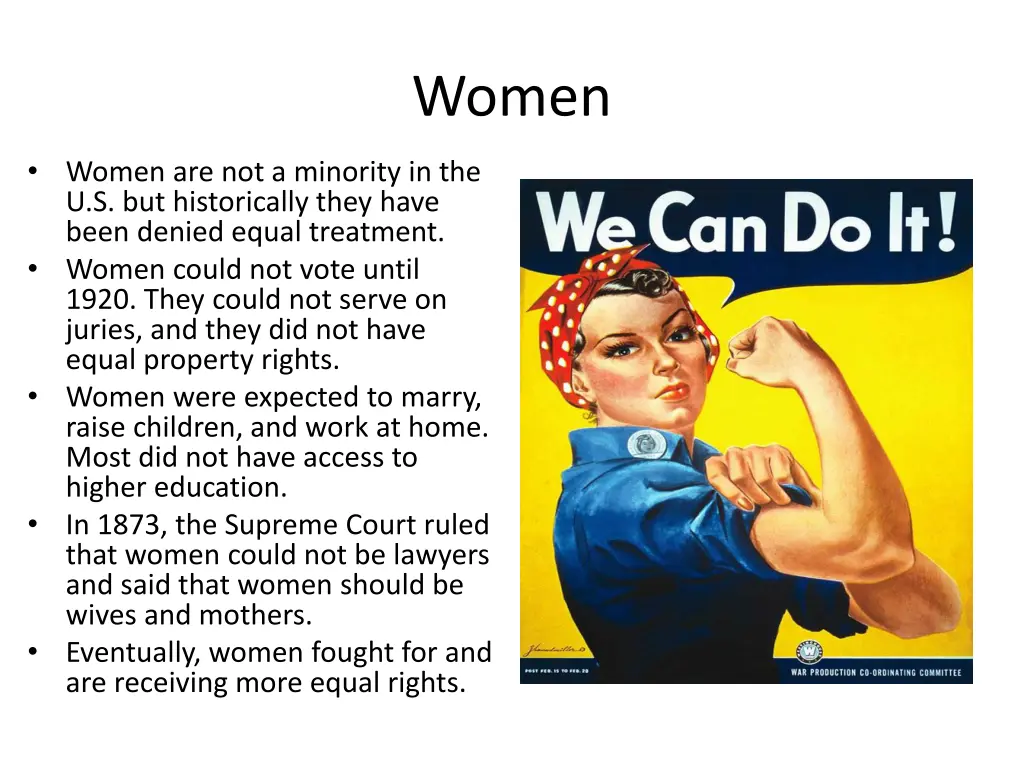
Women Women are not a minority in the U.S. but historically they have been denied equal treatment. Women could not vote until 1920. They could not serve on juries, and they did not have equal property rights. Women were expected to marry, raise children, and work at home. Most did not have access to higher education. In 1873, the Supreme Court ruled that women could not be lawyers and said that women should be wives and mothers. Eventually, women fought for and are receiving more equal rights. http://www.dailytitan.com/wordpress/wp-content/uploads/2013/11/SBT4NOW_Flicker_standard.jpg