Civil Rights Readings and Segregation History
Explore landmark civil rights cases like Brown v. Board of Education and Plessy v. Ferguson, the impact of segregation on society, and the struggle for desegregation in schools and other areas. Learn about the difference between activism and civil disobedience and the efforts to promote equality and opportunity in the face of segregation. Delve into the post-World War II era to understand the challenges faced by African Americans and the fight for civil rights reform.

Download Presentation

Please find below an Image/Link to download the presentation.
The content on the website is provided AS IS for your information and personal use only. It may not be sold, licensed, or shared on other websites without obtaining consent from the author. If you encounter any issues during the download, it is possible that the publisher has removed the file from their server.
You are allowed to download the files provided on this website for personal or commercial use, subject to the condition that they are used lawfully. All files are the property of their respective owners.
The content on the website is provided AS IS for your information and personal use only. It may not be sold, licensed, or shared on other websites without obtaining consent from the author.
E N D
Presentation Transcript
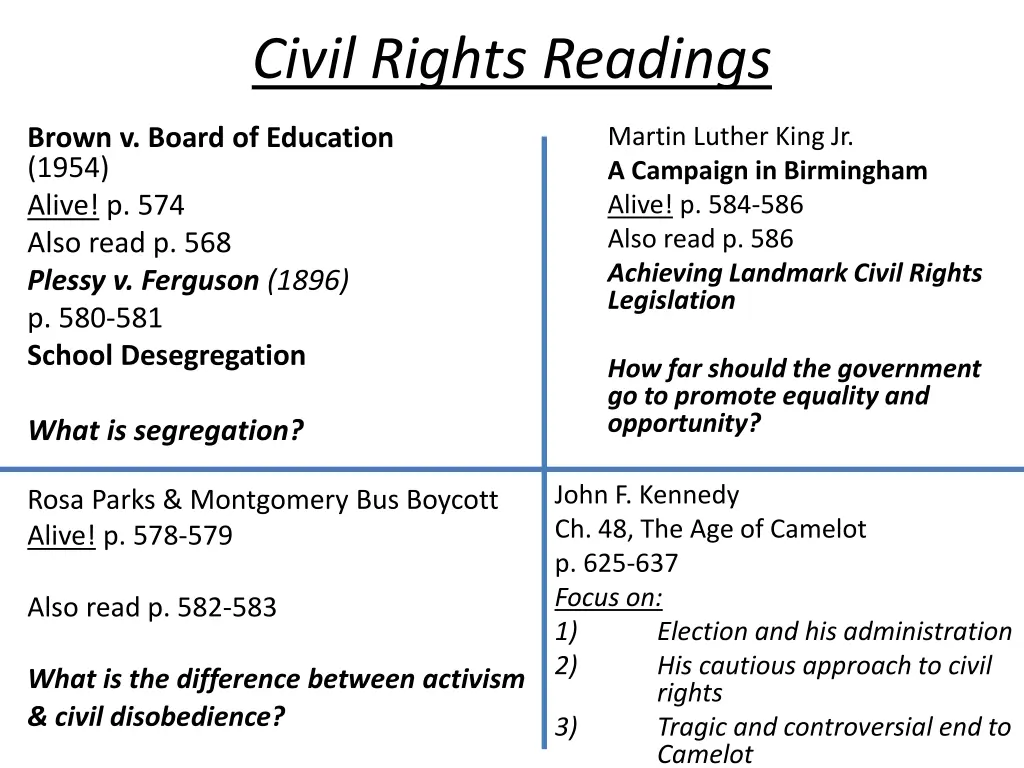
Civil Rights Readings Brown v. Board of Education (1954) Alive! p. 574 Also read p. 568 Plessy v. Ferguson (1896) p. 580-581 School Desegregation Martin Luther King Jr. A Campaign in Birmingham Alive! p. 584-586 Also read p. 586 Achieving Landmark Civil Rights Legislation How far should the government go to promote equality and opportunity? p. 625-637 Focus on: 1) Election and his administration 2) His cautious approach to civil rights 3) Tragic and controversial end to Camelot What is segregation? John F. Kennedy Ch. 48, The Age of Camelot Rosa Parks & Montgomery Bus Boycott Alive! p. 578-579 Also read p. 582-583 What is the difference between activism & civil disobedience?
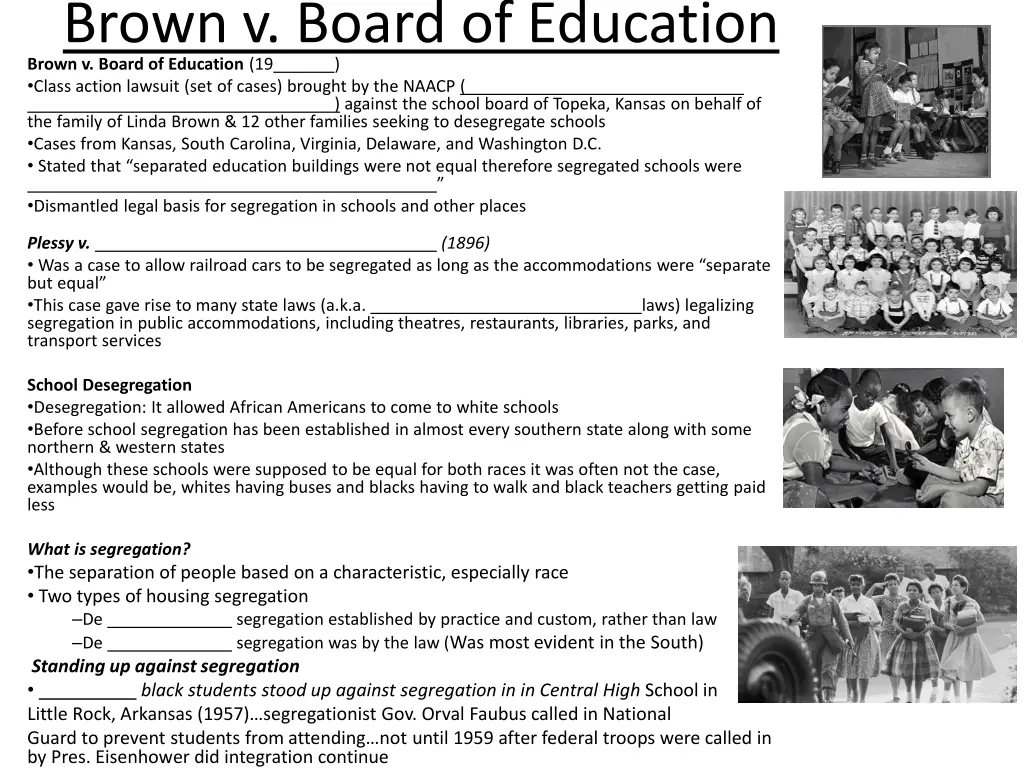
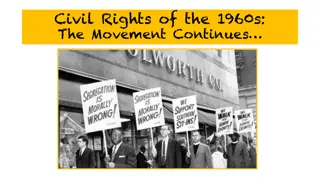
Brown v. Board of Education Brown v. Board of Education (19 ) Class action lawsuit (set of cases) brought by the NAACP ( ) against the school board of Topeka, Kansas on behalf of the family of Linda Brown & 12 other families seeking to desegregate schools Cases from Kansas, South Carolina, Virginia, Delaware, and Washington D.C. Stated that separated education buildings were not equal therefore segregated schools were Dismantled legal basis for segregation in schools and other places Plessy v. Was a case to allow railroad cars to be segregated as long as the accommodations were separate but equal This case gave rise to many state laws (a.k.a. segregation in public accommodations, including theatres, restaurants, libraries, parks, and transport services (1896) laws) legalizing School Desegregation Desegregation: It allowed African Americans to come to white schools Before school segregation has been established in almost every southern state along with some northern & western states Although these schools were supposed to be equal for both races it was often not the case, examples would be, whites having buses and blacks having to walk and black teachers getting paid less What is segregation? The separation of people based on a characteristic, especially race Two types of housing segregation De segregation established by practice and custom, rather than law De segregation was by the law (Was most evident in the South) Standing up against segregation black students stood up against segregation in in Central High School in Little Rock, Arkansas (1957) segregationist Gov. Orval Faubus called in National Guard to prevent students from attending not until 1959 after federal troops were called in by Pres. Eisenhower did integration continue
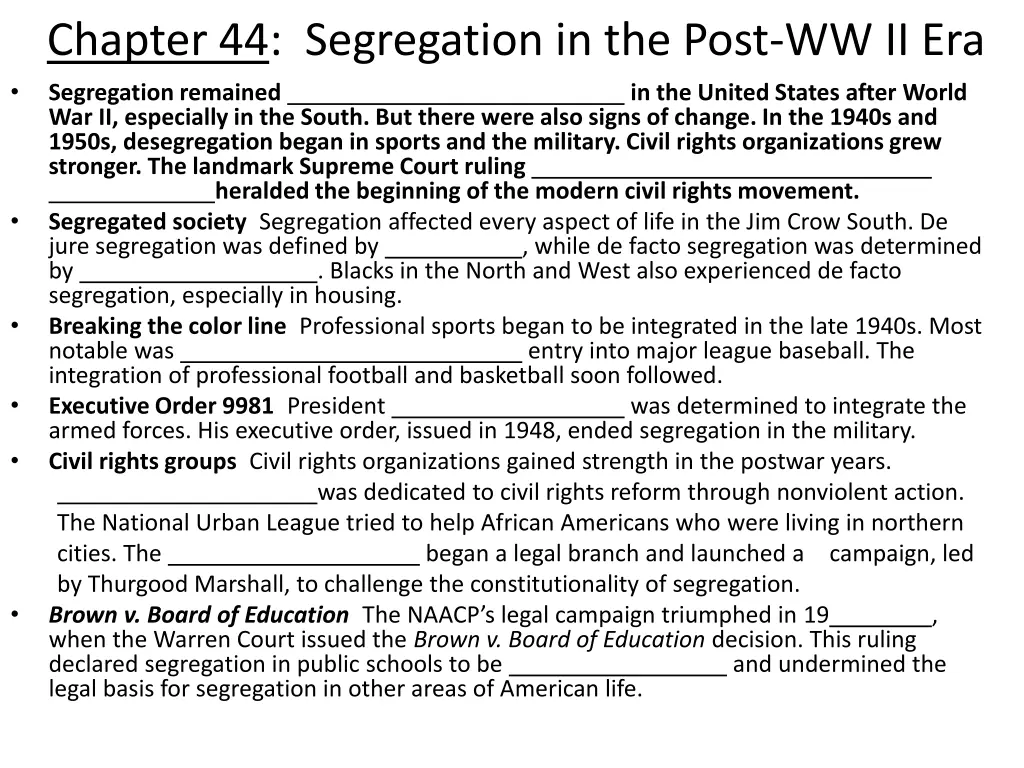
Chapter 44: Segregation in the Post-WW II Era Segregation remained War II, especially in the South. But there were also signs of change. In the 1940s and 1950s, desegregation began in sports and the military. Civil rights organizations grew stronger. The landmark Supreme Court ruling heralded the beginning of the modern civil rights movement. Segregated society Segregation affected every aspect of life in the Jim Crow South. De jure segregation was defined by by . Blacks in the North and West also experienced de facto segregation, especially in housing. Breaking the color line Professional sports began to be integrated in the late 1940s. Most notable was integration of professional football and basketball soon followed. Executive Order 9981 President armed forces. His executive order, issued in 1948, ended segregation in the military. Civil rights groups Civil rights organizations gained strength in the postwar years. was dedicated to civil rights reform through nonviolent action. The National Urban League tried to help African Americans who were living in northern cities. The began a legal branch and launched a campaign, led by Thurgood Marshall, to challenge the constitutionality of segregation. Brown v. Board of Education The NAACP s legal campaign triumphed in 19 when the Warren Court issued the Brown v. Board of Education decision. This ruling declared segregation in public schools to be legal basis for segregation in other areas of American life. in the United States after World , while de facto segregation was determined entry into major league baseball. The was determined to integrate the , and undermined the
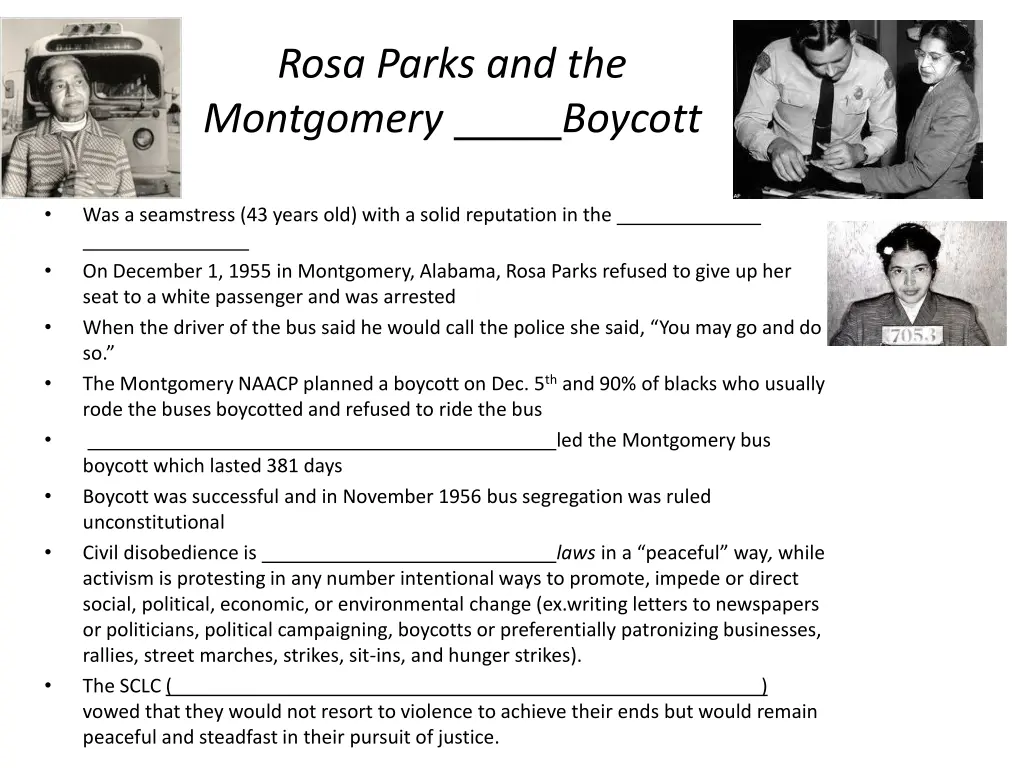
Rosa Parks and the Montgomery Boycott Was a seamstress (43 years old) with a solid reputation in the On December 1, 1955 in Montgomery, Alabama, Rosa Parks refused to give up her seat to a white passenger and was arrested When the driver of the bus said he would call the police she said, You may go and do so. The Montgomery NAACP planned a boycott on Dec. 5th and 90% of blacks who usually rode the buses boycotted and refused to ride the bus boycott which lasted 381 days Boycott was successful and in November 1956 bus segregation was ruled unconstitutional Civil disobedience is activism is protesting in any number intentional ways to promote, impede or direct social, political, economic, or environmental change (ex.writing letters to newspapers or politicians, political campaigning, boycotts or preferentially patronizing businesses, rallies, street marches, strikes, sit-ins, and hunger strikes). The SCLC ( vowed that they would not resort to violence to achieve their ends but would remain peaceful and steadfast in their pursuit of justice. led the Montgomery bus laws in a peaceful way, while )
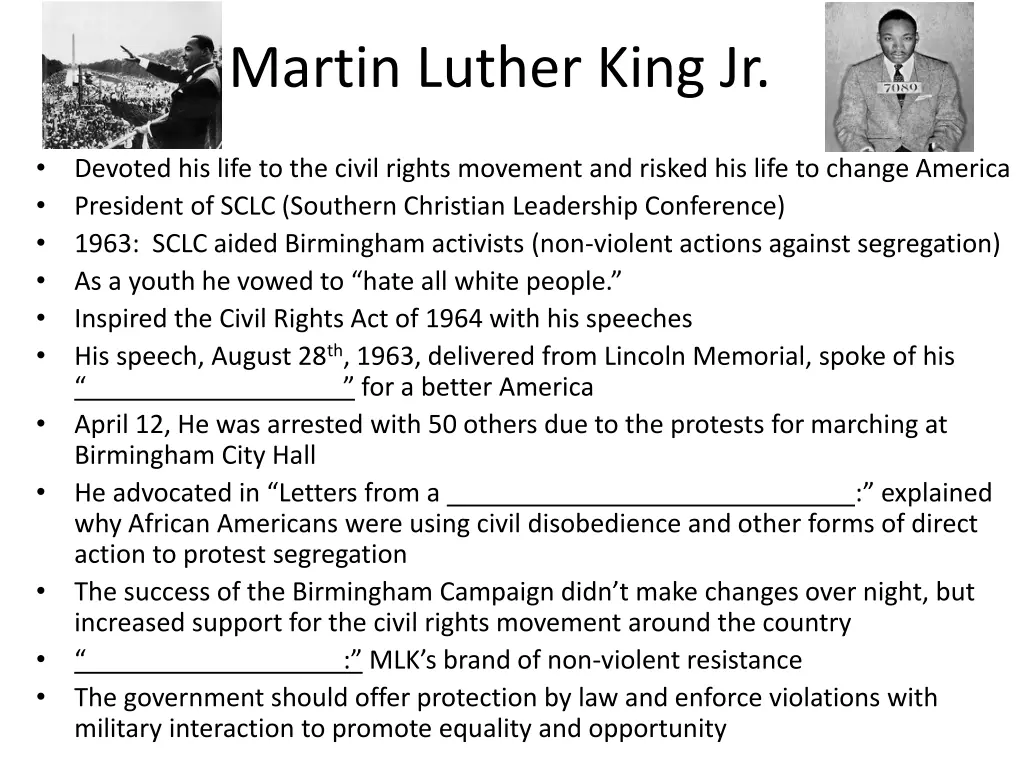
Martin Luther King Jr. Devoted his life to the civil rights movement and risked his life to change America President of SCLC (Southern Christian Leadership Conference) 1963: SCLC aided Birmingham activists (non-violent actions against segregation) As a youth he vowed to hate all white people. Inspired the Civil Rights Act of 1964 with his speeches His speech, August 28th, 1963, delivered from Lincoln Memorial, spoke of his for a better America April 12, He was arrested with 50 others due to the protests for marching at Birmingham City Hall He advocated in Letters from a why African Americans were using civil disobedience and other forms of direct action to protest segregation The success of the Birmingham Campaign didn t make changes over night, but increased support for the civil rights movement around the country : MLK s brand of non-violent resistance The government should offer protection by law and enforce violations with military interaction to promote equality and opportunity : explained
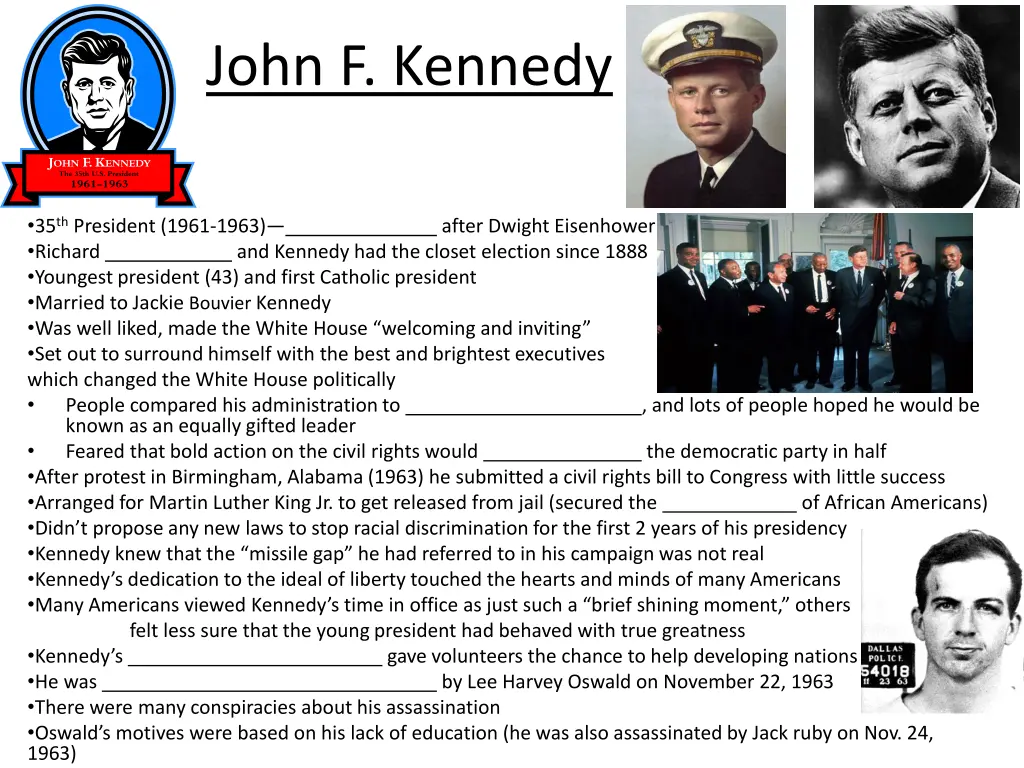
John F. Kennedy 35th President (1961-1963) Richard Youngest president (43) and first Catholic president Married to Jackie Bouvier Kennedy Was well liked, made the White House welcoming and inviting Set out to surround himself with the best and brightest executives which changed the White House politically People compared his administration to known as an equally gifted leader Feared that bold action on the civil rights would After protest in Birmingham, Alabama (1963) he submitted a civil rights bill to Congress with little success Arranged for Martin Luther King Jr. to get released from jail (secured the Didn t propose any new laws to stop racial discrimination for the first 2 years of his presidency Kennedy knew that the missile gap he had referred to in his campaign was not real Kennedy s dedication to the ideal of liberty touched the hearts and minds of many Americans Many Americans viewed Kennedy s time in office as just such a brief shining moment, others felt less sure that the young president had behaved with true greatness Kennedy s gave volunteers the chance to help developing nations He was by Lee Harvey Oswald on November 22, 1963 There were many conspiracies about his assassination Oswald s motives were based on his lack of education (he was also assassinated by Jack ruby on Nov. 24, 1963) after Dwight Eisenhower and Kennedy had the closet election since 1888 , and lots of people hoped he would be the democratic party in half of African Americans)
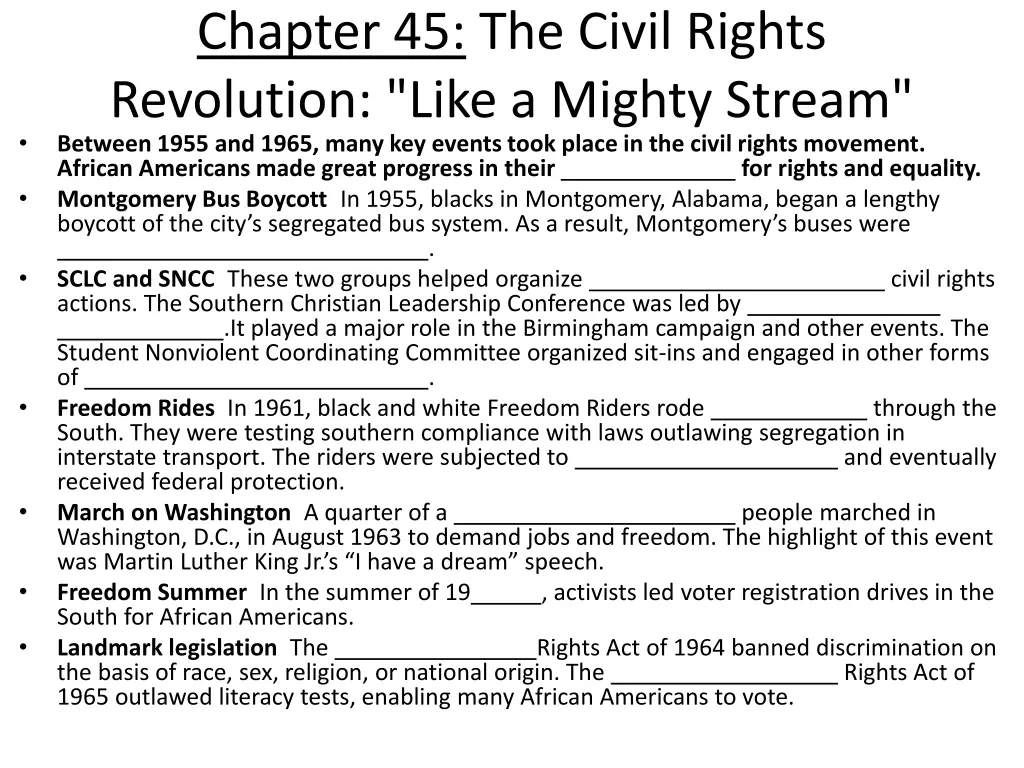
Chapter 45: The Civil Rights Revolution: "Like a Mighty Stream" Between 1955 and 1965, many key events took place in the civil rights movement. African Americans made great progress in their Montgomery Bus Boycott In 1955, blacks in Montgomery, Alabama, began a lengthy boycott of the city s segregated bus system. As a result, Montgomery s buses were . SCLC and SNCC These two groups helped organize actions. The Southern Christian Leadership Conference was led by .It played a major role in the Birmingham campaign and other events. The Student Nonviolent Coordinating Committee organized sit-ins and engaged in other forms of . Freedom Rides In 1961, black and white Freedom Riders rode South. They were testing southern compliance with laws outlawing segregation in interstate transport. The riders were subjected to received federal protection. March on Washington A quarter of a Washington, D.C., in August 1963 to demand jobs and freedom. The highlight of this event was Martin Luther King Jr. s I have a dream speech. Freedom Summer In the summer of 19 South for African Americans. Landmark legislation The the basis of race, sex, religion, or national origin. The 1965 outlawed literacy tests, enabling many African Americans to vote. for rights and equality. civil rights through the and eventually people marched in , activists led voter registration drives in the Rights Act of 1964 banned discrimination on Rights Act of
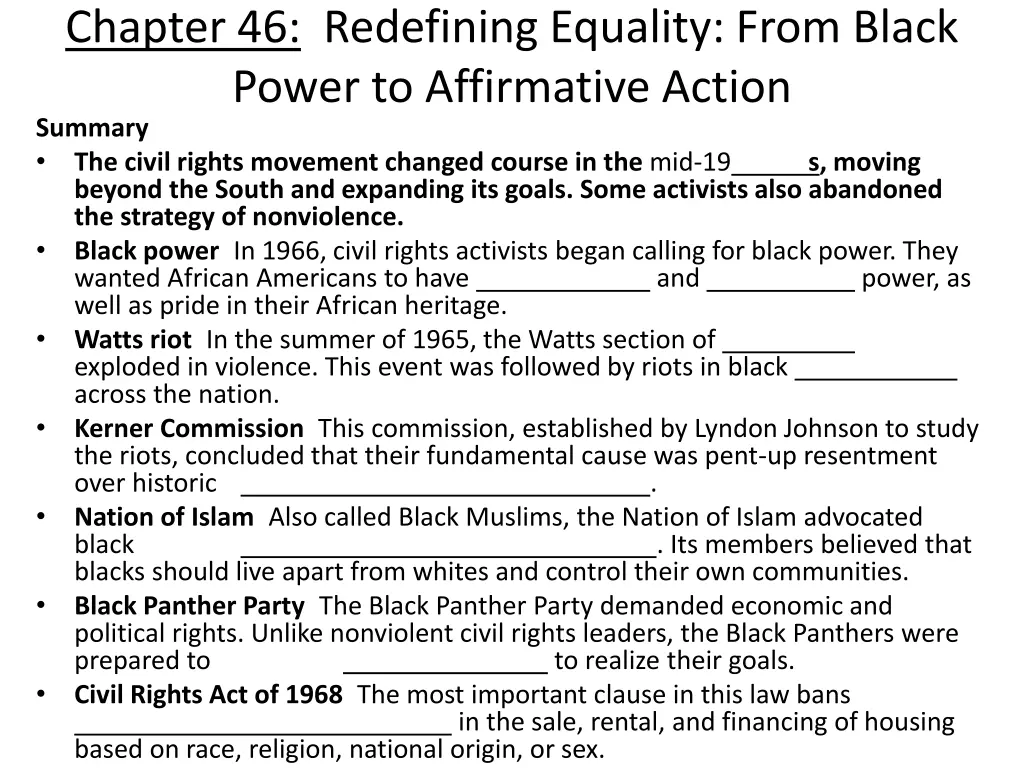
Chapter 46: Redefining Equality: From Black Power to Affirmative Action Summary The civil rights movement changed course in the mid-19 s, moving beyond the South and expanding its goals. Some activists also abandoned the strategy of nonviolence. Black power In 1966, civil rights activists began calling for black power. They wanted African Americans to have well as pride in their African heritage. Watts riot In the summer of 1965, the Watts section of exploded in violence. This event was followed by riots in black across the nation. Kerner Commission This commission, established by Lyndon Johnson to study the riots, concluded that their fundamental cause was pent-up resentment over historic Nation of Islam Also called Black Muslims, the Nation of Islam advocated black blacks should live apart from whites and control their own communities. Black Panther Party The Black Panther Party demanded economic and political rights. Unlike nonviolent civil rights leaders, the Black Panthers were prepared to Civil Rights Act of 1968 The most important clause in this law bans in the sale, rental, and financing of housing based on race, religion, national origin, or sex. and power, as . . Its members believed that to realize their goals.