Classes of Hollow Roots and Hiphil Qatal in Hebrew Grammar
Explore the identification and reading of several classes of hollow roots in Hiphil Qatal, focusing on Qal Qatal verbs. Understand the characteristics, similarities, and differences in the paradigms, as well as the significance of Stative, Dynamic, and Intransitive verbs in this context.

Download Presentation

Please find below an Image/Link to download the presentation.
The content on the website is provided AS IS for your information and personal use only. It may not be sold, licensed, or shared on other websites without obtaining consent from the author. If you encounter any issues during the download, it is possible that the publisher has removed the file from their server.
You are allowed to download the files provided on this website for personal or commercial use, subject to the condition that they are used lawfully. All files are the property of their respective owners.
The content on the website is provided AS IS for your information and personal use only. It may not be sold, licensed, or shared on other websites without obtaining consent from the author.
E N D
Presentation Transcript
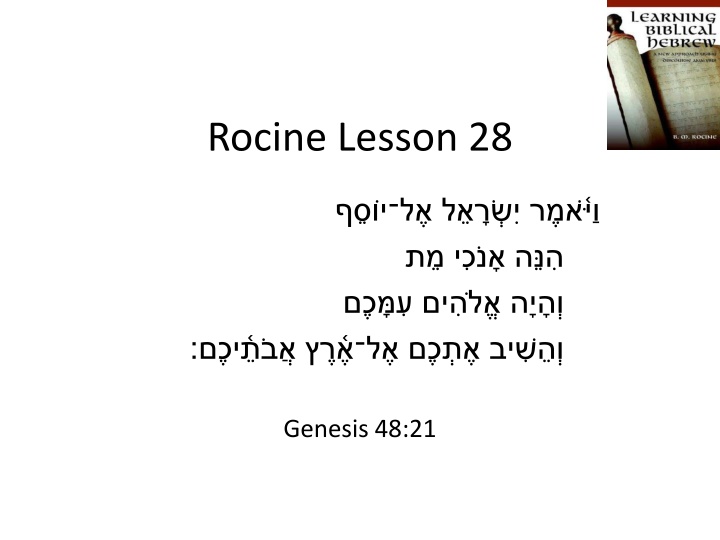
Rocine Lesson 28 Genesis 48:21
Goals Identify and read Several Classes of Hollow Roots Hiphil Qatal of Hollow Roots
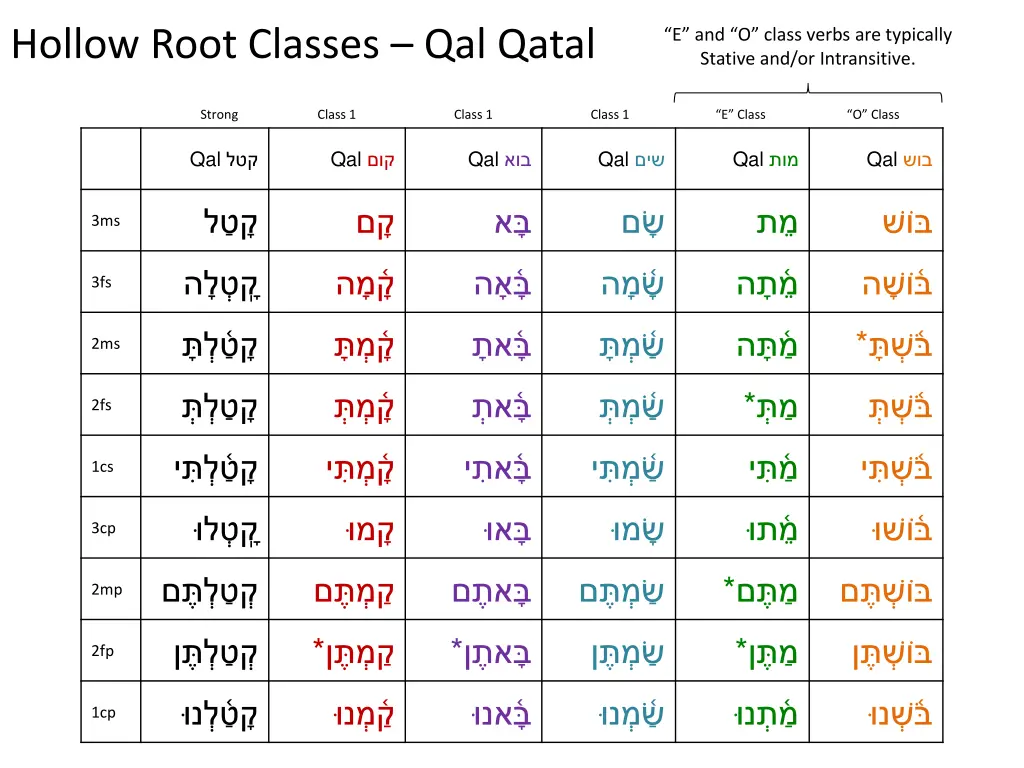
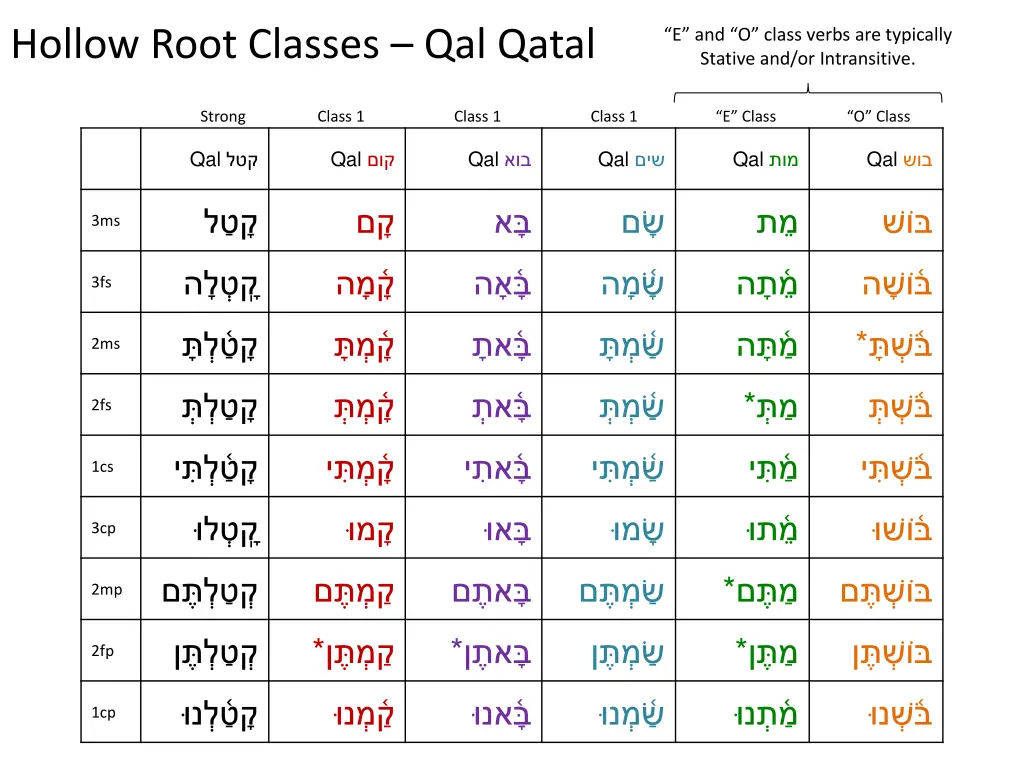
Hollow Root Classes Qal Qatal E and O class verbs are typically Stative and/or Intransitive. Strong Class 1 Class 1 Class 1 E Class O Class Qal Qal Qal Qal Qal Qal 3ms 3fs * 2ms * 2fs 1cs 3cp * 2mp * * * 2fp 1cp
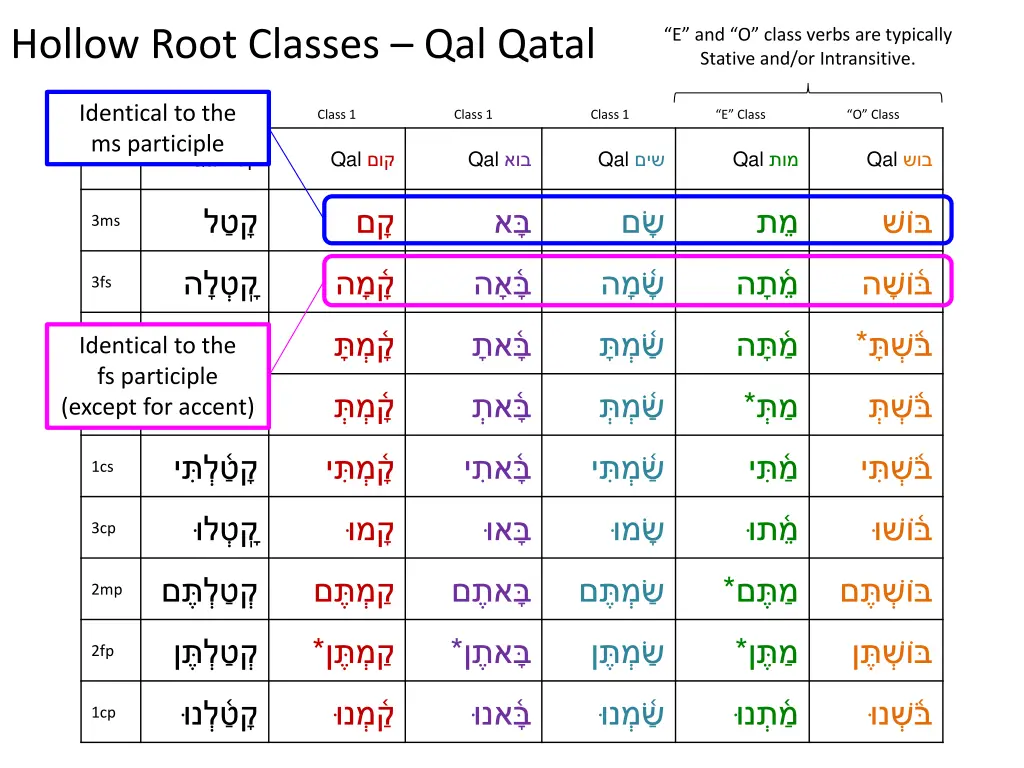
Hollow Root Classes Qal Qatal E and O class verbs are typically Stative and/or Intransitive. Identical to the ms participle Strong Class 1 Class 1 Class 1 E Class O Class Qal Qal Qal Qal Qal Qal 3ms 3fs * 2ms Identical to the fs participle (except for accent) * 2fs 1cs 3cp * 2mp * * * 2fp 1cp
Hollow Roots Qal Qatal In the tables in the next slide, note as many similarities and differences as you can find between the paradigms.
Hollow Root Classes Qal Qatal E and O class verbs are typically Stative and/or Intransitive. Strong Class 1 Class 1 Class 1 E Class O Class Qal Qal Qal Qal Qal Qal 3ms 3fs * 2ms * 2fs 1cs 3cp * 2mp * * * 2fp 1cp
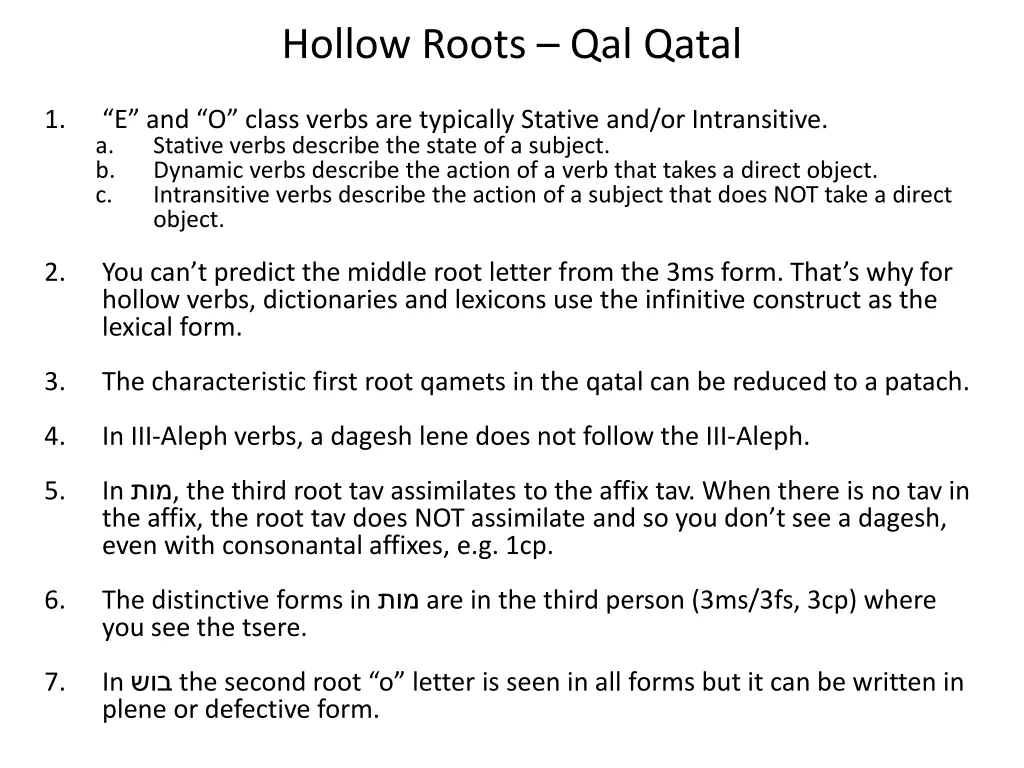
Hollow Roots Qal Qatal 1. E and O class verbs are typically Stative and/or Intransitive. a. Stative verbs describe the state of a subject. b. Dynamic verbs describe the action of a verb that takes a direct object. c. Intransitive verbs describe the action of a subject that does NOT take a direct object. 2. You can t predict the middle root letter from the 3ms form. That s why for hollow verbs, dictionaries and lexicons use the infinitive construct as the lexical form. 3. The characteristic first root qamets in the qatal can be reduced to a patach. 4. In III-Aleph verbs, a dagesh lene does not follow the III-Aleph. In , the third root tav assimilates to the affix tav. When there is no tav in the affix, the root tav does NOT assimilate and so you don t see a dagesh, even with consonantal affixes, e.g. 1cp. 5. The distinctive forms in are in the third person (3ms/3fs, 3cp) where you see the tsere. 6. In the second root o letter is seen in all forms but it can be written in plene or defective form. 7.
Hiphil Qatal (Strong, I-Yod, Hollow) In the tables in the next slide, note as many similarities and differences as you can find between the paradigms.
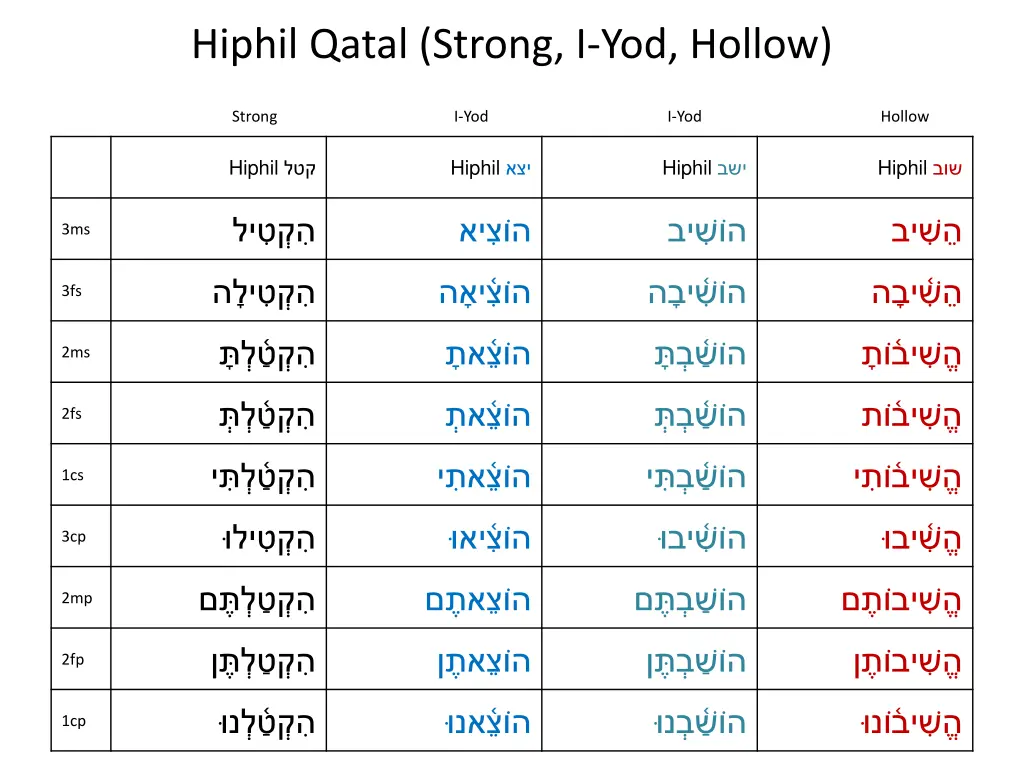
Hiphil Qatal (Strong, I-Yod, Hollow) Strong I-Yod I-Yod Hollow Hiphil Hiphil Hiphil Hiphil 3ms 3fs 2ms 2fs 1cs 3cp 2mp 2fp 1cp
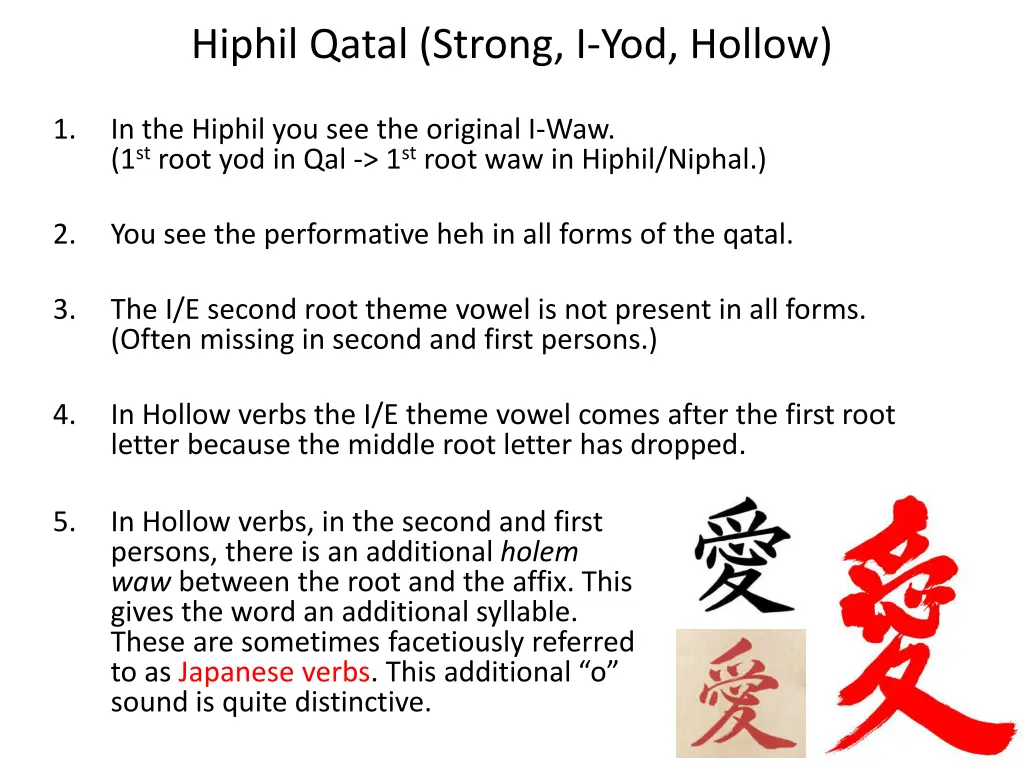
Hiphil Qatal (Strong, I-Yod, Hollow) 1. In the Hiphil you see the original I-Waw. (1st root yod in Qal -> 1st root waw in Hiphil/Niphal.) 2. You see the performative heh in all forms of the qatal. 3. The I/E second root theme vowel is not present in all forms. (Often missing in second and first persons.) 4. In Hollow verbs the I/E theme vowel comes after the first root letter because the middle root letter has dropped. 5. In Hollow verbs, in the second and first persons, there is an additional holem waw between the root and the affix. This gives the word an additional syllable. These are sometimes facetiously referred to as Japanese verbs. This additional o sound is quite distinctive.
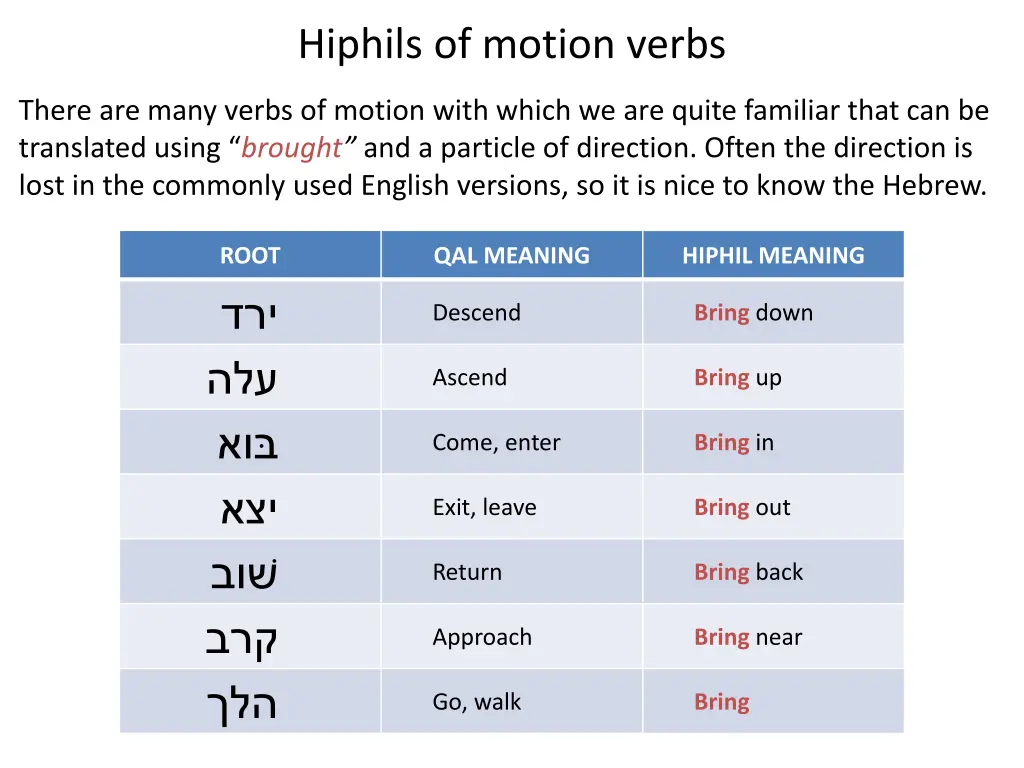
Hiphils of motion verbs There are many verbs of motion with which we are quite familiar that can be translated using brought and a particle of direction. Often the direction is lost in the commonly used English versions, so it is nice to know the Hebrew. ROOT QAL MEANING HIPHIL MEANING Descend Bring down Ascend Bring up Come, enter Bring in Exit, leave Bring out Return Bring back Approach Bring near Go, walk Bring