Classical Encryption Techniques and Cryptography Overview
"Explore classical encryption techniques, symmetric cipher models, conventional cryptosystems, and the fundamental concepts of cryptography and cryptanalysis. Learn about plaintext, ciphertext, secret keys, and decryption algorithms in this comprehensive guide."

Download Presentation

Please find below an Image/Link to download the presentation.
The content on the website is provided AS IS for your information and personal use only. It may not be sold, licensed, or shared on other websites without obtaining consent from the author. If you encounter any issues during the download, it is possible that the publisher has removed the file from their server.
You are allowed to download the files provided on this website for personal or commercial use, subject to the condition that they are used lawfully. All files are the property of their respective owners.
The content on the website is provided AS IS for your information and personal use only. It may not be sold, licensed, or shared on other websites without obtaining consent from the author.
E N D
Presentation Transcript
INTRODUCTION Plaintext: original message Cipher text: coded message Enciphering or encryption: the process of converting from plaintext to cipher text Deciphering or decryption: the process of restoring the plaintext from the cipher text The many schemes used for encryption constitute the area of study known as cryptography. Such a scheme is known as a cipher. Techniques used for deciphering a message without any knowledge of the enciphering details fall into the area of cryptanalysis. Cryptanalysis is what the layperson calls "breaking the code". The areas of cryptography and cryptanalysis together are calledcryptology.
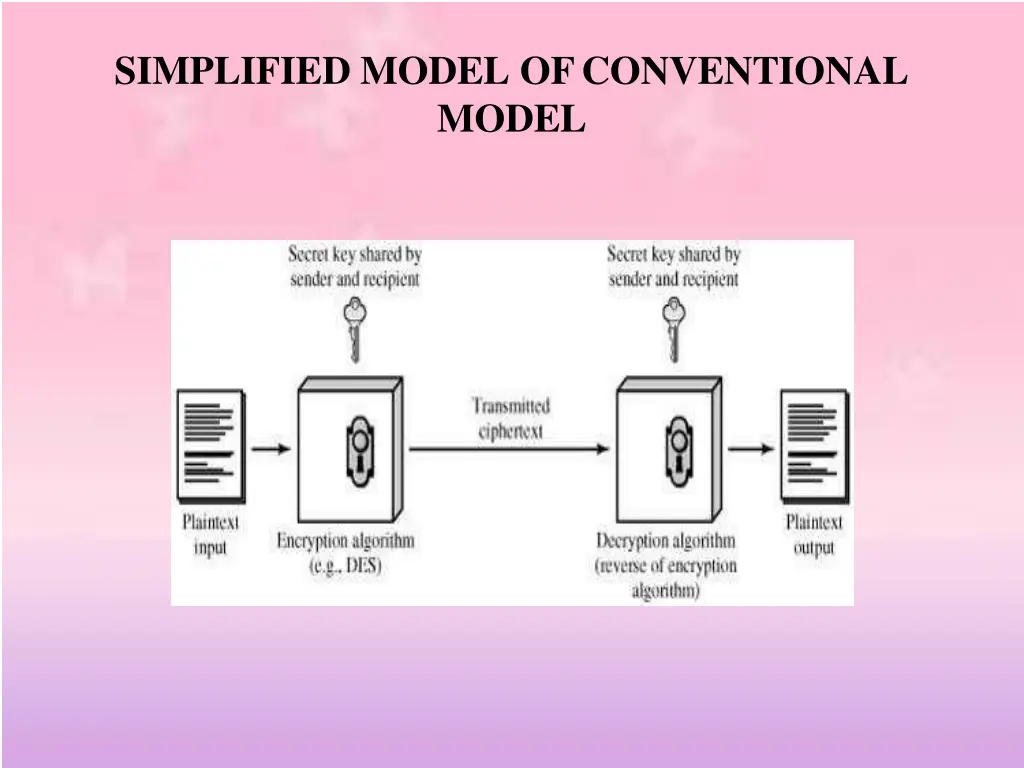
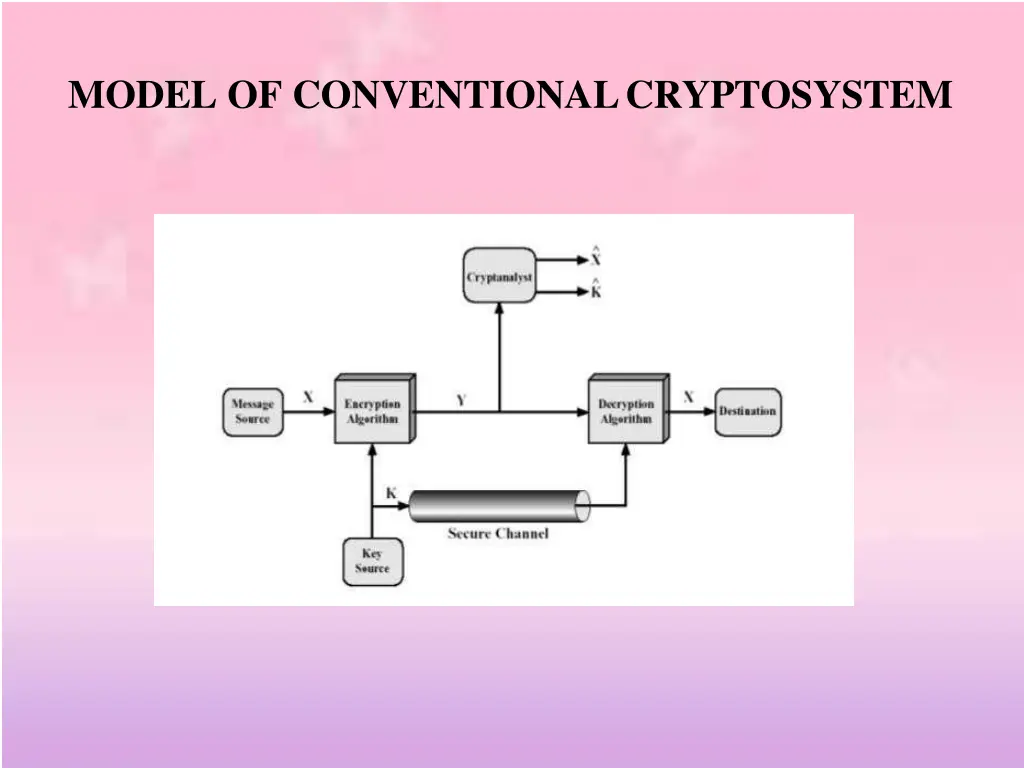
SYMMETRIC CIPHER MODEL A symmetric encryption scheme has fiveingredients Plain text This is the original intelligible message or data that is fed into the algorithm as input. EncryptionAlgorithm The encryption algorithm performs various substitutions and transformations on the plaintext.
Secret key The secret key is also input to the encryption algorithm. The algorithm will produce a different output depending on the specific key begin used at the time. The exact substitutions and transformations performed by the algorithm depend on the key. Ciphertext This is the scrambled message produced as output. It depends on the plaintext and Secret key. Two different keys will produce two different cipher texts. The cipher text is an apparently random stream ofdata. Decryption Algorithm This is essentially the encryption algorithm run is reverse. It takes the cipher text and the secret key and produces the original plaintext.
Symmetric cipher model has two types. There are: Cryptography Cryptanalysis
CRYPTOGRAPHY Cryptographic system are characterized along three independentdimensions: The type of operations used for transforming plaintext to cipher text All encryption algorithms based on two principles: substitution , in which each element in the plaintext (bit , letter , group of bits or letters) is mapped into another element and transposition , in which elements in the plain text are rearranged. Most systems , referred to as product systems multiple stages of substitutions and transpositions.
The number of keysused If both sender and receiver use the same key , the system is referred to as symmetric , single-key , secret-key or conventional encryption. If the sender and receiver use different keys , the system is referred to as asymmetric , two- key or public-keyencryption. The way in which the plaintext is processed A block cipher processes the input one block of elements at a time , producing an output block for each input block. A stream cipher processes the input elements continuously , producing output one element at atime.
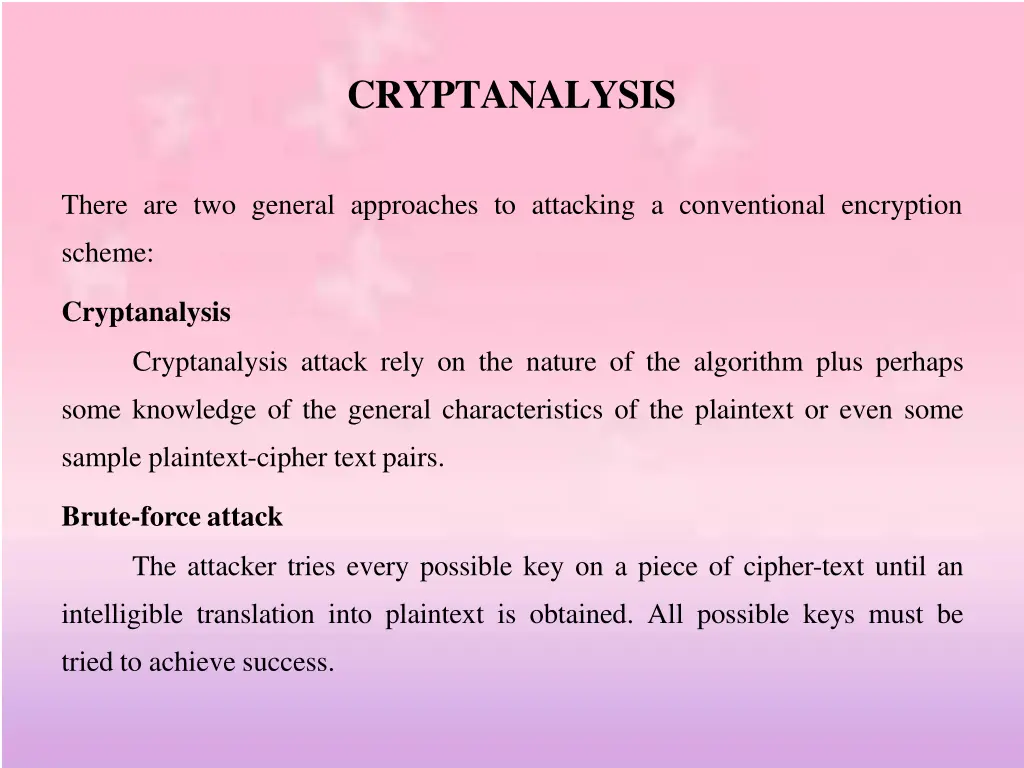
CRYPTANALYSIS There are two general approaches to attacking a conventional encryption scheme: Cryptanalysis Cryptanalysis attack rely on the nature of the algorithm plus perhaps some knowledge of the general characteristics of the plaintext or even some sample plaintext-cipher text pairs. Brute-force attack The attacker tries every possible key on a piece of cipher-text until an intelligible translation into plaintext is obtained. All possible keys must be tried to achieve success.
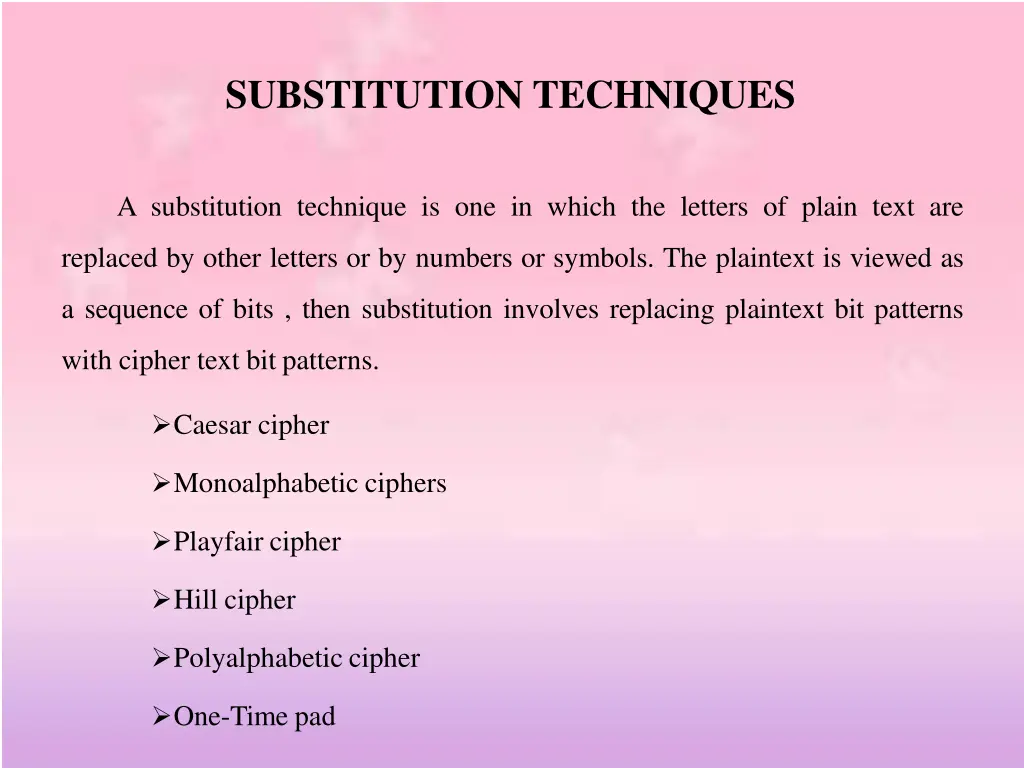
SUBSTITUTION TECHNIQUES A substitution technique is one in which the letters of plain text are replaced by other letters or by numbers or symbols. The plaintext is viewed as a sequence of bits , then substitution involves replacing plaintext bit patterns with cipher text bit patterns. Caesar cipher Monoalphabetic ciphers Playfair cipher Hill cipher Polyalphabetic cipher One-Time pad
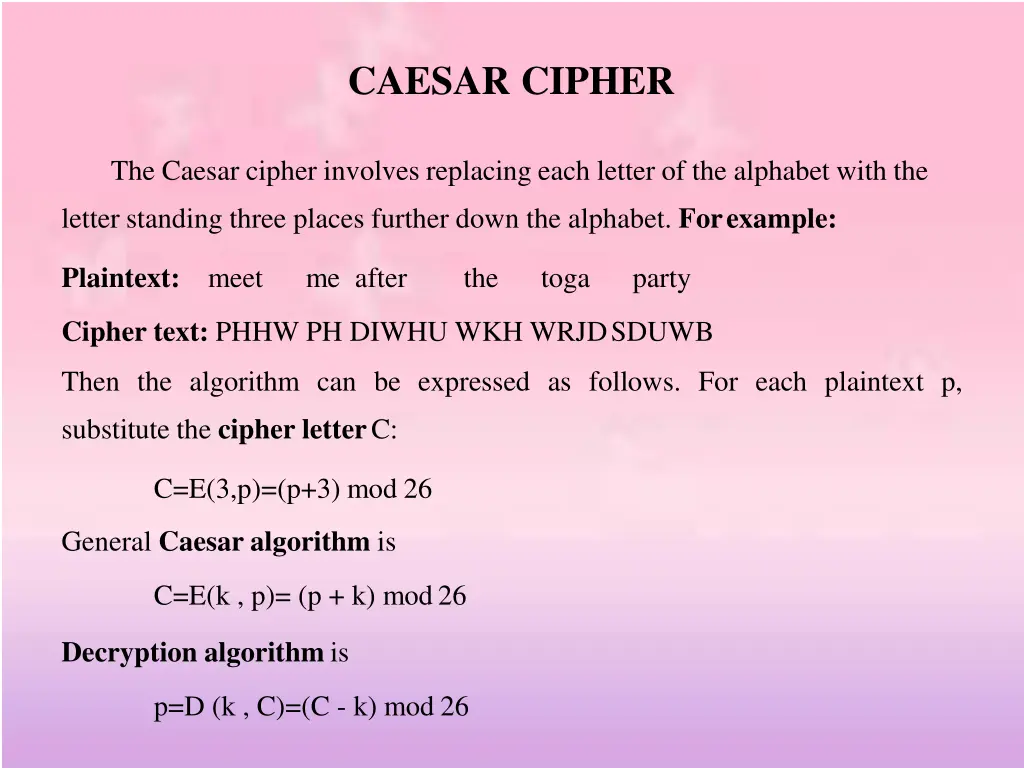
CAESAR CIPHER The Caesar cipher involves replacing each letter of the alphabet with the letter standing three places further down the alphabet. Forexample: Plaintext: meet me after the toga party Cipher text: PHHW PH DIWHU WKH WRJDSDUWB Then the algorithm can be expressed as follows. For each plaintext p, substitute the cipher letterC: C=E(3,p)=(p+3) mod 26 General Caesar algorithm is C=E(k , p)= (p + k) mod26 Decryption algorithmis p=D (k , C)=(C - k) mod 26
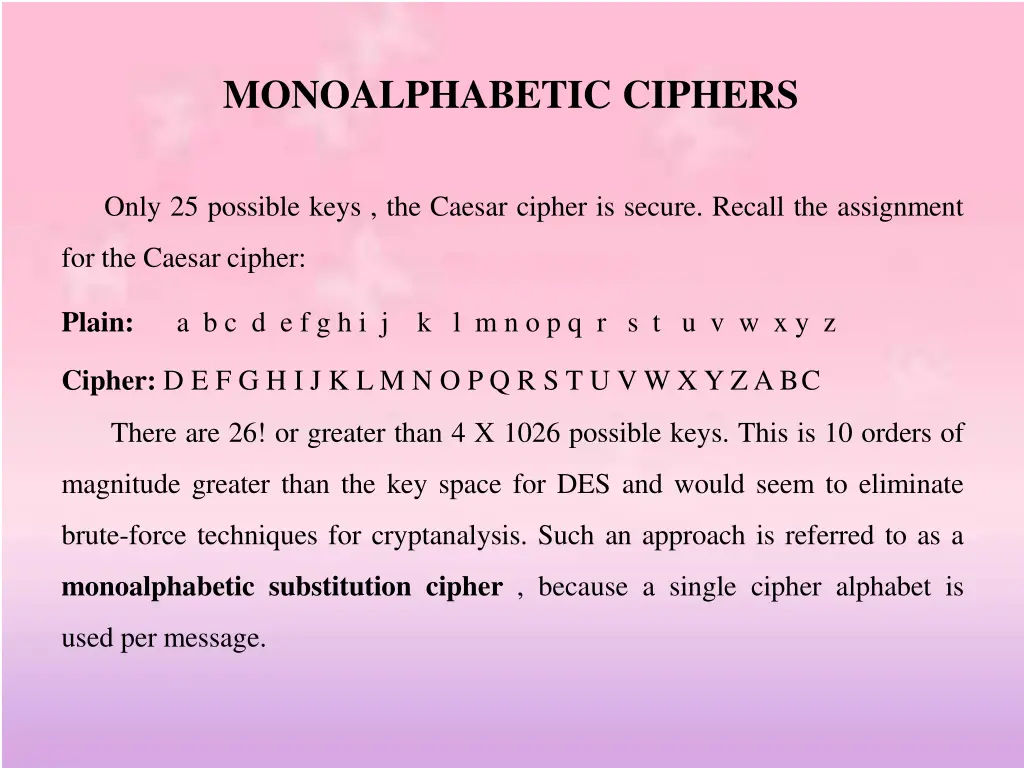
MONOALPHABETIC CIPHERS Only 25 possible keys , the Caesar cipher is secure. Recall the assignment for the Caesar cipher: Plain: a b c d e f g h i j k l m n o p q r s t u v w x y z Cipher: D E F G H I J K L M N O P Q R S T U V W X Y Z A BC There are 26! or greater than 4 X 1026 possible keys. This is 10 orders of magnitude greater than the key space for DES and would seem to eliminate brute-force techniques for cryptanalysis. Such an approach is referred to as a monoalphabetic substitution cipher , because a single cipher alphabet is used per message.
PLAYFAIR CIPHER The playfair algorithm is based on the use of a 5 X 5 matrix of letters constructed using a keyword is monarchy. The matrix is constructed by filling in the letter of the keyword from left to right and from top to bottom , and then filling in the remainder of the matrix with the remaining letters in alphabetic order.The letters I and J count as oneletter. M O N A R C H Y B D E F G I/J K L P Q S T U V W X Z
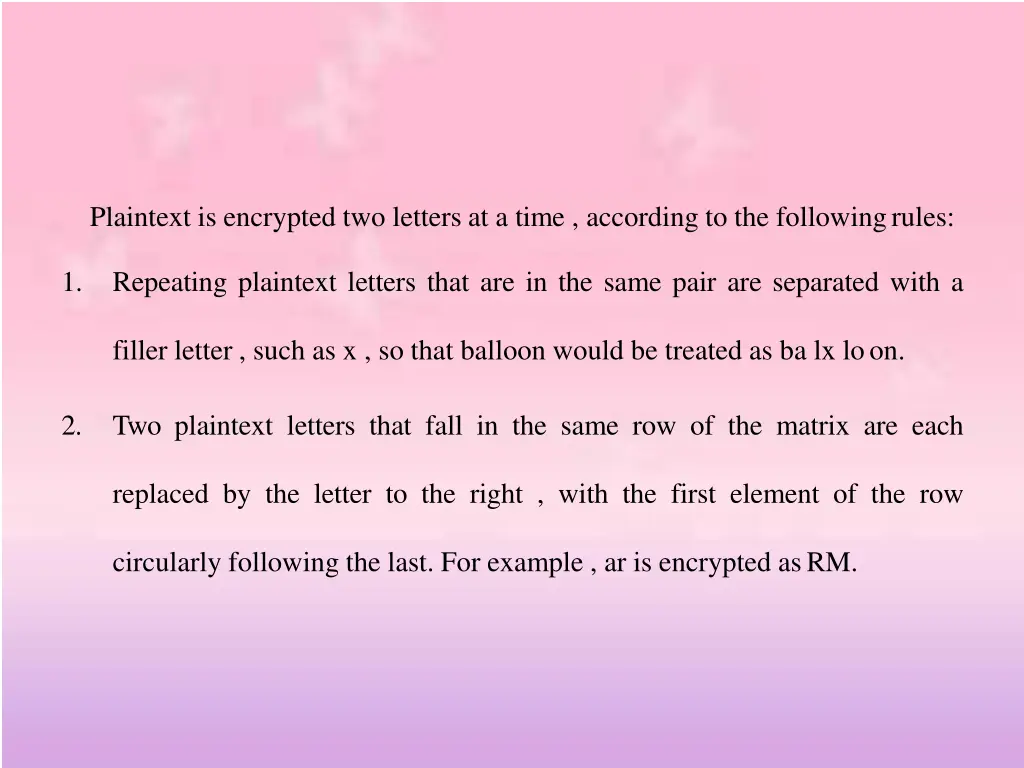
Plaintext is encrypted two letters at a time , according to the followingrules: 1. Repeating plaintext letters that are in the same pair are separated with a filler letter , such as x , so that balloon would be treated as ba lx loon. 2. Two plaintext letters that fall in the same row of the matrix are each replaced by the letter to the right , with the first element of the row circularly following the last. For example , ar is encrypted asRM.
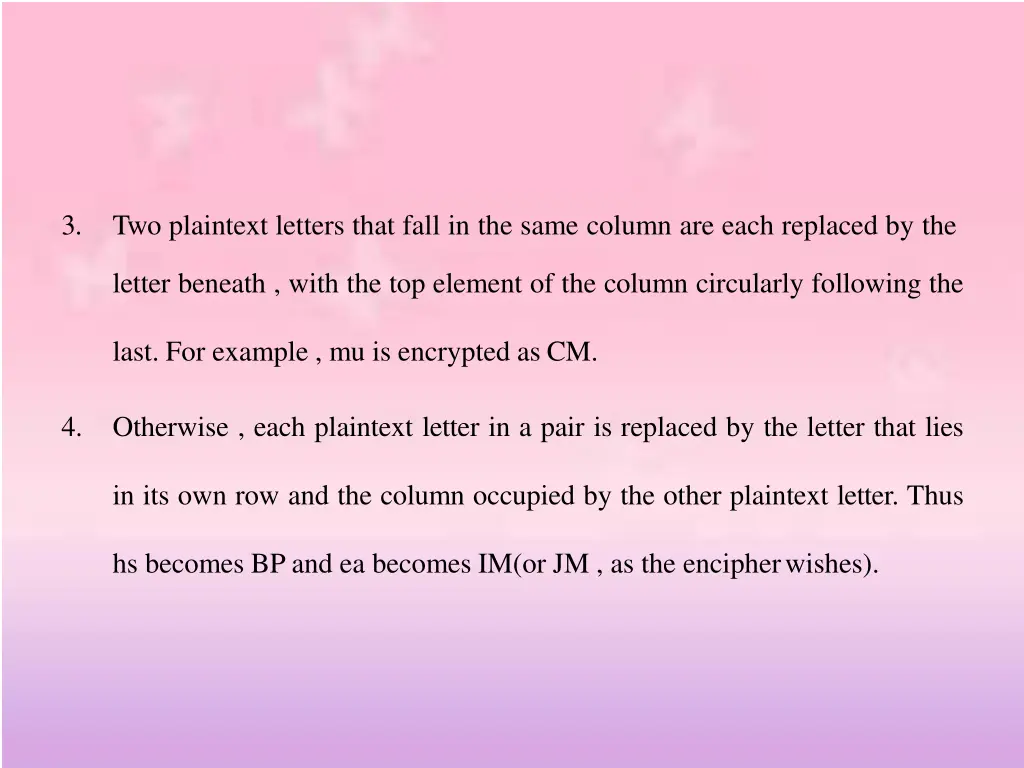
3. Two plaintext letters that fall in the same column are each replaced by the letter beneath , with the top element of the column circularly following the last. For example , mu is encrypted as CM. 4. Otherwise , each plaintext letter in a pair is replaced by the letter that lies in its own row and the column occupied by the other plaintext letter. Thus hs becomes BP and ea becomes IM(or JM , as the encipherwishes).
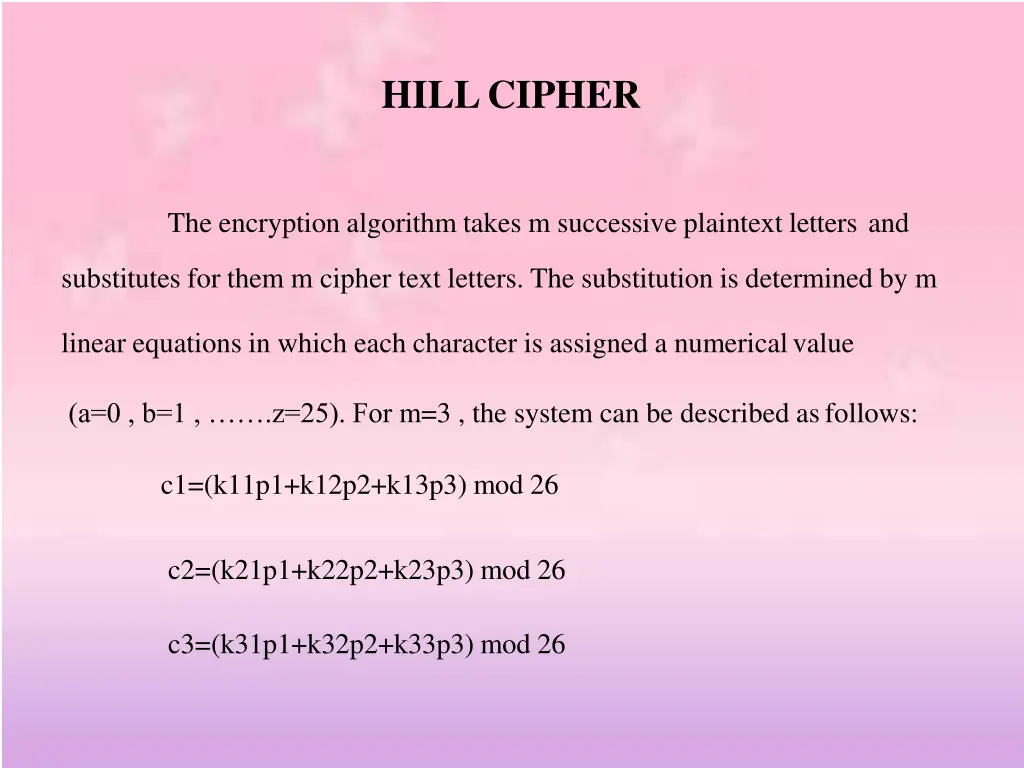
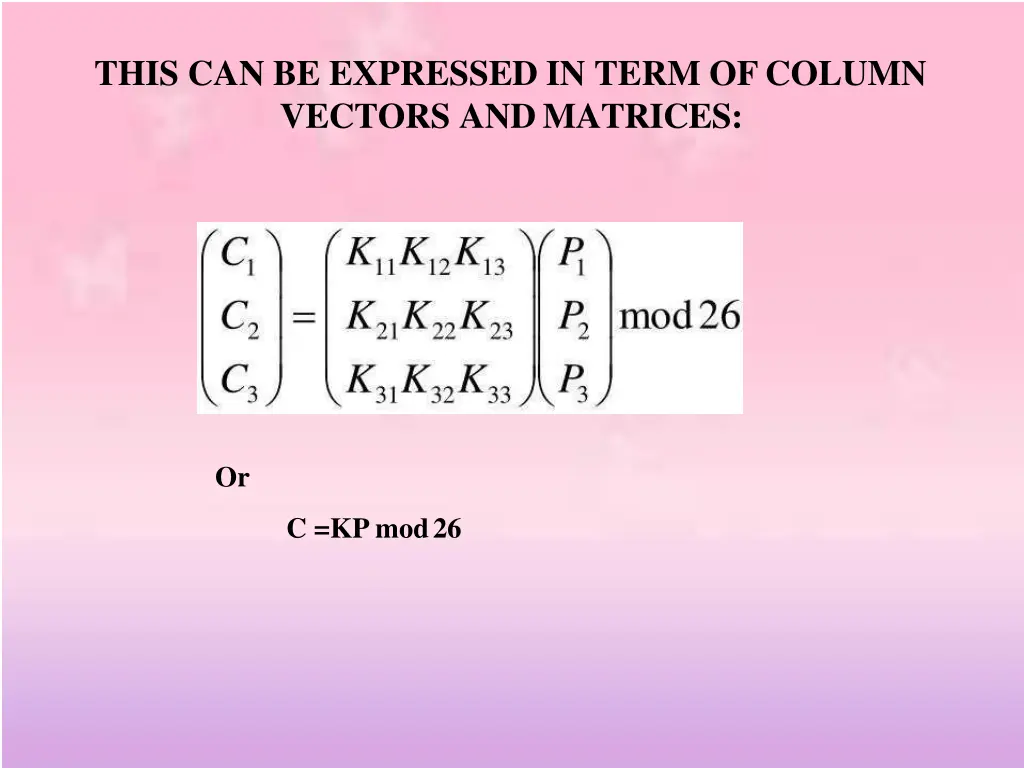
HILLCIPHER The encryption algorithm takes m successive plaintext letters and substitutes for them m cipher text letters. The substitution is determined by m linear equations in which each character is assigned a numericalvalue (a=0 , b=1 , .z=25). For m=3 , the system can be described asfollows: c1=(k11p1+k12p2+k13p3) mod 26 c2=(k21p1+k22p2+k23p3) mod 26 c3=(k31p1+k32p2+k33p3) mod 26
THIS CAN BE EXPRESSED IN TERM OFCOLUMN VECTORS ANDMATRICES: Or C =KP mod26
POLYALHABETIC CIPHERS Another way to improve on the simple monoalphabetic technique is to use different monoalphabetic substitutions as one proceeds through the plaintext message. The general name for this approach is polyalphabetic substitution cipher. All these techniques have the following features in common: Aset of related monoalphabetic substitution rules isused. A key determined which particular rule is chosen for a given transformation
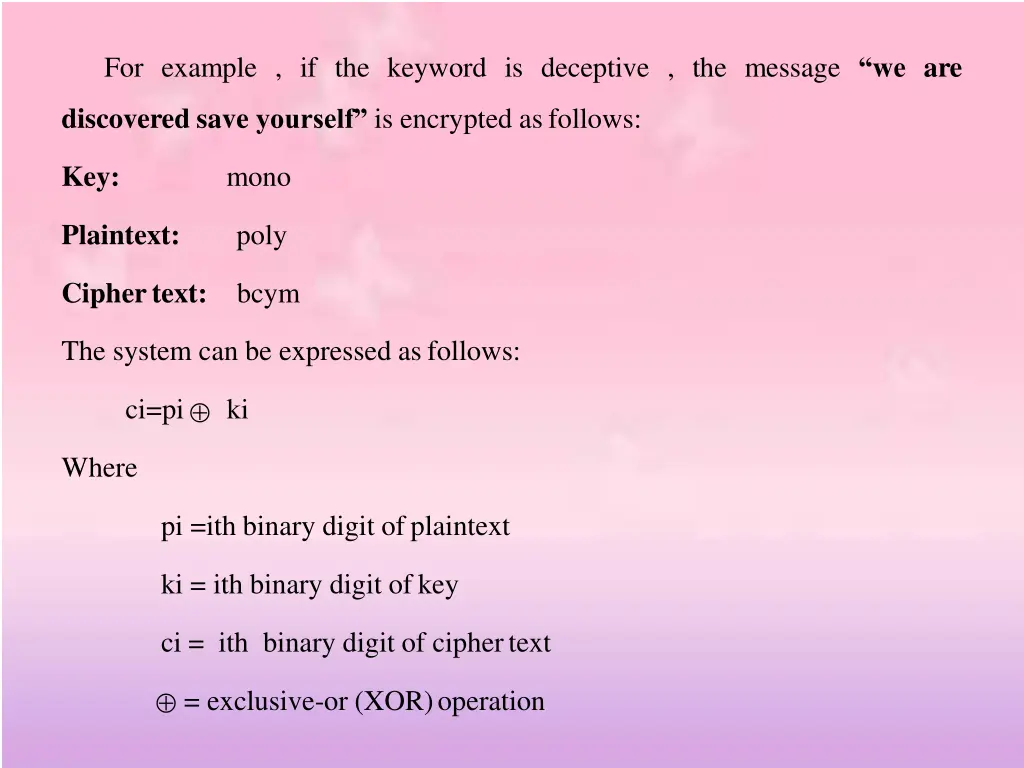
For example , if the keyword is deceptive , the message we are discovered save yourself is encrypted asfollows: Key: mono Plaintext: poly Ciphertext: bcym The system can be expressed asfollows: ci=pi ki Where pi =ith binary digit ofplaintext ki = ith binary digit ofkey ci = ith binary digit of ciphertext = exclusive-or (XOR)operation
ONE-TIME PAD It is a random key as long as the message , so that the key need not be repeated. The key is to be used to encrypt and decrypt a single message , and then is discarded. Each new message requires a new key of the same length as the new message. Such a scheme , known as one-timepad. Two fundamental difficulties: There is the practical problem of making large quantities of random keys. Every more daunting is the problem of key distribution and protection.