Explore the intricate dynamics of rigid bodies in classical mechanics, focusing on concepts like center of mass, moment of inertia tensor, and rotational analysis. Understand the distinction between motion in inertial and non-inertial frames for a comprehensive grasp of the topic.
Please find below an Image/Link to download the presentation.
The content on the website is provided AS IS for your information and personal use only. It may not be sold, licensed, or shared on other websites without obtaining consent from the author. If you encounter any issues during the download, it is possible that the publisher has removed the file from their server.
You are allowed to download the files provided on this website for personal or commercial use, subject to the condition that they are used lawfully. All files are the property of their respective owners.
The content on the website is provided AS IS for your information and personal use only. It may not be sold, licensed, or shared on other websites without obtaining consent from the author.
E N D
Presentation Transcript
PHY 711 Classical Mechanics and Mathematical Methods 10-10:50 AM MWF in Olin 103 Notes for Lecture 10: Rigid bodies Chap. 5 (F &W) 1. Rigid body motion 2. Notion of the center of mass 3. Moment of inertia tensor 4. Torque free motion 9/16/2024 PHY 711 Fall 2024-- Lecture 10 1
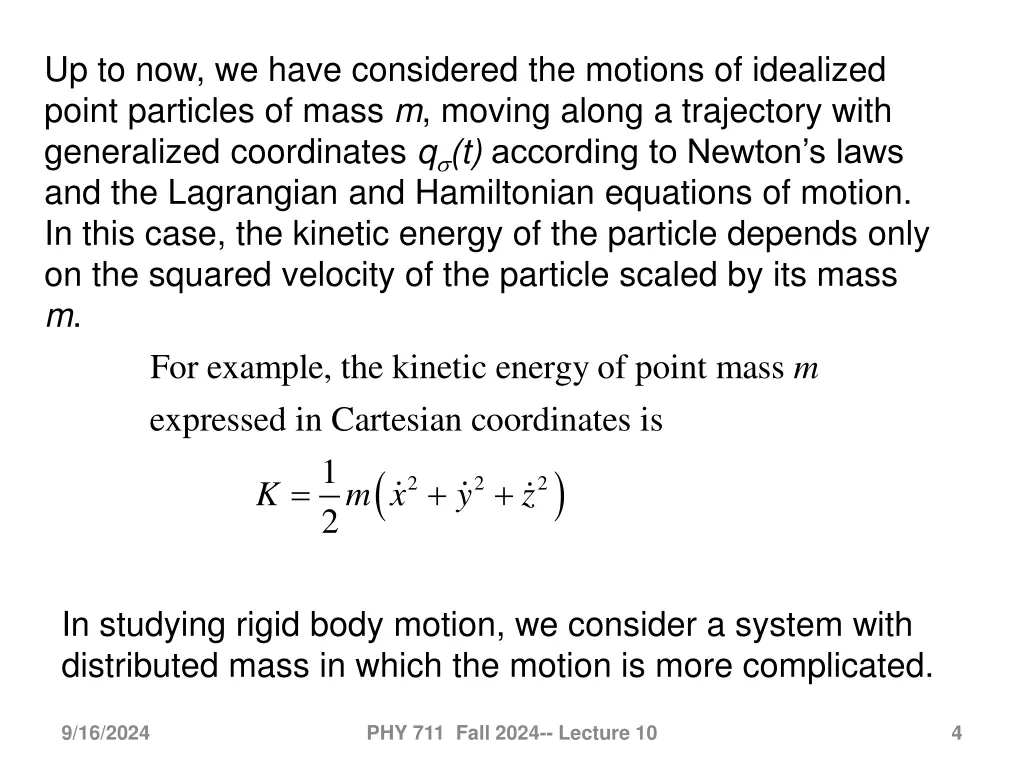
Up to now, we have considered the motions of idealized point particles of mass m, moving along a trajectory with generalized coordinates q (t)according to Newton s laws and the Lagrangian and Hamiltonian equations of motion. In this case, the kinetic energy of the particle depends only on the squared velocity of the particle scaled by its mass m. For example, the kinetic energy of point mass expressed in Cartesian coordinates is 1 2 m ( ) = + + 2 2 2 K m x y z In studying rigid body motion, we consider a system with distributed mass in which the motion is more complicated. 9/16/2024 PHY 711 Fall 2024-- Lecture 10 4
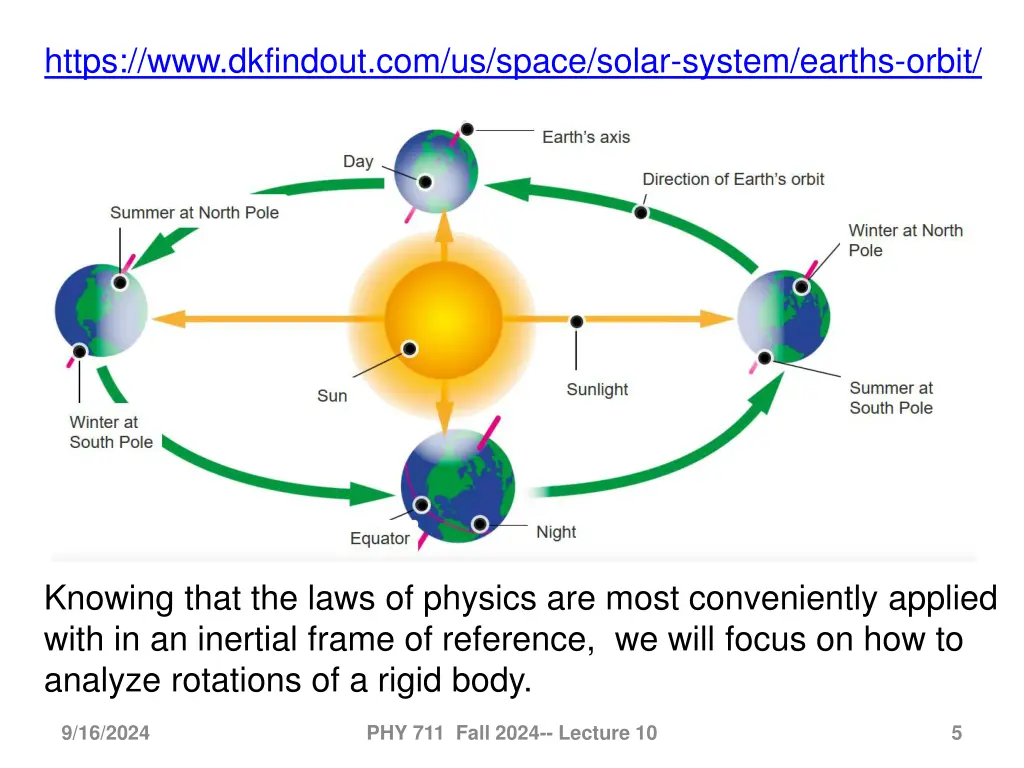
https://www.dkfindout.com/us/space/solar-system/earths-orbit/https://www.dkfindout.com/us/space/solar-system/earths-orbit/ Knowing that the laws of physics are most conveniently applied with in an inertial frame of reference, we will focus on how to analyze rotations of a rigid body. 9/16/2024 PHY 711 Fall 2024-- Lecture 10 5
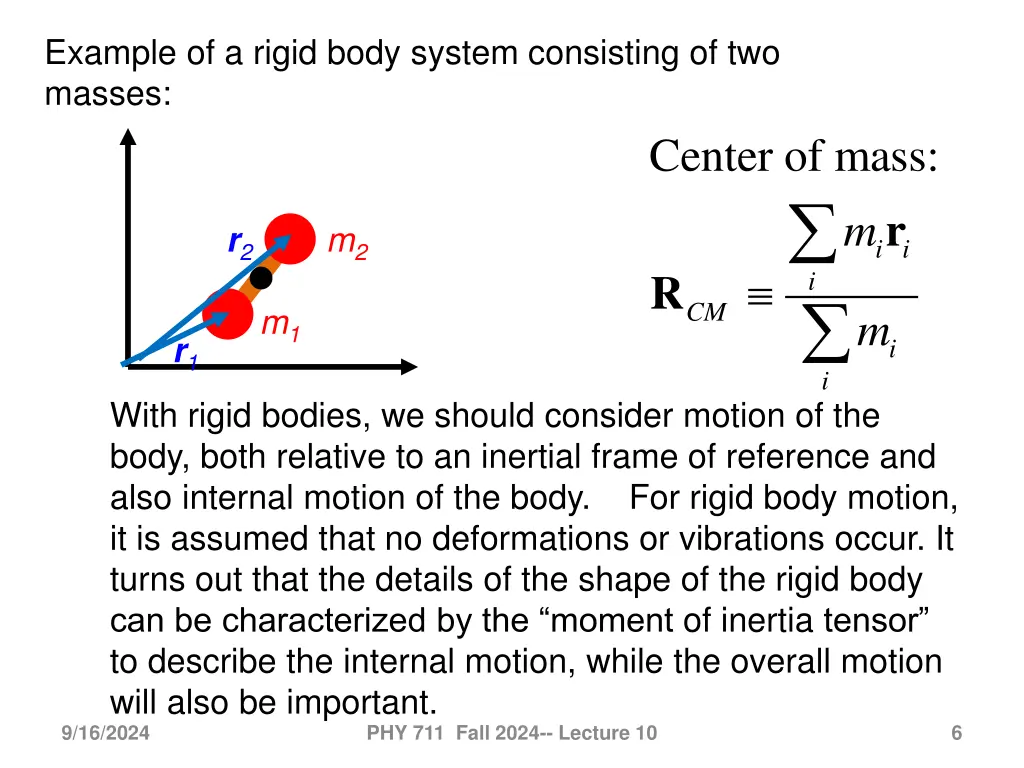
Example of a rigid body system consisting of two masses: Center of mass: R i i r m r2 m2 i CM m1 m r1 i i With rigid bodies, we should consider motion of the body, both relative to an inertial frame of reference and also internal motion of the body. For rigid body motion, it is assumed that no deformations or vibrations occur. It turns out that the details of the shape of the rigid body can be characterized by the moment of inertia tensor to describe the internal motion, while the overall motion will also be important. 9/16/2024 PHY 711 Fall 2024-- Lecture 10 6
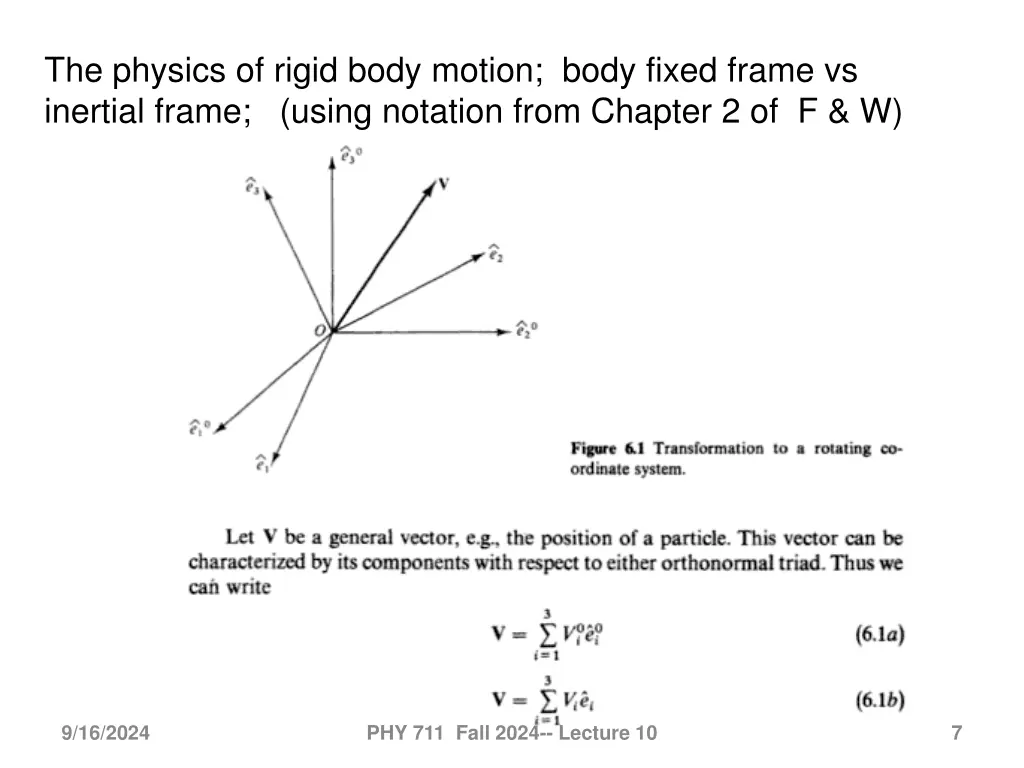
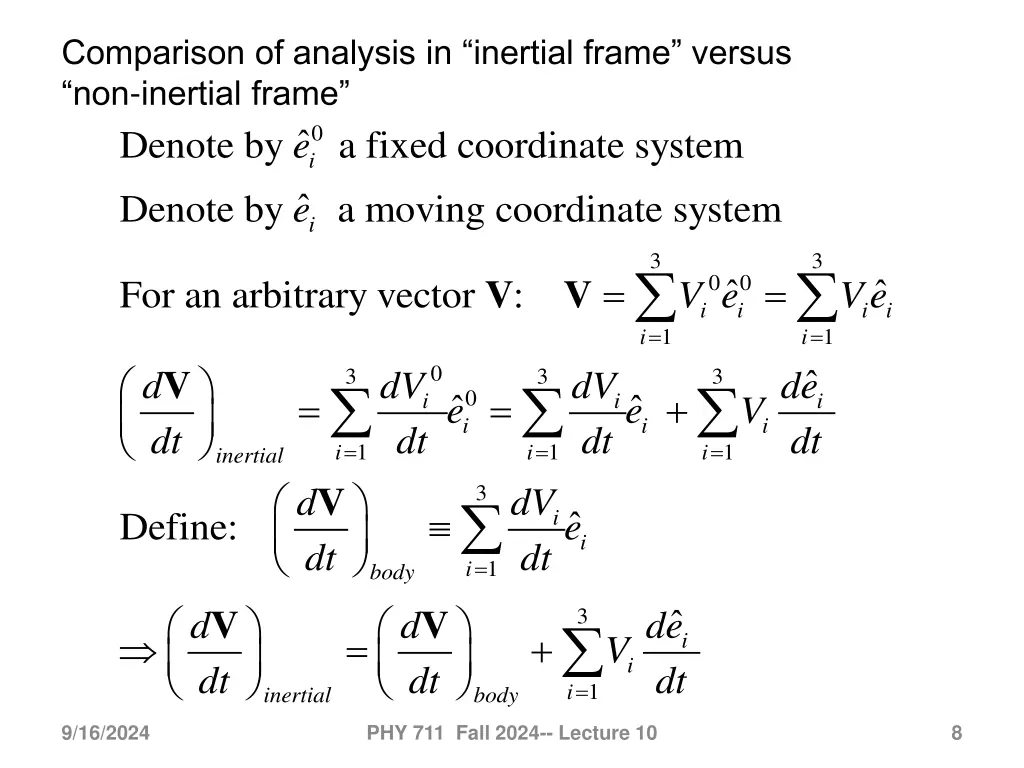
Comparison of analysis in inertial frame versus non-inertial frame 0 Denote by a fixed coordinate system Denote by a moving coordinate system i e e i 3 3 = = 0 0 V V For an arbitrary vector : V e Ve i i i i = = 1 1 i i 0 V dV dt dV dt de dt 3 3 3 d dt = = + 0 i e e i i i V i i = = = 1 1 1 i i i inertial V dV dt 3 d dt e Def ine: i i = 1 i body V V de dt 3 d dt d dt = + i V i = 1 i inertial body 9/16/2024 PHY 711 Fall 2024-- Lecture 10 8
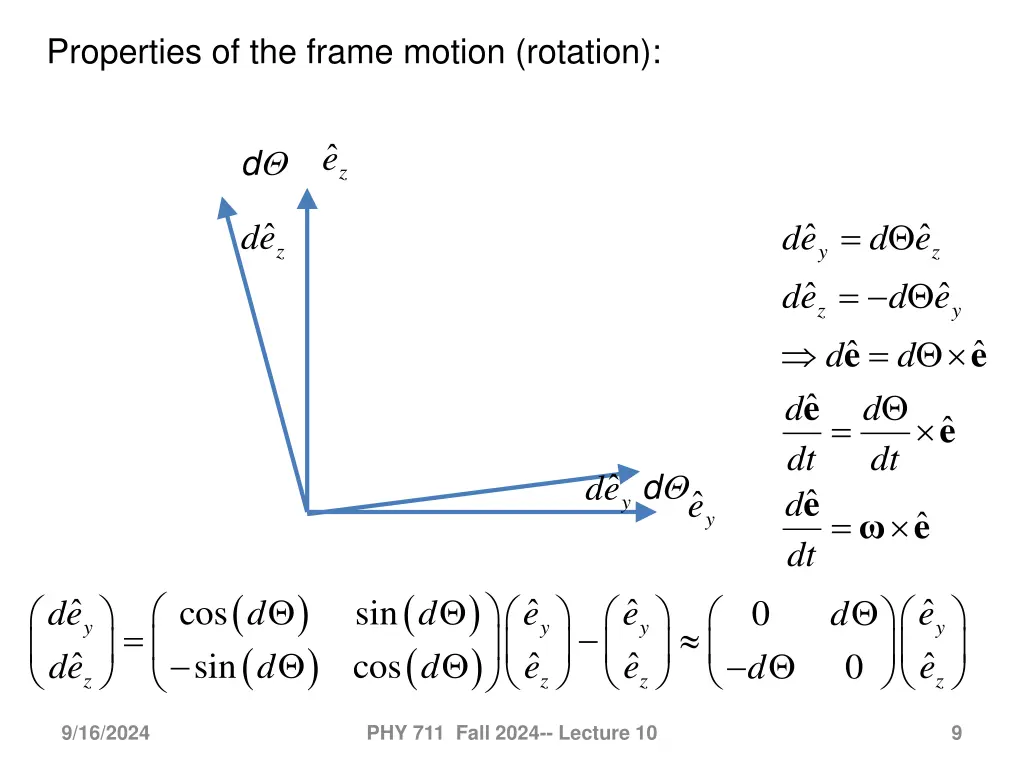
Properties of the frame motion (rotation): ze d = d e e ze d d y z = e e d d z y d = d e e d d dt e = e dt d y e d e y e d = e dt ( ) ( ( ) ) e e e cos sin sin cos d d d 0 d de de e e e d y y y y = ( ) d 0 z z z z 9/16/2024 PHY 711 Fall 2024-- Lecture 10 9
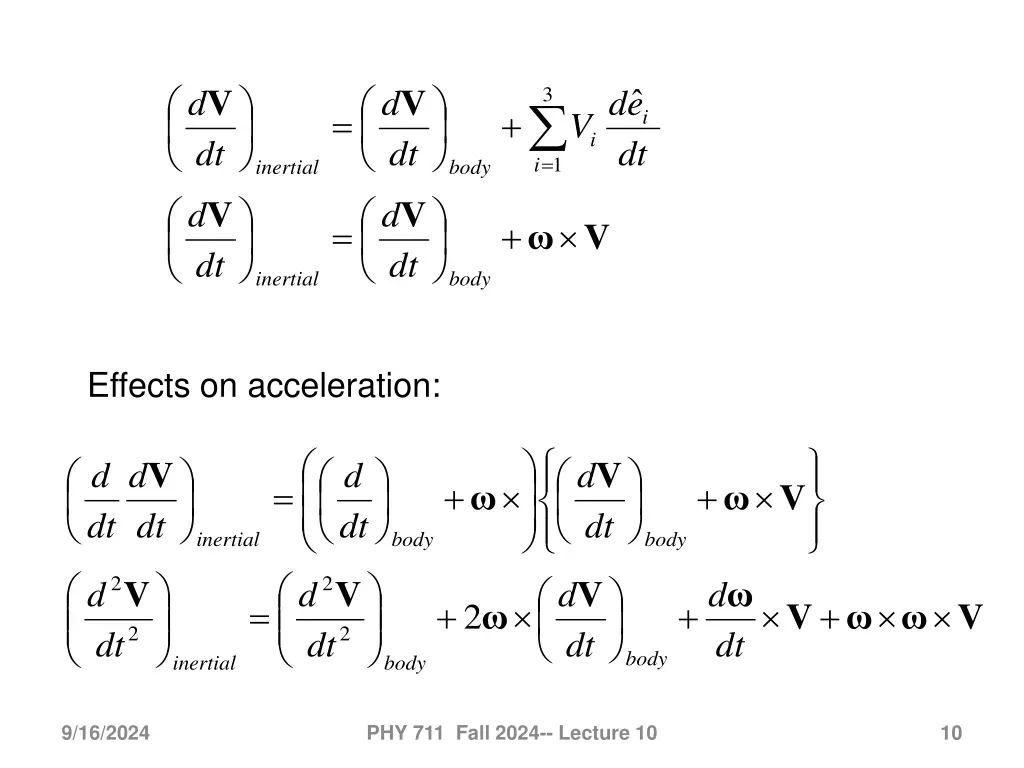
V dt V dt e 3 d d d = i = + i V i dt 1 inertial body V dt V dt d d = + V inertial body Effects on acceleration: V dt V dt d d d d d = + + V dt dt inertial body body 2 2 V 2 V 2 V dt d d d dt = + + + V V 2 dt dt body inertial body 9/16/2024 PHY 711 Fall 2024-- Lecture 10 10
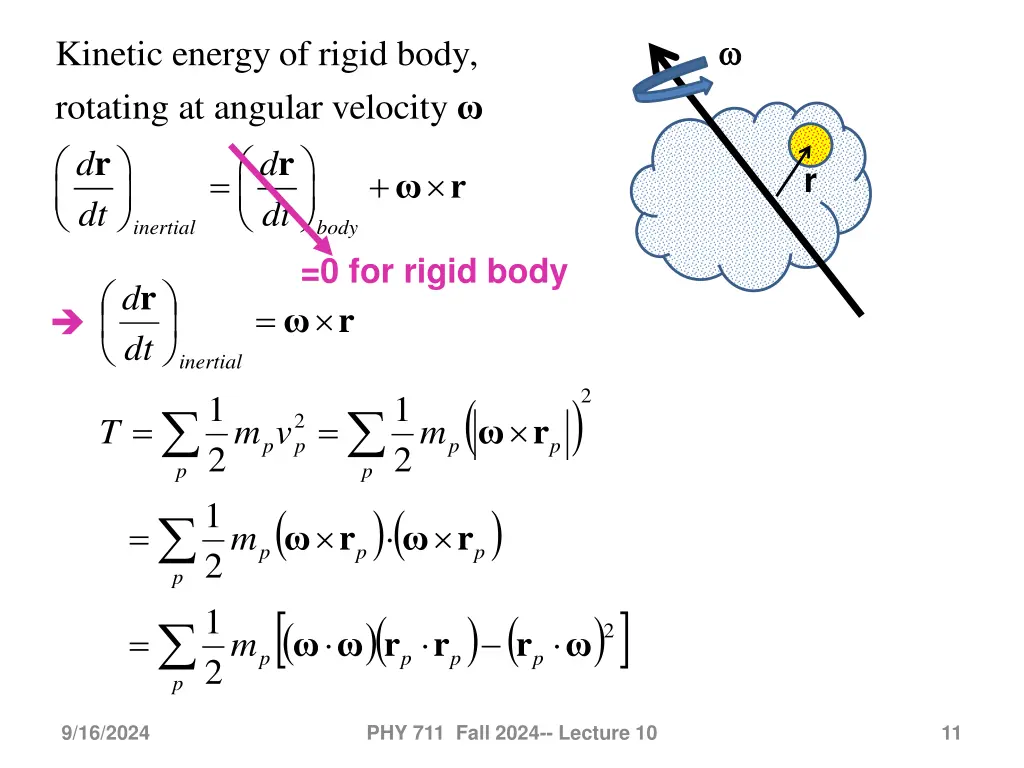
Kinetic energy of rigid body, rotating at angular velocity d d dt dt r r r = + r inertial body =0 for rigid body r d = r p dt inertial ( ) 2 1 1 p = = 2 p r T m v m p p p 2 2 ( )( ) 1 p = r r m p p p 2 )( ) ( ) 1 ( p 2 = r r r m p p p p 2 9/16/2024 PHY 711 Fall 2024-- Lecture 10 11
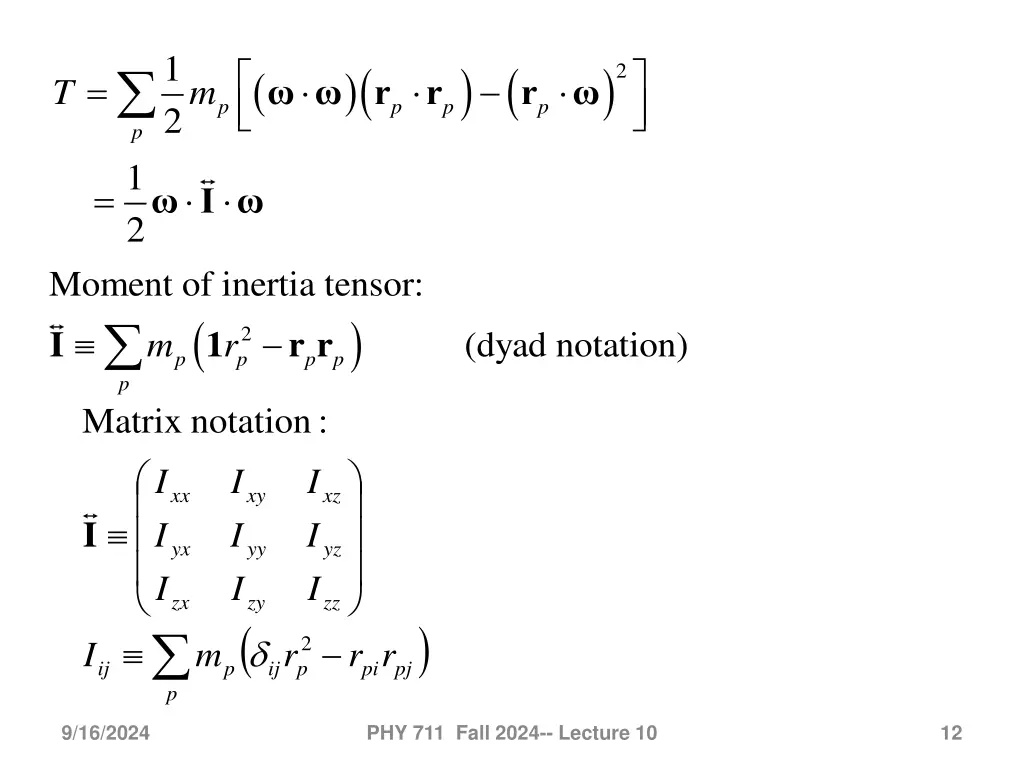
1 2 )( ) ( ) m 2 ( = T r r r p p p p p 1 2 = I Moment of inertia tensor: I 1 ( ) 2 p p p r r (dyad notation) m r p p Matrix I notation : I I I xx xy xz r I I I yx yy yz I I I zx zy zz ( ) p 2 p I m r r ij p ij pi pj 9/16/2024 PHY 711 Fall 2024-- Lecture 10 12
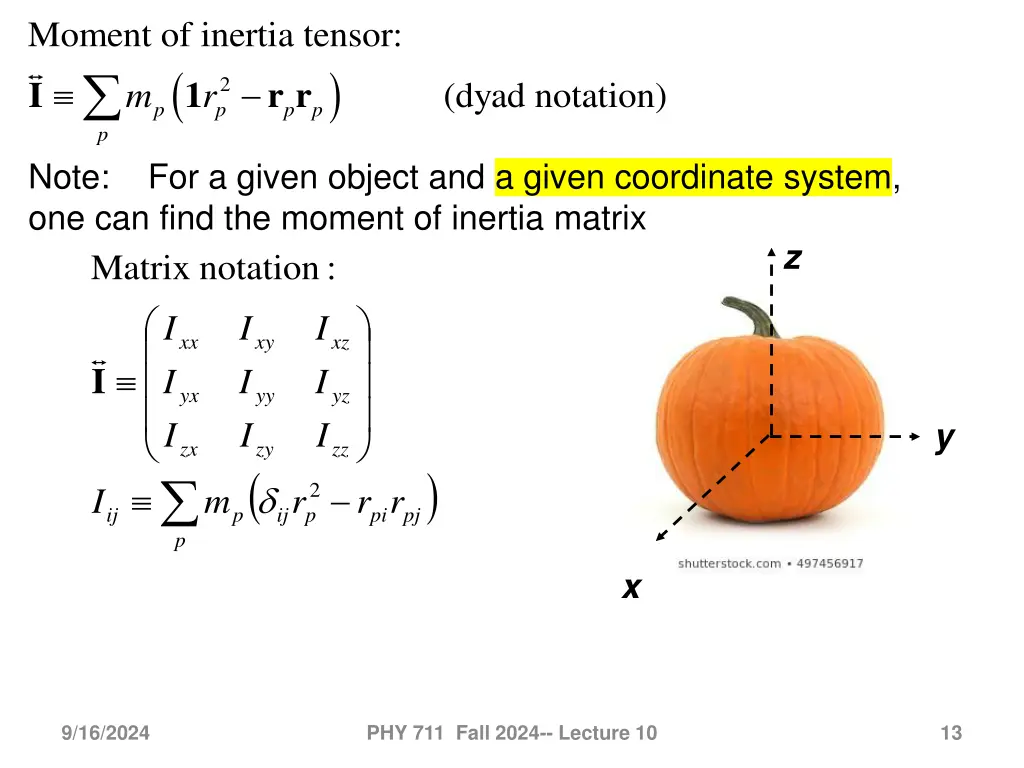
Moment of inertia tensor: I 1 ( ) 2 p p p r r (dyad notation) m r p p Note: For a given object and a given coordinate system, one can find the moment of inertia matrix : notation Matrix yz yy yx I I I z I I I xx xy xz I r I I I y zx zy zz ( ) p 2 p I m r r ij p ij pi pj x 9/16/2024 PHY 711 Fall 2024-- Lecture 10 13
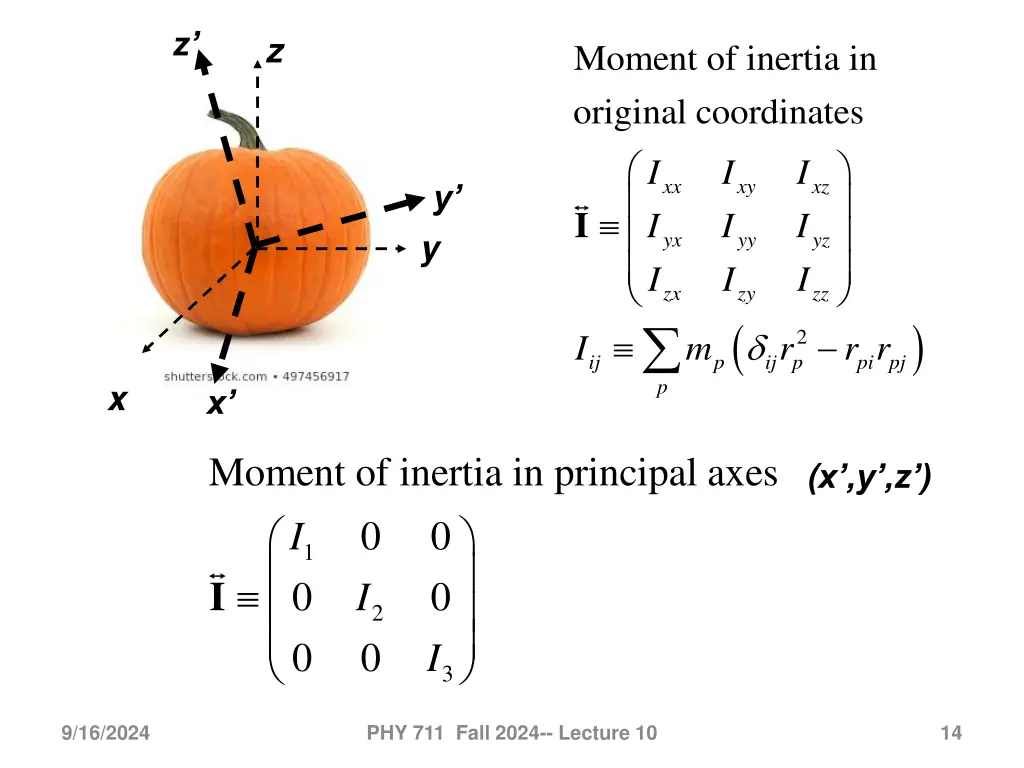
z z Moment of inertia in original coordinates I I I I I I I I I xx xy xz y I y yx yy yz zx zy zz ( ) 2 I m ij p r pi pj r r ij p p x x Moment of inertia in principal axes 0 0 0 0 0 0 I (x ,y ,z ) I 1 I I 2 3 9/16/2024 PHY 711 Fall 2024-- Lecture 10 14
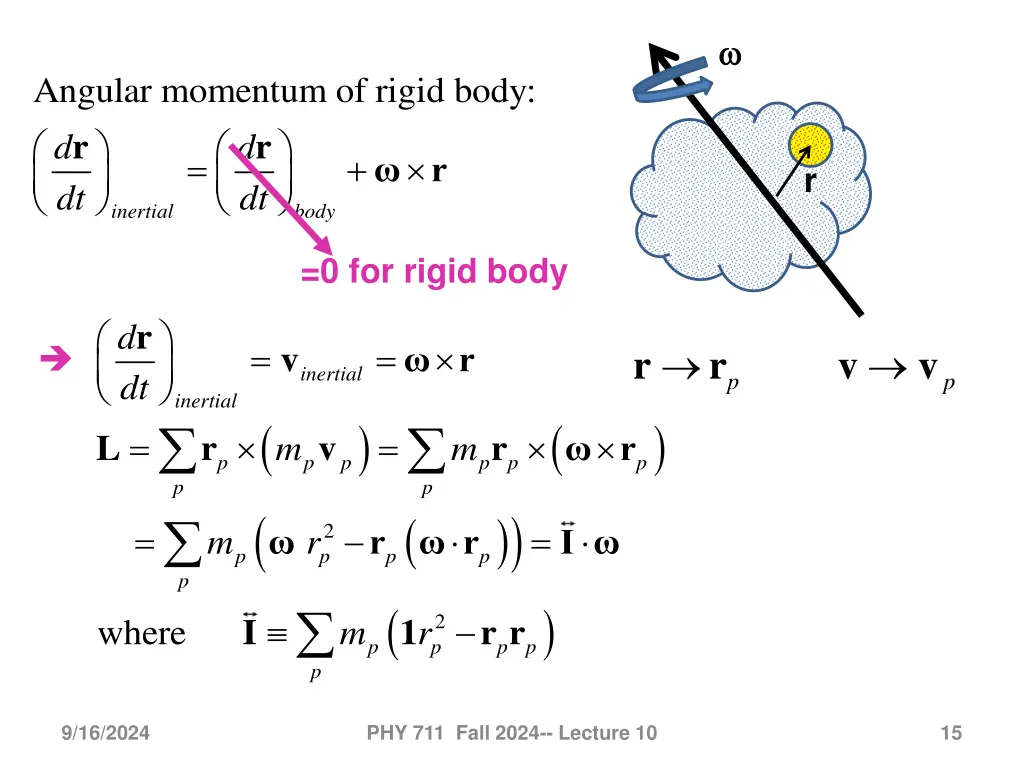
Angular momentum of rigid body: d d dt dt r r = + r r inertial body =0 for rigid body r L d dt = = = v r r r v v inertial p p inertial ( ) ( ) = r v p p r m m r p p p p p p ( ) ( ) = = I 2 p m r r r p p p p ( ) 2 p I 1 p p r r where m r p p 9/16/2024 PHY 711 Fall 2024-- Lecture 10 15
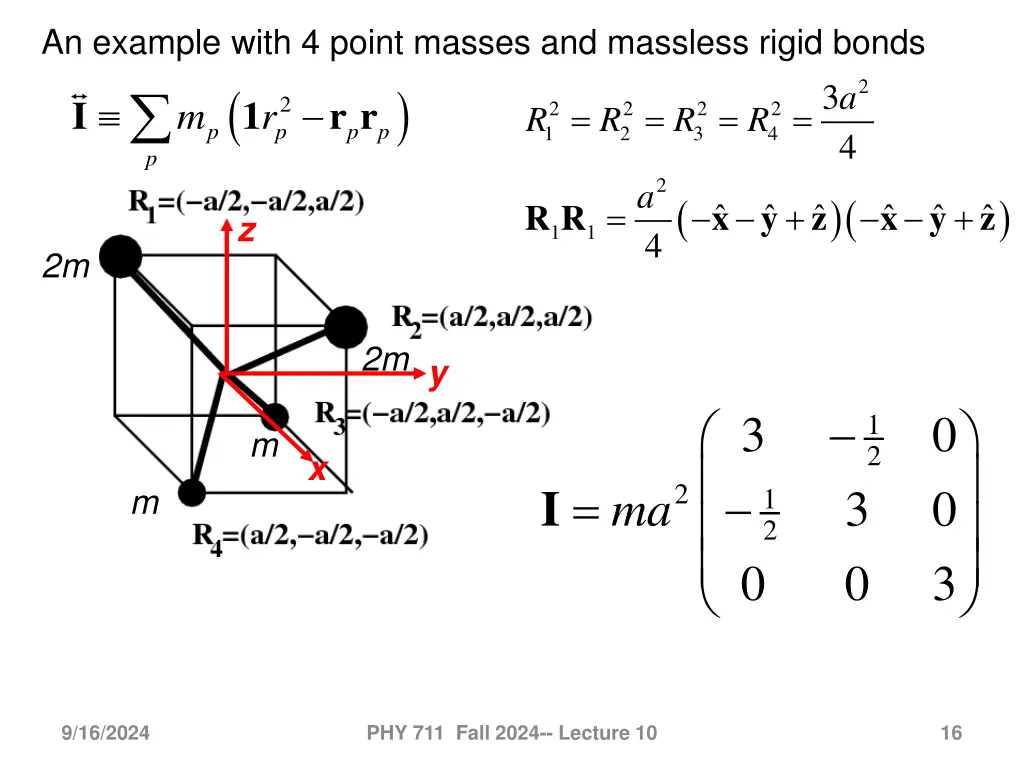
An example with 4 point masses and massless rigid bonds ( p p p p p ) 2 3 a 2 I 1 r r m r = = = = 2 2 2 2 3 2 4 R R R R 1 4 2 a ( )( ) = + + R R x y z x y z z 1 1 4 2m 2m y 3 0 0 3 1 m 2 x = 2 I 3 0 ma m 1 2 0 9/16/2024 PHY 711 Fall 2024-- Lecture 10 16
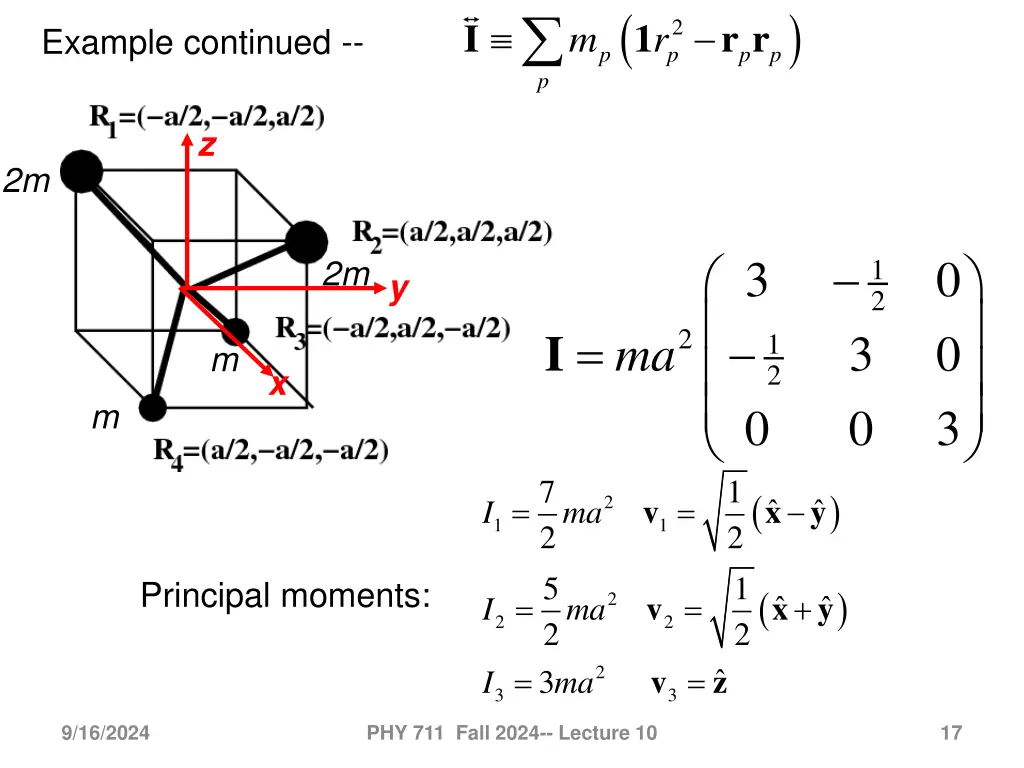
( ) 2 p I 1 p p r r m r Example continued -- p p z 2m 3 0 0 3 2m 1 y 2 = 2 I 3 0 ma 1 2 m x m 0 7 2 5 2 3 1 2 1 2 ( ) = = 2 v x y I ma 1 1 Principal moments: ( ) = = + 2 v x y I ma 2 2 = = z 2 v I ma 3 3 9/16/2024 PHY 711 Fall 2024-- Lecture 10 17
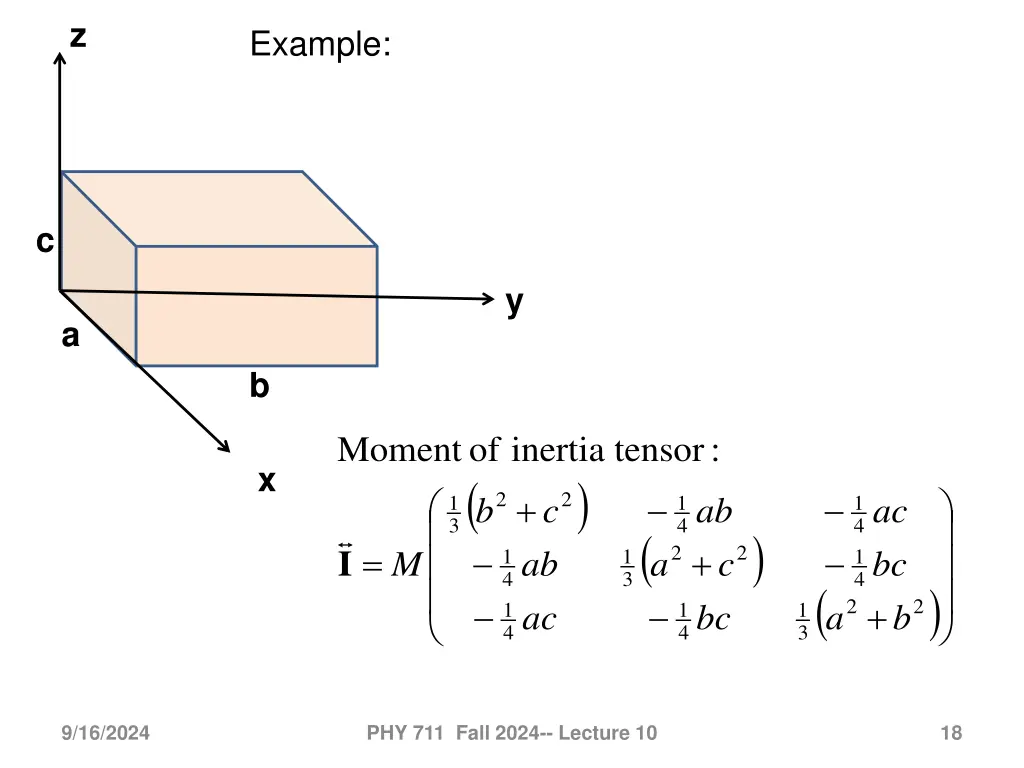
z Example: c y a b Moment of inertia + ab tensor a : x ( ) 2 2 b c ab ac 1 1 1 3 4 4 ( ) = + bc a 2 2 I M c bc 1 1 1 4 3 4 ( ) + 2 2 ac b 1 1 1 4 4 3 9/16/2024 PHY 711 Fall 2024-- Lecture 10 18
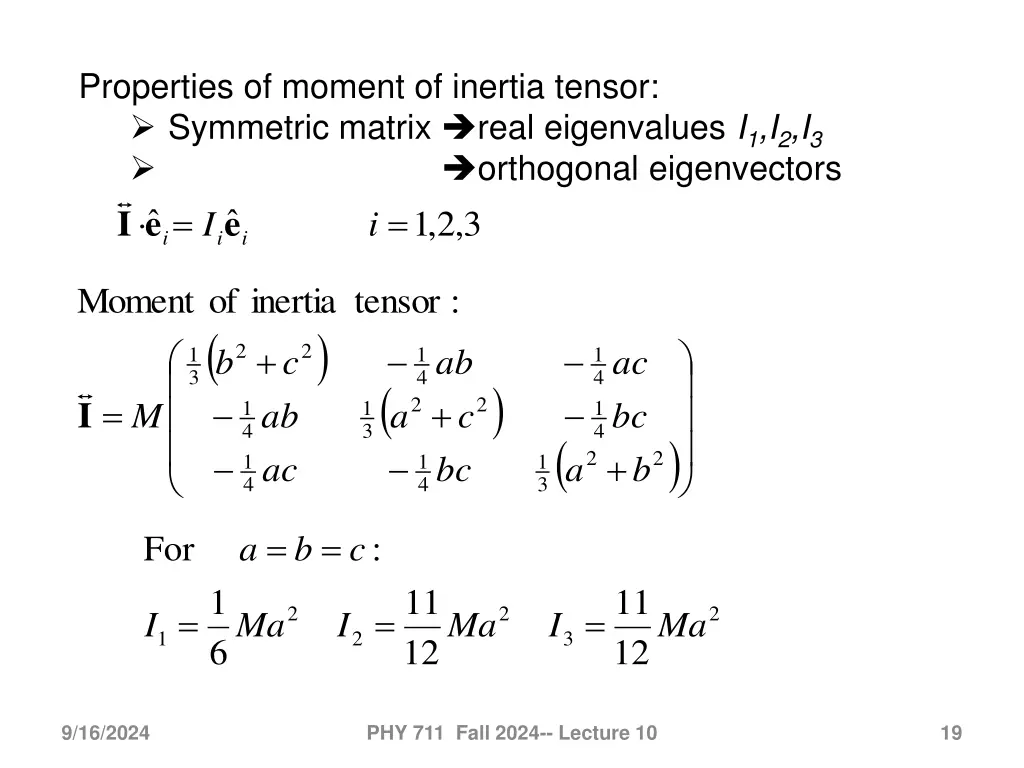
Properties of moment of inertia tensor: Symmetric matrix real eigenvalues I1,I2,I3 orthogonal eigenvectors 3 , 2 , 1 = = i I i i i e e I Moment of inertia + ab tensor a : ( ) 2 2 b c ab ac 1 1 1 3 4 4 ( ) = + bc a 2 2 I M c bc 1 1 1 4 3 4 ( ) + 2 2 ac b 1 1 1 4 4 3 = = For : a b c 1 11 11 = = = 2 2 2 I Ma I Ma I Ma 1 2 3 6 12 12 9/16/2024 PHY 711 Fall 2024-- Lecture 10 19
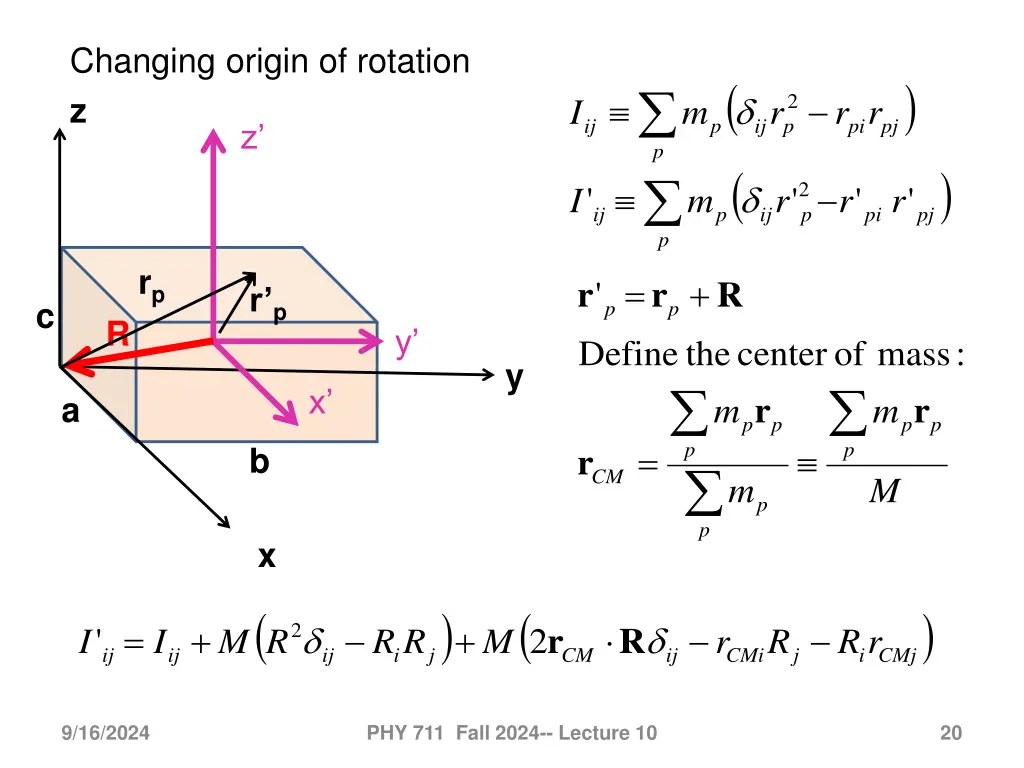
Changing origin of rotation z z ( ( ) p 2 p I m r r r ij p ij pi pj ) p 2 p ' ' ' ' I m r r r ij p ij pi pj rp = + r r R ' r p c p p R y Define center the m p of mass m p : y x r r a p p p p = b CM r m M p p x ( ) ( ) = + + 2 CM r R ' 2 I I M R R R M CMi r R R CMj r ij ij ij i j ij j i 9/16/2024 PHY 711 Fall 2024-- Lecture 10 20
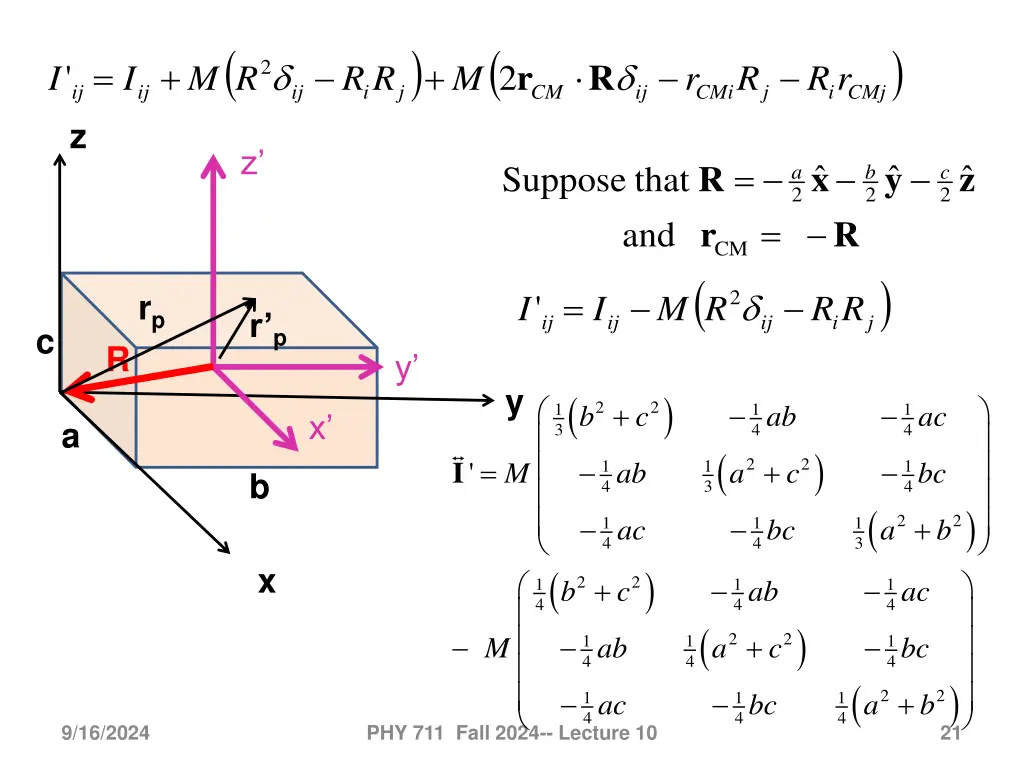
( ) ( ) = + + 2 CM r R ' 2 I I M R R R M CMi r R R CMj r ij z ij ij i j ij j i z = R x y z Suppose that a 2 b 2 c 2 = r ( R R and CM ) = 2 rp ' I I M R R r p ij ij ij i j c R y y ( ) + 2 2 b c ab ac 1 3 1 4 1 4 x a ( ) = + 2 2 I ' M ab a c bc 1 4 1 3 1 4 b ( ) + 2 2 ac bc a b 1 4 1 4 1 3 ( ) x + 2 2 1 4 b c 1 4 ab 1 4 ac ( ) + 2 2 M ab a c bc 1 4 1 4 1 4 ( ) + 2 2 ac bc a b 1 4 1 4 1 4 9/16/2024 PHY 711 Fall 2024-- Lecture 10 21
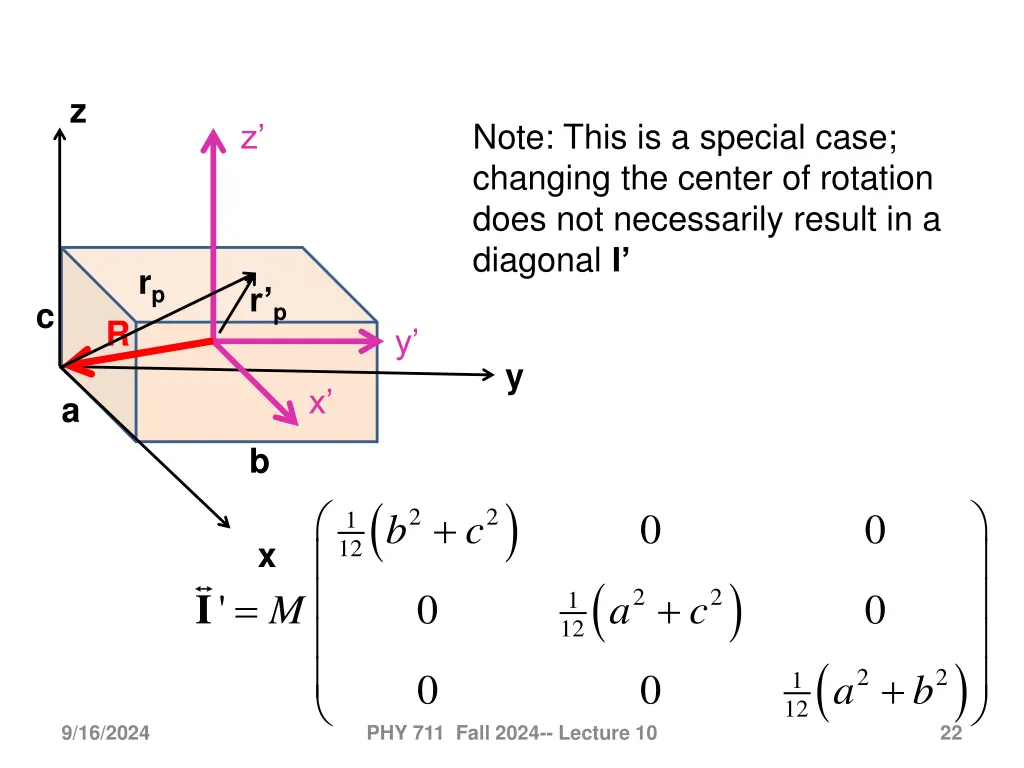
z Note: This is a special case; changing the center of rotation does not necessarily result in a diagonal I z rp r p c R y y x a b ( ) + 2 2 0 0 b c 1 12 x ( ) = + 2 2 I ' 0 0 M a c 1 12 ( ) + 2 2 0 0 a b 1 12 9/16/2024 PHY 711 Fall 2024-- Lecture 10 22
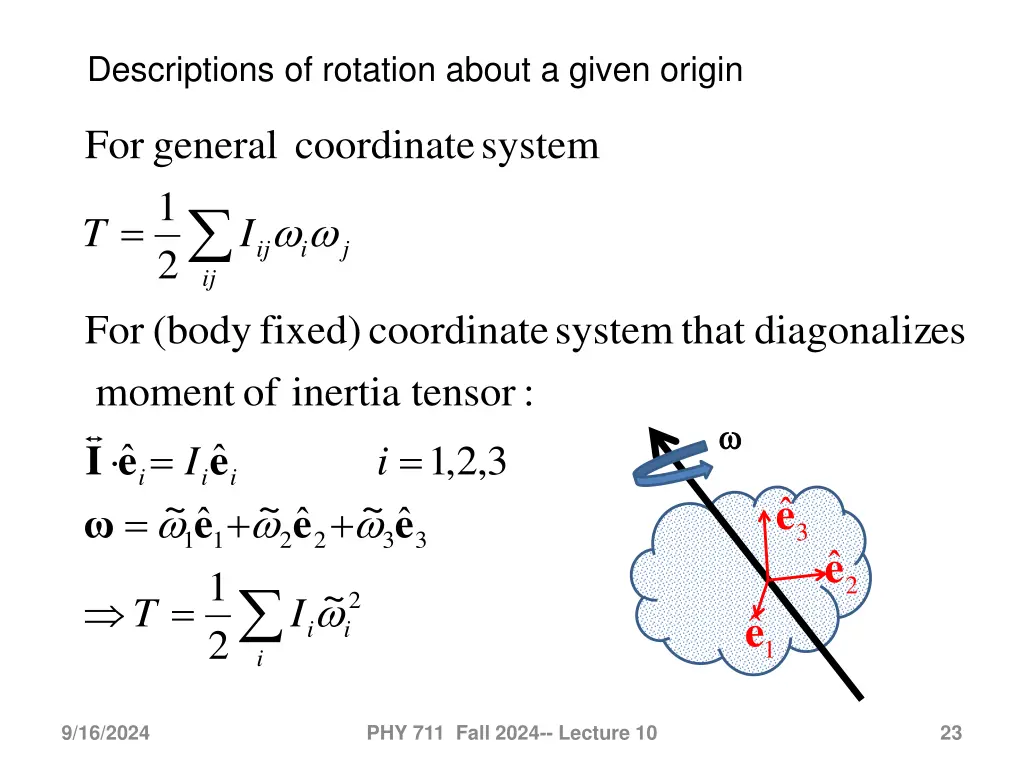
Descriptions of rotation about a given origin For general coordinate system 1 ij = T I ij i j 2 diagonaliz that system coordinate fixed) (body For es moment I of inertia tensor : = = e e e 3 , 2 , 1 I i i i i ~ ~ ~ 3 e = + + e e 1 1 1 2 2 3 3 2 e ~ i = 2 T I 1 e i i 2 9/16/2024 PHY 711 Fall 2024-- Lecture 10 23
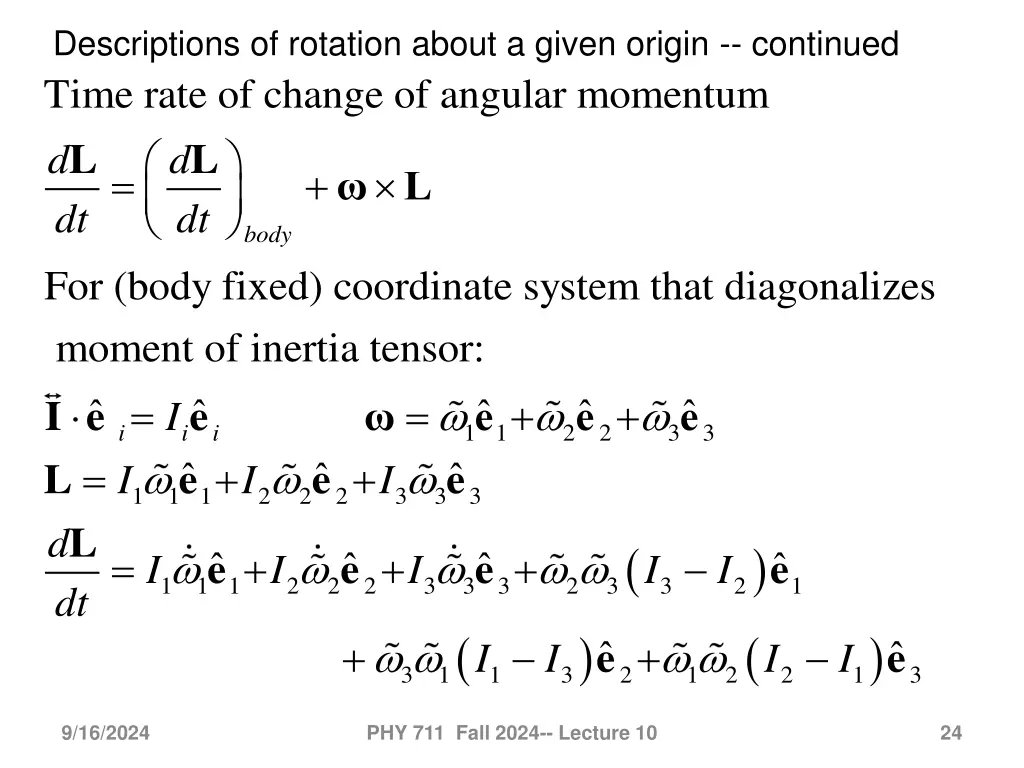
Descriptions of rotation about a given origin -- continued Time rate of change of angular momentum d d dt dt L L = + L body For (body fixed) coordinate system that diagonalizes moment of inertia tensor: i i i I I I = + L 2 2 3 3 3 I d I I I dt I + = = + + 1 1 e e e e I e e + 2 2 3 3 1 1 e e 1 2 L ( ) = + + + 1 1 e e e e I I 1 2 2 2 3 3 3 2 3 3 2 1 ( ) ( ) + e e I I I 3 1 1 3 2 1 2 2 1 3 9/16/2024 PHY 711 Fall 2024-- Lecture 10 24
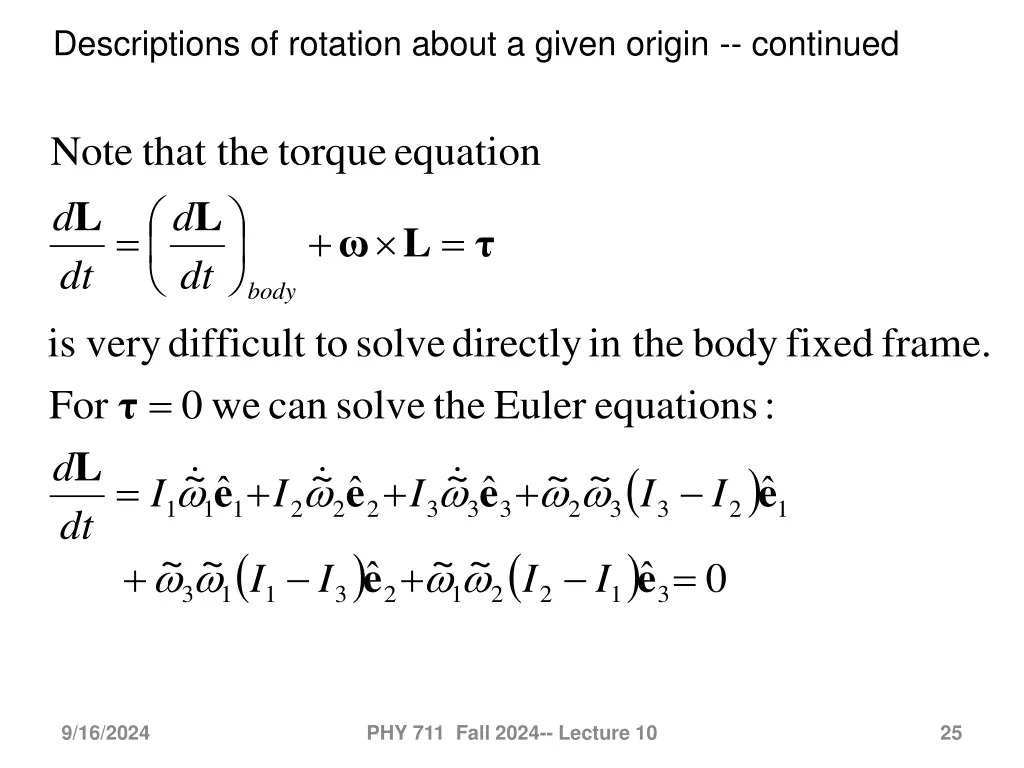
Descriptions of rotation about a given origin -- continued Note L dt that the = dt torque equation L d d + = L body very is difficult = solve to directly in the body fixed frame. For L dt we 0 can solve the Euler equations : d ( ) ) ~ ~ ~ ~ ~ = + + + e e e e I I I I I 1 1 1 2 2 2 3 3 3 2 3 3 2 1 ( ) ( ~ ~ ~ ~ + + = e e 0 I I I I 3 1 1 3 2 1 2 2 1 3 9/16/2024 PHY 711 Fall 2024-- Lecture 10 25
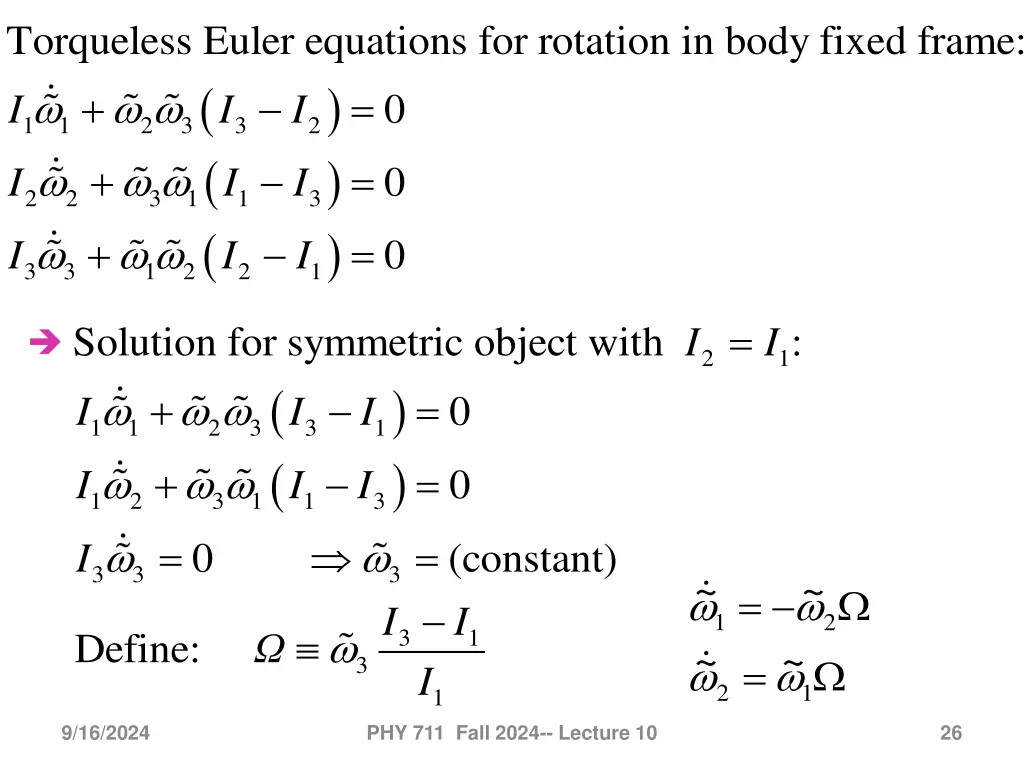
Torqueless Euler equations for rotation in body fixed frame: + = ( ( ( ) ) ) 0 I I I 1 1 2 3 3 2 + = 0 I I I 2 2 3 1 1 3 + = 0 I I I 3 3 1 2 2 1 = Solution for symmetric object with + : I I 2 1 ( ( ) ) = 0 I I I 1 1 2 3 3 1 + = 0 I I I 1 2 3 1 1 3 = = 0 (constant) I I 3 3 3 ~ ~ = ~ I 1 2 3 1 Define: ~ = 1 3 I 2 1 9/16/2024 PHY 711 Fall 2024-- Lecture 10 26
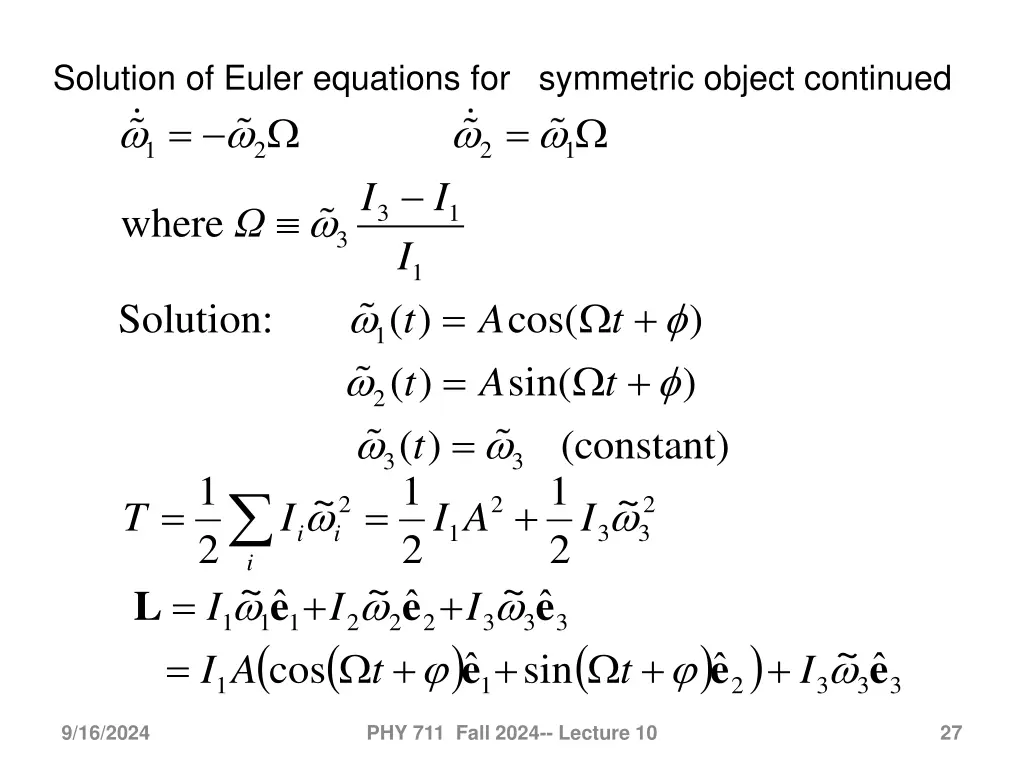
Solution of Euler equations for symmetric object continued I I I t A t A t = 1 ~ 2 i ~ ~ ~ e t A I + + = = = 1 2 2 1 where 3 1 3 1 = = + + Solution: 1 T = ( ) ( ) ( ) cos( sin( (constant) ~ 2 e ) ) t 1 t 2 3 3 + 1 i = 2 i 2 2 3 I I A I 1 3 2 e = + + L e I I I 1 1 1 2 2 2 3 3 sin 3 ( ( ) ( ) ) ~ + + e e cos t I 1 1 2 3 3 3 9/16/2024 PHY 711 Fall 2024-- Lecture 10 27
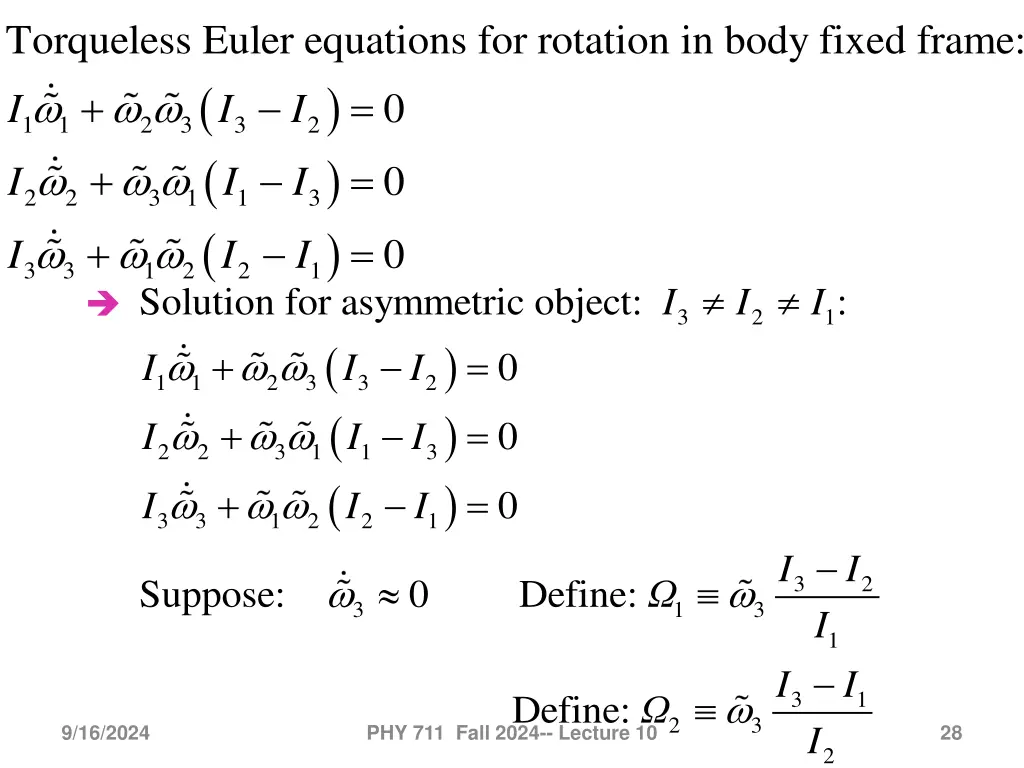
Torqueless Euler equations for rotation in body fixed frame: + = ( ( ( ) ) ) 0 I I I 1 1 2 3 3 2 + = 0 I I I 2 2 3 1 1 3 + = 0 I I I 3 3 1 Solution for asymmetric object: + 2 2 1 : I I I 3 2 1 ( ( ( ) ) ) = 0 I I I 1 1 2 3 3 2 + = 0 I I I 2 2 3 1 1 3 + = 0 I I I 3 3 1 2 2 1 I I 3 2 Suppose: 0 Define: 3 1 3 I 1 I I 3 1 Define : 2 3 I 9/16/2024 PHY 711 Fall 2024-- Lecture 10 28 2
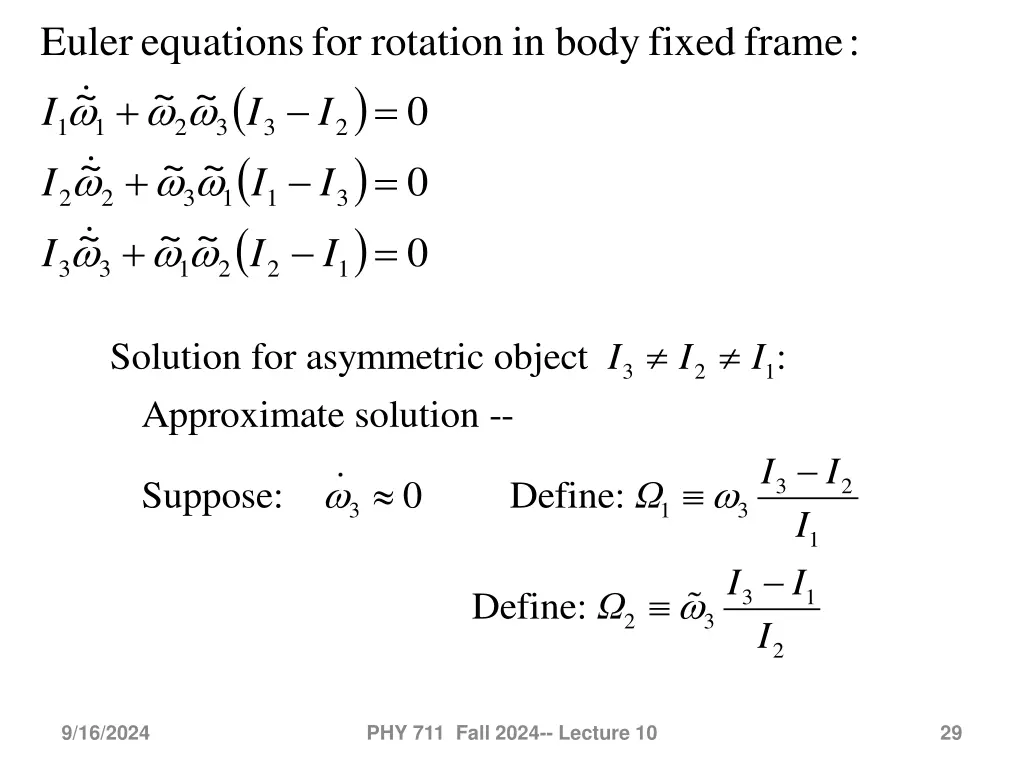
Euler equations rotation for = I body in fixed frame : ( ( ( ) ) ) ~ ~ ~ + 0 I I 1 1 2 3 3 2 ~ ~ ~ + = 0 I I I 2 2 3 1 1 3 ~ ~ ~ + = 0 I I I 3 3 1 2 2 1 Solution for asymmetric object Approximate solution -- : I I I 3 2 1 I I Suppose: 0 Define: 3 2 3 1 3 I I 1 I Define: 3 1 2 3 I 2 9/16/2024 PHY 711 Fall 2024-- Lecture 10 29
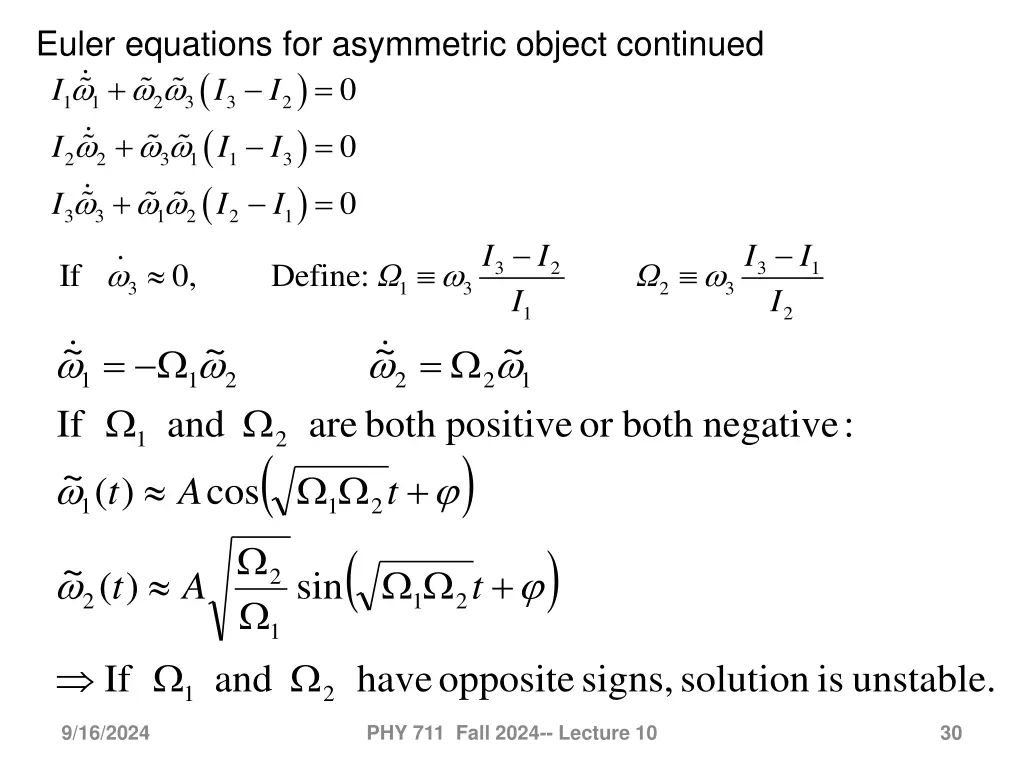
Euler equations for asymmetric object continued ( ( ( ) ) ) + = 0 I I I 1 1 2 3 3 2 + = 0 I I I 2 2 3 1 1 3 + = 0 I I I 3 3 1 2 2 1 I I I I If 0, Define: 3 2 3 1 3 1 3 2 3 I I 1 2 ~ ~ ~ ~ = = 1 1 2 2 2 1 If and A are both t positive or both negative : 1 2 ( ) ~ + ( ) cos t 1 1 2 ( ) ~ + ( ) sin 2 t A t 2 1 2 1 If and have opposite signs, solution unstable. is 1 2 9/16/2024 PHY 711 Fall 2024-- Lecture 10 30