Classifying Matter: Solid, Liquid, Gas & Pure Substances
Explore how matter can be classified based on its state and composition, distinguishing between mixtures, pure substances, elements, and compounds. Learn about physical and chemical properties, changes, and separation methods in chemistry.

Download Presentation

Please find below an Image/Link to download the presentation.
The content on the website is provided AS IS for your information and personal use only. It may not be sold, licensed, or shared on other websites without obtaining consent from the author. If you encounter any issues during the download, it is possible that the publisher has removed the file from their server.
You are allowed to download the files provided on this website for personal or commercial use, subject to the condition that they are used lawfully. All files are the property of their respective owners.
The content on the website is provided AS IS for your information and personal use only. It may not be sold, licensed, or shared on other websites without obtaining consent from the author.
E N D
Presentation Transcript
Chemistry Sept 27, 2019 P3 Challenge Classify an apple according to 1) solid/liquid/gas 2) pure substance/mixture 3) element/compound/homogeneous/heterogeneous When done with P3, study for Element practice quiz. We will do that first.
Objectives and Agenda Objectives To identify physical and chemical properties To identify physical and chemical changes To learn about ways to separate mixtures Agenda: Element quiz Complete Matter Classification Physical properties Chemical properties Physical changes Chemical changes Separation methods (time permitting) Assignment: Physical and chemical properties and changes worksheet
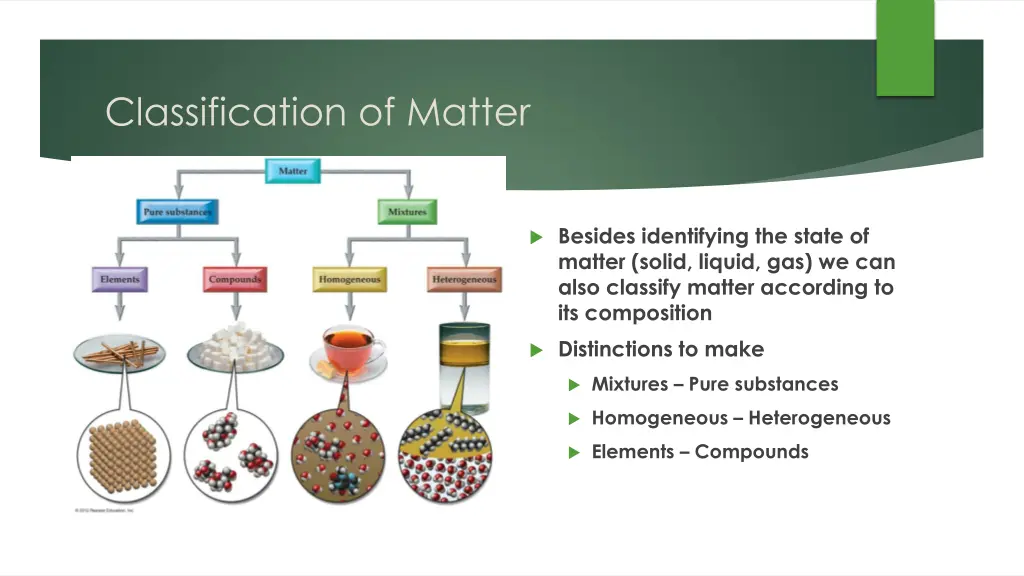
Classification of Matter Besides identifying the state of matter (solid, liquid, gas) we can also classify matter according to its composition Distinctions to make Mixtures Pure substances Homogeneous Heterogeneous Elements Compounds
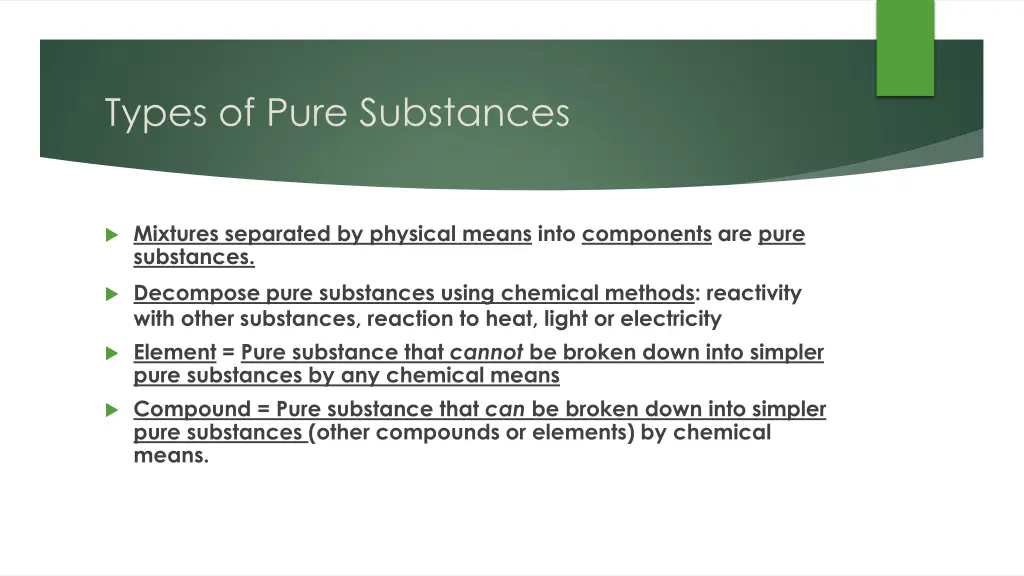
Types of Pure Substances Mixtures separated by physical means into components are pure substances. Decompose pure substances using chemical methods: reactivity with other substances, reaction to heat, light or electricity Element = Pure substance that cannot be broken down into simpler pure substances by any chemical means Compound = Pure substance that can be broken down into simpler pure substances (other compounds or elements) by chemical means.
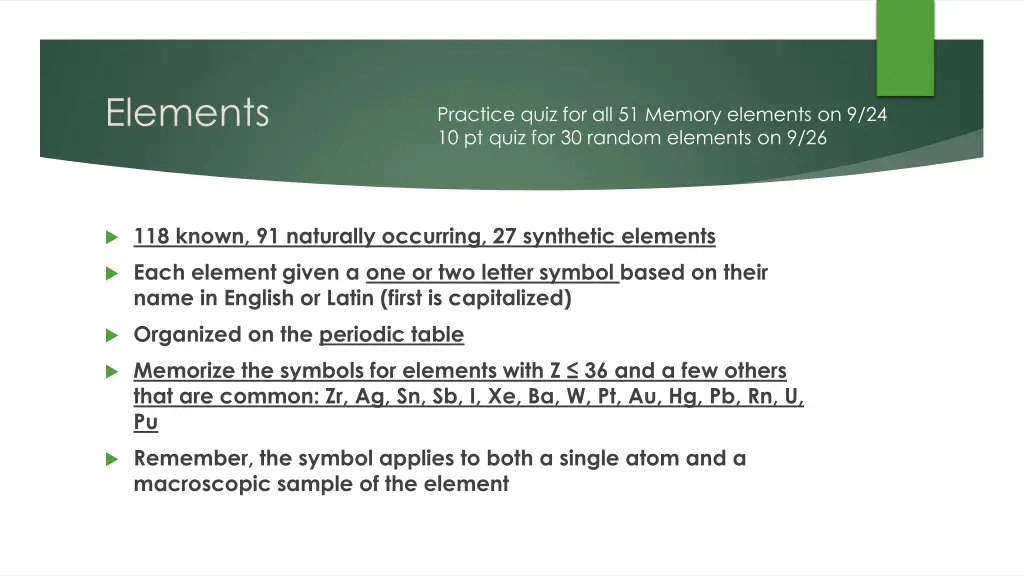
Elements Practice quiz for all 51 Memory elements on 9/24 10 pt quiz for 30 random elements on 9/26 118 known, 91 naturally occurring, 27 synthetic elements Each element given a one or two letter symbol based on their name in English or Latin (first is capitalized) Organized on the periodic table Memorize the symbols for elements with Z 36 and a few others that are common: Zr, Ag, Sn, Sb, I, Xe, Ba, W, Pt, Au, Hg, Pb, Rn, U, Pu Remember, the symbol applies to both a single atom and a macroscopic sample of the element
Compounds Compounds are either crystalline or amorphous (salt/molecule, inorganic/organic) Law of constant composition / definite proportions All samples of a given compound contain exactly the same proportion of elements by mass. Organic Compounds far outnumber Inorganic Compounds even though they only involve a relatively few kinds of elements Organic compounds typically contain C, H, O, and/or N
Properties of Matter Properties distinguish one pure substance from another Physical Properties = characteristics of a substance that do not change its identity State (solid, liquid, gas) Melting point, boiling point Color, odor, taste, hardness, viscosity, electromagnetic behavior Density, mass, volume
Properties of Matter Chemical Properties = characteristics of a substance that describe how its identity changes Reactivity with other substances Ex: Reactions with air or water, flammability, toxicity Stability under certain conditions Ex: Radioactivity, thermal stability
Properties of Matter Extensive properties depend on how much of the substance is present. Ex: mass, moles, volume, length, toxicity Intensive properties are the same regardless of how much of the substance is present. Ex: state, density, boiling point, melting point, molar mass, temperature, hardness, color, odor, taste, heat capacity, elasticity, conductivity, radioactivity, flammability
Changes in Matter Physical Change = a process that changes a substance s physical properties but not its chemical identity change of state forming or separating mixtures Chemical Change = a process that changes a substance s chemical identity products chemical reaction reactants Only an examination of the substances before and after a change can verify whether the change is physical or chemical.
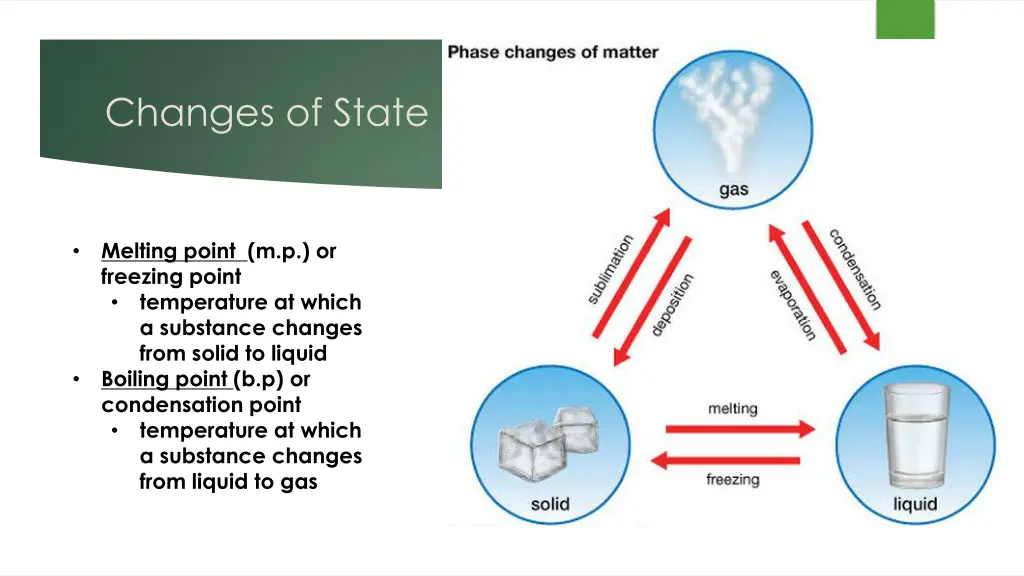
Changes of State Melting point (m.p.) or freezing point temperature at which a substance changes from solid to liquid Boiling point (b.p) or condensation point temperature at which a substance changes from liquid to gas
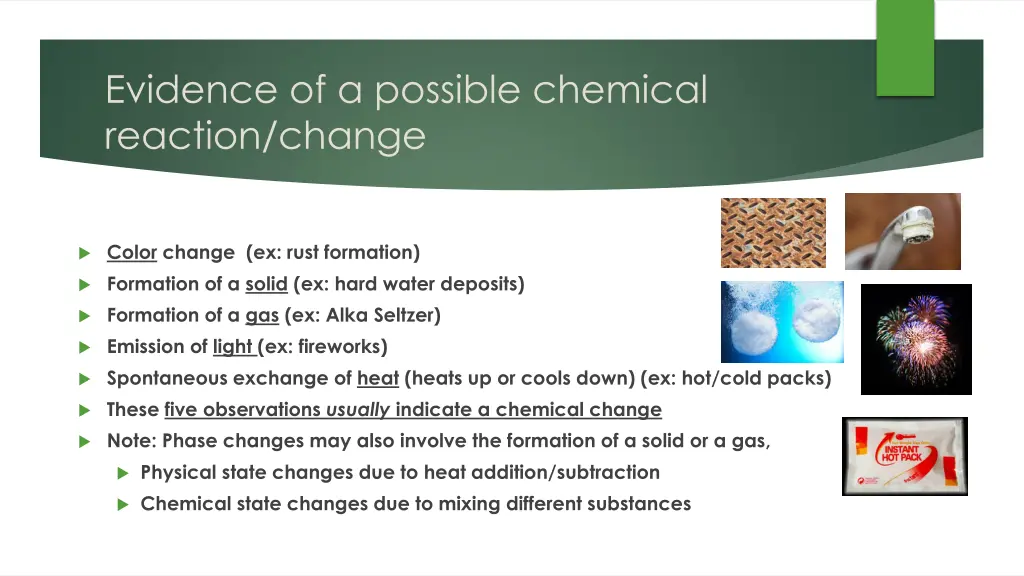
Evidence of a possible chemical reaction/change Color change (ex: rust formation) Formation of a solid (ex: hard water deposits) Formation of a gas (ex: Alka Seltzer) Emission of light (ex: fireworks) Spontaneous exchange of heat (heats up or cools down) (ex: hot/cold packs) These five observations usually indicate a chemical change Note: Phase changes may also involve the formation of a solid or a gas, Physical state changes due to heat addition/subtraction Chemical state changes due to mixing different substances
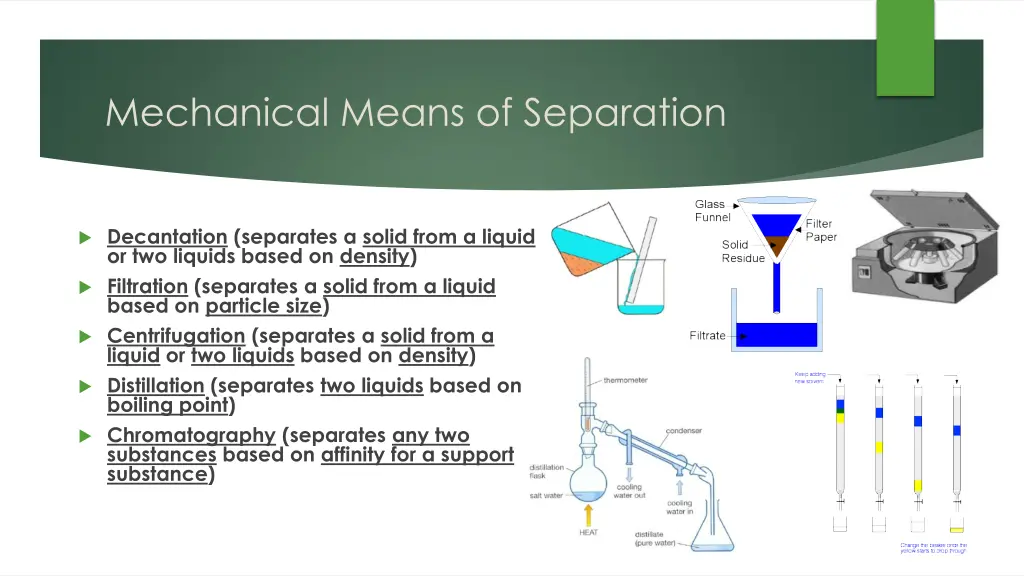
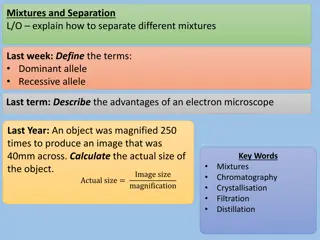
Mechanical Means of Separation Decantation (separates a solid from a liquid or two liquids based on density) Filtration (separates a solid from a liquid based on particle size) Centrifugation (separates a solid from a liquid or two liquids based on density) Distillation (separates two liquids based on boiling point) Chromatography (separates any two substances based on affinity for a support substance)
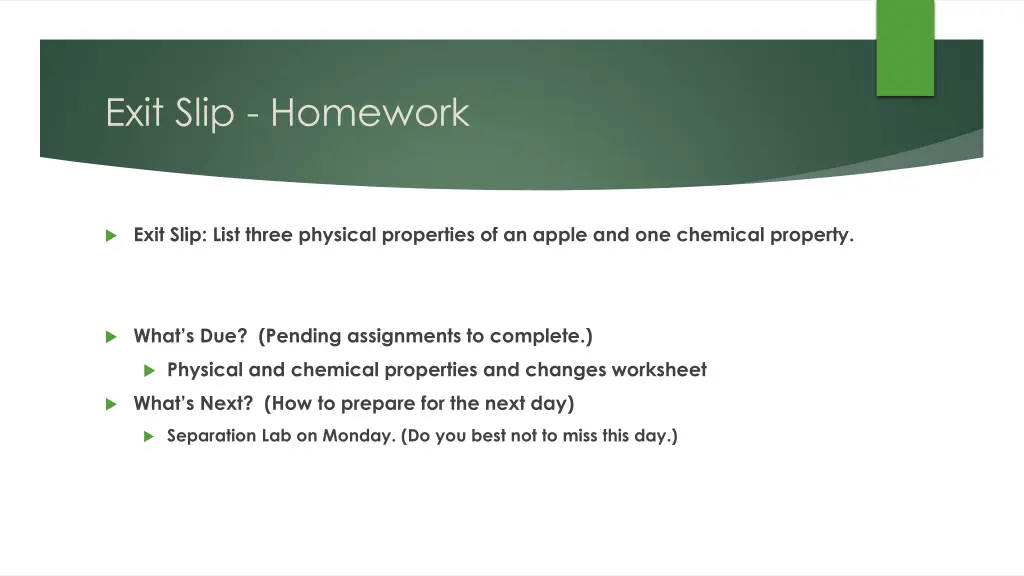
Exit Slip - Homework Exit Slip: List three physical properties of an apple and one chemical property. What s Due? (Pending assignments to complete.) Physical and chemical properties and changes worksheet What s Next? (How to prepare for the next day) Separation Lab on Monday. (Do you best not to miss this day.)