CNS CVD Diamond Properties and Applications
Discover the extreme mechanical hardness, high thermal conductivity, and broad optical transparency of CNS CVD diamond. Learn about its semiconductor properties, accessibility for detectors, and usage in high-energy applications.

Download Presentation

Please find below an Image/Link to download the presentation.
The content on the website is provided AS IS for your information and personal use only. It may not be sold, licensed, or shared on other websites without obtaining consent from the author. If you encounter any issues during the download, it is possible that the publisher has removed the file from their server.
You are allowed to download the files provided on this website for personal or commercial use, subject to the condition that they are used lawfully. All files are the property of their respective owners.
The content on the website is provided AS IS for your information and personal use only. It may not be sold, licensed, or shared on other websites without obtaining consent from the author.
E N D
Presentation Transcript
CNS CVD Diamond S. Michimasa
Properties of diamond Extreme mechanical hardness and extreme high thermal conductivity Broad optical transparency in region from IR to UV Insensitive for visible light Diamond is a semiconductor (band gap = 5.47eV) and very high resistivity at room temperature (1016 cm) No cooling and No p-n junction Easy operation High charge carrier mobility (e: 2200/h: 1600 cm2/Vs) Fast rise time of detector signal High energy needed to remove carbon atom from the lattice (80 eV) Radiation hardness
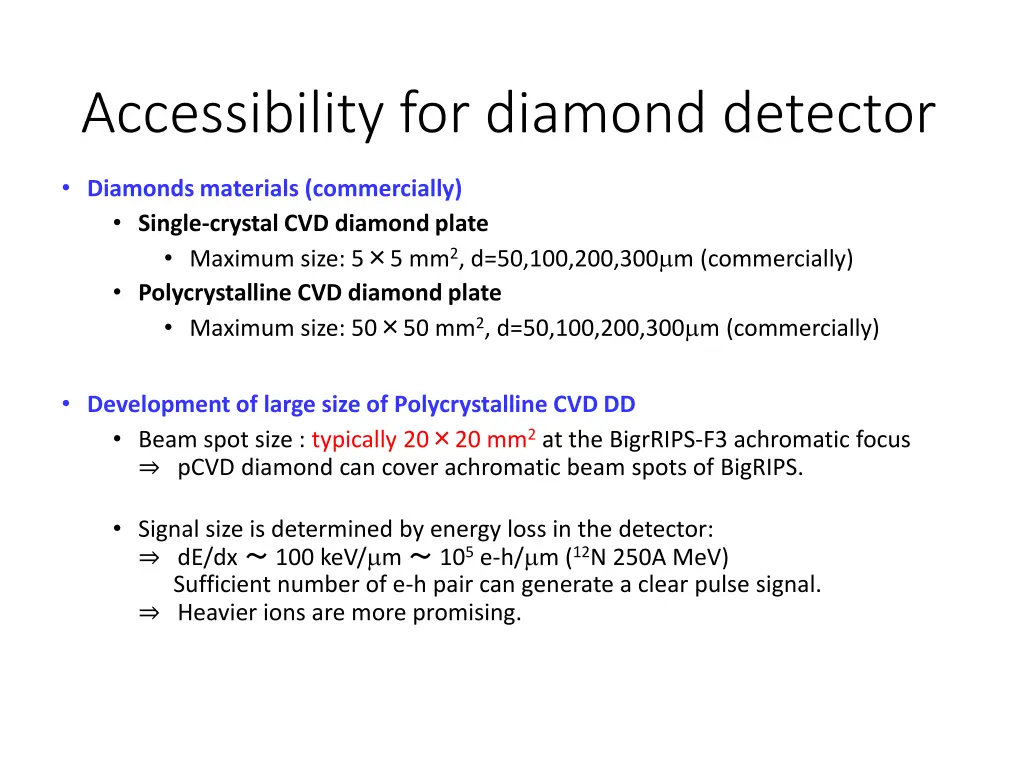
Accessibility for diamond detector Diamonds materials (commercially) Single-crystal CVD diamond plate Maximum size: 5 5 mm2, d=50,100,200,300 m (commercially) Polycrystalline CVD diamond plate Maximum size: 50 50 mm2, d=50,100,200,300 m (commercially) Development of large size of Polycrystalline CVD DD Beam spot size : typically 20 20 mm2at the BigrRIPS-F3 achromatic focus pCVD diamond can cover achromatic beam spots of BigRIPS. Signal size is determined by energy loss in the detector: dE/dx 100 keV/ m 105e-h/ m (12N 250A MeV) Sufficient number of e-h pair can generate a clear pulse signal. Heavier ions are more promising.
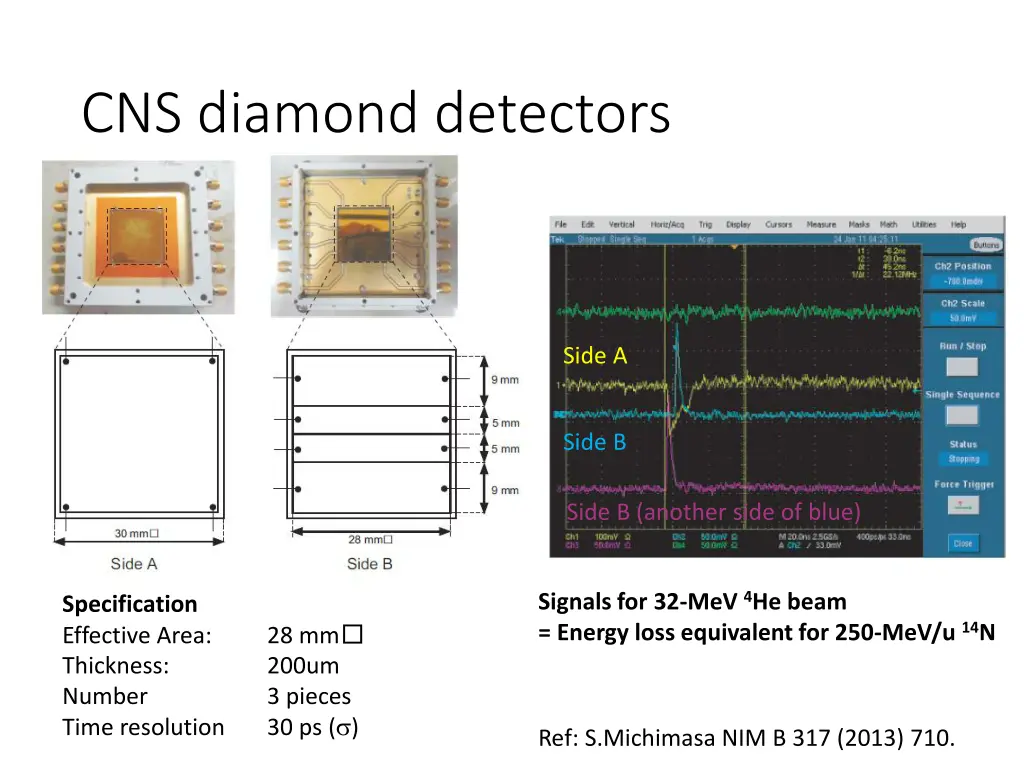
CNS diamond detectors Side A Side B Side B (another side of blue) Signals for 32-MeV 4He beam = Energy loss equivalent for 250-MeV/u 14N Specification Effective Area: Thickness: Number Time resolution 28 mm 200um 3 pieces 30 ps ( ) Ref: S.Michimasa NIM B 317 (2013) 710.
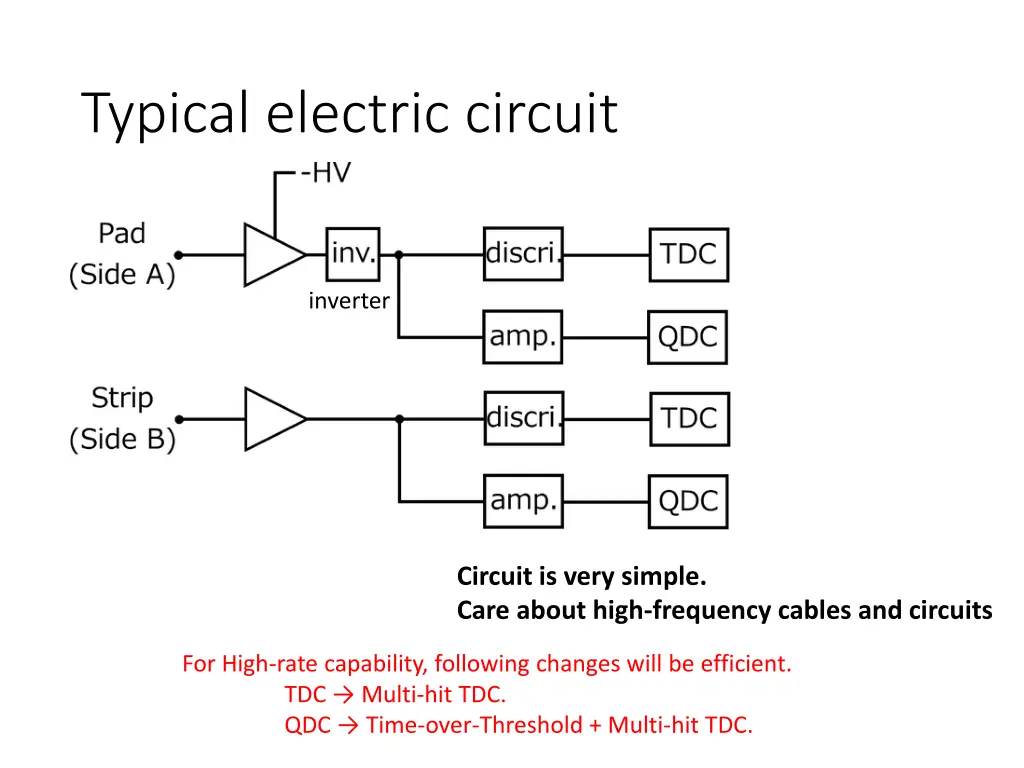
Typical electric circuit inverter Circuit is very simple. Care about high-frequency cables and circuits For High-rate capability, following changes will be efficient. TDC Multi-hit TDC. QDC Time-over-Threshold + Multi-hit TDC.
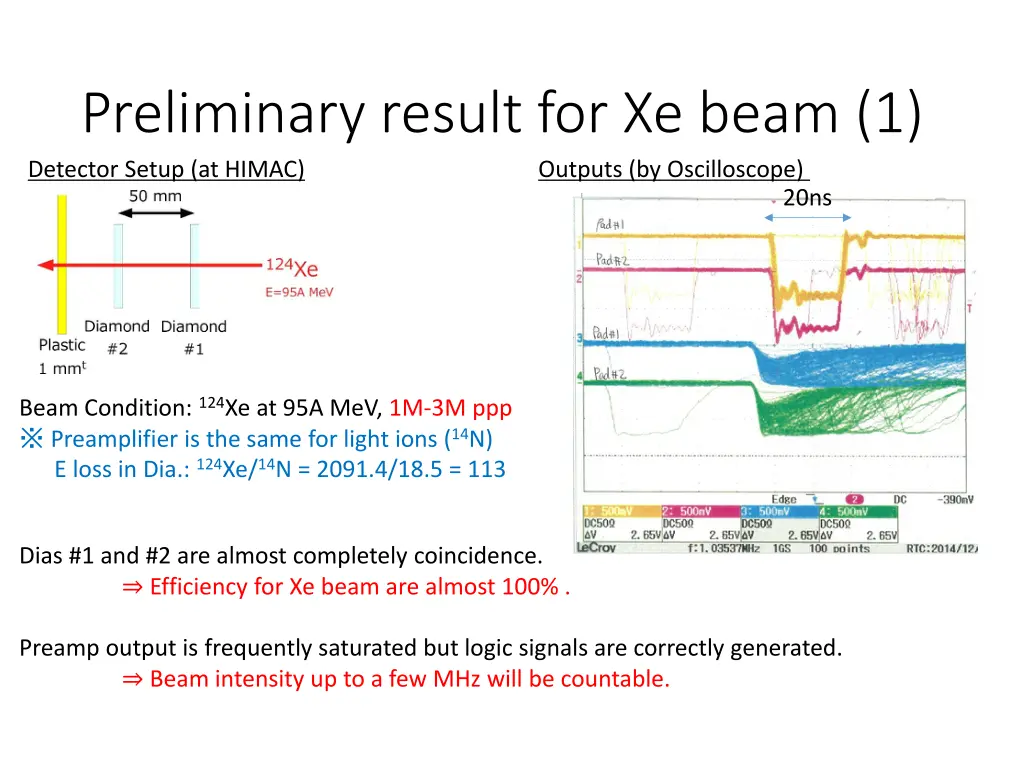
Preliminary result for Xe beam (1) Detector Setup (at HIMAC) Outputs (by Oscilloscope) 20ns Beam Condition: 124Xe at 95A MeV, 1M-3M ppp Preamplifier is the same for light ions (14N) E loss in Dia.: 124Xe/14N = 2091.4/18.5 = 113 Dias #1 and #2 are almost completely coincidence. Efficiency for Xe beam are almost 100% . Preamp output is frequently saturated but logic signals are correctly generated. Beam intensity up to a few MHz will be countable.
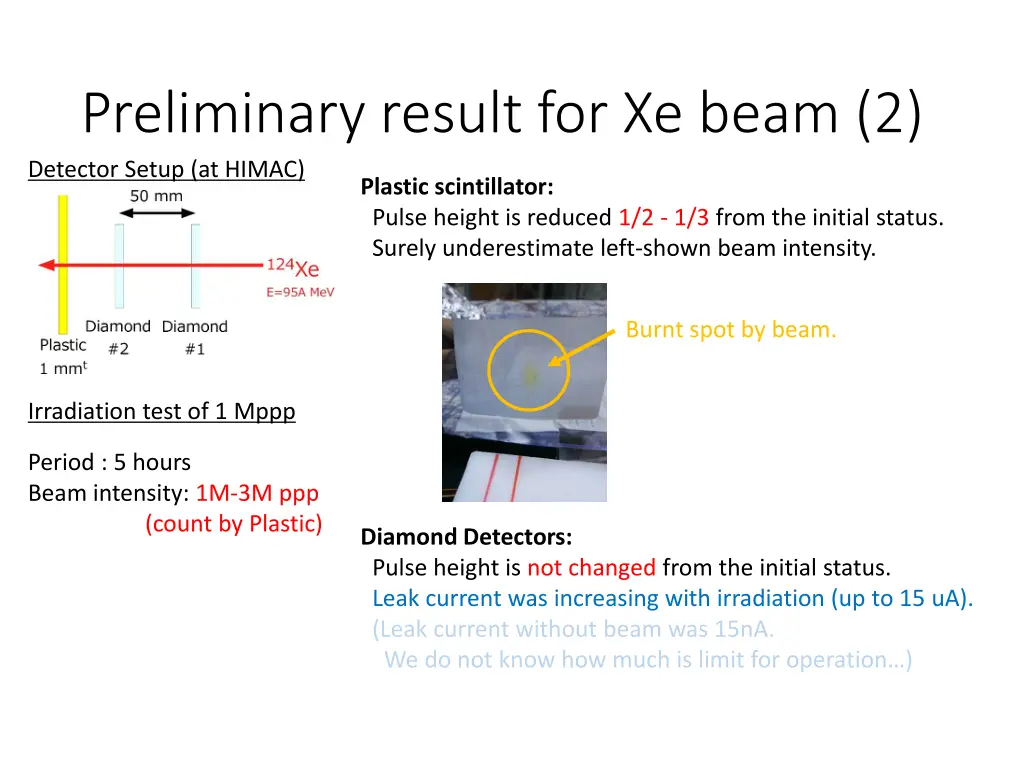
Preliminary result for Xe beam (2) Detector Setup (at HIMAC) Plastic scintillator: Pulse height is reduced 1/2 - 1/3 from the initial status. Surely underestimate left-shown beam intensity. Burnt spot by beam. Irradiation test of 1 Mppp Period : 5 hours Beam intensity: 1M-3M ppp (count by Plastic) Diamond Detectors: Pulse height is not changed from the initial status. Leak current was increasing with irradiation (up to 15 uA). (Leak current without beam was 15nA. We do not know how much is limit for operation )
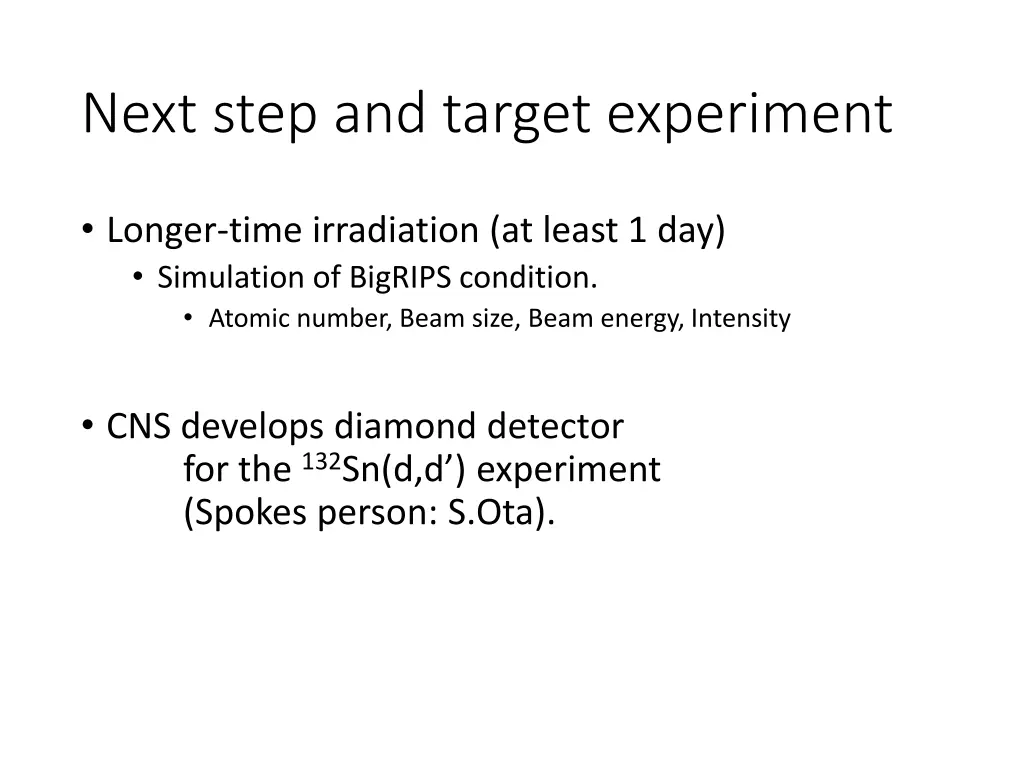
Next step and target experiment Longer-time irradiation (at least 1 day) Simulation of BigRIPS condition. Atomic number, Beam size, Beam energy, Intensity CNS develops diamond detector for the 132Sn(d,d ) experiment (Spokes person: S.Ota).
If You hope further information on a CNS diamond detector. Contact to S. Michimasa (mitimasa@cns.s.u-tokyo.ac.jp)