This capstone proposal by Rebecca Patton focuses on predicting the growth locations of Common Teasel (Dipsacus fullonum L.) in Colorado's public lands. The project examines important site characteristics that influence the plant’s growth, reviews prior studies, and assesses various statistical methods used in ecological research. The aim is to develop a Python program to aid forest managers in identifying potential growth areas for this invasive species, aiding in effective management and environmental conservation efforts.
Please find below an Image/Link to download the presentation.
The content on the website is provided AS IS for your information and personal use only. It may not be sold, licensed, or shared on other websites without obtaining consent from the author. If you encounter any issues during the download, it is possible that the publisher has removed the file from their server.
You are allowed to download the files provided on this website for personal or commercial use, subject to the condition that they are used lawfully. All files are the property of their respective owners.
The content on the website is provided AS IS for your information and personal use only. It may not be sold, licensed, or shared on other websites without obtaining consent from the author.
E N D
Presentation Transcript
Collocation and Idioms Ninth Lecture Third Year/ Evening Classes Translation Department/ College of Arts/ Mustansiriyah University Lecturer Zayneb Elaiwi Sallumi (PhD)
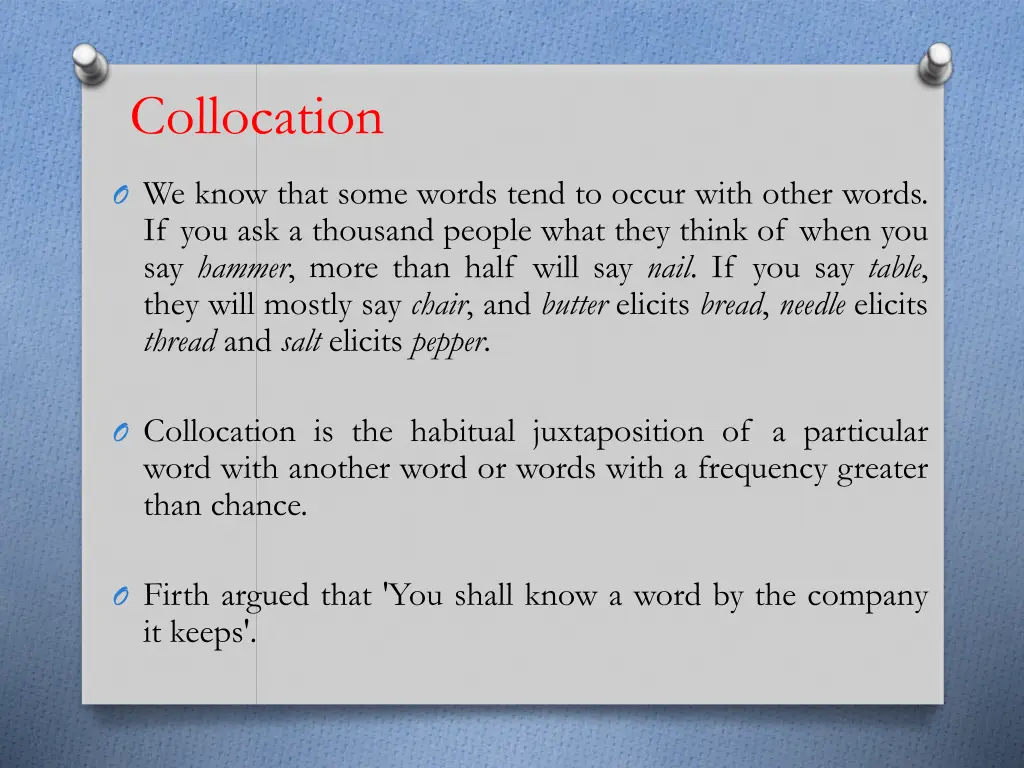
Collocation O We know that some words tend to occur with other words. If you ask a thousand people what they think of when you say hammer, more than half will say nail. If you say table, they will mostly say chair, and butter elicits bread, needle elicits thread and salt elicits pepper. O Collocation is the habitual juxtaposition of a particular word with another word or words with a frequency greater than chance. O Firth argued that 'You shall know a word by the company it keeps'.
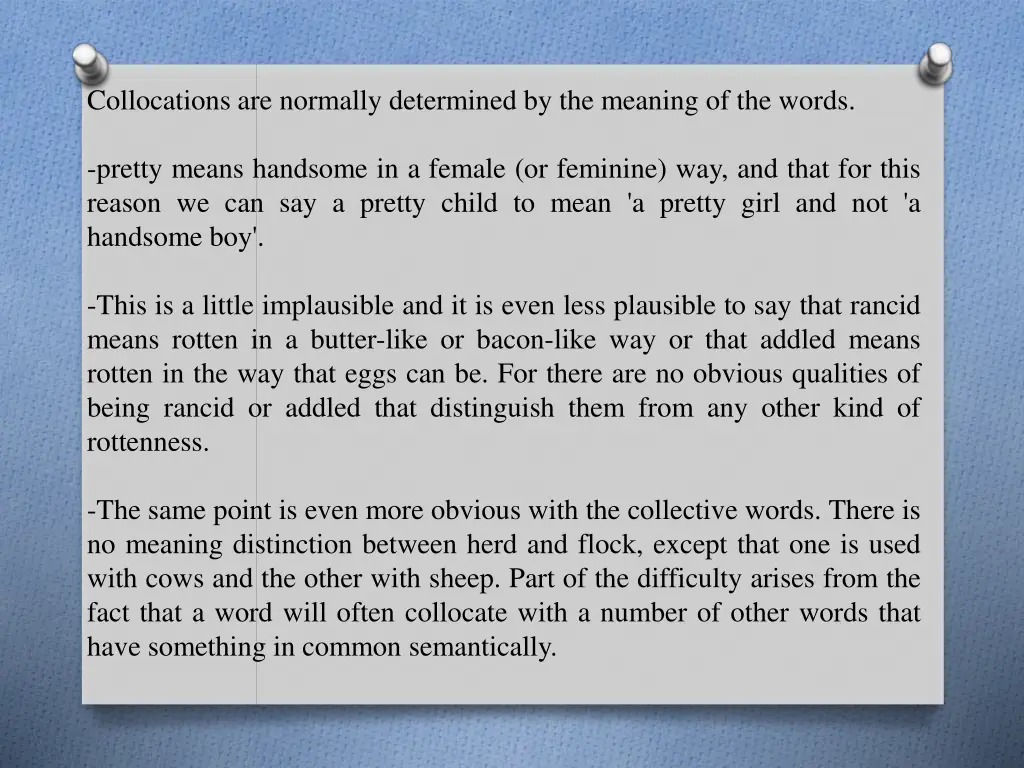
Collocations are normally determined by the meaning of the words. -pretty means handsome in a female (or feminine) way, and that for this reason we can say a pretty child to mean 'a pretty girl and not 'a handsome boy'. -This is a little implausible and it is even less plausible to say that rancid means rotten in a butter-like or bacon-like way or that addled means rotten in the way that eggs can be. For there are no obvious qualities of being rancid or addled that distinguish them from any other kind of rottenness. -The same point is even more obvious with the collective words. There is no meaning distinction between herd and flock, except that one is used with cows and the other with sheep. Part of the difficulty arises from the fact that a word will often collocate with a number of other words that have something in common semantically.
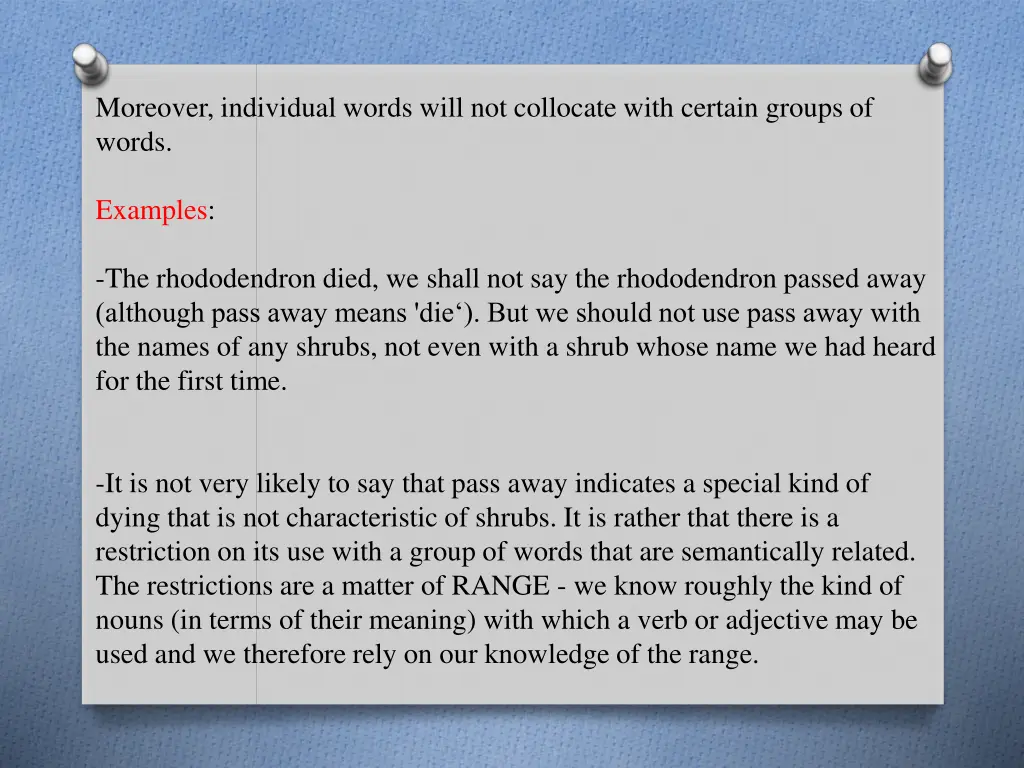
Moreover, individual words will not collocate with certain groups of words. Examples: -The rhododendron died, we shall not say the rhododendron passed away (although pass away means 'die ). But we should not use pass away with the names of any shrubs, not even with a shrub whose name we had heard for the first time. -It is not very likely to say that pass away indicates a special kind of dying that is not characteristic of shrubs. It is rather that there is a restriction on its use with a group of words that are semantically related. The restrictions are a matter of RANGE - we know roughly the kind of nouns (in terms of their meaning) with which a verb or adjective may be used and we therefore rely on our knowledge of the range.
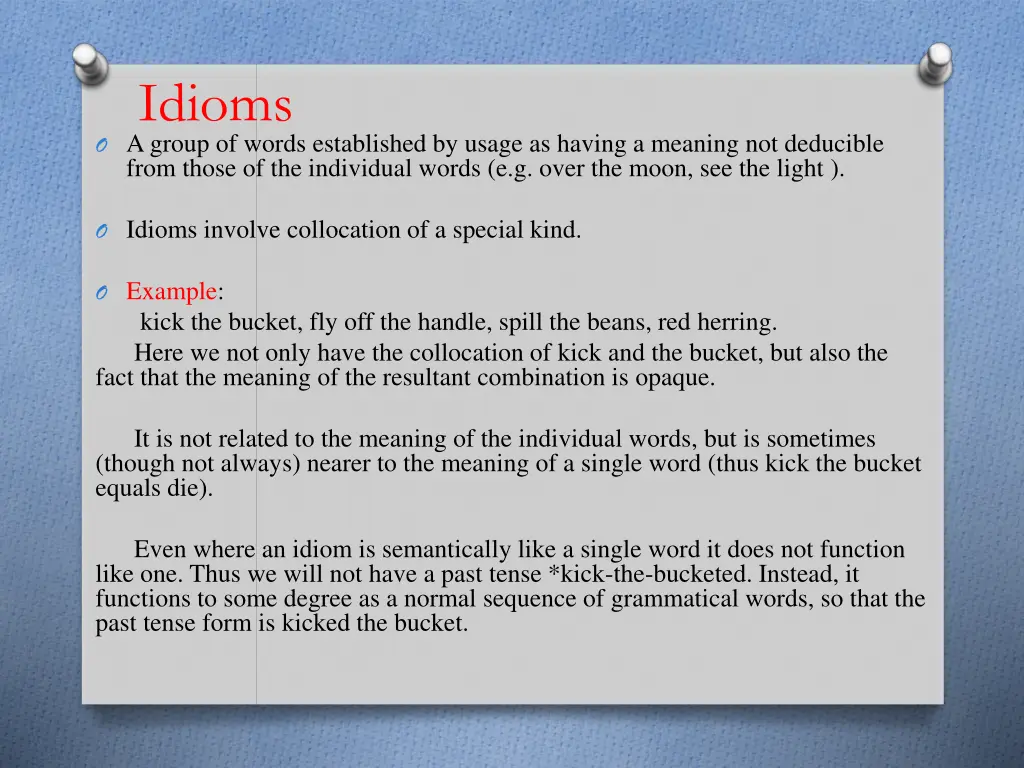
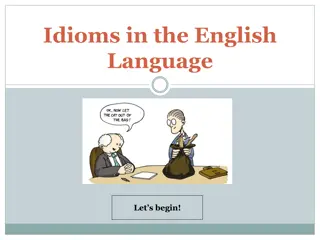
Idioms O A group of words established by usage as having a meaning not deducible from those of the individual words (e.g. over the moon, see the light ). O Idioms involve collocation of a special kind. O Example: kick the bucket, fly off the handle, spill the beans, red herring. Here we not only have the collocation of kick and the bucket, but also the fact that the meaning of the resultant combination is opaque. It is not related to the meaning of the individual words, but is sometimes (though not always) nearer to the meaning of a single word (thus kick the bucket equals die). Even where an idiom is semantically like a single word it does not function like one. Thus we will not have a past tense *kick-the-bucketed. Instead, it functions to some degree as a normal sequence of grammatical words, so that the past tense form is kicked the bucket.
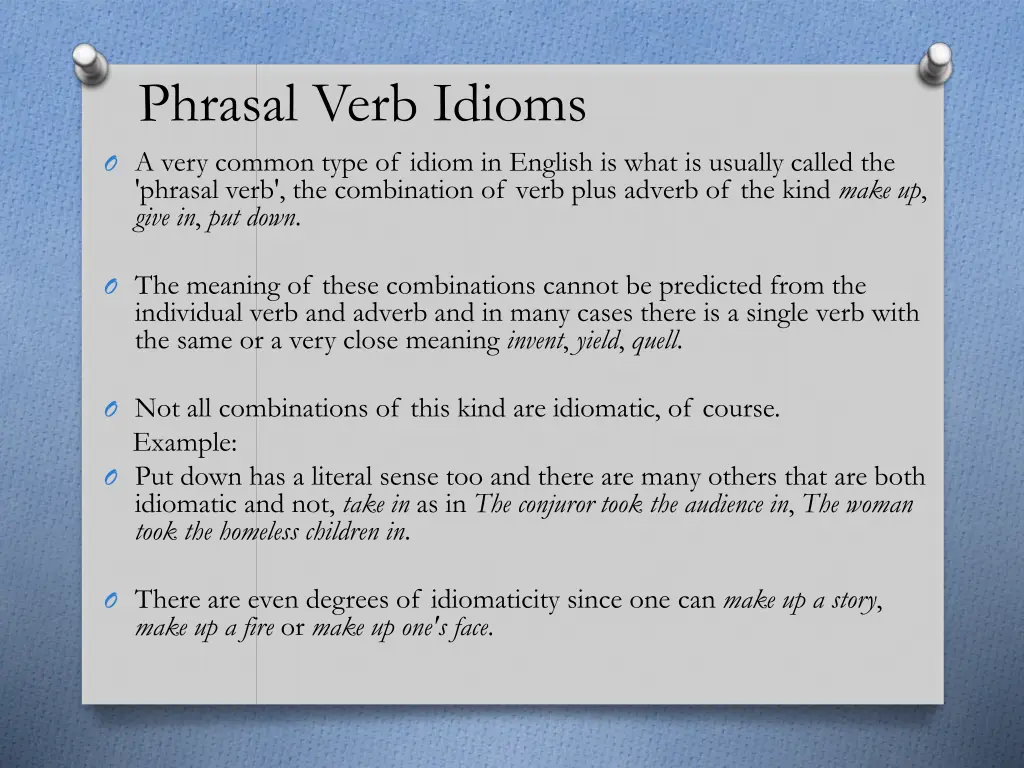
Phrasal Verb Idioms O A very common type of idiom in English is what is usually called the 'phrasal verb', the combination of verb plus adverb of the kind make up, give in, put down. O The meaning of these combinations cannot be predicted from the individual verb and adverb and in many cases there is a single verb with the same or a very close meaning invent, yield, quell. O Not all combinations of this kind are idiomatic, of course. Example: O Put down has a literal sense too and there are many others that are both idiomatic and not, take in as in The conjuror took the audience in, The woman took the homeless children in. O There are even degrees of idiomaticity since one can make up a story, make up a fire or make up one's face.