Community Engagement in Libraries
Community engagement in libraries involves empowering citizens to express their needs, building relationships, and creating programs based on community feedback. It requires informing, consulting, involving, collaborating, and empowering the community throughout the process.

Download Presentation

Please find below an Image/Link to download the presentation.
The content on the website is provided AS IS for your information and personal use only. It may not be sold, licensed, or shared on other websites without obtaining consent from the author.If you encounter any issues during the download, it is possible that the publisher has removed the file from their server.
You are allowed to download the files provided on this website for personal or commercial use, subject to the condition that they are used lawfully. All files are the property of their respective owners.
The content on the website is provided AS IS for your information and personal use only. It may not be sold, licensed, or shared on other websites without obtaining consent from the author.
E N D
Presentation Transcript
Community Engagement Kay Cassell Lecturer Rutgers Department of Libraries and Information Science
Definition of Community Engagement Community engagement encompasses a variety of approaches whereby public service bodies empower citizens to consider and express their views on how their particular needs are best met. (Rogers and Robinson) It is the act of meeting people where they are and building relationships and trust with individuals, community groups and community institutions. For libraries it means going out into the community, meeting people and building relationships, partnerships and trust with the members of the community, community organizations and institutions.
Definition of Community Engagement By going out into the community the library can find out what needs are not being met and where libraries can play a role For example, perhaps people need book delivery, classes or programs that the library could provide. The library might find out that local groups needed space for meetings. The library might find groups who want to partner with the library. But most of all community engagement requires listening to the community and letting them participate in the development of library programs and services.
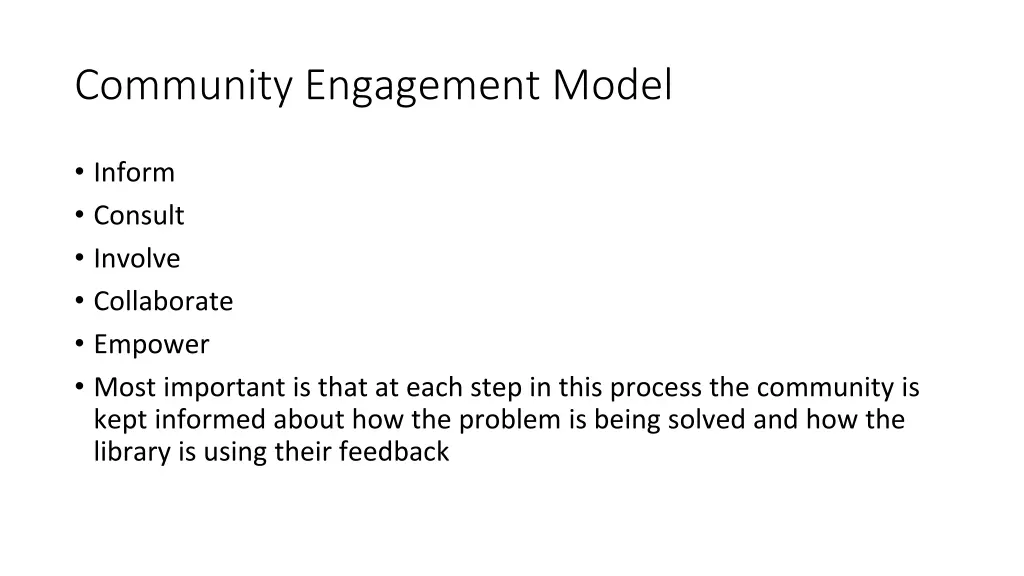
Community Engagement Model Inform Consult Involve Collaborate Empower Most important is that at each step in this process the community is kept informed about how the problem is being solved and how the library is using their feedback
Community Engagement Model Inform Inform means to provide the community with well balanced and objective information so they can understand the problem to be solved Information can come in many formats articles, reports, statistics, audio-visual presentations
Community Engagement Model (2) Consult Consult means to talk and listen to the community and get their feedback which could be analysis, alternative ideas or decisions Look for places where local community members gather so the library can talk informally with them
Community Engagement Model (3) Involve Involve means to continue to talk with the community and to ensure that their concerns and aspirations are met Be sure to let the community know how you are using the information they are providing
Community Engagement Model (4) Collaborate Collaborate means to partner with the community as the library develops its plans Look for partners with similar values and goals
Community Engagement Model (5) Empower Empower means to let the final decisions about programs and services up to the community Be sure that the library s decisions reflect the feedback from the community
What Can the Library Do? Build relationships with the community formal and informal Develop support and trust with the community Listen to what the community wants Work collaboratively with the community to achieve mutual goals Find ways to keep getting feedback from the community through surveys and focus groups as plans develop Develop sustainable programs and services Show the library s authenticity and that the library understands what the community needs
What Can The Library Do? Do research on all aspects of the community and its neighborhoods Use all available data about the community census, etc. Develop a community profile Find out what is available in the way of local resources and services Add something new or partner with an existing program Talk to community leaders to get ideas about what the library can do Set up conversations with members of the community both in the library and in the community
What the Library Can Do? (2) Provide periodic surveys and focus groups to get more feedback Send the library staff into the community on a regular basis to talk to people Have staff attend meetings of a variety of community groups, listen to what they are saying and doing and find ways for the library to contribute Identify possible community partners and talk with them
Partnerships Identify possible community partners and talk with them Partners can also become ambassadors Ask potential partners how they could engage with the library Host a program sponsored by one of your partners Think about joining forces with organizations whose programs align with your work
Asset Mapping Asset mapping means finding out about both the community s assets and their needs It is equally important to find out what the community has to offer its assets The community s assets can form a basis for developing programs and services that involve the community The community s needs provide new information on what services and programs will be well received
Case Studies Halifax (Canada) Public Library Youngstown (OH) Public Library Sno-Isle Libraries Issues That Matter Skokie Public Library Civic Lab Pop-ups Aarhus Public Library (Denmark)
Case Study Halifax (Canada) Public Library The Halifax Public Library did asset mapping to find out more about their immigrant community and how the library could serve it They sent their staff into the community to talk to local people both potential users of the library s services and providers of services for the immigrant community They needed to find out what resources and services were already available As a result of the asset mapping the library developed an Opening Doors program
Opening Doors program The Opening Doors program included A community advisory board Multilingual computer classes A knitting group for immigrant women An art show of the work of immigrants An immigrants culture week
Case Study Youngstown Public Library The Library began to involve the community more in its decision making as a result of a Harwood Institute study that said the community must be the center of the institution s decision making The library involved the community in planning new branches When the Library faced a tough budget decision, the community was already involved and the community supported, for example, the library s need to pass a levy to fund the library The Library continues to have Community Conversations to find out more about what the community wants
Case Study Sno-Isle Libraries The Sno-Isle Libraries does a program series each year entitled Issues That Matter The subjects for the programs are selected by the community such as mental health, drug addition, housing and homelessness The Library uses local resource people to provide the programs The Library provides a list of resources so the community can explore the subject further and a list of possible action items as requested by the community
Case Study Skokie Public Library Skokie Public Library developed Civic Lab Pop-Ups . A resource list for each topic is provided. The topic could be a) a topic in the news such as gun violence, b) basic civic literacy such as how a bill becomes a law, c) a timely topic such as talking about taxes d) news literacy such as what journalism is and isn t Staff lead a 60 - 90 minute discussion in the library
Case Study Aarhus Public Library (Denmark) This Danish public library known as Dokk1 has a worldwide reputation for success with community engagement It has built a network, done community mapping, identified relevant and influential community organizations and individuals and identified possible partners It has developed reports and position papers about the library It has tried to align its programs and services with current city policies and initiatives It has developed a vision for a new library with the assistance of a Strategic Advisory Board and an Idea Group
Summary There is no one right way to do community engagement So much depends on the community Try a variety of approaches to see what works best Be consistent in what you do Good luck!!