Complexity Theory and Problem Solving through Computation
Explore how problems can be solved through computation in Complexity Theory. Learn about deciding languages via Turing machines, handling invalid inputs, and promise problems in a computational context.

Download Presentation

Please find below an Image/Link to download the presentation.
The content on the website is provided AS IS for your information and personal use only. It may not be sold, licensed, or shared on other websites without obtaining consent from the author. If you encounter any issues during the download, it is possible that the publisher has removed the file from their server.
You are allowed to download the files provided on this website for personal or commercial use, subject to the condition that they are used lawfully. All files are the property of their respective owners.
The content on the website is provided AS IS for your information and personal use only. It may not be sold, licensed, or shared on other websites without obtaining consent from the author.
E N D
Presentation Transcript
CMSC 28100 Introduction to Complexity Theory Complexity Theory Spring 2025 Instructor: William Hoza 1
Which problems Which problems can be solved can be solved through computation? through computation? 2
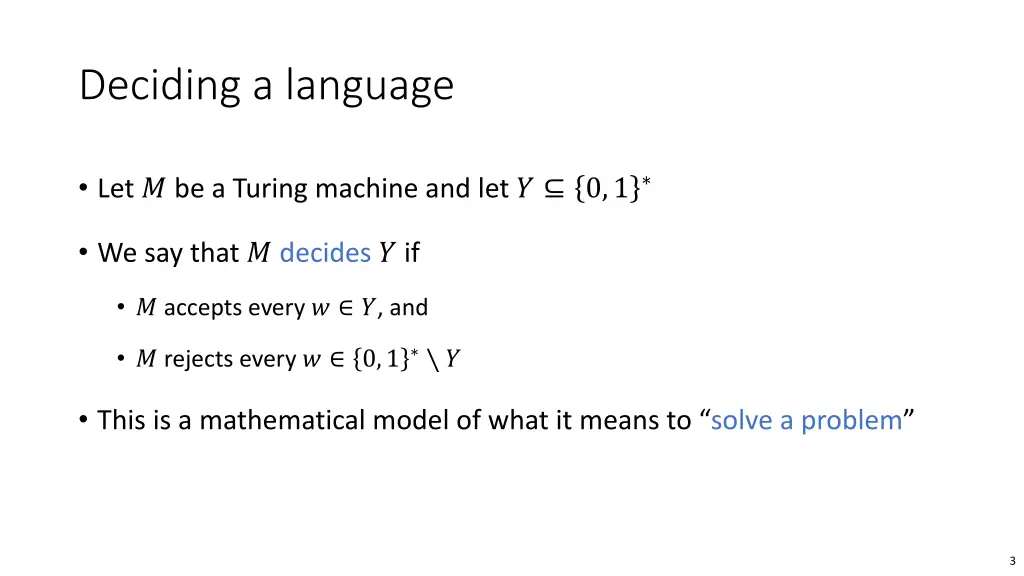
Deciding a language Let ? be a Turing machine and let ? 0,1 We say that ? decides ? if ? accepts every ? ?, and ? rejects every ? 0,1 ? This is a mathematical model of what it means to solve a problem 3
Invalid inputs Informal problem statement: Given a graph ?, determine whether it is connected The same problem, formulated as a language: CONNECTED = ? ? is a connected graph What if we are given ? 0,1 that is not the encoding of any graph? Suppose we want to decide CONNECTED A: This situation cannot occur B:It doesn t matter what we do If we are given ? where ? is a connected graph, we should accept C: We can accept or reject, but we must not loop D: We must reject If we are given ? where ? is a disconnected graph, we should reject Respond at PollEv.com/whoza or text whoza to 22333 4
Invalid inputs There can exist invalid inputs ? 0,1 that do not encode graphs For example, suppose we are using adjacency matrices to encode graphs Then ? is a perfect square for every graph ? Therefore, 10101 is not the encoding of any graph Technically, 10101 CONNECTED = ? ? is a connected graph To decide CONNECTED, a Turing machine would have to reject 10101 5
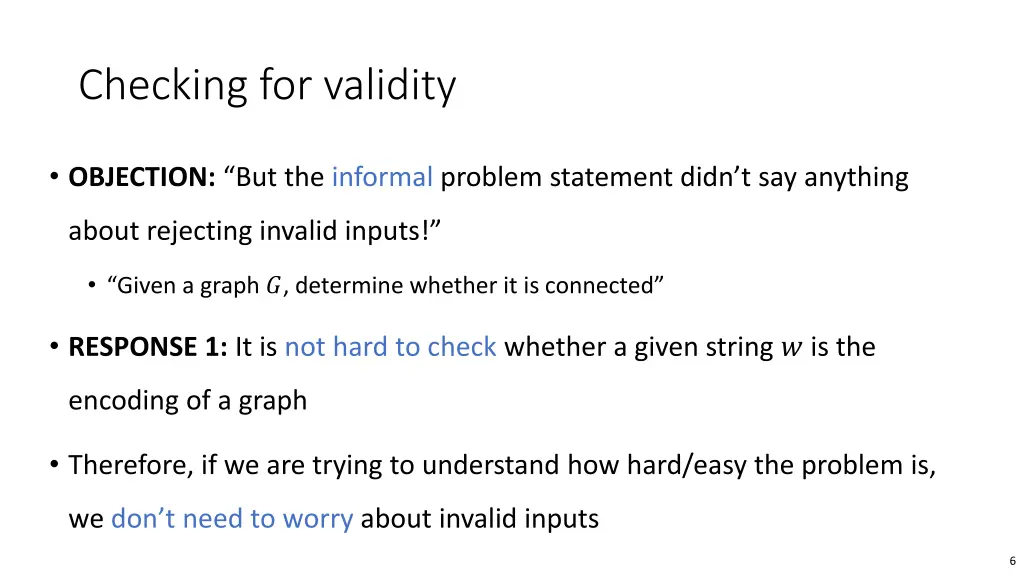
Checking for validity OBJECTION: But the informal problem statement didn t say anything about rejecting invalid inputs! Given a graph ?, determine whether it is connected RESPONSE 1: It is not hard to check whether a given string ? is the encoding of a graph Therefore, if we are trying to understand how hard/easy the problem is, we don t need to worry about invalid inputs 6
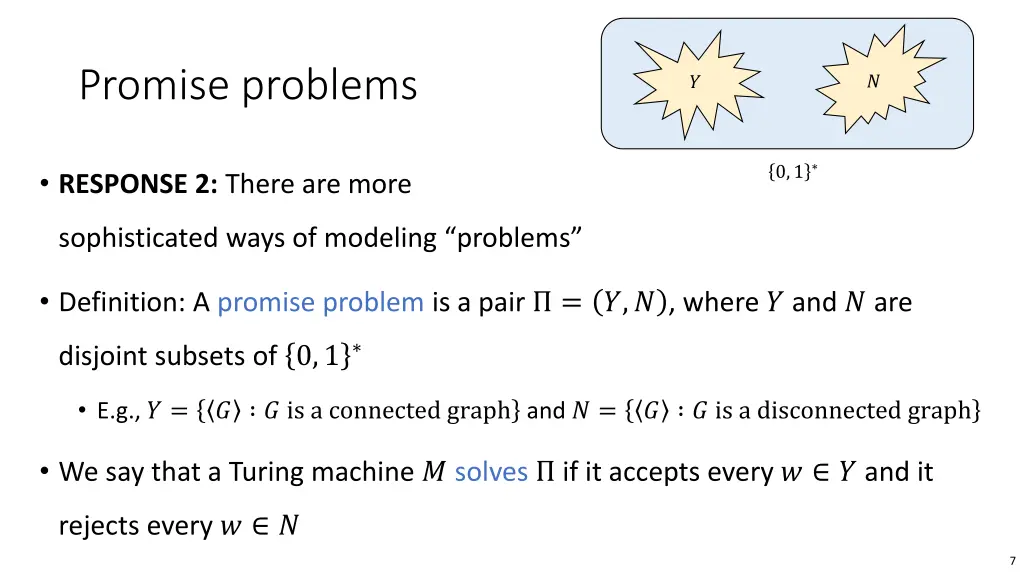
Promise problems ? ? 0,1 RESPONSE 2: There are more sophisticated ways of modeling problems Definition: A promise problem is a pair = ?,? , where ? and ? are disjoint subsets of 0,1 E.g., ? = ? ? is a connected graph and ? = ? ? is a disconnected graph We say that a Turing machine ? solves if it accepts every ? ? and it rejects every ? ? 7
Ignoring invalid inputs In this course, for simplicity s sake and for historical reasons, we will focus on languages rather than promise problems However, for simplicity s sake, we will mostly ignore the issue of invalid inputs 8
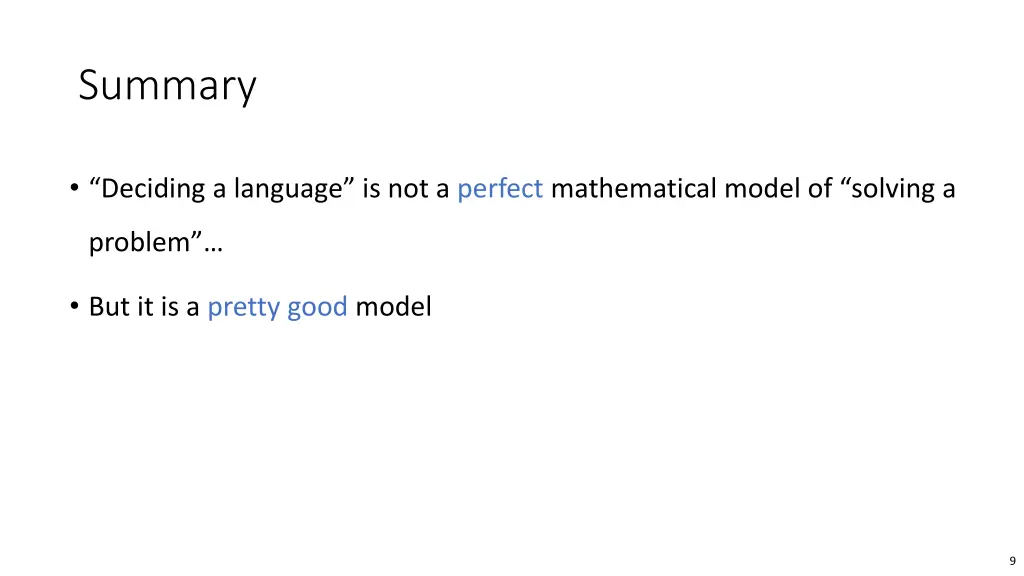
Summary Deciding a language is not a perfect mathematical model of solving a problem But it is a pretty good model 9
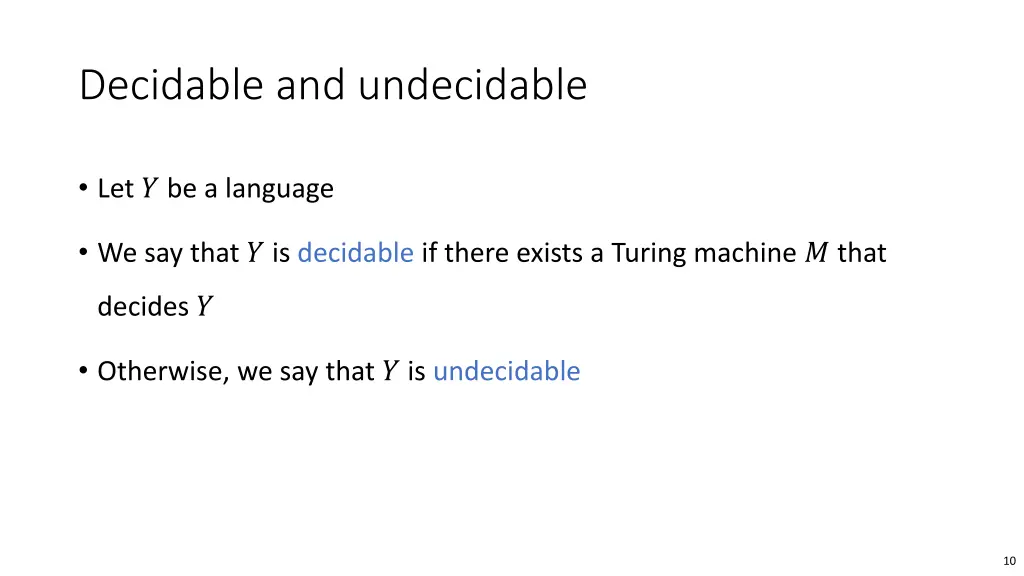
Decidable and undecidable Let ? be a language We say that ? is decidable if there exists a Turing machine ? that decides ? Otherwise, we say that ? is undecidable 10
Which problems Which problems can be solved can be solved through computation? through computation? 11
Which languages are decidable? Which languages are decidable? 12
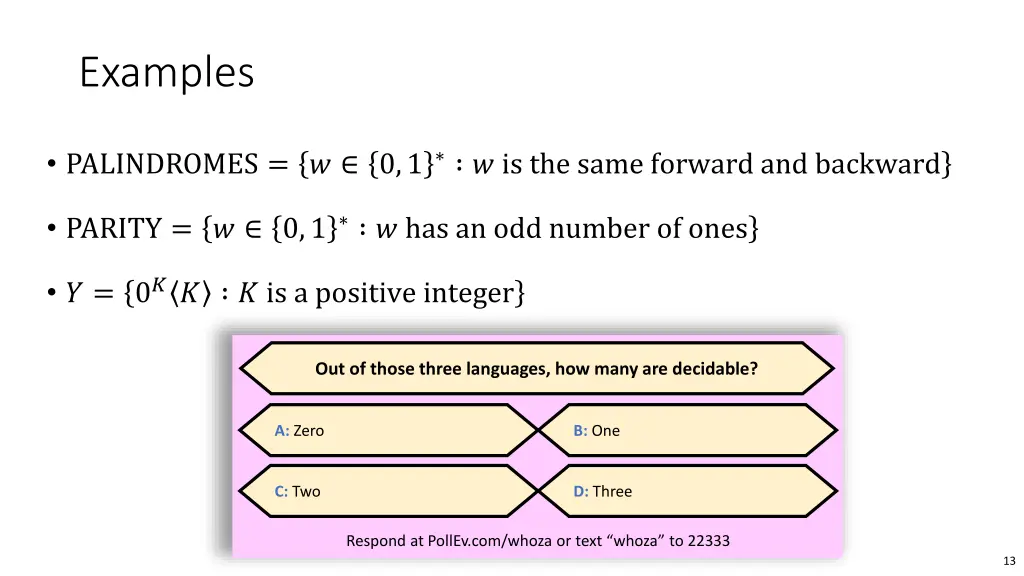
Examples PALINDROMES = ? 0,1 ? is the same forward and backward PARITY = ? 0,1 ? has an odd number of ones ? = 0?? ? is a positive integer Out of those three languages, how many are decidable? A: Zero B: One C: Two D: Three Respond at PollEv.com/whoza or text whoza to 22333 13
Is Is every every language decidable? language decidable? 14
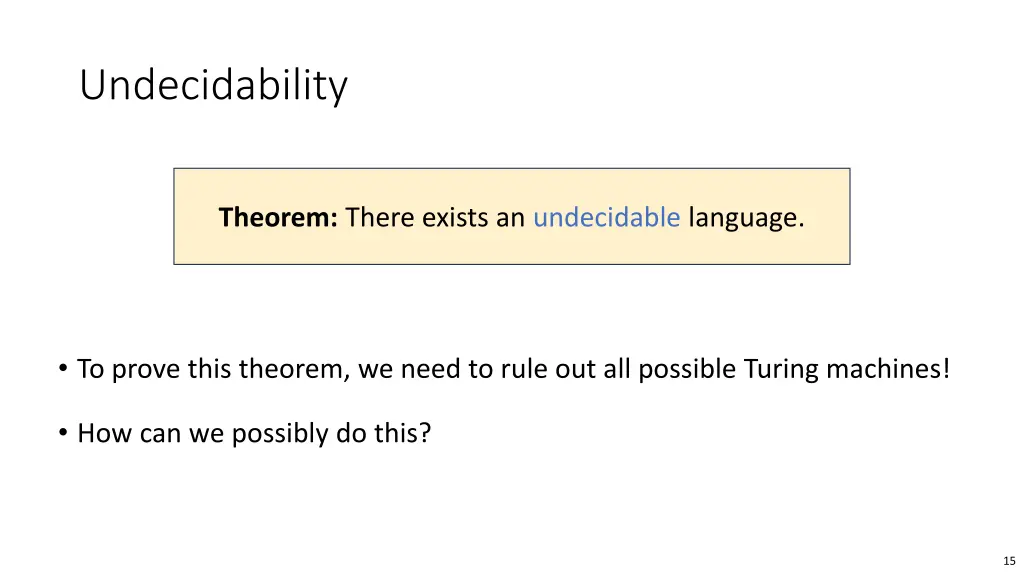
Undecidability Theorem: There exists an undecidable language. To prove this theorem, we need to rule out all possible Turing machines! How can we possibly do this? 15
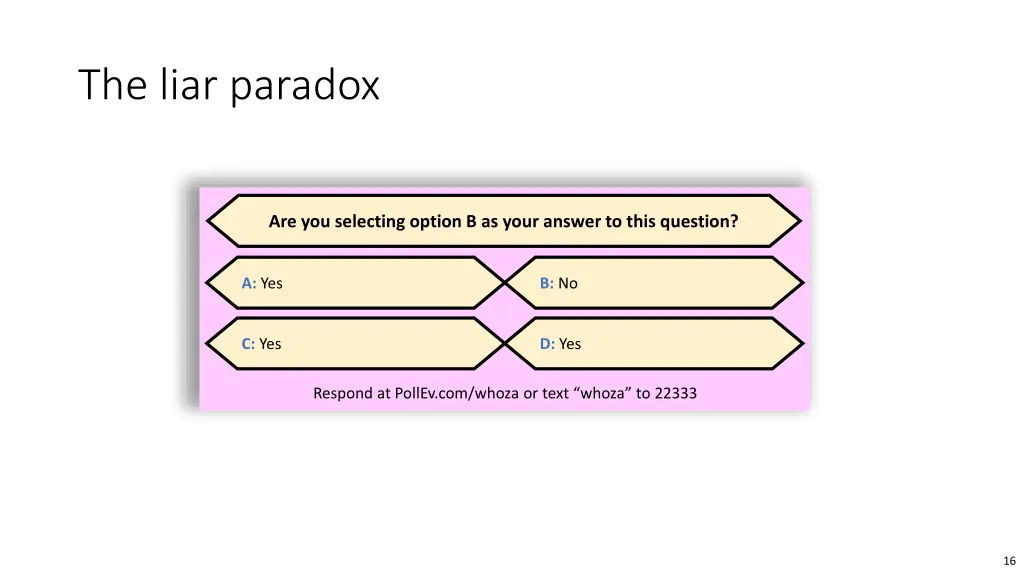
The liar paradox Are you selecting option B as your answer to this question? A: Yes B: No C: Yes D: Yes Respond at PollEv.com/whoza or text whoza to 22333 16
Code as data Plan: We will construct a language ? such that trying to decide ? creates a liar paradox Key idea: A Turing machine ? can be encoded as a binary string ? Code as data We ll discuss this in more detail later 17
Turing machines analyzing Turing machines After encoding a Turing machine ? as a binary string ? We can use ? as the input for another Turing machine! Compilers, syntax highlighting, linters 18
Self-rejecting Turing machines Let ? be a TM A strange-but-legal thing we can do: Run ? on ? Three possibilities: ? accepts ? ? rejects ? ? loops on ? Definition: We say that a Turing machine ? is self-rejecting if ? rejects ? 19
Self-rejecting Turing machines Let SELF-REJECTORS = ? ? is a self-rejecting Turing machine Theorem: SELF-REJECTORSis undecidable Proof: Let ?be any TM. We ll show that ? does not decide SELF-REJECTORS If ? rejects ? , then ? SELF-REJECTORS, so ? ought to accept ? If ?doesn t reject ? , then ? SELF-REJECTORS, so ? ought to reject ? In either case, ? does the wrong thing! 20
Interpreting the theorem We proved that there does not exist a Turing machine that decides SELF-REJECTORS OBJECTION: Yeah, but I don t particularly care about Turing machines. Is there some other type of algorithm that decides SELF-REJECTORS? RESPONSE: The Church-Turing Thesis 21
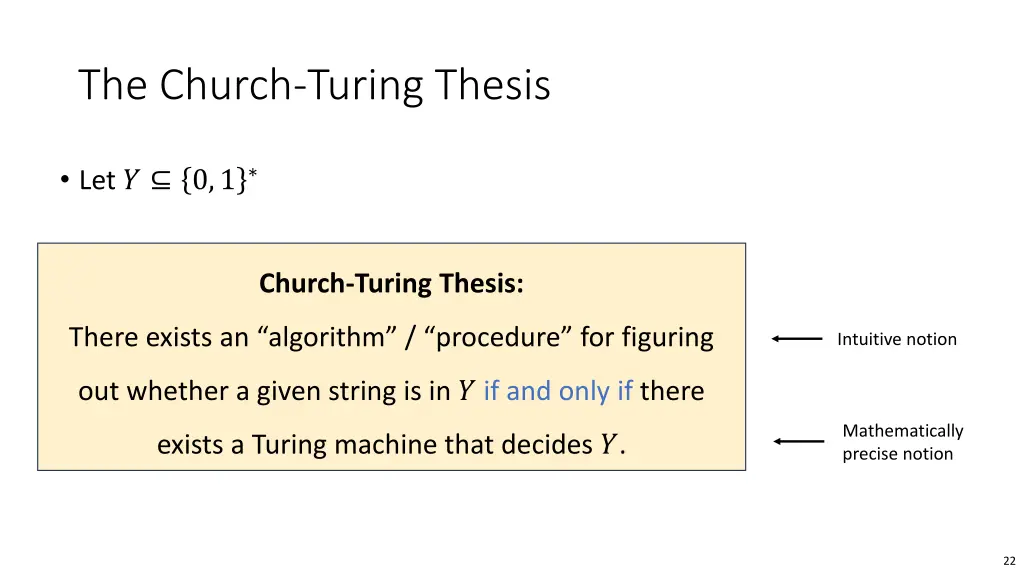
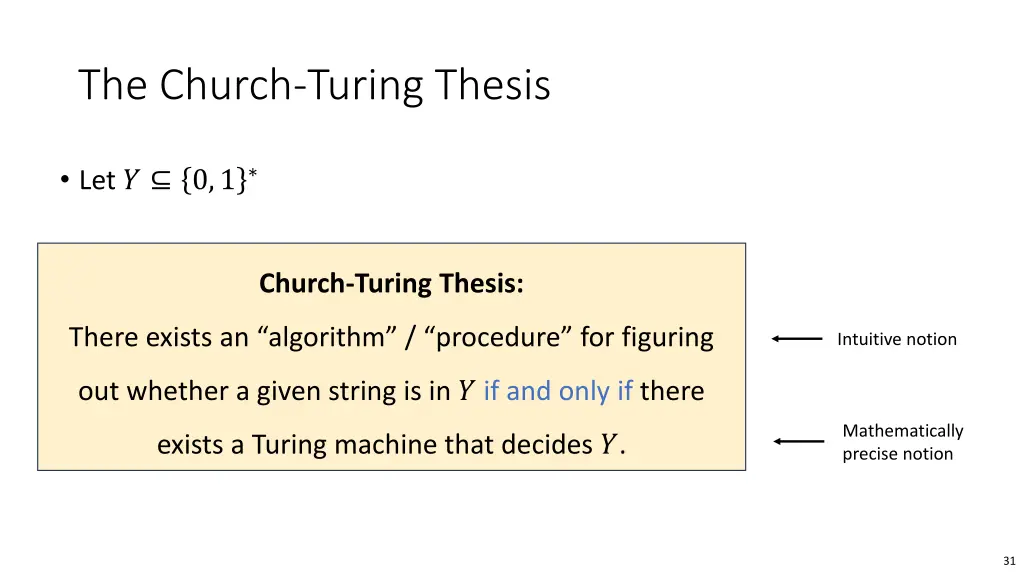
The Church-Turing Thesis Let ? 0,1 Church-Turing Thesis: There exists an algorithm / procedure for figuring Intuitive notion out whether a given string is in ? if and only if there Mathematically precise notion exists a Turing machine that decides ?. 22
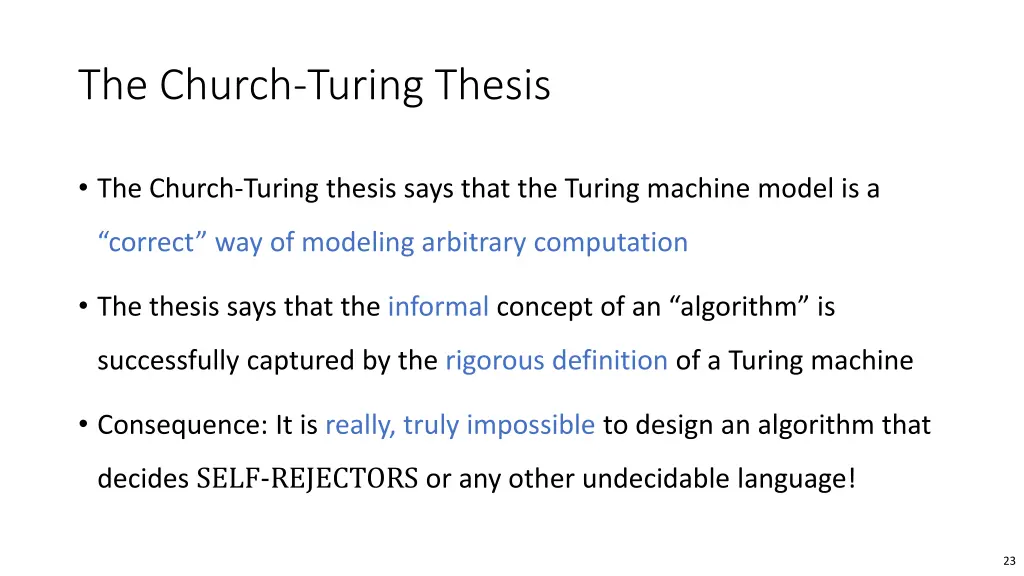
The Church-Turing Thesis The Church-Turing thesis says that the Turing machine model is a correct way of modeling arbitrary computation The thesis says that the informal concept of an algorithm is successfully captured by the rigorous definition of a Turing machine Consequence: It is really, truly impossible to design an algorithm that decides SELF-REJECTORS or any other undecidable language! 23
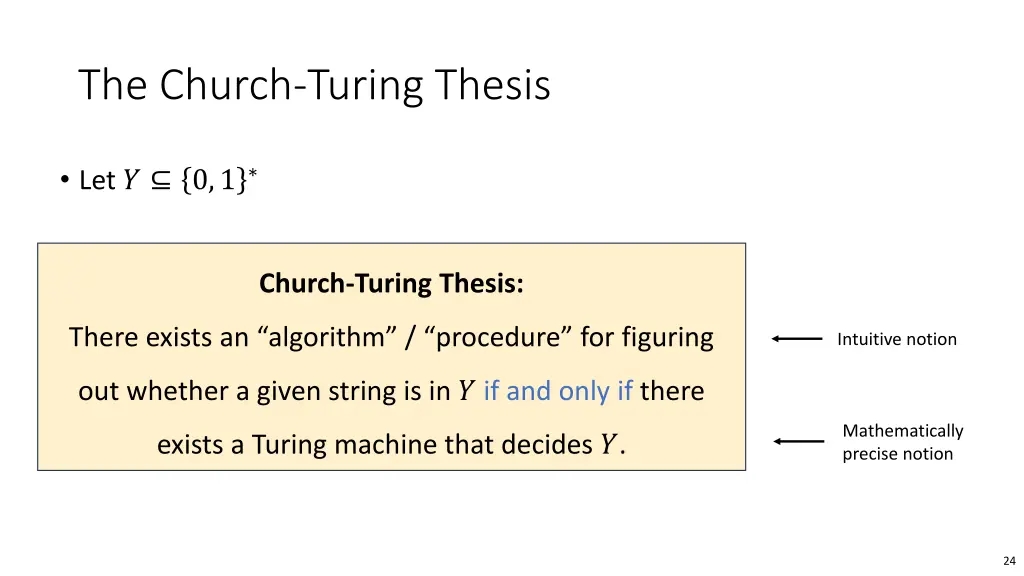
The Church-Turing Thesis Let ? 0,1 Church-Turing Thesis: There exists an algorithm / procedure for figuring Intuitive notion out whether a given string is in ? if and only if there Mathematically precise notion exists a Turing machine that decides ?. 24
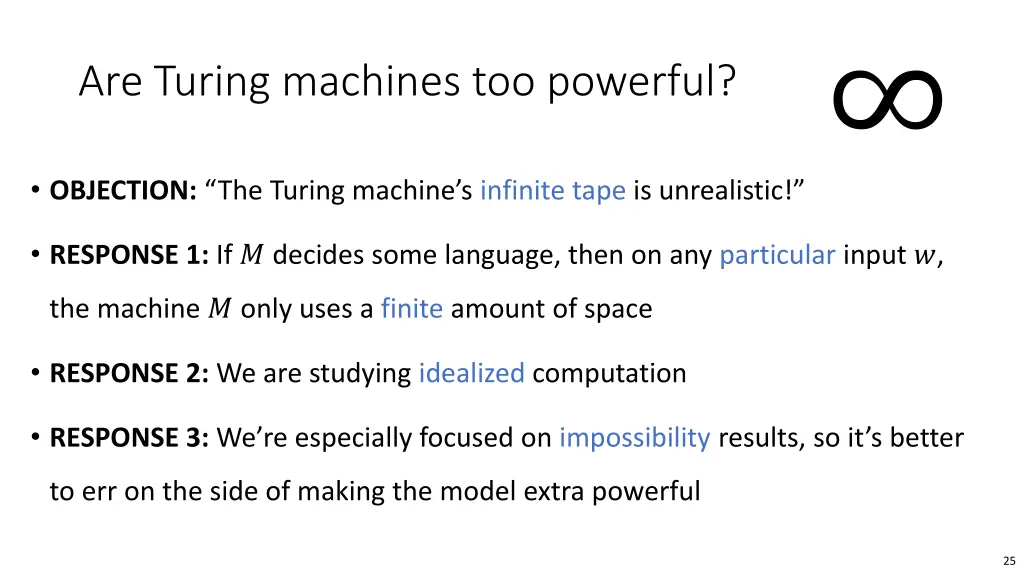
Are Turing machines too powerful? OBJECTION: The Turing machine s infinite tape is unrealistic! RESPONSE 1: If ? decides some language, then on any particular input ?, the machine ? only uses a finite amount of space RESPONSE 2: We are studying idealized computation RESPONSE 3: We re especially focused on impossibility results, so it s better to err on the side of making the model extra powerful 25
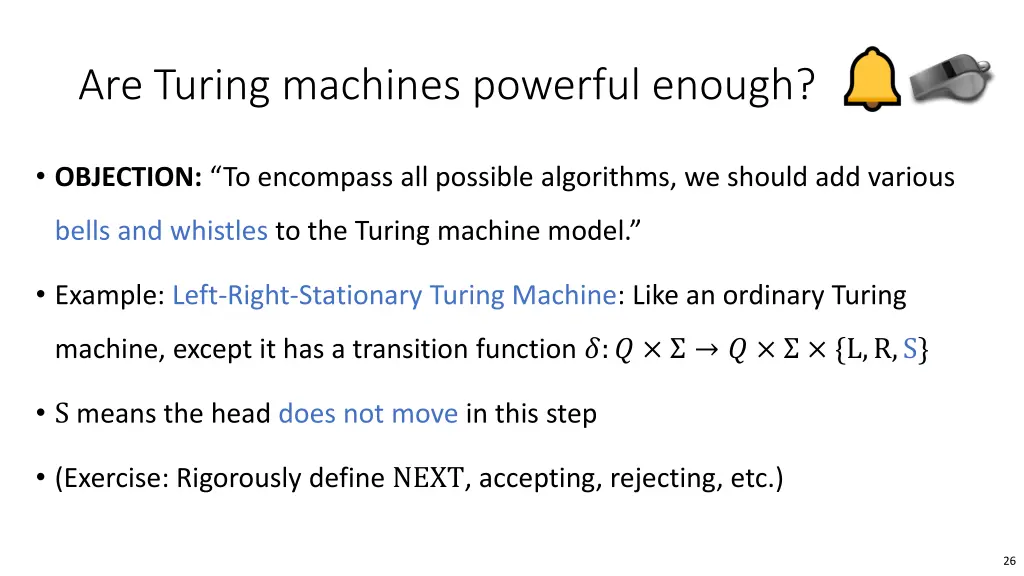
Are Turing machines powerful enough? OBJECTION: To encompass all possible algorithms, we should add various bells and whistles to the Turing machine model. Example: Left-Right-Stationary Turing Machine: Like an ordinary Turing machine, except it has a transition function ?:? ? {L,R,S} S means the head does not move in this step (Exercise: Rigorously define NEXT, accepting, rejecting, etc.) 26
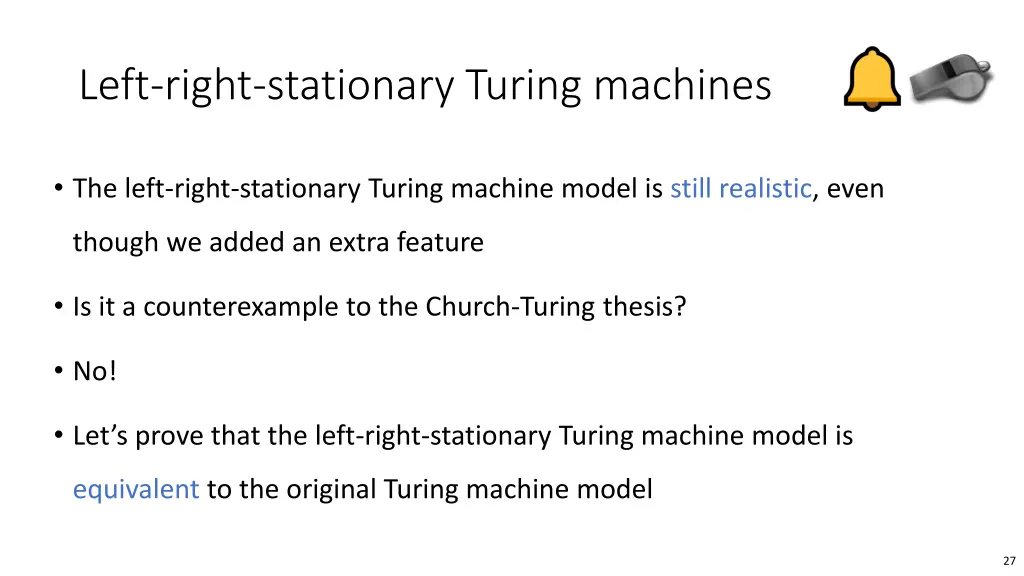
Left-right-stationary Turing machines The left-right-stationary Turing machine model is still realistic, even though we added an extra feature Is it a counterexample to the Church-Turing thesis? No! Let s prove that the left-right-stationary Turing machine model is equivalent to the original Turing machine model 27
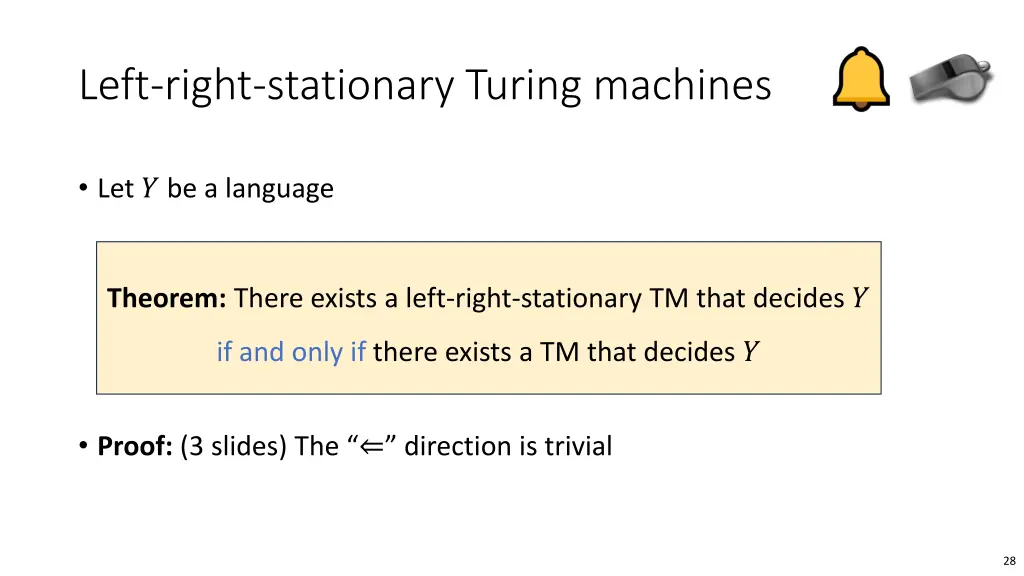
Left-right-stationary Turing machines Let ? be a language Theorem: There exists a left-right-stationary TM that decides ? if and only if there exists a TM that decides ? Proof:(3 slides) The direction is trivial 28
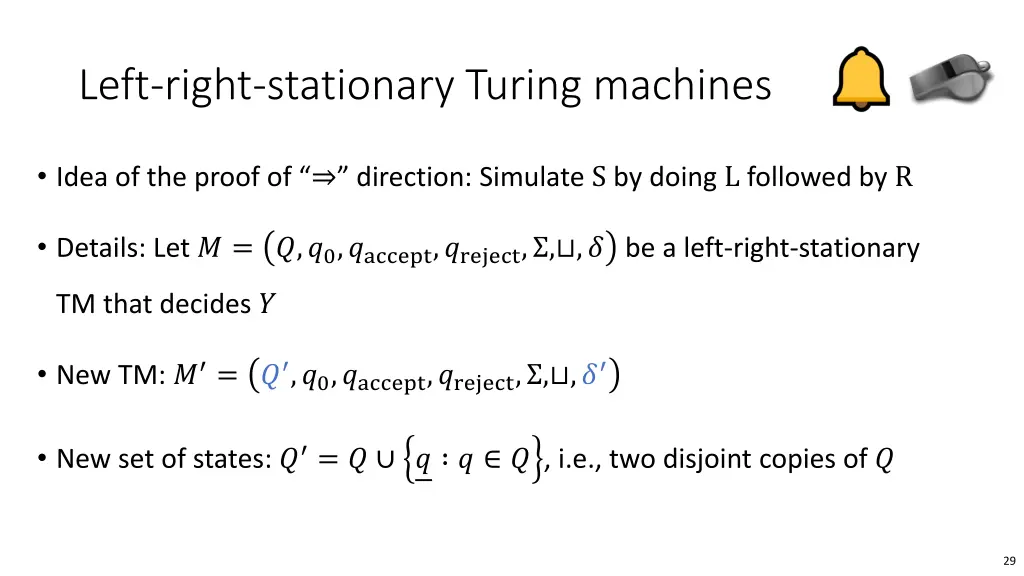
Left-right-stationary Turing machines Idea of the proof of direction: Simulate S by doing L followed by R Details: Let ? = ?,?0,?accept,?reject, , ,? be a left-right-stationary TM that decides ? New TM: ? = ? ,?0,?accept,?reject, , ,? New set of states: ? = ? ? ? ? , i.e., two disjoint copies of ? 29
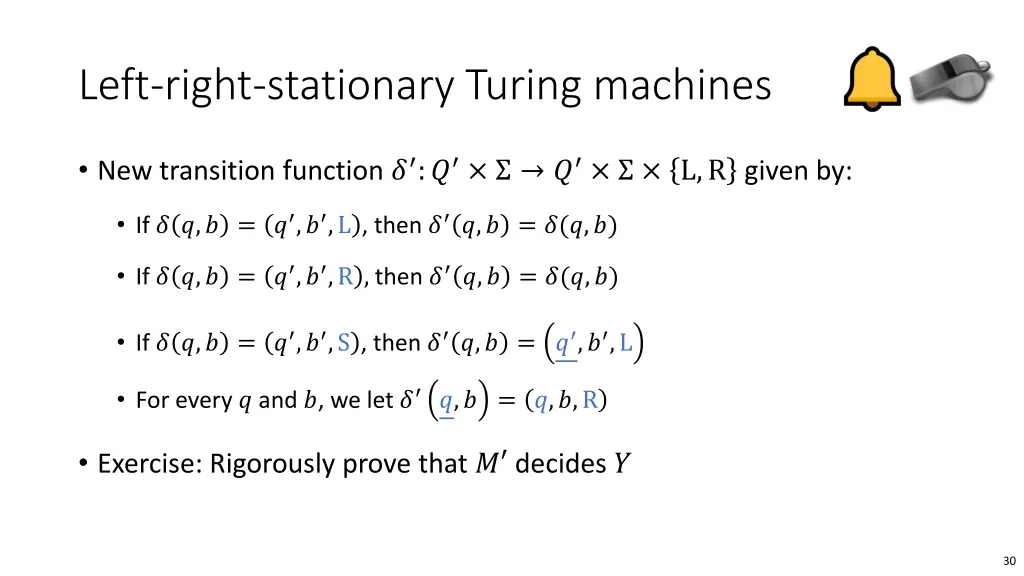
Left-right-stationary Turing machines New transition function ? :? ? L,R given by: If ? ?,? = ? ,? ,L , then ? ?,? = ?(?,?) If ? ?,? = ? ,? ,R , then ? ?,? = ?(?,?) If ? ?,? = ? ,? ,S , then ? ?,? = ? ,? ,L For every ? and ?, we let ? ?,? = ?,?,R Exercise: Rigorously prove that ? decides ? 30
The Church-Turing Thesis Let ? 0,1 Church-Turing Thesis: There exists an algorithm / procedure for figuring Intuitive notion out whether a given string is in ? if and only if there Mathematically precise notion exists a Turing machine that decides ?. 31