Discover the key requirements and procedures involved in implementing threat assessment teams in Pennsylvania schools, as mandated by Article XIII-E of the School Code. Learn about the definition of threats, threat assessment processes, and the importance of early intervention to ensure a safe school environment for all stakeholders.
Please find below an Image/Link to download the presentation.
The content on the website is provided AS IS for your information and personal use only. It may not be sold, licensed, or shared on other websites without obtaining consent from the author. If you encounter any issues during the download, it is possible that the publisher has removed the file from their server.
You are allowed to download the files provided on this website for personal or commercial use, subject to the condition that they are used lawfully. All files are the property of their respective owners.
The content on the website is provided AS IS for your information and personal use only. It may not be sold, licensed, or shared on other websites without obtaining consent from the author.
E N D
Presentation Transcript
INFORMATION FOR SCHOOL STAFF, PARENTS AND GUARDIANS THREAT ASSESSMENT
Introduction In June of 2019, legislation was enacted to assist schools in creating safer environments. One of the acts, Article XIII-E, Threat Assessment was added to the Pennsylvania School Code. The law states that each school entity (school district, intermediate unit, area career and technical school, charter school, regional charter school, or cyber charter school) shall establish at least one threat assessment team. In accordance with the legislation, the School Safety and Security Committee (SSSC), Pennsylvania Commission on Crime and Delinquency (PCCD), and key stakeholders from across Pennsylvania developed model procedures and guidance materials to help local schools establish and operate threat assessment teams.
Overview of Statute: What Do Schools Need To Do? In accordance with 24 P.S. 1302-E - 1303-E, schools shall provide the following: 1. Establish a Threat Assessment Team 2. Facilitate opportunities for team members to be trained on best practices in the threat assessment process 3. Informational Materials a) Students (age appropriate) b) Parents/Guardians c) School Employees
Overview of Statute: What Do Schools Need To Do? 4. Annually present to the school board a report outlining the school s approach to threat assessment. 5. Ensuring Compliance with Federal and State Laws/Regulations Regarding Student Record Confidentiality 6. Communication and Coordination with Other Multidisciplinary Teams a) Student Assistance Program (SAP) Teams b) Special Education Teams (IEPs, 504 Plans, etc.)
Definition of Threat Threat is a communication or behavior that indicates an individual poses a danger to the safety of school staff or students through acts of violence or other behavior that would cause harm to self or others. The threat may be expressed/communicated behaviorally, orally, visually, in writing, electronically, or through any other means. These actions can be considered a threat regardless of whether it is observed by or communicated directly to the target of the threat or observed by a third party, and regardless of whether the target of the threat is aware of the threat. Virginia Department of Criminal Justice Services
Defining Threat Assessment Threat assessment is a fact-based process for the assessment of and intervention with students whose behaviors may indicate a threat to the safety of the student, other students, school employees, school facilities, the community, or others. PA Public School Code, Article XIII-E. Threat Assessment. Threat assessment is a prevention strategy. School communities work together to identify student threats before they become acts of violence Schools have systems in place to process information Students receive assistance through early identification
The Threat Assessment Team The people on the threat assessment team are appointed by the superintendent or executive director in consultation with the school safety and security coordinator. There are some positions that are required in statute to be on the team and there are others that may be assigned based on the needs of the school. The chief school administrator is to appoint a threat assessment team leader. In addition, when a student is referred to the threat assessment team, it would behoove the team to consult with or engage the participation of someone in the school building who knows the student well, whether that be a teacher, aide, custodian, secretary, food service worker, coach, or other school staff person.
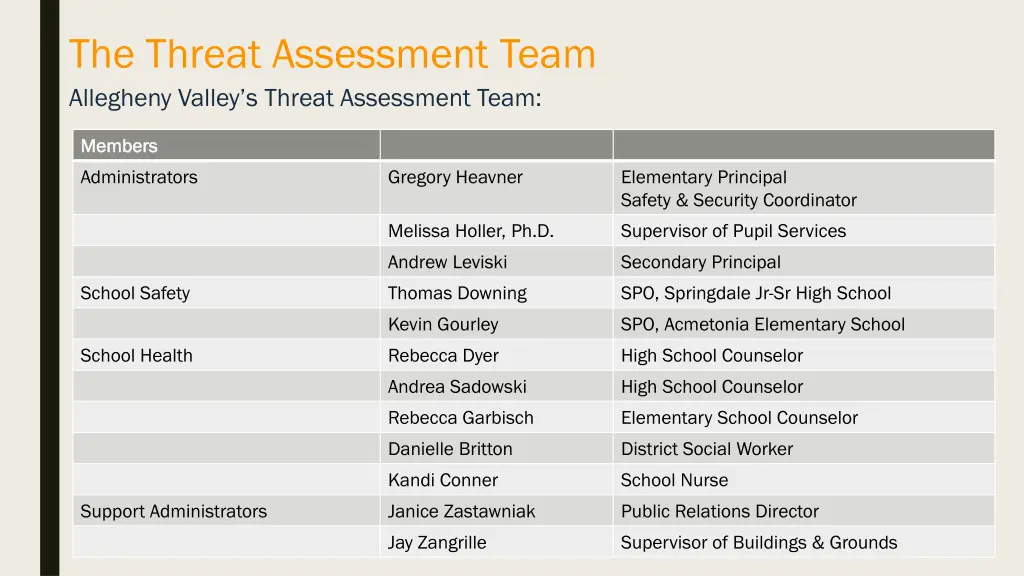
The Threat Assessment Team Allegheny Valley s Threat Assessment Team: Members Members Administrators Gregory Heavner Elementary Principal Safety & Security Coordinator Supervisor of Pupil Services Secondary Principal SPO, Springdale Jr-Sr High School SPO, Acmetonia Elementary School High School Counselor High School Counselor Elementary School Counselor District Social Worker School Nurse Public Relations Director Supervisor of Buildings & Grounds Melissa Holler, Ph.D. Andrew Leviski Thomas Downing Kevin Gourley Rebecca Dyer Andrea Sadowski Rebecca Garbisch Danielle Britton Kandi Conner Janice Zastawniak Jay Zangrille School Safety School Health Support Administrators
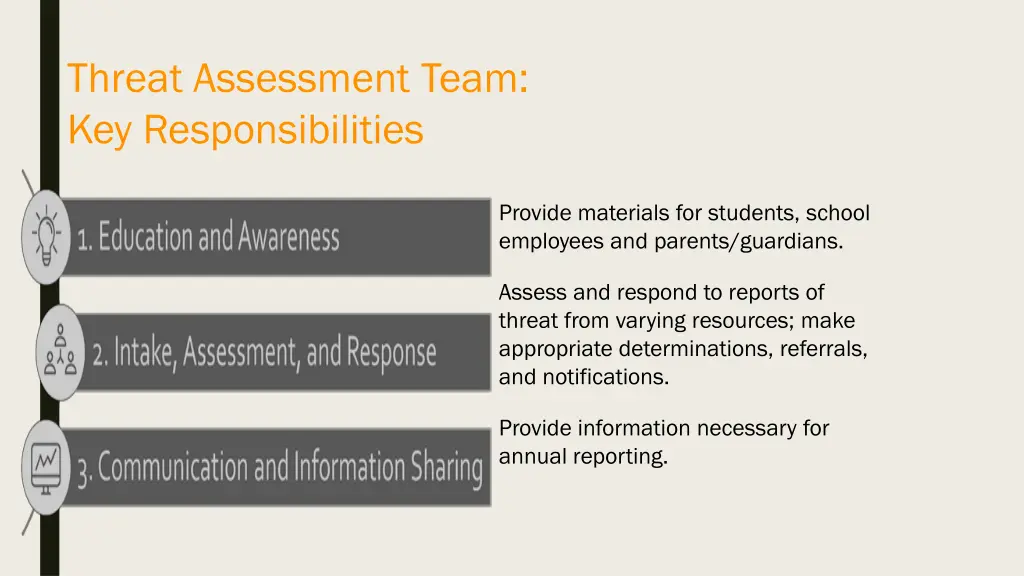
Threat Assessment Team: Key Responsibilities Provide materials for students, school employees and parents/guardians. Assess and respond to reports of threat from varying resources; make appropriate determinations, referrals, and notifications. Provide information necessary for annual reporting.
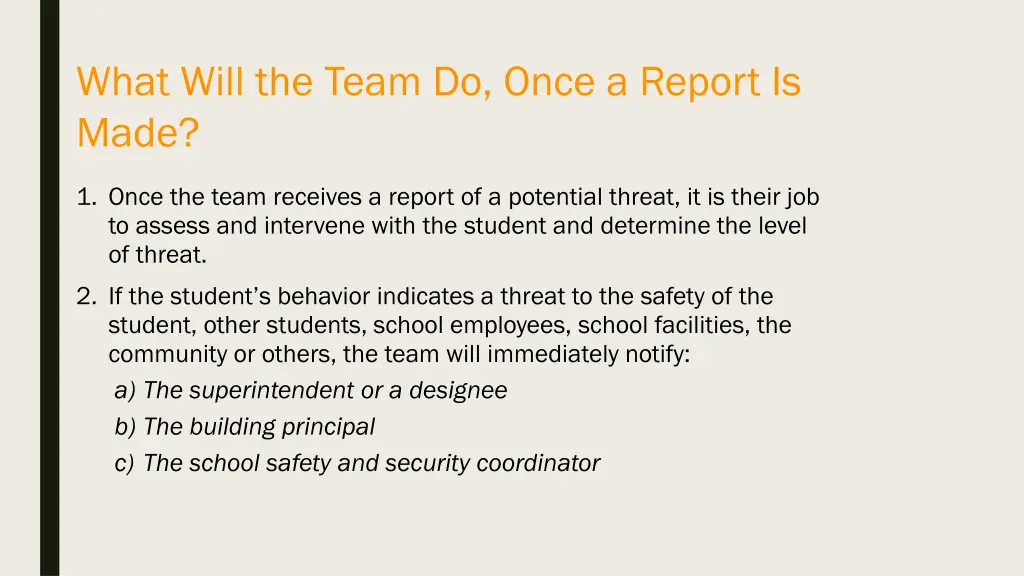
What Will the Team Do, Once a Report Is Made? 1. Once the team receives a report of a potential threat, it is their job to assess and intervene with the student and determine the level of threat. 2. If the student s behavior indicates a threat to the safety of the student, other students, school employees, school facilities, the community or others, the team will immediately notify: a) The superintendent or a designee b) The building principal c) The school safety and security coordinator
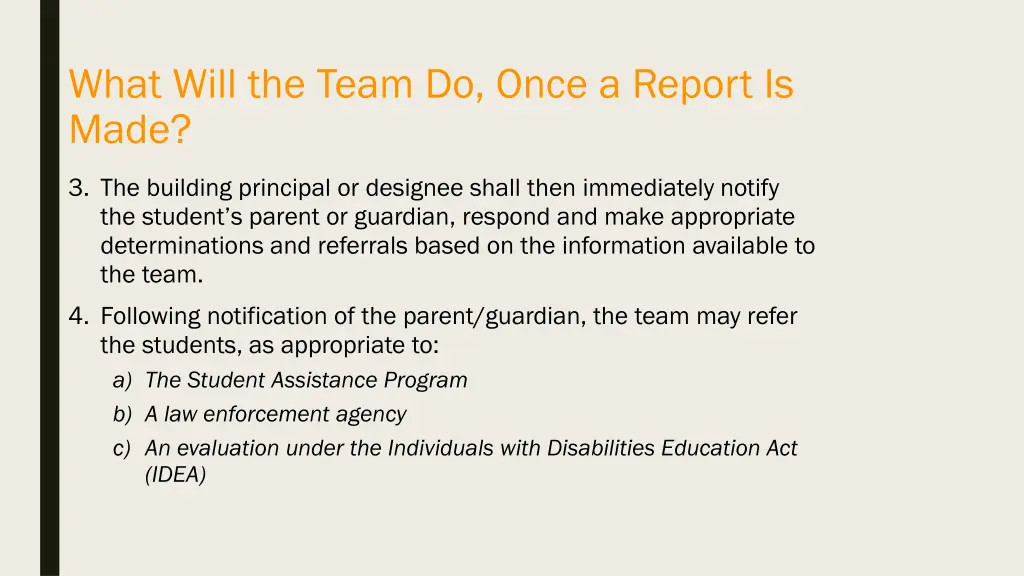
What Will the Team Do, Once a Report Is Made? 3. The building principal or designee shall then immediately notify the student s parent or guardian, respond and make appropriate determinations and referrals based on the information available to the team. 4. Following notification of the parent/guardian, the team may refer the students, as appropriate to: a) The Student Assistance Program b) A law enforcement agency c) An evaluation under the Individuals with Disabilities Education Act (IDEA)
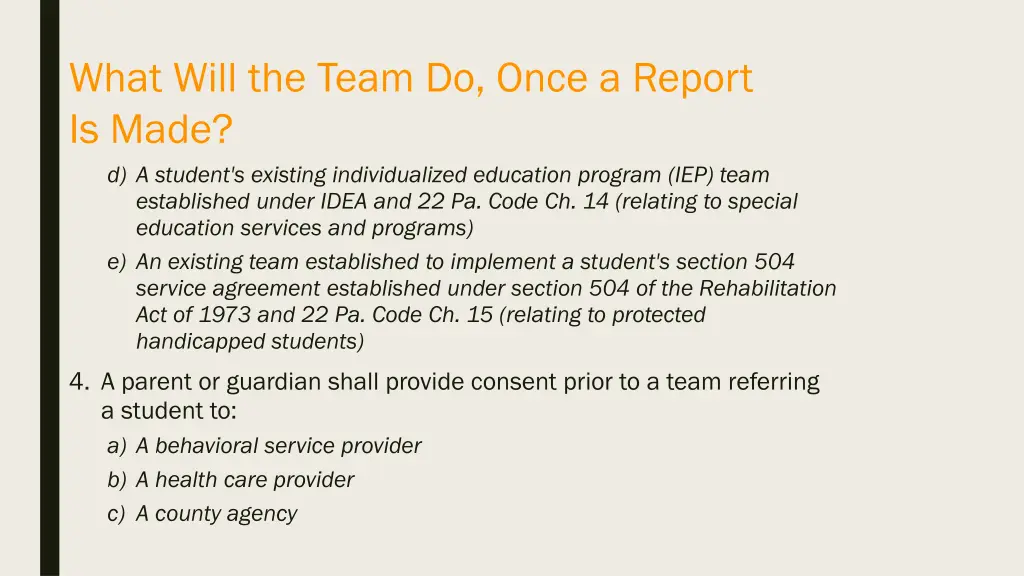
What Will the Team Do, Once a Report Is Made? d) A student's existing individualized education program (IEP) team established under IDEA and 22 Pa. Code Ch. 14 (relating to special education services and programs) e) An existing team established to implement a student's section 504 service agreement established under section 504 of the Rehabilitation Act of 1973 and 22 Pa. Code Ch. 15 (relating to protected handicapped students) 4. A parent or guardian shall provide consent prior to a team referring a student to: a) A behavioral service provider b) A health care provider c) A county agency
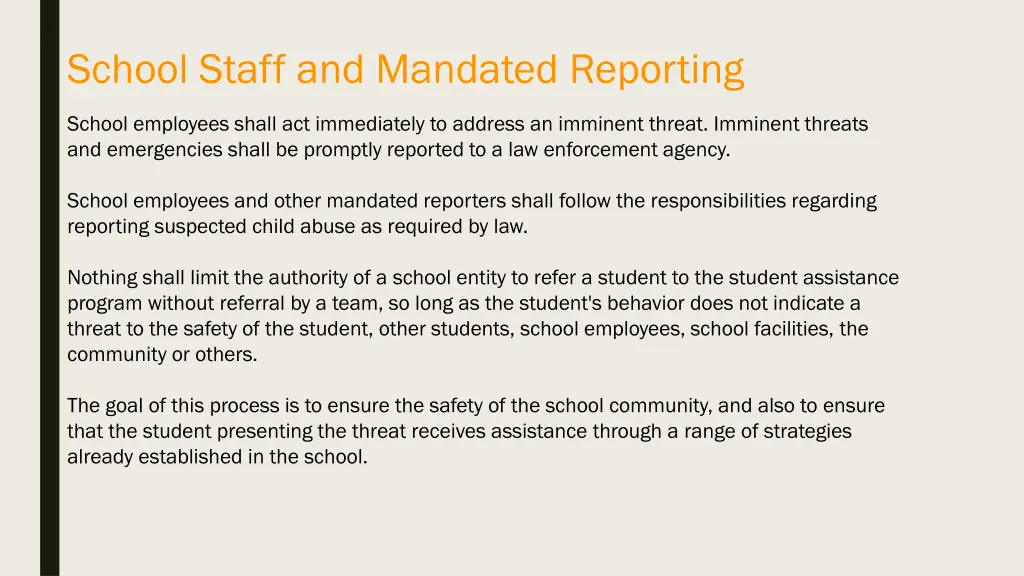
School Staff and Mandated Reporting School employees shall act immediately to address an imminent threat. Imminent threats and emergencies shall be promptly reported to a law enforcement agency. School employees and other mandated reporters shall follow the responsibilities regarding reporting suspected child abuse as required by law. Nothing shall limit the authority of a school entity to refer a student to the student assistance program without referral by a team, so long as the student's behavior does not indicate a threat to the safety of the student, other students, school employees, school facilities, the community or others. The goal of this process is to ensure the safety of the school community, and also to ensure that the student presenting the threat receives assistance through a range of strategies already established in the school.
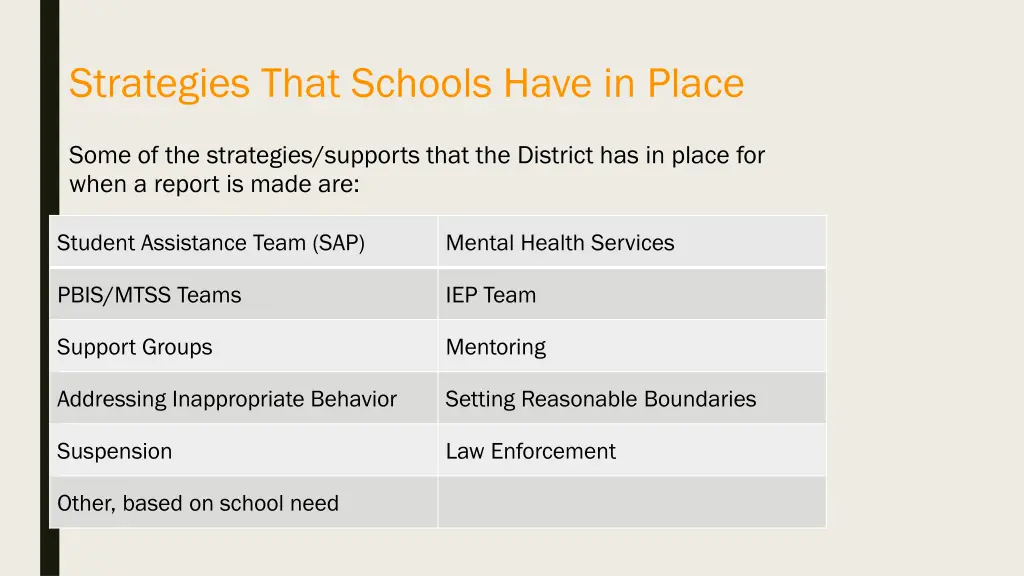
Strategies That Schools Have in Place Some of the strategies/supports that the District has in place for when a report is made are: Student Assistance Team (SAP) Mental Health Services PBIS/MTSS Teams IEP Team Support Groups Mentoring Addressing Inappropriate Behavior Setting Reasonable Boundaries Suspension Law Enforcement Other, based on school need
Recognizing At-Risk Behaviors There are observable behaviors which may not be normal and are out-of-character for most students. These behaviors may lead to acts of violence. If the behaviors are noticed early on and dealt with through the strategies that are in place in the school, then appropriate measures can be taken to assist the student before the violence occurs.
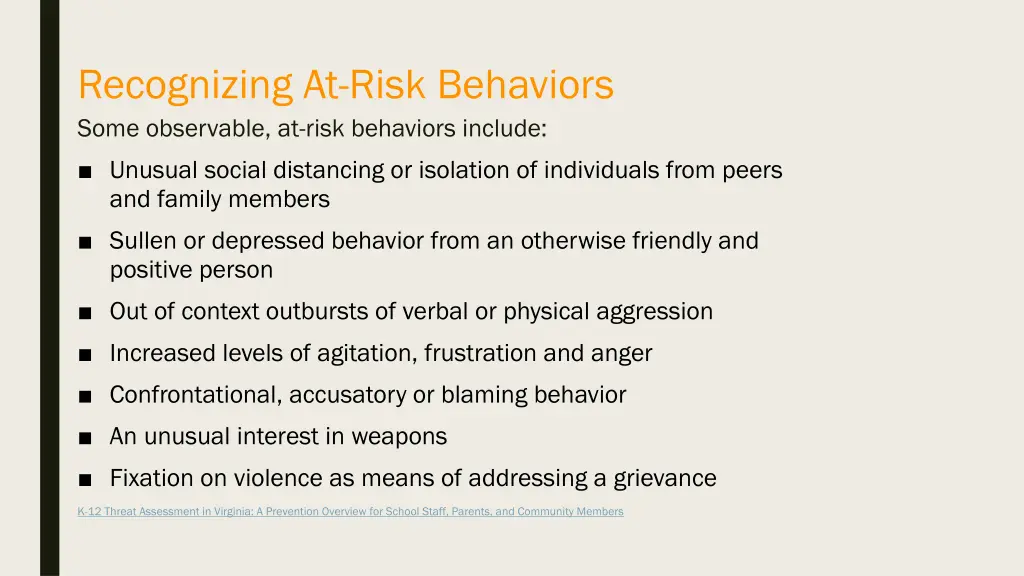
Recognizing At-Risk Behaviors Some observable, at-risk behaviors include: Unusual social distancing or isolation of individuals from peers and family members Sullen or depressed behavior from an otherwise friendly and positive person Out of context outbursts of verbal or physical aggression Increased levels of agitation, frustration and anger Confrontational, accusatory or blaming behavior An unusual interest in weapons Fixation on violence as means of addressing a grievance K-12 Threat Assessment in Virginia: A Prevention Overview for School Staff, Parents, and Community Members
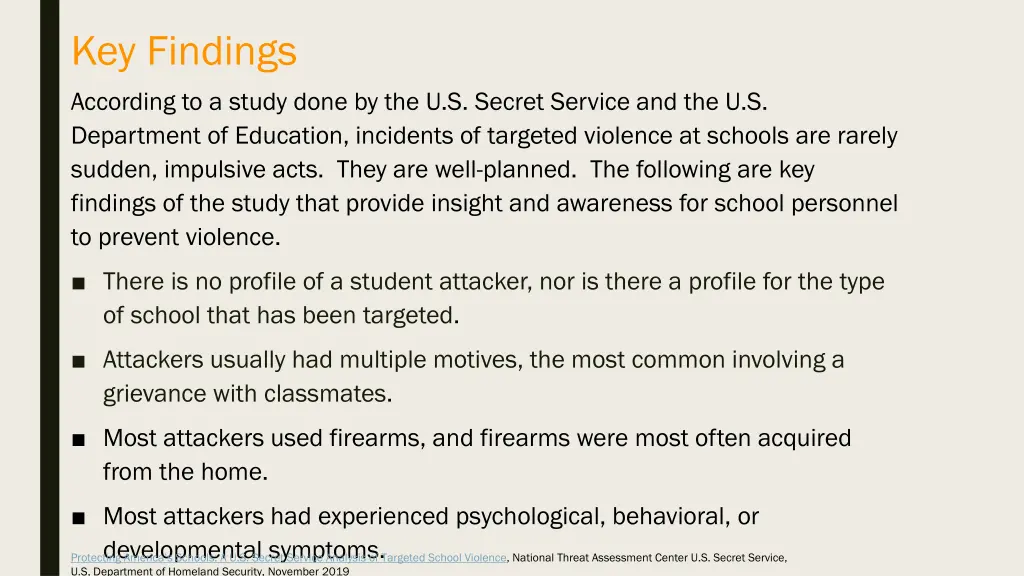
Key Findings According to a study done by the U.S. Secret Service and the U.S. Department of Education, incidents of targeted violence at schools are rarely sudden, impulsive acts. They are well-planned. The following are key findings of the study that provide insight and awareness for school personnel to prevent violence. There is no profile of a student attacker, nor is there a profile for the type of school that has been targeted. Attackers usually had multiple motives, the most common involving a grievance with classmates. Most attackers used firearms, and firearms were most often acquired from the home. Most attackers had experienced psychological, behavioral, or developmental symptoms. Protecting America s Schools: A U.S. Secret Service Analysis of Targeted School Violence, National Threat Assessment Center U.S. Secret Service, U.S, Department of Homeland Security, November 2019
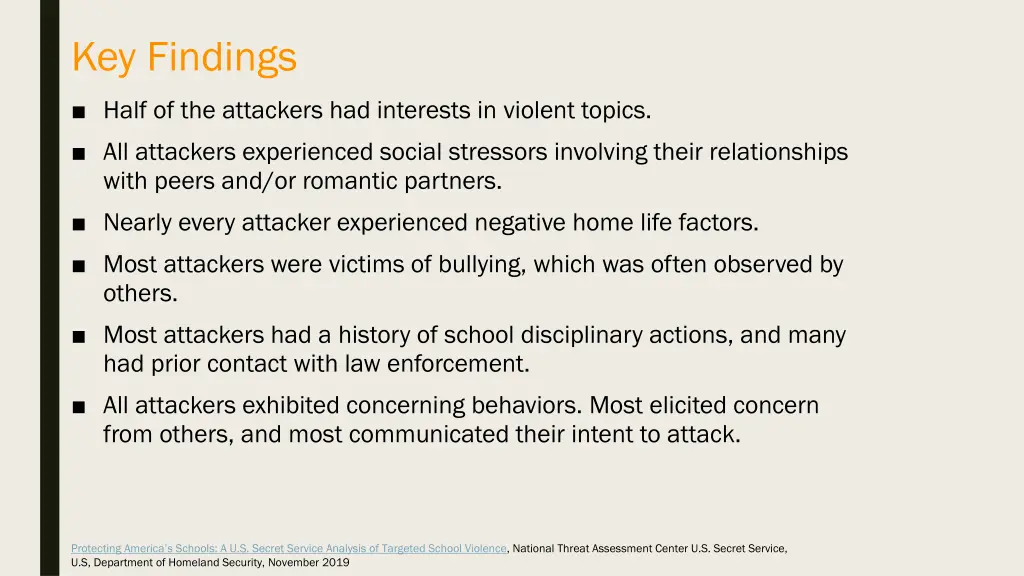
Key Findings Half of the attackers had interests in violent topics. All attackers experienced social stressors involving their relationships with peers and/or romantic partners. Nearly every attacker experienced negative home life factors. Most attackers were victims of bullying, which was often observed by others. Most attackers had a history of school disciplinary actions, and many had prior contact with law enforcement. All attackers exhibited concerning behaviors. Most elicited concern from others, and most communicated their intent to attack. Protecting America s Schools: A U.S. Secret Service Analysis of Targeted School Violence, National Threat Assessment Center U.S. Secret Service, U.S, Department of Homeland Security, November 2019
Reporting If a student is exhibiting out-of-character behaviors, one should seek to get help and report the instances in a timely manner, following school protocol for reporting procedures. Schools have methods that they use to report threats and other at- risk behaviors. Your school s procedure will have the most updated listing and steps to follow. Contact your school administrator for more information on the school s procedures and threat assessment team.
Reporting In January of 2019, Pennsylvania initiated the Safe2Say Something Anonymous Reporting System, which is run through the Attorney General s Office. It is a 24/7 hotline that allows people to submit tips via phone calls, a secure website or a mobile app. The reporting system allows people to submit secure and anonymous safety concerns to help identify and intervene upon at- risk individuals BEFORE they hurt themselves or others. Individuals can do this by reporting observed threats, behaviors, actions and harassment. Find out more information on the Safe2Say Something website. A downloadable APP for mobile devices is available on Google Play and the App Store.
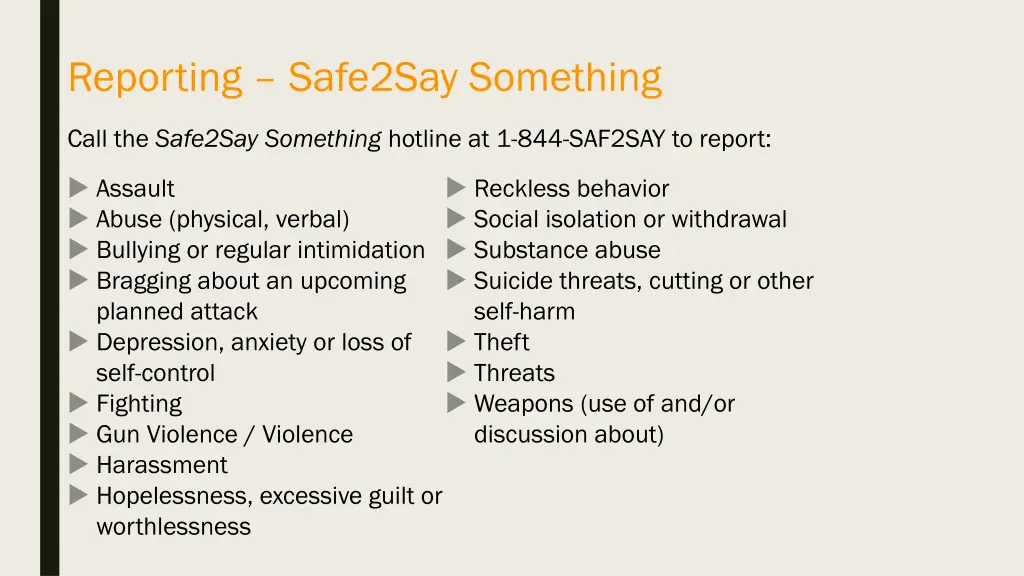
Reporting Safe2Say Something Call the Safe2Say Something hotline at 1-844-SAF2SAY to report: Assault Abuse (physical, verbal) Bullying or regular intimidation Bragging about an upcoming planned attack Depression, anxiety or loss of self-control Fighting Gun Violence / Violence Harassment Hopelessness, excessive guilt or worthlessness Reckless behavior Social isolation or withdrawal Substance abuse Suicide threats, cutting or other self-harm Theft Threats Weapons (use of and/or discussion about)
Summary Pennsylvania statute requires that school entities, as defined in 24 P.S. 1301-1303-E, are to establish threat assessment teams, procedures, and reporting protocols. Schools can adapt the Pennsylvania Model Procedures and Guidelines to meet their needs in preventing school violence. The threat assessment process is a prevention strategy used to identify and assess threats of violence before the act occurs. Students usually plan out the attack in advance, exhibiting observable behaviors and making others aware of their plans.
Summary It may be possible to prevent future school attacks from occurring through awareness education, following reporting procedures and using the threat assessment team to help students who may have the intent and capacity to commit an act of violence. Not only are schools a place to learn, they are also a place of safety and security for the students, staff and community members who walk through the doors. The school community s awareness and participation in the threat assessment process will help to ensure the safety of the people and buildings.
Resources There are many resources that can help you to learn more about the threat assessment process and what you can do to assist. Talking with students about violence Talking with students about violence The National Association of School Psychologists (NASP) is an excellent resource for information in assisting schools and families in dealing with acts of violence, threats of violence, and the threat assessment process in schools. NASP has information that can assist adults in speaking with students. Talking to Children About Violence: Tips for Parents and Teachers provides printable documents of developmentally appropriate tips, with infographics in both English and Spanish: Talking to Children Hablarles a los ni os
Resources Suicide Awareness Suicide Awareness The Pennsylvania Department of Human Services provides support in suicide prevention efforts. The Office of Mental Health and Substance Abuse Services works with youth-based organizations and schools to develop youth suicide prevention activities. Prevent Suicide PA provides education, resources, and trainings so that people are more aware of the warning signs of suicide and how to prevent it from occurring.