Computation Graphs and Parallelism Concepts
Explore the concepts of computation graphs, work, span, parallelism, and scheduling. Learn about greedy scheduling, speedup, scalability, strong scaling, weak scaling, Amdahl's Law, and Gustafson's Law. Understand performance expectations, scalability indicators, strong scaling calculations, and efficiency in parallel algorithms.

Uploaded on | 0 Views
Download Presentation

Please find below an Image/Link to download the presentation.
The content on the website is provided AS IS for your information and personal use only. It may not be sold, licensed, or shared on other websites without obtaining consent from the author. If you encounter any issues during the download, it is possible that the publisher has removed the file from their server.
You are allowed to download the files provided on this website for personal or commercial use, subject to the condition that they are used lawfully. All files are the property of their respective owners.
The content on the website is provided AS IS for your information and personal use only. It may not be sold, licensed, or shared on other websites without obtaining consent from the author.
E N D
Presentation Transcript
Review Describe computation graph For a computation graph, how do we define Work(CG), span(CG), and parallelism? Scheduling computation graph o What is a greedy schedule? o How good is greedy schedule?
Speedup and Scalability Speedup, Scalability, strong scaling, weak scaling Amdahl s law Gustafson s law
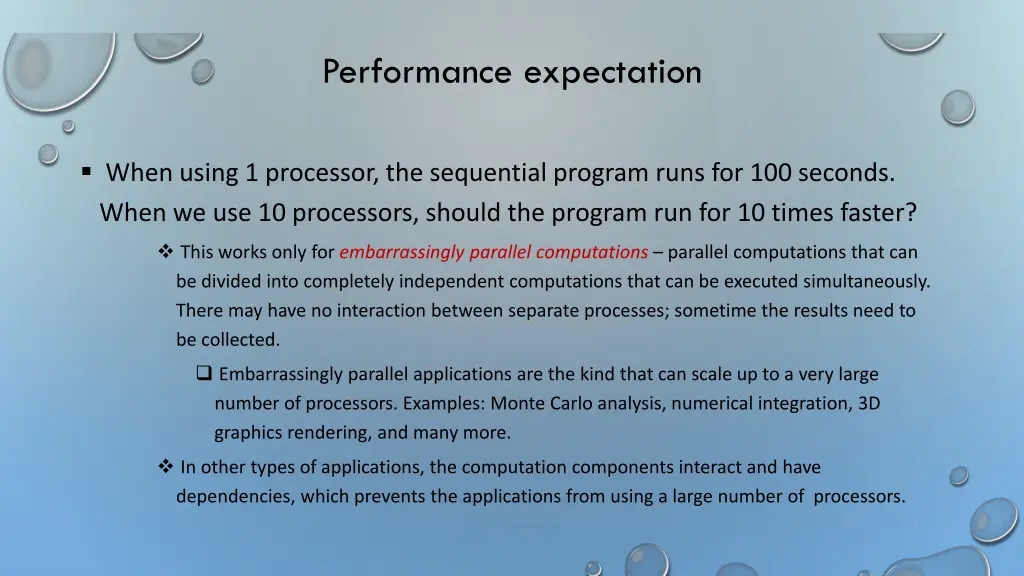
Performance expectation When using 1 processor, the sequential program runs for 100 seconds. When we use 10 processors, should the program run for 10 times faster? This works only for embarrassingly parallel computations parallel computations that can be divided into completely independent computations that can be executed simultaneously. There may have no interaction between separate processes; sometime the results need to be collected. Embarrassingly parallel applications are the kind that can scale up to a very large number of processors. Examples: Monte Carlo analysis, numerical integration, 3D graphics rendering, and many more. In other types of applications, the computation components interact and have dependencies, which prevents the applications from using a large number of processors.
Scalability Scalability of a program measures how many processors that the program can make effective use of. o For a computation represented by a computation graph, parallelism is a good indicator of scalability.
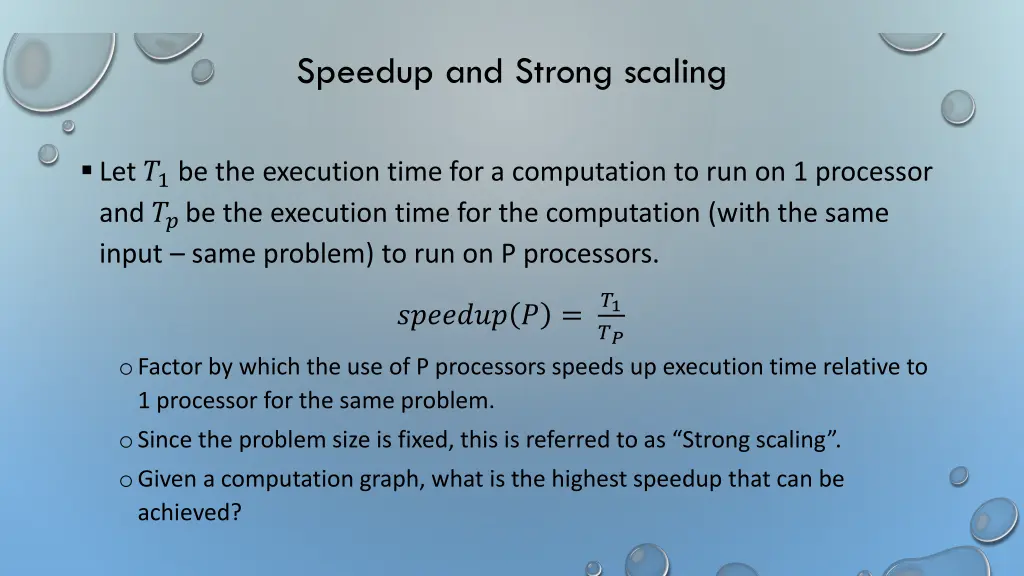
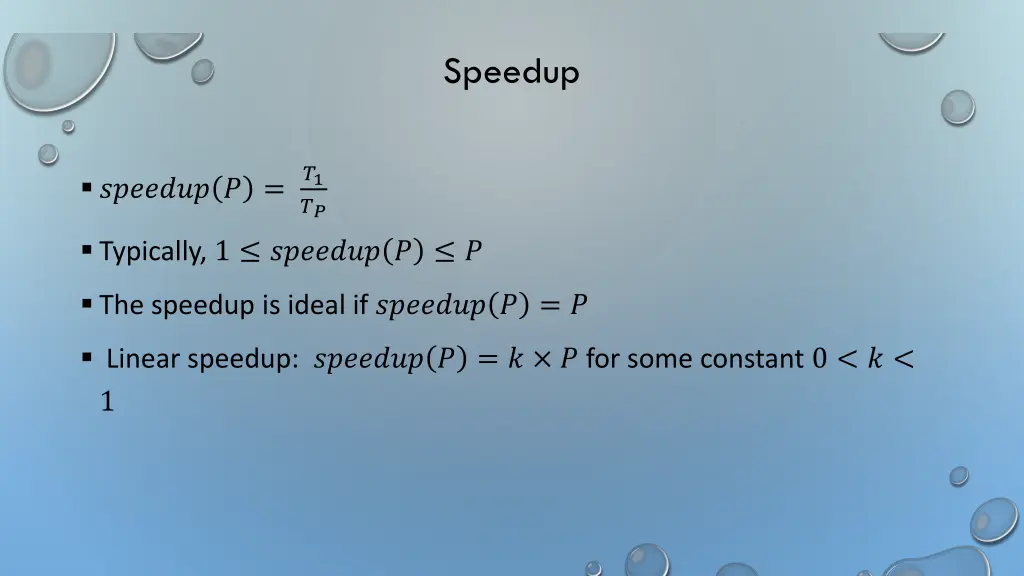
Speedup and Strong scaling Let ?1be the execution time for a computation to run on 1 processor and ??be the execution time for the computation (with the same input same problem) to run on P processors. ?1 ?? ??????? ? = oFactor by which the use of P processors speeds up execution time relative to 1 processor for the same problem. oSince the problem size is fixed, this is referred to as Strong scaling . oGiven a computation graph, what is the highest speedup that can be achieved?
Speedup ?1 ?? ??????? ? = Typically, 1 ??????? ? ? The speedup is ideal if ??????? ? = ? Linear speedup: ??????? ? = ? ? for some constant 0 < ? < 1
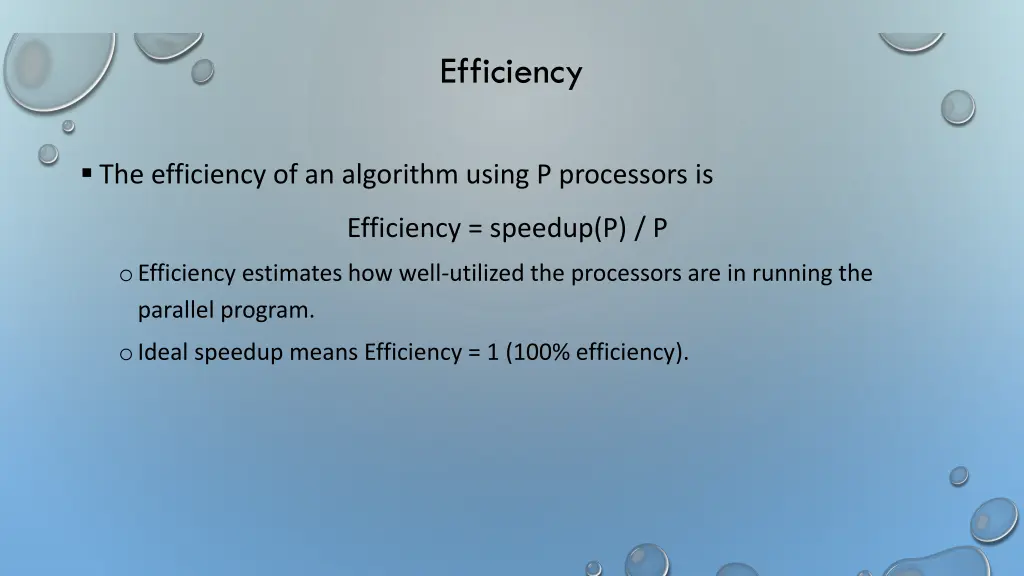
Efficiency The efficiency of an algorithm using P processors is Efficiency = speedup(P) / P oEfficiency estimates how well-utilized the processors are in running the parallel program. oIdeal speedup means Efficiency = 1 (100% efficiency).
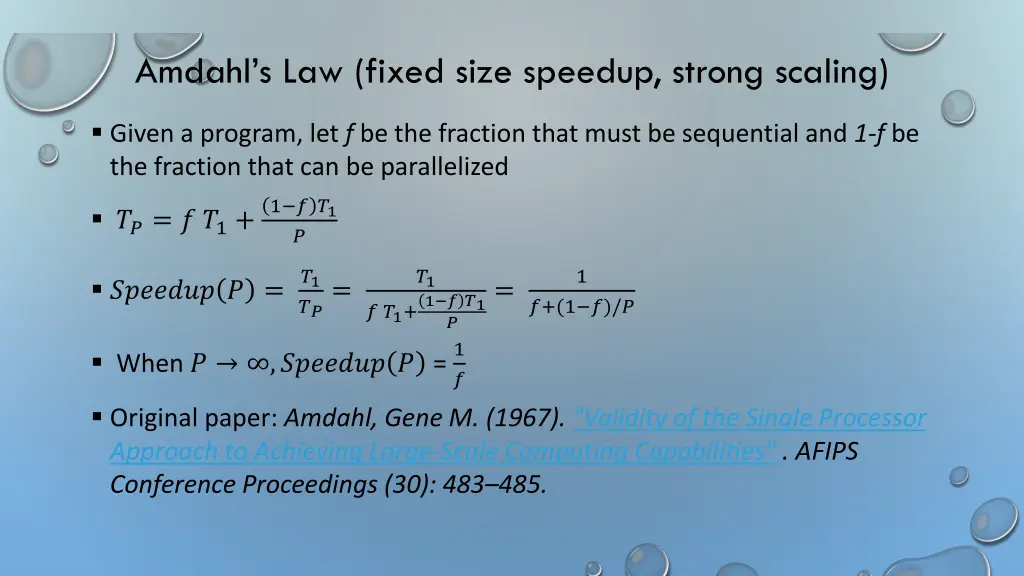
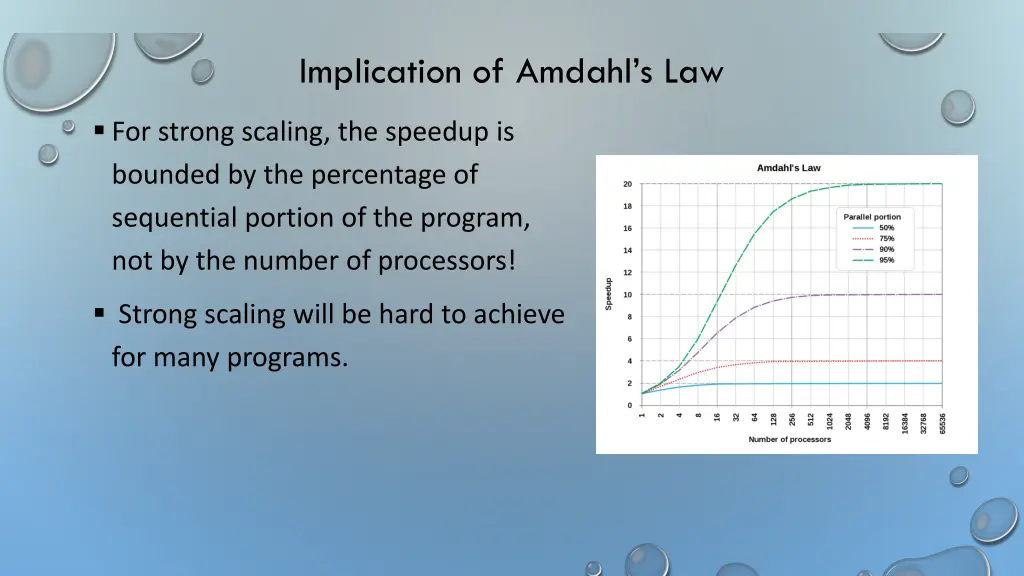
Amdahls Law (fixed size speedup, strong scaling) Given a program, let f be the fraction that must be sequential and 1-f be the fraction that can be parallelized 1 ? ?1 ? ??= ? ?1+ ?1 ??= ?1 1 ??????? ? = = ? ?1+1 ? ?1 ?+(1 ?)/? ? When ? ,??????? ? = 1 ? "Validity of the Single Processor Approach to Achieving Large-Scale Computing Capabilities" "Validity of the Single Processor Approach to Achieving Large-Scale Computing Capabilities" Original paper: Amdahl, Gene M. (1967). "Validity of the Single Processor Approach to Achieving Large-Scale Computing Capabilities" . AFIPS Conference Proceedings (30): 483 485.
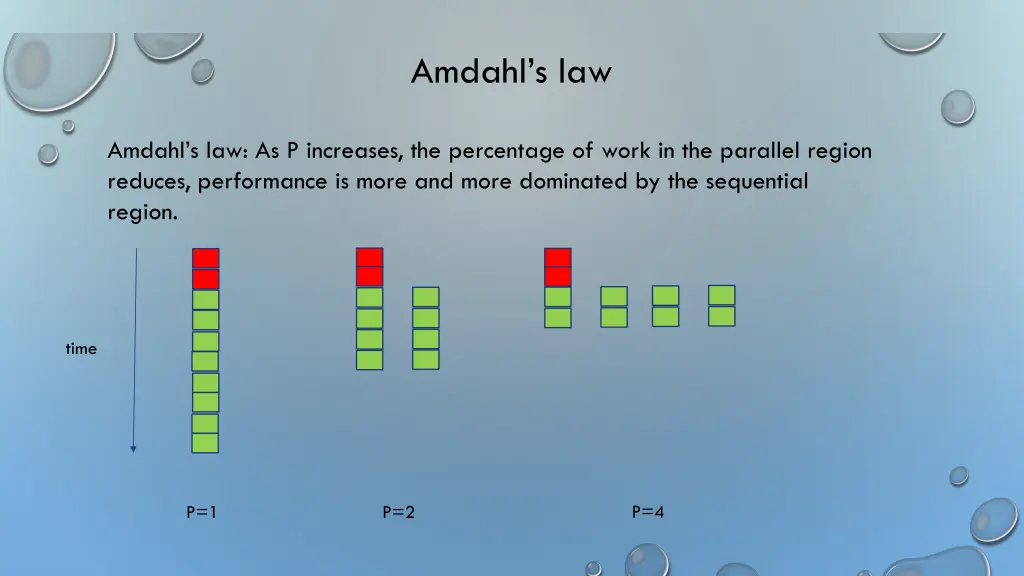
Amdahls law Amdahl s law: As P increases, the percentage of work in the parallel region reduces, performance is more and more dominated by the sequential region. time P=4 P=1 P=2
Implication of Amdahls Law For strong scaling, the speedup is bounded by the percentage of sequential portion of the program, not by the number of processors! Strong scaling will be hard to achieve for many programs.
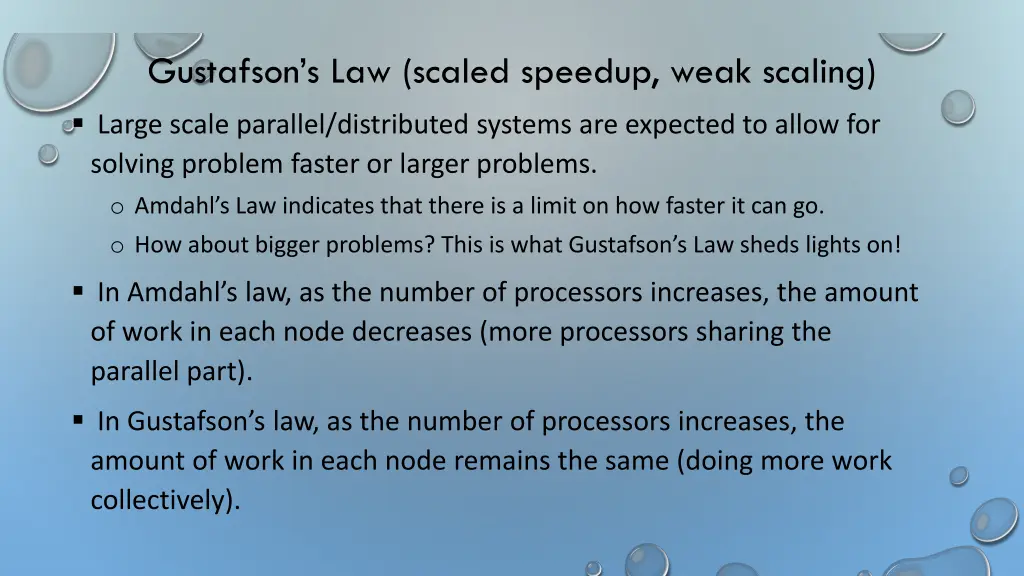
Gustafsons Law (scaled speedup, weak scaling) Large scale parallel/distributed systems are expected to allow for solving problem faster or larger problems. oAmdahl s Law indicates that there is a limit on how faster it can go. oHow about bigger problems? This is what Gustafson s Law sheds lights on! In Amdahl s law, as the number of processors increases, the amount of work in each node decreases (more processors sharing the parallel part). In Gustafson s law, as the number of processors increases, the amount of work in each node remains the same (doing more work collectively).
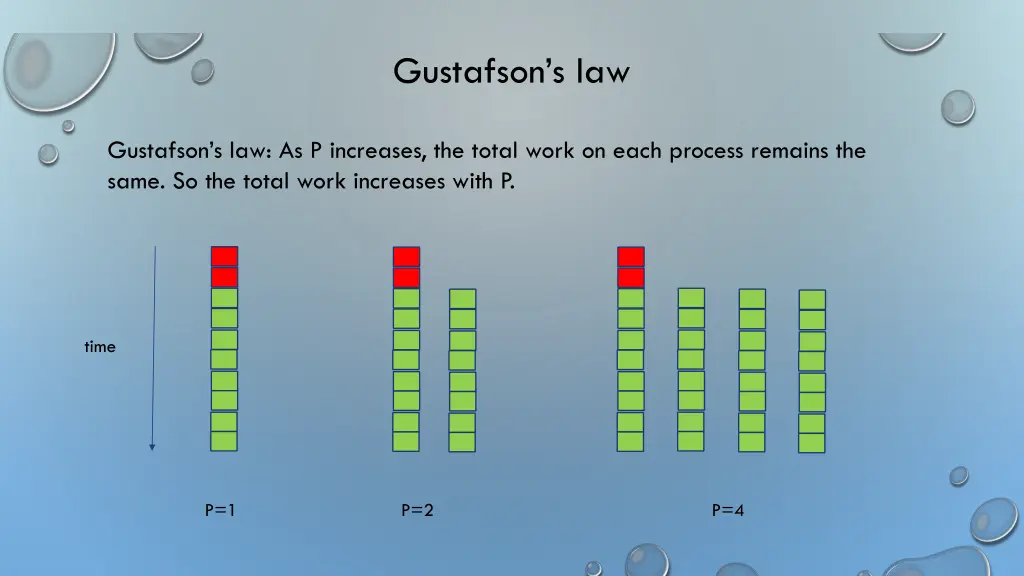
Gustafsons law Gustafson s law: As P increases, the total work on each process remains the same. So the total work increases with P. time P=1 P=2 P=4
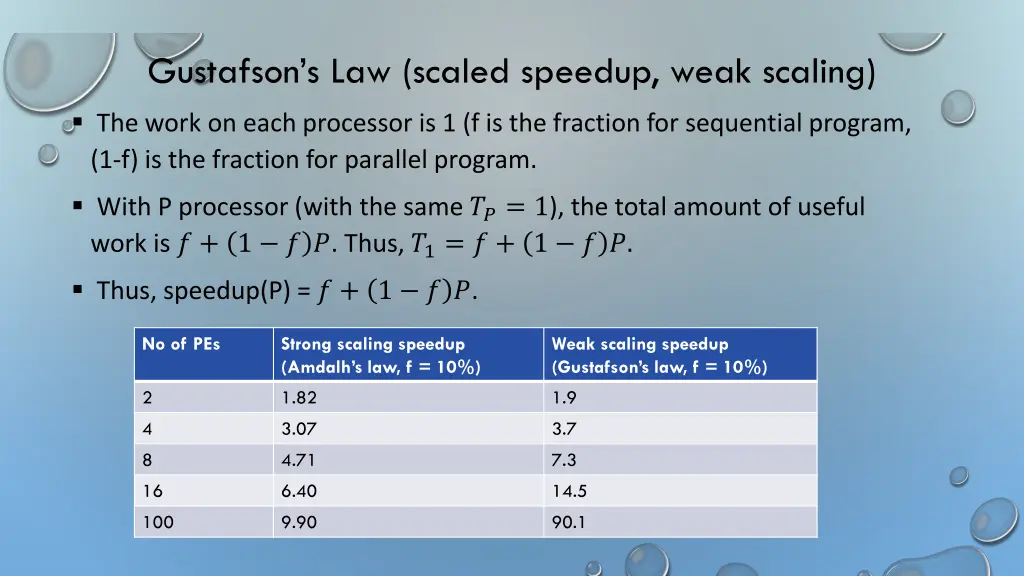
Gustafsons Law (scaled speedup, weak scaling) The work on each processor is 1 (f is the fraction for sequential program, (1-f) is the fraction for parallel program. With P processor (with the same ??= 1), the total amount of useful work is ? + 1 ? ?. Thus, ?1= ? + 1 ? ?. Thus, speedup(P) = ? + 1 ? ?. No of PEs Strong scaling speedup (Amdalh s law, f = 10%) Weak scaling speedup (Gustafson s law, f = 10%) 2 1.82 1.9 4 3.07 3.7 8 4.71 7.3 16 6.40 14.5 100 9.90 90.1
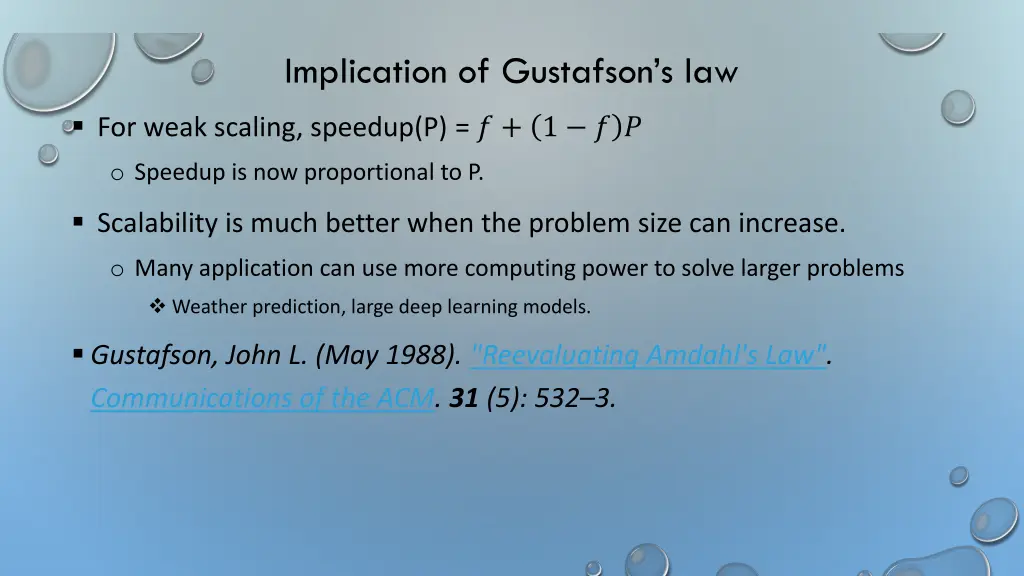
Implication of Gustafsons law For weak scaling, speedup(P) = ? + 1 ? ? o Speedup is now proportional to P. Scalability is much better when the problem size can increase. o Many application can use more computing power to solve larger problems Weather prediction, large deep learning models. "Reevaluating Amdahl's Law" Gustafson, John L. (May 1988). "Reevaluating Amdahl's Law". Communications of the ACM Communications of the ACM. 31 (5): 532 3.
Summary Speedup, Scalability, strong scaling, weak scaling Amdahl s law Gustafson s law