Computational Social Science Methods and Applications Overview
Explore the world of Computational Social Science with a focus on defining the field, common methodology, sample problems, and applications. Discover how digitized information and statistical methods are used to analyze social phenomena. Dive into topics like time series analysis, classification, and word embeddings.

Uploaded on | 0 Views
Download Presentation

Please find below an Image/Link to download the presentation.
The content on the website is provided AS IS for your information and personal use only. It may not be sold, licensed, or shared on other websites without obtaining consent from the author. If you encounter any issues during the download, it is possible that the publisher has removed the file from their server.
You are allowed to download the files provided on this website for personal or commercial use, subject to the condition that they are used lawfully. All files are the property of their respective owners.
The content on the website is provided AS IS for your information and personal use only. It may not be sold, licensed, or shared on other websites without obtaining consent from the author.
E N D
Presentation Transcript
Computational Social Science: Methods and Applications Anjalie Field, anjalief@cs.cmu.edu 1 Language Technologies Institute
Overview Defining computational social science Sample problems Common Methodology Time series analysis Classification Topic Modeling (LDA) Word Embeddings 2 Language Technologies Institute 2
Definitions and Examples 3 Language Technologies Institute
What is Computational Social Science? The study of social phenomena using digitized information and computational and statistical methods [Wallach 2018] 4 Language Technologies Institute 4
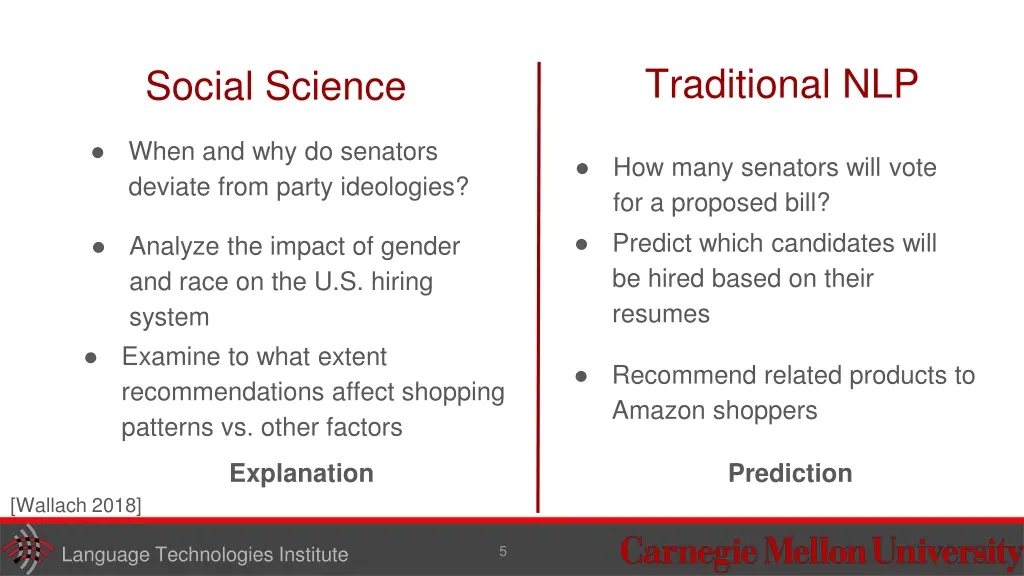
Traditional NLP Social Science When and why do senators deviate from party ideologies? How many senators will vote for a proposed bill? Predict which candidates will be hired based on their resumes Analyze the impact of gender and race on the U.S. hiring system Examine to what extent recommendations affect shopping patterns vs. other factors Recommend related products to Amazon shoppers Explanation Prediction [Wallach 2018] 5 Language Technologies Institute 5
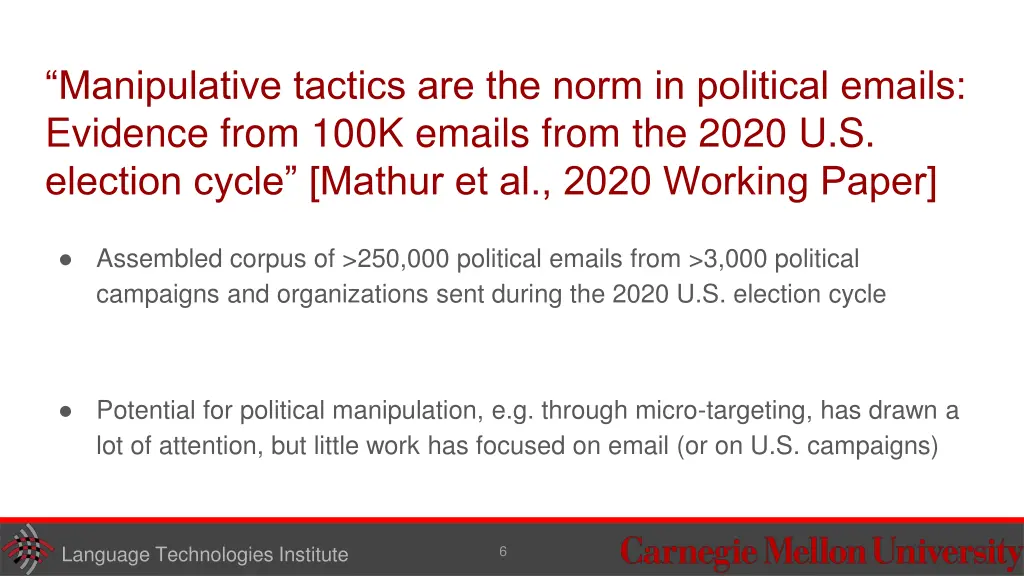
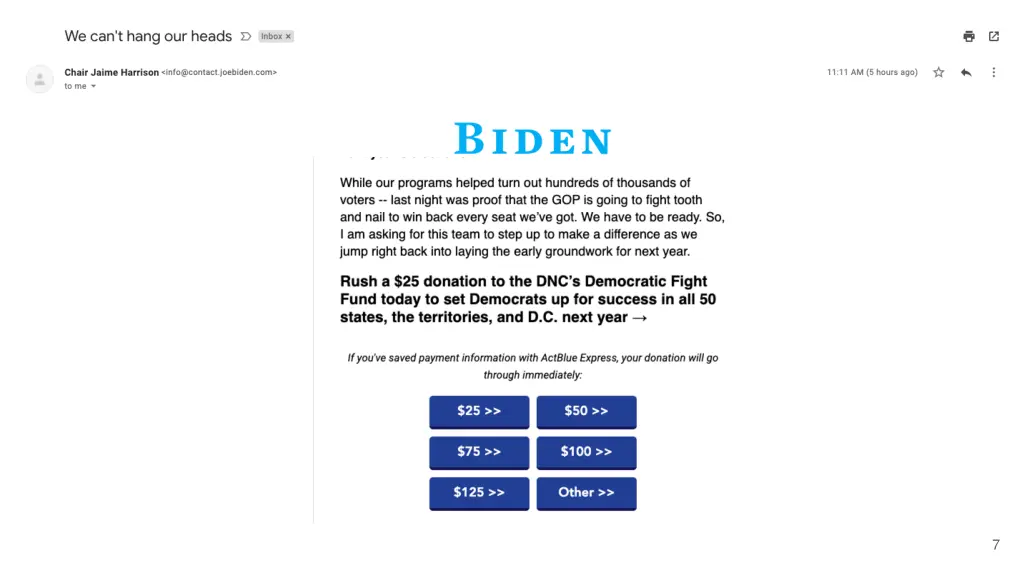
Manipulative tactics are the norm in political emails: Evidence from 100K emails from the 2020 U.S. election cycle [Mathur et al., 2020 Working Paper] Assembled corpus of >250,000 political emails from >3,000 political campaigns and organizations sent during the 2020 U.S. election cycle Potential for political manipulation, e.g. through micro-targeting, has drawn a lot of attention, but little work has focused on email (or on U.S. campaigns) 6 Language Technologies Institute 6
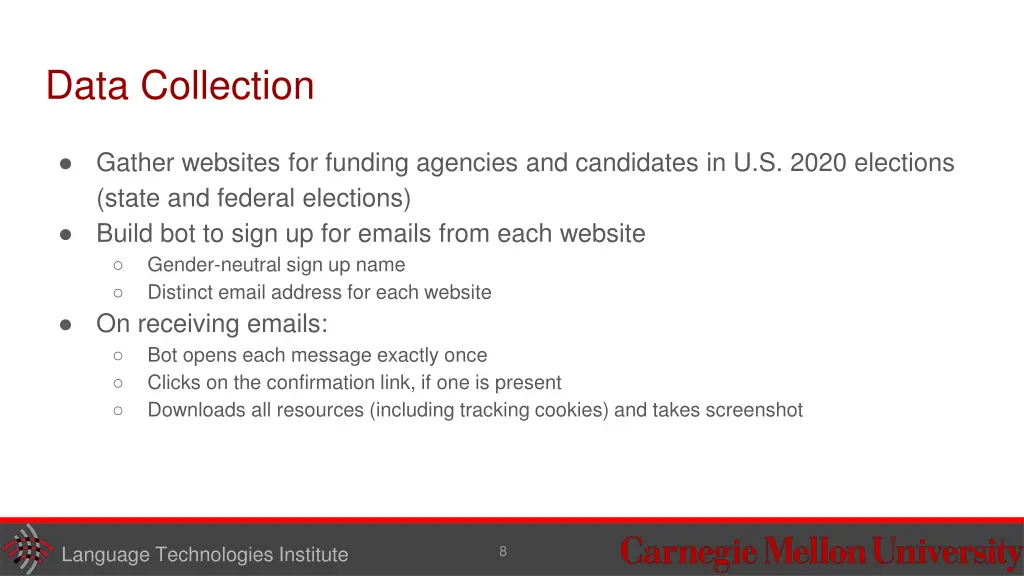
Data Collection Gather websites for funding agencies and candidates in U.S. 2020 elections (state and federal elections) Build bot to sign up for emails from each website Gender-neutral sign up name Distinct email address for each website On receiving emails: Bot opens each message exactly once Clicks on the confirmation link, if one is present Downloads all resources (including tracking cookies) and takes screenshot 8 Language Technologies Institute 8
Research Questions What topics are discussed in emails? How do they vary by party affiliation? How do senders overcome fundraising fatigue ? [What strategies are used to encourage recipient to open emails?] [Examine privacy violations: sharing email addresses across campaigns] 9 Language Technologies Institute 9
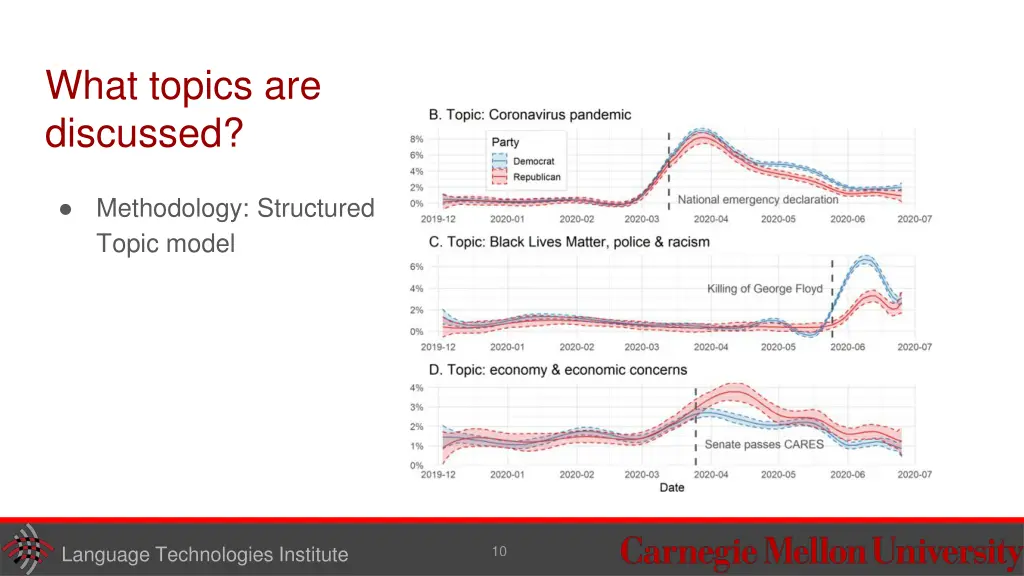
What topics are discussed? Methodology: Structured Topic model 10 Language Technologies Institute 10
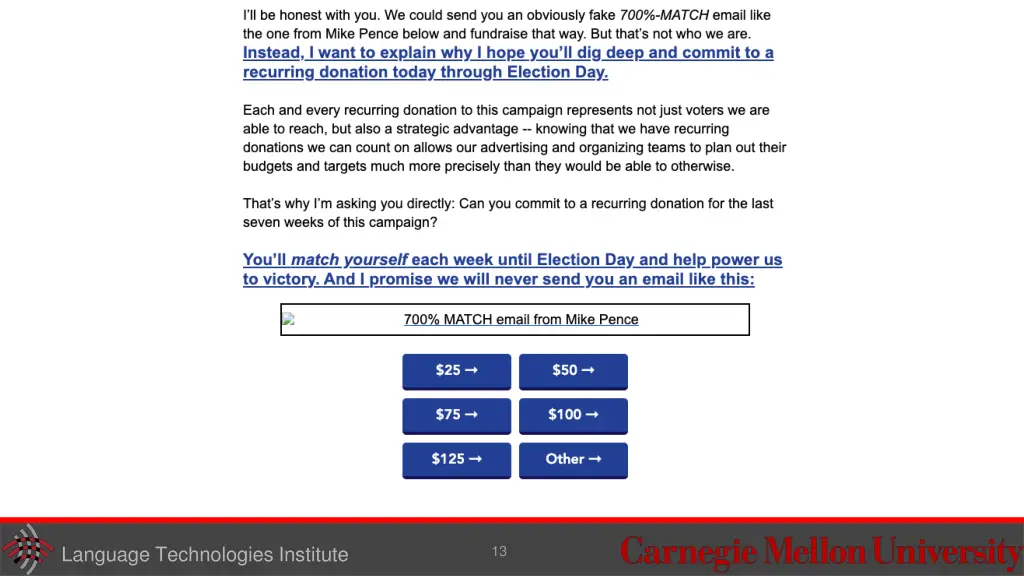
How do senders overcome fundraising fatigue? Methodology: Hand-code examples Verify trends at a larger scale using more automated methods (e.g. building supervised classifier from hand-annotated samples) Selected Findings Subjects often don t relate to content of email Falsely promise donation matching (but this is impossible since FEC has limits on how much an individual can donate to a campaign) References to imminent fundraising deadlines 11 Language Technologies Institute 11
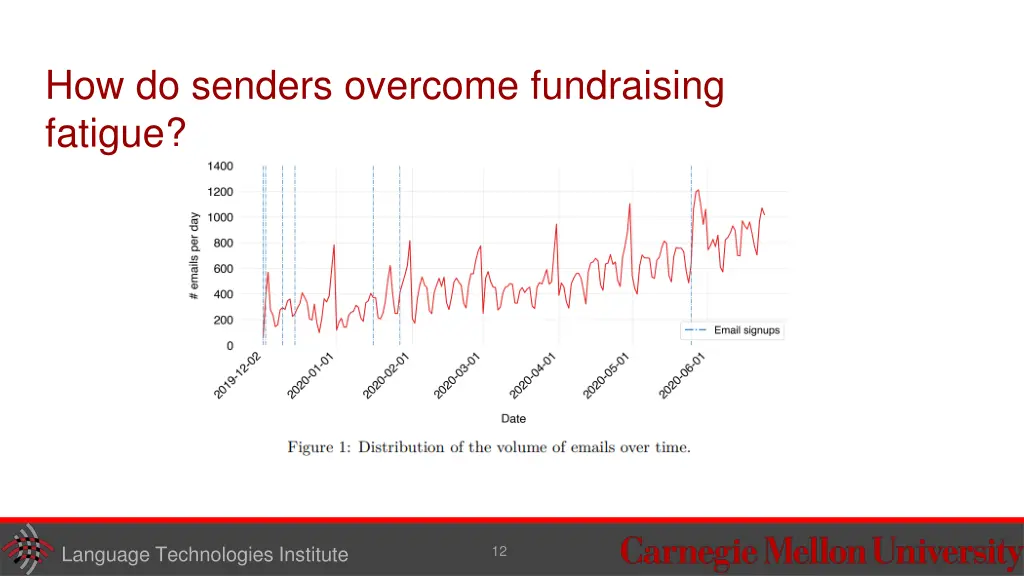
How do senders overcome fundraising fatigue? 12 Language Technologies Institute 12
13 Language Technologies Institute 13
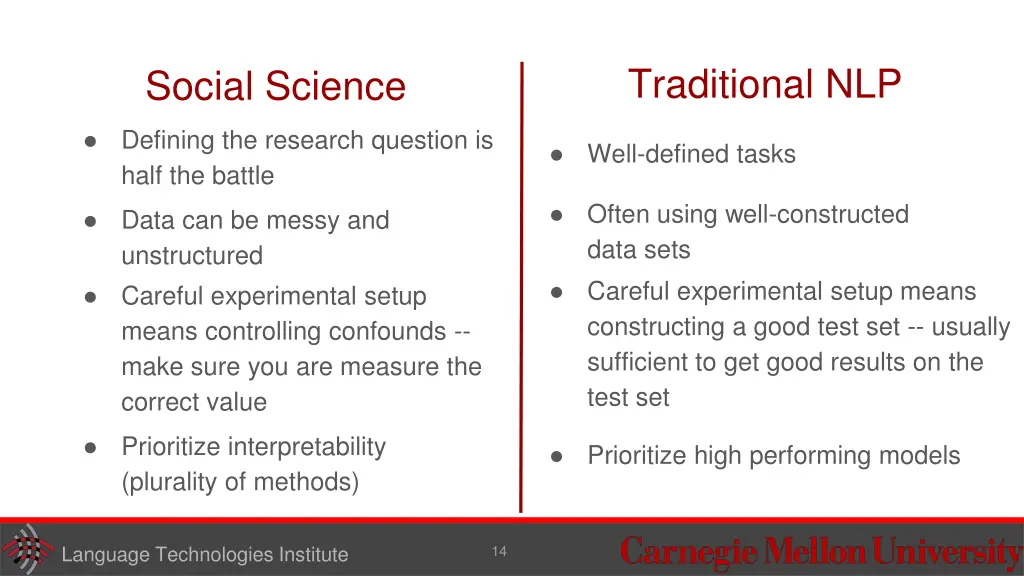
Traditional NLP Social Science Defining the research question is half the battle Well-defined tasks Often using well-constructed data sets Careful experimental setup means constructing a good test set -- usually sufficient to get good results on the test set Data can be messy and unstructured Careful experimental setup means controlling confounds -- make sure you are measure the correct value Prioritize interpretability (plurality of methods) Prioritize high performing models 14 Language Technologies Institute 14
Methodology 15 Language Technologies Institute
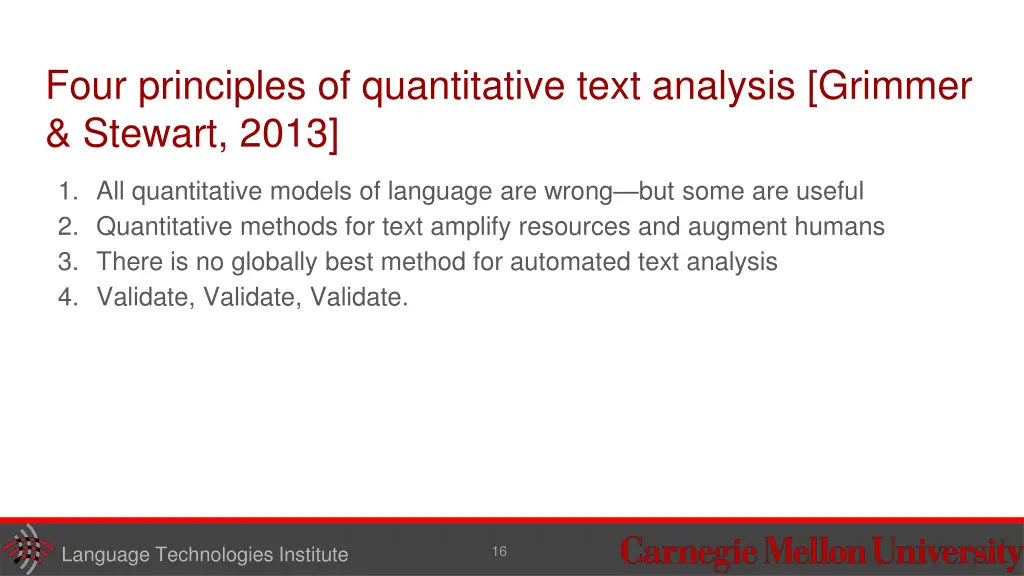
Four principles of quantitative text analysis [Grimmer & Stewart, 2013] 1. All quantitative models of language are wrong but some are useful 2. Quantitative methods for text amplify resources and augment humans 3. There is no globally best method for automated text analysis 4. Validate, Validate, Validate. 16 Language Technologies Institute 16
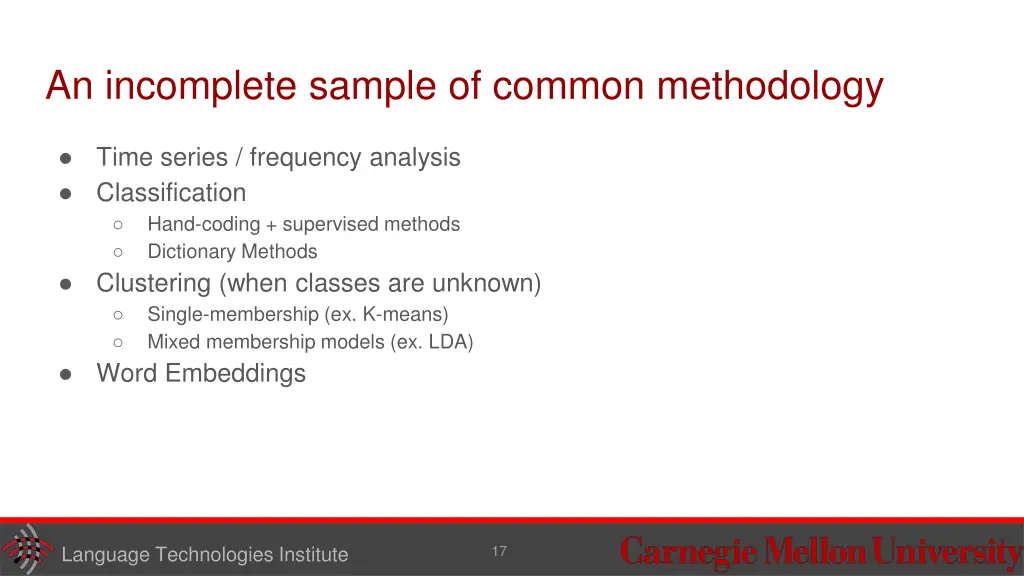
An incomplete sample of common methodology Time series / frequency analysis Classification Hand-coding + supervised methods Dictionary Methods Clustering (when classes are unknown) Single-membership (ex. K-means) Mixed membership models (ex. LDA) Word Embeddings 17 Language Technologies Institute 17
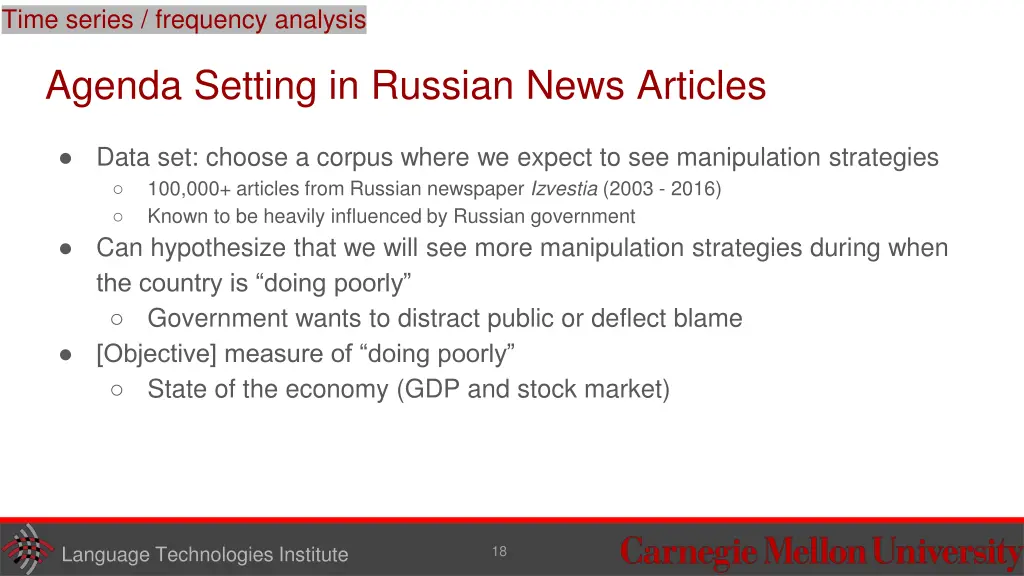
Time series / frequency analysis Agenda Setting in Russian News Articles Data set: choose a corpus where we expect to see manipulation strategies 100,000+ articles from Russian newspaper Izvestia (2003 - 2016) Known to be heavily influenced by Russian government Can hypothesize that we will see more manipulation strategies during when the country is doing poorly Government wants to distract public or deflect blame [Objective] measure of doing poorly State of the economy (GDP and stock market) 18 Language Technologies Institute 18
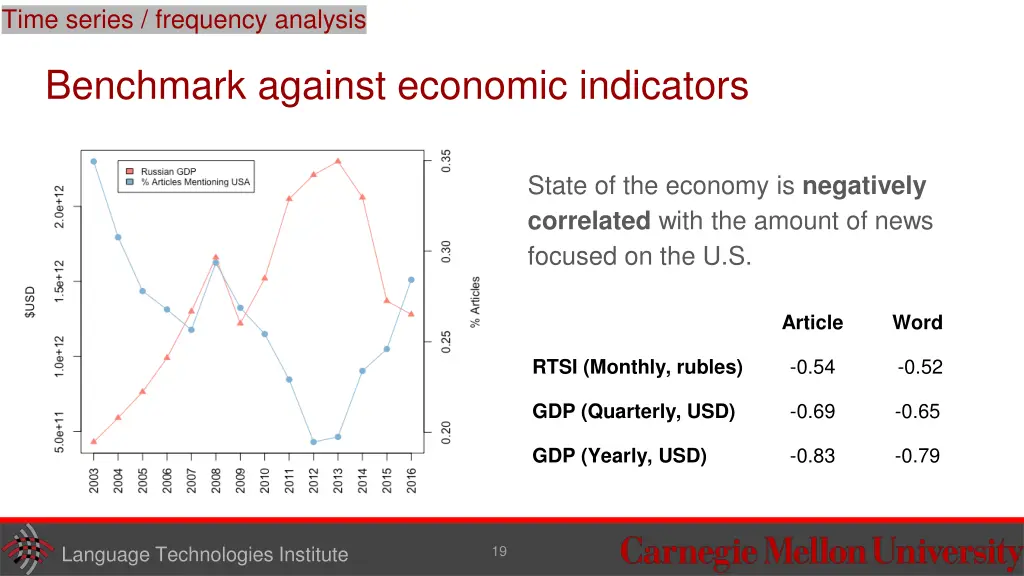
Time series / frequency analysis Benchmark against economic indicators State of the economy is negatively correlated with the amount of news focused on the U.S. Article Word -0.54 -0.52 RTSI (Monthly, rubles) -0.69 -0.65 GDP (Quarterly, USD) -0.83 -0.79 GDP (Yearly, USD) 19 Language Technologies Institute 19
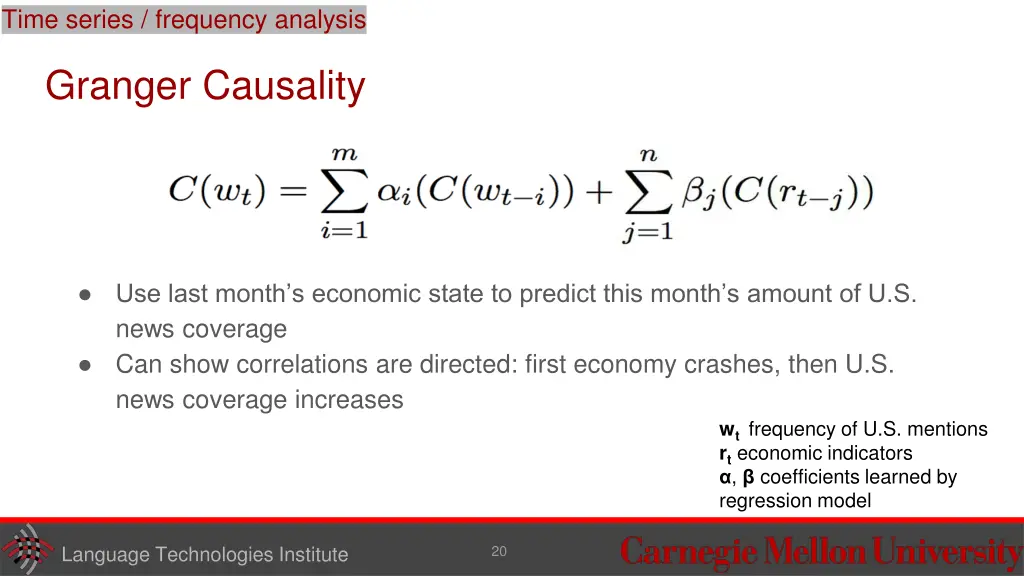
Time series / frequency analysis Granger Causality Use last month s economic state to predict this month s amount of U.S. news coverage Can show correlations are directed: first economy crashes, then U.S. news coverage increases wt frequency of U.S. mentions rteconomic indicators , coefficients learned by regression model 20 Language Technologies Institute 20
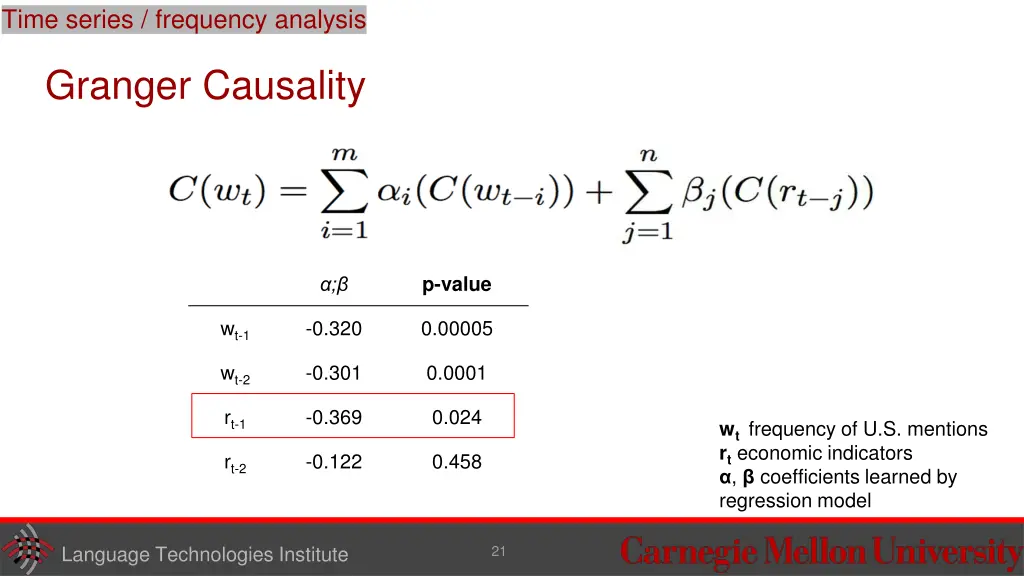
Time series / frequency analysis Granger Causality p-value ; wt-1 -0.320 0.00005 wt-2 -0.301 0.0001 rt-1 -0.369 0.024 wt frequency of U.S. mentions rteconomic indicators , coefficients learned by regression model rt-2 -0.122 0.458 21 Language Technologies Institute 21
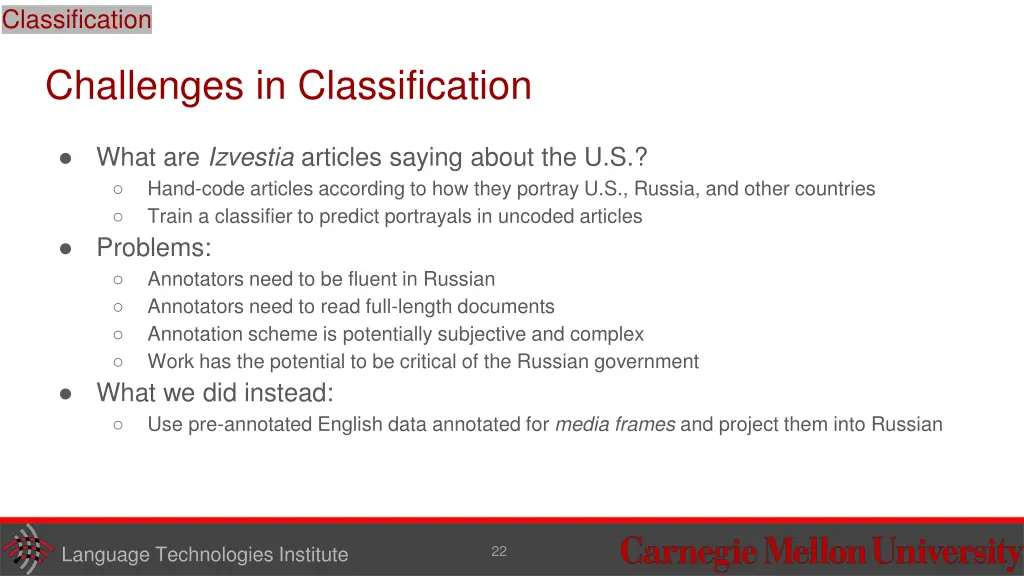
Classification Challenges in Classification What are Izvestia articles saying about the U.S.? Hand-code articles according to how they portray U.S., Russia, and other countries Train a classifier to predict portrayals in uncoded articles Problems: Annotators need to be fluent in Russian Annotators need to read full-length documents Annotation scheme is potentially subjective and complex Work has the potential to be critical of the Russian government What we did instead: Use pre-annotated English data annotated for media frames and project them into Russian 22 Language Technologies Institute 22
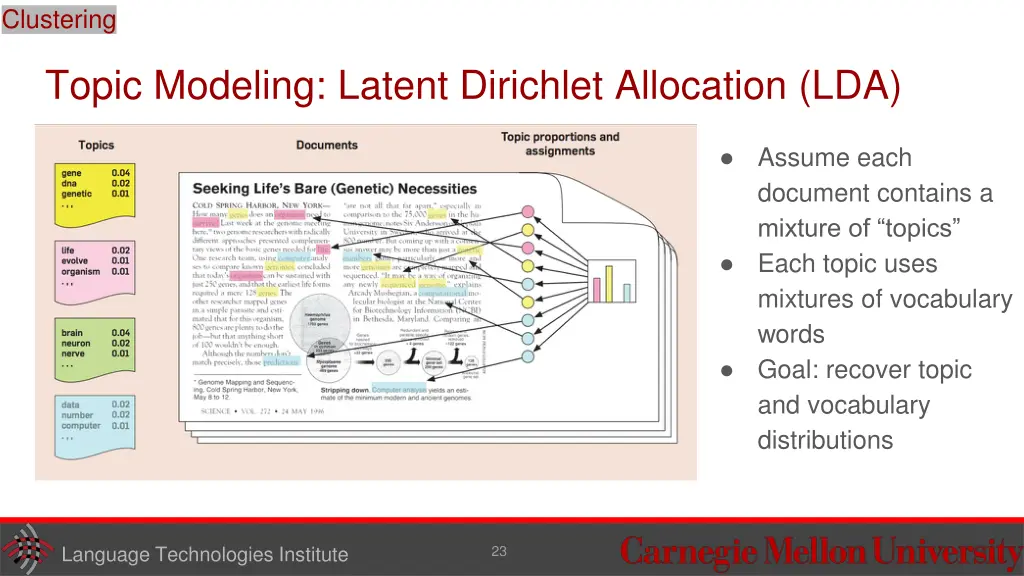
Clustering Topic Modeling: Latent Dirichlet Allocation (LDA) Assume each document contains a mixture of topics Each topic uses mixtures of vocabulary words Goal: recover topic and vocabulary distributions 23 Language Technologies Institute 23
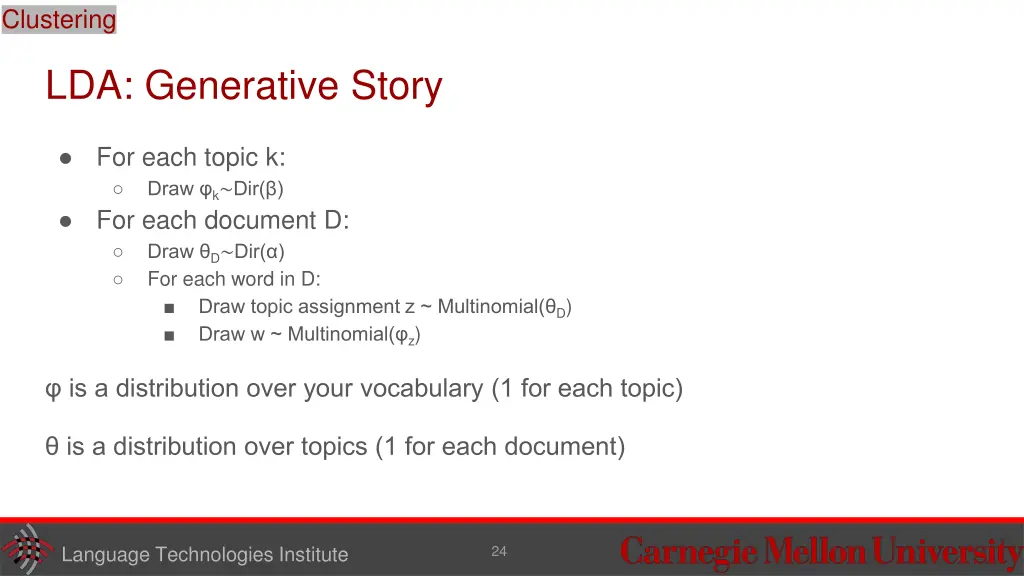
Clustering LDA: Generative Story For each topic k: Draw k Dir( ) For each document D: Draw D Dir( ) For each word in D: Draw topic assignment z ~ Multinomial( D) Draw w ~ Multinomial( z) is a distribution over your vocabulary (1 for each topic) is a distribution over topics (1 for each document) 24 Language Technologies Institute 24
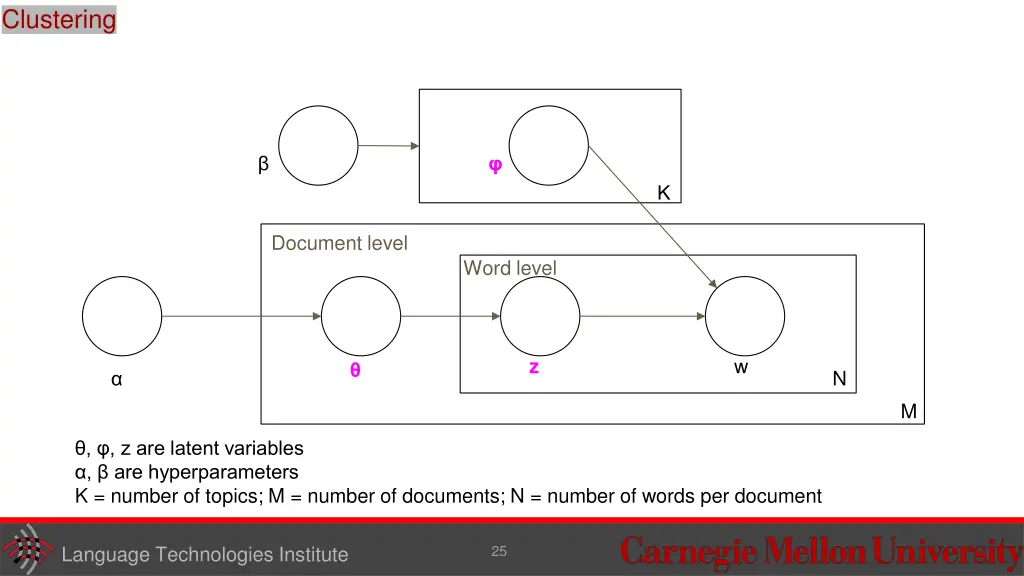
Clustering Document level Word level w z N M , , z are latent variables , are hyperparameters K = number of topics; M = number of documents; N = number of words per document 25 Language Technologies Institute 25
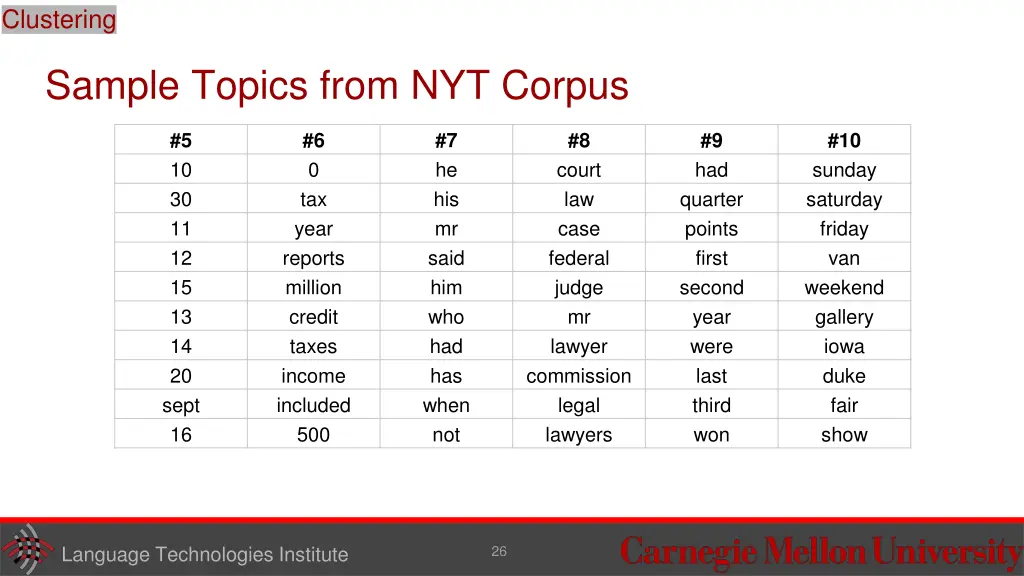
Clustering Sample Topics from NYT Corpus #5 10 30 11 12 15 13 14 20 sept 16 #6 0 tax year reports million credit taxes income included 500 #7 he his mr said him who had has when not #8 #9 had quarter points first second year were last third won #10 sunday saturday friday van weekend gallery iowa duke fair show court law case federal judge mr lawyer commission legal lawyers 26 Language Technologies Institute 26
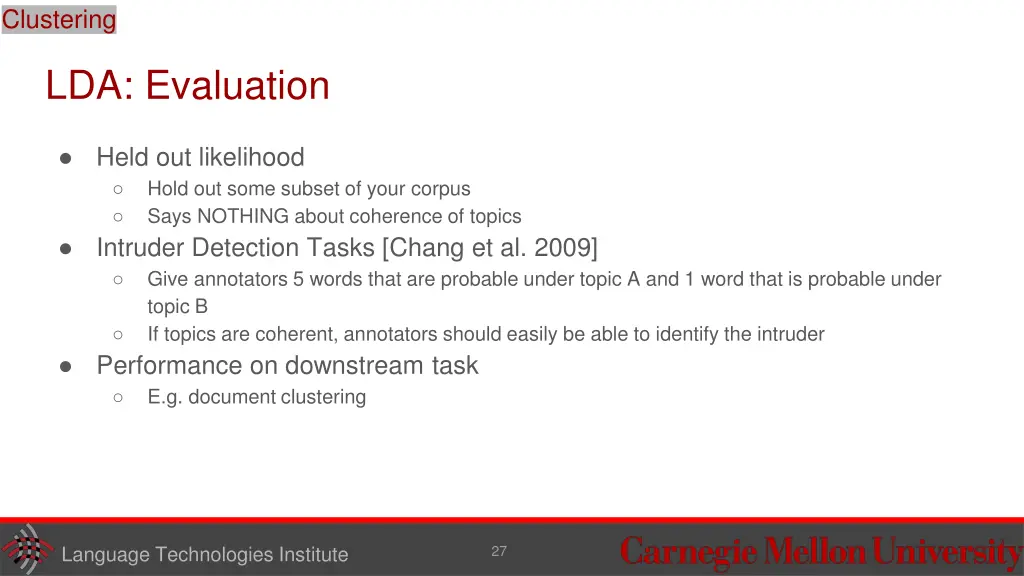
Clustering LDA: Evaluation Held out likelihood Hold out some subset of your corpus Says NOTHING about coherence of topics Intruder Detection Tasks [Chang et al. 2009] Give annotators 5 words that are probable under topic A and 1 word that is probable under topic B If topics are coherent, annotators should easily be able to identify the intruder Performance on downstream task E.g. document clustering 27 Language Technologies Institute 27
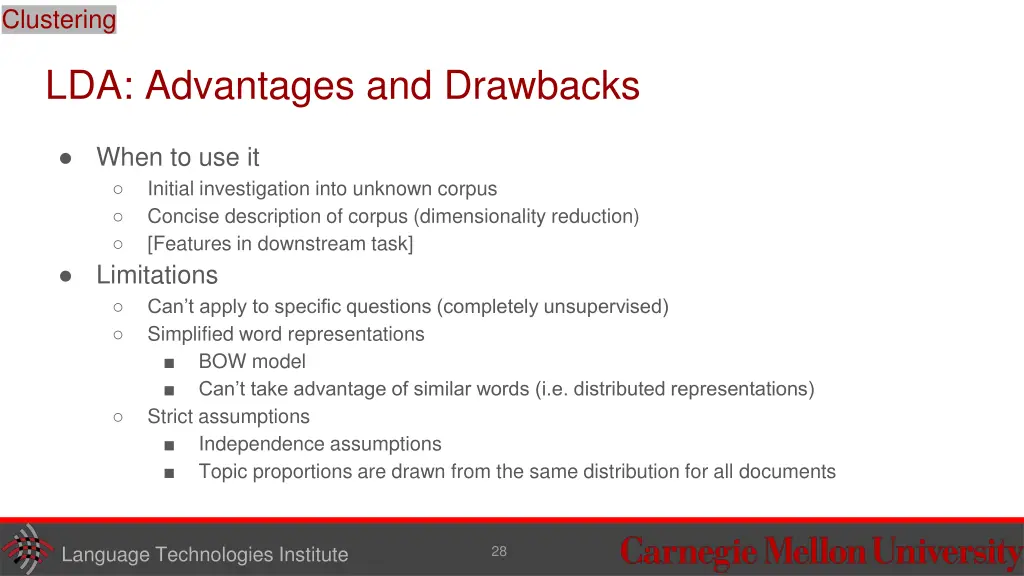
Clustering LDA: Advantages and Drawbacks When to use it Initial investigation into unknown corpus Concise description of corpus (dimensionality reduction) [Features in downstream task] Limitations Can t apply to specific questions (completely unsupervised) Simplified word representations BOW model Can t take advantage of similar words (i.e. distributed representations) Strict assumptions Independence assumptions Topic proportions are drawn from the same distribution for all documents 28 Language Technologies Institute 28
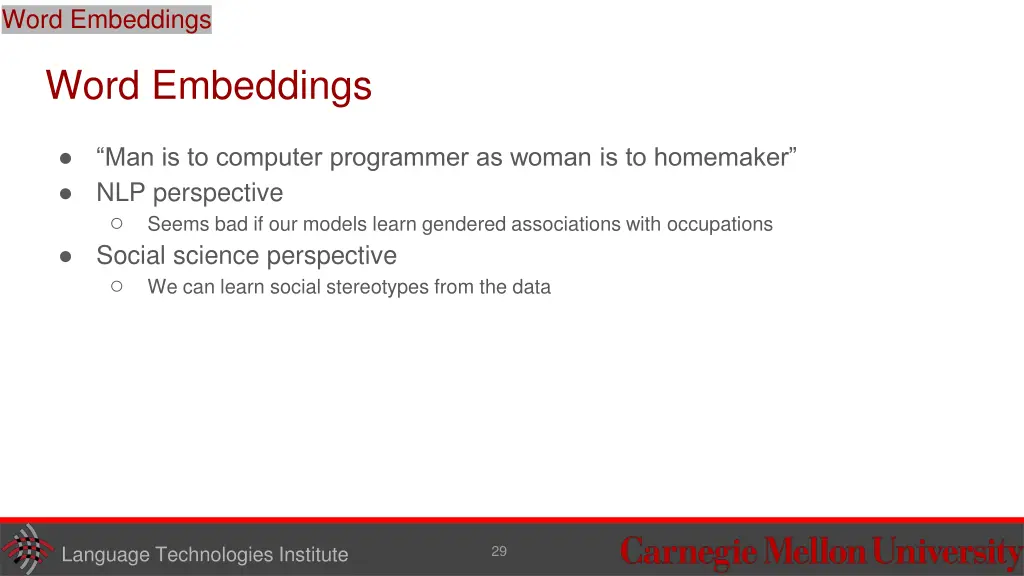
Word Embeddings Word Embeddings Man is to computer programmer as woman is to homemaker NLP perspective Seems bad if our models learn gendered associations with occupations Social science perspective We can learn social stereotypes from the data 29 Language Technologies Institute 29
Word Embeddings Diachronic Word Embeddings Reveal Statistical Laws of Semantic Change [Hamilton et al. 2016] Methodology: Construct word embeddings for each time segment of a large corpus and align them across time (Use Word2Vec, but also statistical methods like SVD) Evaluation: Examine how well word embeddings capture known shifts in word meanings over time e.g. gay moves away from happy, showy and toward homosexual, lesbian 30 Language Technologies Institute 30
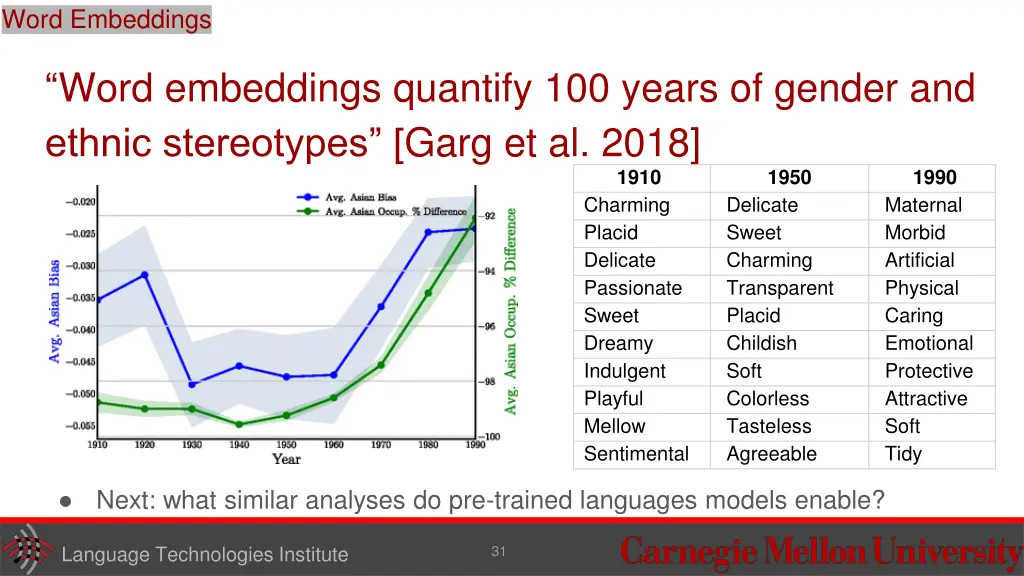
Word Embeddings Word embeddings quantify 100 years of gender and ethnic stereotypes [Garg et al. 2018] 1910 1950 1990 Charming Placid Delicate Passionate Sweet Dreamy Indulgent Playful Mellow Sentimental Delicate Sweet Charming Transparent Placid Childish Soft Colorless Tasteless Agreeable Maternal Morbid Artificial Physical Caring Emotional Protective Attractive Soft Tidy Next: what similar analyses do pre-trained languages models enable? 31 Language Technologies Institute 31
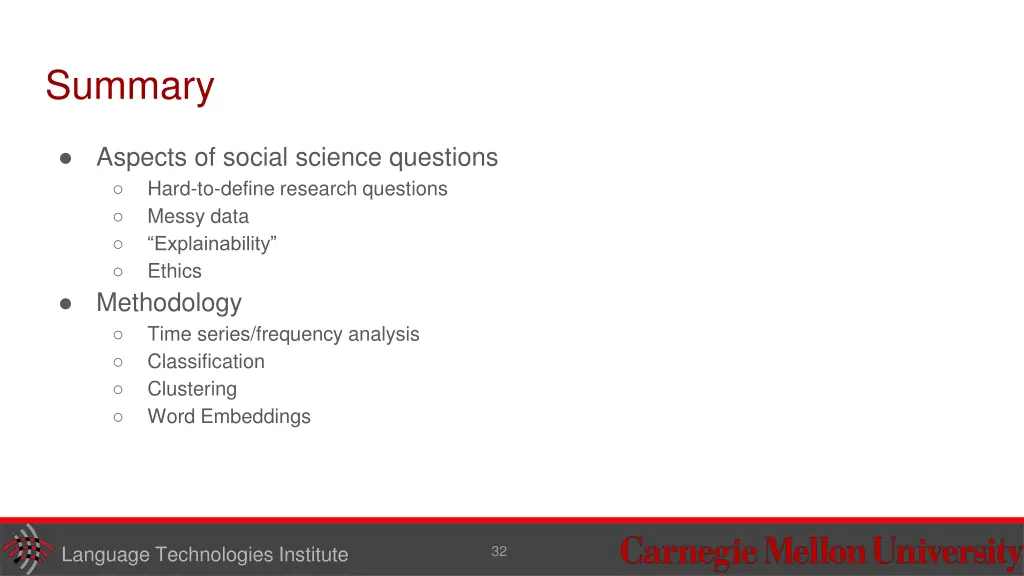
Summary Aspects of social science questions Hard-to-define research questions Messy data Explainability Ethics Methodology Time series/frequency analysis Classification Clustering Word Embeddings 32 Language Technologies Institute 32
Why Computational Social Science? Despite all the hype, machine learning is not a be-all and end-all solution. We still need social scientists if we are going to use machine learning to study social phenomena in a responsible and ethical manner. [Wallach 2018] 33 Language Technologies Institute 33
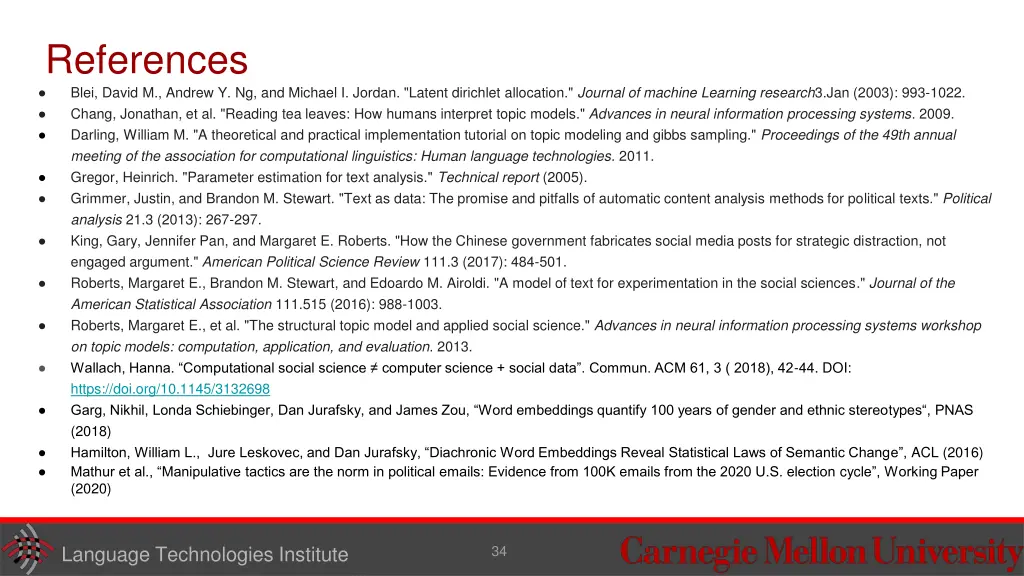
References Blei, David M., Andrew Y. Ng, and Michael I. Jordan. "Latent dirichlet allocation." Journal of machine Learning research3.Jan (2003): 993-1022. Chang, Jonathan, et al. "Reading tea leaves: How humans interpret topic models." Advances in neural information processing systems. 2009. Darling, William M. "A theoretical and practical implementation tutorial on topic modeling and gibbs sampling." Proceedings of the 49th annual meeting of the association for computational linguistics: Human language technologies. 2011. Gregor, Heinrich. "Parameter estimation for text analysis." Technical report (2005). Grimmer, Justin, and Brandon M. Stewart. "Text as data: The promise and pitfalls of automatic content analysis methods for political texts." Political analysis 21.3 (2013): 267-297. King, Gary, Jennifer Pan, and Margaret E. Roberts. "How the Chinese government fabricates social media posts for strategic distraction, not engaged argument." American Political Science Review 111.3 (2017): 484-501. Roberts, Margaret E., Brandon M. Stewart, and Edoardo M. Airoldi. "A model of text for experimentation in the social sciences." Journal of the American Statistical Association 111.515 (2016): 988-1003. Roberts, Margaret E., et al. "The structural topic model and applied social science." Advances in neural information processing systems workshop on topic models: computation, application, and evaluation. 2013. Wallach, Hanna. Computational social science computer science + social data . Commun. ACM 61, 3 ( 2018), 42-44. DOI: https://doi.org/10.1145/3132698 Garg, Nikhil, Londa Schiebinger, Dan Jurafsky, and James Zou, Word embeddings quantify 100 years of gender and ethnic stereotypes , PNAS (2018) Hamilton, William L., Jure Leskovec, and Dan Jurafsky, Diachronic Word Embeddings Reveal Statistical Laws of Semantic Change , ACL (2016) Mathur et al., Manipulative tactics are the norm in political emails: Evidence from 100K emails from the 2020 U.S. election cycle , Working Paper (2020) 34 Language Technologies Institute 34