Computer Data Representation and Number Systems Overview
Explore the fundamentals of computer data representation and number systems with topics such as Boolean operations, data conversion, binary systems, decimal systems, octal systems, and hexadecimal systems. Understand how computers represent data using digital signals and learn about the binary number system, octal and hexadecimal numbering systems, and more.

Download Presentation

Please find below an Image/Link to download the presentation.
The content on the website is provided AS IS for your information and personal use only. It may not be sold, licensed, or shared on other websites without obtaining consent from the author. If you encounter any issues during the download, it is possible that the publisher has removed the file from their server.
You are allowed to download the files provided on this website for personal or commercial use, subject to the condition that they are used lawfully. All files are the property of their respective owners.
The content on the website is provided AS IS for your information and personal use only. It may not be sold, licensed, or shared on other websites without obtaining consent from the author.
E N D
Presentation Transcript
University of Gujrat Department of Computer Science Course Code : CS-252 Computer Organization and Assembly Language Lecture # 3 1 Data Representation and Conversion Boolean Operations University of Gujrat
Data Representation & Conversion 2 University of Gujrat
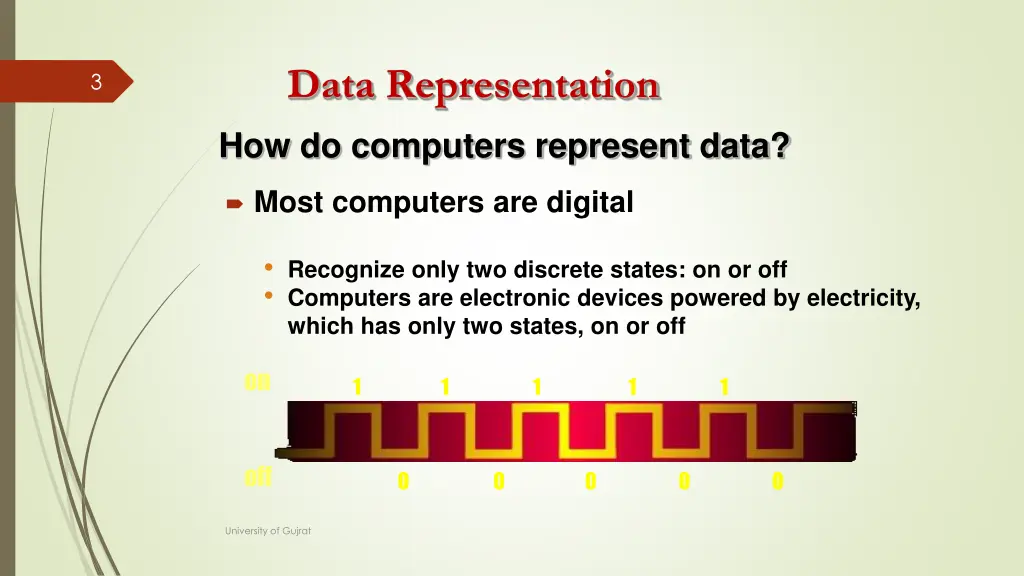
Data Representation How do computers represent data? 3 Most computers are digital Recognize only two discrete states: on or off Computers are electronic devices powered by electricity, which has only two states, on or off on 1 1 1 1 1 off 0 0 0 0 0 University of Gujrat
Number Systems Different ways to say how many 4 University of Gujrat
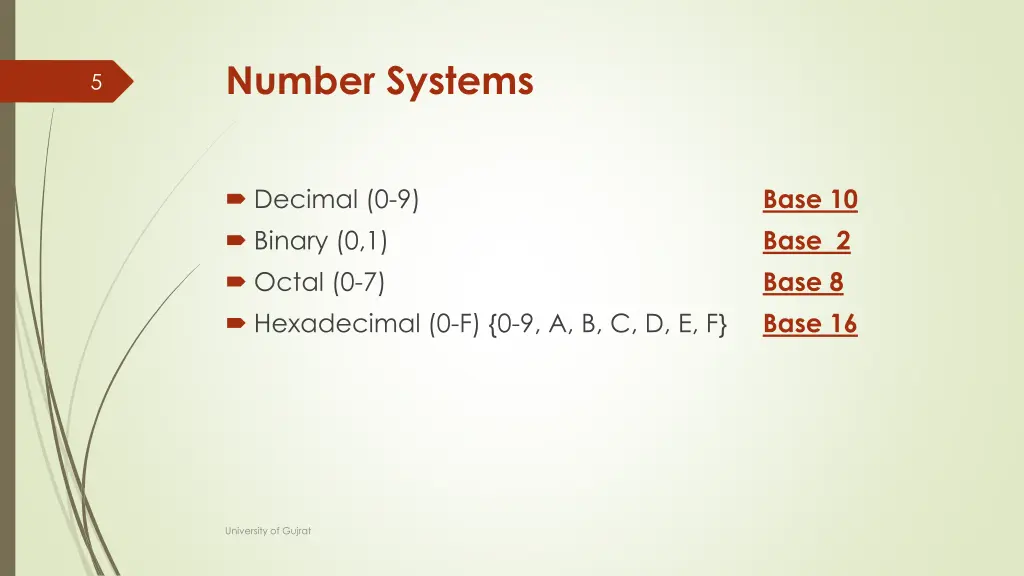
Number Systems 5 Decimal (0-9) Binary (0,1) Octal (0-7) Hexadecimal (0-F) {0-9, A, B, C, D, E, F} Base 10 Base 2 Base 8 Base 16 University of Gujrat
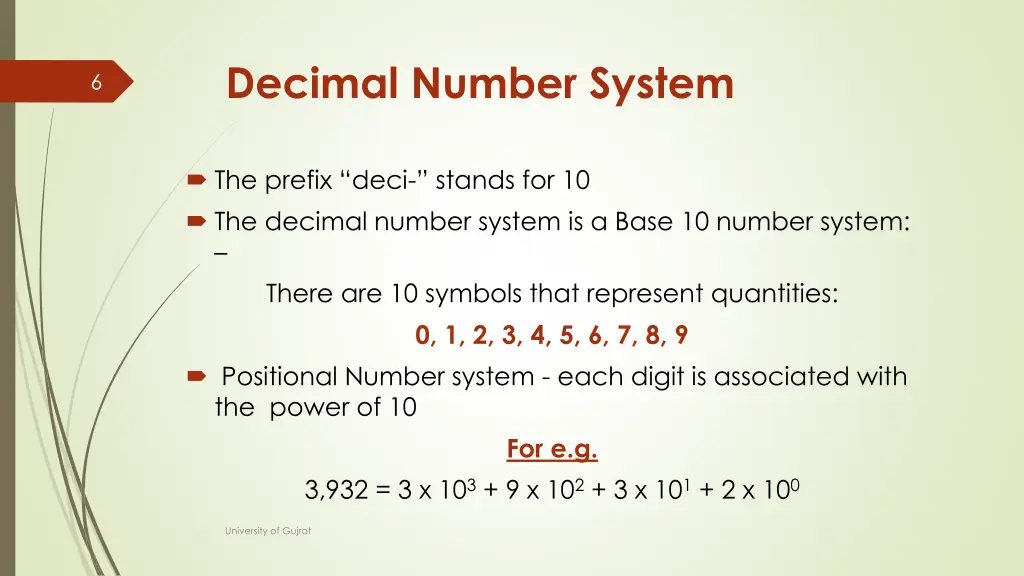
Decimal Number System 6 The prefix deci- stands for 10 The decimal number system is a Base 10 number system: There are 10 symbols that represent quantities: 0, 1, 2, 3, 4, 5, 6, 7, 8, 9 Positional Number system - each digit is associated with the power of 10 For e.g. 3,932 = 3 x 10³ + 9 x 10² + 3 x 101 + 2 x 100 University of Gujrat
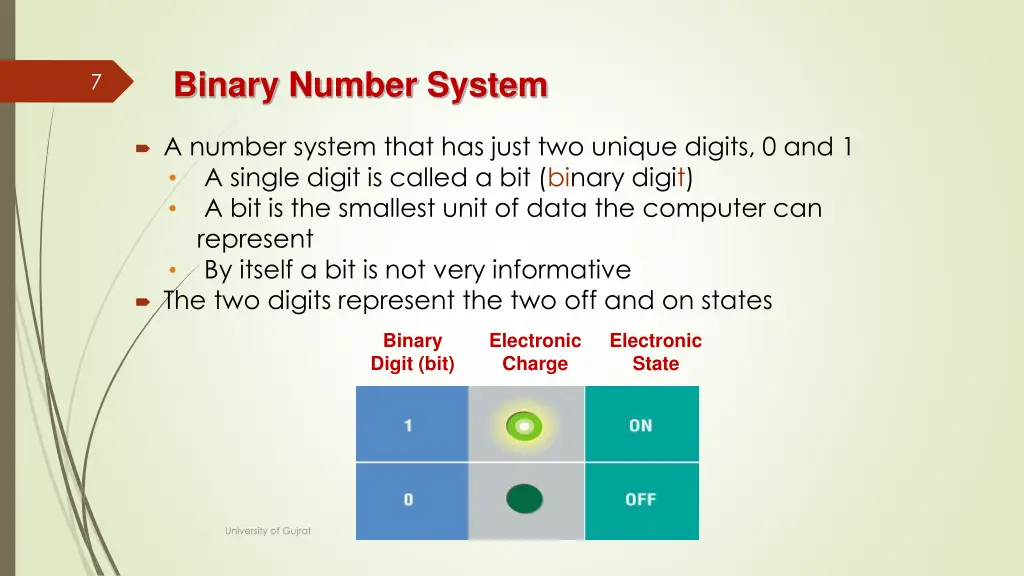
Binary Number System 7 A number system that has just two unique digits, 0 and 1 A single digit is called a bit (binary digit) A bit is the smallest unit of data the computer can represent By itself a bit is not very informative The two digits represent the two off and on states Binary Digit (bit) Electronic Charge Electronic State University of Gujrat
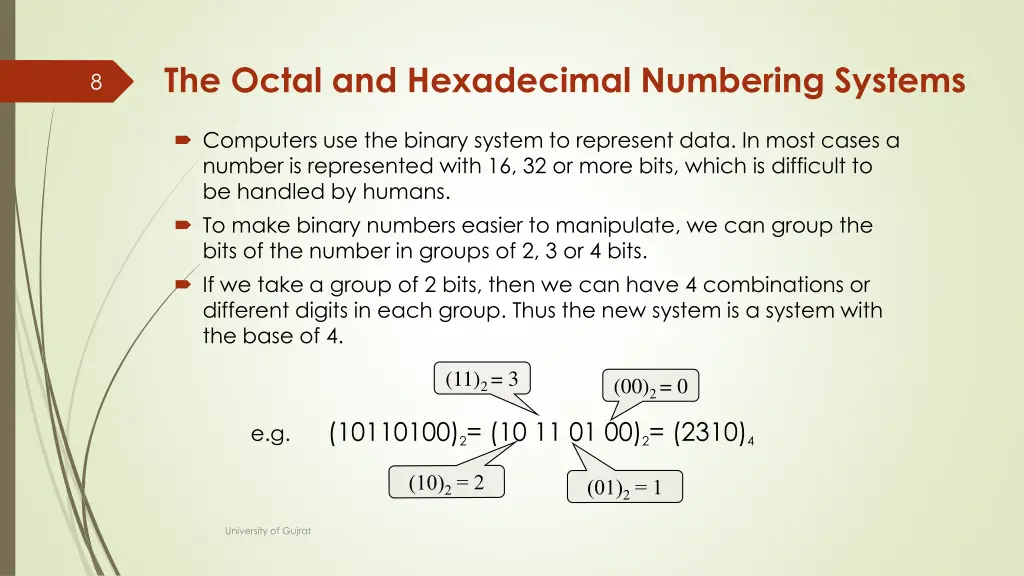
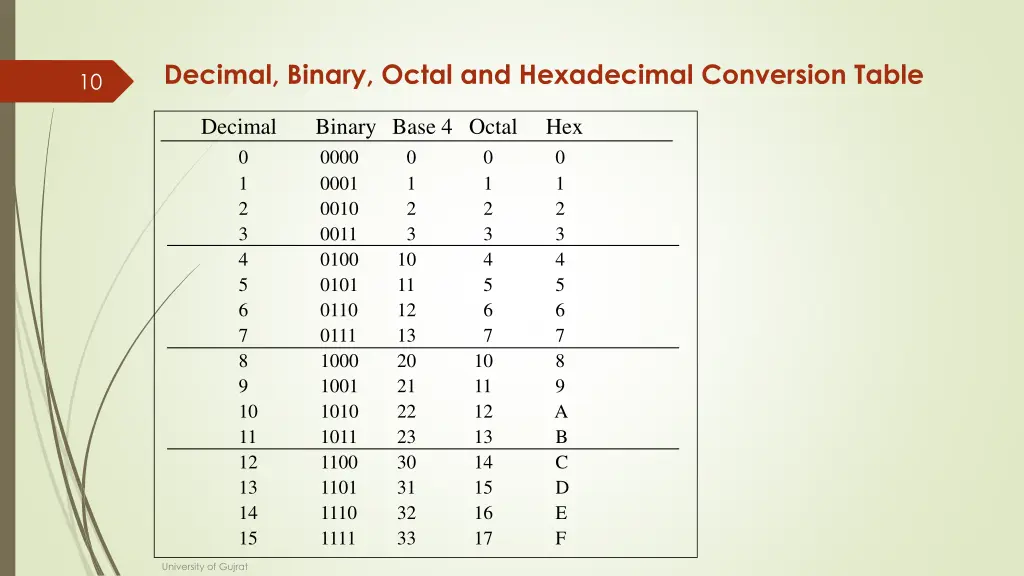
The Octal and Hexadecimal Numbering Systems 8 Computers use the binary system to represent data. In most cases a number is represented with 16, 32 or more bits, which is difficult to be handled by humans. To make binary numbers easier to manipulate, we can group the bits of the number in groups of 2, 3 or 4 bits. If we take a group of 2 bits, then we can have 4 combinations or different digits in each group. Thus the new system is a system with the base of 4. (11)2 = 3 (00)2 = 0 (10110100)2= (10 11 01 00)2= (2310)4 e.g. University of Gujrat
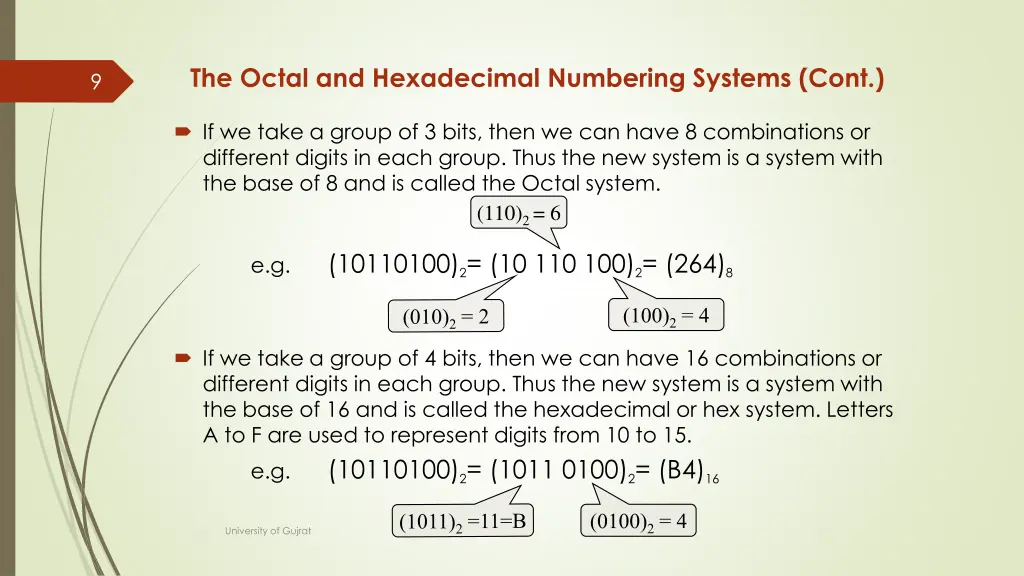
The Octal and Hexadecimal Numbering Systems (Cont.) 9 If we take a group of 3 bits, then we can have 8 combinations or different digits in each group. Thus the new system is a system with the base of 8 and is called the Octal system. (110)2 = 6 (10110100)2= (10 110 100)2= (264)8 e.g. If we take a group of 4 bits, then we can have 16 combinations or different digits in each group. Thus the new system is a system with the base of 16 and is called the hexadecimal or hex system. Letters A to F are used to represent digits from 10 to 15. e.g. (10110100)2= (1011 0100)2= (B4)16 University of Gujrat
Decimal, Binary, Octal and Hexadecimal Conversion Table 10 Decimal 0 1 2 3 4 5 6 7 8 9 10 11 12 13 14 15 Binary Base 4 Octal 0000 0 0001 1 0010 2 0011 3 0100 10 0101 11 0110 12 0111 13 1000 20 1001 21 1010 22 1011 23 1100 30 1101 31 1110 32 1111 33 Hex 0 1 2 3 4 5 6 7 8 9 A B C D E F 0 1 2 3 4 5 6 7 10 11 12 13 14 15 16 17 University of Gujrat
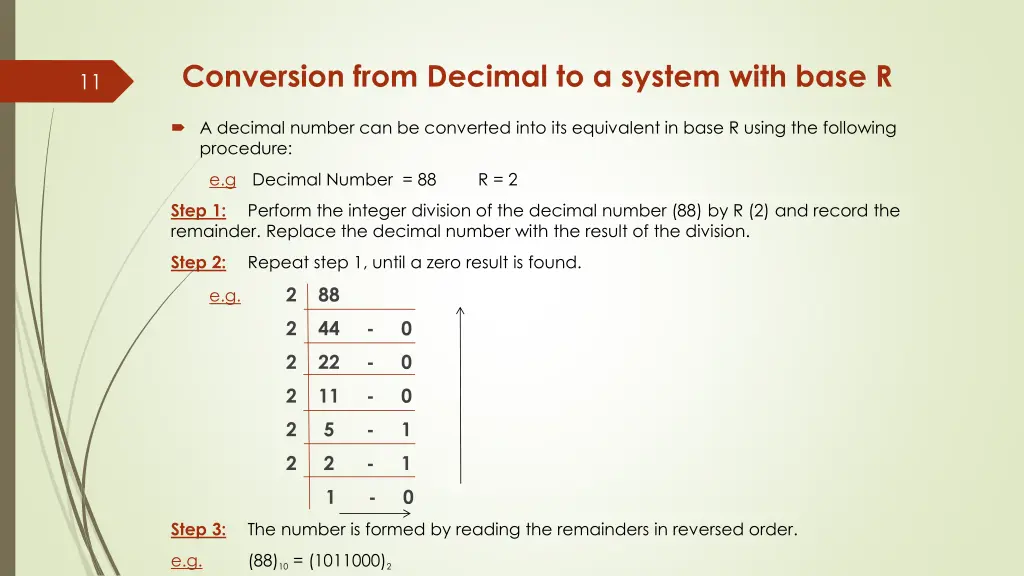
Conversion from Decimal to a system with base R 11 A decimal number can be converted into its equivalent in base R using the following procedure: e.g Decimal Number = 88 R = 2 Step 1: remainder. Replace the decimal number with the result of the division. Perform the integer division of the decimal number (88) by R (2) and record the Step 2: Repeat step 1, until a zero result is found. 2 88 e.g. 2 44 - 0 2 22 - 0 2 11 - 0 2 5 - 1 2 2 - 1 1 - 0 Step 3: The number is formed by reading the remainders in reversed order. e.g. (88)10 = (1011000)2
Binary Arithmetic 12 University of Gujrat
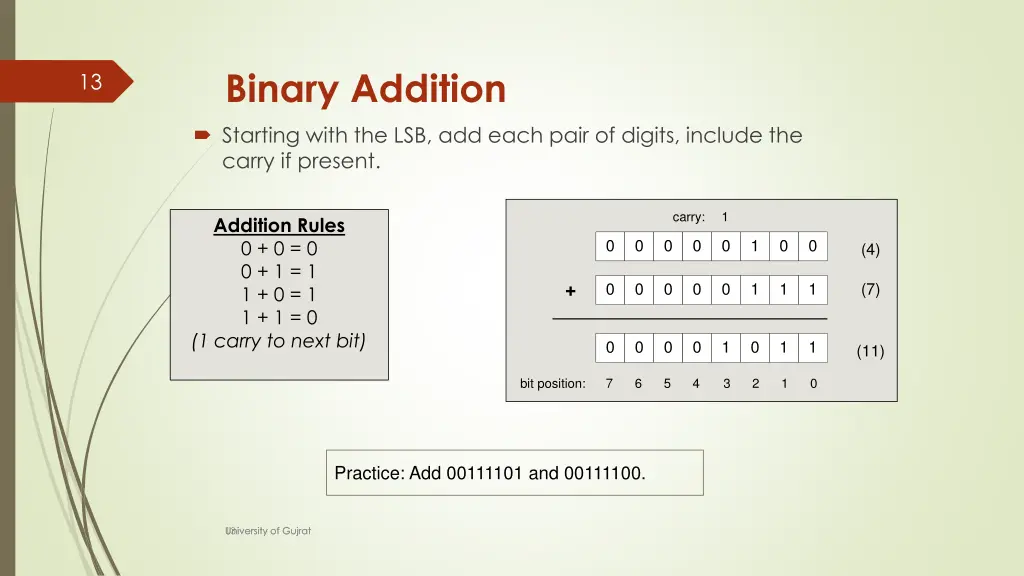
Binary Addition Starting with the LSB, add each pair of digits, include the carry if present. 13 carry: 1 Addition Rules 0 + 0 = 0 0 + 1 = 1 1 + 0 = 1 1 + 1 = 0 (1 carry to next bit) 0 0 0 0 0 1 0 0 (4) + 0 0 0 0 0 1 1 1 (7) 0 0 0 0 1 0 1 1 (11) bit position: 7 6 5 4 3 2 1 0 Practice: Add 00111101 and 00111100. University of Gujrat 13 University of Gujrat
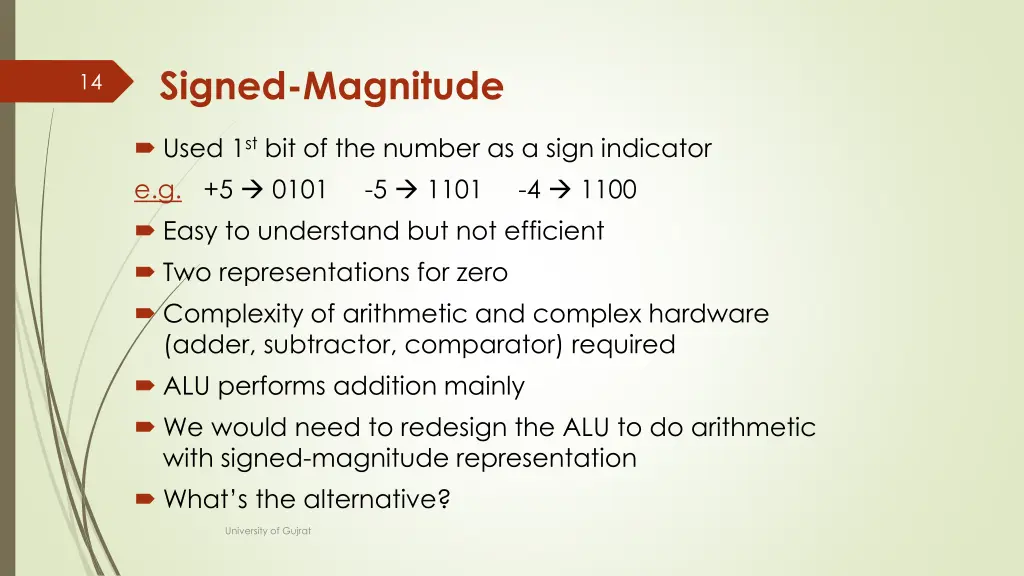
Signed-Magnitude 14 Used 1st bit of the number as a sign indicator e.g. +5 0101 -5 1101 Easy to understand but not efficient Two representations for zero Complexity of arithmetic and complex hardware (adder, subtractor, comparator) required ALU performs addition mainly We would need to redesign the ALU to do arithmetic with signed-magnitude representation What s the alternative? -4 1100 University of Gujrat
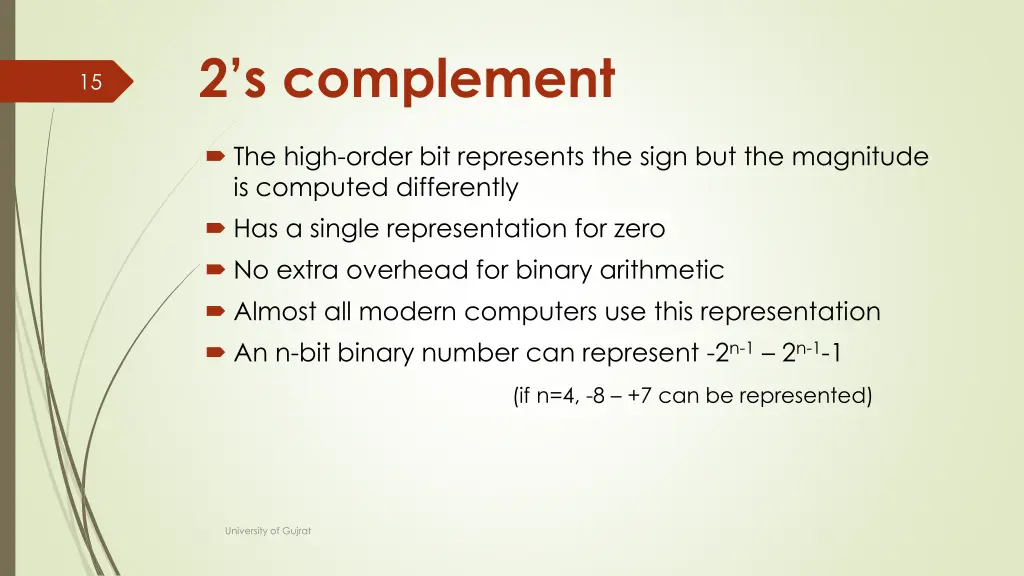
2s complement 15 The high-order bit represents the sign but the magnitude is computed differently Has a single representation for zero No extra overhead for binary arithmetic Almost all modern computers use this representation An n-bit binary number can represent -2n-1 2n-1-1 (if n=4, -8 +7 can be represented) University of Gujrat
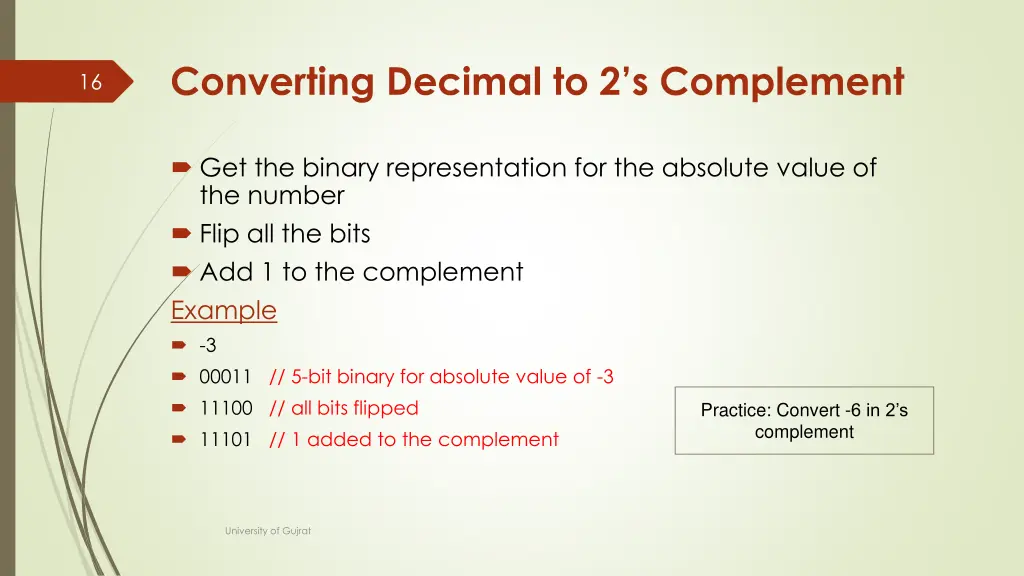
Converting Decimal to 2s Complement 16 Get the binary representation for the absolute value of the number Flip all the bits Add 1 to the complement Example -3 00011 // 5-bit binary for absolute value of -3 11100 // all bits flipped 11101 // 1 added to the complement Practice: Convert -6 in 2 s complement University of Gujrat
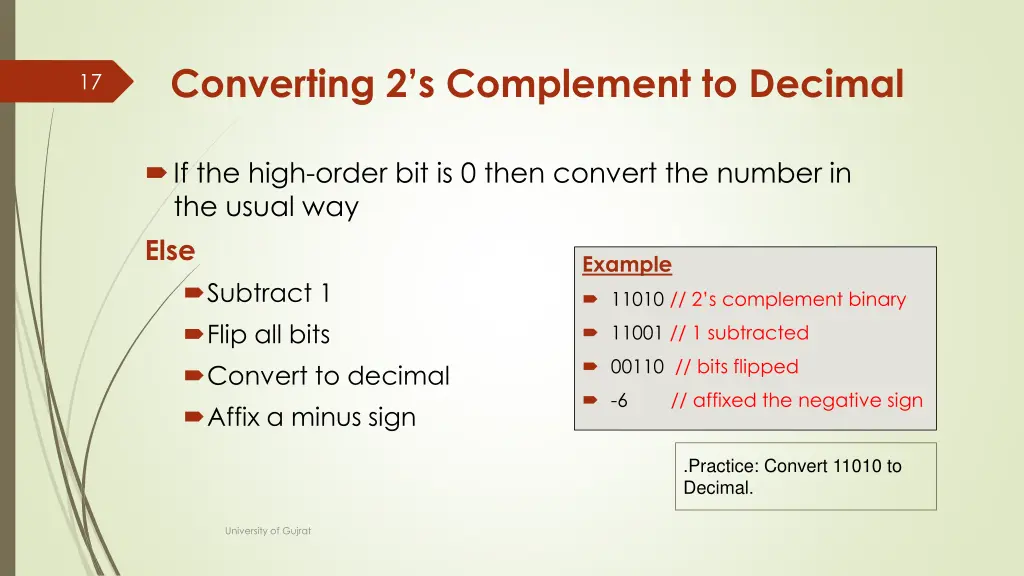
Converting 2s Complement to Decimal 17 If the high-order bit is 0 then convert the number in the usual way Else Subtract 1 Flip all bits Convert to decimal Affix a minus sign Example 11010 // 2 s complement binary 11001 // 1 subtracted 00110 // bits flipped -6 // affixed the negative sign .Practice: Convert 11010 to Decimal. University of Gujrat
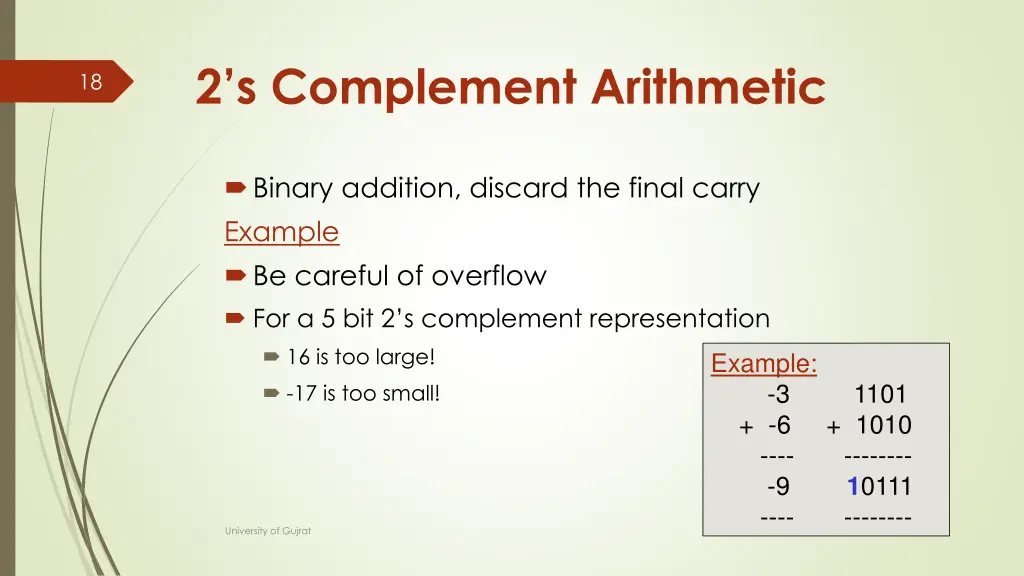
2s Complement Arithmetic 18 Binary addition, discard the final carry Example Be careful of overflow For a 5 bit 2 s complement representation 16 is too large! -17 is too small! Example: -3 1101 + -6 + 1010 ---- -------- -9 10111 ---- -------- University of Gujrat
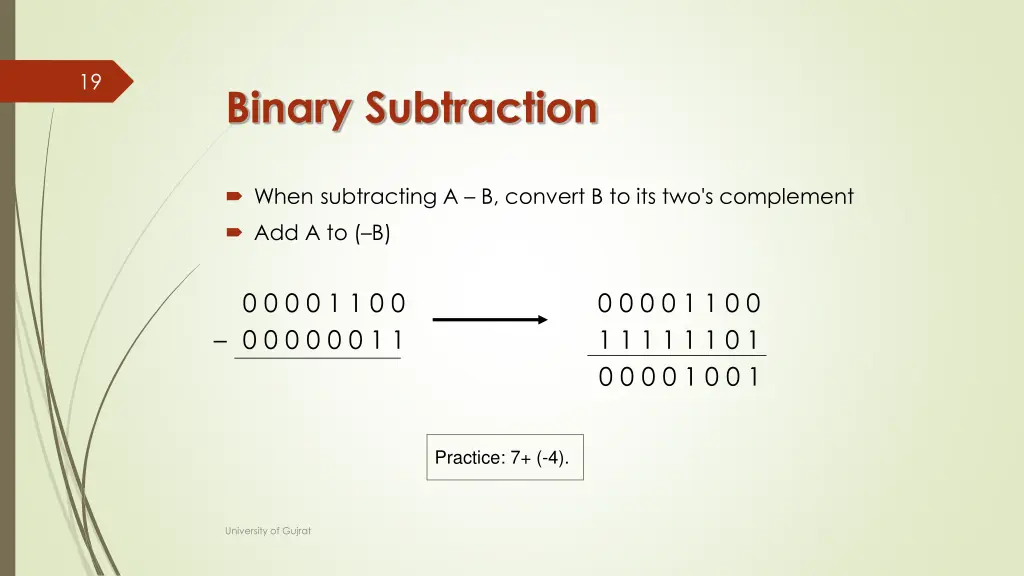
19 Binary Subtraction When subtracting A B, convert B to its two's complement Add A to ( B) 0 0 0 0 1 1 0 0 0 0 0 0 0 0 1 1 0 0 0 0 1 0 0 1 0 0 0 0 1 1 0 0 1 1 1 1 1 1 0 1 Practice: 7+ (-4). University of Gujrat
Hexadecimal Arithmetic 20 University of Gujrat
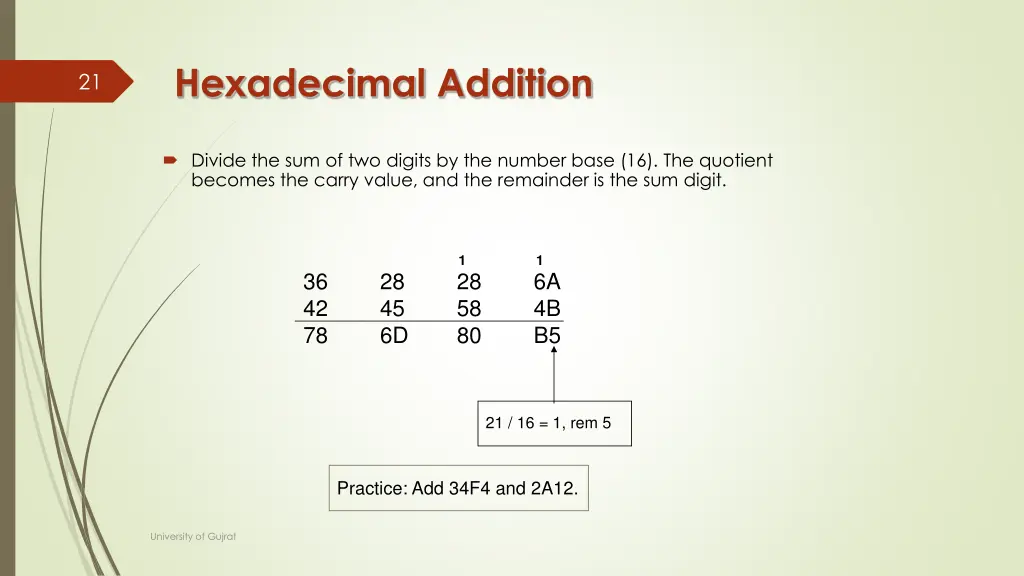
Hexadecimal Addition 21 Divide the sum of two digits by the number base (16). The quotient becomes the carry value, and the remainder is the sum digit. 1 1 36 42 78 28 45 6D 28 58 80 6A 4B B5 21 / 16 = 1, rem 5 Practice: Add 34F4 and 2A12. University of Gujrat
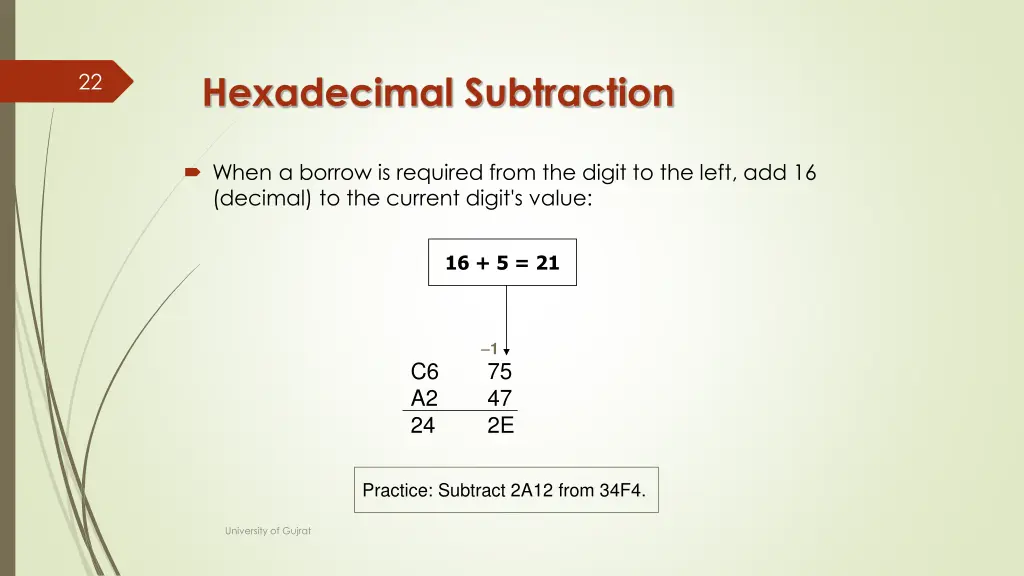
Hexadecimal Subtraction 22 When a borrow is required from the digit to the left, add 16 (decimal) to the current digit's value: 16 + 5 = 21 1 C6 A2 24 75 47 2E Practice: Subtract 2A12 from 34F4. University of Gujrat
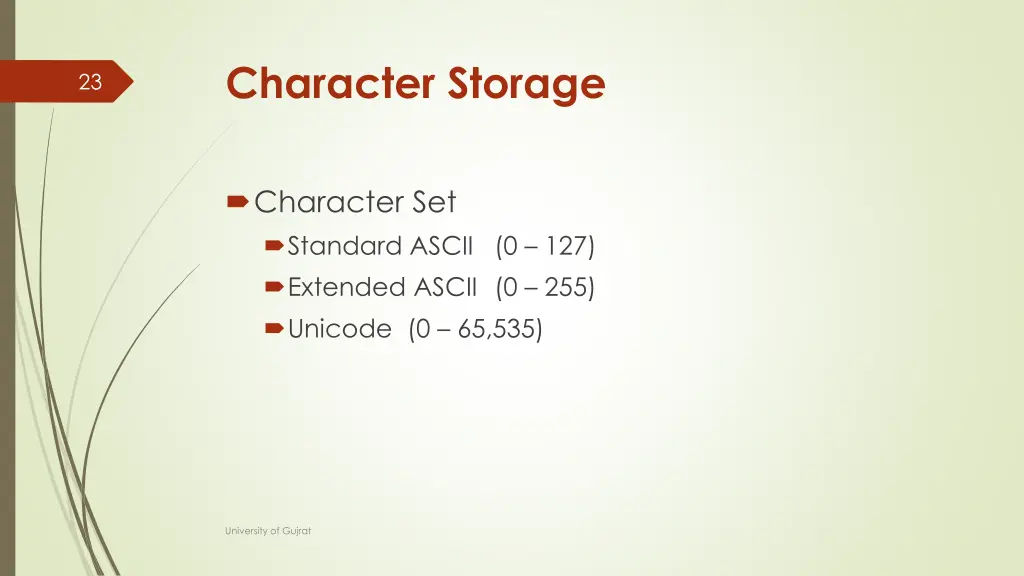
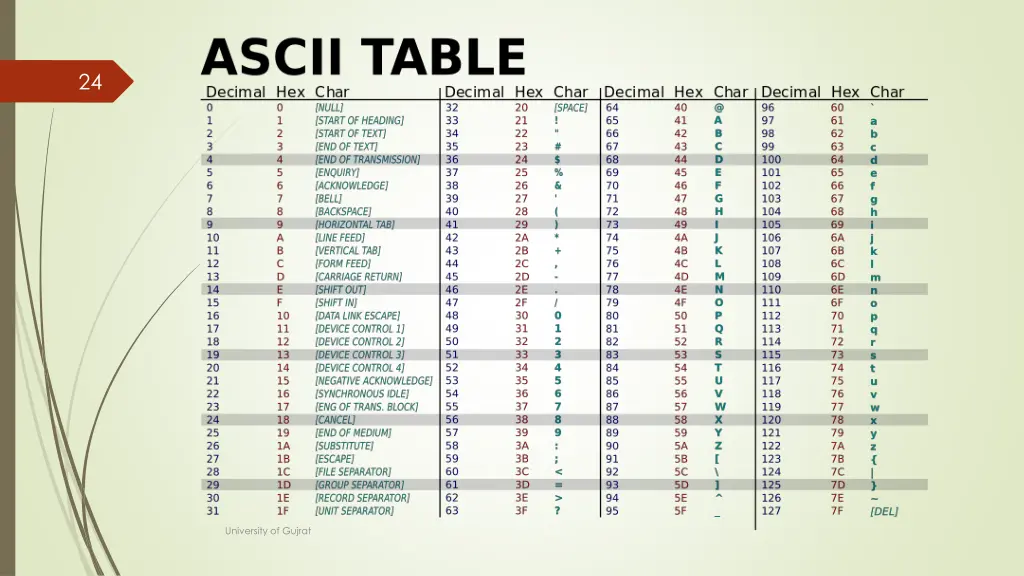
Character Storage 23 Character Set Standard ASCII (0 127) Extended ASCII (0 255) Unicode (0 65,535) University of Gujrat
24 University of Gujrat
Boolean Operations 25 University of Gujrat
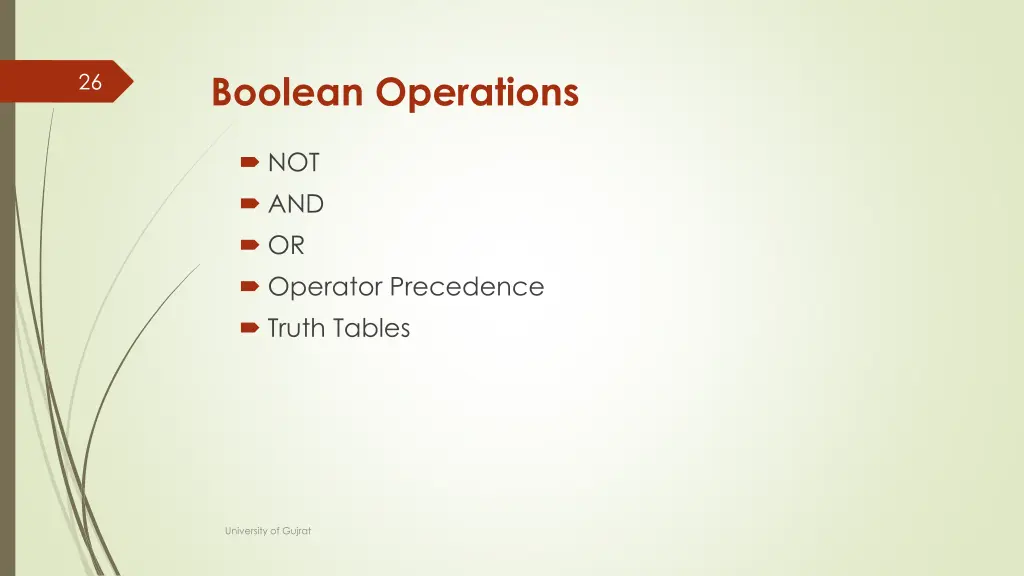
Boolean Operations 26 NOT AND OR Operator Precedence Truth Tables University of Gujrat
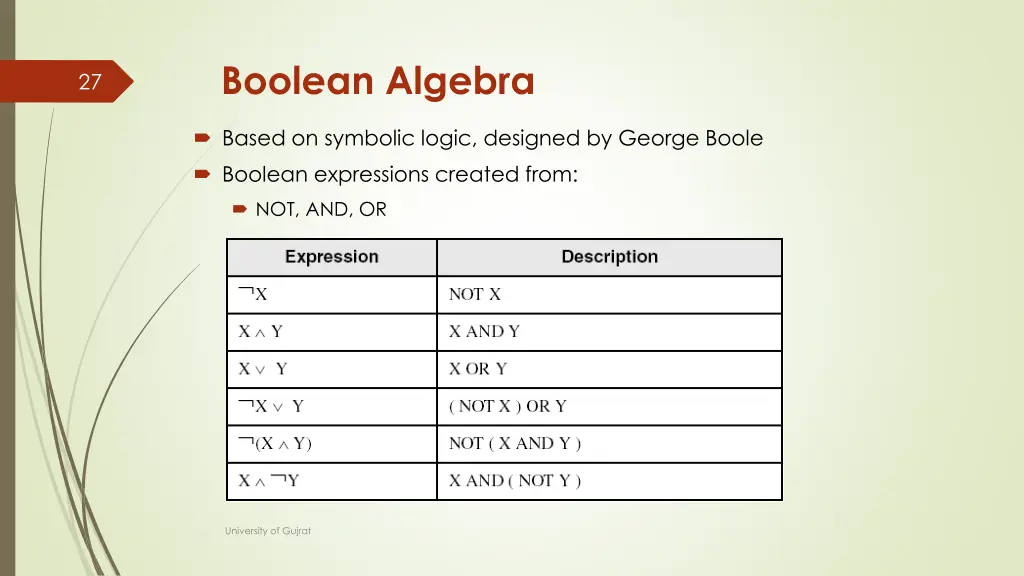
Boolean Algebra 27 Based on symbolic logic, designed by George Boole Boolean expressions created from: NOT, AND, OR University of Gujrat
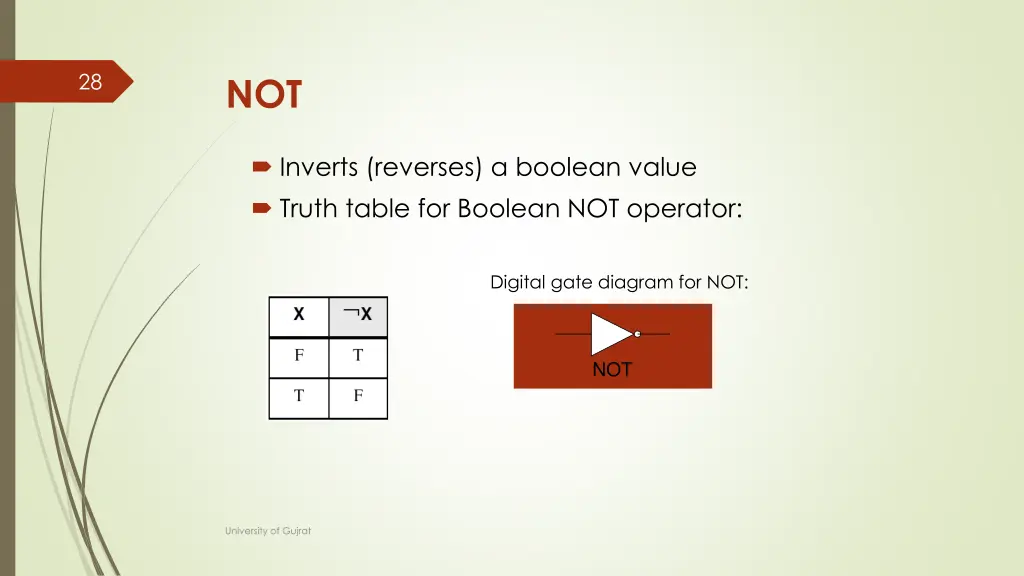
28 NOT Inverts (reverses) a boolean value Truth table for Boolean NOT operator: Digital gate diagram for NOT: NOT University of Gujrat
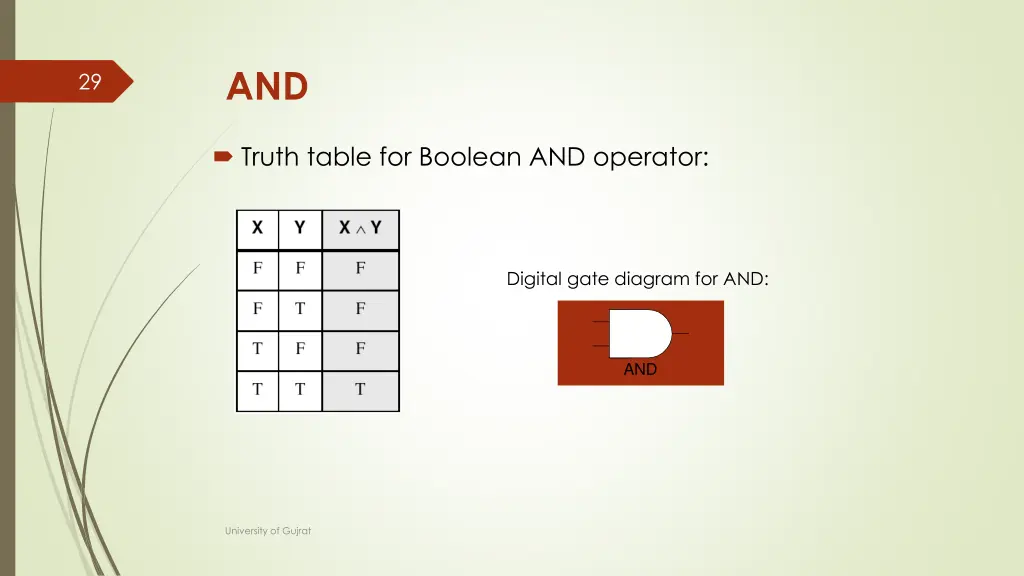
AND 29 Truth table for Boolean AND operator: Digital gate diagram for AND: AND University of Gujrat
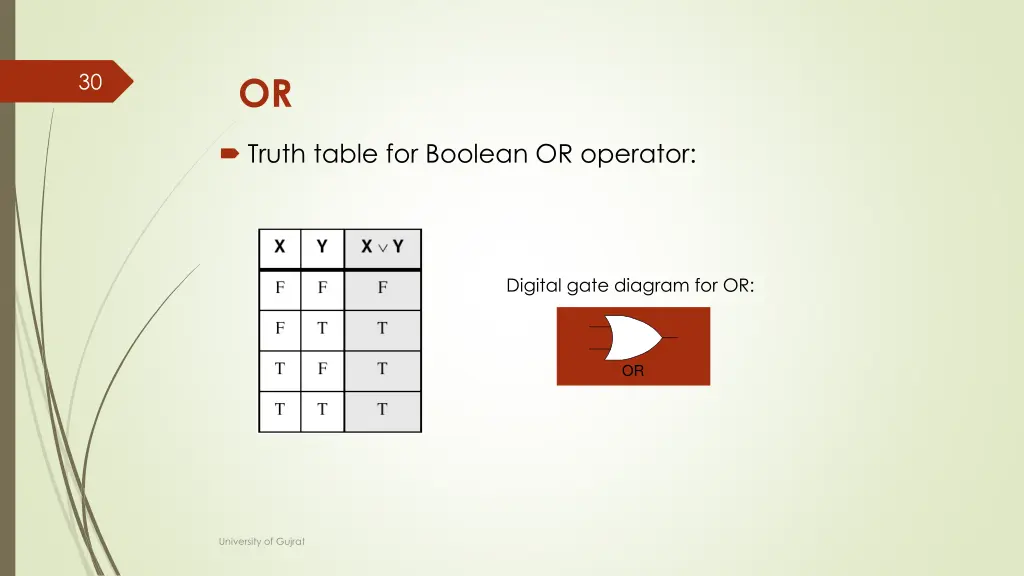
30 OR Truth table for Boolean OR operator: Digital gate diagram for OR: OR University of Gujrat
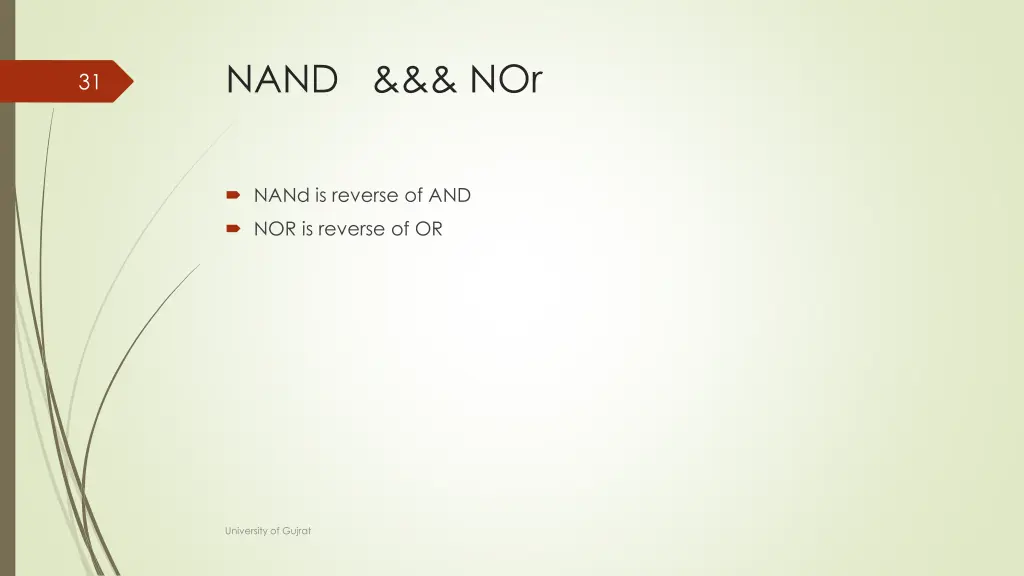
NAND &&& NOr 31 NANd is reverse of AND NOR is reverse of OR University of Gujrat
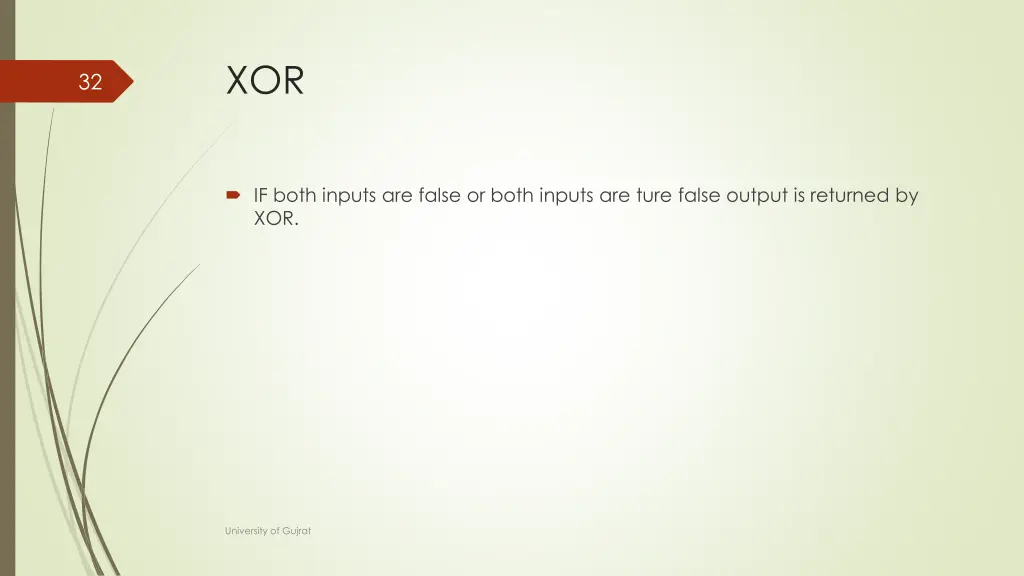
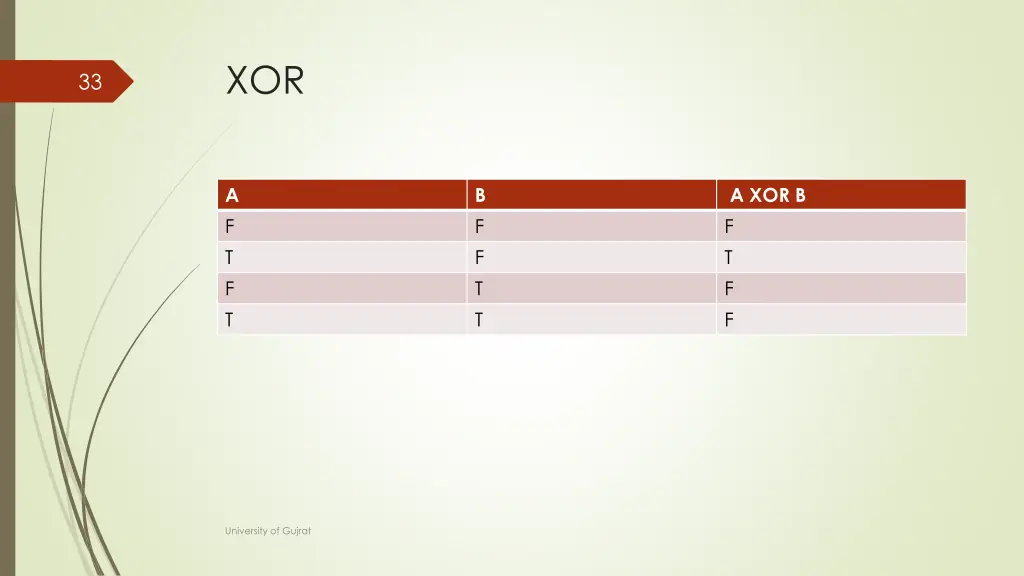
XOR 32 IF both inputs are false or both inputs are ture false output is returned by XOR. University of Gujrat
XOR 33 A F T F T B F F T T A XOR B F T F F University of Gujrat
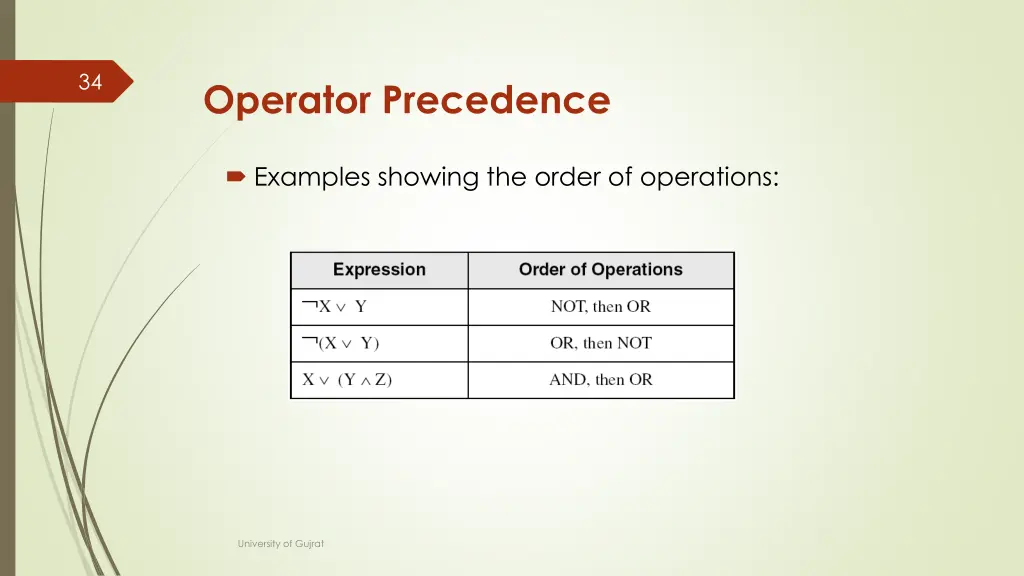
34 Operator Precedence Examples showing the order of operations: University of Gujrat
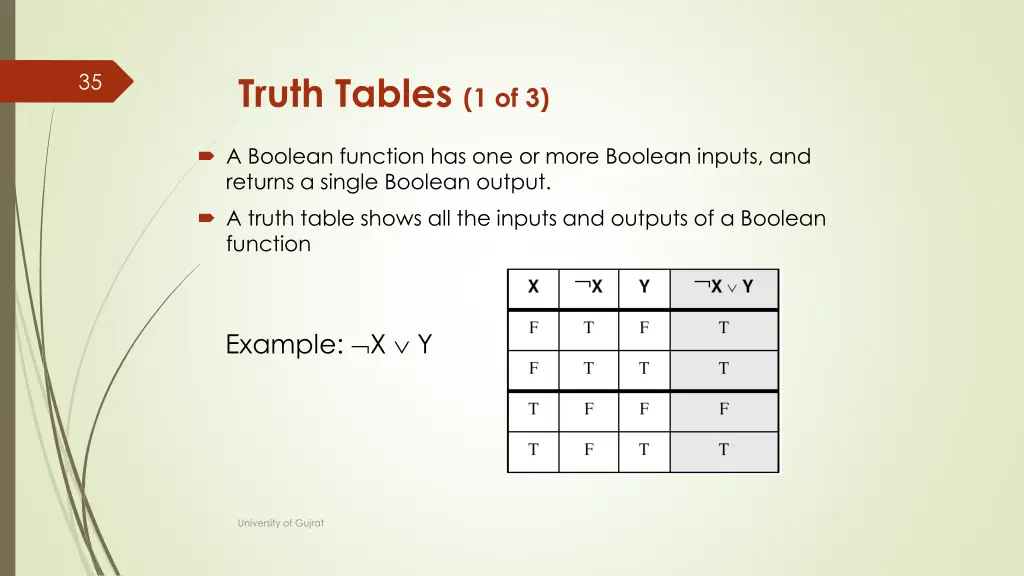
35 Truth Tables (1 of 3) A Boolean function has one or more Boolean inputs, and returns a single Boolean output. A truth table shows all the inputs and outputs of a Boolean function Example: X Y University of Gujrat
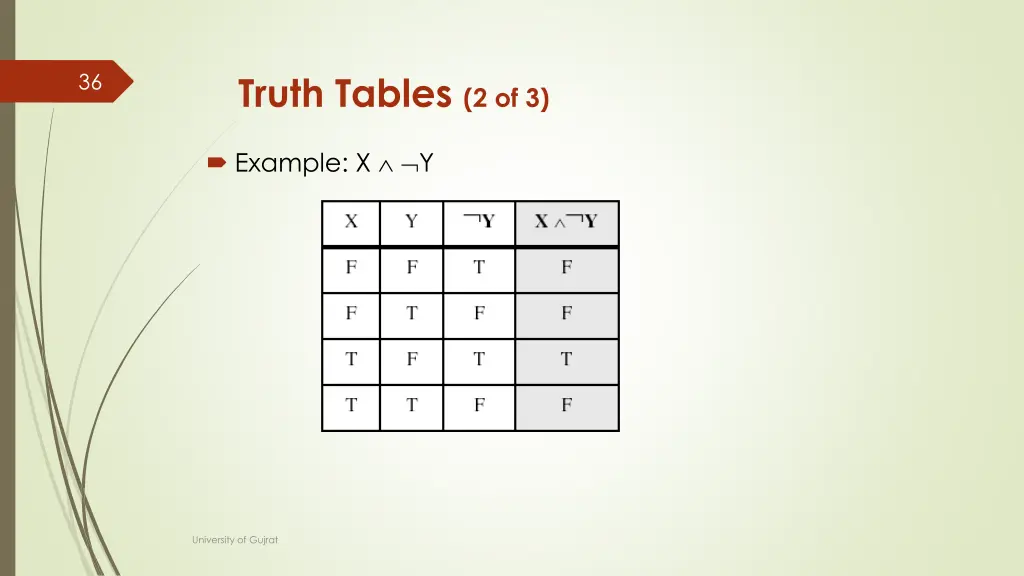
36 Truth Tables (2 of 3) Example: X Y University of Gujrat
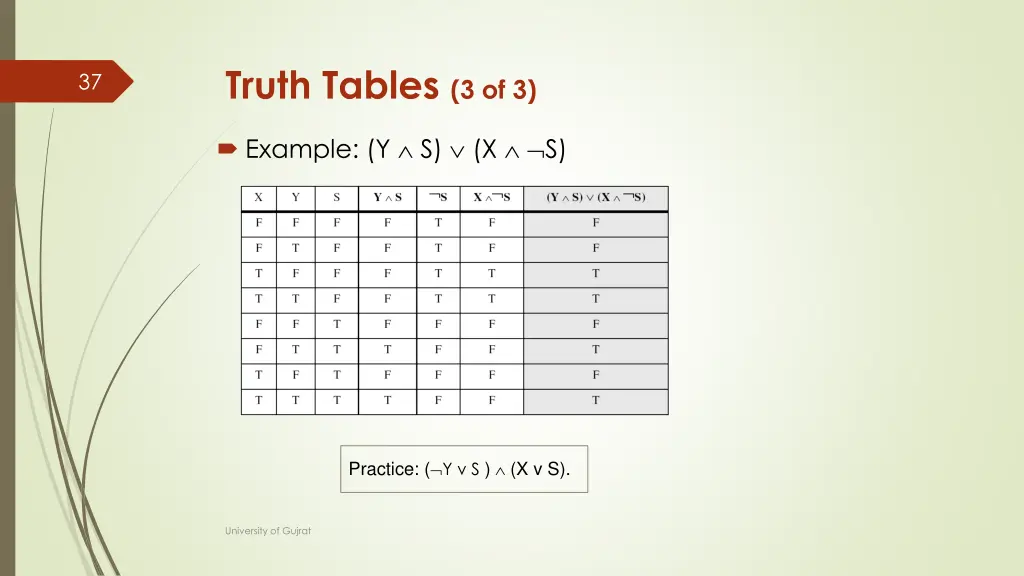
Truth Tables (3 of 3) 37 Example: (Y S) (X S) Practice: ( Y v S ) (X v S). University of Gujrat
THE END 38 University of Gujrat