Computer Organization and Design Course Overview - Fall 2015
Explore the Computer Organization and Design course taught by Zhenghao Zhang in Fall 2015. Get insights into the class communication methods, required textbook, lecture notes, motivations, and the importance of understanding hardware-software interfaces in computer systems.

Download Presentation

Please find below an Image/Link to download the presentation.
The content on the website is provided AS IS for your information and personal use only. It may not be sold, licensed, or shared on other websites without obtaining consent from the author. If you encounter any issues during the download, it is possible that the publisher has removed the file from their server.
You are allowed to download the files provided on this website for personal or commercial use, subject to the condition that they are used lawfully. All files are the property of their respective owners.
The content on the website is provided AS IS for your information and personal use only. It may not be sold, licensed, or shared on other websites without obtaining consent from the author.
E N D
Presentation Transcript
Special Thanks Thanks to Dr. Xiuwen Liu for letting me use his class slides and other materials as a base for this course
About Me My name is Zhenghao Zhang Why I am teaching this course: I worked for two years as an embedded system engineer, writing codes for embedded controllers. 3/21/2025 CDA3100 4
Class Communication This class will use class web site to post news, changes, and updates. So please check the class website regularly Please also make sure that you check your emails on the account on your University record Blackboard will be used for posting the grades 3/21/2025 CDA3100 5
Required Textbook The required textbook for this class is Computer Organization and Design The hardware/software interface By David A. Patterson and John L. Hennessy Fifth Edition 3/21/2025 CDA3100 6
Lecture Notes and Textbook All the materials that you will be tested on will be covered in the lectures Even though you may need to read the textbook for review and further detail explanations The lectures will be based on the textbook and handouts distributed in class 3/21/2025 CDA3100 7
What you will learn How does the software instruct the hardware to perform the needed functions What is going on in the processor How a simple processor is designed
Why This Class Important? If you want to create better computers It introduces necessary concepts, components, and principles for a computer scientist By understanding the existing systems, you may create better ones If you want to build software with better performance If you want to have a good choice of jobs If you want to be a real computer scientist 3/21/2025 CDA3100 10
Required Background Based on years of teaching this course, I find that you will suffer if you do not have the required C/C++ programming background. We will need assembly coding, which is more advanced than C/C++. If you do not have a clear understanding at this moment of array and loop , it is recommended that you take this course at a later time, after getting more experience with C/C++ programming.
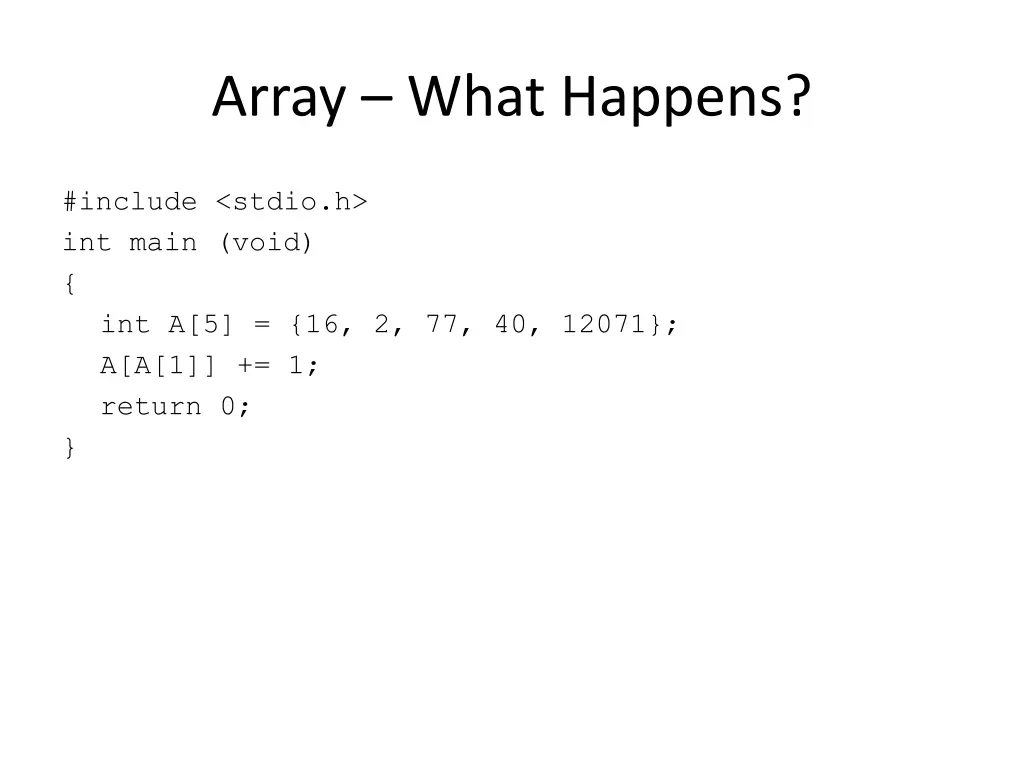
Array What Happens? #include <stdio.h> int main (void) { int A[5] = {16, 2, 77, 40, 12071}; A[A[1]] += 1; return 0; }
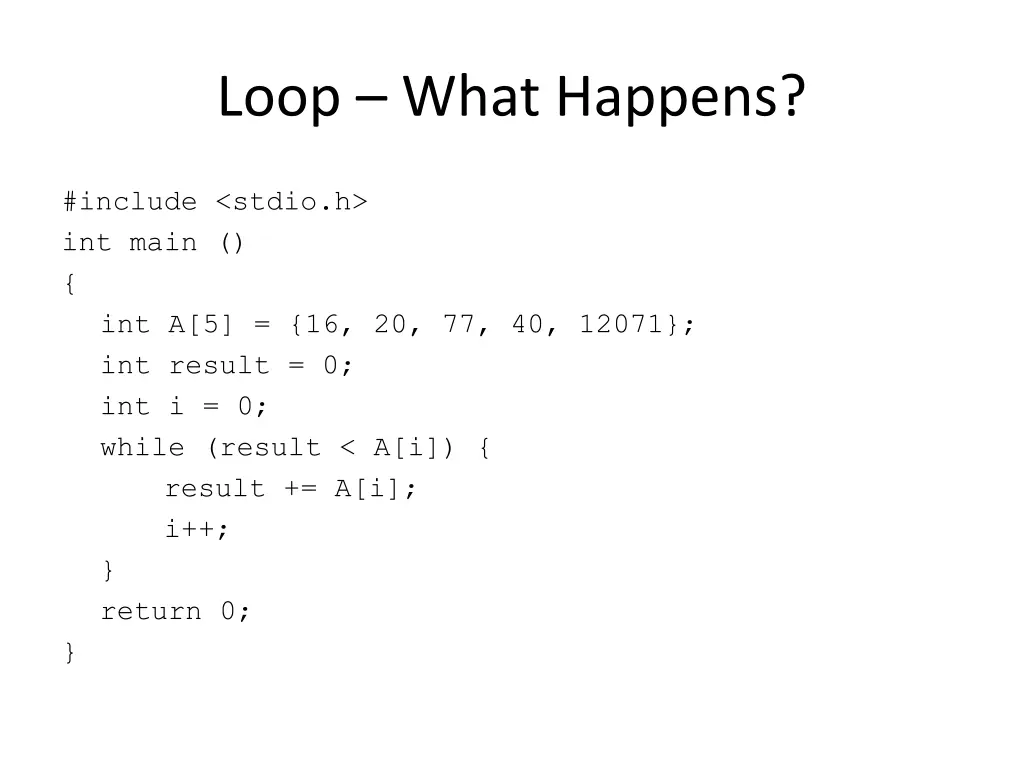
Loop What Happens? #include <stdio.h> int main () { int A[5] = {16, 20, 77, 40, 12071}; int result = 0; int i = 0; while (result < A[i]) { result += A[i]; i++; } return 0; }
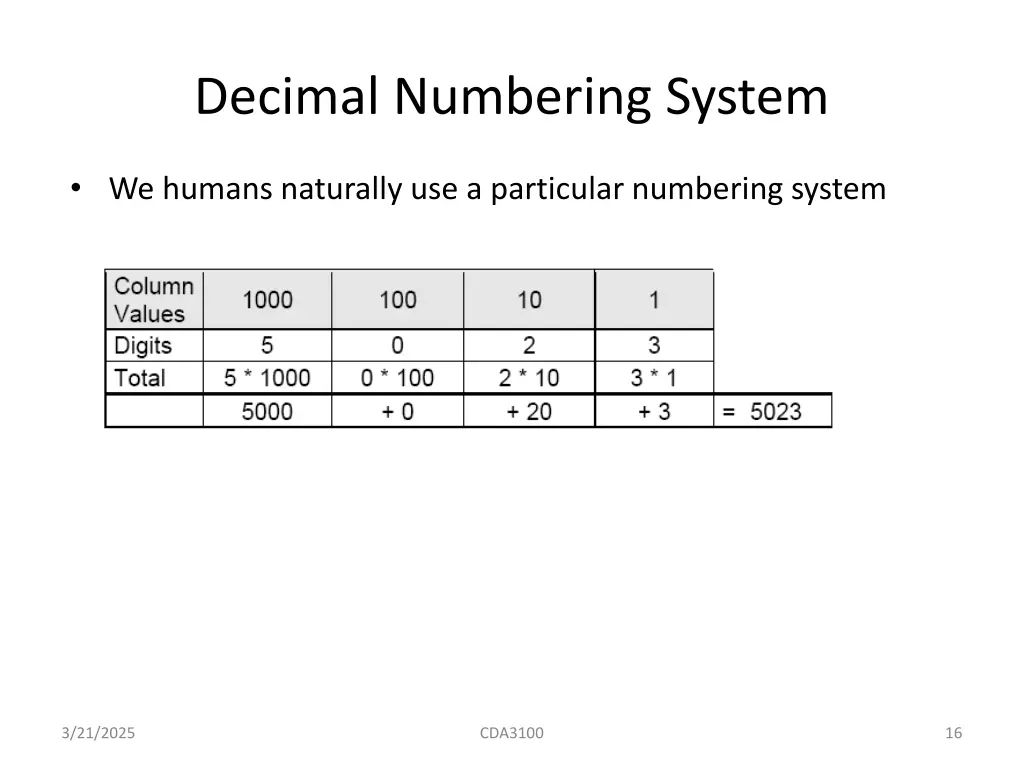
Decimal Numbering System We humans naturally use a particular numbering system 3/21/2025 CDA3100 16
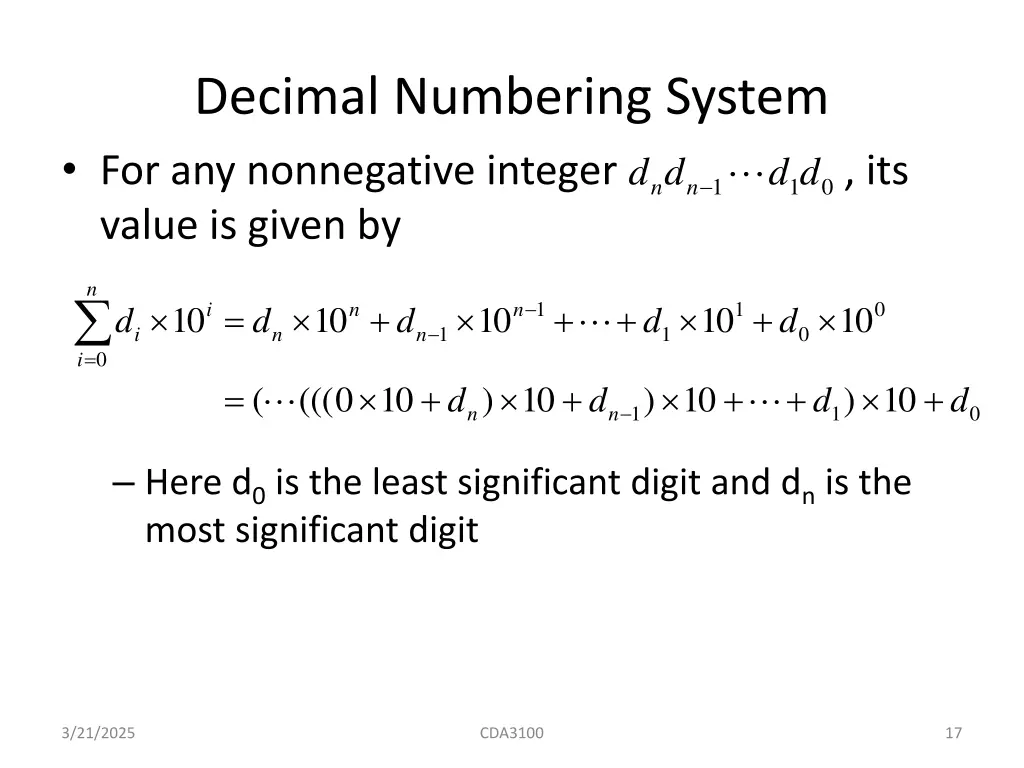
Decimal Numbering System For any nonnegative integer , its value is given by d d d d 1 1 0 n n n = = + + + + 1 1 0 i n n 10 10 10 10 10 d d d d d 1 1 0 i n n 0 i = + + + + + ( ((( 0 10 ) 10 ) 10 ) 10 d d d d 1 1 0 n n Here d0 is the least significant digit and dn is the most significant digit 3/21/2025 CDA3100 17
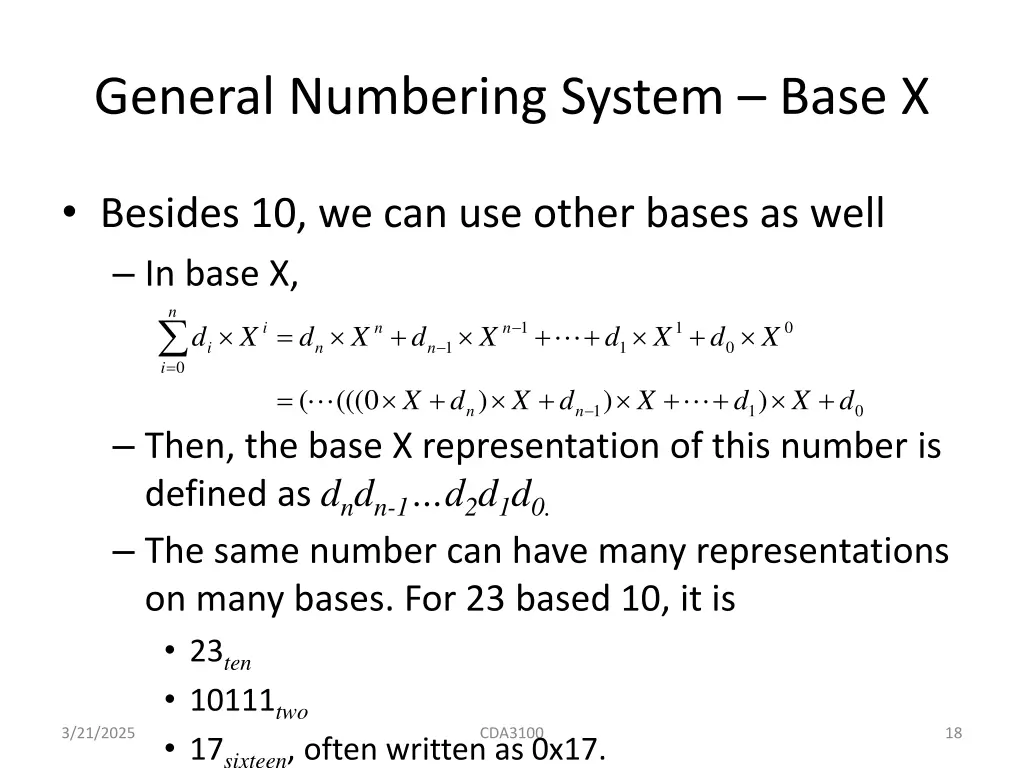
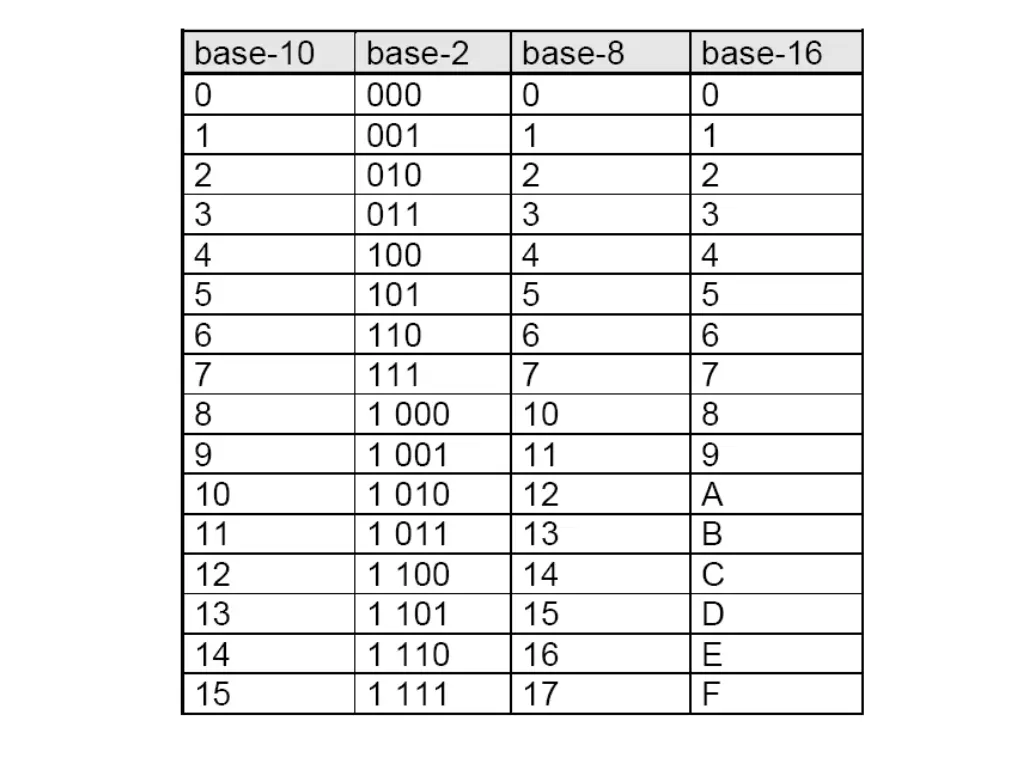
General Numbering System Base X Besides 10, we can use other bases as well In base X, n i i + = = + + + 1 1 0 n n d X d X d X d X d X 1 1 0 n n 0 i = + + + + + ( ((( 0 ) ) ) X d X d X d X d 1 1 0 n n Then, the base X representation of this number is defined as dndn-1 d2d1d0. The same number can have many representations on many bases. For 23 based 10, it is 23ten 10111two 17sixteen, often written as 0x17. 3/21/2025 CDA3100 18
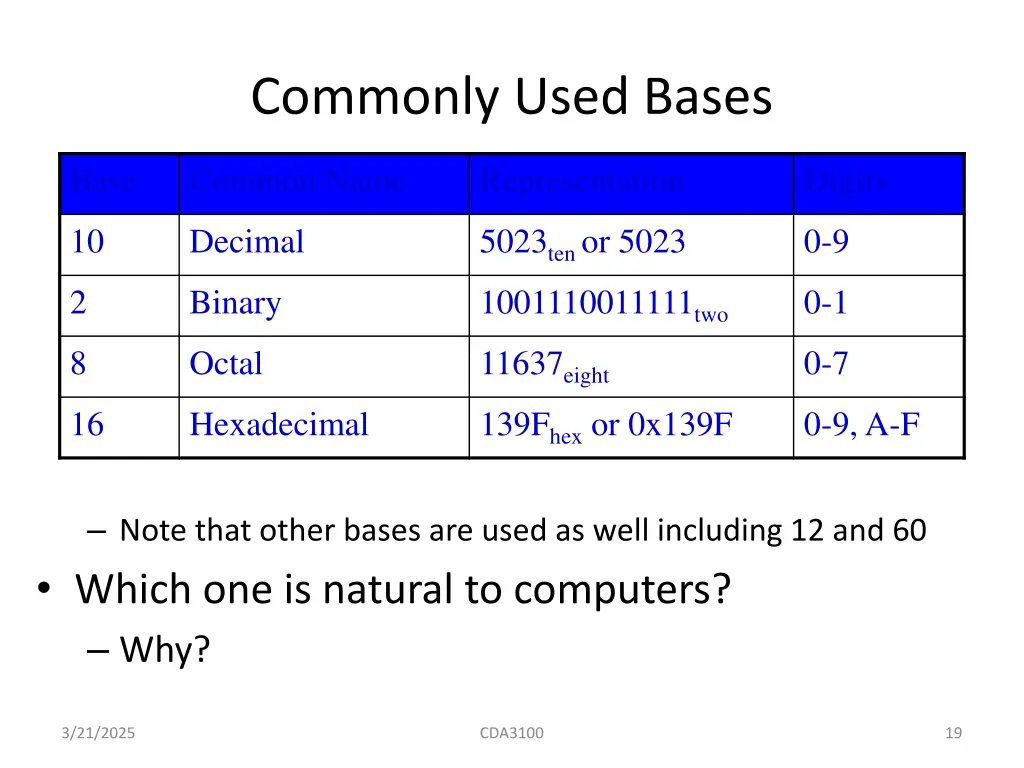
Commonly Used Bases Base Common Name Representation Digits 10 Decimal 5023ten or 5023 1001110011111two 11637eight 139Fhex or 0x139F 0-9 2 Binary 0-1 8 Octal 0-7 16 Hexadecimal 0-9, A-F Note that other bases are used as well including 12 and 60 Which one is natural to computers? Why? 3/21/2025 CDA3100 19
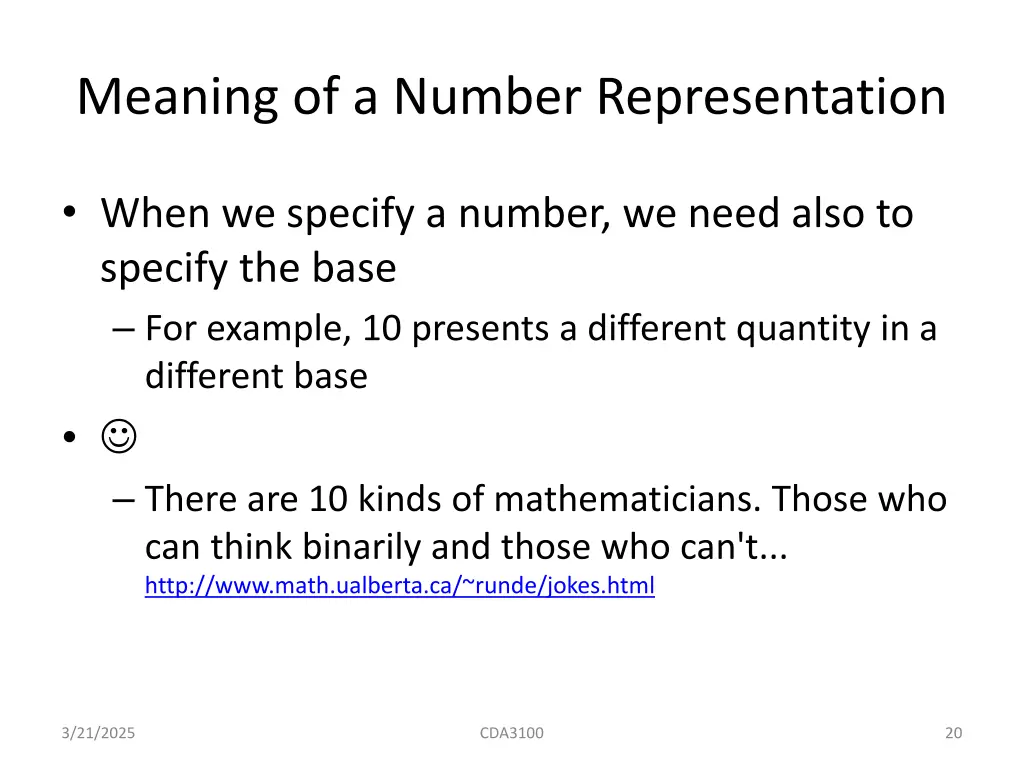
Meaning of a Number Representation When we specify a number, we need also to specify the base For example, 10 presents a different quantity in a different base There are 10 kinds of mathematicians. Those who can think binarily and those who can't... http://www.math.ualberta.ca/~runde/jokes.html 3/21/2025 CDA3100 20
Question How many different numbers that can be represented by 4 bits?
Question How many different numbers that can be represented by 4 bits? Always 16 (24), because there are this number of different combinations with 4 bits, regardless of the type of the number these 4 bits are representing. Obviously, this also applies to other number of bits. With n bits, we can represent 2n different numbers. If the number is unsigned integer, it is from 0 to 2n-1.