Computing Shortest Paths among Curved Obstacles
Explore the challenges in computing shortest paths among curved obstacles in the plane, covering obstacles of various shapes and sizes. Discover innovative approaches and previous works, shedding light on modeling and navigating complex obstacle landscapes efficiently.

Uploaded on | 2 Views
Download Presentation

Please find below an Image/Link to download the presentation.
The content on the website is provided AS IS for your information and personal use only. It may not be sold, licensed, or shared on other websites without obtaining consent from the author. If you encounter any issues during the download, it is possible that the publisher has removed the file from their server.
You are allowed to download the files provided on this website for personal or commercial use, subject to the condition that they are used lawfully. All files are the property of their respective owners.
The content on the website is provided AS IS for your information and personal use only. It may not be sold, licensed, or shared on other websites without obtaining consent from the author.
E N D
Presentation Transcript
Computing Shortest Paths among Computing Shortest Paths among Curved Obstacles in the Plane Curved Obstacles in the Plane Danny Z. Chen1and Haitao Wang2 1University of Notre Dame 2Utah State University SoCG 2013
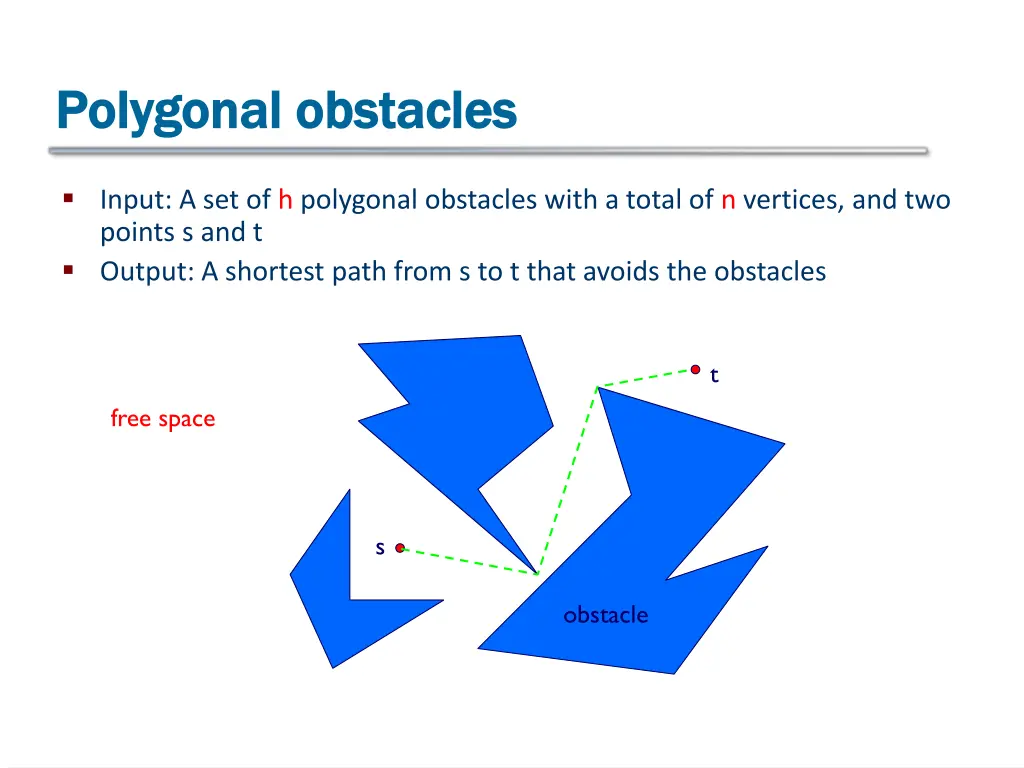
Polygonal obstacles Polygonal obstacles Input: A set of h polygonal obstacles with a total of n vertices, and two points s and t Output: A shortest path from s to t that avoids the obstacles t free space s obstacle
Curved obstacles Curved obstacles Input: a set of obstacles whose boundaries are curves Output: a shortest path from s to t in the free space t s
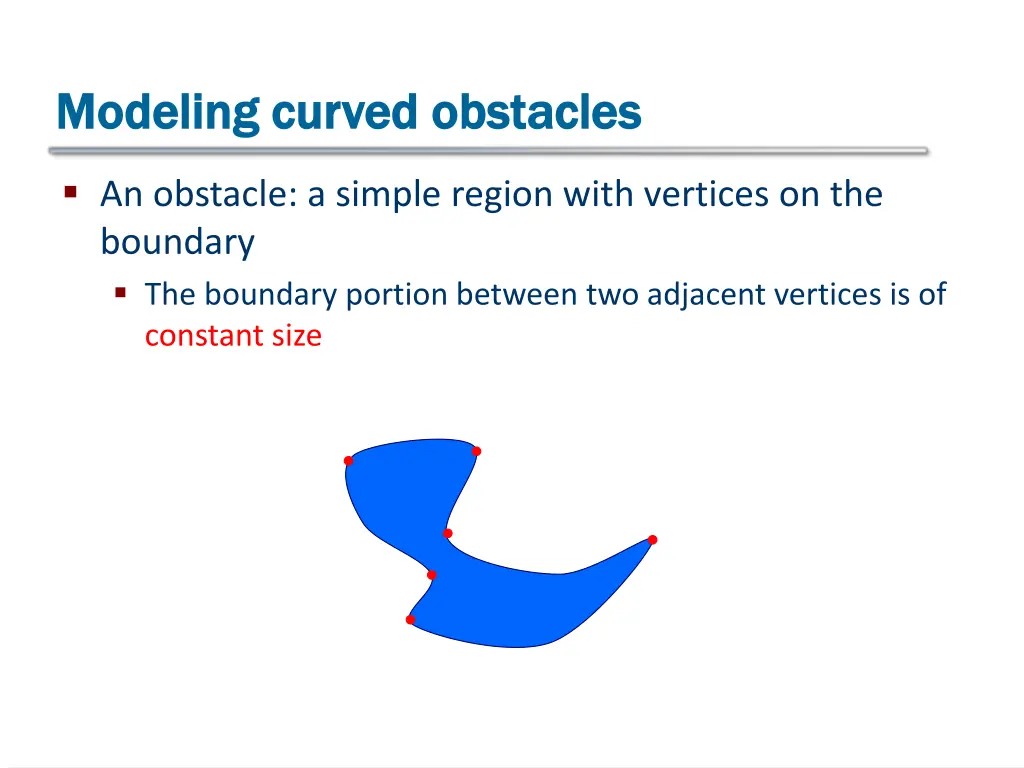
Modeling curved obstacles Modeling curved obstacles An obstacle: a simple region with vertices on the boundary The boundary portion between two adjacent vertices is of constant size
Modeling curved obstacles (cont.) Modeling curved obstacles (cont.) h: the number of obstacles n: the total number of vertices s, t: two points in the free space t s
Previous work Previous work polygonal obstacles polygonal obstacles Building visibility graphs O(k+nlogn) time (Ghosh and Mount 91 ) k=O(n2): the size of the visibility graph t s obstacle
Previous work Previous work polygonal obstacles polygonal obstacles Building visibility graphs O(k+nlogn) time (Ghosh and Mount 91 ) k=O(n2): the size of the visibility graph Continuous Disjkstra scheme O(n1.5+ ) time (Mitchell 96 ) first sub-quadratic algorithm O(nlogn) time and space (Hershberger and Suri 99 ) time-optimal
Curved obstacles Curved obstacles previous and new results results previous and new Convex case: all obstacles are convex Chew 85 , Chang et al. 05 , Hershberger and Guibas 88 , Storer and Reif 94 O(n2) time (Chen and Wang 11 ) Non-convex case: the previous talk, Hershberger, Suri, and Yildiz Approach: continuous Dijkstra our result: O(n+hlog1+ h+k) time k=O(h2): sensitive to the input Approach: visibility graph
A sub A sub- -problem: Computing the problem: Computing the relevant visibility graph visibility graph of convex obstacles of convex obstacles relevant Relevant visibility graph: Given a set of h convex obstacles of n vertices, compute their free common tangents k=O(h2): the number of all free common tangents
Previous work and our result Previous work and our result For polygonal convex obstacles: O(n + h2logn) time, Rohnert, 96 ; Kapoor, Maheshwari, Mitchell, 97 An open question: O(n + klogn) time O(nlogn+k) time, Pocchiola and Vegter, 95 h=n Each obstacle is of constant size Our result: O(n+hlogh + k) time and O(n) working space Better than the open question Optimal solution
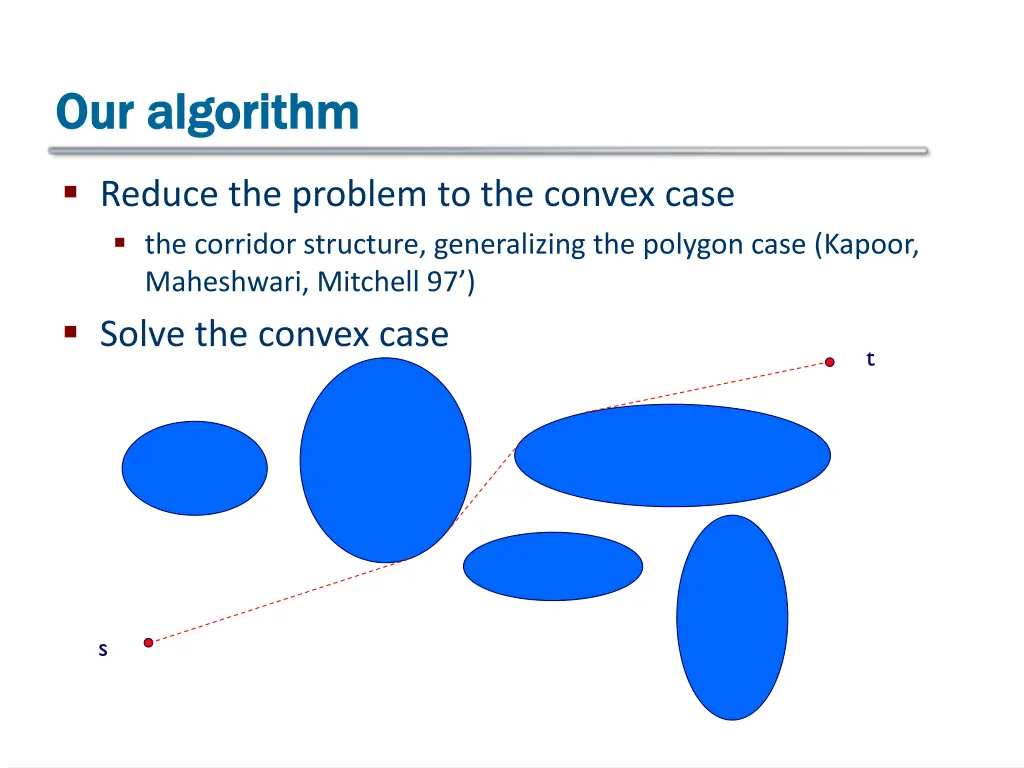
Our algorithm Our algorithm Reduce the problem to the convex case the corridor structure, generalizing the polygon case (Kapoor, Maheshwari, Mitchell 97 ) Solve the convex case t s
The algorithm for the convex case The algorithm for the convex case Step 1: Compute the relevant visibility graph G A shortest s-t path in the plane corresponds to a shortest s-t path in G Our sub-problem Step 2: Finding a shortest s-t path in G ---- Dijkstra s algorithm G has O(h2) nodes and O(h2) edges O(h2log h) time How to remove the logh ? t s
Solving Step 2 (Chen and Wang 11) Solving Step 2 (Chen and Wang 11 ) A follow-up of the work by Hershberger and Guibas 88 Transform G to a smaller graph G such that A shortest s-t path in G G has O(h2) edges but only O(h) nodes O(h2) time for Dijkstra s algorithm on G a shortest s-t path in G
Computing the relevant visibility graph Computing the relevant visibility graph Given a set of h convex obstacles of n vertices, compute all bitangents (free common tangents ) k=O(h2): the number of all bitangents
The algorithm The algorithm An extension of Pocchiola and Vegter s algorithm (called the PV algorithm) h=n and all obstacles are of constant size O(nlogn+k) time and O(n) space Our result: O(n+hlogh+k) time and O(n) space Similar to the PV algorithm with some modifications Challenge: the time analysis PV algorithm: local analysis Ours: global analysis
Pseudo Pseudo- -triangulations triangulations A pseudo-triangulation: a plane subdivision induced by a maximal number (3h-3) of disjoint bitangents Each region is a pseudo-triangle a common tangent line
The topological flip algorithm The topological flip algorithm Start from a pseudo-triangulation T Flip operations: flip a bitangent b insert the bitangent b of the two pseudo-triangles incident to b remove b from T obtain another pseudo-triangulation T Repeat the flip operations Two issues: Start from which pseudo-triangulation? Which is the next bitangent to flip? b b
Handle the first issue: the initial Handle the first issue: the initial pseudo pseudo- -triangulation triangulation T T0 0 Let B be the set of all bitangents T0is induced by the following bitangents b1b2b3 . b1is the bitangent of the smallest slope in B b2is the bitangent of the smallest slope in B that does not intersect b1 b3is the bitangent of the smallest slope in B that does not intersect b1 or b2 .. b1 b3 b2
Handling the second issue: pick the Handling the second issue: pick the next next bitangent bitangent to flip to flip pick an arbitrary minimal bitangent to flip T: a pseudo-triangulation A bitangent b in T is minimal if its slope is the smallest among all bitangents on the two pseudo- triangles incident to b b
The topological flip algorithm The topological flip algorithm Compute T0and determine a set C of minimal bitangents of T0; while (C ) pick any b from C; flip b; update C; find the two bitangents with the smallest slopes in the two pseudo-triangles incident to b an example
Implementation Implementation Key: implement the flip operations efficiently Goal: O(n+k) time for all k flip operations Consider a flip on b a naive approach: start from b, walk clockwise on the boundaries of the two pseudo-triangles incident to b synchronously time-consuming an improvement: jump to certain locations of the boundaries to start the walk
Time analysis Time analysis Implement all walks in the entire algorithm in O(n+k) time Key: prove that there are a total of O(n+k) arcs and bitangents passed by the walks
Proving the total walked Proving the total walked arcs and bitangents bitangents is O( is O(n+k n+k) ) arcs and There are k flips in total Each flip needs to walk on a constant number of bitangents and boundary portions on obstacles a bitangent needs O(1) time a boundary portion of an obstacle may need (n) time as the portion may be of size (n) O(1) time for the PV algorithm as each obstacle is of constant size need a global time analysis for our problem
Conclusions Conclusions An O(n+hlog1+ h+k) time algorithm for finding shortest paths among curved obstacles k=O(h2): sensitive to the input A sub-problem: Computing the relevant visibility graph O(n + hlogh +k) time and O(n) working space Applicable to polygonal obstacles