Concurrency in CSE Lecture: Principles and Examples
Explore the concepts of concurrency in CSE through lectures covering topics such as bad interleavings, example scenarios, and principles to prevent variables from becoming stale. Understand potential issues with thread interleaving and how to mitigate them effectively.

Download Presentation

Please find below an Image/Link to download the presentation.
The content on the website is provided AS IS for your information and personal use only. It may not be sold, licensed, or shared on other websites without obtaining consent from the author. If you encounter any issues during the download, it is possible that the publisher has removed the file from their server.
You are allowed to download the files provided on this website for personal or commercial use, subject to the condition that they are used lawfully. All files are the property of their respective owners.
The content on the website is provided AS IS for your information and personal use only. It may not be sold, licensed, or shared on other websites without obtaining consent from the author.
E N D
Presentation Transcript
More Concurrency CSE 332 25Sp Lecture 23
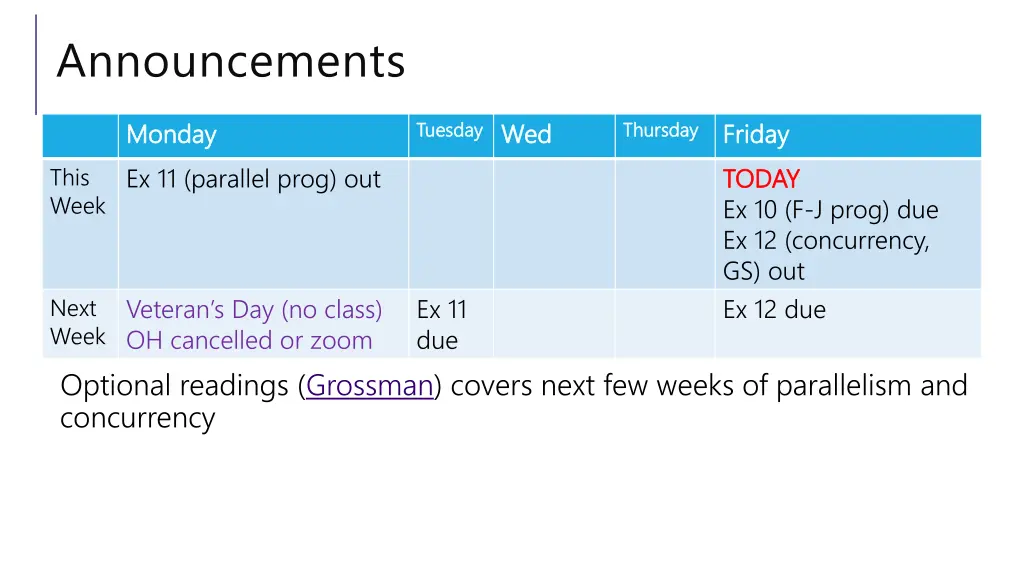
Announcements Monday Monday Ex 11 (parallel prog) out Tuesday TuesdayWed Wed Friday Friday TODAY TODAY Ex 10 (F-J prog) due Ex 12 (concurrency, GS) out Ex 12 due Thursday Thursday This Week Veteran s Day (no class) OH cancelled or zoom Ex 11 due Next Week Optional readings (Grossman) covers next few weeks of parallelism and concurrency
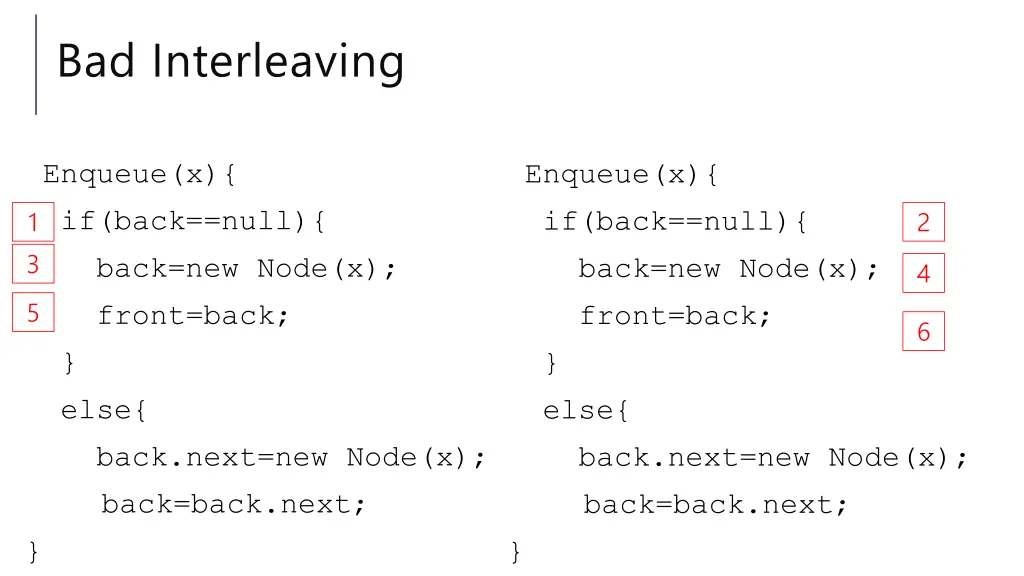
Bad Interleaving Enqueue(x){ if(back==null){ back=new Node(x); front=back; } else{ back.next=new Node(x); back=back.next; Enqueue(x){ if(back==null){ back=new Node(x); front=back; } else{ back.next=new Node(x); back=back.next; } 1 3 2 4 5 6 }
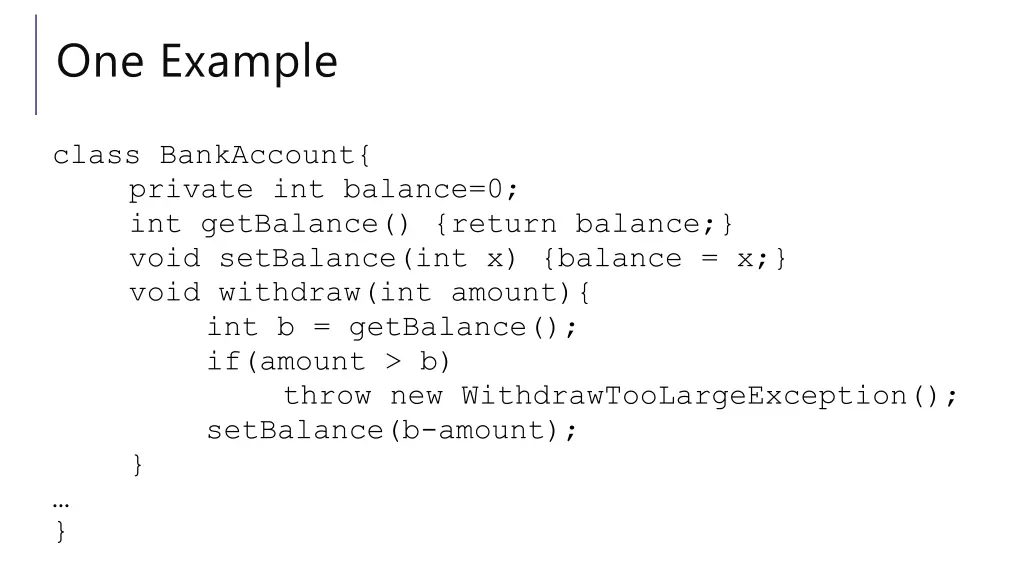
One Example class BankAccount{ private int balance=0; int getBalance() {return balance;} void setBalance(int x) {balance = x;} void withdraw(int amount){ int b = getBalance(); if(amount > b) throw new WithdrawTooLargeException(); setBalance(b-amount); } }
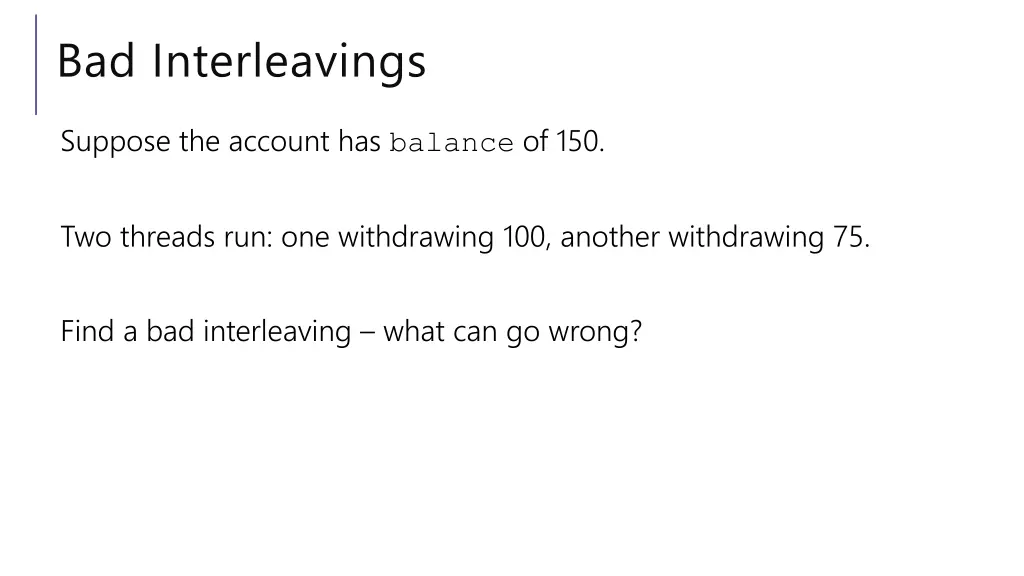
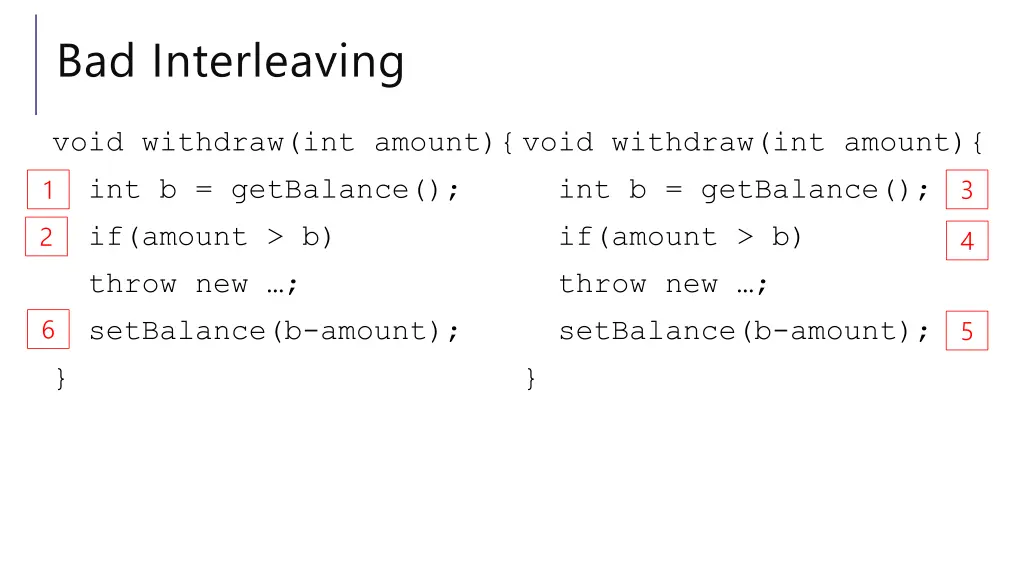
Bad Interleavings Suppose the account has balance of 150. Two threads run: one withdrawing 100, another withdrawing 75. Find a bad interleaving what can go wrong?
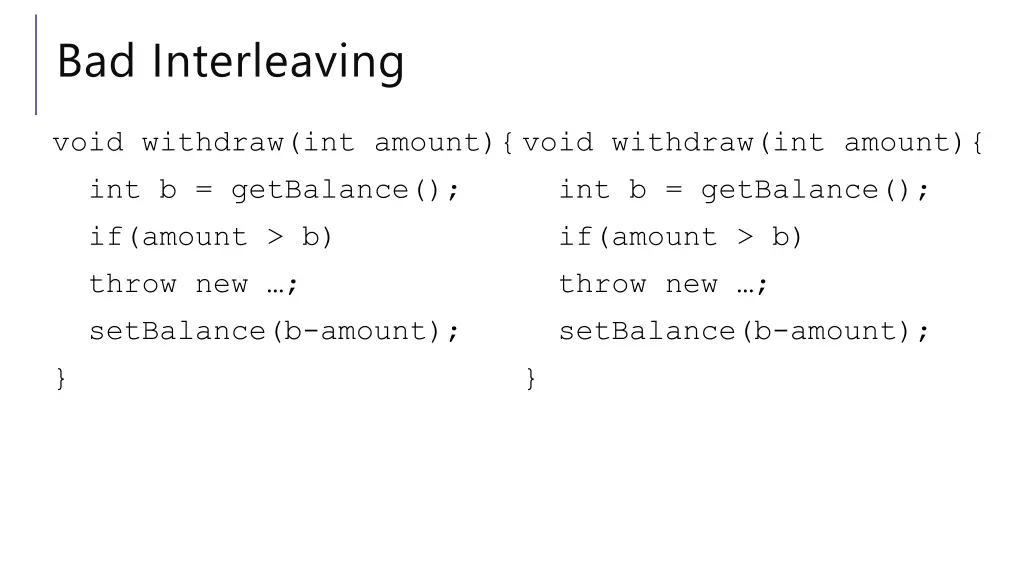
Bad Interleaving void withdraw(int amount){ int b = getBalance(); if(amount > b) throw new ; setBalance(b-amount); } void withdraw(int amount){ int b = getBalance(); if(amount > b) throw new ; setBalance(b-amount); }
Bad Interleaving void withdraw(int amount){ int b = getBalance(); if(amount > b) throw new ; setBalance(b-amount); } void withdraw(int amount){ int b = getBalance(); if(amount > b) throw new ; setBalance(b-amount); } 1 3 2 4 6 5
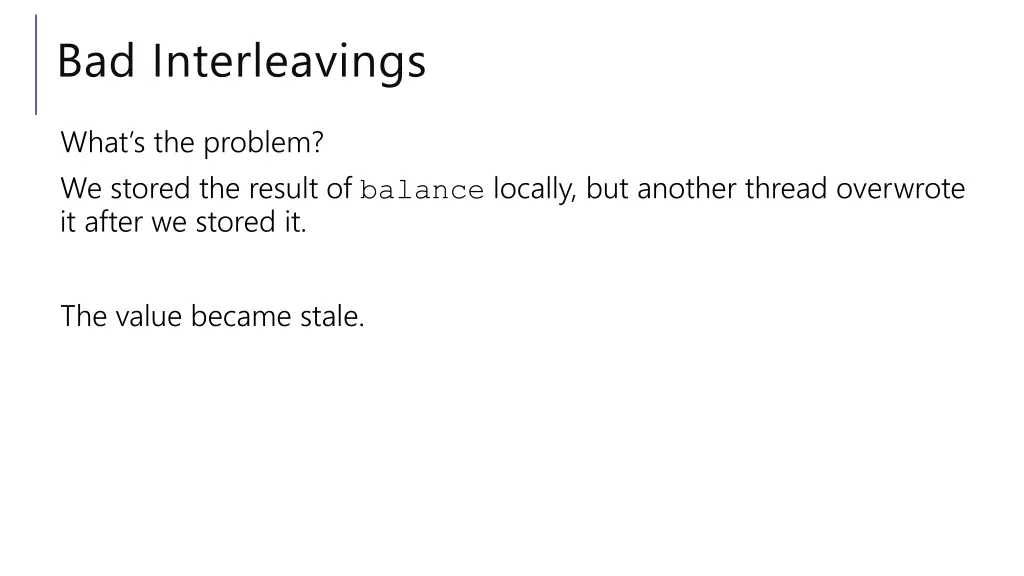
Bad Interleavings What s the problem? We stored the result of balance locally, but another thread overwrote it after we stored it. The value became stale.
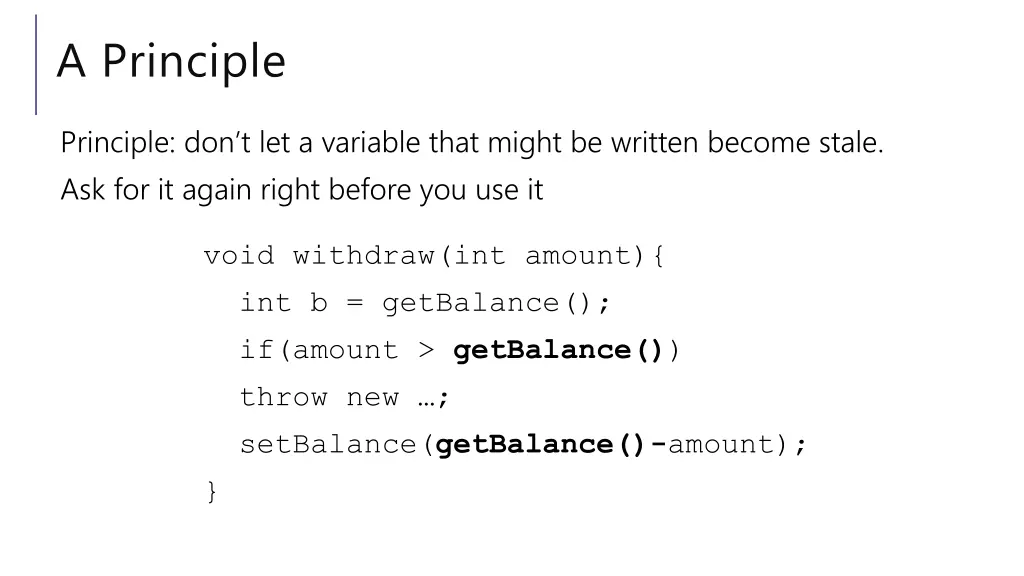
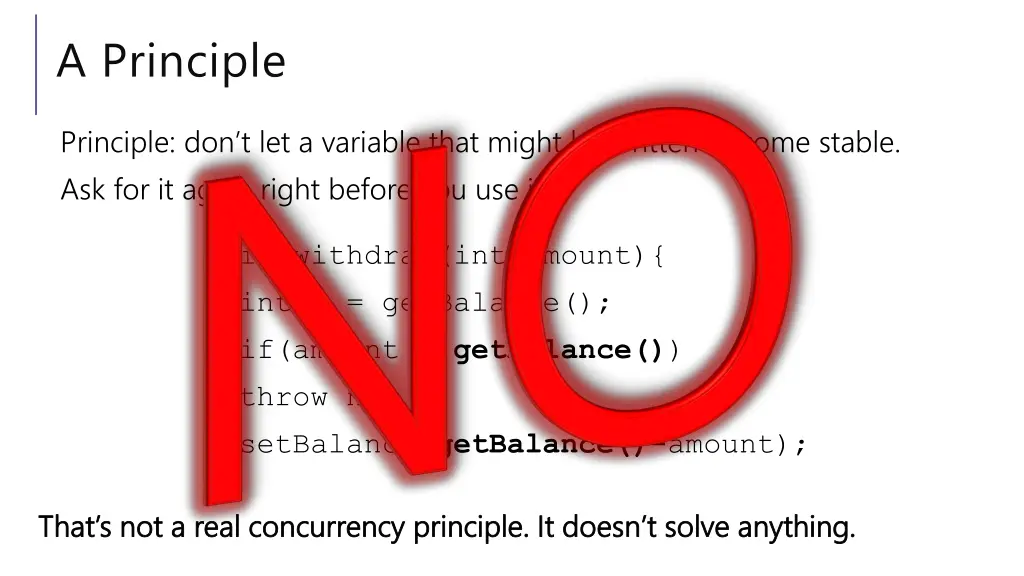
A Principle Principle: don t let a variable that might be written become stale. Ask for it again right before you use it void withdraw(int amount){ int b = getBalance(); if(amount > getBalance()) throw new ; setBalance(getBalance()-amount); }
A Principle Principle: don t let a variable that might be written become stable. Ask for it again right before you use it void withdraw(int amount){ int b = getBalance(); if(amount > getBalance()) throw new ; setBalance(getBalance()-amount); } That s not a real concurrency principle. It doesn t solve anything. That s not a real concurrency principle. It doesn t solve anything.
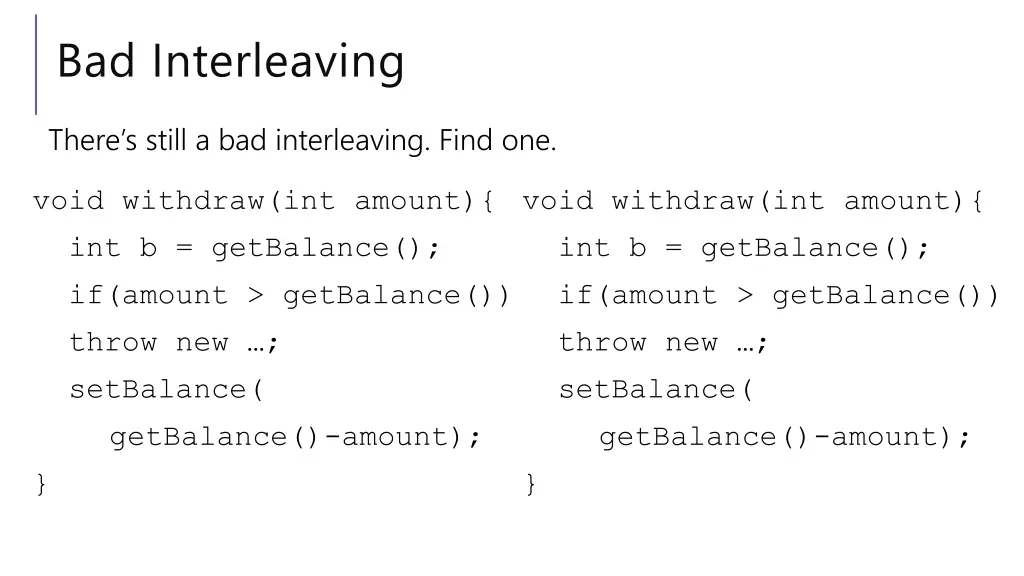
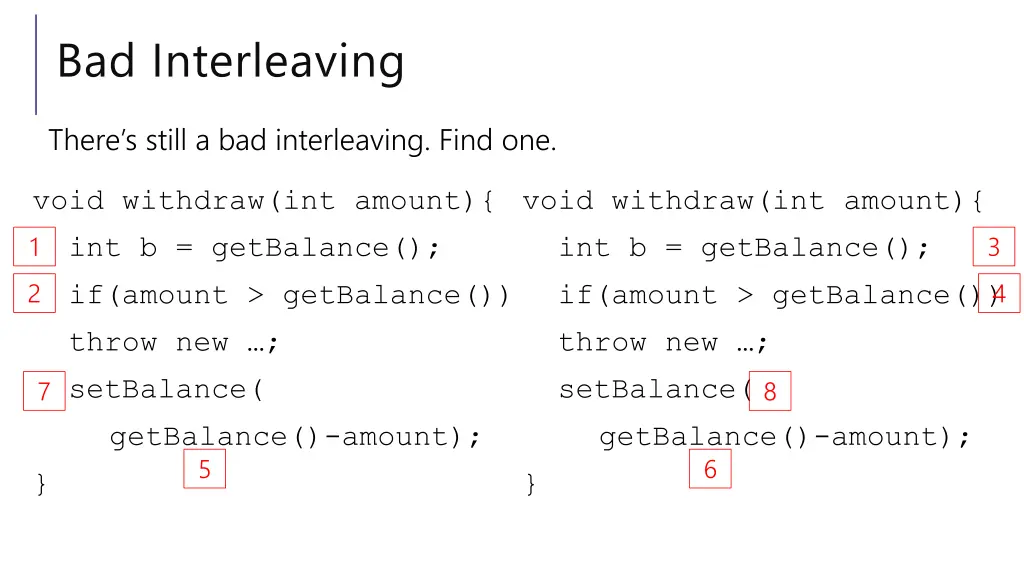
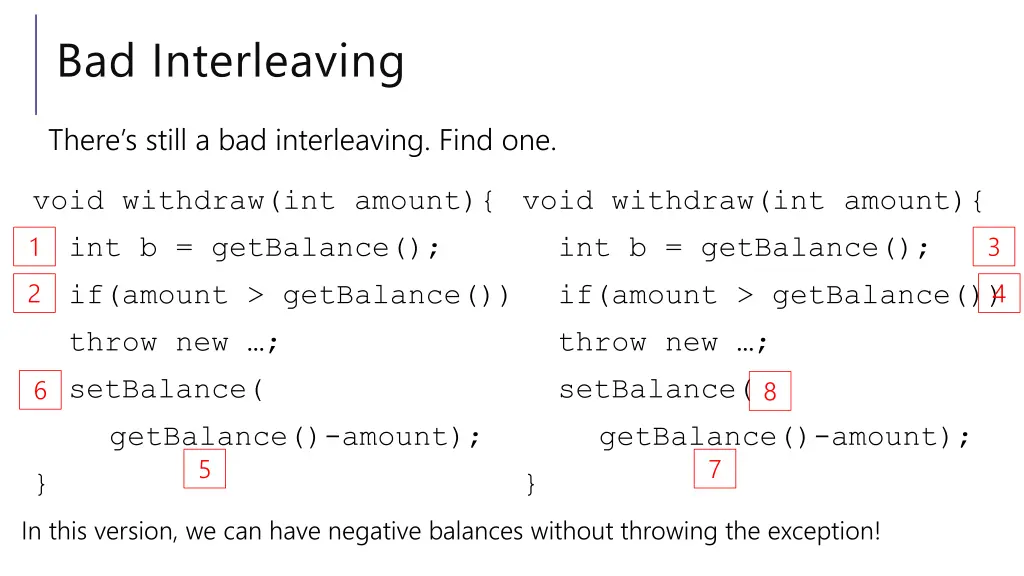
Bad Interleaving There s still a bad interleaving. Find one. void withdraw(int amount){ int b = getBalance(); if(amount > getBalance()) throw new ; setBalance( getBalance()-amount); } void withdraw(int amount){ int b = getBalance(); if(amount > getBalance()) throw new ; setBalance( getBalance()-amount); }
Bad Interleaving There s still a bad interleaving. Find one. void withdraw(int amount){ int b = getBalance(); if(amount > getBalance()) throw new ; setBalance( getBalance()-amount); } void withdraw(int amount){ int b = getBalance(); if(amount > getBalance()) throw new ; setBalance( getBalance()-amount); } 1 2 3 4 7 8 5 6
Bad Interleaving There s still a bad interleaving. Find one. void withdraw(int amount){ int b = getBalance(); if(amount > getBalance()) throw new ; setBalance( getBalance()-amount); } In this version, we can have negative balances without throwing the exception! void withdraw(int amount){ int b = getBalance(); if(amount > getBalance()) throw new ; setBalance( getBalance()-amount); } 1 2 3 4 6 8 5 7
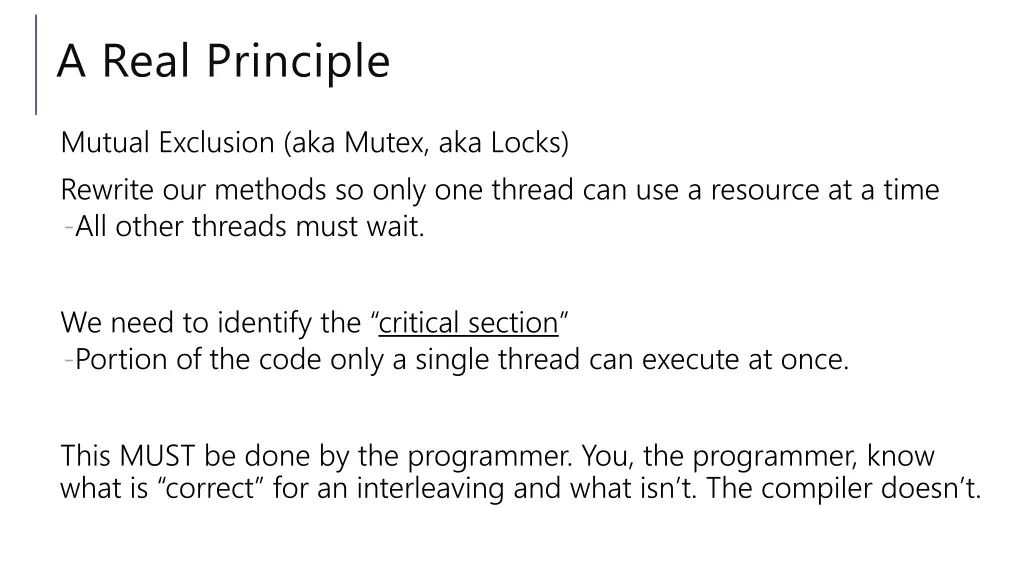
A Real Principle Mutual Exclusion (aka Mutex, aka Locks) Rewrite our methods so only one thread can use a resource at a time -All other threads must wait. We need to identify the critical section -Portion of the code only a single thread can execute at once. This MUST be done by the programmer. You, the programmer, know what is correct for an interleaving and what isn t. The compiler doesn t.
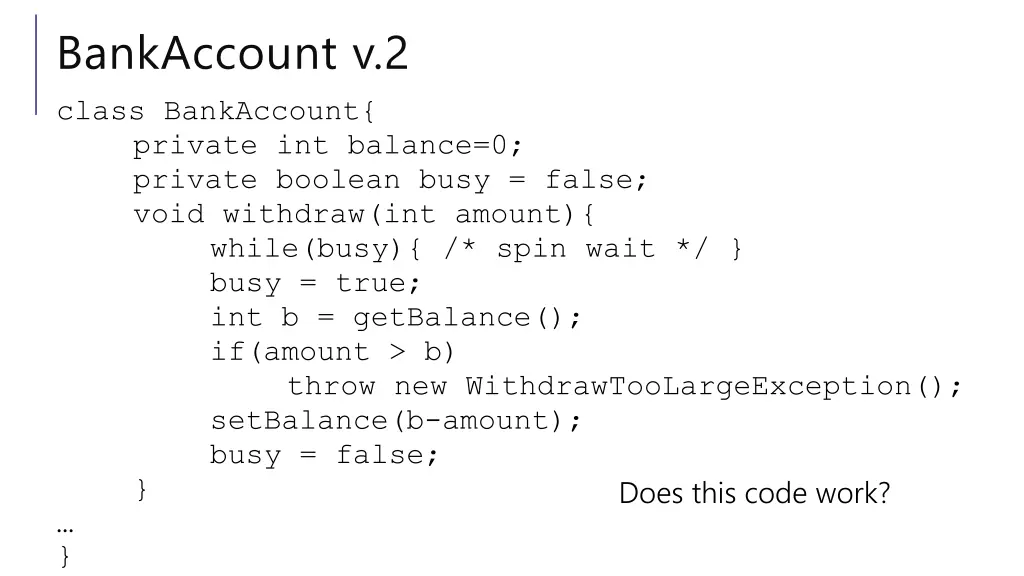
BankAccount v.2 class BankAccount{ private int balance=0; private boolean busy = false; void withdraw(int amount){ while(busy){ /* spin wait */ } busy = true; int b = getBalance(); if(amount > b) throw new WithdrawTooLargeException(); setBalance(b-amount); busy = false; } } Does this code work?
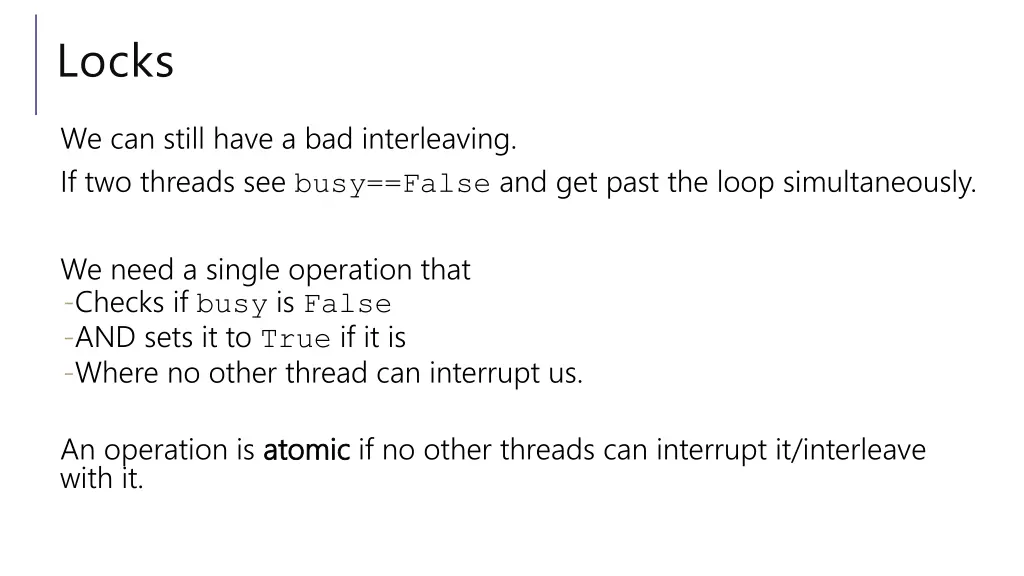
Locks We can still have a bad interleaving. If two threads see busy==False and get past the loop simultaneously. We need a single operation that -Checks if busy is False -AND sets it to True if it is -Where no other thread can interrupt us. An operation is atomic with it. atomic if no other threads can interrupt it/interleave
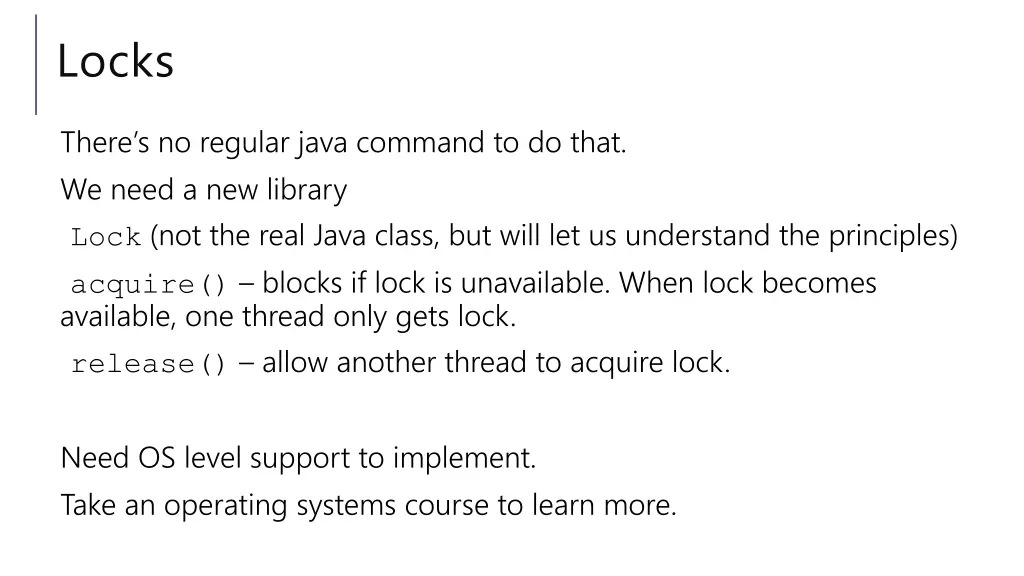
Locks There s no regular java command to do that. We need a new library Lock (not the real Java class, but will let us understand the principles) acquire() blocks if lock is unavailable. When lock becomes available, one thread only gets lock. release() allow another thread to acquire lock. Need OS level support to implement. Take an operating systems course to learn more.
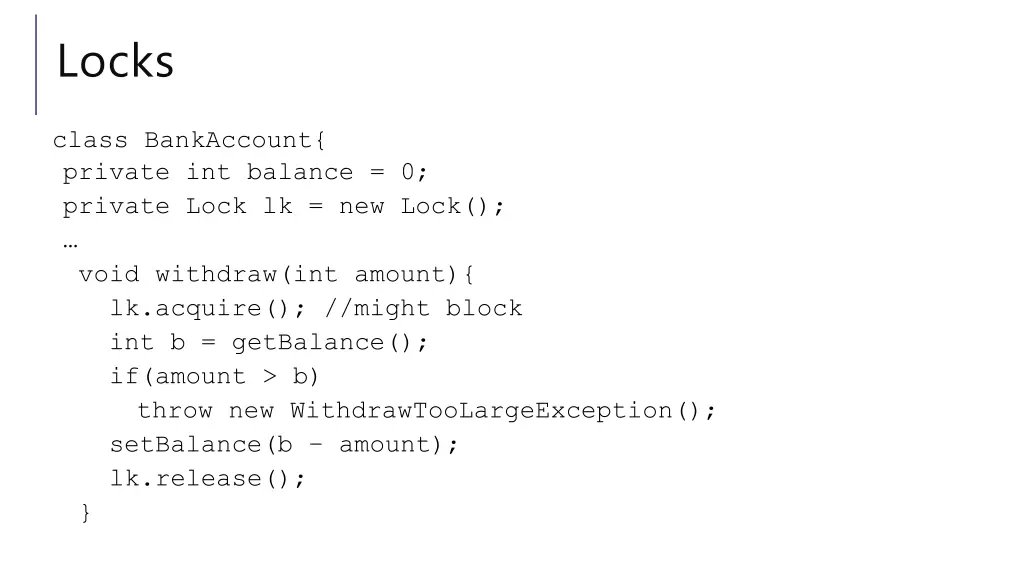
Locks class BankAccount{ private int balance = 0; private Lock lk = new Lock(); void withdraw(int amount){ lk.acquire(); //might block int b = getBalance(); if(amount > b) throw new WithdrawTooLargeException(); setBalance(b amount); lk.release(); }
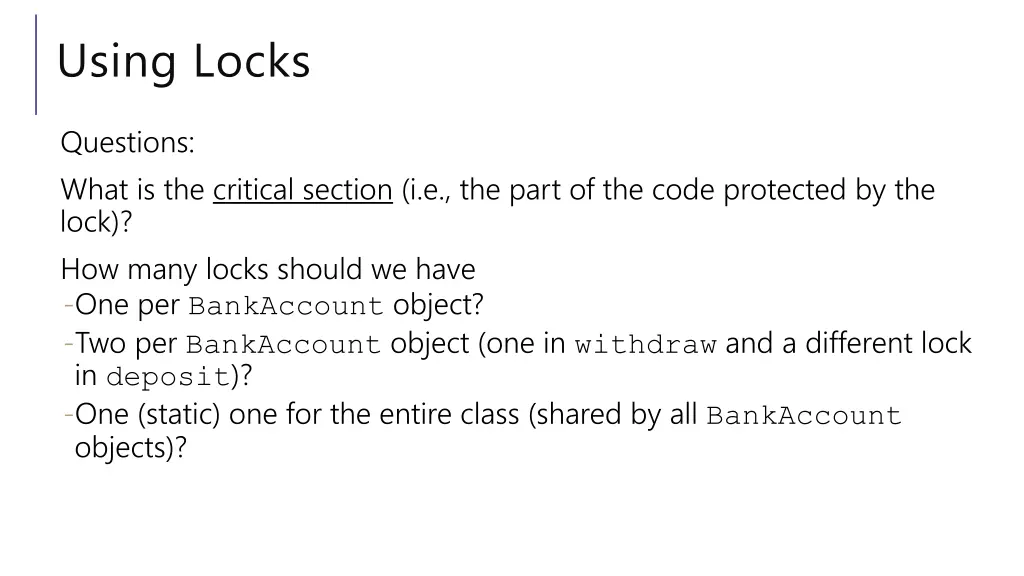
Using Locks Questions: What is the critical section (i.e., the part of the code protected by the lock)? How many locks should we have -One per BankAccount object? -Two per BankAccount object (one in withdraw and a different lock in deposit)? -One (static) one for the entire class (shared by all BankAccount objects)?
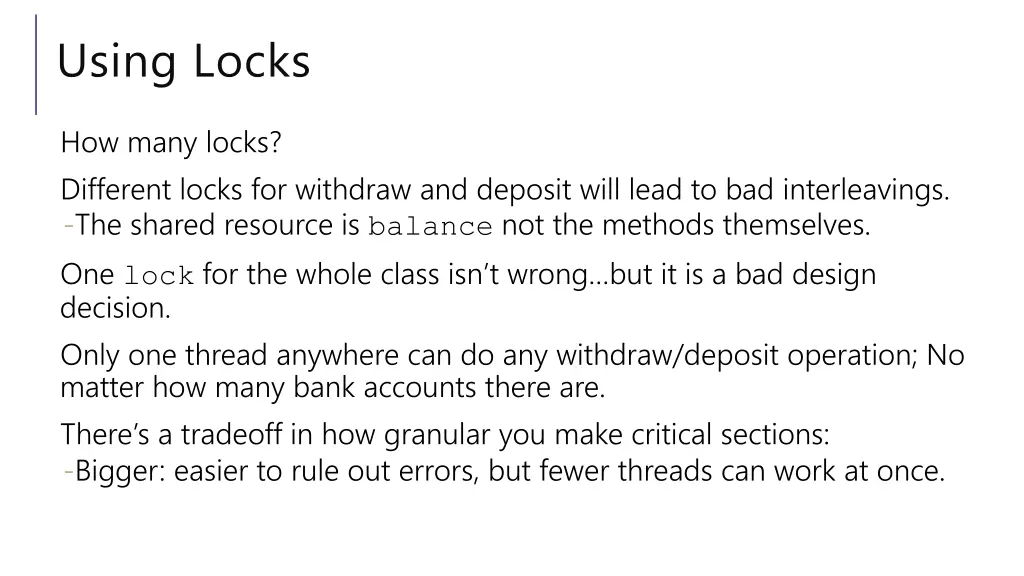
Using Locks How many locks? Different locks for withdraw and deposit will lead to bad interleavings. -The shared resource is balance not the methods themselves. One lockfor the whole class isn t wrong but it is a bad design decision. Only one thread anywhere can do any withdraw/deposit operation; No matter how many bank accounts there are. There s a tradeoff in how granular you make critical sections: -Bigger: easier to rule out errors, but fewer threads can work at once.
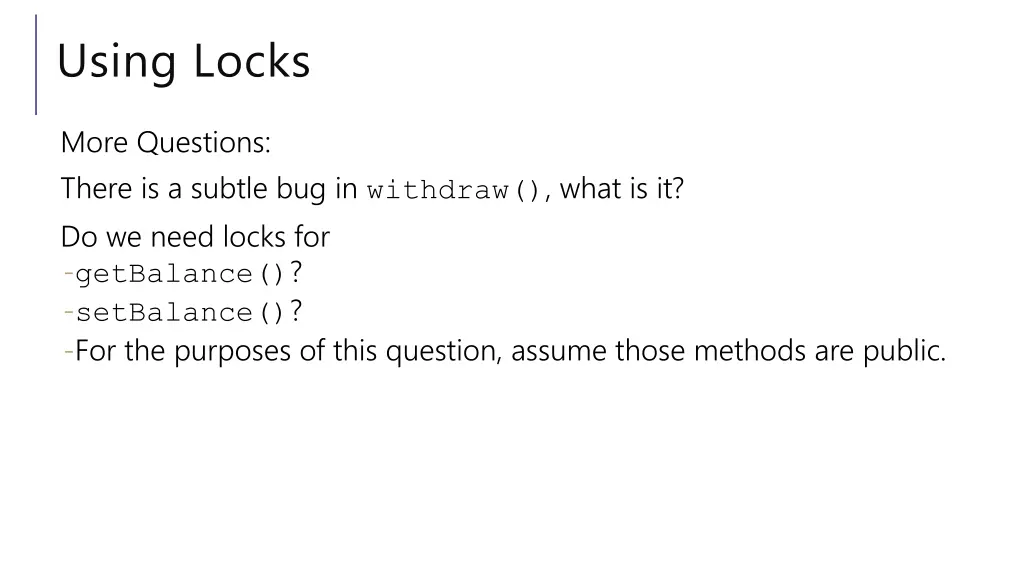
Using Locks More Questions: There is a subtle bug in withdraw(), what is it? Do we need locks for -getBalance()? -setBalance()? -For the purposes of this question, assume those methods are public.
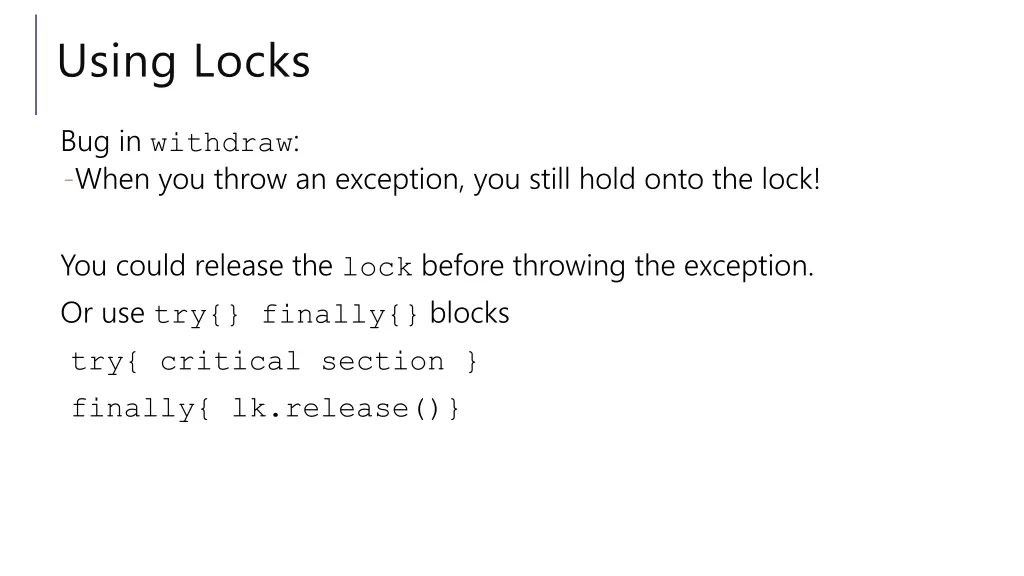
Using Locks Bug in withdraw: -When you throw an exception, you still hold onto the lock! You could release the lock before throwing the exception. Or use try{} finally{} blocks try{ critical section } finally{ lk.release()}
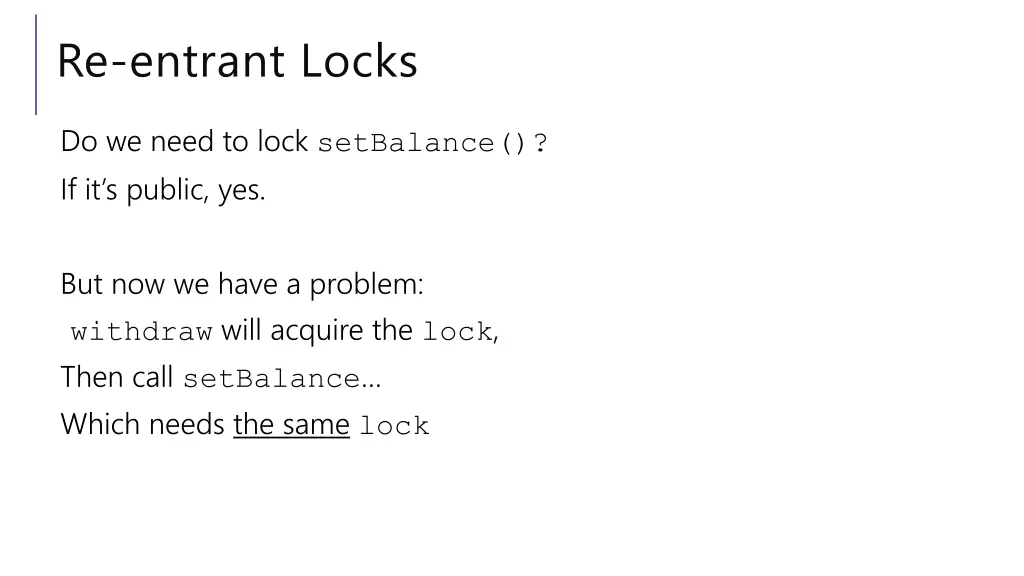
Re-entrant Locks Do we need to lock setBalance()? If it s public, yes. But now we have a problem: withdraw will acquire the lock, Then call setBalance Which needs the same lock
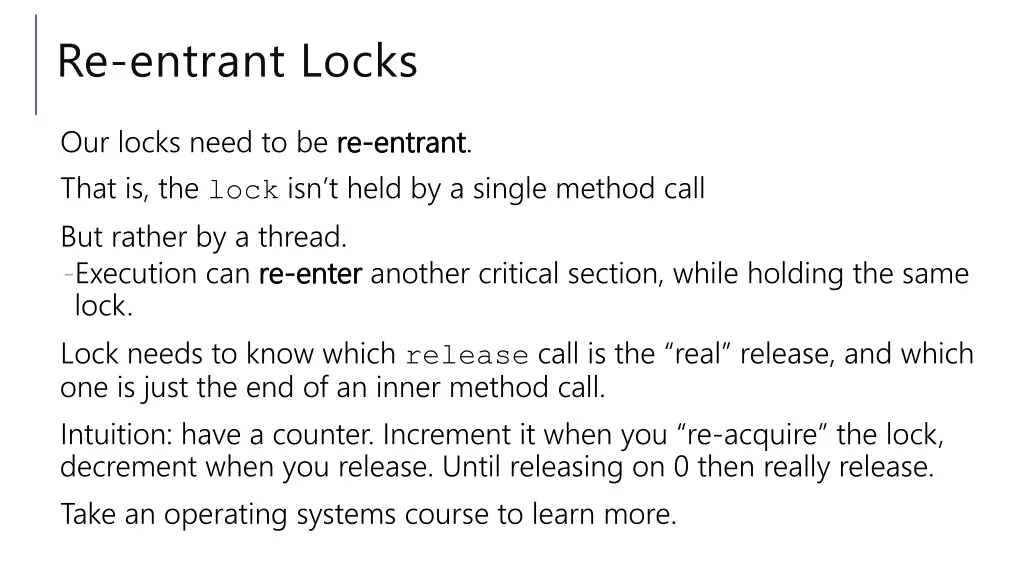
Re-entrant Locks Our locks need to be re re- -entrant That is, the lockisn t held by a single method call But rather by a thread. -Execution can re re- -enter enter another critical section, while holding the same lock. Lock needs to know which releasecall is the real release, and which one is just the end of an inner method call. Intuition: have a counter. Increment it when you re-acquire the lock, decrement when you release. Until releasing on 0 then really release. Take an operating systems course to learn more. entrant.
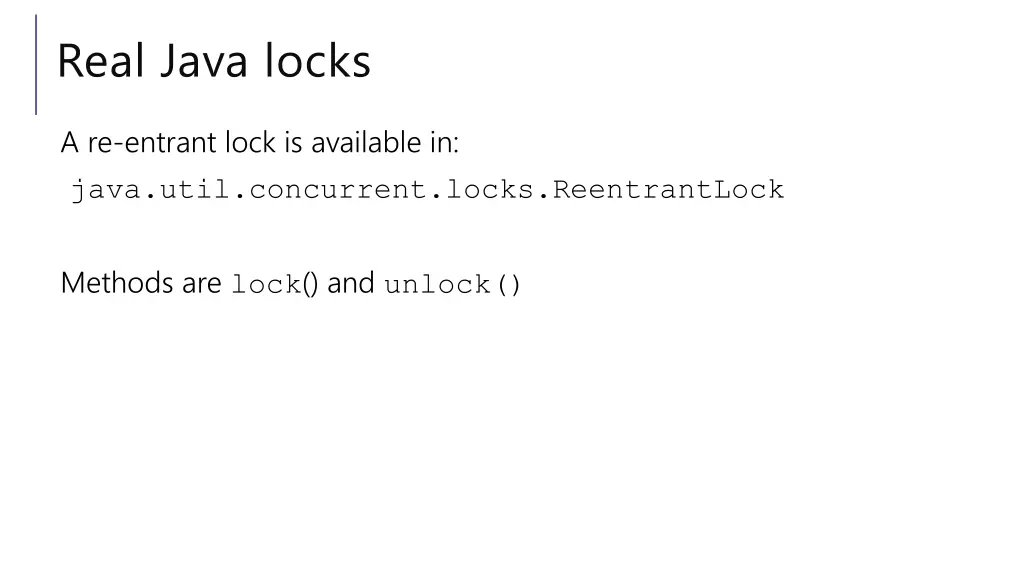
Real Java locks A re-entrant lock is available in: java.util.concurrent.locks.ReentrantLock Methods are lock() and unlock()
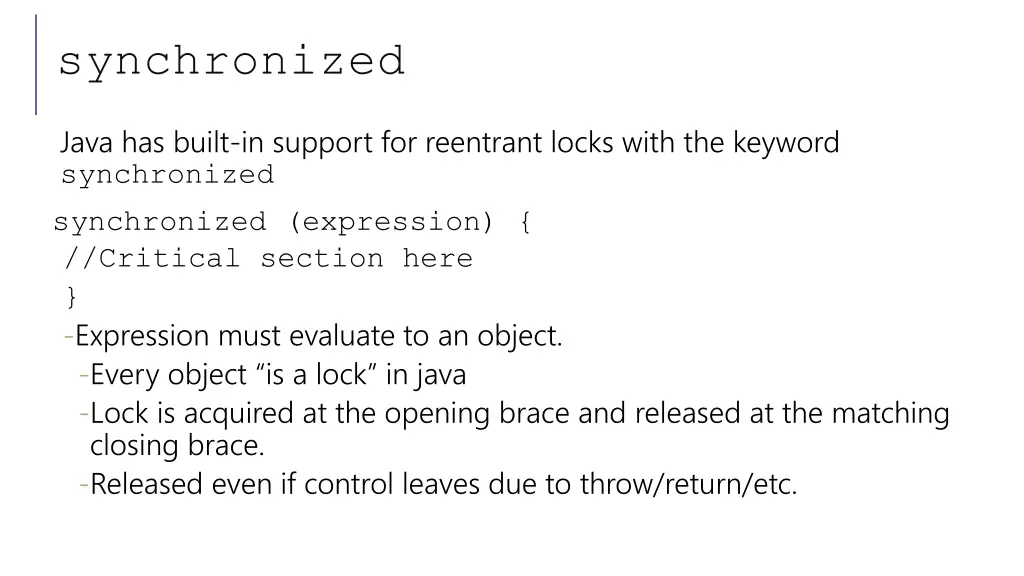
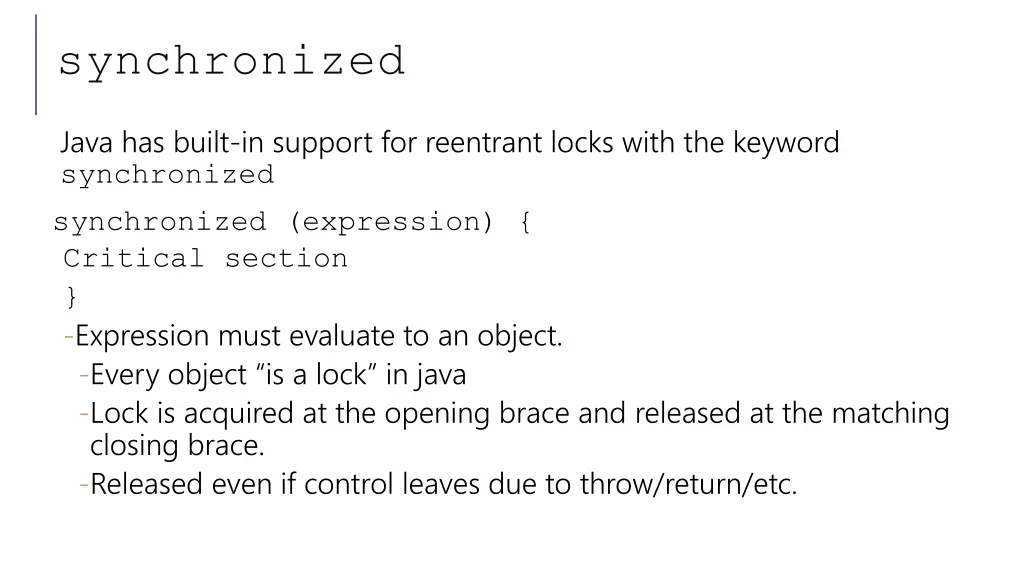
synchronized Java has built-in support for reentrant locks with the keyword synchronized synchronized (expression) { //Critical section here } -Expression must evaluate to an object. -Every object is a lock in java -Lock is acquired at the opening brace and released at the matching closing brace. -Released even if control leaves due to throw/return/etc.
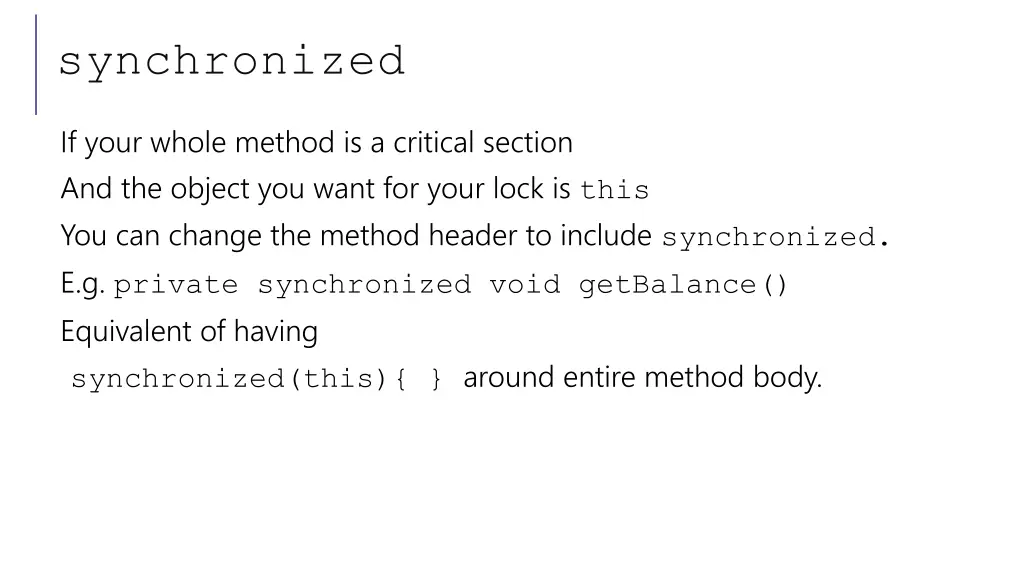
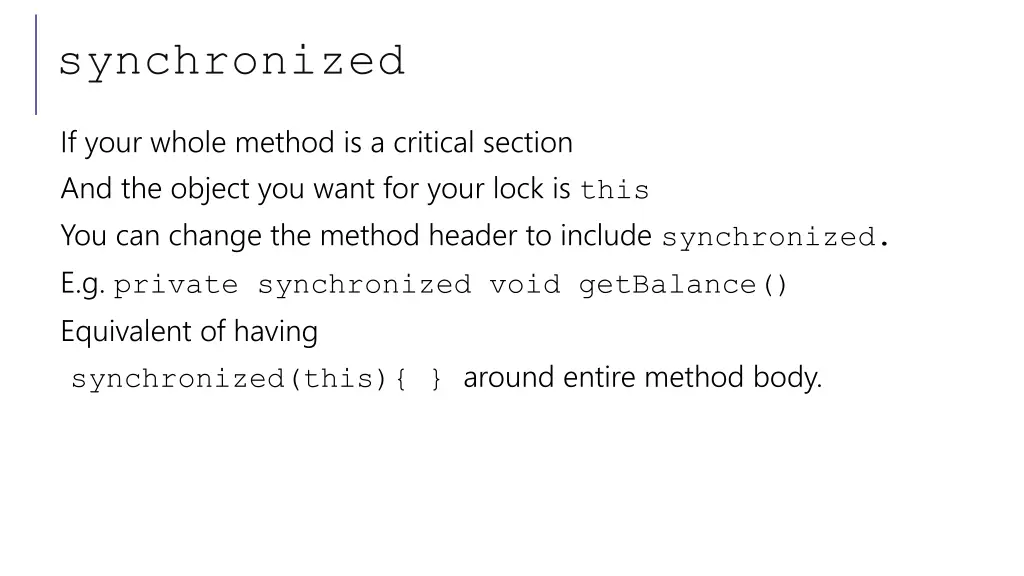
synchronized If your whole method is a critical section And the object you want for your lock is this You can change the method header to include synchronized. E.g. private synchronized void getBalance() Equivalent of having synchronized(this){ } around entire method body.
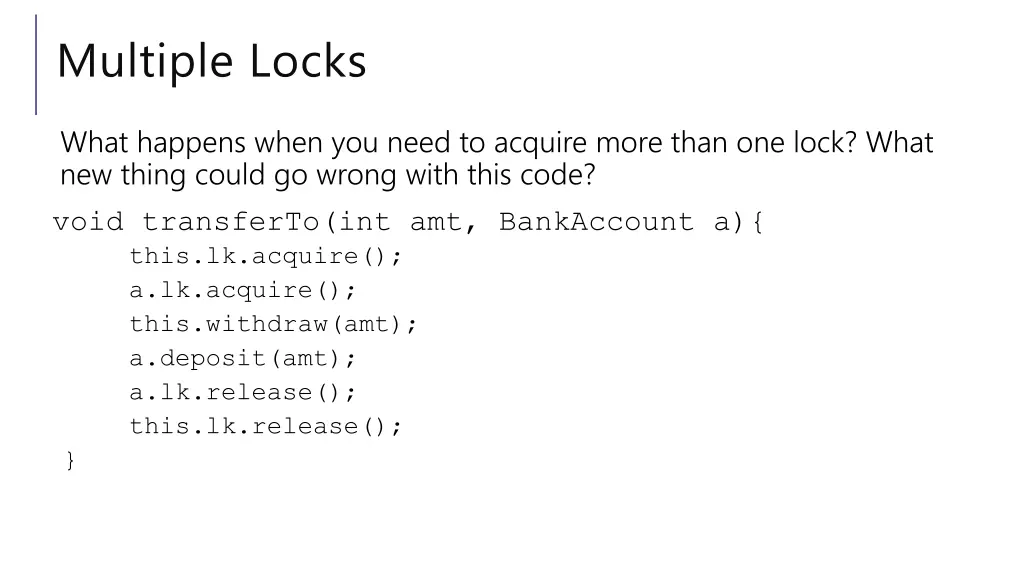
Multiple Locks What happens when you need to acquire more than one lock? What new thing could go wrong with this code? void transferTo(int amt, BankAccount a){ this.lk.acquire(); a.lk.acquire(); this.withdraw(amt); a.deposit(amt); a.lk.release(); this.lk.release(); }
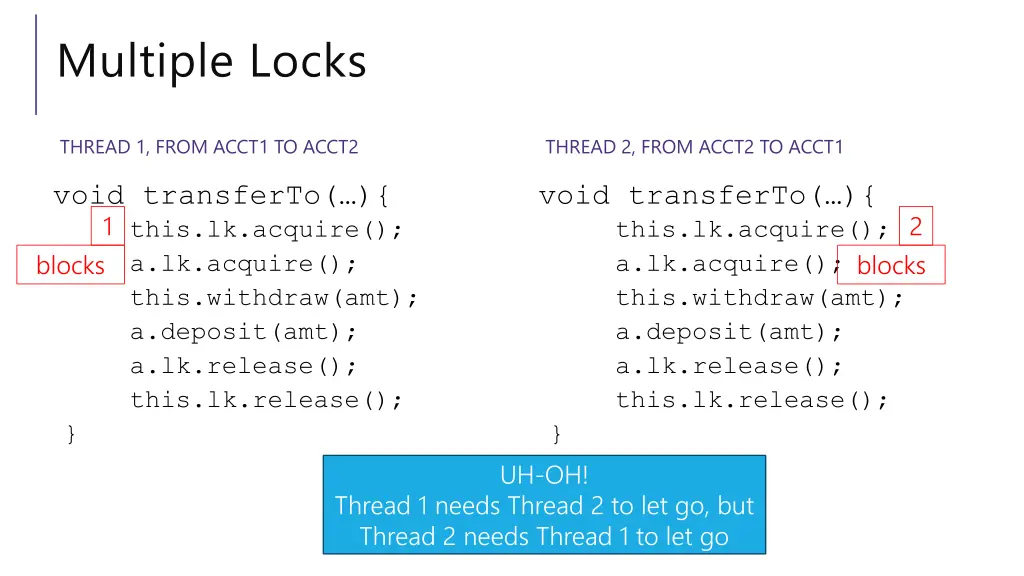
Multiple Locks THREAD 1, FROM ACCT1 TO ACCT2 THREAD 2, FROM ACCT2 TO ACCT1 void transferTo( ){ this.lk.acquire(); a.lk.acquire(); this.withdraw(amt); a.deposit(amt); a.lk.release(); this.lk.release(); } void transferTo( ){ this.lk.acquire(); a.lk.acquire(); this.withdraw(amt); a.deposit(amt); a.lk.release(); this.lk.release(); } UH-OH! Thread 1 needs Thread 2 to let go, but Thread 2 needs Thread 1 to let go 1 2 blocks blocks
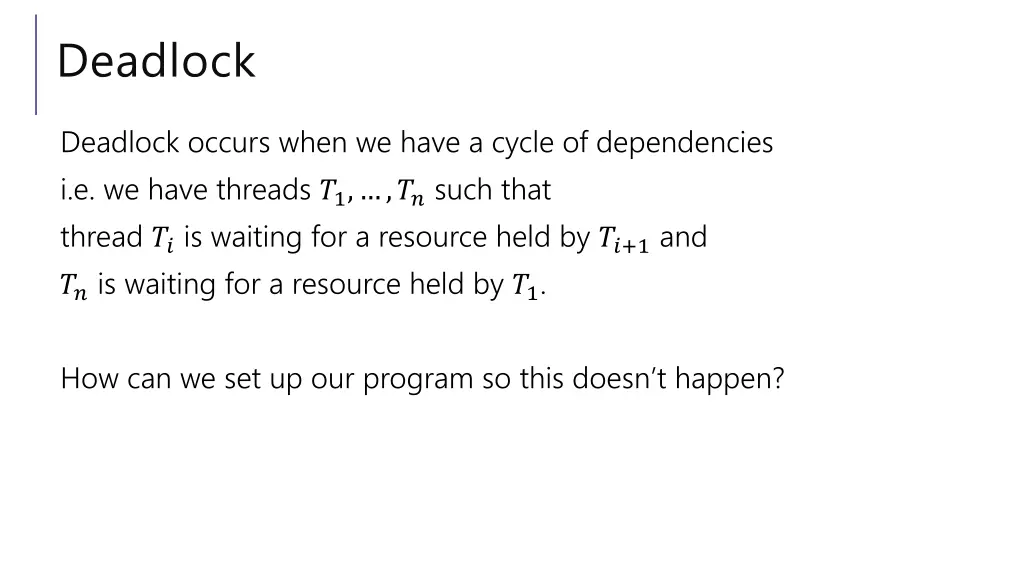
Deadlock Deadlock occurs when we have a cycle of dependencies i.e. we have threads ?1, ,?? such that thread ?? is waiting for a resource held by ??+1 and ?? is waiting for a resource held by ?1. How can we set up our program so this doesn t happen?
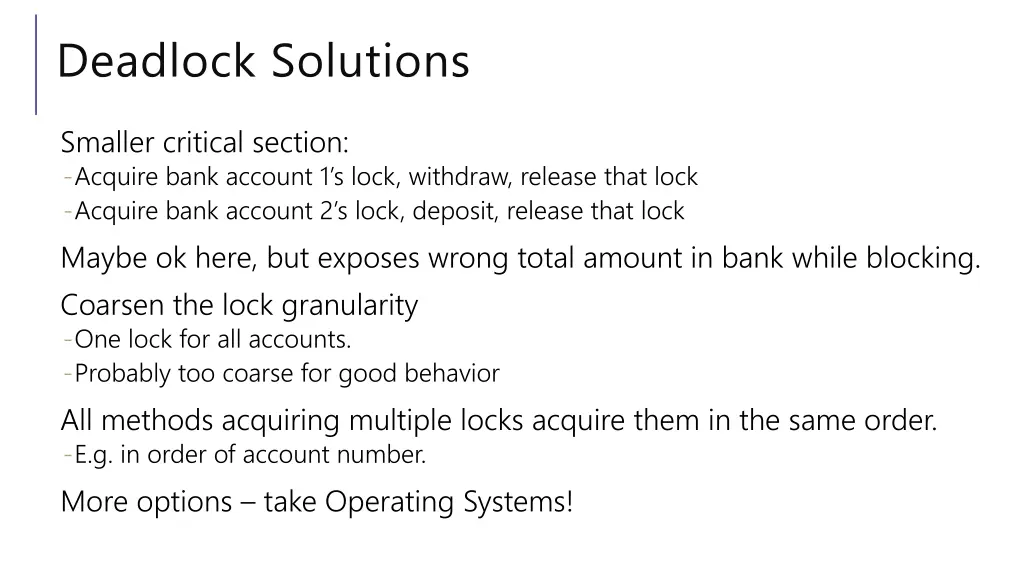
Deadlock Solutions Smaller critical section: -Acquire bank account 1 s lock, withdraw, release that lock -Acquire bank account 2 s lock, deposit, release that lock Maybe ok here, but exposes wrong total amount in bank while blocking. Coarsen the lock granularity -One lock for all accounts. -Probably too coarse for good behavior All methods acquiring multiple locks acquire them in the same order. -E.g. in order of account number. More options take Operating Systems!
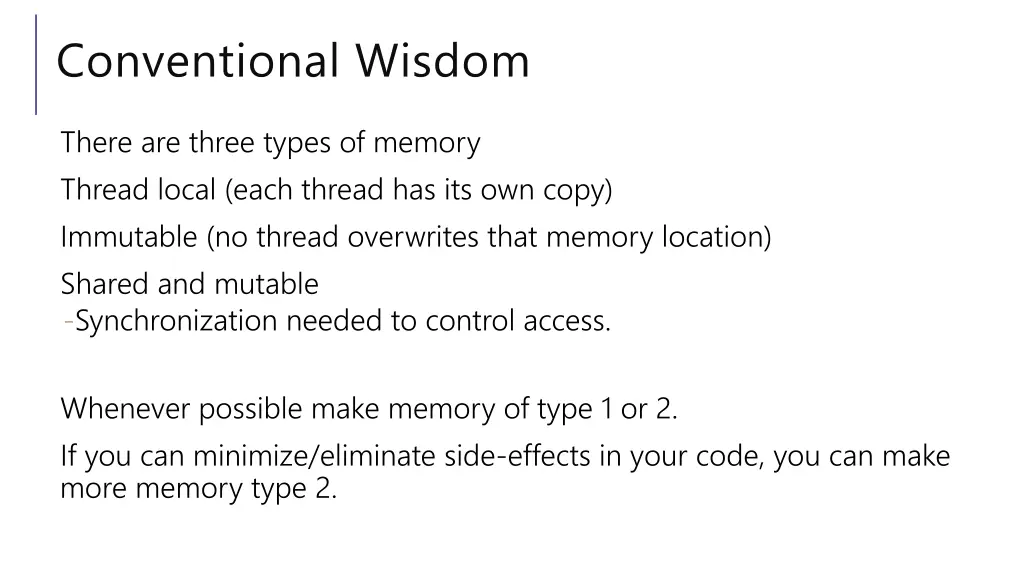
Conventional Wisdom There are three types of memory Thread local (each thread has its own copy) Immutable (no thread overwrites that memory location) Shared and mutable -Synchronization needed to control access. Whenever possible make memory of type 1 or 2. If you can minimize/eliminate side-effects in your code, you can make more memory type 2.
Conventional Wisdom Consistent locking: Every location that reads or writes a shared resource has a lock. Even if you can t think of a bad interleaving, better safe than sorry. When deciding how big to make a critical section: Start coarse grained, and move finer if you really need to improve performance.
Conventional Wisdom Avoid expensive computations or I/O in critical sections. If possible release the lock, do the long computation, and reacquire the lock. Just make sure you haven t introduced a race condition. Think in terms of what operations need to be atomic. i.e. consider atomicity first, then think about where the locks go.
Conventional Wisdom Don t write your own. There s probably a library that does what you need. Use it. There are thread-safe libraries like ConcurrentHashMap. No need to do it yourself when experts already did it -and probably did it better.
Real Java locks A re-entrant lock is available in java.util java.util.concurrent.locks.ReentrantLock Methods are lock() and unlock()
synchronized Java has built-in support for reentrant locks with the keyword synchronized synchronized (expression) { Critical section } -Expression must evaluate to an object. -Every object is a lock in java -Lock is acquired at the opening brace and released at the matching closing brace. -Released even if control leaves due to throw/return/etc.
synchronized If your whole method is a critical section And the object you want for your lock is this You can change the method header to include synchronized. E.g. private synchronized void getBalance() Equivalent of having synchronized(this){ } around entire method body.
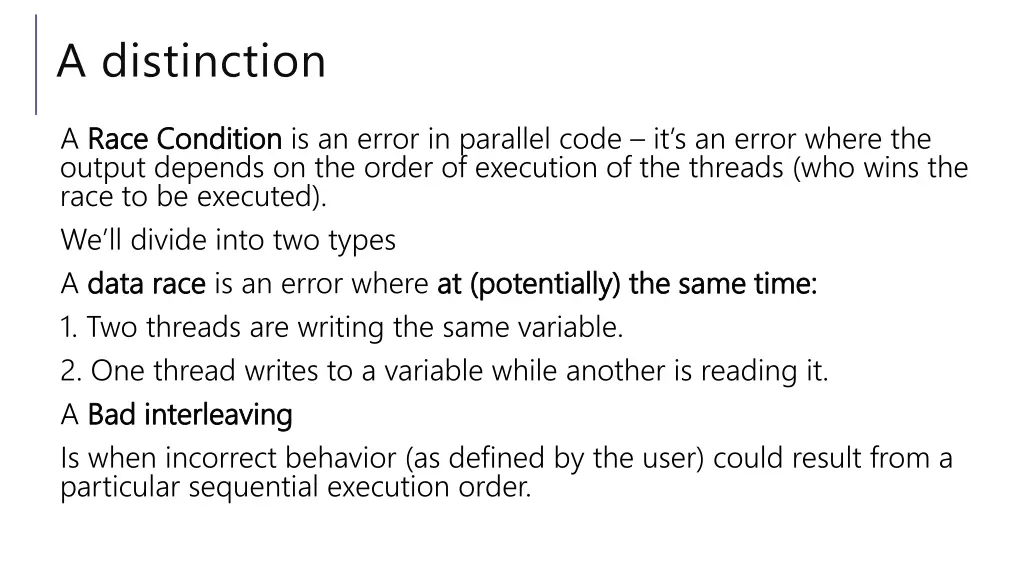
A distinction A Race Condition Race Condition is an error in parallel code it s an error where the output depends on the order of execution of the threads (who wins the race to be executed). We ll divide into two types A data race data race is an error where at (potentially) the same time: at (potentially) the same time: 1. Two threads are writing the same variable. 2. One thread writes to a variable while another is reading it. A Bad interleaving Bad interleaving Is when incorrect behavior (as defined by the user) could result from a particular sequential execution order.
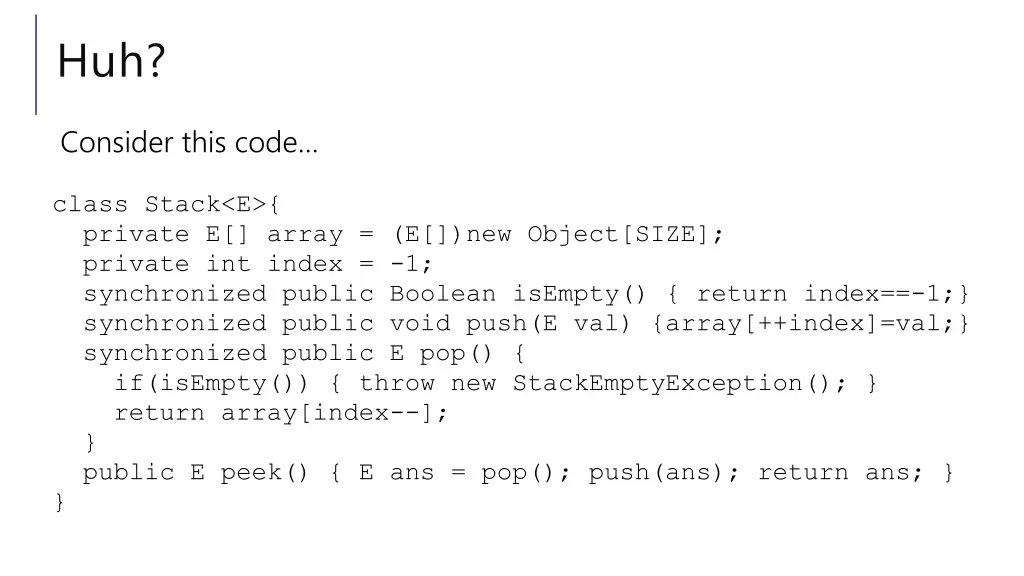
Huh? Consider this code class Stack<E>{ private E[] array = (E[])new Object[SIZE]; private int index = -1; synchronized public Boolean isEmpty() { return index==-1;} synchronized public void push(E val) {array[++index]=val;} synchronized public E pop() { if(isEmpty()) { throw new StackEmptyException(); } return array[index--]; } public E peek() { E ans = pop(); push(ans); return ans; } }
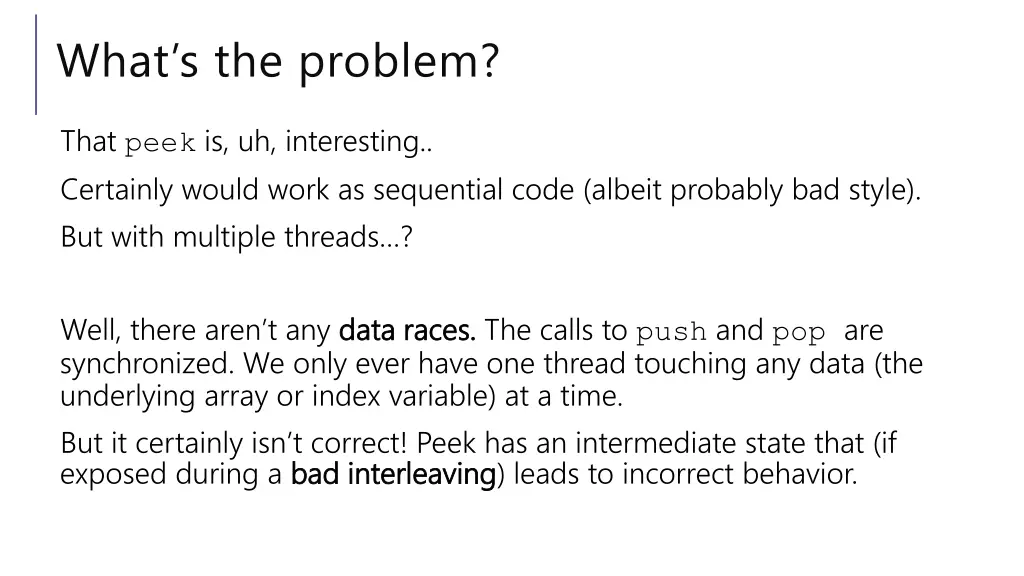
Whats the problem? That peek is, uh, interesting.. Certainly would work as sequential code (albeit probably bad style). But with multiple threads ? Well, there aren t any data races. synchronized. We only ever have one thread touching any data (the underlying array or index variable) at a time. But it certainly isn t correct! Peek has an intermediate state that (if exposed during a bad interleaving bad interleaving) leads to incorrect behavior. data races. The calls to push and pop are
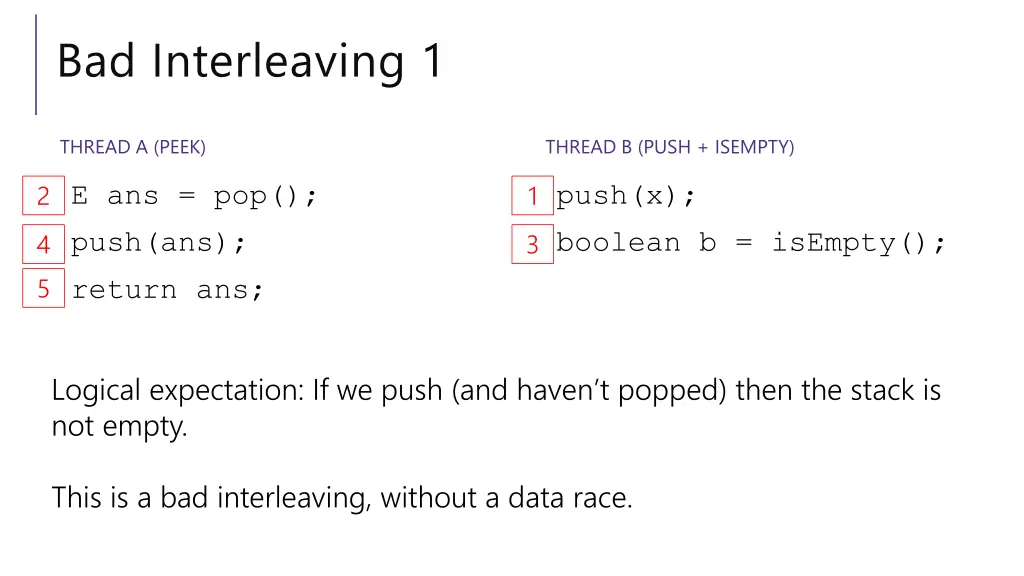
Bad Interleaving 1 THREAD A (PEEK) THREAD B (PUSH + ISEMPTY) 2 1 E ans = pop(); push(ans); return ans; push(x); boolean b = isEmpty(); 4 5 3 Logical expectation: If we push (and haven t popped) then the stack is not empty. This is a bad interleaving, without a data race.
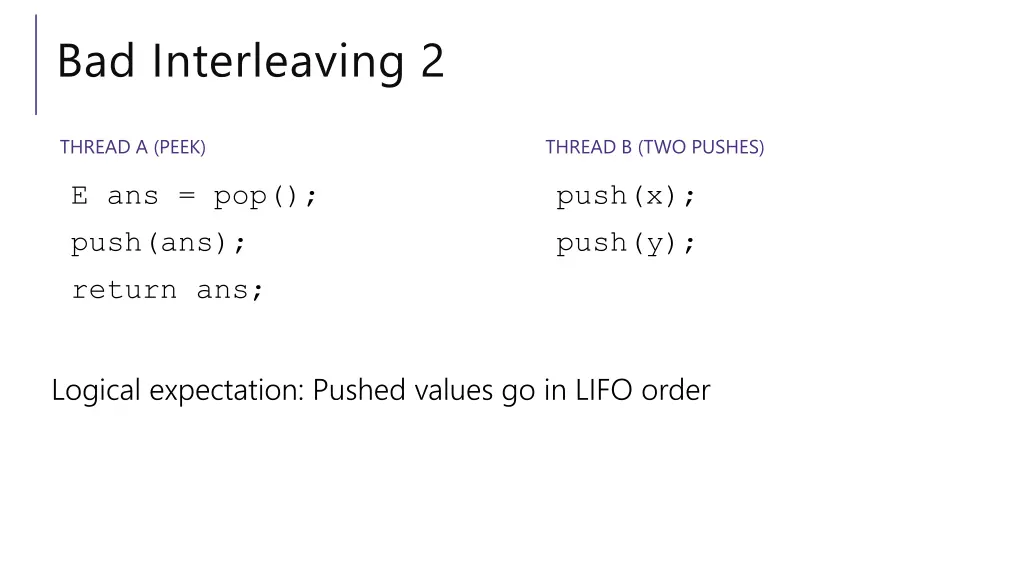
Bad Interleaving 2 THREAD A (PEEK) THREAD B (TWO PUSHES) E ans = pop(); push(ans); return ans; push(x); push(y); Logical expectation: Pushed values go in LIFO order
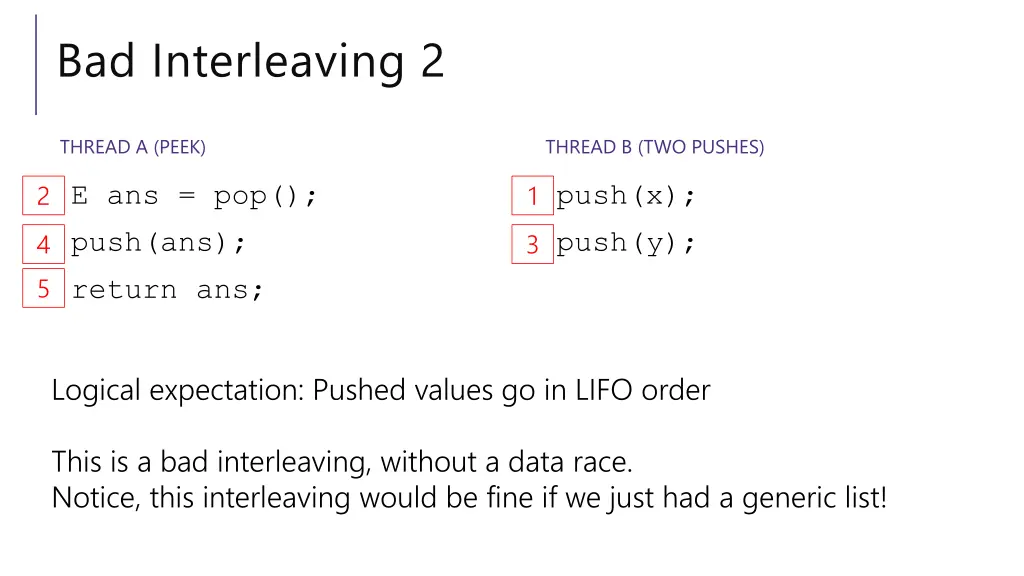
Bad Interleaving 2 THREAD A (PEEK) THREAD B (TWO PUSHES) 2 1 E ans = pop(); push(ans); return ans; push(x); push(y); 3 4 5 Logical expectation: Pushed values go in LIFO order This is a bad interleaving, without a data race. Notice, this interleaving would be fine if we just had a generic list!
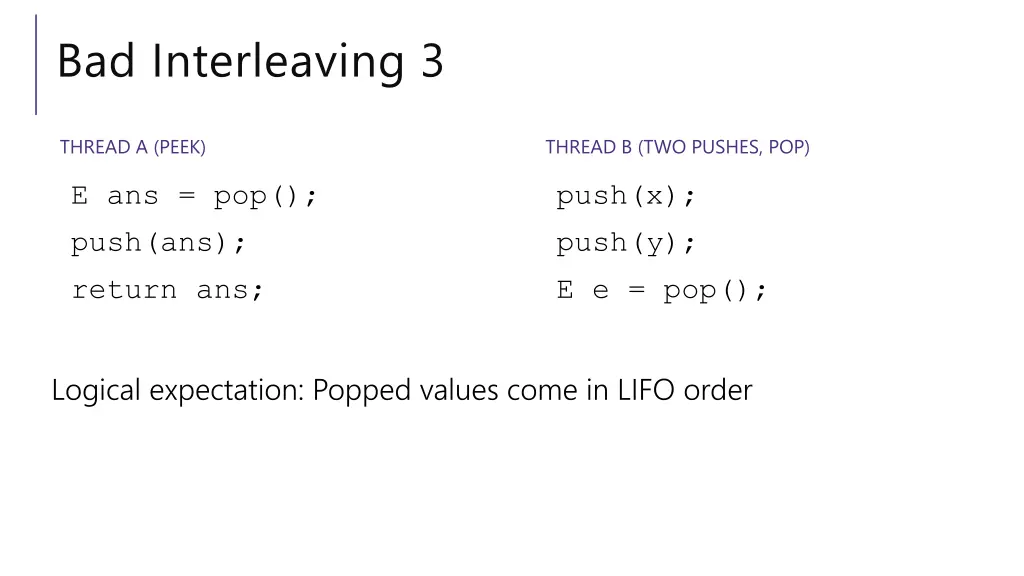
Bad Interleaving 3 THREAD A (PEEK) THREAD B (TWO PUSHES, POP) E ans = pop(); push(ans); return ans; push(x); push(y); E e = pop(); Logical expectation: Popped values come in LIFO order