Conditionals in Programming for CSE Students
Explore the concept of conditionals in programming through the lens of CSE 121 Lesson 9. Understand the execution of blocks of code based on various conditions being met or not. Dive into examples and practical applications to enhance your programming skills.

Download Presentation

Please find below an Image/Link to download the presentation.
The content on the website is provided AS IS for your information and personal use only. It may not be sold, licensed, or shared on other websites without obtaining consent from the author. If you encounter any issues during the download, it is possible that the publisher has removed the file from their server.
You are allowed to download the files provided on this website for personal or commercial use, subject to the condition that they are used lawfully. All files are the property of their respective owners.
The content on the website is provided AS IS for your information and personal use only. It may not be sold, licensed, or shared on other websites without obtaining consent from the author.
E N D
Presentation Transcript
CSE 121 Lesson 9: Conditionals Matt Wang Spring 2024 Andy Anju Archit Arkita Autumn Christian TAs: Hannah H Hannah S Heather Hibbah Janvi Jessie Jonus Julia Luke Maria Mia Ritesh Shayna Simon Trey Vidhi Vivian Gumball? sli.do #cse121-9 Today s playlist: CSE 121 lecture beats 24sp
Announcements, Reminders Creative Project 2 released, due Thursday May 2nd Note: uses Javadoc! R2 out yesterday, due Thursday May 2nd Note: this is the last time C0 is eligible for resubmission! Mid-Quarter Formative Feedback with Ken Yasuhara for part of class on Wednesday, May 1st IPL tips! Lesson 9 - Spring 2024 2
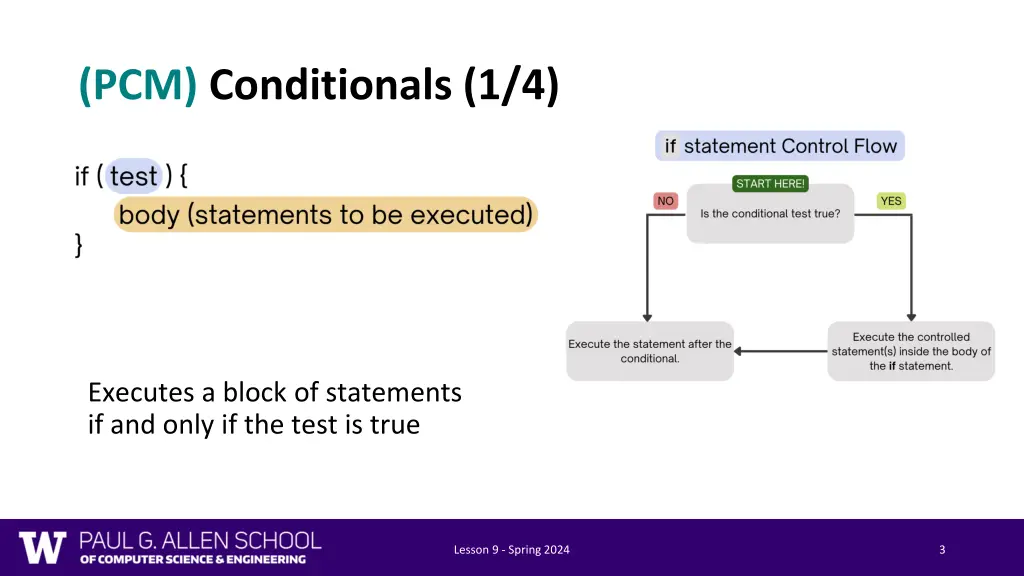
(PCM) Conditionals (1/4) Executes a block of statements if and only if the test is true Lesson 9 - Spring 2024 3
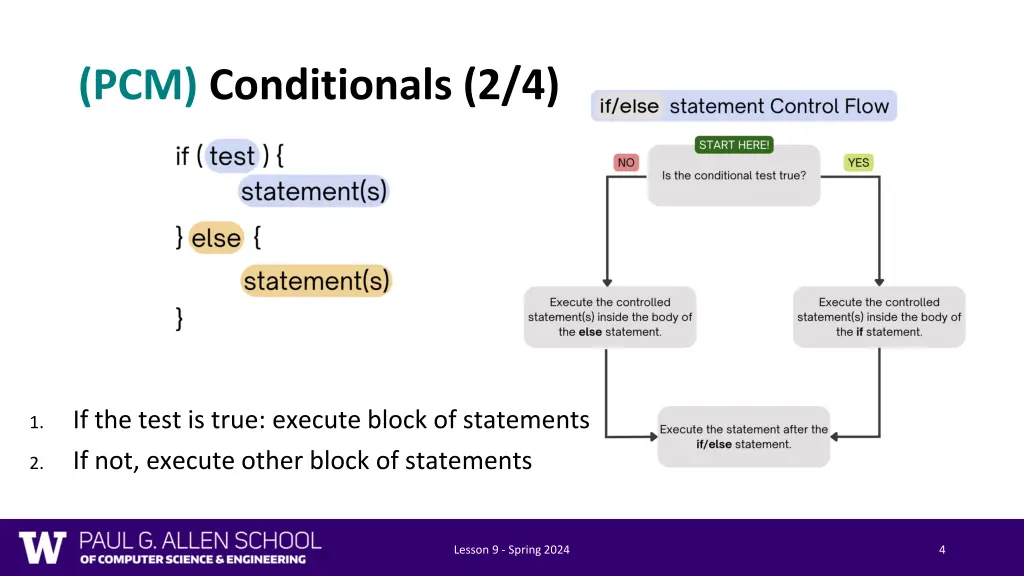
(PCM) Conditionals (2/4) If the test is true: execute block of statements If not, execute other block of statements 1. 2. Lesson 9 - Spring 2024 4
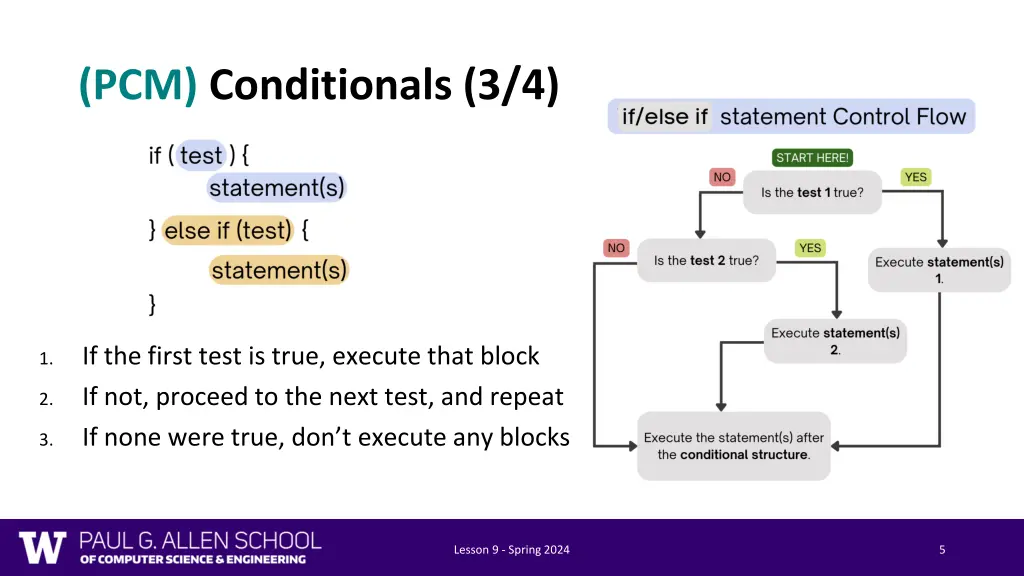
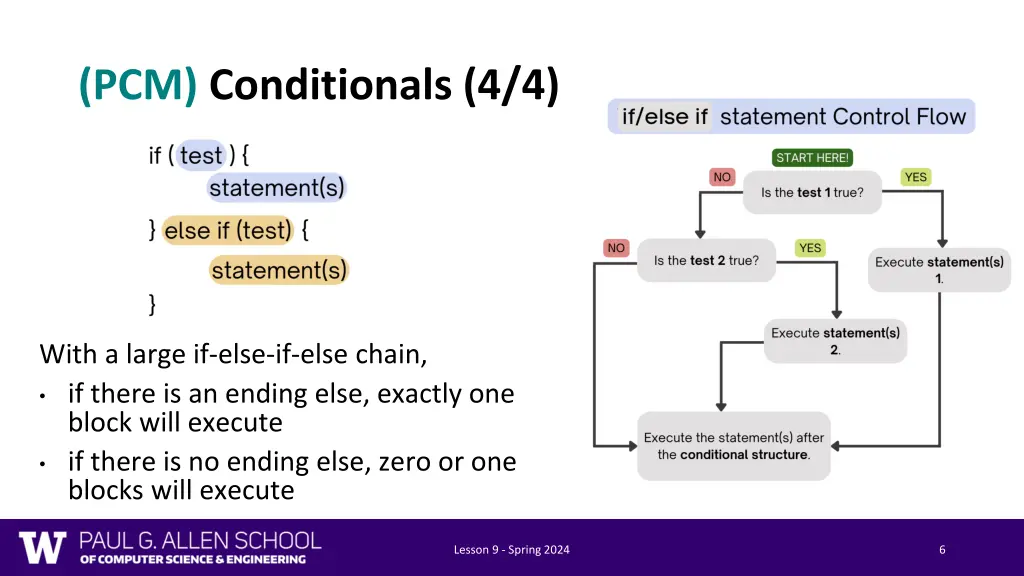
(PCM) Conditionals (3/4) If the first test is true, execute that block If not, proceed to the next test, and repeat If none were true, don t execute any blocks 1. 2. 3. Lesson 9 - Spring 2024 5
(PCM) Conditionals (4/4) With a large if-else-if-else chain, if there is an ending else, exactly one block will execute if there is no ending else, zero or one blocks will execute Lesson 9 - Spring 2024 6
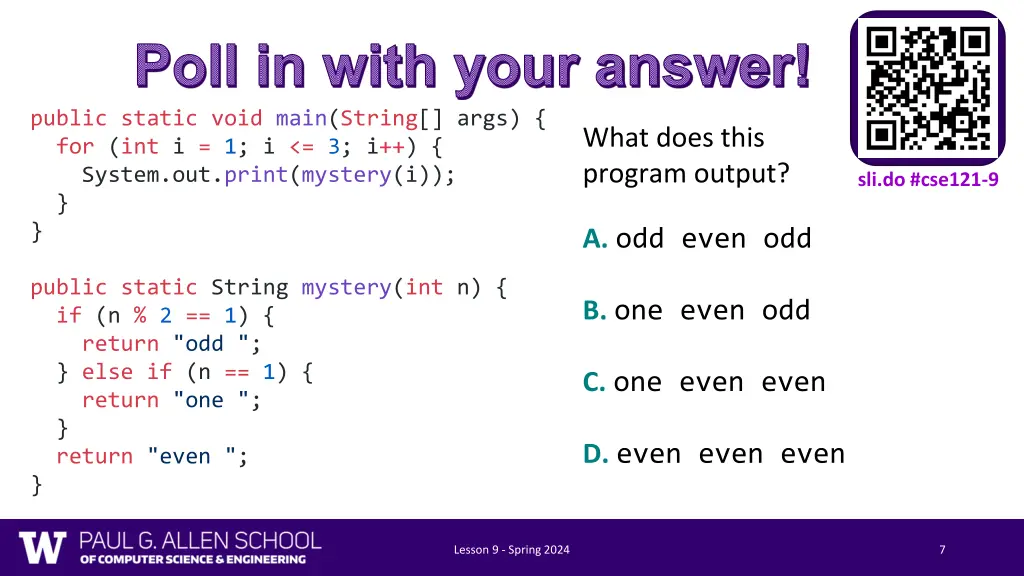
Poll in with your answer! public static void main(String[] args) { for (int i = 1; i <= 3; i++) { System.out.print(mystery(i)); } } What does this program output? sli.do #cse121-9 A. odd even odd public static String mystery(int n) { if (n % 2 == 1) { return "odd "; } else if (n == 1) { return "one "; } return "even "; } B. one even odd C. one even even D. even even even Lesson 9 - Spring 2024 7
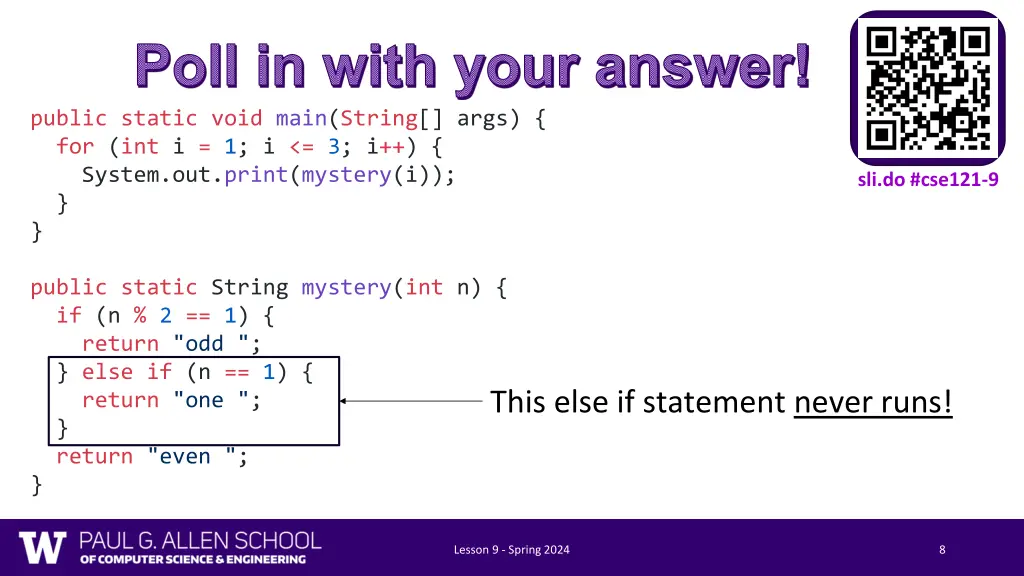
Poll in with your answer! public static void main(String[] args) { for (int i = 1; i <= 3; i++) { System.out.print(mystery(i)); } } sli.do #cse121-9 public static String mystery(int n) { if (n % 2 == 1) { return "odd "; } else if (n == 1) { return "one "; } return "even "; } This else if statement never runs! Lesson 9 - Spring 2024 8
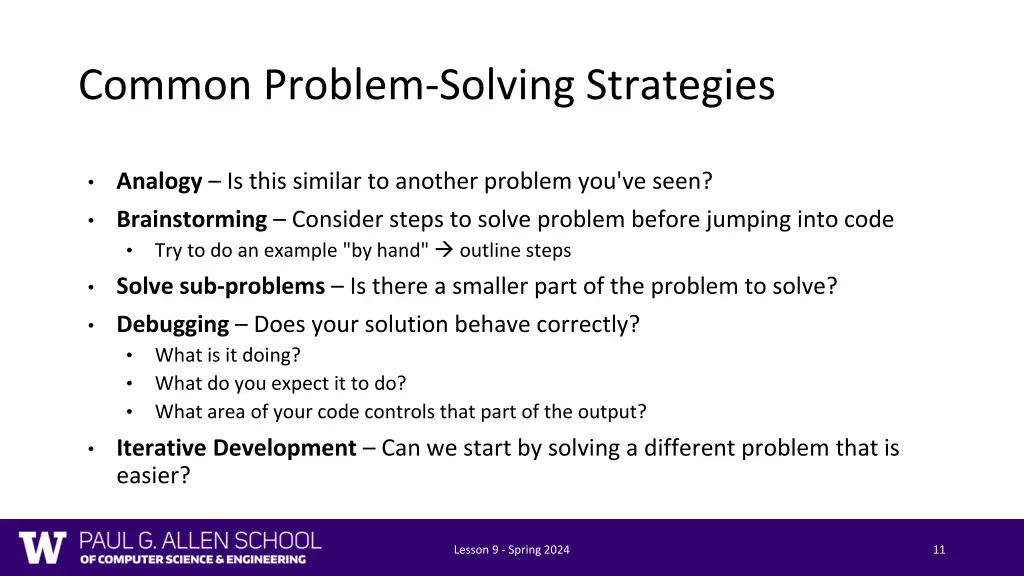
Common Problem-Solving Strategies Analogy Is this similar to another problem you've seen? Brainstorming Consider steps to solve problem before jumping into code Try to do an example "by hand" outline steps Solve sub-problems Is there a smaller part of the problem to solve? Debugging Does your solution behave correctly? What is it doing? What do you expect it to do? What area of your code controls that part of the output? Iterative Development Can we start by solving a different problem that is easier? Lesson 9 - Spring 2024 11
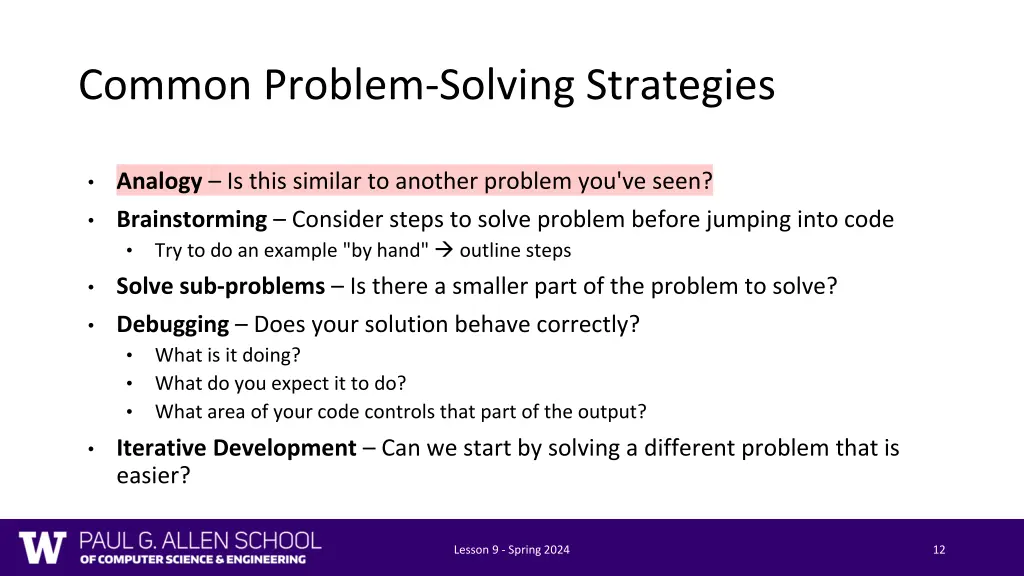
Common Problem-Solving Strategies Analogy Is this similar to another problem you've seen? Brainstorming Consider steps to solve problem before jumping into code Try to do an example "by hand" outline steps Solve sub-problems Is there a smaller part of the problem to solve? Debugging Does your solution behave correctly? What is it doing? What do you expect it to do? What area of your code controls that part of the output? Iterative Development Can we start by solving a different problem that is easier? Lesson 9 - Spring 2024 12
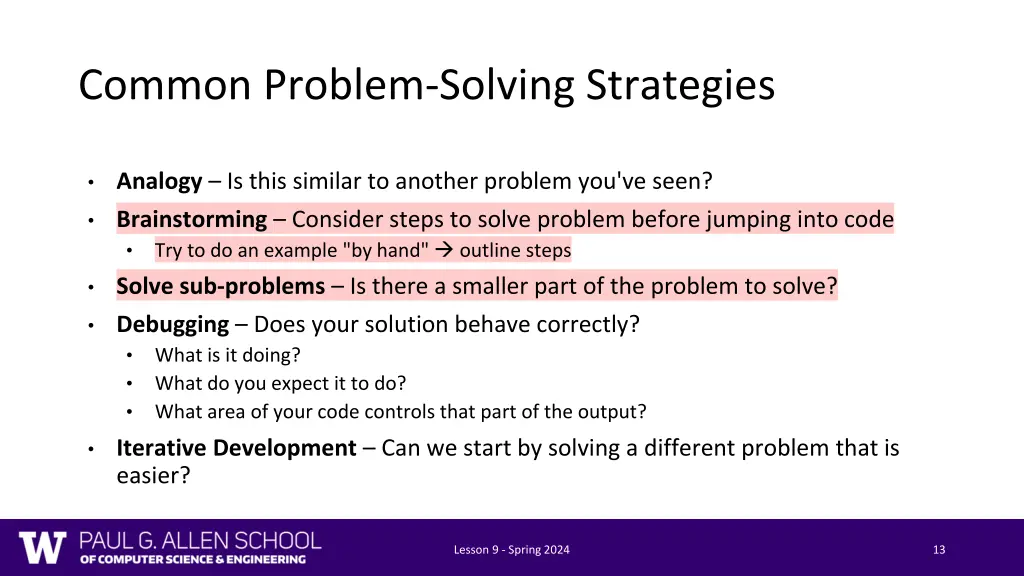
Common Problem-Solving Strategies Analogy Is this similar to another problem you've seen? Brainstorming Consider steps to solve problem before jumping into code Try to do an example "by hand" outline steps Solve sub-problems Is there a smaller part of the problem to solve? Debugging Does your solution behave correctly? What is it doing? What do you expect it to do? What area of your code controls that part of the output? Iterative Development Can we start by solving a different problem that is easier? Lesson 9 - Spring 2024 13
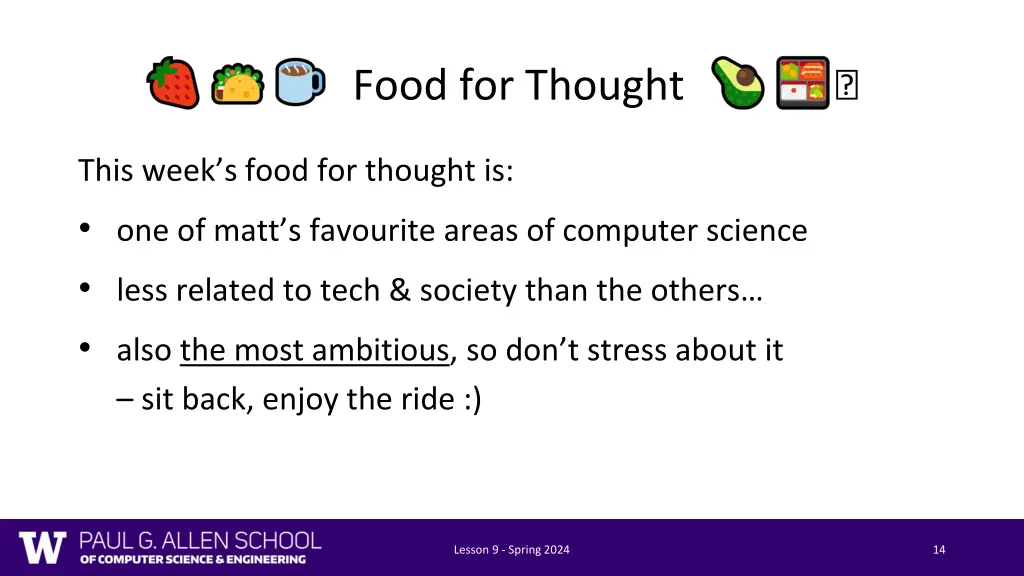
Food for Thought ? This week s food for thought is: one of matt s favourite areas of computer science less related to tech & society than the others also the most ambitious, so don t stress about it sit back, enjoy the ride :) Lesson 9 - Spring 2024 14
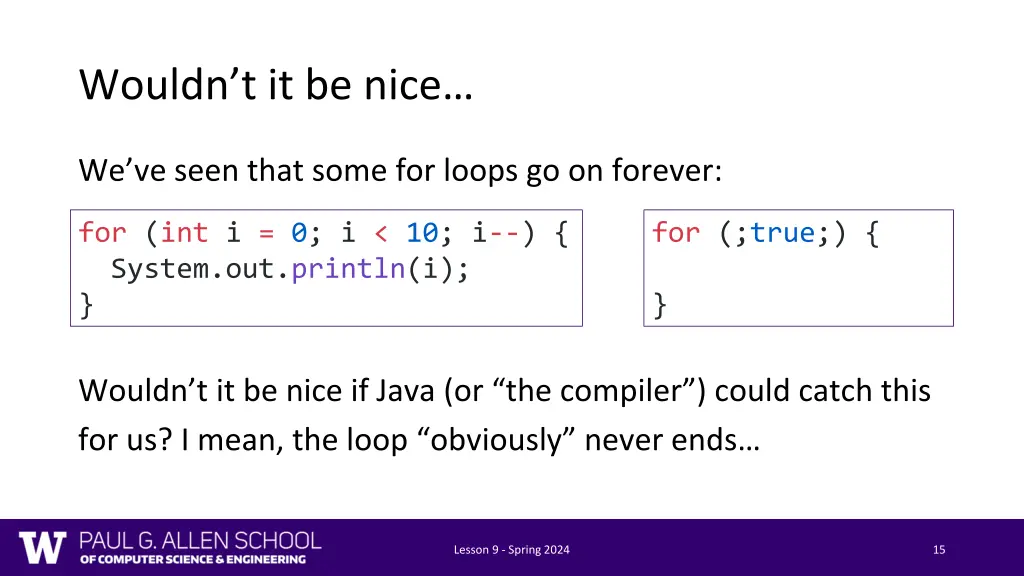
Wouldnt it be nice We ve seen that some for loops go on forever: for (int i = 0; i < 10; i--) { System.out.println(i); } for (;true;) { } Wouldn t it be nice if Java (or the compiler ) could catch this for us? I mean, the loop obviously never ends Lesson 9 - Spring 2024 15
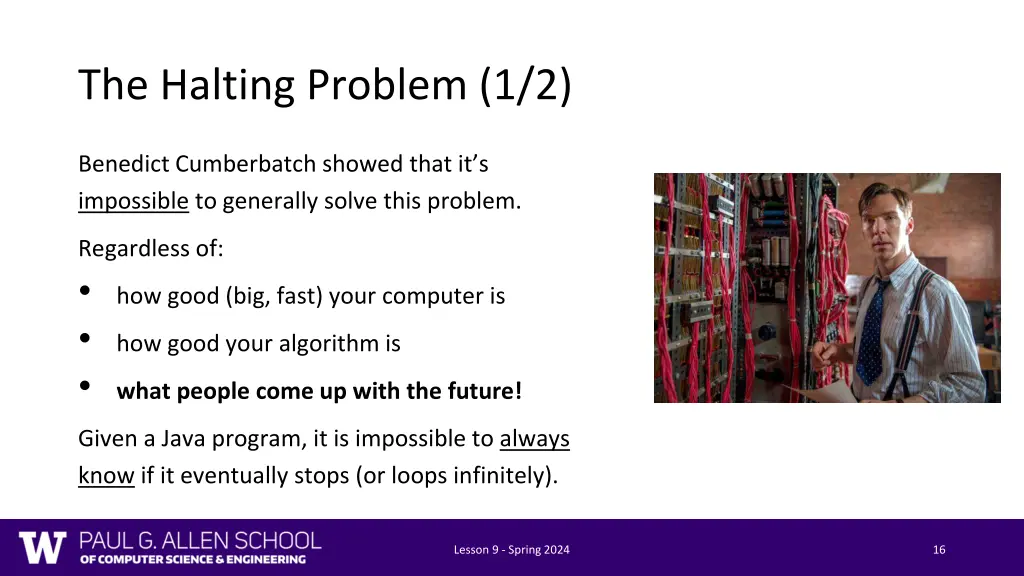
The Halting Problem (1/2) Benedict Cumberbatch showed that it s impossible to generally solve this problem. Regardless of: how good (big, fast) your computer is how good your algorithm is what people come up with the future! Given a Java program, it is impossible to always know if it eventually stops (or loops infinitely). Lesson 9 - Spring 2024 16
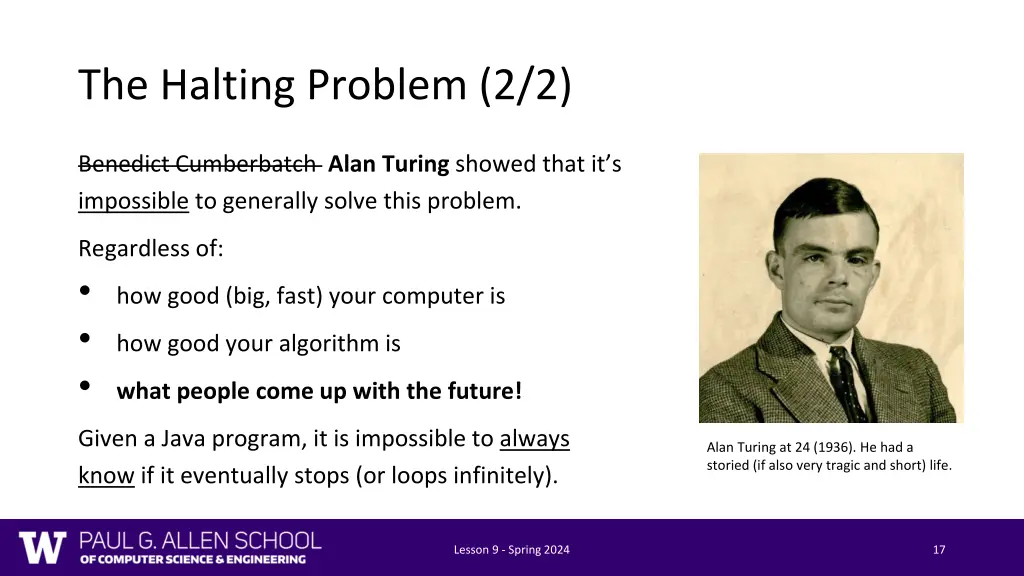
The Halting Problem (2/2) Benedict Cumberbatch Alan Turing showed that it s impossible to generally solve this problem. Regardless of: how good (big, fast) your computer is how good your algorithm is what people come up with the future! Given a Java program, it is impossible to always know if it eventually stops (or loops infinitely). Alan Turing at 24 (1936). He had a storied (if also very tragic and short) life. Lesson 9 - Spring 2024 17
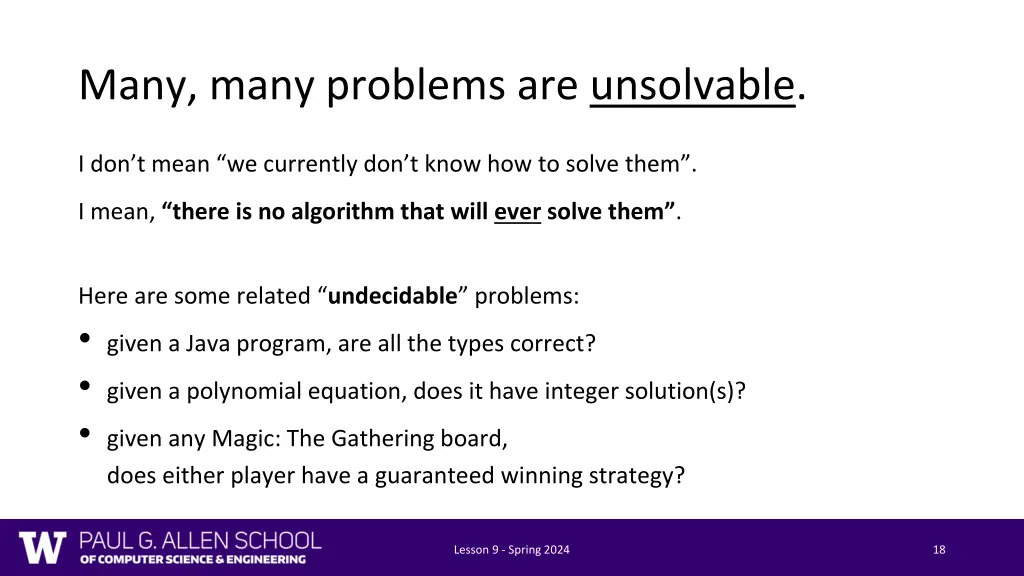
Many, many problems are unsolvable. I don t mean we currently don t know how to solve them . I mean, there is no algorithm that will ever solve them . Here are some related undecidable problems: given a Java program, are all the types correct? given a polynomial equation, does it have integer solution(s)? given any Magic: The Gathering board, does either player have a guaranteed winning strategy? Lesson 9 - Spring 2024 18
This statement is false In fact, there s an even more concerning result: there is at least one math statement that we can t prove true or false. What is that statement? It looks something like This statement is false . Lesson 9 - Spring 2024 19
In search of perfection Even though we know it s impossible , we still: try avoiding infinite loops type-check our Java programs play Magic: The Gathering (?) try to prove things in (and do) math! Lesson 9 - Spring 2024 20
Dessert for Thought! I argue there are two takeaways: 1. Don t let perfection be the enemy of the good! applies to you in CSE 121 and as a programmer :) fundamental basis of much of computer science 2. Like thinking about these sorts of problems? This is also computer science! (not all CS is just coding ) See: CSE 311, CSE 417/431 Lesson 9 - Spring 2024 21