Explore the concept of coNP in computational complexity theory, including definitions, examples, and relationships with NP. Learn about coNP-complete languages, the complexity of TAUTOLOGY and UNSAT problems, and the interplay between NP and coNP classes.
Please find below an Image/Link to download the presentation.
The content on the website is provided AS IS for your information and personal use only. It may not be sold, licensed, or shared on other websites without obtaining consent from the author. If you encounter any issues during the download, it is possible that the publisher has removed the file from their server.
You are allowed to download the files provided on this website for personal or commercial use, subject to the condition that they are used lawfully. All files are the property of their respective owners.
The content on the website is provided AS IS for your information and personal use only. It may not be sold, licensed, or shared on other websites without obtaining consent from the author.
Definition: coNP = { L | L NP } What does a coNP computation look like? In NP algorithms, we can use a guess instruction in pseudocode: Guess string y of |x|klength and the machine accepts if some y leads to an accept state In coNP algorithms, we can use a try all instruction: Try all strings y of |x|klength and the machine accepts if every y leads to an accept state
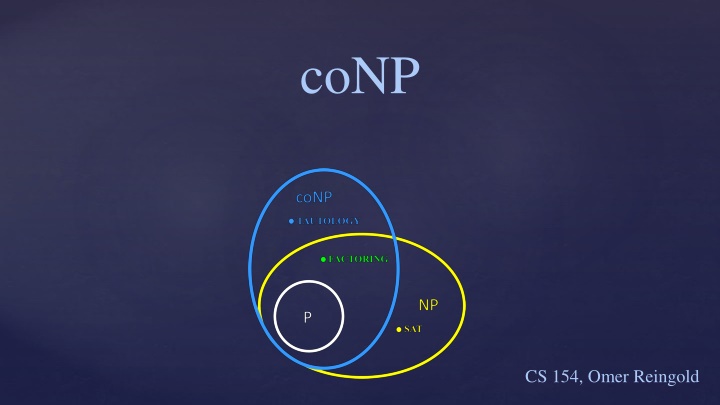
TAUTOLOGY = { | is a Boolean formula and every variable assignment satisfies } Theorem: TAUTOLOGY is in coNP How would we write pseudocode for a coNP machine that decides TAUTOLOGY? How would we write TAUTOLOGY as the complement of some NP language?
Is P coNP? Yes! L P implies that L P (hence L NP) In general, deterministic complexity classes are closed under complement
UNSAT = { | is a Boolean formula and no variable assignment satisfies } Theorem: UNSAT is coNP-complete Proof: UNSAT coNP because UNSAT = SAT (2) UNSAT is coNP-hard: Let A coNP. We show A P UNSAT On input w, transform w into a formula using the Cook- Levin Theorem and an NP machine N for A w A SAT w A SAT w A UNSAT w A UNSAT
UNSAT = { | is a Boolean formula and no variable assignment satisfies } Theorem: UNSAT is coNP-complete TAUTOLOGY = { | is a Boolean formula and every variable assignment satisfies } = { | UNSAT} Theorem: TAUTOLOGY is coNP-complete 1. TAUTOLOGY coNP (already shown) 2. TAUTOLOGY is coNP-hard: UNSAT P TAUTOLOGY: Given formula , output
An Interesting Problem in NP coNP FACTORING = { (m, n) | m > n > 1 are integers, there is a prime factor p of m where n p < m } If FACTORING P, then we could break most public-key cryptography currently in use! Theorem: FACTORING NP coNP
FACTORING = { (m, n) | m, n > 1 are integers, there is a prime factor p of m where n p < m } Theorem: FACTORING NP coNP Proof: The prime factorization p1e1 pkek of m can be used to efficiently prove that either (m,n) is in FACTORING or (m,n) is not in FACTORING: First verify each pi is prime and p1e1 pkek = m If there is a pi n then (m,n) is in FACTORING If for all i, pi < n then (m,n) is not in FACTORING
NP-complete problems: SAT, 3SAT, CLIQUE, VC, SUBSET-SUM, coNP-complete problems: UNSAT, TAUTOLOGY, NOHAMPATH, (NP coNP)-complete problems: Nobody knows if they exist P, NP, coNP can be defined in terms of specific machine models, and for every possible machine we can give an encoding of it. NP coNP is not known to have a corresponding machine model
Parting thoughts: NP has short proofs, how about coNP? What is there beyond NP and coNP?