Explore the CONSERT experiment aboard the Rosetta spacecraft, aimed at determining cometary properties through dielectric measurements. Discover the hardware setup, scientific objectives, datasets, and signal data analysis. Verify the scientific integrity of the data sets and confirm their usability for long-term research.
Please find below an Image/Link to download the presentation.
The content on the website is provided AS IS for your information and personal use only. It may not be sold, licensed, or shared on other websites without obtaining consent from the author. If you encounter any issues during the download, it is possible that the publisher has removed the file from their server.
You are allowed to download the files provided on this website for personal or commercial use, subject to the condition that they are used lawfully. All files are the property of their respective owners.
The content on the website is provided AS IS for your information and personal use only. It may not be sold, licensed, or shared on other websites without obtaining consent from the author.
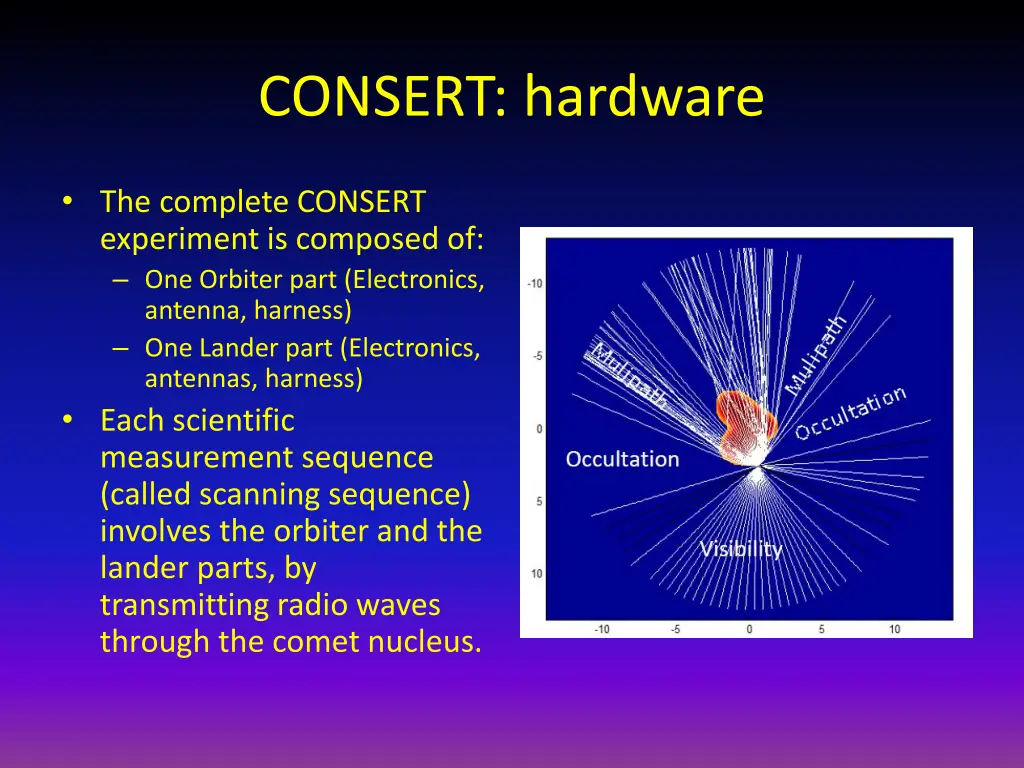
CONSERT: hardware The complete CONSERT experiment is composed of: One Orbiter part (Electronics, antenna, harness) One Lander part (Electronics, antennas, harness) Each scientific measurement sequence (called scanning sequence) involves the orbiter and the lander parts, by transmitting radio waves through the comet nucleus.
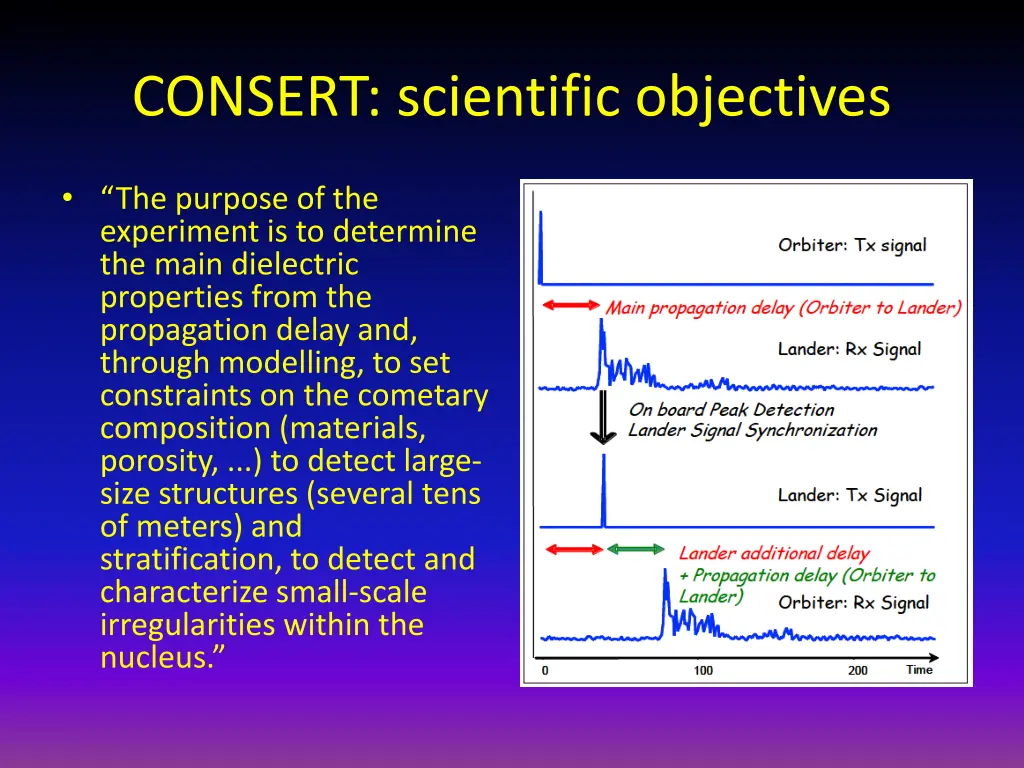
CONSERT: scientific objectives The purpose of the experiment is to determine the main dielectric properties from the propagation delay and, through modelling, to set constraints on the cometary composition (materials, porosity, ...) to detect large- size structures (several tens of meters) and stratification, to detect and characterize small-scale irregularities within the nucleus.
The CONSERT datasets Two types of datasets: Revised versions of Level 3 datasets reviewed in 2017; The new Level 4 datasets that had been produced in the last year (both test/calibration data and actual measurements). RORL-CAL-CONSERT-3-CR2-V2.0 RORL-CAL-CONSERT-3-CR4A-V2.0 RORL-CAL-CONSERT-3-CR5-V2.0 RORL-CAL-CONSERT-3-EAR2-V2.0 RORL-CAL-CONSERT-3-EAR3-V2.0 RORL-CAL-CONSERT-3-MARS-V2.0 RORL-CAL-CONSERT-3-PHC-V2.0 RORL-CAL-CONSERT-4-CR2-V1.0 RORL-CAL-CONSERT-4-CR4A-V1.0 RORL-CAL-CONSERT-4-CR5-V1.0 RORL-CAL-CONSERT-4-EAR2-V1.0 RORL-CAL-CONSERT-4-EAR3-V1.0 RORL-CAL-CONSERT-4-GRND-V1.0 RORL-CAL-CONSERT-4-MARS-V1.0 RORL-CAL-CONSERT-4-PDCS-V1.0 RORL-CAL-CONSERT-4-PHC-V1.0 RORL-C-CONSERT-4-FSS-V1.0 RORL-C-CONSERT-4-SDL-V1.0
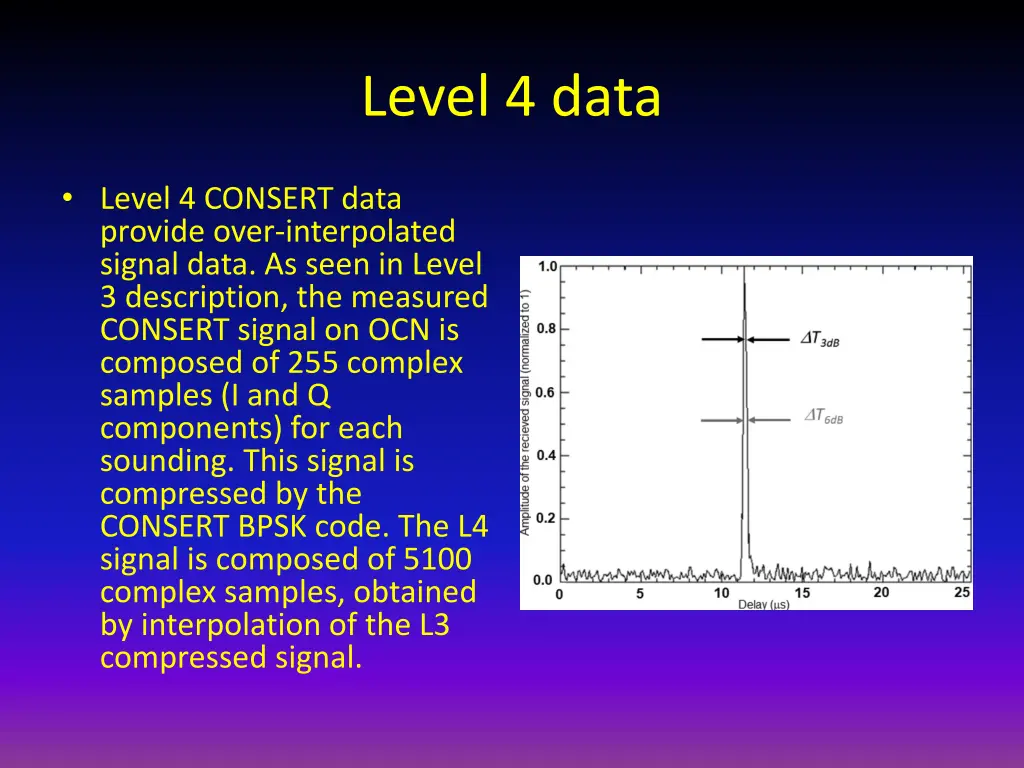
Level 4 data Level 4 CONSERT data provide over-interpolated signal data. As seen in Level 3 description, the measured CONSERT signal on OCN is composed of 255 complex samples (I and Q components) for each sounding. This signal is compressed by the CONSERT BPSK code. The L4 signal is composed of 5100 complex samples, obtained by interpolation of the L3 compressed signal.
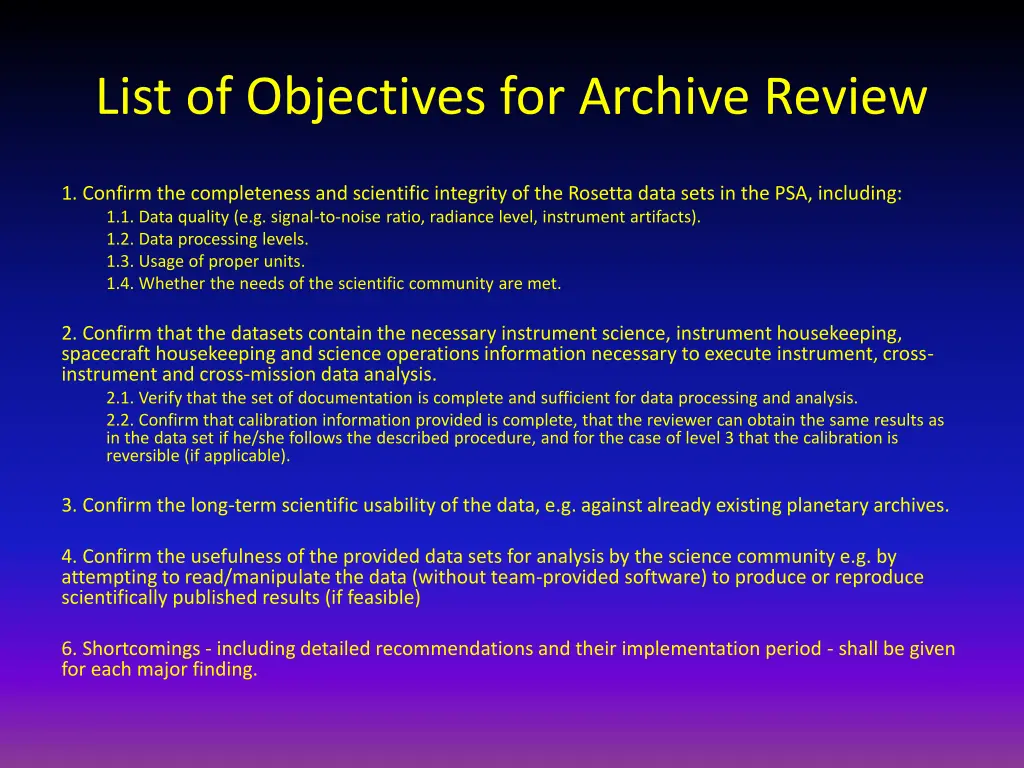
List of Objectives for Archive Review 1. Confirm the completeness and scientific integrity of the Rosetta data sets in the PSA, including: 1.1. Data quality (e.g. signal-to-noise ratio, radiance level, instrument artifacts). 1.2. Data processing levels. 1.3. Usage of proper units. 1.4. Whether the needs of the scientific community are met. 2. Confirm that the datasets contain the necessary instrument science, instrument housekeeping, spacecraft housekeeping and science operations information necessary to execute instrument, cross- instrument and cross-mission data analysis. 2.1. Verify that the set of documentation is complete and sufficient for data processing and analysis. 2.2. Confirm that calibration information provided is complete, that the reviewer can obtain the same results as in the data set if he/she follows the described procedure, and for the case of level 3 that the calibration is reversible (if applicable). 3. Confirm the long-term scientific usability of the data, e.g. against already existing planetary archives. 4. Confirm the usefulness of the provided data sets for analysis by the science community e.g. by attempting to read/manipulate the data (without team-provided software) to produce or reproduce scientifically published results (if feasible) 6. Shortcomings - including detailed recommendations and their implementation period - shall be given for each major finding.
1. Confirm the completeness and scientific integrity All data sets have been augmented with information on the acquisition of ground test and calibration data. All documentation describing testing and operations has been revised. Level 3 datasets contain an older version of the EAICD.
2. Confirm that the datasets contain the necessary information Information on the fine correction and most precise calculation of the signal travel time, mostly constituted by the peak detection and signal interpolation methods, has been included in Level 4 data. The CONSERT_COMPRESSION_CODE.TAB is still missing from the DOCUMENT directory.
3. Confirm the long-term scientific usability of the data This was considered adequate in previous reviews. No further comments, as the archive structure remained unchanged in Level 3 data and is replicated in Level 4 data.
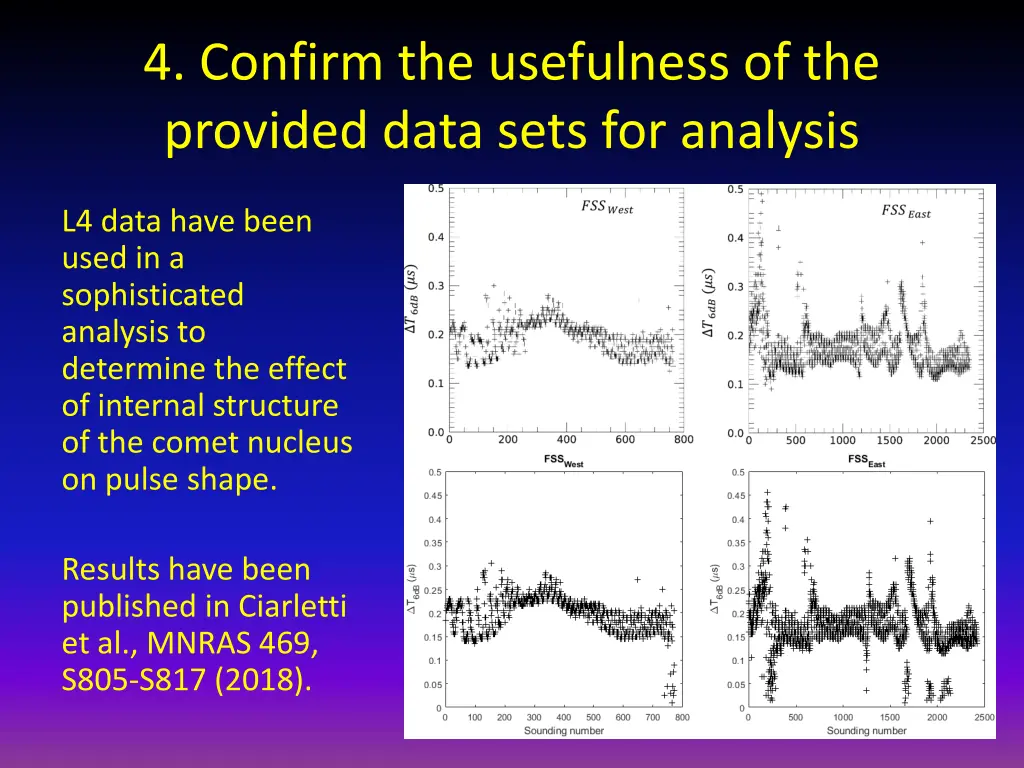
4. Confirm the usefulness of the provided data sets for analysis L4 data have been used in a sophisticated analysis to determine the effect of internal structure of the comet nucleus on pulse shape. Results have been published in Ciarletti et al., MNRAS 469, S805-S817 (2018).
5. Shortcomings shall be given for each major finding No major issues found. The CONSERT_COMPRESSION_CODE.TAB, which should be in the DOCUMENT folder according to the EAICD, is still missing. Level 3 datasets contain an older version of the EAICD.