Explore key issues in setting mobile termination rates, transitioning to cost-based pricing, and ensuring consumer benefits from regulatory mechanisms. Understand the impact of observed vs. expected costs, differences between cost and price, and the role of regulators in competitive and non-competitive markets.
Please find below an Image/Link to download the presentation.
The content on the website is provided AS IS for your information and personal use only. It may not be sold, licensed, or shared on other websites without obtaining consent from the author. If you encounter any issues during the download, it is possible that the publisher has removed the file from their server.
You are allowed to download the files provided on this website for personal or commercial use, subject to the condition that they are used lawfully. All files are the property of their respective owners.
The content on the website is provided AS IS for your information and personal use only. It may not be sold, licensed, or shared on other websites without obtaining consent from the author.
Key Issues to consider in arriving at the Price of Service the final price to include an allowance for the network externality? final price be above cost to encourage the operator(s) to invest further in their networks? the final price be above currently observed cost to reflect future network roll-out into less profitable areas? How long should NRAs allow operators to transition from market [current] prices to cost-based prices? Should termination rates be symmetrical or asymmetrical and if asymmetrical, for how long? Should NRAs ensure that all cuts in MTRs are passed on to consumers by mandating an equivalent cut in the retail cost of calling a mobile phone, especially from a fixed network? 1. 2. 3. 4. 5. 6. AFRALTI 3
Different Types of Considerations Is there a difference between the observed cost and the expected cost going forward? (2, 3) Should there be a difference between cost and price in the short to medium term? (4, 5) Should there be a difference between cost and price in the long term? (1, potentially 5) Is there a need for an additional regulatory mechanism to ensure consumer benefits from the MTR regulation? (6) AFRALTI 4
Different Types of Considerations, 2 In unregulated competitive markets the prices of goods and services should, over time, equal the marginal cost of production including a reasonable return on capital. Where in the long-run all costs are variable under conditions of perfect competition What level of return of capital is reasonable is one of the questions which needs to be answered by individual NRAs. AFRALTI 5
Different Types of Considerations, 3 If a market is not regarded as competitive, such as in the case of individual operator mobile termination, a regulator may intervene to ensure that prices are set to maximise consumer welfare in the long term. The long term is somewhat ambiguous but the guiding principle is to ensure that the market players are incentivised to continue developing infrastructure and investing. This is one of the reasons why a regulator would include adjustments to the basic costs of mobile termination. Some of the areas and options that are considered by operators and regulators are covered. AFRALTI 6
Different Types of Considerations, 4 In unregulated competitive markets the prices of goods and services should, over time, equal the marginal cost of production including a reasonable return on capital. Where in the long-run all costs are variable under conditions of perfect competition What level of return of capital is reasonable is one of the questions which needs to be answered by individual NRAs. If a market is not regarded as competitive, such as in the case of individual operator mobile termination, a regulator may intervene to ensure that prices are set to maximise consumer welfare in the long term. AFRALTI 7
Network Externality, 1 If NRAs set regulated prices equal to or with reference to costs alone this may not result in economically efficient (welfare maximising) prices for consumers. NRAs must determine whether the costs of the different services is in the interests of consumers to take account of externalities and their impact on the efficient level of prices for mobile terminating services. An externality is an effect (i.e. a cost or a benefit) that impacts on a third party by a decision (i.e. to consume or produce) taken by another party. Since this cost (or benefit) does not affect the party that makes the decision, the latter does not, in general, take account of this cost/benefit in his decision (Source: ITU, 24- 28 January 2005) AFRALTI 8
Allocation of costs between services The most appropriate way of allocating costs between services is to use consumption or routing factors. Routing factors will allow network costs to be allocated according to both the level of demand for a service and the extent to which that service uses the cost element in question. The simplest example is with respect to mobile base stations. AFRALTI 9
Allocation of costs between services On-net calls are allocated more cost per minute than incoming or outgoing calls An on-net call requires two radio network legs to fulfil the call, Incoming or outgoing calls only require one radio network leg. AFRALTI 10
Allocation of costs between services Based on models that have been constructed using routing factors, it is common for an incoming call to be more costly than an outgoing call to another network. Some network elements are used exclusively for terminating calls (or messages), e.g. the HLR and the location processing elements in the MSCs. A call to a mobile network will typically be handed over to that mobile network at the nearest point of interconnect, The mobile network using more of its core network, especially transmission, to terminate calls than to AFRALTI 11
Allocation of costs between services comparison of incoming calls to outgoing calls to other mobile networks: It is possible that outgoing calls to fixed networks are handled on a far-end handover basis and will use more of the mobile network s core transmission and switching. AFRALTI 12
Spectrum allocation It is argued that the biggest source of enduring cost differences between operators is spectrum allocations. These differences can relate to the quantity or type of spectrum or both. Operators with lower frequency spectrum (e.g. 900 MHz) can achieve the same level of coverage as an operator with higher frequency spectrum (e.g. 1800 MHz) with fewer cell sites due to the propagation characteristics of radio waves. As such, where operators build networks with areas that are coverage constrained, rather than capacity constrained, the lower frequency operators will have fewer sites and ceterus paribus lower costs. AFRALTI 13
Spectrum allocation, 2 An additional difference relates to radio wave propagation characteristics in densely populated built-up areas. It is generally accepted that lower frequency spectrum is better able to penetrate dense materials such as buildings. As such, in capacity constrained areas, where in-building coverage is important, the lower frequency operators will be able to provide the same level of service, in terms of availability and quality, as higher frequency operators, but with fewer cells. AFRALTI 14
Spectrum allocation, 3 Based on the differences above, a priori expectation is that ceteris paribus lower frequency operators will have lower costs than higher frequency operators. There are however a number of reasons why this might not be the case, including: If spectrum is auctioned efficiently, in theory, the cost savings from lower frequency spectrum should be bid away in the auction process through higher payments for lower frequency, until the cost differential is removed. Lower frequency operators might have less spectrum than higher frequency operators. The operator with more spectrum will have to deploy less sites to meet capacity requirements, and the observed costs of the higher frequency operator could be higher or lower depending on the balance of capacity- constrained and coverage-constrained areas in the network. AFRALTI 15
Spectrum allocation, 3 It has often been the case in Europe that 900 MHz operators were the early entrants into the mobile market. As such, they didn t benefit from the learning effects that later entrants were able to benefit from, and therefore their networks might be less optimal. This raises a separate set of questions regarding efficiency standards, but in terms of observed operator-specific costs, could be a reason for cost differentials between the operators. AFRALTI 16
Spectrum allocation, 4 Clearly, the issue of spectrum will be specific to each country, Each NRA must determine the effect actual spectrum allocations are likely to have on the operators actual costs and by extension, the most appropriate modelling approach, e.g. with respect to a hypothetical v actual operator approach. AFRALTI 17
Network Externality, 2 A common type of externality discussed in relation to mobile networks is the network externality . In the mobile market it is argued, especially in developing countries where mobile penetration is rising rapidly, that if a mobile network acquires a new customer then there is a marginal social benefit conferred on the entire network comprising a private benefit and a public or external benefit . There is an external benefit to existing mobile subscribers and callers to mobile subscribers as there are more people to communicate with. This is in addition to the private benefit that the new subscriber themselves experiences. AFRALTI 18
Network Externality, 3 Therefore a new customer may confer a positive external benefit on the communications (mobile and fixed) sector. When a potential new subscriber makes a decision to join a mobile network they do not necessarily take into account the external benefit they may create. They base their acquisition decision on their private benefit alone. Therefore there may be subscribers who do not choose to subscribe at a given price because the private benefit to them is too low, whereas if they were to take into account the external benefit of their subscription they would subscribe. These subscribers require a subsidy to incentivise them to join the network and to realise the full social benefit of their acquisition. AFRALTI 19
Setting of mobile termination rates, 1 In the presence of externalities, and assuming a policy desire to account for externalities within the sector, consumer welfare will be improved through the application of an externality adjustment to prices. This operates by changing the balance of prices across all mobile services. For example, instead of setting the price for all mobile services equal to their cost, the price for some services is set below cost and this shortfall is subsidised through increasing the level of prices for other services. This change in the structure of prices affects consumers behaviour, takes into account externalities and maximises overall welfare. AFRALTI 20
Setting of mobile termination rates, 2 An operator could argue to offer prices at a discount or offer subsidies, for example on handsets or even to engage in strong marketing activities, to increase the size of the market and boost welfare. [A GSMA study on the impact of mobile network growth, showed that a 10% increase in mobile penetration results in an annual GDP rise of 1.2% (www.gsmworld.com/tax).] If prices were set at marginal cost there could be too few subscribers to mobile networks and therefore the welfare of society would not be maximised. AFRALTI 21
Setting of mobile termination rates, 3 In effect, an operator could argue to include some contribution to customer acquisition, retention and/or maintenance costs or general subscriber-related retail costs in the mobile termination rate. This would ensure that there is an incentive to attract new customers and maintain existing customers which in turn increase social welfare. This would result in the existing customers benefit and so it could be justified that they pay towards this benefit. AFRALTI 22
Setting of mobile termination rates, 4 While many operators in developed countries have recognised the theoretical validity of the network externalities argument, many have chosen not to apply an externality surcharge. This is partially due to the complexities involved in calculating the optimal mark-up, but principally because developed countries have high mobile penetration (usually >90%), Whilst calculating externalities is complex, the same can be said for many other elements of costing and price-setting and as such is not in itself sufficient justification for ignoring externalities. The meaning is that the number of potential new mobile subscribers is much smaller, and a larger proportion of these non- subscribers are highly price-insensitive, thus unlikely to be marginal non-subscribers [However, Ofcom s empirical study concluded that 34% of UK subscribers are marginal]. This reasoning is less likely to hold in developing countries where mobile penetration is lower. AFRALTI 23
Setting of mobile termination rates, 6 In practice, the network externality will be a balance between the social welfare gains from increased subscribers compared to the social welfare gains of increased usage. Depending on the relative demand elasticities, there is the possibility that the externality calculation will reduce the efficient cost of calls (including or specifically terminating calls) and increase the cost of access/subscription. The issue of externalities has been widely considered by NRAs and where externalities have been included, they have typically increased termination rates rather than reduce them. Some examples where regulators permitted network externalities to be included in the mobile termination rate are considered below. AFRALTI 24
Developed Countries Examples, 1 UK: Competition Commission/Ofcom In the UK, the issue of mobile termination rates has been reviewed on numerous occasions,: Oftel in the late 1990s, Competition Commission in 2001 and then Ofcom again. In all of these decisions, the network externality has been considered in great detail, and the conclusion has been that it is appropriate to include an allowance for the network externality in the mobile termination rate. Ofcom has continued to apply a mark-up for network externalities and in the review of mobile termination rates states: In the presence of a network externality, not enough consumers may choose to become mobile subscribers from the perspective of society as a whole. To the extent that not all of the network externality is internalised, social welfare can be increased by providing a subsidy to some of those consumers who are not willing to pay the full price of subscription. AFRALTI 25
Developed Country Examples, 2 Greek decision In Greece, the NRA completed a review of mobile termination rates shortly after the Competition Commission completed its review in the UK. The NRA agreed with the Competition Commission s conclusion that a network externality should be included in the mobile termination rate and used the same model as the Competition Commission, updated with Greek inputs, to estimate the value of the externality. AFRALTI 26
Developed Countries Examples, 3 Italian decision In Italy, NRA recognised the need for a network externality, but was aware of the difficulties of collecting the right data for a sufficiently robust estimation of its value. In order to get round this problem, NRA s decision on MTRs states that where data is problematic, the network externality can be based on other countries which display similar characteristics in terms of mobile market size, penetration and number of operators Israeli decision The Ministry of Communication commissioned Analysys Consulting to calculate the appropriate MTRs in Israel. In the decision document, the conclusion is reached that the network externality is relevant, but using the UK model with Israeli specific inputs, the externality was immaterial in the context of the estimated cost-based MTRs. AFRALTI 27
Implications for developing countries, 1 Developing countries are in many ways very different from Europe. However, that does not mean that the experience from Europe is not relevant. In Europe, mobile operators initially entered a market with high fixed line penetration. The mobile markets have not been a substitute for fixed lines and as the markets develop convergence is the key phrase between fixed and mobile. In many developing countries this is not the case. Fixed line penetration tends to be low and new subscribers are more likely to take up a mobile service or a fixed wireless service. AFRALTI 28
Implications for developing countries, 2 People may be contactable on a mobile phone only. The service offering and usage may also be significantly different: Voice call usage may be low, particularly for low income users who may only use their mobile for incoming calls. There is evidence of flashing . That is, a subscriber would ring another mobile but hang up before the call is completed. The receiver would then know that the caller wanted their attention which is the only point of the flashing . It s even cheaper than sending a please call me SMS. The frequency of flashing in Africa is such that a number of African operators, have introduced free Call me back text messages, some, offer a restricted number of which can be sent each day, even up to ten free call me back messages per day. AFRALTI
Implications for developing countries, 3 There is a social benefit to increasing the number of mobile users even if the incremental users have a very low usage and the priority for owning a mobile is to receive calls. More people are able to communicate and are contactable. These low income incremental customers are most likely to be pre-paid users but they still generate some retail, fixed and common costs. How are these costs to be recovered if the subscriber does not make any calls? There could be a justification for including a surcharge to the cost-based mobile termination rate to ensure that mobile operators cover the costs of increasing the mobile subscriber base and increasing social welfare. AFRALTI 30
Network expansion objectives, 1 In developing countries, and even in developed countries where mobile markets are expanding, there is an argument that the mobile termination rate should be above the estimated cost of terminating a call on the existing sized network. Mobile termination rates at cost could restrict the roll- out of networks. A network operator may have a reduced incentive to expand their network to some rural areas, road, train lines etc. AFRALTI
Network expansion objectives, 1 The costs of building could be very expensive and the usage in these areas may not be enough to justify the cost. The differences in coverage between operators might be an exogenous cost factor that can be reflected in asymmetric termination rates. It is possible that a cost-based termination rate distorts an operator s investment incentives, such that it curtails its network roll-out into less profitable areas. This is likely to happen if the regulator imposes cost based termination rates when all the cities have been covered AFRALTI
Network expansion objectives, 2 It is not obviously the case that high MTRs are necessary to encourage network expansion. The incentives to invest is a function of a number of factors, of which MTRs is one. It should be noted that NRAs might find it difficult to ensure that above-cost MTRs are actually used for the intended purpose. NRAs will need to determine a method for policing such a scheme, which might prove costly. As in the network externality, considering the costs of acquiring and maintaining customers, welfare is maximised if the networks are expanded. The costs associated with the expansion to low usage areas could be partly recovered through the mobile termination charge as all mobile and fixed customers benefit from the increase subscriber base and network coverage. AFRALTI 33
Network expansion objectives: Options to consider Explicit surcharge on MTR for funding network expansion; Explicit inclusion of network expansion costs within the base cost model. If using a bottom-up model then the regulators/operators must be careful not to include network expansion in the base costs and also add a surcharge; Glide-path to cost-orientated rates allows time for operators to expand networks; Asymmetry in mobile termination rates may be reasonable for new entrants or for a lagging mobile operator to allow them time to build a network to compete effectively; and New technologies. For example, asymmetry in termination rates between 2G and 3G/4G termination to allow 3G/4G new entrants to compete with the established operators while they build out an enhanced network. AFRALTI 34
Symmetrical v asymmetrical rates The issue of symmetrical (or asymmetrical) termination rates has caused much debate between operators and NRAs. Symmetrical termination rates in some markets and asymmetrical termination rates in other markets. No definitive pattern has emerged in terms of symmetry v asymmetry per se, although there has been a clear trend towards more symmetrical termination rates over the last few years (particularly members of the European Union). This is largely a result of the extension of MTR regulation to all mobile operators rather than just the larger operators recognising that termination of calls on each network is a separate market and each operator has a monopoly of termination to its customers. AFRALTI 35
Symmetrical v asymmetrical rates Economic theory suggests that under perfect competition, different operators offering the same service will charge the same price. With regulators often attempting to mimic competitive outcomes when regulating MTRs, there can be an expectation that a single market rate will prevail. However, with respect to MTRs, conditions of perfect competition are not fully met, e.g. where termination on each network is deemed to be a separate market. As a consequence, the issue of symmetrical or asymmetrical termination rates cannot be resolved quickly with reference to economic theory. AFRALTI 36
Symmetrical v asymmetrical rates In principle, the developed countries are in favour of symmetrical termination rates. Hover, regulators should bear in mind that asymmetric regulation is sustainable only on a transitional period NRAs should not come to any conclusions about the relative costs of different operators without performing the appropriate level of analysis. This will include analysing all the market and cost information that a NRA will gather during the process of regulating MTRs. Only then will a NRA be in a position to form view on whether symmetrical or asymmetrical termination rates are appropriate. AFRALTI 37
Glide path A glide path refers to a regulated price control where regulators require operators to reduce prices over time rather than mandate an immediate move to the cost-orientated level. This allows operators time to plan for the decreased revenue from mobile termination charges, and offers stability rather than a one- off shock if the difference between the existing MTR and the cost- orientated MTR is great. There are a number of options available: Glide path from current prices to cost-orientated or benchmark prices One-off step change then glide path to cost-oriented or benchmark prices Immediate move to cost-orientated/benchmark prices AFRALTI 38
Glide path The optimal length of a glide path is a matter of debate. Regulators have generally set glide paths of one to three years. For example, UK has previously used four year charge control periods during which the MTRs glide to the cost-orientated rate. Spain has had a three year glide path. The European Commission has stated on a number of occasions that while it supports the use of glide paths, these should be as short as possible and in many cases has encouraged NRAs to revise glide paths which are over two years long. A glide path has been used in developing markets. The cost based termination may be too low to encourage network expansion and development in new services. For example CCK (Now CA) had set a glide path of four years in a cost-based study Analysys AFRALTI 39
Pass-through of termination rate cuts, 1 The primary purpose of regulating MTRs is to increase consumer welfare. If there is effective competition in the retail market for mobile telephony, MTR cuts should be passed through to consumers. Mobile subscribers decisions are influenced by the retail prices and there is a tendency to compete at this level and the result is that termination revenues are shared between mobile operators. If there is a monopoly in the fixed market there is little incentive for a fixed operator to pass on any reduction in mobile termination costs to their own subscribers as there is not sufficient competition in retail fixed to mobile calls. AFRALTI 40
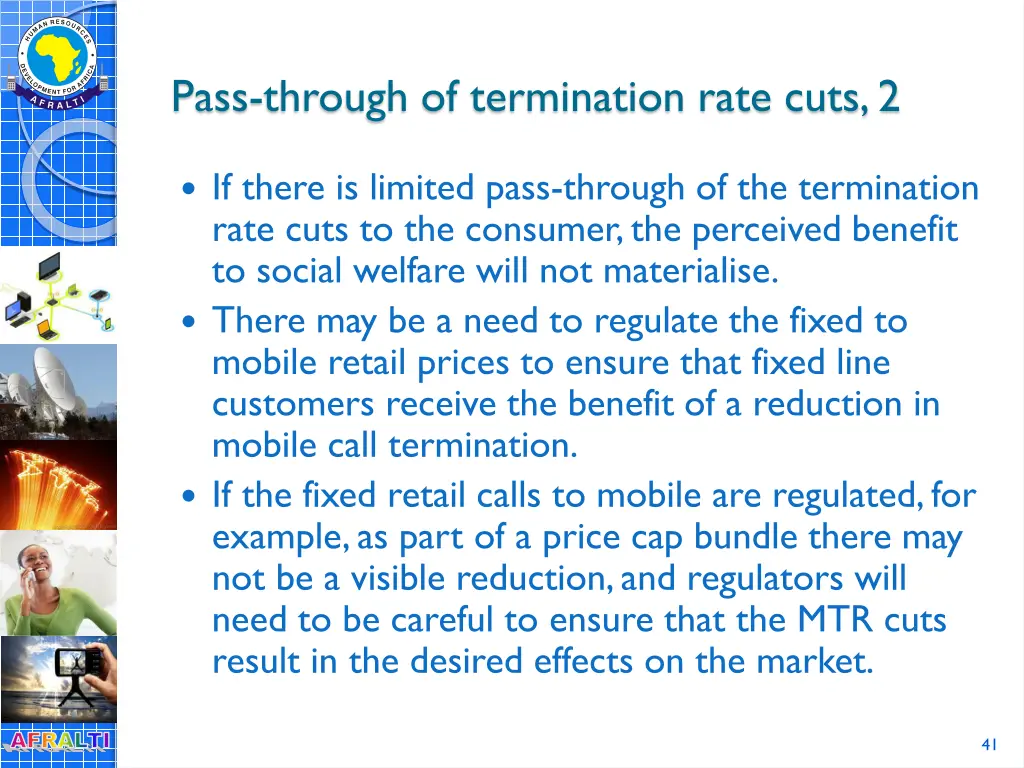
Pass-through of termination rate cuts, 2 If there is limited pass-through of the termination rate cuts to the consumer, the perceived benefit to social welfare will not materialise. There may be a need to regulate the fixed to mobile retail prices to ensure that fixed line customers receive the benefit of a reduction in mobile call termination. If the fixed retail calls to mobile are regulated, for example, as part of a price cap bundle there may not be a visible reduction, and regulators will need to be careful to ensure that the MTR cuts result in the desired effects on the market. AFRALTI 41
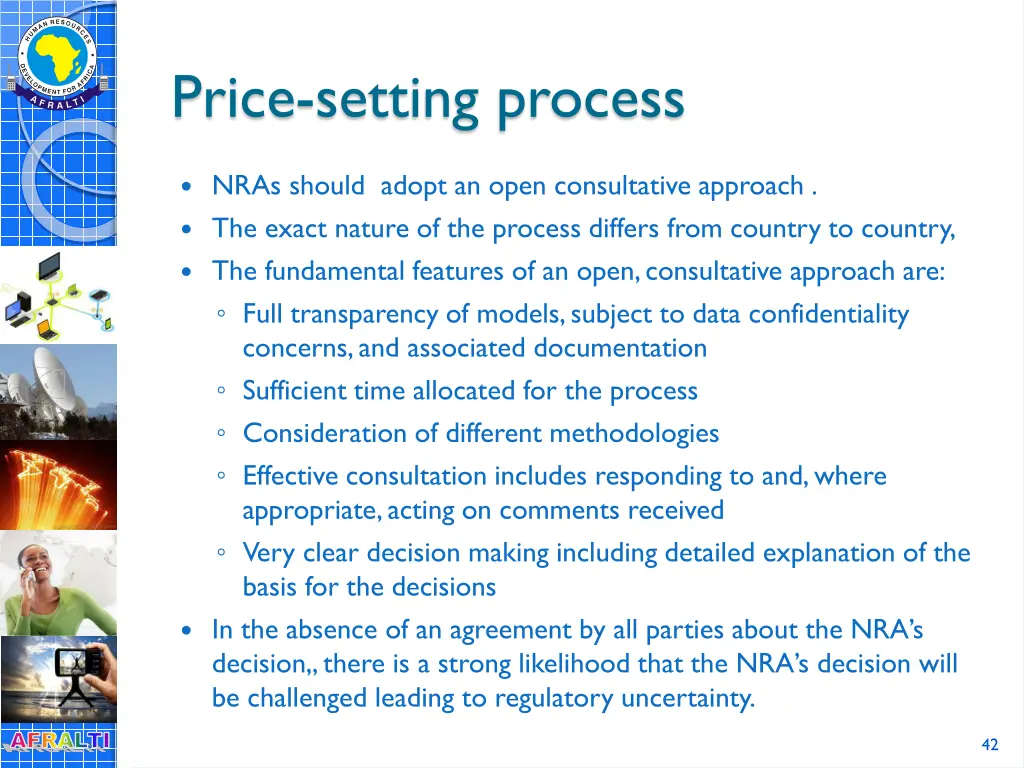
Price-setting process NRAs should adopt an open consultative approach . The exact nature of the process differs from country to country, The fundamental features of an open, consultative approach are: Full transparency of models, subject to data confidentiality concerns, and associated documentation Sufficient time allocated for the process Consideration of different methodologies Effective consultation includes responding to and, where appropriate, acting on comments received Very clear decision making including detailed explanation of the basis for the decisions In the absence of an agreement by all parties about the NRA s decision,, there is a strong likelihood that the NRA s decision will be challenged leading to regulatory uncertainty. AFRALTI 42