Construction Sector Overview & Project Management

Construction is the process of building infrastructure, with a focus on collaboration, planning, design, and supervision. It encompasses various disciplines and involves project managers, construction managers, and engineers. The construction sector contributes significantly to the GDP and requires attention to zoning requirements, safety, materials, logistics, and more. Effective project management is crucial for successful outcomes, considering client demands and budget constraints across commercial, residential, industrial, and civil projects.

Download Presentation

Please find below an Image/Link to download the presentation.
The content on the website is provided AS IS for your information and personal use only. It may not be sold, licensed, or shared on other websites without obtaining consent from the author.If you encounter any issues during the download, it is possible that the publisher has removed the file from their server.
You are allowed to download the files provided on this website for personal or commercial use, subject to the condition that they are used lawfully. All files are the property of their respective owners.
The content on the website is provided AS IS for your information and personal use only. It may not be sold, licensed, or shared on other websites without obtaining consent from the author.
E N D
Presentation Transcript
DIPLOMA SEM VI PREPARED & & PRESENTED by by SELESTIAN AUGUSTINO
UNIT I LECTURE 1 1.1.0 CONSTRUCTION SECTOR 1.1.1 CONSTRUCTION Construction is the process of constructing a building or infrastructure. Construction differs from manufacturing in that manufacturing typically involves mass production of similar items without a designated purchaser, while construction typically takes place on location for a known client. According to the country s National Bureau of Statistics (NBS), the sector is the biggest driver of national Gross Domestic Product (GDP) contributing 7.8% in 2010, 13.6% in 2015 and a growth rate of 13.2% in the first quarter of 2019. Construction starts with planning, design, and financing; it continues until the project is built and ready for use.
1.1.0 CONSTRUCTION SECTOR 1.1.1 CONSTRUCTION Large-scale construction requires collaboration across multiple disciplines. A project manager normally manages the budget on the job, and a construction manager, design engineer, construction engineer or architect do supervises it. Those involved with the design and execution must consider zoning requirements, environmental impact of the job, scheduling, budgeting, construction-site safety, availability and transportation of building materials, logistics, inconvenience to the public caused by construction delays and bidding.
1.1.0 CONSTRUCTION SECTOR 1.1.1 CONSTRUCTION Building construction is the process of adding structure to real property or construction of buildings. The majority of building construction jobs are small renovations, such as addition of a room, or renovation of a bathroom. Often, the owner of the property acts as laborer, paymaster, and design team for the entire project. Although building construction projects consist of common elements such as design, financial, estimating and legal considerations, projects of varying sizes may reach undesirable end results, such as structural collapse, cost overruns, and/or litigation. For this reason, those with experience in the field make detailed plans and maintain careful oversight during the project to ensure a positive outcome.
1.1.0 CONSTRUCTION SECTOR 1.1.1 CONSTRUCTION Construction project management/ project management can be defined as the direction, regulation, and supervision of a project from early development to completion. The ultimate goal of construction project management is the full satisfaction of the client s demands for a viable project both in terms of functionality and budget. There is a wide range of construction project types, such as commercial, residential, industrial and heavy civil. The main concept of construction project management is closely connected to technical parameters like budget and execution but it also requires solid communication between all the agents (stakeholders, contractors, community).
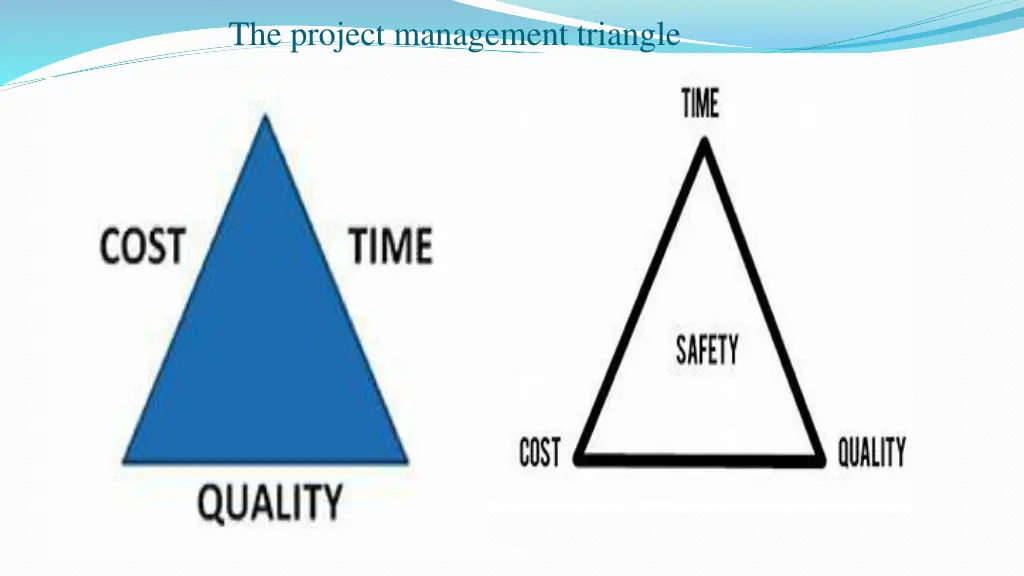
1.1.0 CONSTRUCTION SECTOR 1.1.1 CONSTRUCTION Construction management (CM) is a professional service that uses specialized, project management techniques to oversee the planning, design, and construction of a project, from its beginning to its end. The purpose of CM is to control a project's time /delivery, cost and quality, it is sometimes referred to as a project management triangle or "triple constraints. The Project Management Triangle (also called the Triple Constraint, Iron Triangle and "Project Triangle") is a model of the constraints of project management.
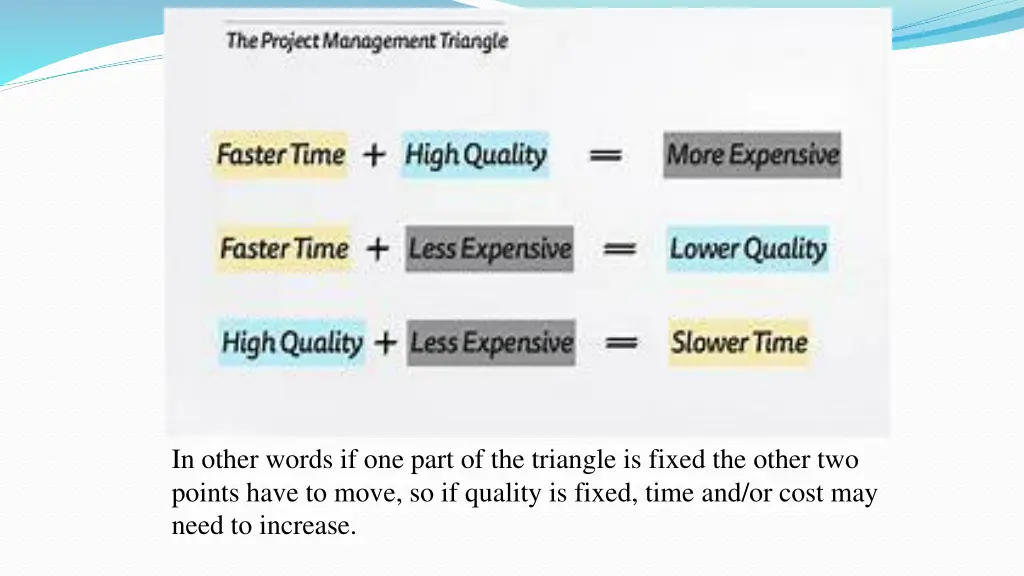
In other words if one part of the triangle is fixed the other two points have to move, so if quality is fixed, time and/or cost may need to increase.
Functions of construction management Project Management Planning Although it is only one of the six functions of construction management, planning out the entire project is an essential task as it lays out the stepping stones for completing a project. Before a project can even be started, the project manager must plan out each step of the project. Project managers must define workers tasks, and estimate the duration of each activity. This information is necessary when planning out a project thoroughly. Without a great construction plan, it is challenging to develop a budget and work schedule.
Functions of construction management Cost Management Understanding the costs of a project is a necessary part of managing construction. The second in the six functions of construction management is creating a budget. Project managers use the budget to determine the total costs and returns expected from a particular project. Understanding one s budget can help build the payment table. Project managers use the budget and plan to determine when steps are complete. Sometimes project managers request payment at the completion of each step. This can keep projects more affordable since subcontractors aren t saddled with the entire cost at the start. Along with the budget comes a cost plan which will outline all the costs of the construction and the costs of the entire project. The budget shows the limit of expenses, while the cost plan shows where and when project managers can spend the money, although they seem quite similar.
Functions of construction management Time Management Time is something you can never get back once you lose it, thus people make use of their time wisely. In construction, the more time spent on a project equates to higher expenses. The ability to use time wisely and efficiently is an important skill needed for someone in construction management and is the reason that it is considered one of the key functions of construction management. A manager must have these skills: clear and effective communication, delegation, and prioritization. It is even more critical in the field of construction because any single mistake due to miscommunication or any form of time lag can build up the project expenses. Increasing expenses burden subcontractors when they lack proper scheduling and documentation.
Functions of construction management Quality Management Project managers are also responsible for project quality, which is why it is one of the functions of construction management. In order to ensure that quality is excellent, construction management will need to analyse their work practices to see if they are up to par, determine if the material used is standard quality, and ensure that the finished product is protected from any potential harm or damage that may come to it. Without quality management it is harder to win bids from other.
Functions of construction management Contract Administration Contract administration usually begins when the other functions of construction management, such as cost and time management, have already been taken care of. Contract administration is conducted between the owner and the construction management team. All parties exchange information and make decisions for the overall success and completion of the project. The management team completes the project to contract, and can ensure this by using the original contract documents, and analyzing and observing the overall progress of the construction project. This allows a final opportunity to correct any inaccuracies, doubts, or deviations from the initial design. This final check between the owner and management is crucial. It ensures that both parties are happy with the development of the project.
Functions of construction management Safety Management Construction is an industry where the smallest mistake could lead to injury or even worse, death. This is why safety management is considered a huge part of the functions of construction management. In order to safely start a project, a manager must first plan ahead and determine all the potential safety hazards for each job. By implementing safety protocols such as personal protective equipment and zoning, managers can prevent injury to both workers and bystanders. One of the most overlooked safety issues in the construction workplace is exhaustion. Exhausted workers are more likely to cut corners to finish a project faster, and often don t follow the safety protocol. In order to prevent exhaustion, management should make sure that workers are not working too many overtime shifts.
Objectives of Construction Management Completing the work within estimated budget and specified time. Maintaining a reputation for high quality workmanship. Taking sound decisions and delegation of authority. Developing an organization that works as a team.
1.1.2 Role of government and construction agencies in national development The construction industry is a real investment in the economy either in civil engineering construction, non-residential or residential. It is considered as a component of a strategy to promote aggregate demand for building and industrial sectors. The volume of investments varies depending on the policy of stability through the decision to reduce or increase spending on social services. The two projects that can enhance economy of the country are highway projects and housing projects which both of this fall under construction industry.
1.1.2 Role of government and construction agencies in national development Highway transportation is the method for subtle element circulation between homes, shops, and others. It is just the streets which can convey merchandise from and to aerodromes, larbors and rail route stations. Considering the utility of streets anyplace in the distinctive parts of a nation, they can be rightly contrasted with corridors in a human body generally as supply routes keep up man s wellbeing by giving flow of blood; likewise streets advance country s riches by keeping its kin and merchandise moving. Hence, we see that advance and prosperity of a country depends much on streets. Actually, streets are the life lines of country s economy.
1.1.2 Role of government and construction agencies in national development Housing is one of the basic requirements for ensuring the well-being of the people is protected. The construction sector also contributed to economic growth that has direct relevance to other sectors, including the services sector and the manufacturing sector of building materials. In fulfilling this requirement, such factors as the ability of buyers, development costs and selling prices always affect the demand and supply of housing. Based on the current state of affairs, housing construction is largely concentrated in urban and suburban areas densely populated with potential buyers was high and the housing market is more widespread.
1.1.3 Types of construction Brick and Block construction In modern traditionally built houses the walls are built in two leaves. There is an internal blockwork wall and the external wall built of brick or stone. These, together with some internal partitions which are also built of blockwork, will support the structure of the house. Brick and block can be one of the cheapest construction types. Most builders would prefer to build in masonry, so builders tend to price a bit more competitively, and of course a lot of self-builders are in the trade, so they have more chance of getting better rates from mates or family in the trade, than they will from a timber frame company. Modern masonry construction is however slower than a frame construction which can be up with a matter of days.
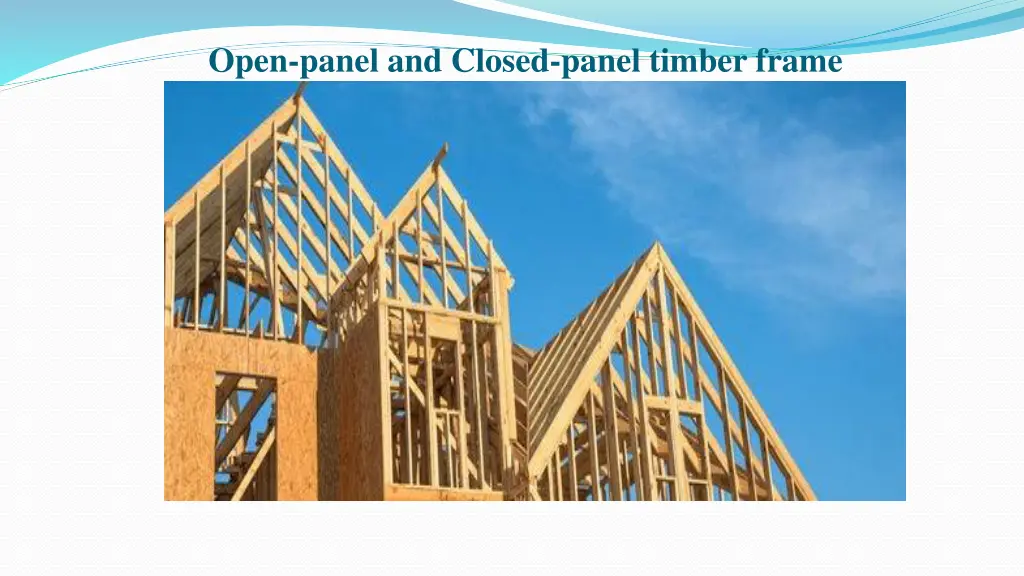
1.1.3 Types of construction Timber Frame construction Open-Panel Timber frame open panel systems, are structurally engineered panels that form the inside load-bearing leaf of the external wall, comprising studs, rails, sheathing on one face and a breather membrane. The open panel system is made from treated softwood timber framing, over which a structural sheet material of either Ply or OSB board is fixed.
1.1.3 Types of construction Timber Frame construction Closed-Panel Are made from studs, rails and insulation, with sheathings and/or linings on the faces of the panel. A vapour barrier is also provided on the warm side of the insulation and a breather membrane on the outer face of the panel. If desired, closed panels may also include fitted windows and internal service zone battens, for ease of installation and construction. These solutions have been designed to deliver excellent thermal and airtightness properties and are ideal as the basis of a modern energy efficient home.
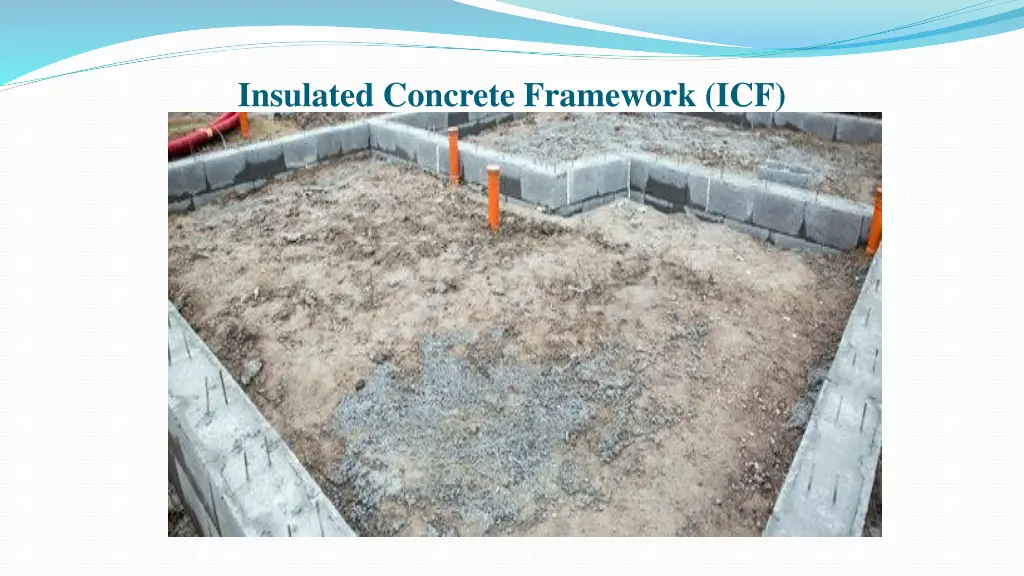
1.1.3 Types of construction Insulated Concrete Framework (ICF) constriction Insulating concrete formwork (ICF) or permanently insulated formwork (PIF) is an insulated in-situ concrete system of building that is quick to construct, providing a practical method of building insulated walls for houses. ICF is based on hollow lightweight block components that lock together without intermediate bedding materials, such as mortar, to provide a formwork system into which concrete is poured. The block is formed of sheets of insulation materials normally expanded polystyrene tied together with plastic or steel ties, or an integral web of the same insulation. Once set, it becomes a high strength concrete frame structure with the formwork remaining in place as thermal insulation.
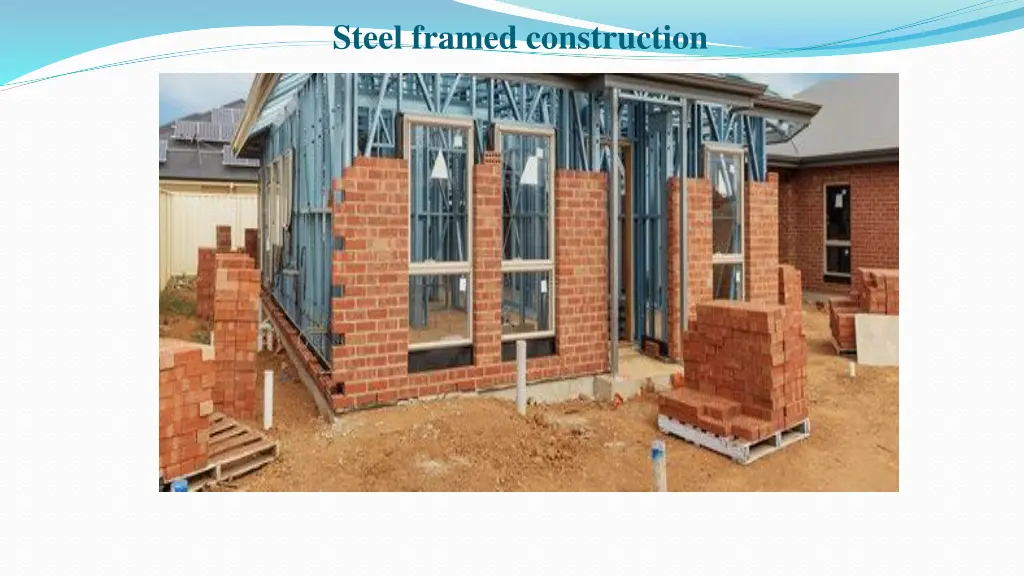
1.1.3 Types of construction Steel Framed Construction Building in steel has been popular in the USA and South Africa for some time and recently has been the subject of much interest in this country. The steel framework is lightweight, strong, weather resistant and quick to erect. Exterior panels are attached to the steel frame and then rendered. Most of the materials are made to measure prior to delivery on site and thus the house can be made weatherproof very quickly.
1.1.3 Types of construction Structural Insulated Panels (SIPS) construction Structural Insulated Panels (SIPs) provide a cost effective, environmentally friendly and labour saving alternative to traditional timber framing and masonry construction methods. SIPs are quick to erect (typical house erected in 5-7 days including roof), strong and energy-efficient (7 times stronger than timber frame, 3 x stronger than brick and block) making them a fantastic option for self builders not least because their accurate manufacture helps simplify construction on site, reducing the chance of the project falling behind schedule. Structural insulated panels are usually used in roofs and external walls of buildings but may also be used in floors and internal walls. The long term benefit of building using SIPs is lower energy bills and reduced energy consumption and CO2 emissions. Their lightweight and factory production reduces transport energy and onsite wastage, therefore reducing the overall carbon footprint.
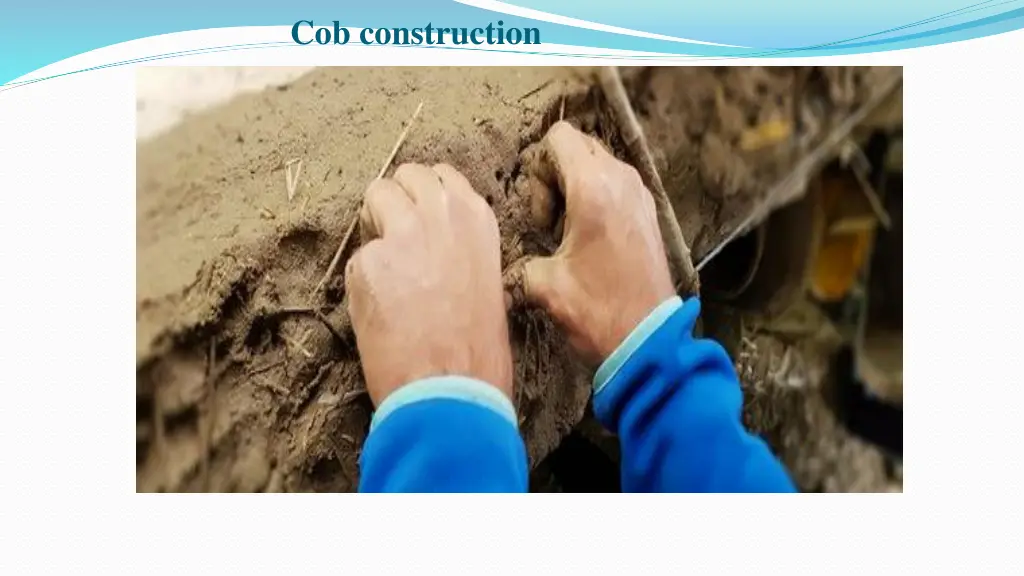
1.1.3 Types of construction Cob Construction Making buildings with dirt is an idea that's been around almost as long as man has been on earth. The traditional material for English cob was soil (clay-based) mixed with water and straw, sometimes with sand added. The technique involves building up thick walls by working in layers, letting each one harden before adding the next. The wall is then plastered with clay or lime, or can be left unfinished. Cob is simple, cheap, requires few tools other than your hands and is extremely environmentally friendly. The end result dries almost as hard as concrete, making it ideal for structural walls. It s durable, fire-resistant, has high levels of insulation and malleability, allowing the walls take on any shape you wish. The downside is that the build process can be time- consuming
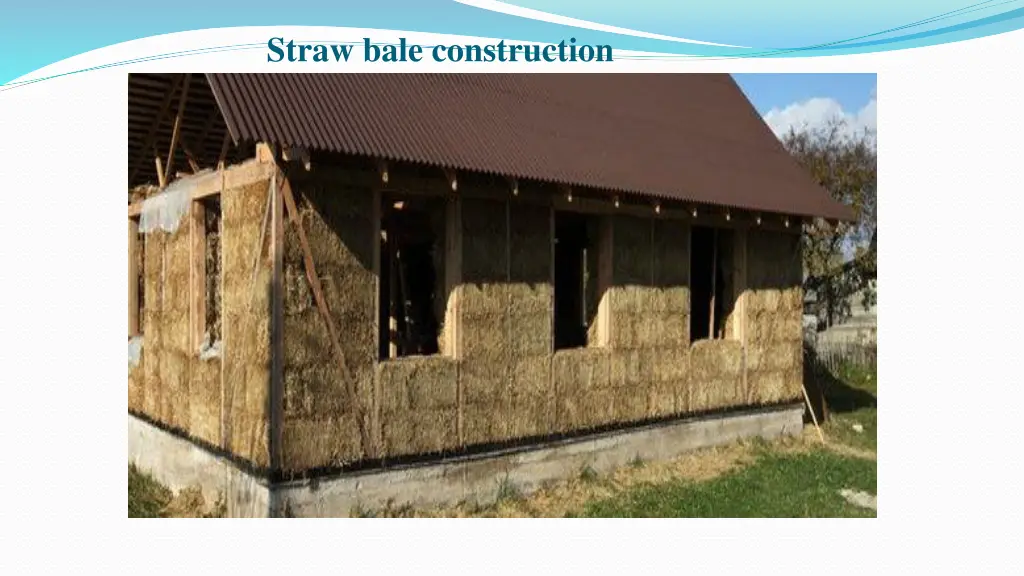
1.1.3 Types of construction Straw Bale Construction People have built homes using straw, grass, or reed throughout history due to the low cost and ready availability. With straw often being a farm surplus product and very cheap, it's inexpensive, and an easily renewable medium. Properly built, straw bale houses are fire-resistant, waterproof and actually pest free, with super-insulated walls. Construction Methods Structural Bale Construction. When used to bear load, the bales are placed on top of each other in a stretcher or running bond with long wooden pegs driven through to connect the layers.
1.1.4 Types of construction sector There are two types of sectors involved in our construction industry; there are public sector and private sector. The private sector is typically made out of associations that are privately possessed and not some piece of the government. These as a rule incorporate enterprises (both benefit and non-benefit), organizations, and foundations. A simpler approach to think about the private sector is by considering associations that are not claimed or worked by the government. For instance, retail locations, credit unions, and neighborhood organizations will work in the private sector. The public sector is generally made out of associations that are claimed and worked by the legislature. This incorporates elected, commonplace, state, or metropolitan governments, contingent upon where you live. Protection enactment more often than not calls associations in the public sector a public body or a public power. .
1.1.5 Construction practice The standard and planned practices followed in the construction industry that will guarantee optimal outcome and profit are regarded as best practices in construction. These practices can be a policy, procedure or a complete system implemented at a given period of time. The best Business Practices in Construction are; Procurement, Partnering, Risk Management, Value Management, Benchmarking, Whole Life Costing, Health and Safety, and Sustainable Construction.
1.1.6 Duties and responsibilities of clients/owner The main duties/responsibilities of the client on all construction projects are to: Ensure that suitable management arrangements are made for the project Select & appoint a competent and resourced Principal Designer. Select & appoint a competent and resourced Principal contractor. Notify the relevant enforcing authority of certain projects (notifiable). Ensure sufficient time and resources are allowed for all stages of the project. Provide the pre-construction information (PCI) to the designers and contractors. Verify the sufficiency of the construction phase plan (CPP) prior to construction commencement. Verify that suitable welfare facilities are in place prior to construction commencement. Contractor training - Ensure the necessary information, instruction and training is received and appropriate supervision is provided to comply with the regulations. Ensure co-operation and co-ordination between the client's employees and client contractors with the project contractors where the client's work activities overlap the construction work and to enable others to perform their duties. Subsequent to receipt of the health and safety file from the Principal Designer, maintain the information up to date and provide access to any person who needs to see it for health and safety purposes.
1.1.7 Duties and responsibilities of consultant Evaluating project parameters All project consultants, regardless of industry, evaluate the project parameters. This involves interviewing clients and actively listening to their answers. The better they perform this duty, the easier the following duties are to complete. Analyzing project strengths and areas needing improvement Project consultants use their understanding of the client s overall goals to analyze their current progress for strengths and areas needing improvement. The level of progress varies for each client. Sometimes their job involves making small tweaks to an existing plan, and other times, it involves creating a whole new plan from scratch. A variation of the SWOT analysis (strengths, weaknesses, opportunities, and threats) is used by many project consultants. Devising a project plan based on client needs Once project consultants understand the client goals and the resources available, they create a project plan outlining how resources will be used to achieve the project parameters.
1.1.7 Duties and responsibilities of consultant Projecting tasks to employees Project consultants who work in-house are directly responsible for delegating project tasks to each employee to get the project done as efficiently as possible. Project consultants who work on their own or for a consulting firm coach decision makers through this process. Testing and tweaking project solutions to perfection Project consultants monitor the completion of each stage of the project, making tweaks to the plan based on feedback. They are also responsible for testing the effectiveness of the project solutions if applicable. Presenting plans and results to project stakeholders Finally, project consultants spend a fair amount of time presenting both their plans and final results to project stakeholders. This requires good communication and negotiation skills.
1.1.8 Duties and responsibilities of a contractor Contractors on all projects must: Make sure the client is aware of the client duties before any work starts. Plan, manage and monitor all work carried out by themselves and their workers, taking into account the risks to anyone who might be affected by it (including members of the public) and the measures needed to protect them. Check that all workers they employ or appoint have the skills, knowledge, training and experience to carry out the work, or are in the process of obtaining them. Make sure that all workers under their control have a suitable, site-specific induction, unless this has already been provided by the principal contractor. Provide appropriate supervision, information and instructions to workers under their control.
1.1.8 Duties and responsibilities of a contractor Contractors on all projects must: Ensure they do not start work on site unless reasonable steps have been taken to prevent unauthorised access. Ensure suitable welfare facilities are provided from the start for workers under their control, and maintain them throughout the work. Coordinate their work with the work of others in the project team. Comply with directions given by the principal designer or principal contractor. Comply with parts of the construction phase plan relevant to their work.
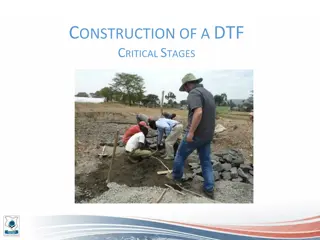
1.1.9 Stages in construction of a project The construction of a project has several stages of completion prior to the actual finishing point. A project undergoes mainly five stages to be achieved fully, and these are described below in detail: Design stage The design stage is the preliminary stage of a construction project, and the bidding process comes to pass during this project stage. The design team is responsible for making certain that the design meets the regulations and codes of the building. This stage of a construction project includes four major sub-steps as defined below: Programming & feasibility: To start with the actual designing of the project, the desires, objectives and goals are ought to be decided for the project/building. The decisions, in this stage, are required to be made based on the number of rooms, size of the building, number and type of occupants, and depending on how the space would be employed. Schematic design: These are sketches used to identify patterns, shapes and spaces, and these sketches must also take into consideration the textures, materials, colors and sizes as well.
1.1.9 Stages in construction of a project Design development (DD): The third step undertakes thorough research into the type of equipments and materials that should be used in the project construction, along with their respective costs. Contract documents (CDs): Also known as working drawings, these are the construction project s final specifications and drawings. Builders use these documents for the purpose of construction, while contractors use them to settle on their bid. Pre-Construction stage This second stage of a construction project commences when a notice is given by the owner to move on to the contractor who has been chosen by the process of bidding. The proceeding notice signifies that the owner offers consent to the contractor for starting the construction work on the building. In this stage, the owner allots the project team that comprises of the contract administrator, project manager and field engineer. A site examination is also essential during this stage of pre- construction to ascertain if any other steps are required to be put into practice on the job site. Prior to the actual process of construction, the site gets all set in this stage.
1.1.9 Stages in construction of a project Procurement stage The third stage of procurement is when the required equipment, materials, and labor are purchased for the project completion. A general contractor can undertake this task in cases where the entire work of construction is done by the company itself. There is also a possibility that a sub-contractor might be appointed by the contractor to assume this task of procurement. Contractors who concentrate in a specific aspect of the construction work like carpentry, glass, or concrete are known as Subcontractors. Construction stage The superintendent brings in concert a pre-construction meeting during this stage of a construction project. This meeting takes into consideration and discusses issues such as site access, quality control, material storage, and work hours. The subsequent step is to shift everything on the construction locate and take hold of it all.
1.1.9 Stages in construction of a project Post-Construction stage On completion of the project, a few steps must be followed to set up the building for possession. These steps comprise of the signing of documentation and paperwork, and the release of final imbursement to the contractor.
1.2.0 PROJECT FEASIBILITY REPORT A feasibility study is an assessment of the practicality of a proposed project. It aims to objectively and rationally uncover the strengths and weaknesses of an existing project or opportunities and threats present in the natural environment, the resources required to carry through, and ultimately the prospects for success. In its simplest terms, the two criteria to judge feasibility are cost required and value to be attained. A project feasibility study is a comprehensive report that examines in detail the five frames of analysis of a given project. The goal is to determine whether the project should go ahead, be redesigned, or else abandoned altogether. The five frames of analysis are: The frame of definition; the frame of contextual risks; the frame of potentiality; the parametric frame; the frame of dominant and contingency strategies.
1.2.0 PROJECT FEASIBILITY REPORT 1.2.1 Technical/Financial/Economic/Ecological analysis Technical analysis Technical analysis seek out to decide whether the fundamentals for the successful commissioning of the project has been considered and reasonably good options have been made with respect to location, size, process etc. The important questions raised in technical analysis are the following Whether preliminary tests and studies have been done? Whether the availability of raw materials, power, and other inputs has been recognized? Whether the production method opted is suitable? Whether the equipment and machines chosen are suitable? Whether provision has been made for handling of effluents? Whether the planned layout of the site, building, and plant is sound? Whether work schedules have been reasonably drawn up? Whether the technology planned to be employed is suitable from the social plant of view?
1.2.1 Technical/Financial/Economic/Ecological analysis Financial analysis Financial analysis tries to ascertain whether the planned project will be financially feasible in the sense of being able to meet the saddle of servicing debt and whether the planned project will convince the return expectations of those who provide the capital. The feature that have to be looked into while conditioning financial appraisal are the following: Investment pay out and cost of project Means of financing Cost of capital Projected profitability Break-even point Cash flow of the project Projected financial position Level of risk
1.2.1 Technical/Financial/Economic/Ecological analysis Economic analysis Economic analysis is also referred to as social cost benefit analysis and is concerned with evaluating a project from the larger social point of view. In such a judgement the focus is on the social costs and benefits of a project which may usually be different from its economic costs and benefits. The questions sought to be answered in social benefit analysis are the following; What are the direct economic benefits and costs of the project measured in terms of efficiency prices and not in terms of market prices? What would be the impact of the project on the allocation of income in the society? What would be the outcome of the project on the level of savings and investment in the society? What would be the involvement of the project towards the achievement of certain merit wants like self-sufficiency, employment, and social order?
1.2.1 Technical/Financial/Economic/Ecological analysis Ecological analysis Ecological analysis should be done particularly for major projects which have significant ecological inference like plants and irrigation schemes, and environmental polluting industries like bulk drugs, chemicals and leather processing. The key questions raised in ecological analysis are the following; What is the likely harm caused by the project to the environment? What is the cost of reinstatement measures needed to make sure that the damage to the environment is contained within acceptable limits?