Contracting Policy Update and Small Business Initiatives for FY24 and FY25
Discover the latest policy pronouncements and initiatives aimed at increasing opportunities for small disadvantaged businesses in federal contracting. Learn about SBA set-asides, DoD strategies, SBA rules adjustments, and FAR rule amendments to support small businesses. Stay informed on targets set by the Biden administration and OMB to advance equity and inclusivity in government contracting.

Download Presentation

Please find below an Image/Link to download the presentation.
The content on the website is provided AS IS for your information and personal use only. It may not be sold, licensed, or shared on other websites without obtaining consent from the author. If you encounter any issues during the download, it is possible that the publisher has removed the file from their server.
You are allowed to download the files provided on this website for personal or commercial use, subject to the condition that they are used lawfully. All files are the property of their respective owners.
The content on the website is provided AS IS for your information and personal use only. It may not be sold, licensed, or shared on other websites without obtaining consent from the author.
E N D
Presentation Transcript
Small Business Set-asides (November 2023 v.2) (c) Centre Law & Consulting LLC 1
Agenda Introductions Policy Pronouncements/Rules Types of Set-asides SBA 8(a) Program Companies HUBZone Companies WOSB/EDWOSB Companies SDVOSB Companies Questions and Comments (c ) Centre Law & Consulting 2
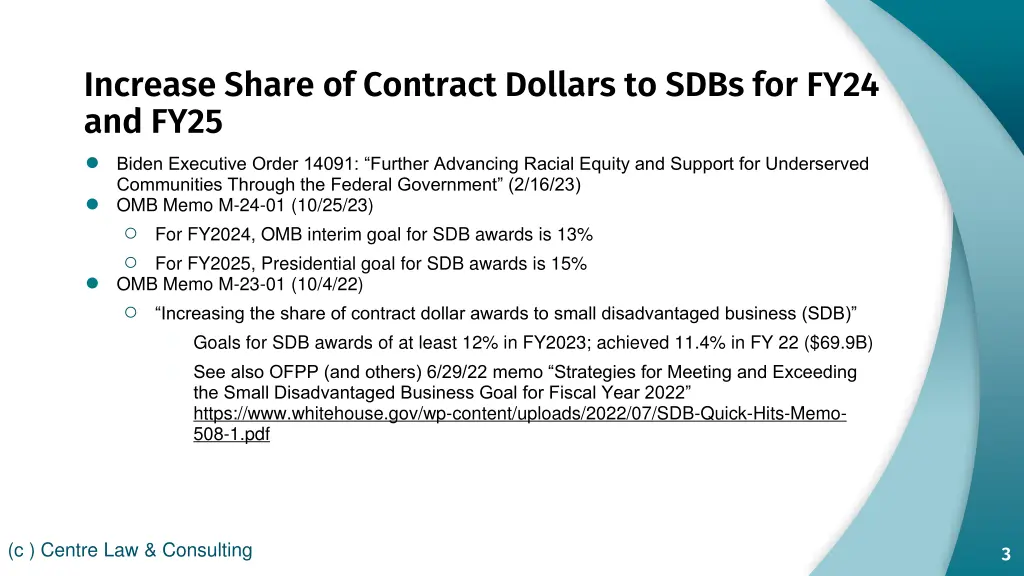
Increase Share of Contract Dollars to SDBs for FY24 and FY25 Biden Executive Order 14091: Further Advancing Racial Equity and Support for Underserved Communities Through the Federal Government (2/16/23) OMB Memo M-24-01 (10/25/23) For FY2024, OMB interim goal for SDB awards is 13% For FY2025, Presidential goal for SDB awards is 15% OMB Memo M-23-01 (10/4/22) Increasing the share of contract dollar awards to small disadvantaged business (SDB) Goals for SDB awards of at least 12% in FY2023; achieved 11.4% in FY 22 ($69.9B) See also OFPP (and others) 6/29/22 memo Strategies for Meeting and Exceeding the Small Disadvantaged Business Goal for Fiscal Year 2022 https://www.whitehouse.gov/wp-content/uploads/2022/07/SDB-Quick-Hits-Memo- 508-1.pdf (c ) Centre Law & Consulting 3
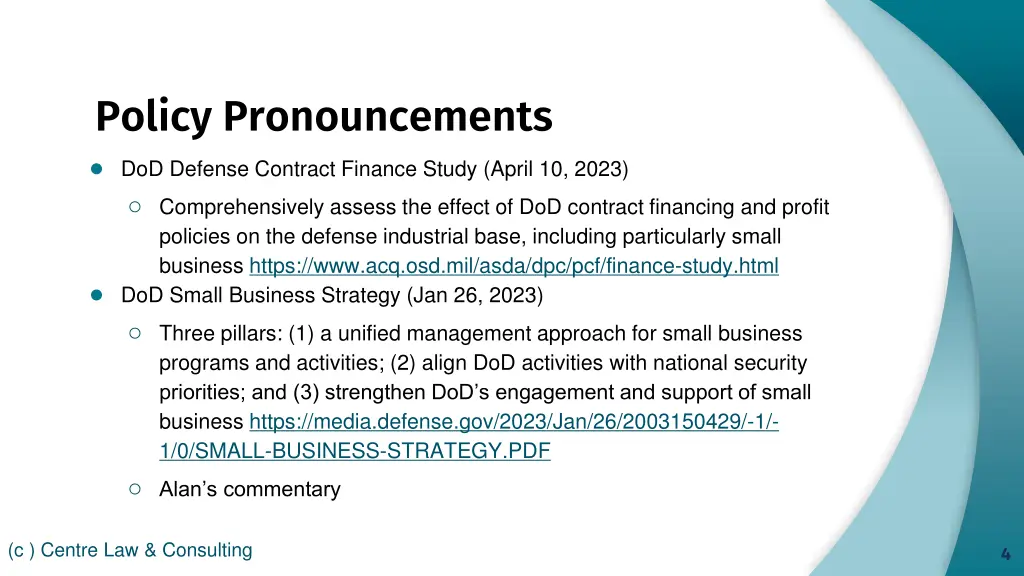
Policy Pronouncements DoD Defense Contract Finance Study (April 10, 2023) Comprehensively assess the effect of DoD contract financing and profit policies on the defense industrial base, including particularly small business https://www.acq.osd.mil/asda/dpc/pcf/finance-study.html DoD Small Business Strategy (Jan 26, 2023) Three pillars: (1) a unified management approach for small business programs and activities; (2) align DoD activities with national security priorities; and (3) strengthen DoD s engagement and support of small business https://media.defense.gov/2023/Jan/26/2003150429/-1/- 1/0/SMALL-BUSINESS-STRATEGY.PDF Alan s commentary (c ) Centre Law & Consulting 4
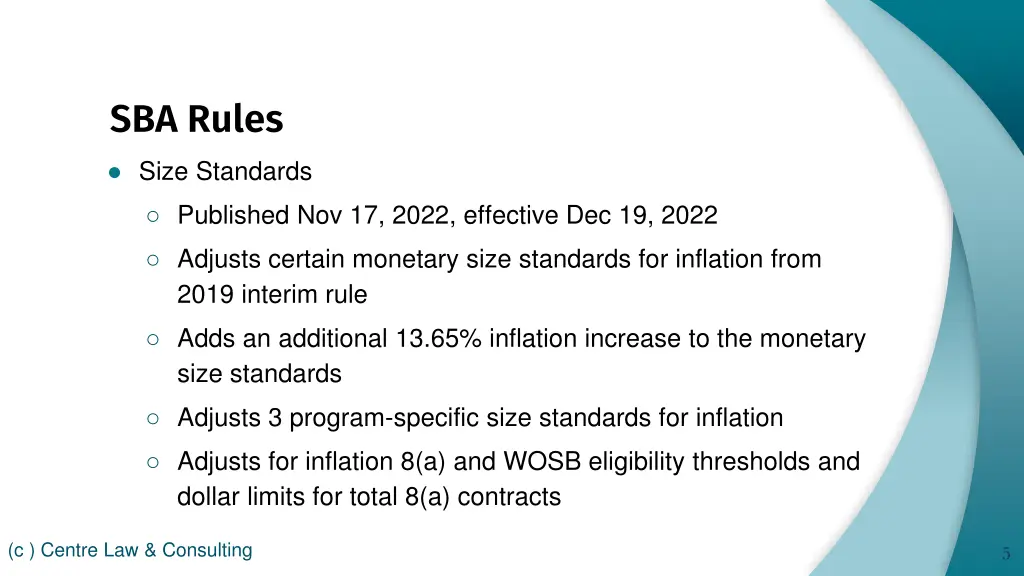
SBA Rules Size Standards Published Nov 17, 2022, effective Dec 19, 2022 Adjusts certain monetary size standards for inflation from 2019 interim rule Adds an additional 13.65% inflation increase to the monetary size standards Adjusts 3 program-specific size standards for inflation Adjusts for inflation 8(a) and WOSB eligibility thresholds and dollar limits for total 8(a) contracts (c ) Centre Law & Consulting 5
FAR Rules Small Business Program Amendments Final FAR rule published Feb 14, 2023, effective March16, 2023 (FAC 2023-02) Implements SBA final rule published Nov 29, 2019 Determines size as of the date of initial offer for the multiple- award contract, whether or not the offer includes price, aligning with SBA regulations (c ) Centre Law & Consulting 6
Similarly Situated Entity A similarly situated entity is a concern that has the same required size and small business program status as the prime contractor (c ) Centre Law & Consulting 7
Rule of Two If at least two small businesses could do the work for a fair price, the contract should be set aside exclusively for small businesses to compete If fewer than two, CO is authorized to create a sole-source contract for certain socio-economic types, or otherwise offer it for full and open competition Both SBA s regulations and the FAR require CO to consider SBA socio- economic programs first for set-aside and sole-source contracts above $250,000. There is no order of preference among the programs Set-asides for socio-economic programs cannot be made if: The requirement would be fulfilled through the award of Federal Prison Industries, Inc. or Javits-Wagner-O Day Act participating nonprofit agencies for the blind and severely disabled The requirement is currently being performed by an 8(a) participant or SBA has accepted that requirement for performance under the 8(a) program Sole-source award for socio-economic programs can be made if and as permitted under each program's requirements and procedures (c ) Centre Law & Consulting 8
Nonmanufacturer Rule If a small business receives a set-aside award but doesn t manufacture the product it sells to the government, it must supply the product of another small business that is manufactured in the United States Contracting officer can apply for an SBA waiver if it is not possible to use a small business product The non-manufacturer rule: Applies to all set-aside contracts under the 8(a), HUBZone, SDVOSB, and WOSB programs Does not apply to small business set-aside contracts at or below $250,000 (c ) Centre Law & Consulting 9
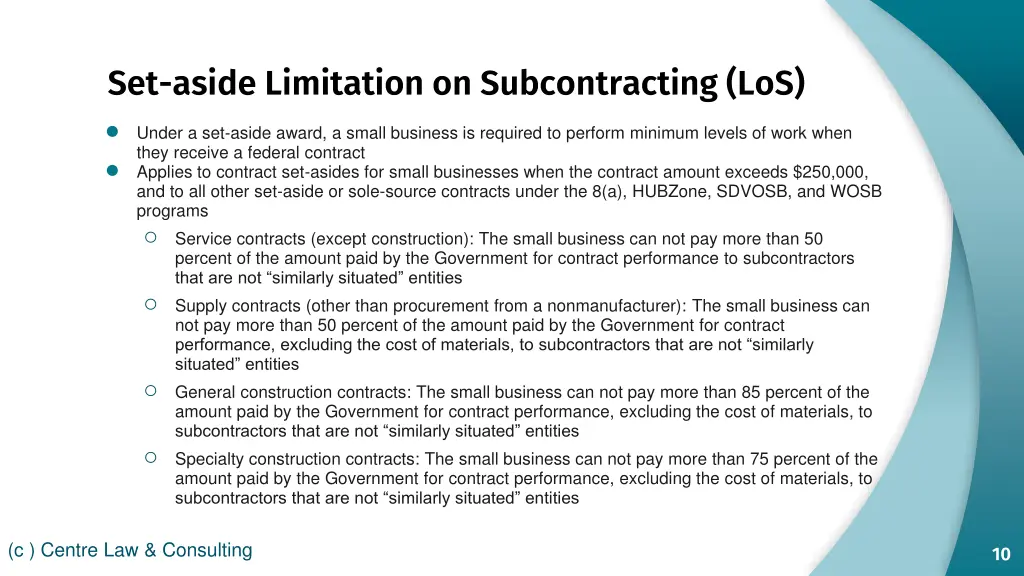
Set-aside Limitation on Subcontracting (LoS) Under a set-aside award, a small business is required to perform minimum levels of work when they receive a federal contract Applies to contract set-asides for small businesses when the contract amount exceeds $250,000, and to all other set-aside or sole-source contracts under the 8(a), HUBZone, SDVOSB, and WOSB programs Service contracts (except construction): The small business can not pay more than 50 percent of the amount paid by the Government for contract performance to subcontractors that are not similarly situated entities Supply contracts (other than procurement from a nonmanufacturer): The small business can not pay more than 50 percent of the amount paid by the Government for contract performance, excluding the cost of materials, to subcontractors that are not similarly situated entities General construction contracts: The small business can not pay more than 85 percent of the amount paid by the Government for contract performance, excluding the cost of materials, to subcontractors that are not similarly situated entities Specialty construction contracts: The small business can not pay more than 75 percent of the amount paid by the Government for contract performance, excluding the cost of materials, to subcontractors that are not similarly situated entities (c ) Centre Law & Consulting 10
Types of Set-Asides 8(a) Business Development program HUBZone program Women-Owned Small Business program Service-Disabled Veteran-Owned Small Business program CO must document: The rationale to support the specific set-aside including the type and extent of market research in the contract file Winning contractor s certification in SAM (c ) Centre Law & Consulting 11
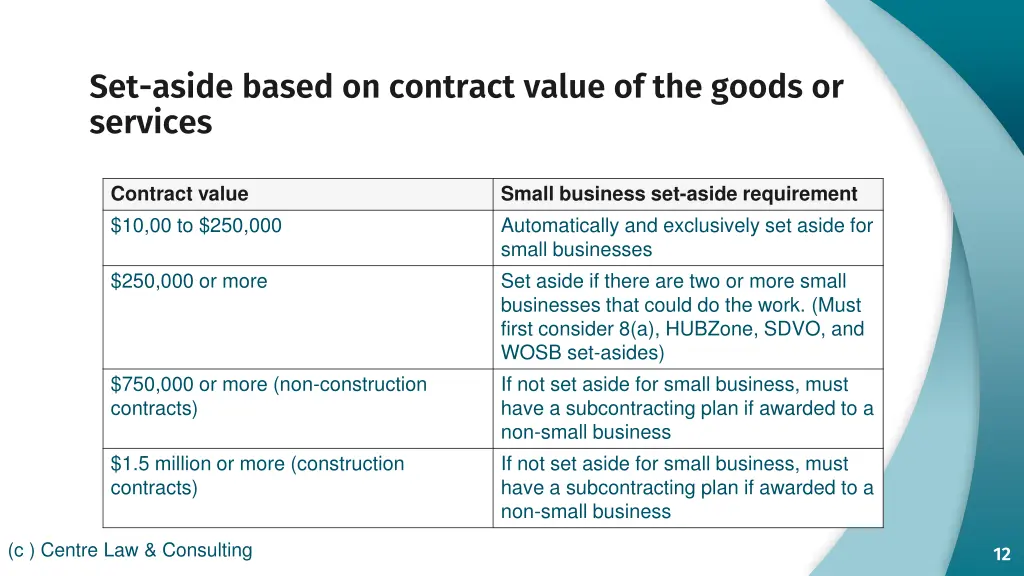
Set-aside based on contract value of the goods or services Contract value $10,00 to $250,000 Small business set-aside requirement Automatically and exclusively set aside for small businesses Set aside if there are two or more small businesses that could do the work. (Must first consider 8(a), HUBZone, SDVO, and WOSB set-asides) If not set aside for small business, must have a subcontracting plan if awarded to a non-small business If not set aside for small business, must have a subcontracting plan if awarded to a non-small business $250,000 or more $750,000 or more (non-construction contracts) $1.5 million or more (construction contracts) (c ) Centre Law & Consulting 12
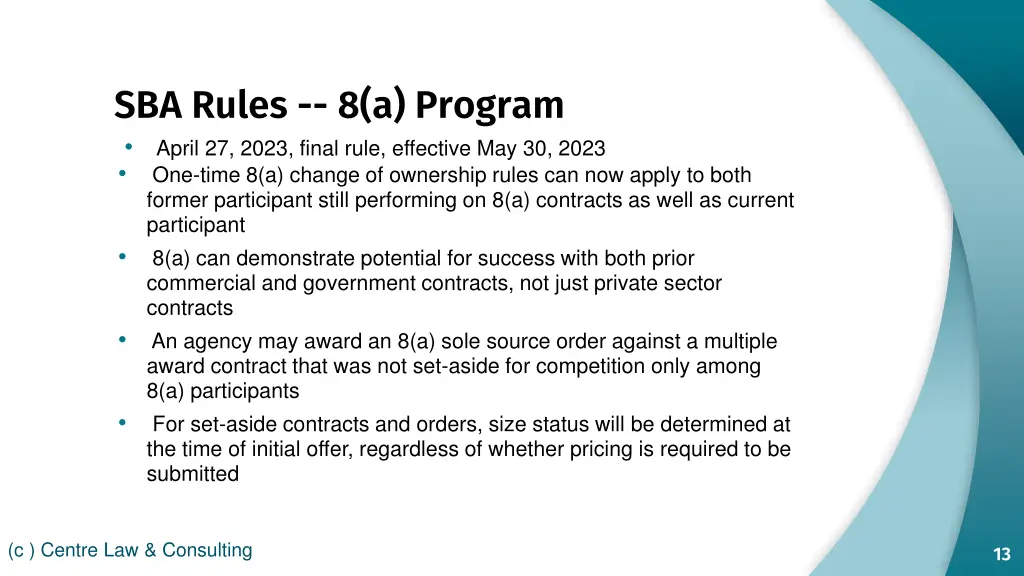
SBA Rules -- 8(a) Program April 27, 2023, final rule, effective May 30, 2023 One-time 8(a) change of ownership rules can now apply to both former participant still performing on 8(a) contracts as well as current participant 8(a) can demonstrate potential for success with both prior commercial and government contracts, not just private sector contracts An agency may award an 8(a) sole source order against a multiple award contract that was not set-aside for competition only among 8(a) participants For set-aside contracts and orders, size status will be determined at the time of initial offer, regardless of whether pricing is required to be submitted (c ) Centre Law & Consulting 13
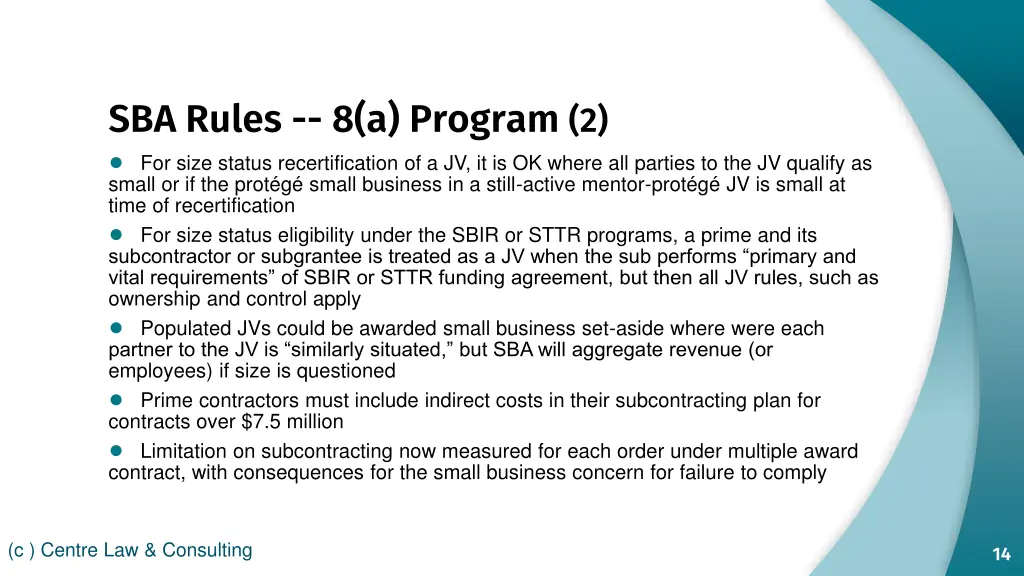
SBA Rules -- 8(a) Program (2) For size status recertification of a JV, it is OK where all parties to the JV qualify as small or if the prot g small business in a still-active mentor-prot g JV is small at time of recertification For size status eligibility under the SBIR or STTR programs, a prime and its subcontractor or subgrantee is treated as a JV when the sub performs primary and vital requirements of SBIR or STTR funding agreement, but then all JV rules, such as ownership and control apply Populated JVs could be awarded small business set-aside where were each partner to the JV is similarly situated, but SBA will aggregate revenue (or employees) if size is questioned Prime contractors must include indirect costs in their subcontracting plan for contracts over $7.5 million Limitation on subcontracting now measured for each order under multiple award contract, with consequences for the small business concern for failure to comply (c ) Centre Law & Consulting 14
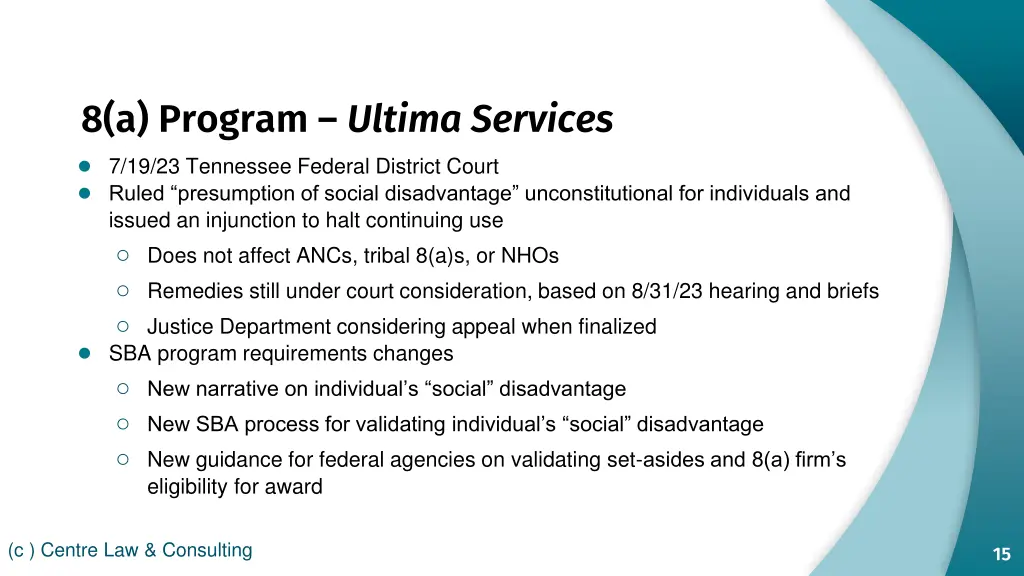
8(a) Program Ultima Services 7/19/23 Tennessee Federal District Court Ruled presumption of social disadvantage unconstitutional for individuals and issued an injunction to halt continuing use Does not affect ANCs, tribal 8(a)s, or NHOs Remedies still under court consideration, based on 8/31/23 hearing and briefs Justice Department considering appeal when finalized SBA program requirements changes New narrative on individual s social disadvantage New SBA process for validating individual s social disadvantage New guidance for federal agencies on validating set-asides and 8(a) firm s eligibility for award (c ) Centre Law & Consulting 15
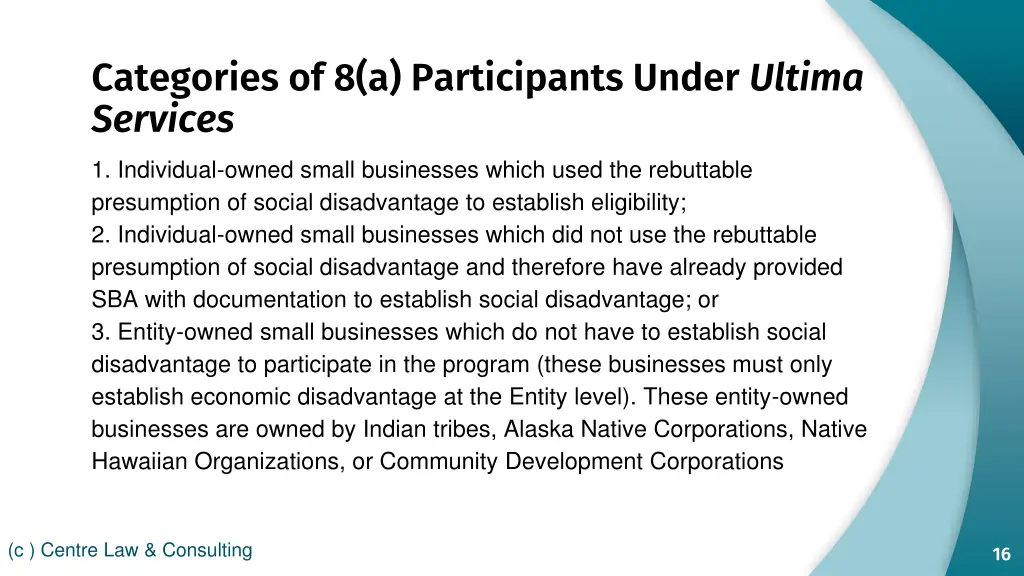
Categories of 8(a) Participants Under Ultima Services 1. Individual-owned small businesses which used the rebuttable presumption of social disadvantage to establish eligibility; 2. Individual-owned small businesses which did not use the rebuttable presumption of social disadvantage and therefore have already provided SBA with documentation to establish social disadvantage; or 3. Entity-owned small businesses which do not have to establish social disadvantage to participate in the program (these businesses must only establish economic disadvantage at the Entity level). These entity-owned businesses are owned by Indian tribes, Alaska Native Corporations, Native Hawaiian Organizations, or Community Development Corporations (c ) Centre Law & Consulting 16
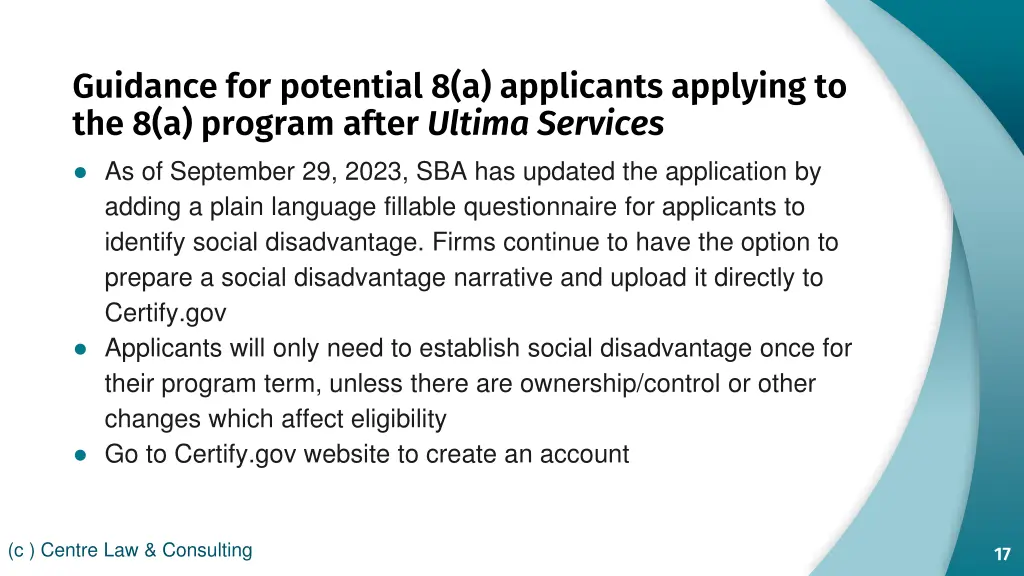
Guidance for potential 8(a) applicants applying to the 8(a) program after Ultima Services As of September 29, 2023, SBA has updated the application by adding a plain language fillable questionnaire for applicants to identify social disadvantage. Firms continue to have the option to prepare a social disadvantage narrative and upload it directly to Certify.gov Applicants will only need to establish social disadvantage once for their program term, unless there are ownership/control or other changes which affect eligibility Go to Certify.gov website to create an account (c ) Centre Law & Consulting 17
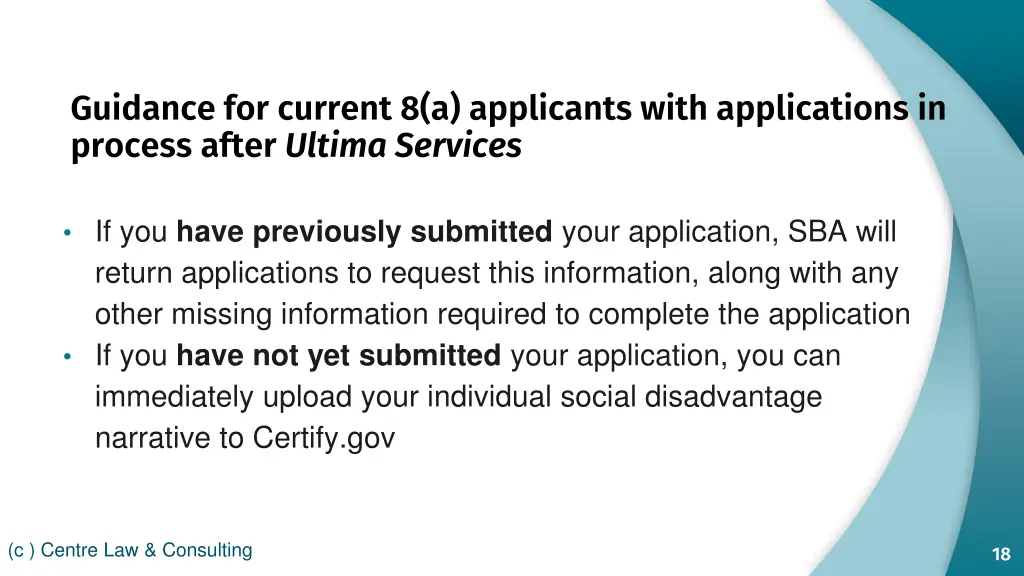
Guidance for current 8(a) applicants with applications in process after Ultima Services If you have previously submitted your application, SBA will return applications to request this information, along with any other missing information required to complete the application If you have not yet submitted your application, you can immediately upload your individual social disadvantage narrative to Certify.gov (c ) Centre Law & Consulting 18
Guidance for Federal Agencies re 8(a) offerings after Ultima Services New guidance effective August 18, 2023 Agencies can immediately continue to send offering letters to SBA Submission of New Requirements to the 8(a) Program Before an award can be made to an individual-owned participant that previously relied on the presumption of social disadvantage to support its eligibility, SBA must make an affirmative determination that the individual upon whom eligibility is based has established personal social disadvantage without the presumption For sole source 8(a) awards offered behalf of a specific 8(a) nominee, SBA will verify the nominee s eligibility for award as part of its acceptance of the procurement into the 8(a) Program. SBA will verify that the nominee meets the social disadvantage requirement in connection with its acceptance Agencies may not rely on SBA inaction as approval. For individual-owned participants, agencies may not proceed to finalizing a contract with the participant until SBA has affirmatively indicated that the individual-owned participant has demonstrated its social disadvantage For competitive 8(a) awards, the procuring agency must request an eligibility determination of the identified apparent successful offeror or offerors and SBA will verify that the nominee(s) meets the social disadvantage requirement in connection with the contract eligibility determination For competitive 8(a) awards outside of 8(a) ordering vehicles (e.g., an 8(a) competitive order under a multiple award contract that is not itself an 8(a) contract), procuring agency must request an eligibility determination of the identified apparent successful offeror or offerors from SBA and SBA will verify that the nominee(s) meets the social disadvantage requirement in connection with the contract eligibility determination Does not apply to awards that are made to 8(a) participants after full and open competition (c ) Centre Law & Consulting 19
Existing Contracts and Options/Modifications with 8(a) Participants after Ultima Services Contracts that were placed into the 8(a) Program prior to July 19, 2023, are not affected by the Ultima Services court injunction Performance on such contracts, as well as most future actions such as issuing priced options and in-scope modifications, may continue as usual If an eligibility determination is required in connection with an 8(a) contract to an individual- owned participant, SBA must make an affirmative finding of social disadvantage Agencies cannot deem SBA to have made that determination through inaction; must await affirmative confirmation from SBA Where a contracting action under a previously awarded 8(a) contract or agreement requires SBA acceptance, SBA will determine the qualifying individual s social disadvantage in accordance with the procedures above Replacing one 8(a) participant with another 8(a) participant (novating) on an 8(a) contract is considered a new contracting action to the firm receiving the award, requiring SBA affirmation that the receiving firm meets the social disadvantage requirement in connection with the novation (c ) Centre Law & Consulting 20
SBA Rules -- HUBZones New map released March 9, 2023, effective July 1, 2023 Expiring HUBZones grandfathered until July 1, 2026 SBA final rule April 10, 2023, effective May 10, 2023 Provides OHA procedures for appeals of protests/determinations regarding HUBZone status (c ) Centre Law & Consulting 21
HUBZone Program Eligibility --Definitions Attempt to maintain means making substantive and documented efforts, such as written offers of employment, published advertisements seeking employees, and attendance at job fairs and applies only to concerns during the performance of any HUBZone contract Employee means all individuals employed on a full-time, part-time, or other basis, so long as that individual works a minimum of 40 hours during the four-week period immediately prior to the relevant date of review, which is either the date the concern submits its HUBZone application to SBA or the date of recertification HUBZone SB means a small business concern that meets the requirements described in 13 CFR 126.200 and that SBA has certified as eligible for federal contracting assistance under the HUBZone program A concern that was a certified HUBZone small business concern as of December 12, 2017, and that had its principal office located in a redesignated area set to expire prior to January 1, 2020, remained a certified HUBZone small business concern until June 30, 2023, as long as all other HUBZone eligibility requirements are met (c ) Centre Law & Consulting 22
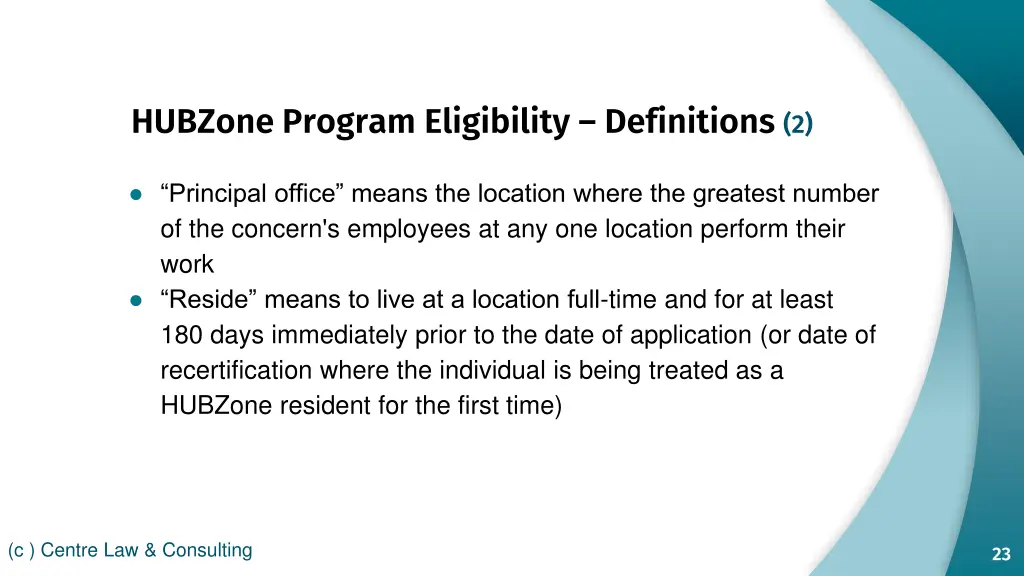
HUBZone Program Eligibility Definitions (2) Principal office means the location where the greatest number of the concern's employees at any one location perform their work Reside means to live at a location full-time and for at least 180 days immediately prior to the date of application (or date of recertification where the individual is being treated as a HUBZone resident for the first time) (c ) Centre Law & Consulting 23
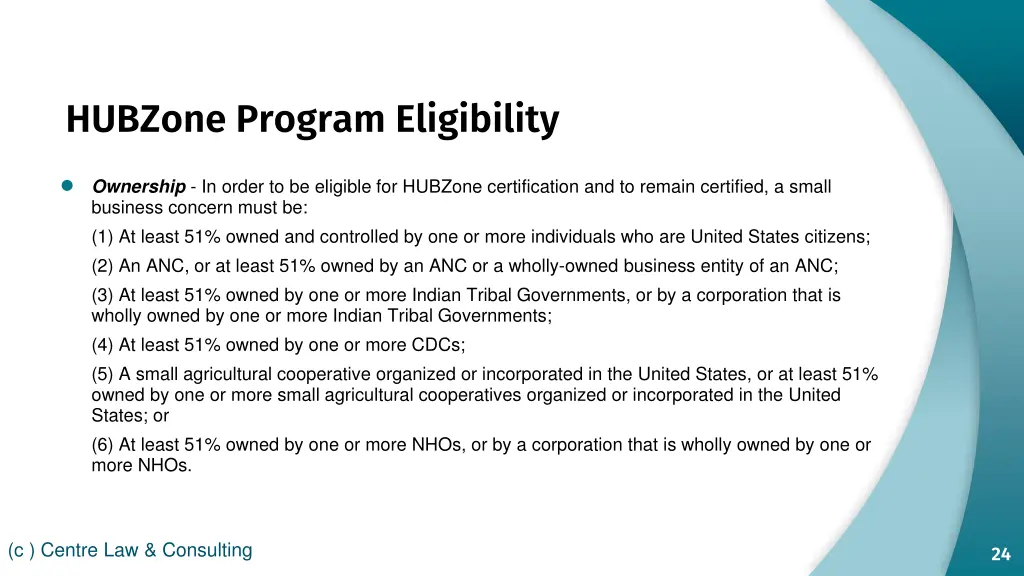
HUBZone Program Eligibility Ownership - In order to be eligible for HUBZone certification and to remain certified, a small business concern must be: (1) At least 51% owned and controlled by one or more individuals who are United States citizens; (2) An ANC, or at least 51% owned by an ANC or a wholly-owned business entity of an ANC; (3) At least 51% owned by one or more Indian Tribal Governments, or by a corporation that is wholly owned by one or more Indian Tribal Governments; (4) At least 51% owned by one or more CDCs; (5) A small agricultural cooperative organized or incorporated in the United States, or at least 51% owned by one or more small agricultural cooperatives organized or incorporated in the United States; or (6) At least 51% owned by one or more NHOs, or by a corporation that is wholly owned by one or more NHOs. (c ) Centre Law & Consulting 24
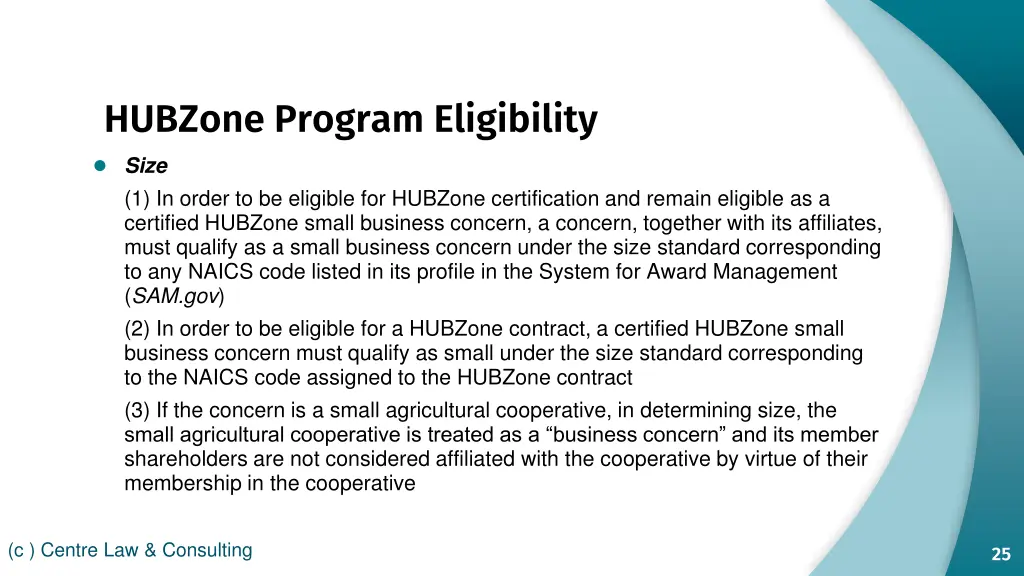
HUBZone Program Eligibility Size (1) In order to be eligible for HUBZone certification and remain eligible as a certified HUBZone small business concern, a concern, together with its affiliates, must qualify as a small business concern under the size standard corresponding to any NAICS code listed in its profile in the System for Award Management (SAM.gov) (2) In order to be eligible for a HUBZone contract, a certified HUBZone small business concern must qualify as small under the size standard corresponding to the NAICS code assigned to the HUBZone contract (3) If the concern is a small agricultural cooperative, in determining size, the small agricultural cooperative is treated as a business concern and its member shareholders are not considered affiliated with the cooperative by virtue of their membership in the cooperative (c ) Centre Law & Consulting 25
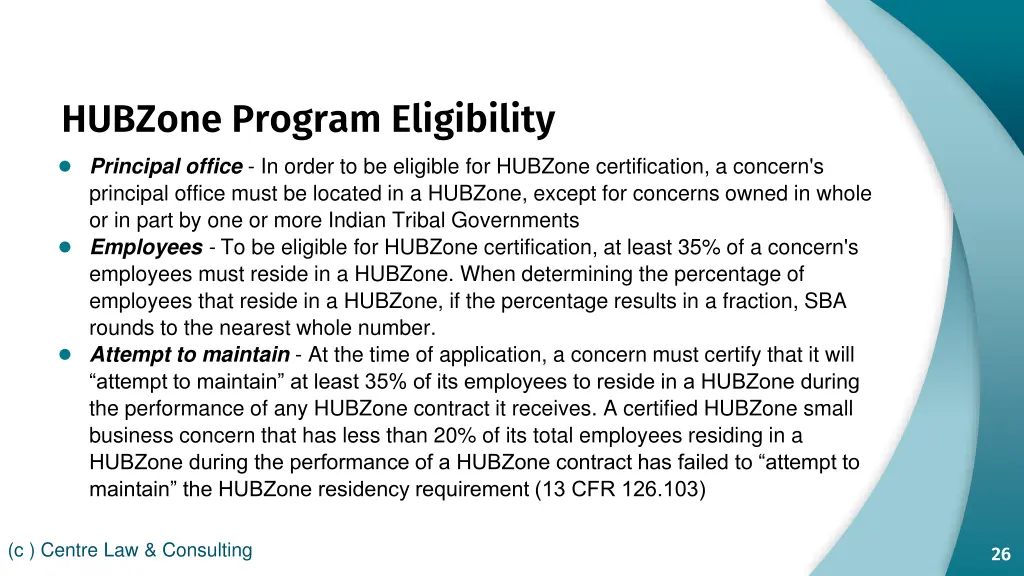
HUBZone Program Eligibility Principal office - In order to be eligible for HUBZone certification, a concern's principal office must be located in a HUBZone, except for concerns owned in whole or in part by one or more Indian Tribal Governments Employees - To be eligible for HUBZone certification, at least 35% of a concern's employees must reside in a HUBZone. When determining the percentage of employees that reside in a HUBZone, if the percentage results in a fraction, SBA rounds to the nearest whole number. Attempt to maintain - At the time of application, a concern must certify that it will attempt to maintain at least 35% of its employees to reside in a HUBZone during the performance of any HUBZone contract it receives. A certified HUBZone small business concern that has less than 20% of its total employees residing in a HUBZone during the performance of a HUBZone contract has failed to attempt to maintain the HUBZone residency requirement (13 CFR 126.103) (c ) Centre Law & Consulting 26
HUBZone Types of Awards A competitive HUBZone set-aside contract can be awarded if the contracting officer has a reasonable expectation that at least two responsible HUBZone small businesses will submit offers and that the resulting contract can be awarded at a fair market price. Set-asides can also be created for specific orders within Multiple Award Contracts that were awarded through full and open competition A sole-source HUBZone contract can be awarded if the contracting officer does not have a reasonable expectation that two or more qualified HUBZone small businesses will submit offers, but still determines that (1) the qualified HUBZone small business is responsible, and (2) the contract can be awarded at a fair price. The government estimate cannot exceed $7 million for a manufacturing requirement or $4.5 million for any other requirement A full and open competition contract can be awarded with a price evaluation preference for HUBZone small businesses. The offer of a HUBZone small business must be considered lower than the offer of a non-HUBZone/non-small business, provided that the offer of the HUBZone small business is not more than 10 percent higher If a requirement has been accepted by SBA under the 8(a) program, it must remain in the 8(a) program unless SBA agrees to its release (c ) Centre Law & Consulting 27
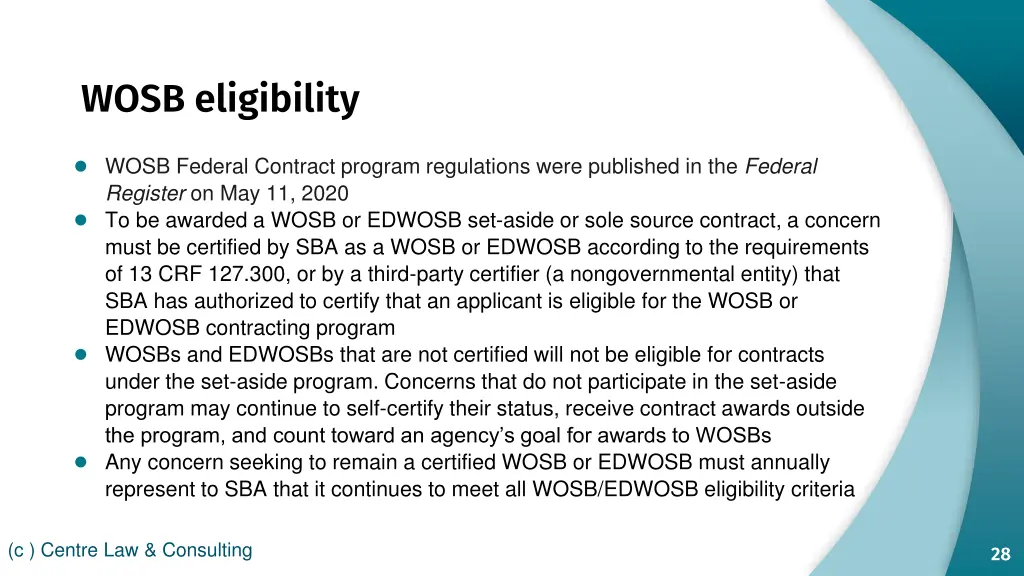
WOSB eligibility WOSB Federal Contract program regulations were published in the Federal Register on May 11, 2020 To be awarded a WOSB or EDWOSB set-aside or sole source contract, a concern must be certified by SBA as a WOSB or EDWOSB according to the requirements of 13 CRF 127.300, or by a third-party certifier (a nongovernmental entity) that SBA has authorized to certify that an applicant is eligible for the WOSB or EDWOSB contracting program WOSBs and EDWOSBs that are not certified will not be eligible for contracts under the set-aside program. Concerns that do not participate in the set-aside program may continue to self-certify their status, receive contract awards outside the program, and count toward an agency s goal for awards to WOSBs Any concern seeking to remain a certified WOSB or EDWOSB must annually represent to SBA that it continues to meet all WOSB/EDWOSB eligibility criteria (c ) Centre Law & Consulting 28
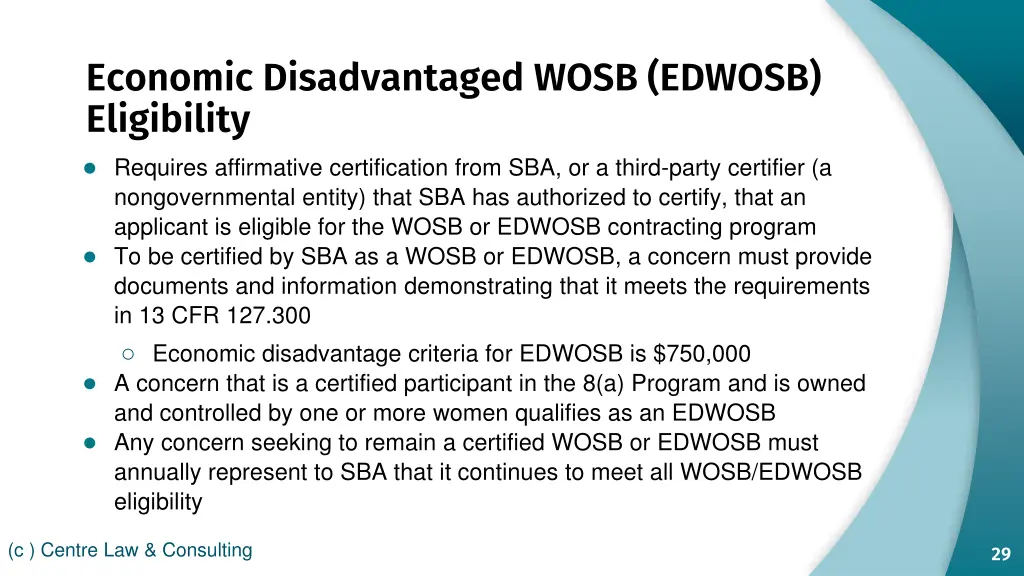
Economic Disadvantaged WOSB (EDWOSB) Eligibility Requires affirmative certification from SBA, or a third-party certifier (a nongovernmental entity) that SBA has authorized to certify, that an applicant is eligible for the WOSB or EDWOSB contracting program To be certified by SBA as a WOSB or EDWOSB, a concern must provide documents and information demonstrating that it meets the requirements in 13 CFR 127.300 Economic disadvantage criteria for EDWOSB is $750,000 A concern that is a certified participant in the 8(a) Program and is owned and controlled by one or more women qualifies as an EDWOSB Any concern seeking to remain a certified WOSB or EDWOSB must annually represent to SBA that it continues to meet all WOSB/EDWOSB eligibility (c ) Centre Law & Consulting 29
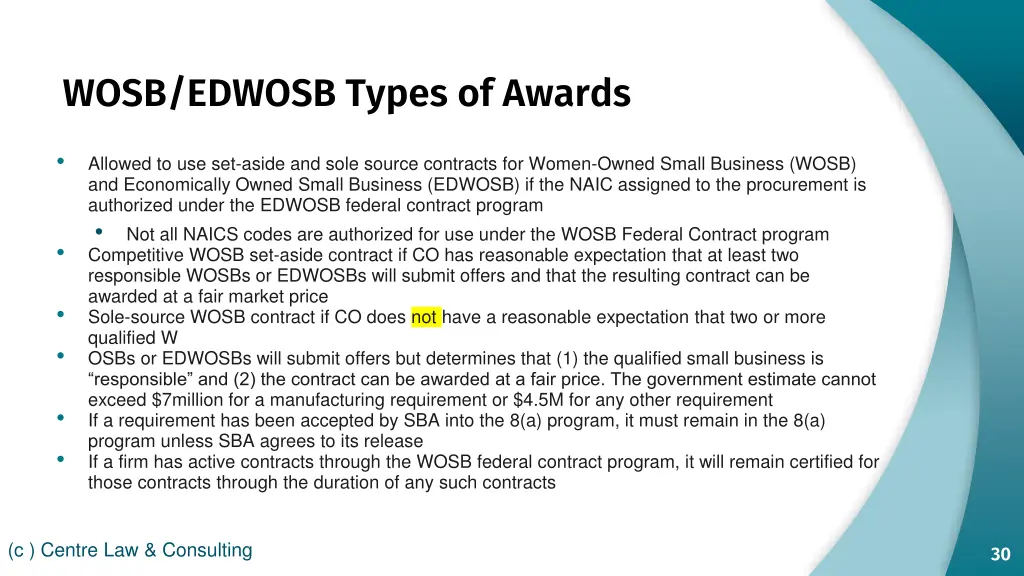
WOSB/EDWOSB Types of Awards Allowed to use set-aside and sole source contracts for Women-Owned Small Business (WOSB) and Economically Owned Small Business (EDWOSB) if the NAIC assigned to the procurement is authorized under the EDWOSB federal contract program Not all NAICS codes are authorized for use under the WOSB Federal Contract program Competitive WOSB set-aside contract if CO has reasonable expectation that at least two responsible WOSBs or EDWOSBs will submit offers and that the resulting contract can be awarded at a fair market price Sole-source WOSB contract if CO does not have a reasonable expectation that two or more qualified W OSBs or EDWOSBs will submit offers but determines that (1) the qualified small business is responsible and (2) the contract can be awarded at a fair price. The government estimate cannot exceed $7million for a manufacturing requirement or $4.5M for any other requirement If a requirement has been accepted by SBA into the 8(a) program, it must remain in the 8(a) program unless SBA agrees to its release If a firm has active contracts through the WOSB federal contract program, it will remain certified for those contracts through the duration of any such contracts (c ) Centre Law & Consulting 30
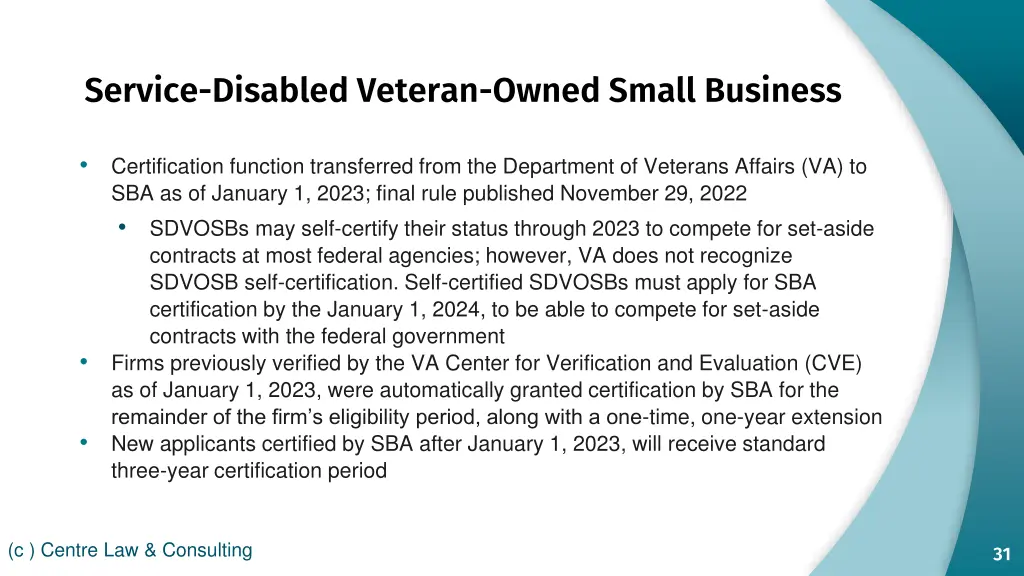
Service-Disabled Veteran-Owned Small Business Certification function transferred from the Department of Veterans Affairs (VA) to SBA as of January 1, 2023; final rule published November 29, 2022 SDVOSBs may self-certify their status through 2023 to compete for set-aside contracts at most federal agencies; however, VA does not recognize SDVOSB self-certification. Self-certified SDVOSBs must apply for SBA certification by the January 1, 2024, to be able to compete for set-aside contracts with the federal government Firms previously verified by the VA Center for Verification and Evaluation (CVE) as of January 1, 2023, were automatically granted certification by SBA for the remainder of the firm s eligibility period, along with a one-time, one-year extension New applicants certified by SBA after January 1, 2023, will receive standard three-year certification period (c ) Centre Law & Consulting 31
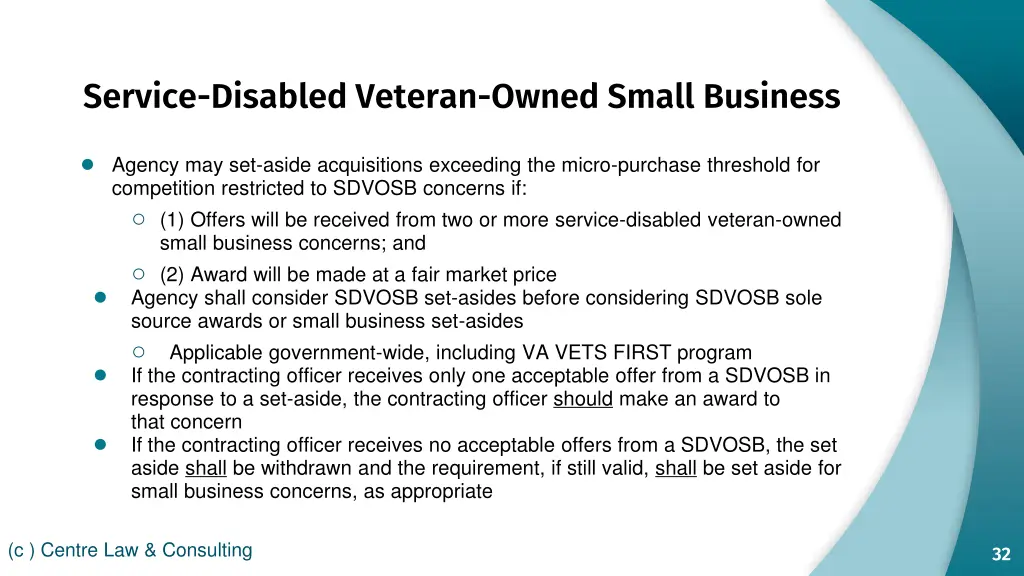
Service-Disabled Veteran-Owned Small Business Agency may set-aside acquisitions exceeding the micro-purchase threshold for competition restricted to SDVOSB concerns if: (1) Offers will be received from two or more service-disabled veteran-owned small business concerns; and (2) Award will be made at a fair market price Agency shall consider SDVOSB set-asides before considering SDVOSB sole source awards or small business set-asides Applicable government-wide, including VA VETS FIRST program If the contracting officer receives only one acceptable offer from a SDVOSB in response to a set-aside, the contracting officer should make an award to that concern If the contracting officer receives no acceptable offers from a SDVOSB, the set aside shall be withdrawn and the requirement, if still valid, shall be set aside for small business concerns, as appropriate (c ) Centre Law & Consulting 32
Questions? Alan Chvotkin, Esq. Partner Centre Law & Consulting LLC O: (703) 288-2800 x224 C: (202) 255-3786 achvotkin@centrelawgroup.com www.centrelawgroup.com (c ) Centre Law & Consulting 33