Contractor Past Performance Rating System Overview
In the construction industry, the Contractor Past Performance Rating (CPPR) system plays a crucial role in evaluating and determining bidding capacity based on past performance grades. This system allows for a more objective assessment, effective communication of performance issues, and raising the bar for contractors' performance. By factoring in past performance, customers can better assess and select contractors in a fair and transparent manner, ultimately impacting bidding capacity and pre-qualification. Take a closer look at how the CPPR system influences bidding capacity and contractor selection criteria for construction projects.

Uploaded on | 2 Views
Download Presentation

Please find below an Image/Link to download the presentation.
The content on the website is provided AS IS for your information and personal use only. It may not be sold, licensed, or shared on other websites without obtaining consent from the author. If you encounter any issues during the download, it is possible that the publisher has removed the file from their server.
You are allowed to download the files provided on this website for personal or commercial use, subject to the condition that they are used lawfully. All files are the property of their respective owners.
The content on the website is provided AS IS for your information and personal use only. It may not be sold, licensed, or shared on other websites without obtaining consent from the author.
E N D
Presentation Transcript
Contractor Past Contractor Past Performance Rating Performance Rating (CPPR) (CPPR) Presented by Wayne Jackson 2018 Construction Academy July 31, 2018
Why CPPR System? Why CPPR System? More objective process Communicate performance issues proactively Tied to outcomes that are important to Customers Raise the bar on Contractor s performance Factor in past performance as part of Low-Bid system
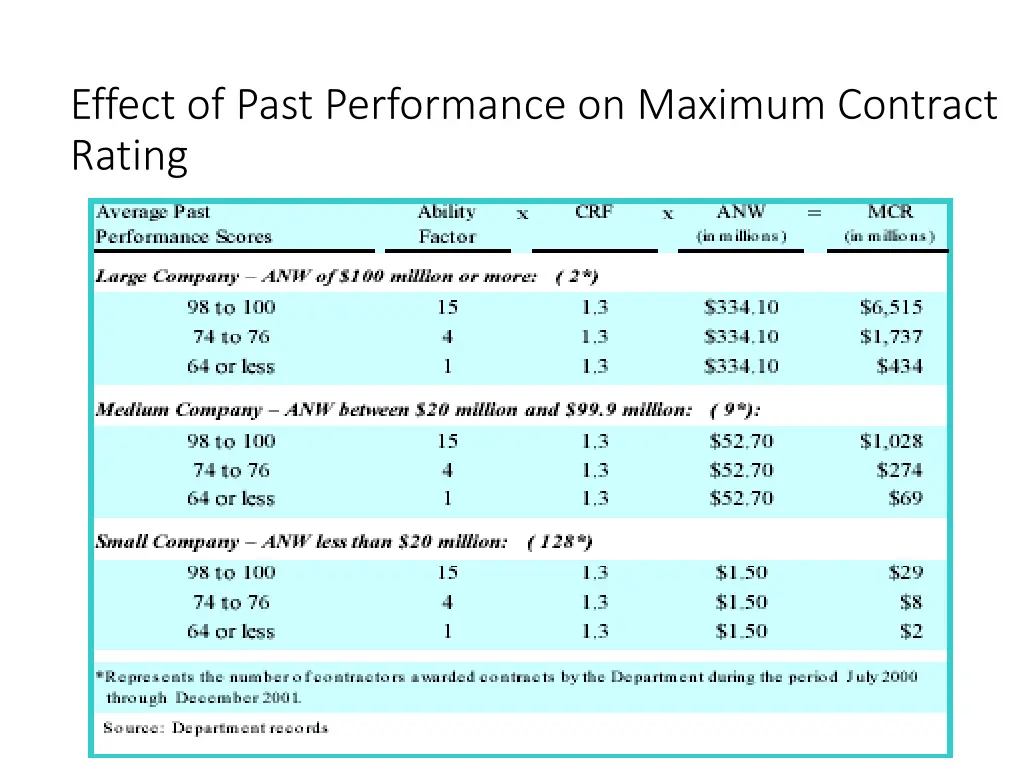
Impacts of Past Performance Grades Derived: Rule 14-22 Florida Administrative Code Impacts to pre-qualification and bidding capacity. The higher the average score, the higher the bidding capacity.
Impacts of Past Performance Grades Contractor past performance score is used to determine bidding capacity. Typically, previous year s scores are averaged but under certain circumstances, up to the last five years of scores can be averaged. Year starts from the date of the Contractor s pre-qualification (typically April). TAKE IT SERIOUSLY! WE NEED TO BE FAIR, BUT STILL, A GOOD IS A GOOD AND A BAD IS A BAD
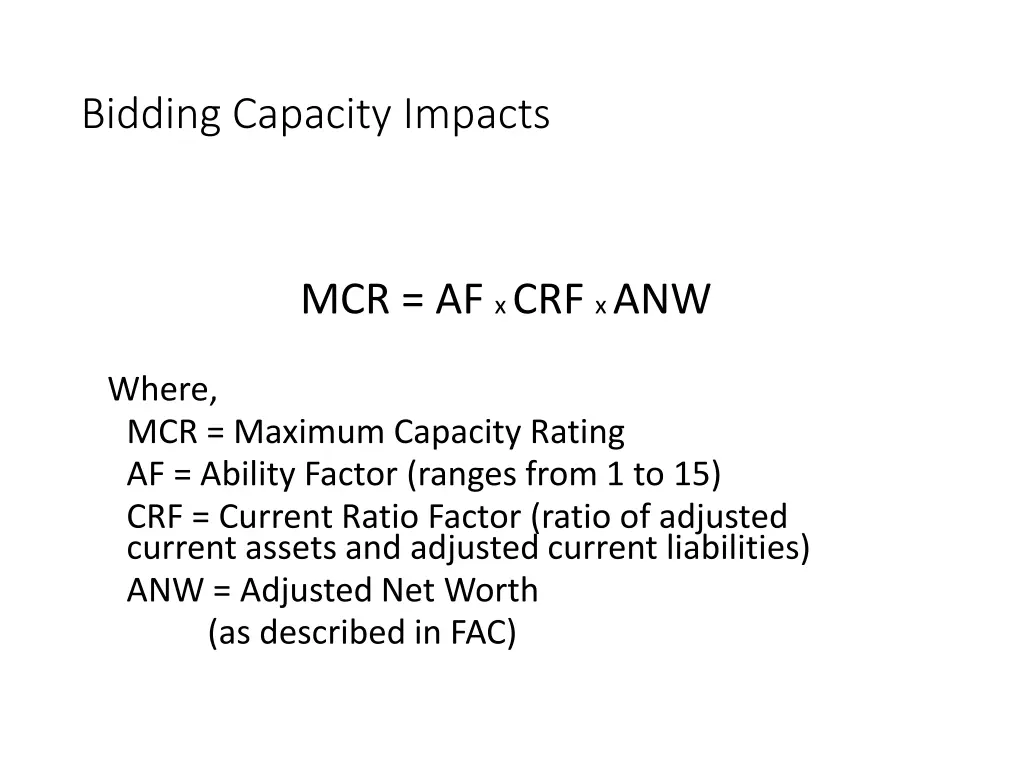
Bidding Capacity Impacts MCR = AF x CRF x ANW Where, MCR = Maximum Capacity Rating AF = Ability Factor (ranges from 1 to 15) CRF = Current Ratio Factor (ratio of adjusted current assets and adjusted current liabilities) ANW = Adjusted Net Worth (as described in FAC)
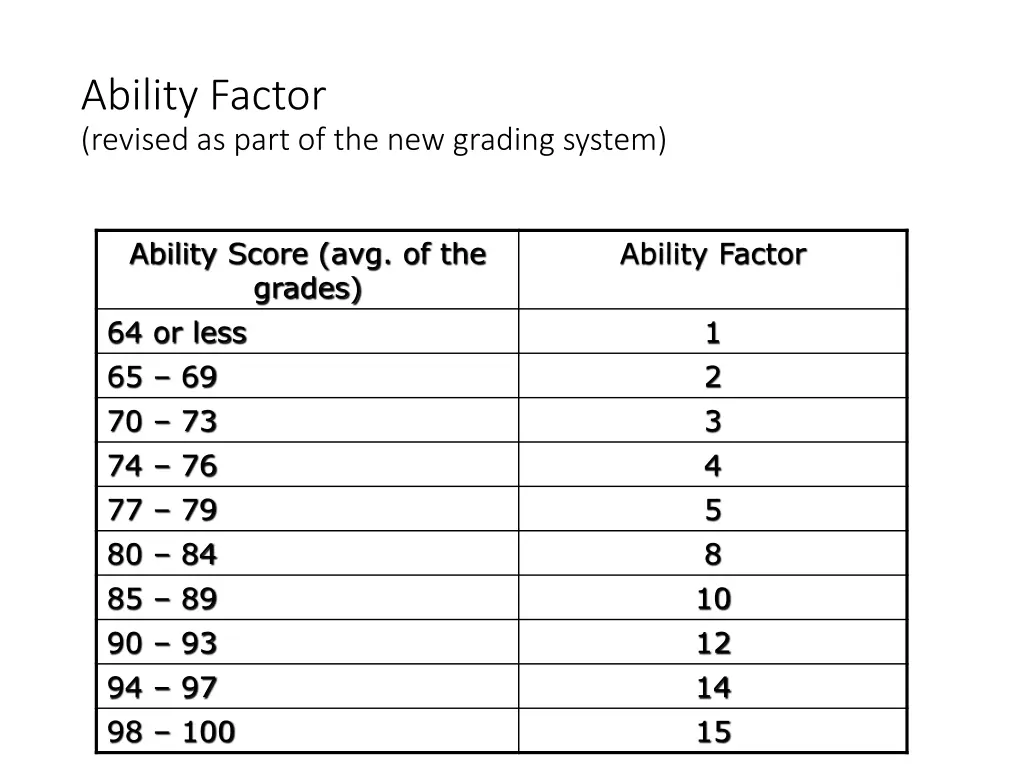
Ability Factor (revised as part of the new grading system) Ability Score (avg. of the grades) 64 or less 65 69 70 73 74 76 77 79 80 84 85 89 90 93 94 97 98 100 Ability Factor 1 2 3 4 5 8 10 12 14 15
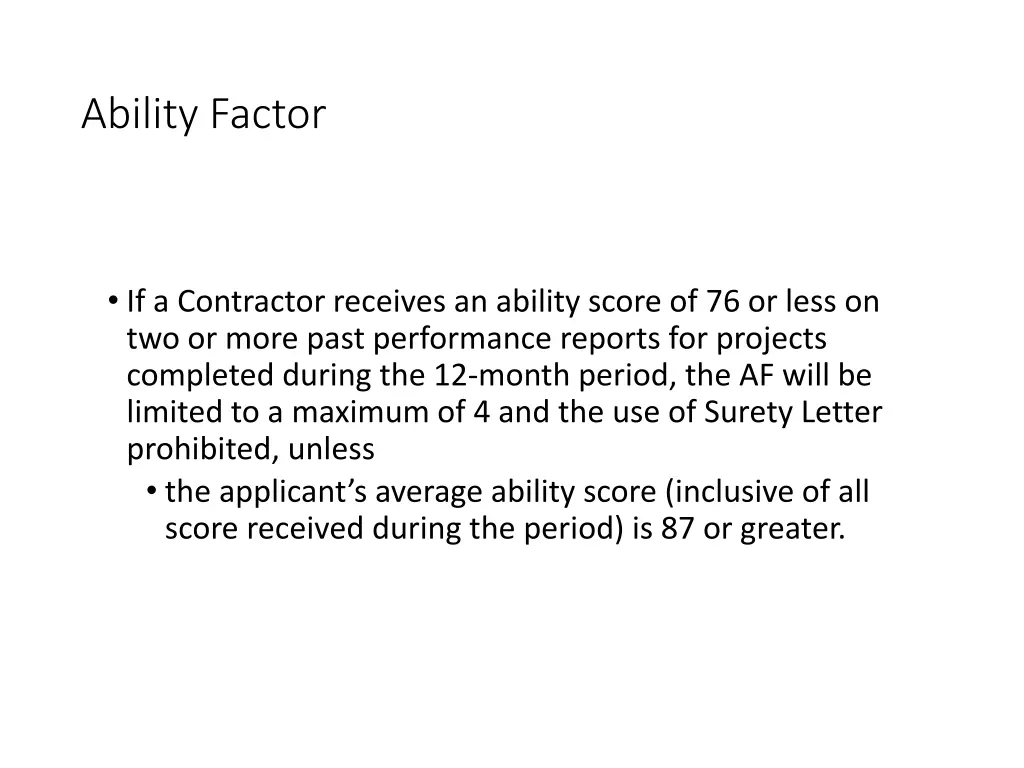
Ability Factor If a Contractor receives an ability score of 76 or less on two or more past performance reports for projects completed during the 12-month period, the AF will be limited to a maximum of 4 and the use of Surety Letter prohibited, unless the applicant s average ability score (inclusive of all score received during the period) is 87 or greater.
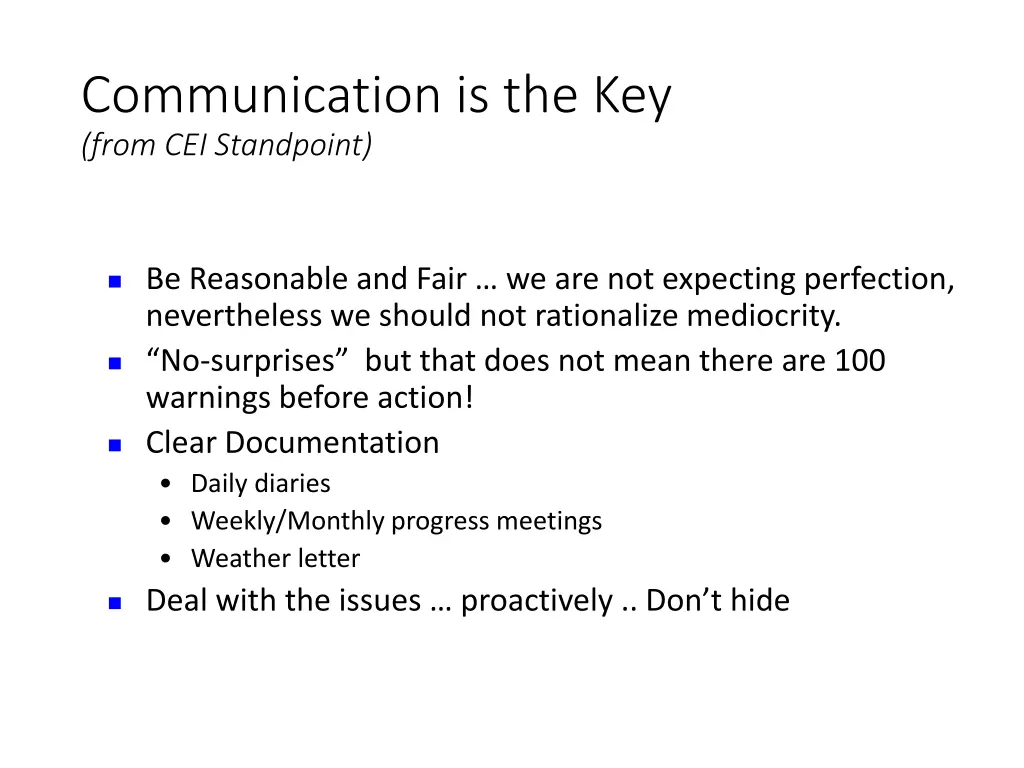
Communication is the Key (from CEI Standpoint) Be Reasonable and Fair we are not expecting perfection, nevertheless we should not rationalize mediocrity. No-surprises but that does not mean there are 100 warnings before action! Clear Documentation Daily diaries Weekly/Monthly progress meetings Weather letter Deal with the issues proactively .. Don t hide
Communication is the Key At the Pre-Con, establish who with the Contractor needs to be notified w/project performance issues. Contractor s upper management needs to keep tabs on what is being said and written. Deal with the issues proactively .. Don t hide
Outcomes Scores that truly depict Performance Clearer divisions between Contractors based on performance rather than perception.
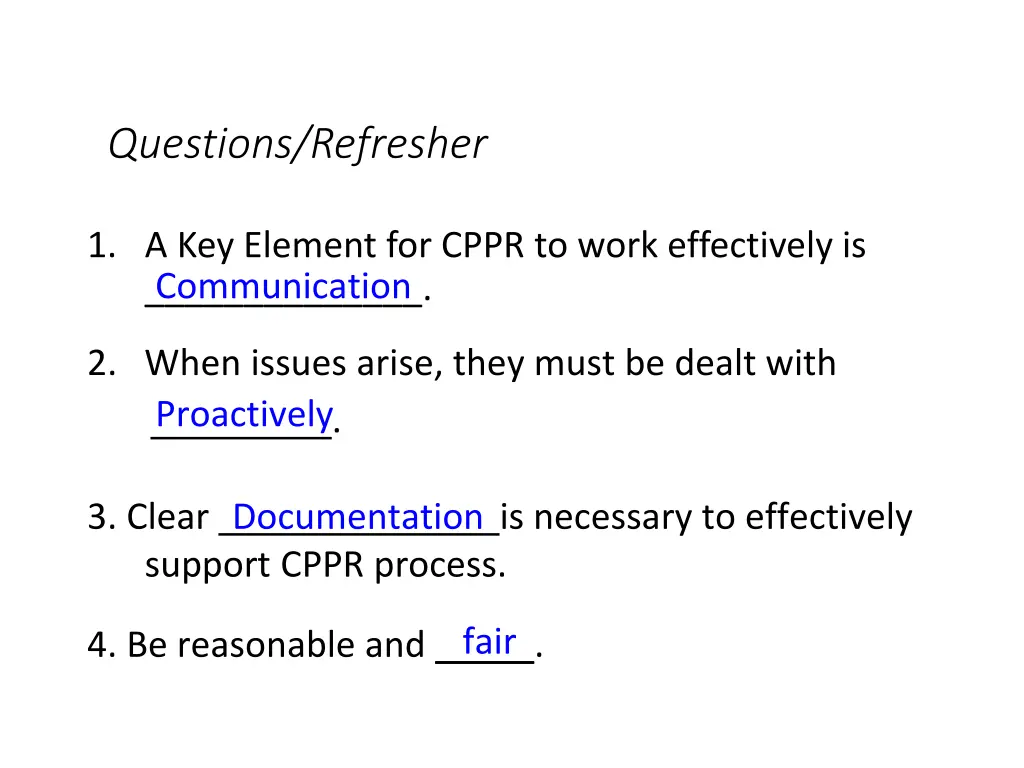
Questions/Refresher 1. A Key Element for CPPR to work effectively is ______________. Communication 2. When issues arise, they must be dealt with . Proactively 3. Clear support CPPR process. Documentation is necessary to effectively fair 4. Be reasonable and _____.
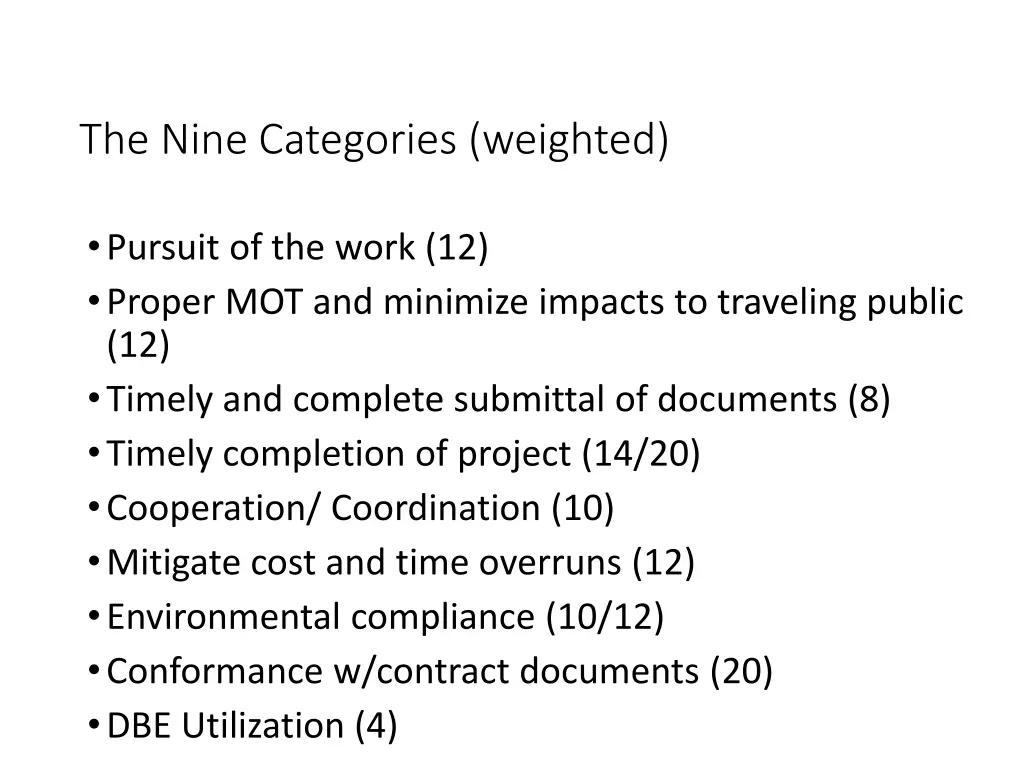
The Nine Categories (weighted) Pursuit of the work (12) Proper MOT and minimize impacts to traveling public (12) Timely and complete submittal of documents (8) Timely completion of project (14/20) Cooperation/ Coordination (10) Mitigate cost and time overruns (12) Environmental compliance (10/12) Conformance w/contract documents (20) DBE Utilization (4)
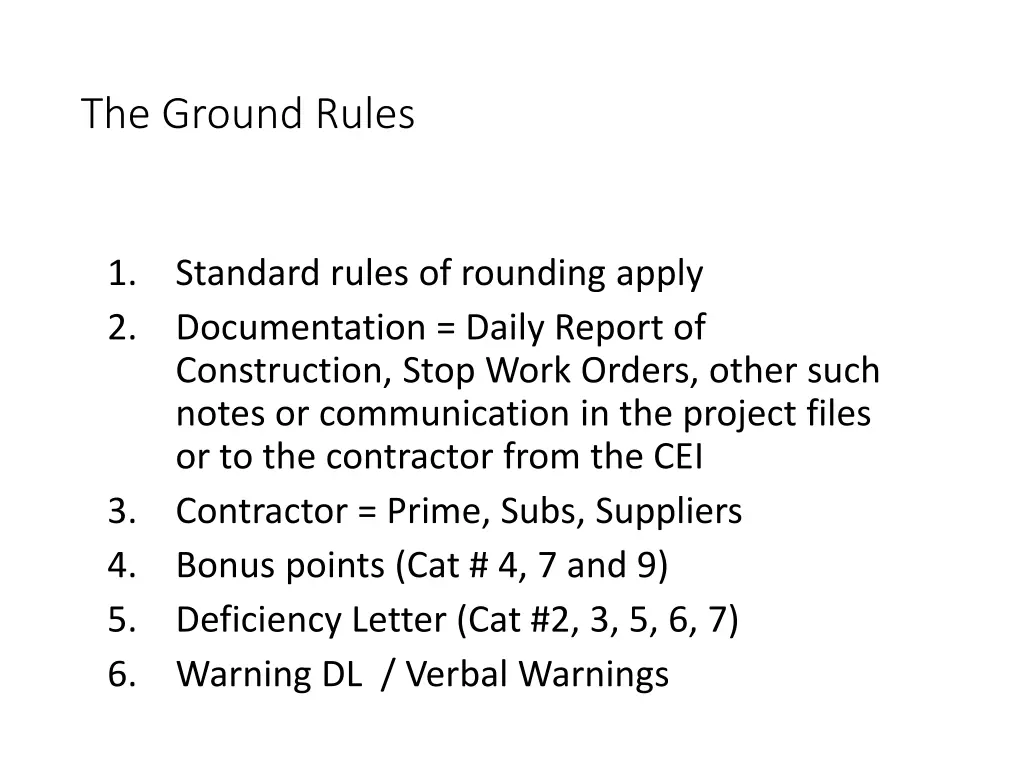
The Ground Rules 1. 2. Standard rules of rounding apply Documentation = Daily Report of Construction, Stop Work Orders, other such notes or communication in the project files or to the contractor from the CEI Contractor = Prime, Subs, Suppliers Bonus points (Cat # 4, 7 and 9) Deficiency Letter (Cat #2, 3, 5, 6, 7) Warning DL / Verbal Warnings 3. 4. 5. 6.
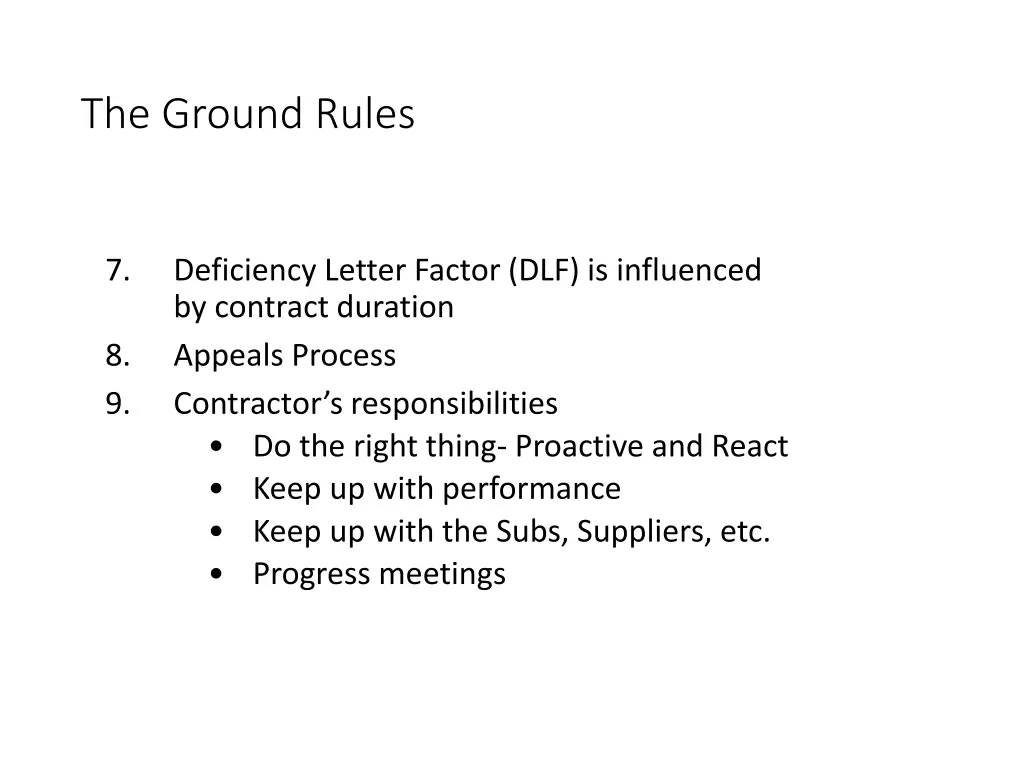
The Ground Rules 7. Deficiency Letter Factor (DLF) is influenced by contract duration Appeals Process Contractor s responsibilities Do the right thing- Proactive and React Keep up with performance Keep up with the Subs, Suppliers, etc. Progress meetings 8. 9.
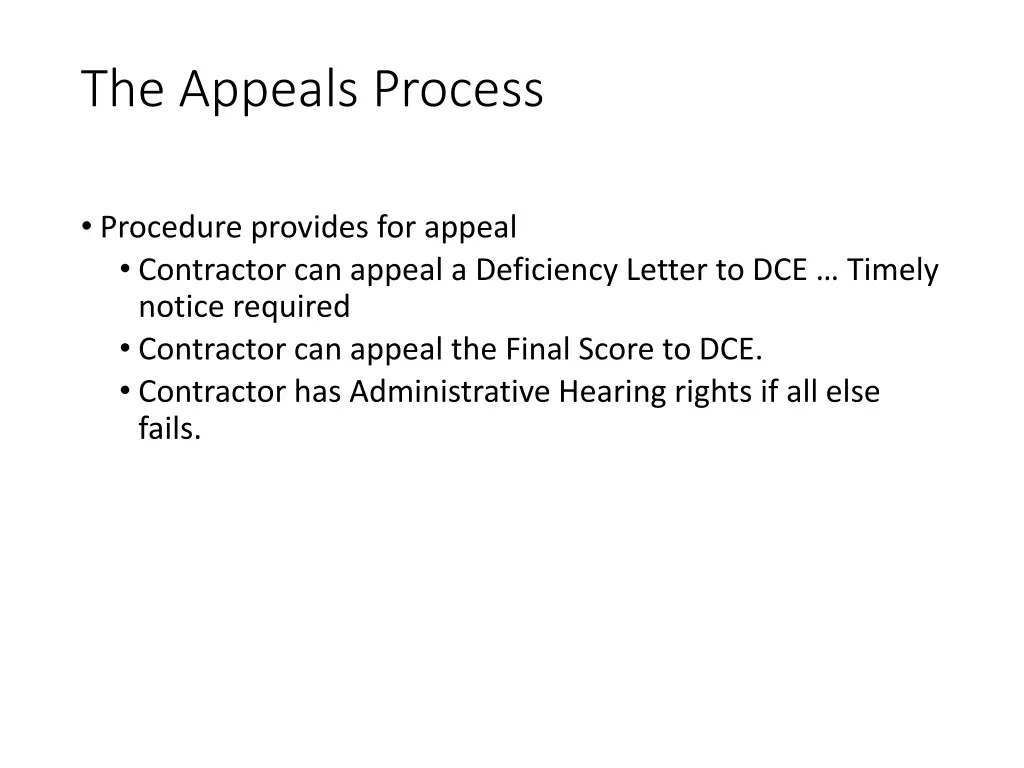
The Appeals Process Procedure provides for appeal Contractor can appeal a Deficiency Letter to DCE Timely notice required Contractor can appeal the Final Score to DCE. Contractor has Administrative Hearing rights if all else fails.
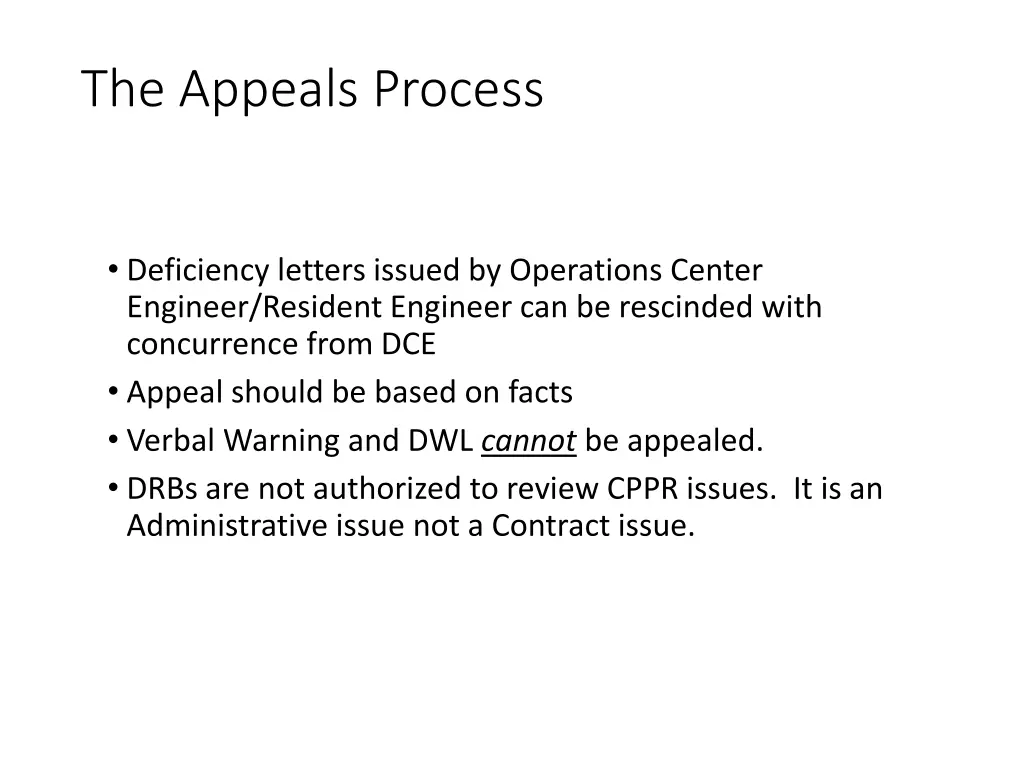
The Appeals Process Deficiency letters issued by Operations Center Engineer/Resident Engineer can be rescinded with concurrence from DCE Appeal should be based on facts Verbal Warning and DWL cannot be appealed. DRBs are not authorized to review CPPR issues. It is an Administrative issue not a Contract issue.
Category 1: Pursuit of the Work Based on the Contractor diligently and systematically pursuing the work each day *Critical Path Based on how contract time was established Pursuit is based on work days. Work days will always be less than Present Contract Time. Cannot be greater than 100 % No Deficiency Letter used Daily Report of Construction tracks this.
Category 1: Pursuit of the Work Pursuit of Work cannot be greater than 100 %. Percent is based on allowable contract time (minus weather days) on a five-day work week unless otherwise stated in the Contract. On some contracts, the contract time is based on a six-day or a seven-day (rare) workweek.
Category 1: Pursuit of the Work - Examples Pursuit of Work cannot be greater than 100 %. If the Contract Time is based on a five-day workweek but the Contractor has been working six or seven days, Pursuit of Work will based on the five-day workweek and whether Contractor pursued work on that many number or days. Make a notation in the remarks section. This will prevent from banking the extra days so as to prevent potential abandoning the projects later on and not have negative grade implications.
Category 1: Pursuit of the Work - Examples Contract Time was based on a six-day work week For the total month, Contractor worked 20 days of 24 days (20 days divided by 24 days = 83%).
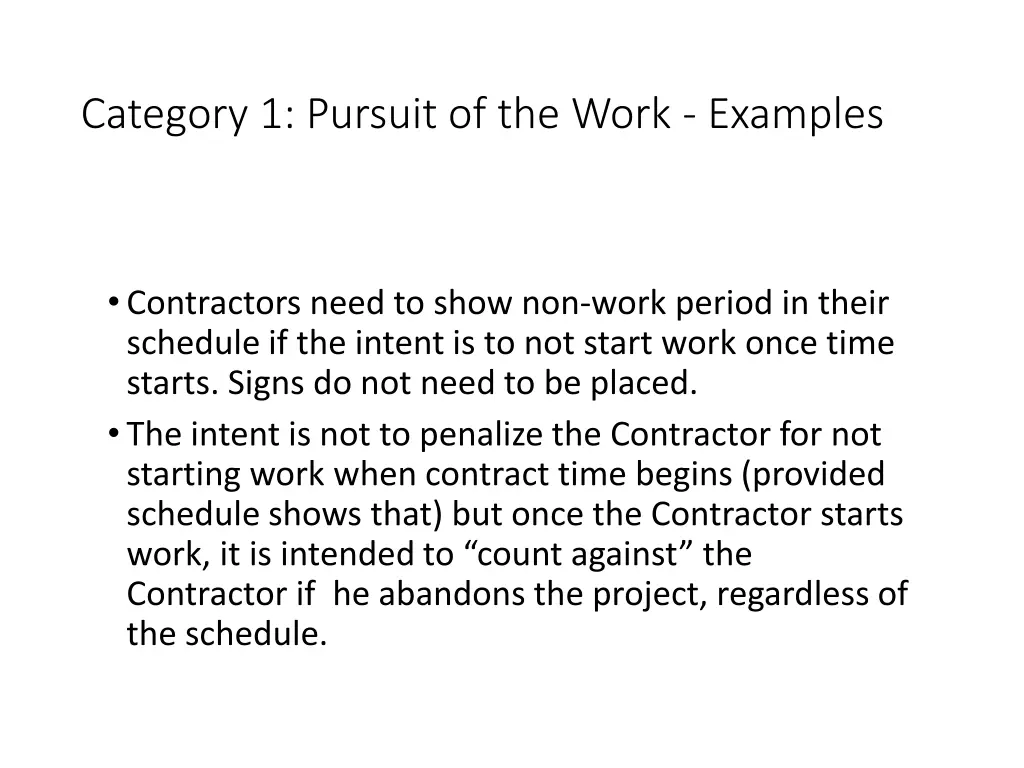
Category 1: Pursuit of the Work - Examples Contractors need to show non-work period in their schedule if the intent is to not start work once time starts. Signs do not need to be placed. The intent is not to penalize the Contractor for not starting work when contract time begins (provided schedule shows that) but once the Contractor starts work, it is intended to count against the Contractor if he abandons the project, regardless of the schedule.
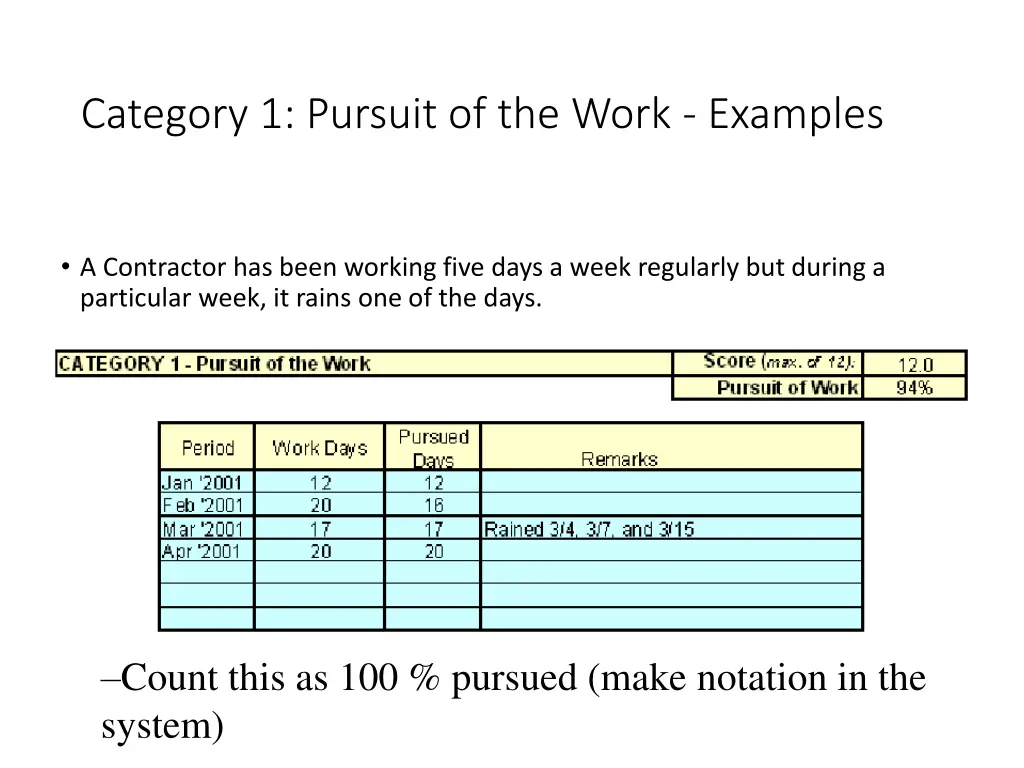
Category 1: Pursuit of the Work - Examples A Contractor has been working five days a week regularly but during a particular week, it rains one of the days. Count this as 100 % pursued (make notation in the system)
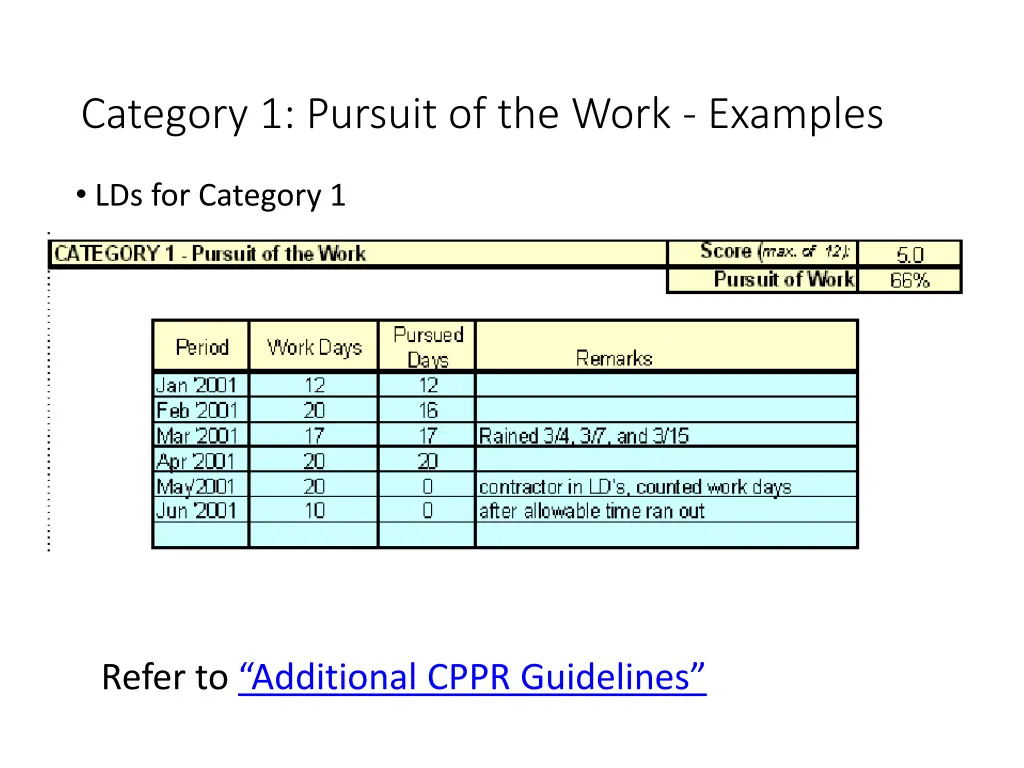
Category 1: Pursuit of the Work - Examples LDs for Category 1 Refer to Additional CPPR Guidelines
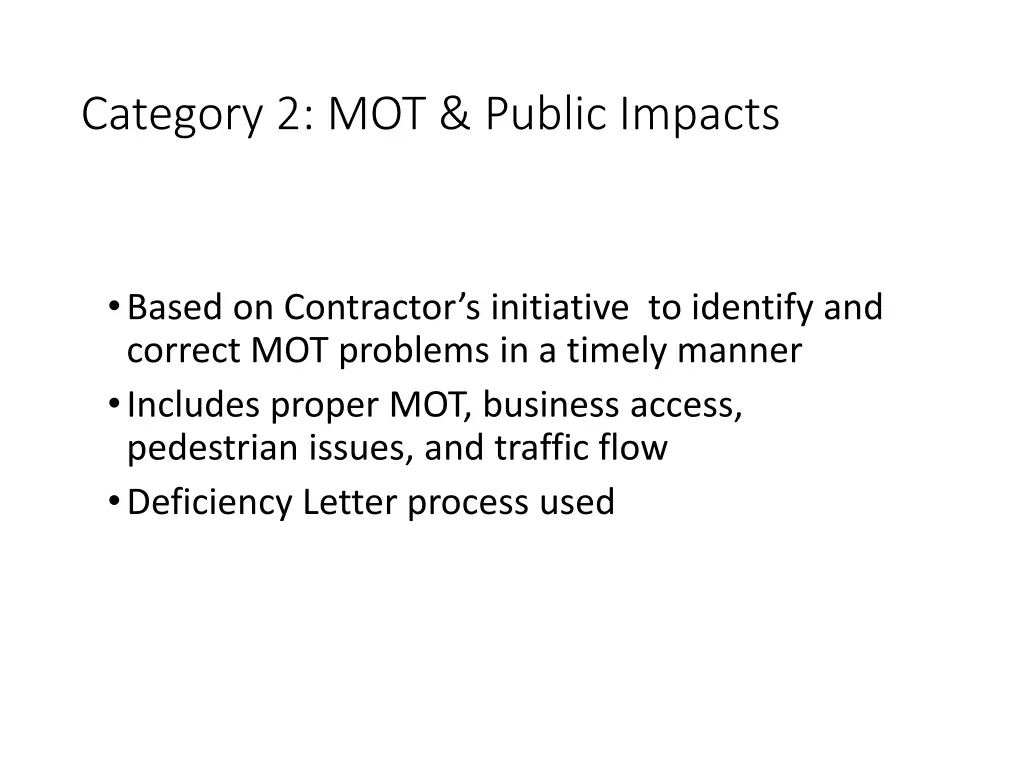
Category 2: MOT & Public Impacts Based on Contractor s initiative to identify and correct MOT problems in a timely manner Includes proper MOT, business access, pedestrian issues, and traffic flow Deficiency Letter process used
Category 2: MOT & Public Impacts - Examples Does the Contractor have to be reminded that barricades are lying on ground? Does the Contractor have to be reminded of lane closure restrictions? Blatant violations, such as violating lane closures restrictions, warrant a DL unless it is an unforeseen situation and the Engineer has been advised and has given concurrence.
Category 2: MOT & Public Impacts - Examples It is not the intent to remind the Contractor on every requirement of the Contract prior to issuance of a DWL. We need to recognize that things happens and give the Contractor the benefit of doubt, BUT at the same time, we should not tolerate the Contractor s inability to mitigate the things from happening.
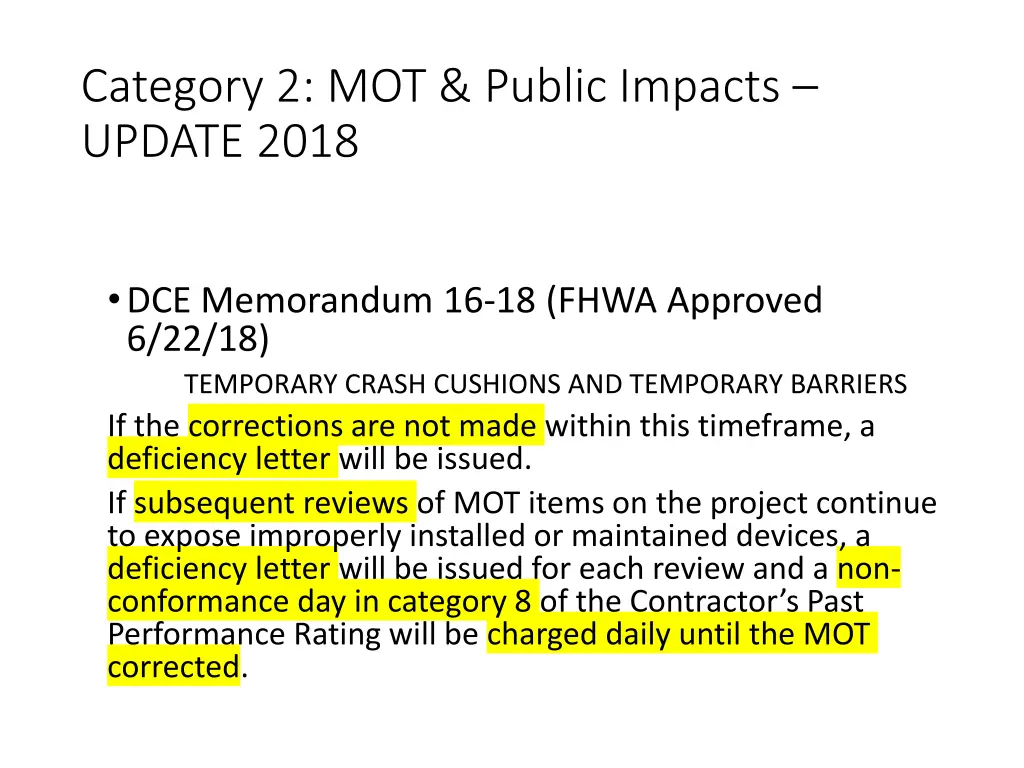
Category 2: MOT & Public Impacts UPDATE 2018 DCE Memorandum 16-18 (FHWA Approved 6/22/18) TEMPORARY CRASH CUSHIONS AND TEMPORARY BARRIERS Issue: Improperly installed and maintained Temporary Crash Cushions and Temporary Barriers CPAM Chapter 9.1 addresses work zone inspections and the role that the Department representatives are to fulfill.
Category 2: MOT & Public Impacts UPDATE 2018 DCE Memorandum 16-18 (FHWA Approved 6/22/18) TEMPORARY CRASH CUSHIONS AND TEMPORARY BARRIERS When improperly installed or maintained devices are found, the contractor will be given a verbal warning and required to make corrections to critical safety issues immediately and to minor issues within 24 hours.
Category 2: MOT & Public Impacts UPDATE 2018 DCE Memorandum 16-18 (FHWA Approved 6/22/18) TEMPORARY CRASH CUSHIONS AND TEMPORARY BARRIERS If the corrections are not made within this timeframe, a deficiency letter will be issued. If subsequent reviews of MOT items on the project continue to expose improperly installed or maintained devices, a deficiency letter will be issued for each review and a non- conformance day in category 8 of the Contractor s Past Performance Rating will be charged daily until the MOT corrected.
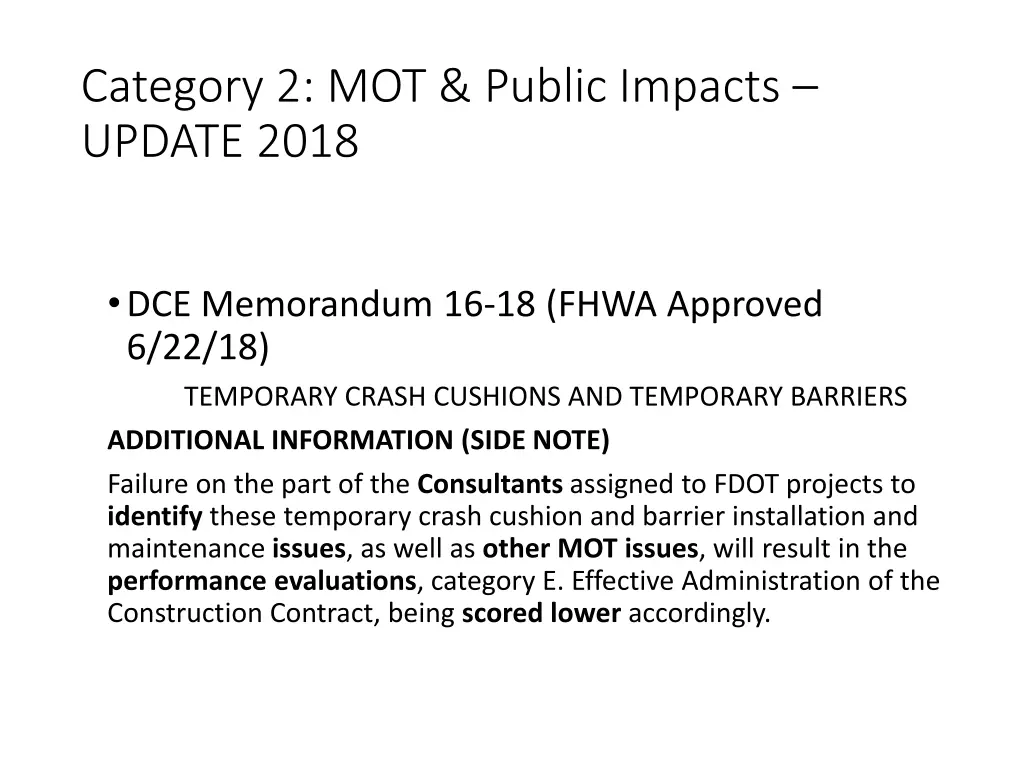
Category 2: MOT & Public Impacts UPDATE 2018 DCE Memorandum 16-18 (FHWA Approved 6/22/18) TEMPORARY CRASH CUSHIONS AND TEMPORARY BARRIERS ADDITIONAL INFORMATION (SIDE NOTE) Failure on the part of the Consultants assigned to FDOT projects to identify these temporary crash cushion and barrier installation and maintenance issues, as well as otherMOTissues, will result in the performance evaluations, category E. Effective Administration of the Construction Contract, being scored lower accordingly.
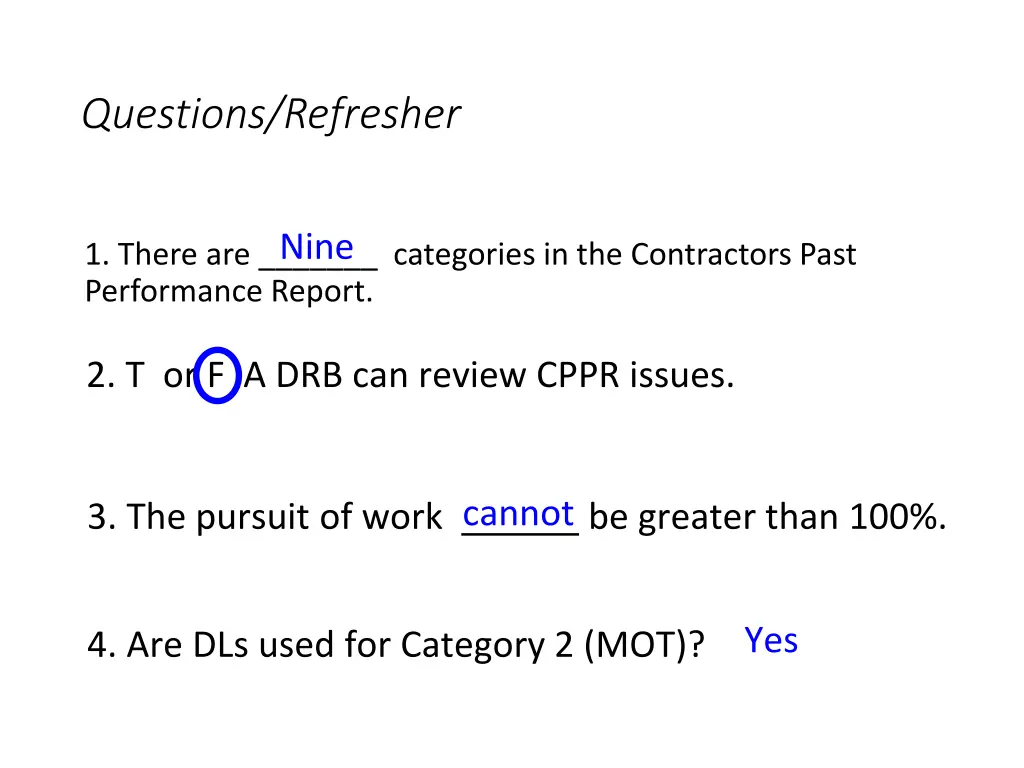
Questions/Refresher Nine 1. There are _______ categories in the Contractors Past Performance Report. 2. T or F A DRB can review CPPR issues. cannot 3. The pursuit of work be greater than 100%. Yes 4. Are DLs used for Category 2 (MOT)?
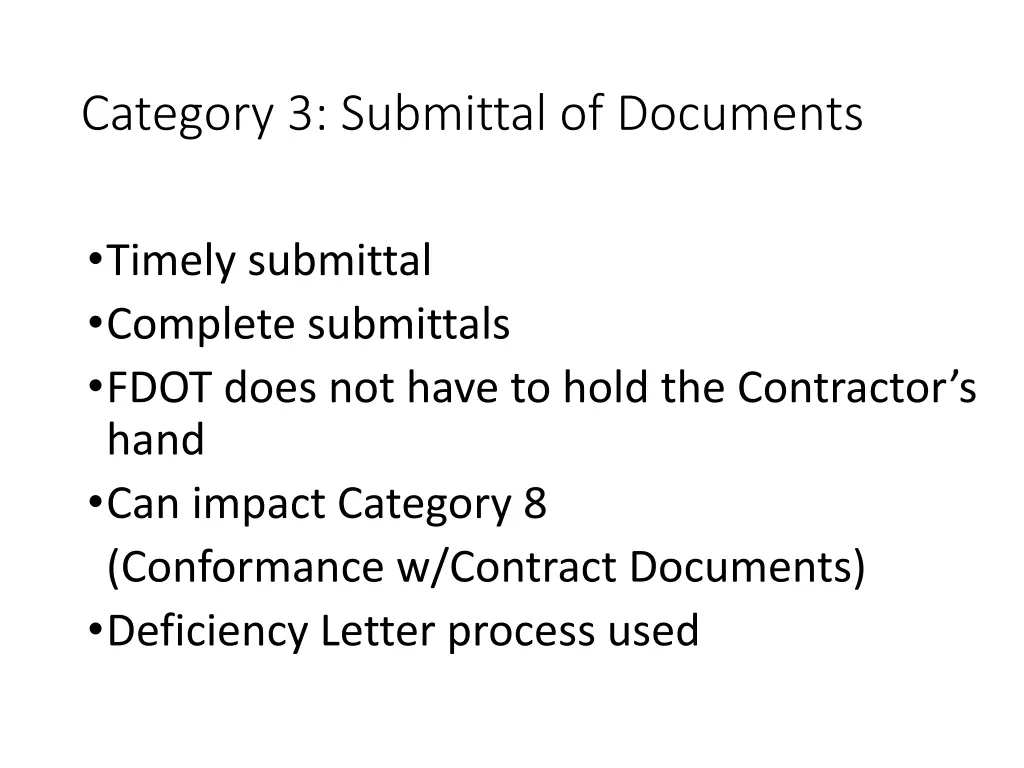
Category 3: Submittal of Documents Timely submittal Complete submittals FDOT does not have to hold the Contractor s hand Can impact Category 8 (Conformance w/Contract Documents) Deficiency Letter process used
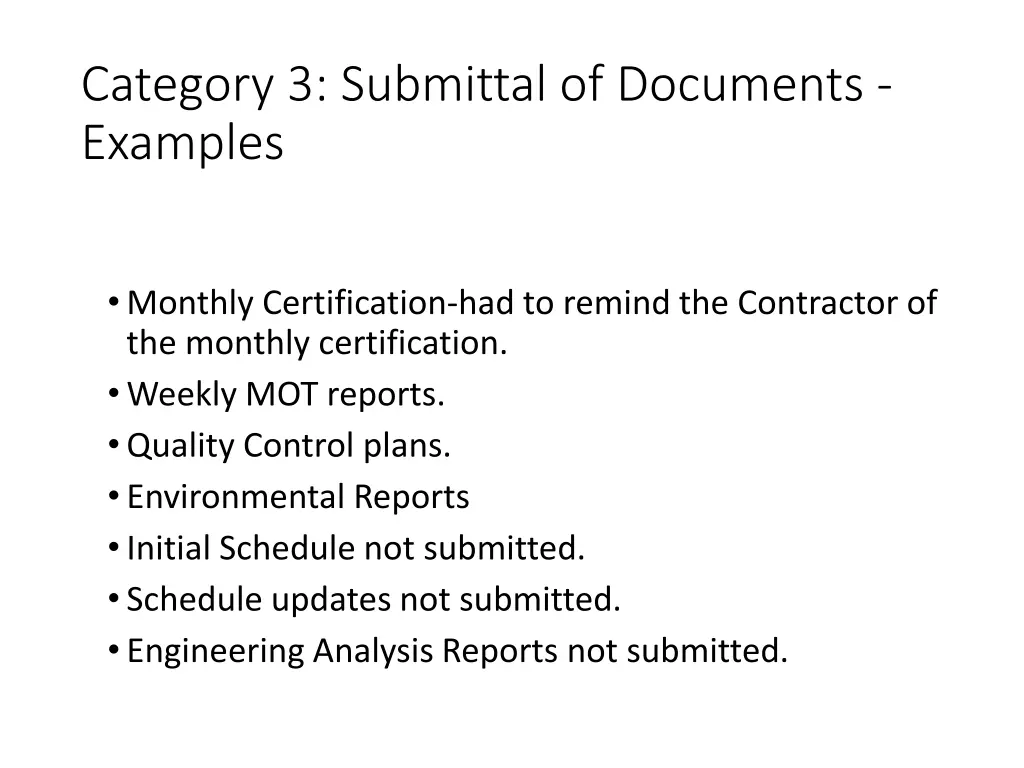
Category 3: Submittal of Documents - Examples Monthly Certification-had to remind the Contractor of the monthly certification. Weekly MOT reports. Quality Control plans. Environmental Reports Initial Schedule not submitted. Schedule updates not submitted. Engineering Analysis Reports not submitted.
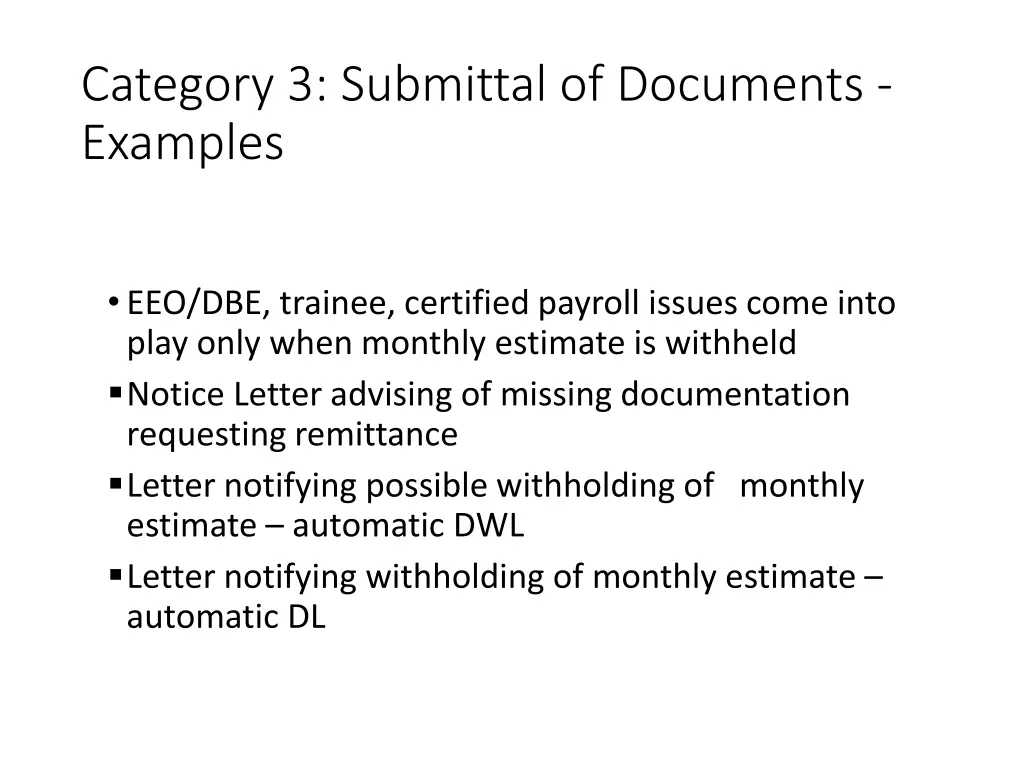
Category 3: Submittal of Documents - Examples EEO/DBE, trainee, certified payroll issues come into play only when monthly estimate is withheld Notice Letter advising of missing documentation requesting remittance Letter notifying possible withholding of monthly estimate automatic DWL Letter notifying withholding of monthly estimate automatic DL
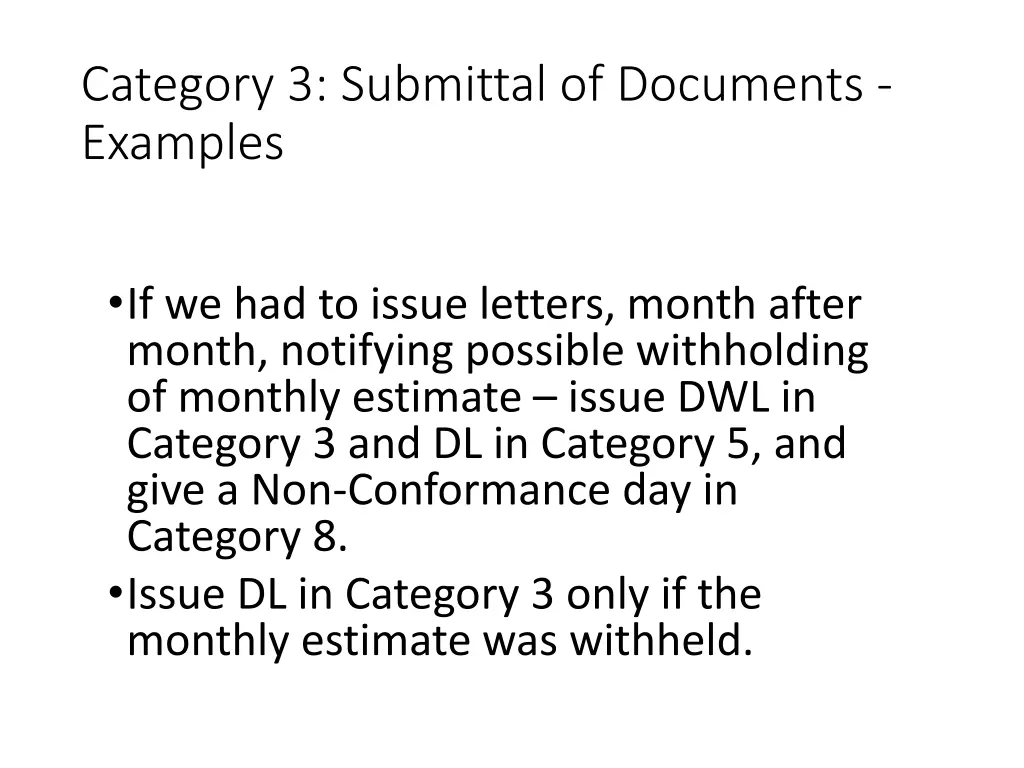
Category 3: Submittal of Documents - Examples If we had to issue letters, month after month, notifying possible withholding of monthly estimate issue DWL in Category 3 and DL in Category 5, and give a Non-Conformance day in Category 8. Issue DL in Category 3 only if the monthly estimate was withheld.
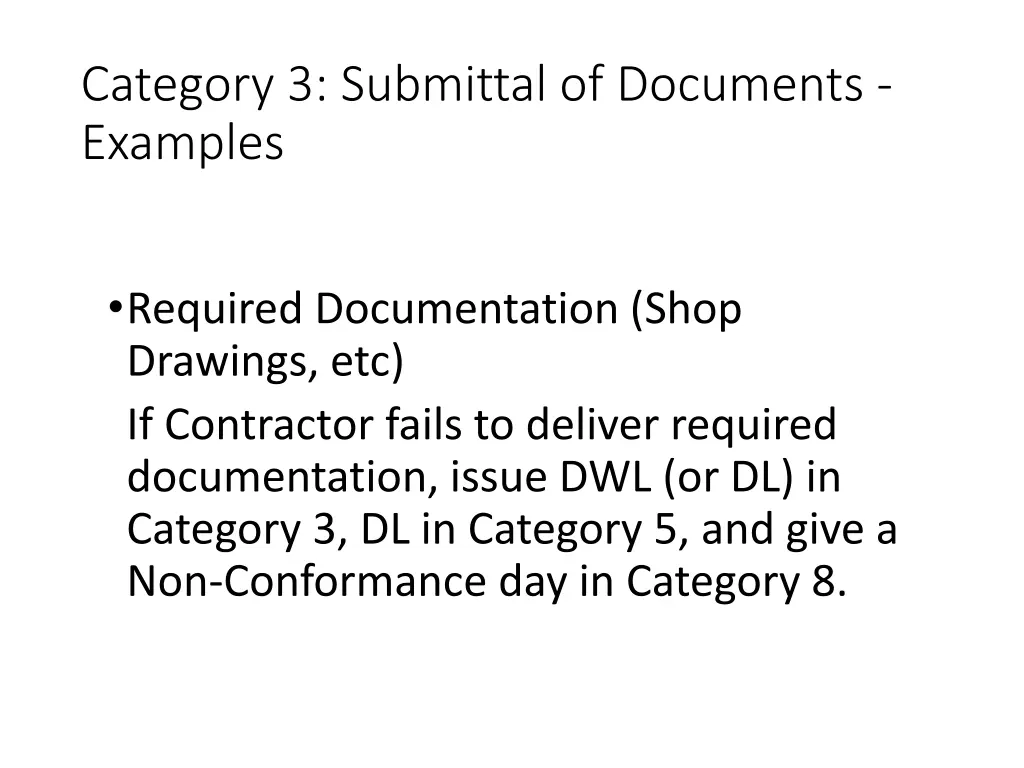
Category 3: Submittal of Documents - Examples Required Documentation (Shop Drawings, etc) If Contractor fails to deliver required documentation, issue DWL (or DL) in Category 3, DL in Category 5, and give a Non-Conformance day in Category 8.
Category 3: Submittal of Documents - Examples Engineering Analysis Reports (EAR) Once it is determined that an EAR is needed, mutually agree on a timetable of when this submittal is made. If the Contractor fails to acknowledge, then establish a reasonable timeframe ( ie,10 working days) to submit If no submittal is made, then issue a DWL and provide for another 5 working days. If still no submittal, then issue a DL
Category 4: Project Completion 14 points for finishing within Allowable Contract Time. Bonus points for early completion or within Original Contract Time. Significant scoring reduction for finishing late No Deficiency Letters used
Category 5: Cooperation/Coordination Includes CEI personnel as well as property owners, utilities, and third parties Based on Contractor s initiative Deficiency Letter process used Blatant violations are when CEI tells the Contractor not to do something but the Contractor proceeds anyway. Contractors need to escalate disagreements or misinterpretations prior to proceeding with the work.
Category 5: Cooperation/Coordination - Examples Contractor was advised to stop work and did not. Contractor was advised to stop paving and get out of the road due to lane closure time requirement in the Contract. This could result in multiple negative implications (DL in this category, non conformance day in Category 8) Lack of good coordination, everything seems to be last minute. PLANNING IS KEY.
Category 6: Mitigate Cost and Time Overruns Contractor s initiative to avoid or minimize cost and time increases Deficiency Letter process used
Category 6: Mitigate Cost and Time Overruns - Examples Contractor worked diligently to supply all information on the cost and time increases on claims submitted by them. The requests for additional money and time are well documented, fair and submitted timely. Contractor showed good-faith by relocating resources in order to mitigate cost and time increases.
Category 7: Environmental Compliance Based on Contractor s initiative to identify and correct problems FDOT does not have to hold Contractor s hand Bonus points for jobs over 300 original days Deficiency Letter process used
Category 7: Environmental Compliance - Examples Contractor complied with all the environmental regulation requirements for Federal, State and local. Contractor complied with the contract erosion control plan, permits, and specifications and corrected deficiencies as necessary. Proactive in maintenance of erosion control features. Had foresight on extended weather forecast and put necessary features in place.
Category 7: Environmental Compliance - Examples Washout into streams, rivers, and waterways result in automatic DL. Completed the SWPPP inspection reports as required by permit in a timely, meaningful manner with full compliance in all areas of the project.