Explore different types of level control specifications, including tight and averaging control, along with models for level control loops such as process model, control valve model, and sensor/transmitter model. Understand the dynamics of liquid level control systems and the applications in various industrial processes.
Please find below an Image/Link to download the presentation.
The content on the website is provided AS IS for your information and personal use only. It may not be sold, licensed, or shared on other websites without obtaining consent from the author. If you encounter any issues during the download, it is possible that the publisher has removed the file from their server.
You are allowed to download the files provided on this website for personal or commercial use, subject to the condition that they are used lawfully. All files are the property of their respective owners.
The content on the website is provided AS IS for your information and personal use only. It may not be sold, licensed, or shared on other websites without obtaining consent from the author.
Types of Level Control There are two opposite specifications for level control loop: tight level control and averaging level control. Tight level control requires that the level be kept at or very near its set point, as in natural circulation evaporators and reboilers, because of the large sensitivity of the heat transfer rate on the level. Averaging level control is specified for surge tanks and accumulators, where the objective is to attenuate, variations in inlet flow so that the outlet flow does not vary suddenly. An intermediate specification is required for reactors and similar equipment where the objective of controlling the level is to keep the volume of liquid in the tank approximately constant, which is looser than for an evaporator or reboiler. 2
Level Control Loop Model Liquid level control is one of the few continuous processes that can be treated as an integrating process. The Figure 1 shows a schematic of conventional level control loops. In this system the effect of liquid level on pressure drop across the control valve is almost negligible. Fig.1 3
Level Control Loop Model Process model (constant density): ) ( dt dh t = ( ) ( ) A f t f t i o Take Laplace: 1 As ) s = ( ) ( ) ( H s F s F i o Where: A is cross section area (ft2) fiand fo are inlet and outlet flow (cfm) h is liquid level (ft) 4
Level Control Loop Model Control valve model: G P ( ) dV t ( ) m 100 t = max L : ( ) ( ) v f t C V t p + = FC : ( ) V t o v p v p dt f & ( ) dV t G ( ) m 100 t P p + = p1 V = FO : ( ) 1 V t max EP : ( ) v f t C v p o v dt f Linearize and take Laplace: K = ( ) ( ) v + F s M s o 1 s v Where: f max for L cfm 100 = Kv ln %CO for EP f 100 5
Level Control Loop Model Sensor/transmitter model (linear without dynamic): ( ) h t h = = ( ) 100 ( ) ( ) min h c t C s K H s T max h min Where: %TO 100 = KT ft max h h min level controllers, whether tuned for tight or averaging, are usually proportional controllers: ) ( ) ( t c K m t m c + = = set ( ) ( ) ( ) c t M s K E s c Where Kc (%CO/%TO) is the controller gain. 6
Level Control Loop Model The block diagram of system is shown in the following Figure: Closed loop transfer function (assume Kc > 0 and Kv > 0): ) 1 + K ) 1 + K ( ( As s s K set ( ) ( ) C s F s v v set ( ) ( ) C s F s T i K K K i As = = ( ) c v T c V E s ( ) E s 2 K K K A s As + + + 1 c v T 1 v ) 1 + ( As s K K K K K K v c v T c v T 7
Level Control Loop Model Offset for a step change in setpoint: ) 1 + K ( As s C v K K = = lim s ( ) lim s 0 c v T sE s 2 A s As 0 0 + + 1 v K K K K K K c v T c v T Offset for a step change in inlet flow: + ( ) 1 s F v i K K F = = lim ( ) lim c V i sE s 2 A s As K K 0 0 s s + + 1 v c v K K K K K K c v T c v T 8
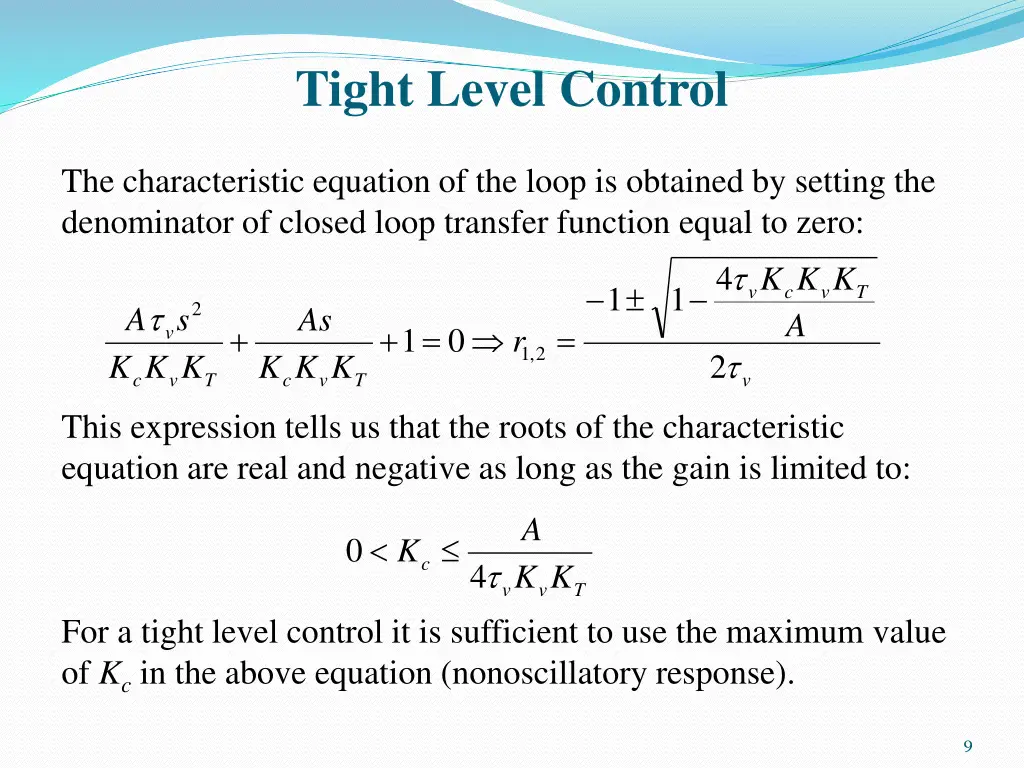
Tight Level Control The characteristic equation of the loop is obtained by setting the denominator of closed loop transfer function equal to zero: 4 K K K 1 1 v c A v T 2 A s As + + = = 1 0 v r 2 , 1 2 K K K K K K c v T c v T v This expression tells us that the roots of the characteristic equation are real and negative as long as the gain is limited to: A 0 K c 4 K K v v T For a tight level control it is sufficient to use the maximum value of Kc in the above equation (nonoscillatory response). 9
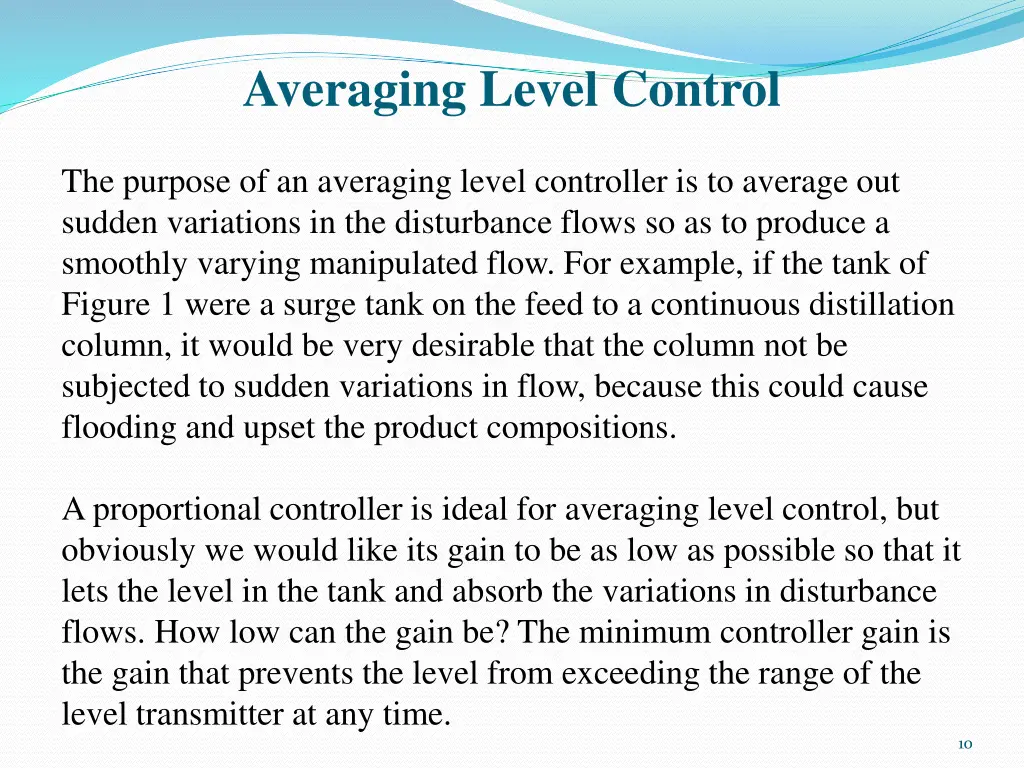
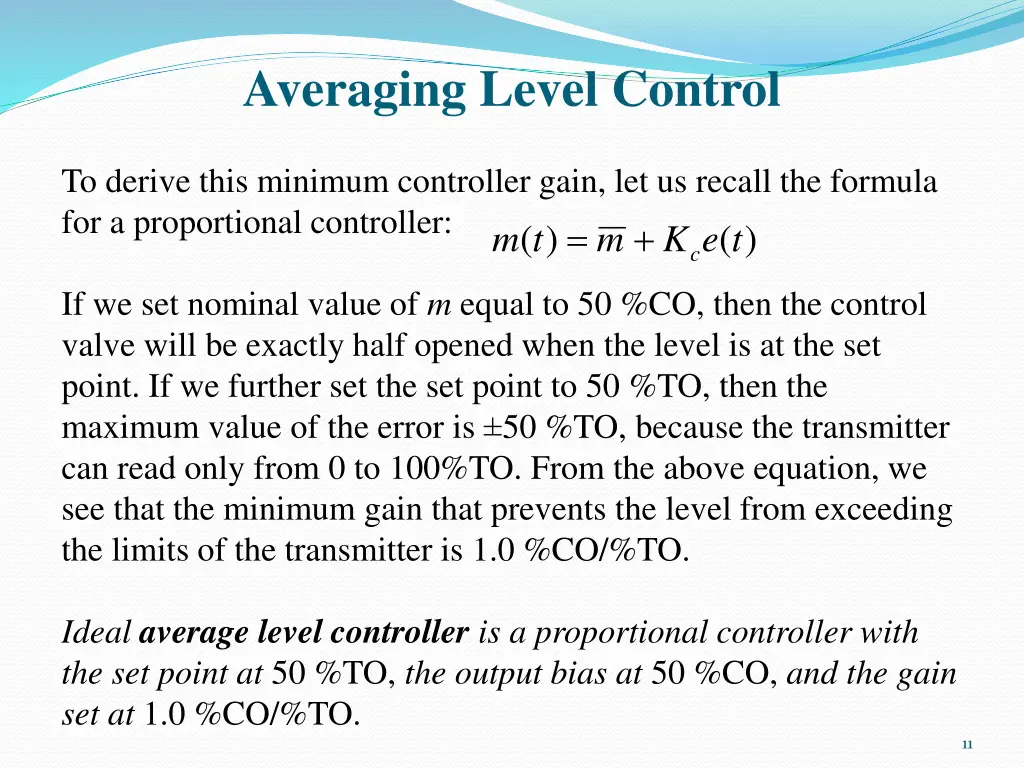
Averaging Level Control The purpose of an averaging level controller is to average out sudden variations in the disturbance flows so as to produce a smoothly varying manipulated flow. For example, if the tank of Figure 1 were a surge tank on the feed to a continuous distillation column, it would be very desirable that the column not be subjected to sudden variations in flow, because this could cause flooding and upset the product compositions. A proportional controller is ideal for averaging level control, but obviously we would like its gain to be as low as possible so that it lets the level in the tank and absorb the variations in disturbance flows. How low can the gain be? The minimum controller gain is the gain that prevents the level from exceeding the range of the level transmitter at any time. 10
Averaging Level Control To derive this minimum controller gain, let us recall the formula for a proportional controller: m = + ( ) ( ) t m K e t c If we set nominal value of m equal to 50 %CO, then the control valve will be exactly half opened when the level is at the set point. If we further set the set point to 50 %TO, then the maximum value of the error is 50 %TO, because the transmitter can read only from 0 to 100%TO. From the above equation, we see that the minimum gain that prevents the level from exceeding the limits of the transmitter is 1.0 %CO/%TO. Ideal average level controller is a proportional controller with the set point at 50 %TO, the output bias at 50 %CO, and the gain set at 1.0 %CO/%TO. 11