Coordinate Geometry Practice Questions for Lines
Practice questions involving the intersection of lines in coordinate geometry. Use graphs and algebra to verify the solutions. Improve your understanding by visualizing the concepts on a coordinated plane.

Download Presentation

Please find below an Image/Link to download the presentation.
The content on the website is provided AS IS for your information and personal use only. It may not be sold, licensed, or shared on other websites without obtaining consent from the author.If you encounter any issues during the download, it is possible that the publisher has removed the file from their server.
You are allowed to download the files provided on this website for personal or commercial use, subject to the condition that they are used lawfully. All files are the property of their respective owners.
The content on the website is provided AS IS for your information and personal use only. It may not be sold, licensed, or shared on other websites without obtaining consent from the author.
E N D
Presentation Transcript
CHAPTER 14 Coordinate Geometry I: The Line Solutions: Practice Questions 14.10
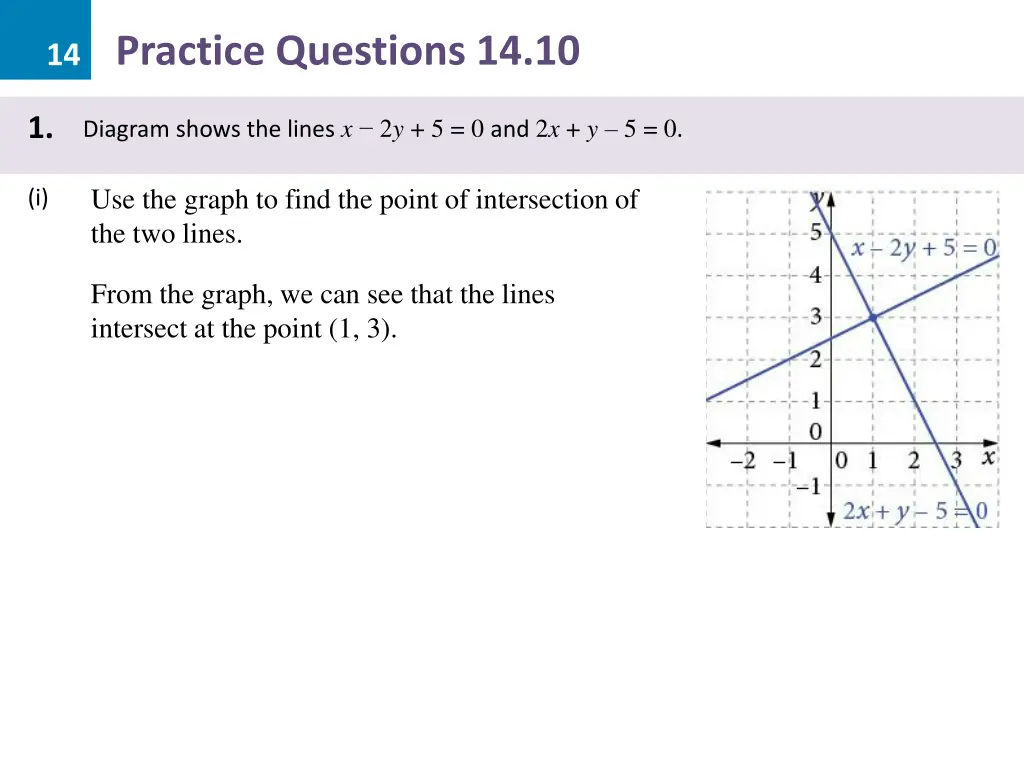
14 Practice Questions 14.10 1. Diagram shows the lines x 2y + 5 = 0 and 2x + y 5 = 0. Use the graph to find the point of intersection of the two lines. (i) From the graph, we can see that the lines intersect at the point (1, 3).
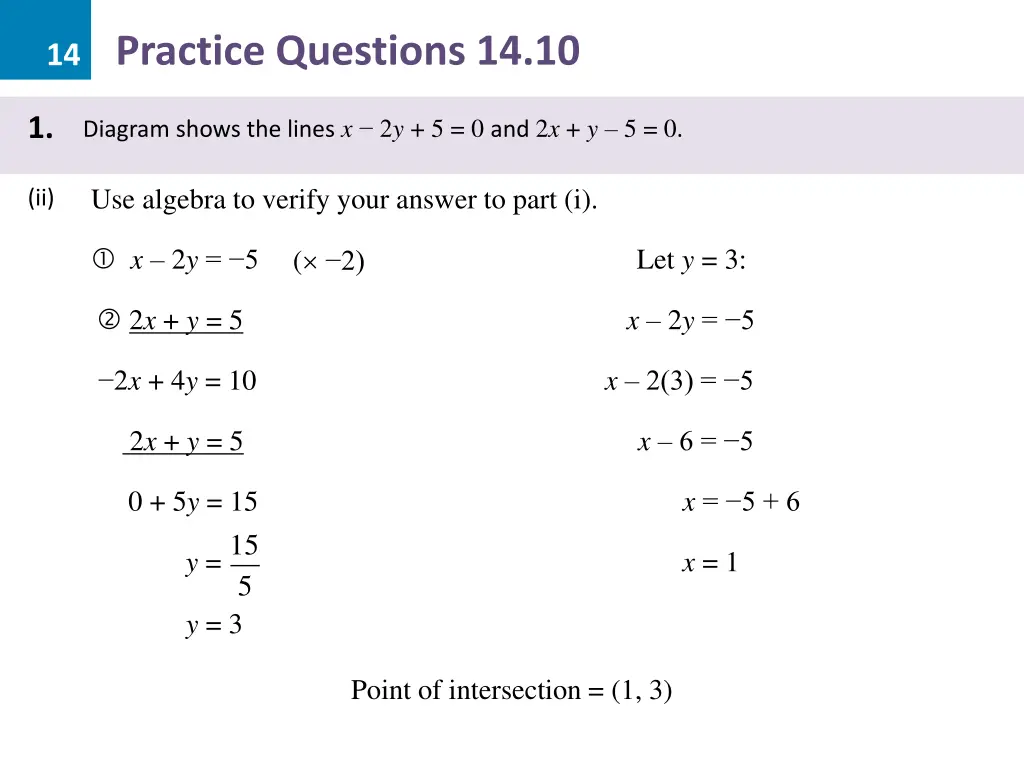
14 Practice Questions 14.10 1. Diagram shows the lines x 2y + 5 = 0 and 2x + y 5 = 0. Use algebra to verify your answer to part (i). (ii) ( 2) x 2y= 5 Let y = 3: 2x + y = 5 x 2y= 5 2x + 4y = 10 x 2(3) = 5 2x + y = 5 x 6 = 5 0 + 5y = 15 y = 15 x= 5 + 6 x = 1 5 y = 3 Point of intersection = (1, 3)
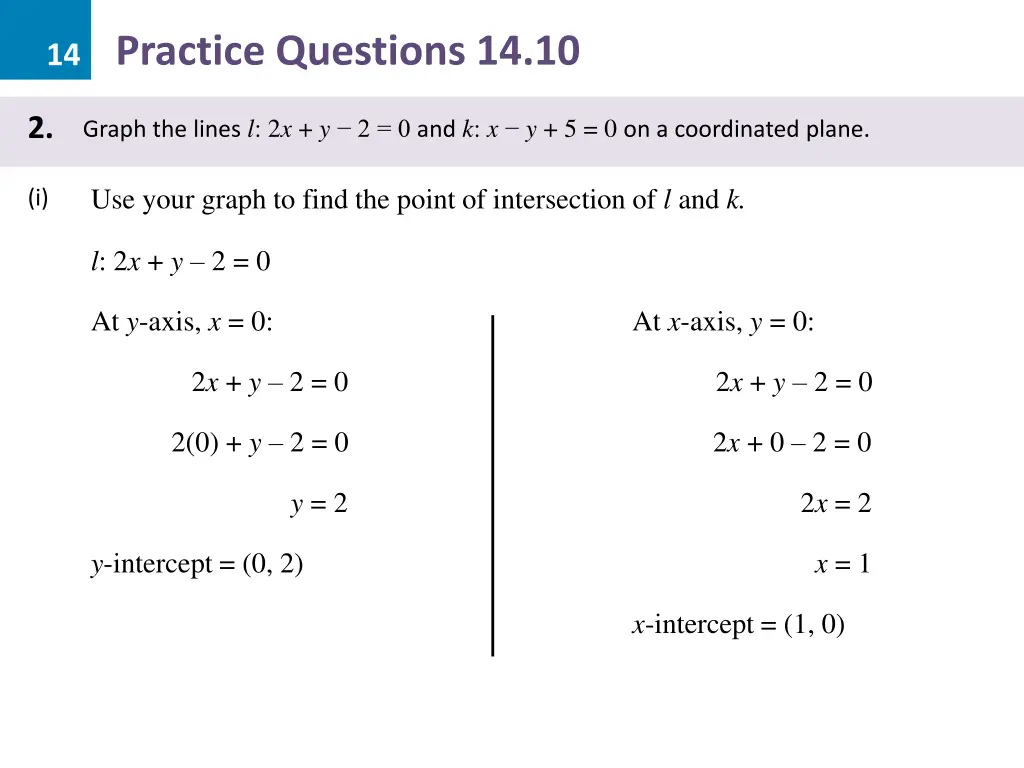
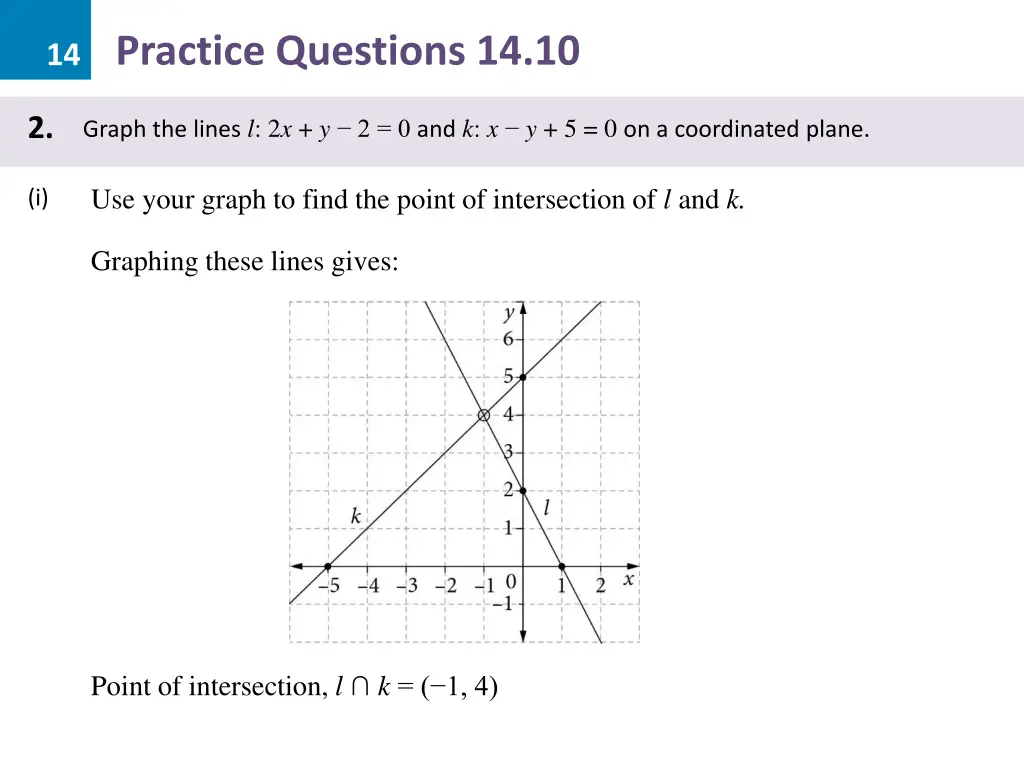
14 Practice Questions 14.10 2. Graph the lines l: 2x + y 2 = 0 and k: x y + 5 = 0 on a coordinated plane. Use your graph to find the point of intersection of l and k. (i) l: 2x + y 2 = 0 At y-axis, x = 0: At x-axis, y = 0: 2x + y 2 = 0 2x + y 2 = 0 2(0) + y 2 = 0 2x + 0 2 = 0 y = 2 2x = 2 y-intercept = (0, 2) x = 1 x-intercept = (1, 0)
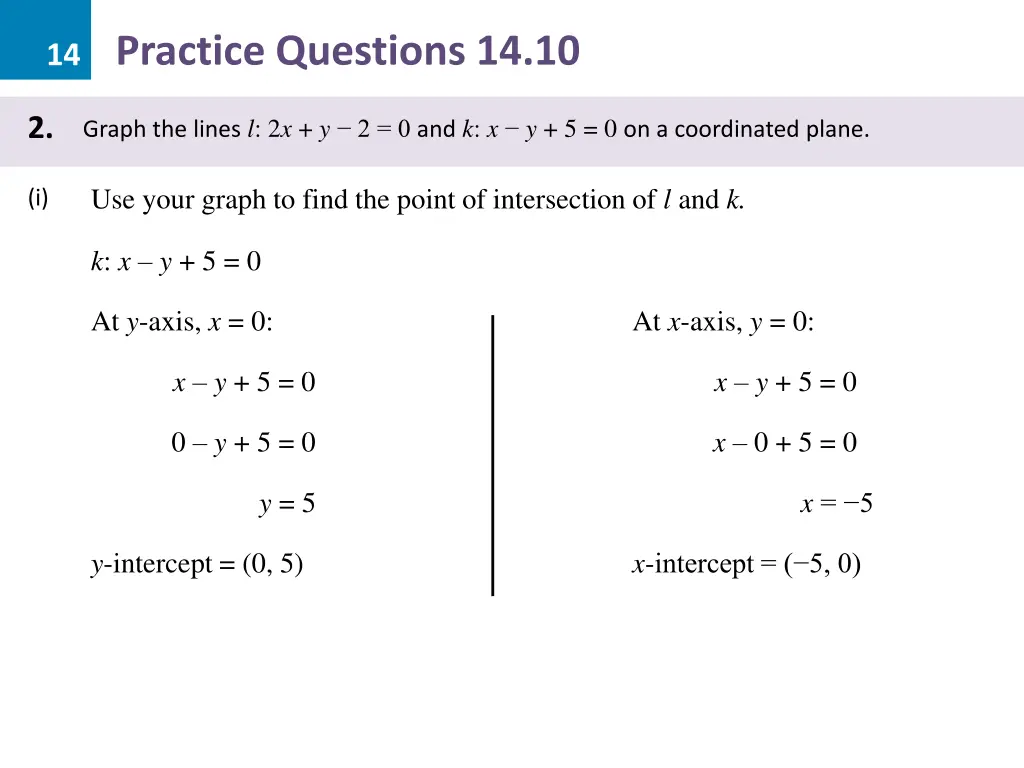
14 Practice Questions 14.10 2. Graph the lines l: 2x + y 2 = 0 and k: x y + 5 = 0 on a coordinated plane. Use your graph to find the point of intersection of l and k. (i) k: x y + 5 = 0 At y-axis, x = 0: At x-axis, y = 0: x y + 5 = 0 x y + 5 = 0 0 y + 5 = 0 x 0 + 5 = 0 y = 5 x= 5 y-intercept = (0, 5) x-intercept = ( 5, 0)
14 Practice Questions 14.10 2. Graph the lines l: 2x + y 2 = 0 and k: x y + 5 = 0 on a coordinated plane. Use your graph to find the point of intersection of l and k. (i) Graphing these lines gives: Point of intersection, l k= ( 1, 4)
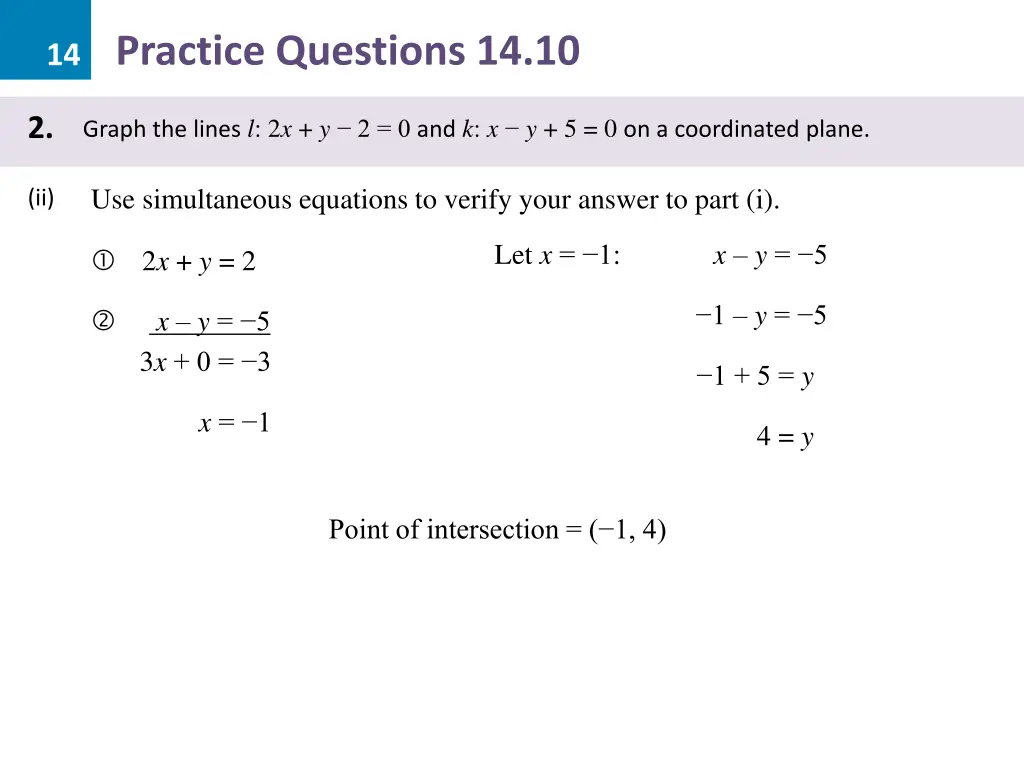
14 Practice Questions 14.10 2. Graph the lines l: 2x + y 2 = 0 and k: x y + 5 = 0 on a coordinated plane. Use simultaneous equations to verify your answer to part (i). (ii) Let x= 1: x y= 5 2x + y = 2 1 y= 5 x y= 5 3x+ 0 = 3 1 + 5 = y x= 1 4 = y Point of intersection = ( 1, 4)
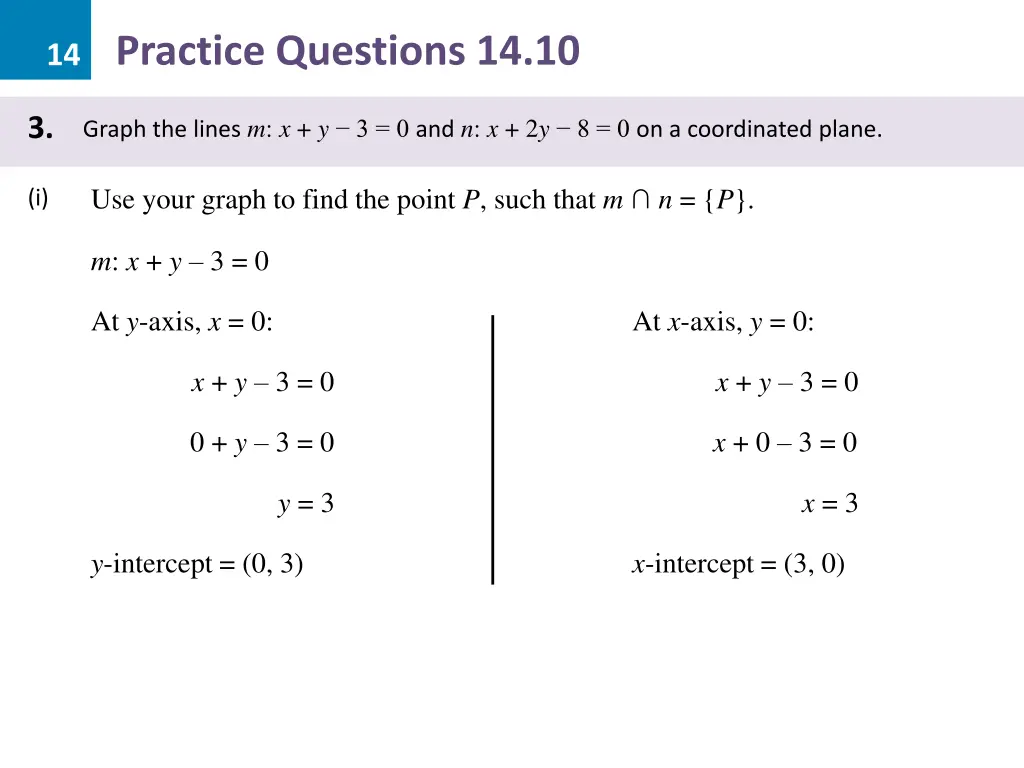
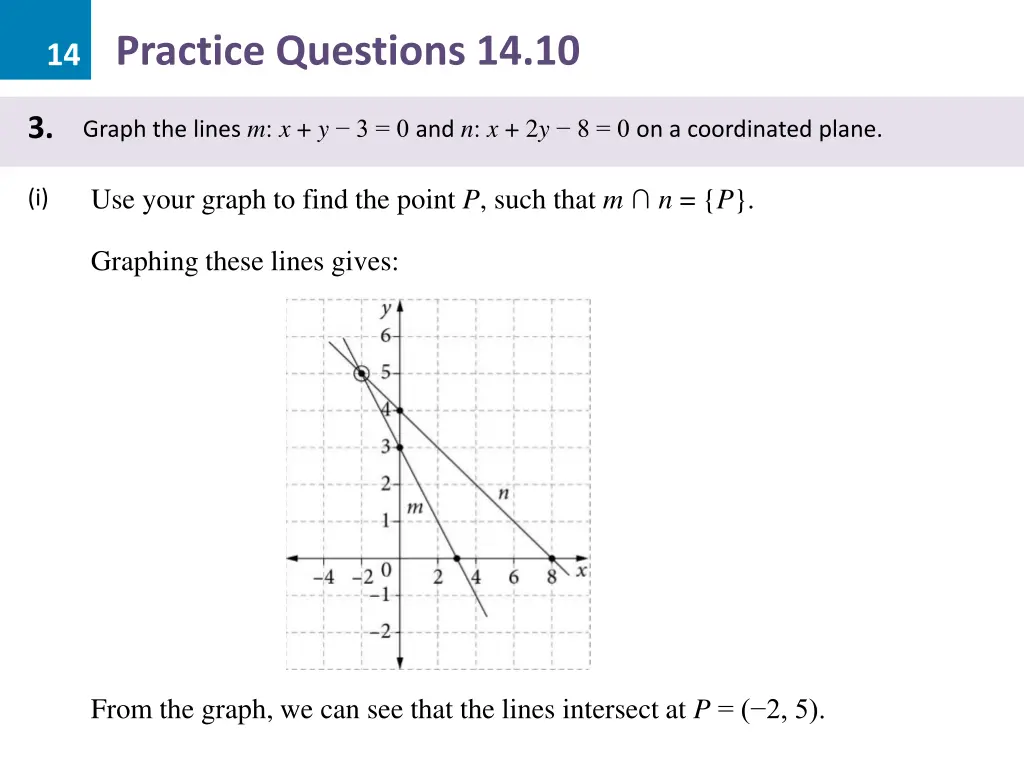
14 Practice Questions 14.10 3. Graph the lines m: x + y 3 = 0 and n: x + 2y 8 = 0 on a coordinated plane. Use your graph to find the point P, such that m n = {P}. (i) m: x + y 3 = 0 At y-axis, x = 0: At x-axis, y = 0: x + y 3 = 0 x + y 3 = 0 0 + y 3 = 0 x + 0 3 = 0 y = 3 x = 3 y-intercept = (0, 3) x-intercept = (3, 0)
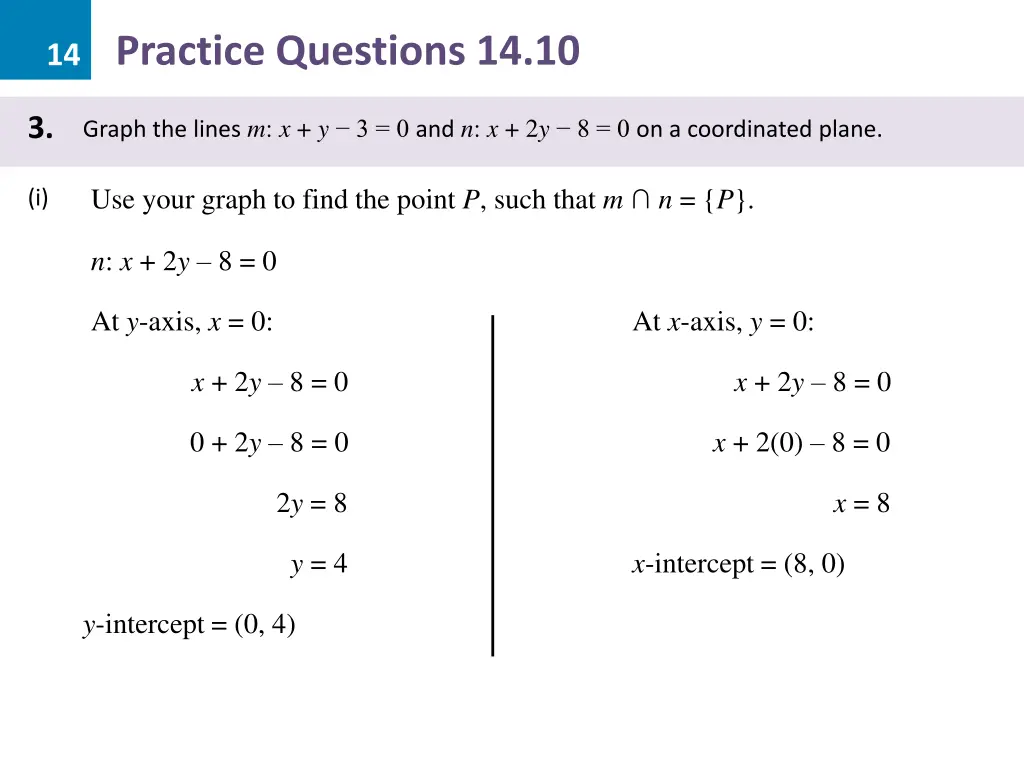
14 Practice Questions 14.10 3. Graph the lines m: x + y 3 = 0 and n: x + 2y 8 = 0 on a coordinated plane. Use your graph to find the point P, such that m n = {P}. (i) n: x + 2y 8 = 0 At y-axis, x = 0: At x-axis, y = 0: x + 2y 8 = 0 x + 2y 8 = 0 0 + 2y 8 = 0 x + 2(0) 8 = 0 2y = 8 x = 8 y = 4 x-intercept = (8, 0) y-intercept = (0, 4)
14 Practice Questions 14.10 3. Graph the lines m: x + y 3 = 0 and n: x + 2y 8 = 0 on a coordinated plane. Use your graph to find the point P, such that m n = {P}. (i) Graphing these lines gives: From the graph, we can see that the lines intersect at P= ( 2, 5).
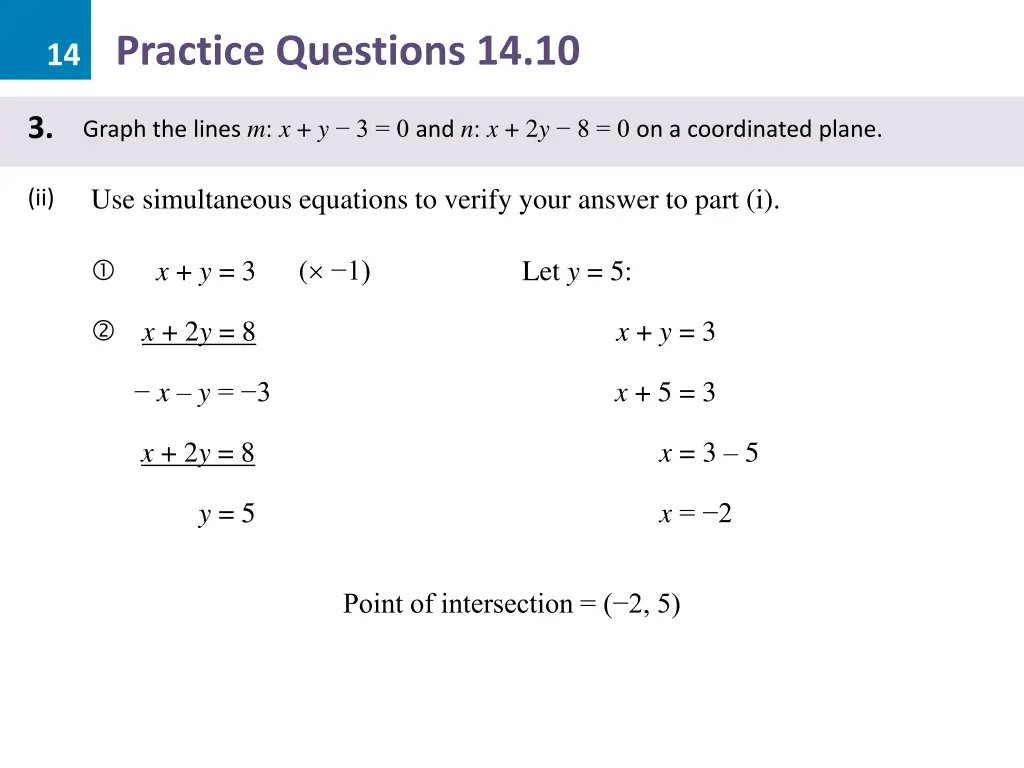
14 Practice Questions 14.10 3. Graph the lines m: x + y 3 = 0 and n: x + 2y 8 = 0 on a coordinated plane. Use simultaneous equations to verify your answer to part (i). (ii) ( 1) x + y = 3 Let y = 5: x + 2y = 8 x + y = 3 x y= 3 x + 5 = 3 x + 2y = 8 x = 3 5 y = 5 x= 2 Point of intersection = ( 2, 5)
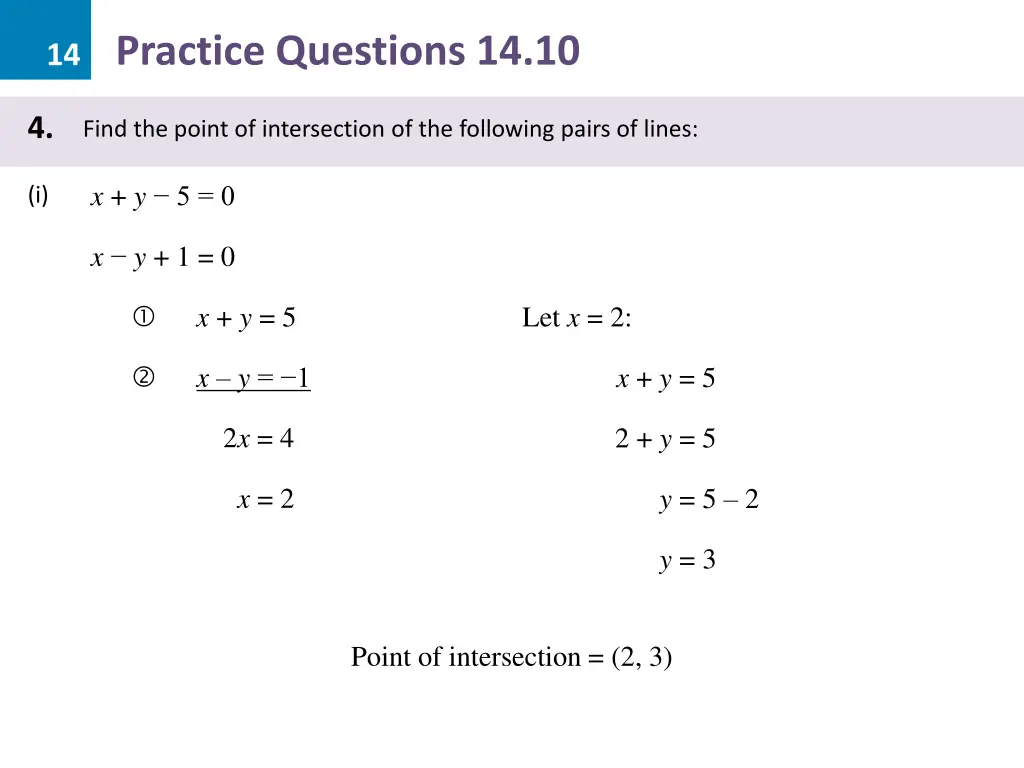
14 Practice Questions 14.10 4. Find the point of intersection of the following pairs of lines: x + y 5 = 0 (i) x y + 1 = 0 x + y = 5 Let x = 2: x y= 1 x + y = 5 2x = 4 2 + y = 5 x = 2 y = 5 2 y = 3 Point of intersection = (2, 3)
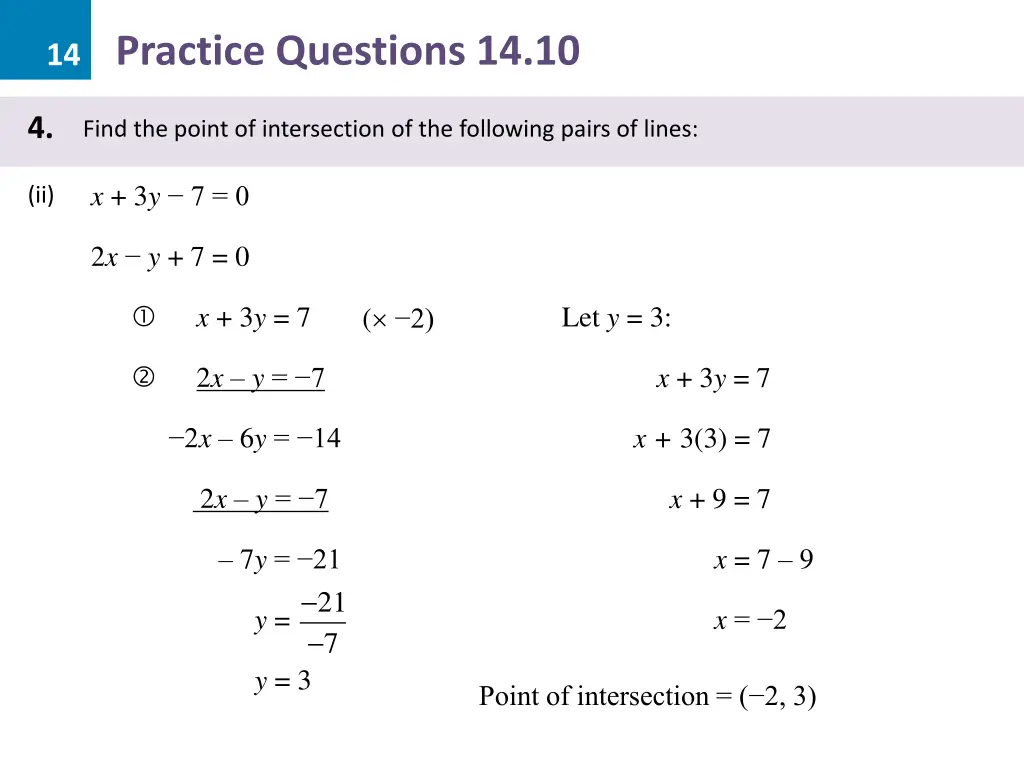
14 Practice Questions 14.10 4. Find the point of intersection of the following pairs of lines: x + 3y 7 = 0 (ii) 2x y + 7 = 0 ( 2) x + 3y = 7 Let y = 3: 2x y= 7 x + 3y = 7 2x 6y= 14 x + 3(3) = 7 2x y= 7 x + 9 = 7 7y= 21 x = 7 9 -21 -7 y = x= 2 y = 3 Point of intersection = ( 2, 3)
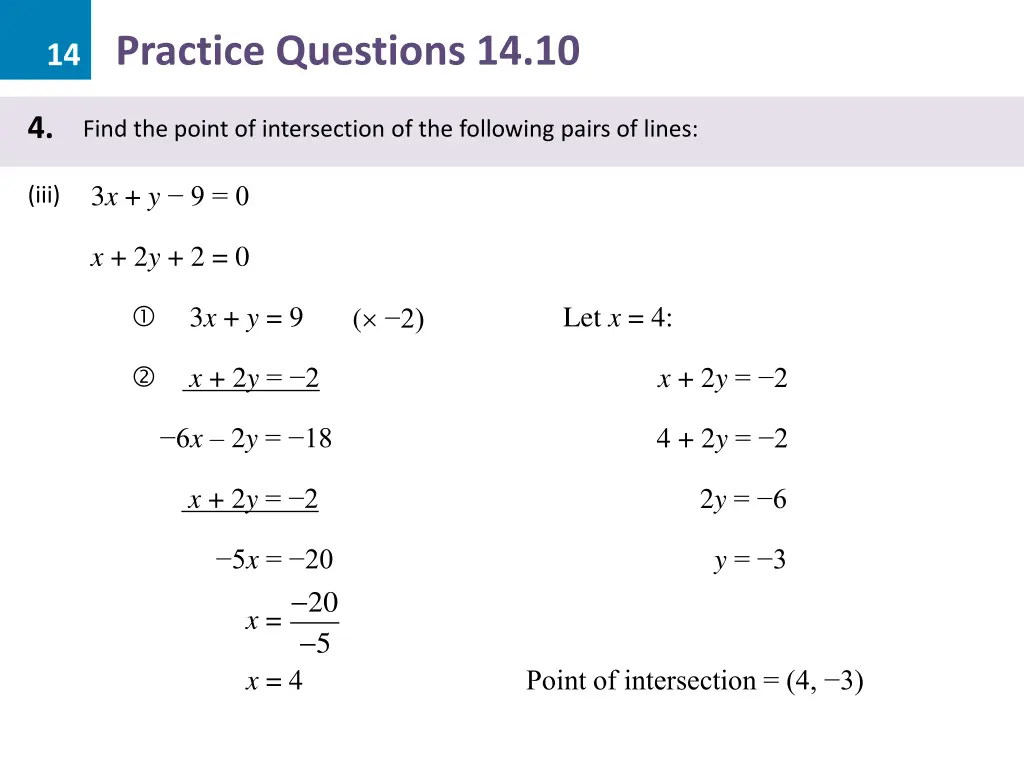
14 Practice Questions 14.10 4. Find the point of intersection of the following pairs of lines: 3x + y 9 = 0 (iii) x + 2y + 2 = 0 ( 2) 3x + y = 9 Let x = 4: x + 2y= 2 x + 2y= 2 6x 2y= 18 4 + 2y= 2 x + 2y= 2 2y= 6 5x= 20 y= 3 -20 -5 x = x = 4 Point of intersection = (4, 3)
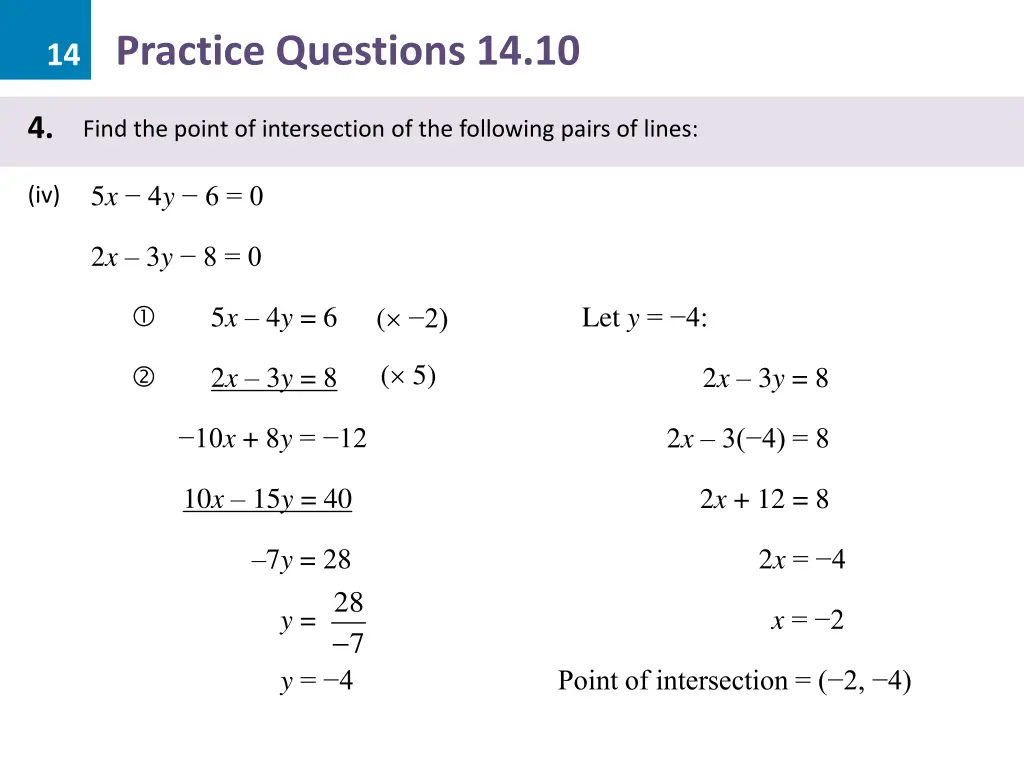
14 Practice Questions 14.10 4. Find the point of intersection of the following pairs of lines: 5x 4y 6 = 0 (iv) 2x 3y 8 = 0 ( 2) 5x 4y = 6 Let y= 4: ( 5) 2x 3y = 8 2x 3y = 8 10x + 8y= 12 2x 3( 4) = 8 10x 15y = 40 2x + 12 = 8 7y = 28 2x= 4 28 -7 y = x= 2 y= 4 Point of intersection = ( 2, 4)
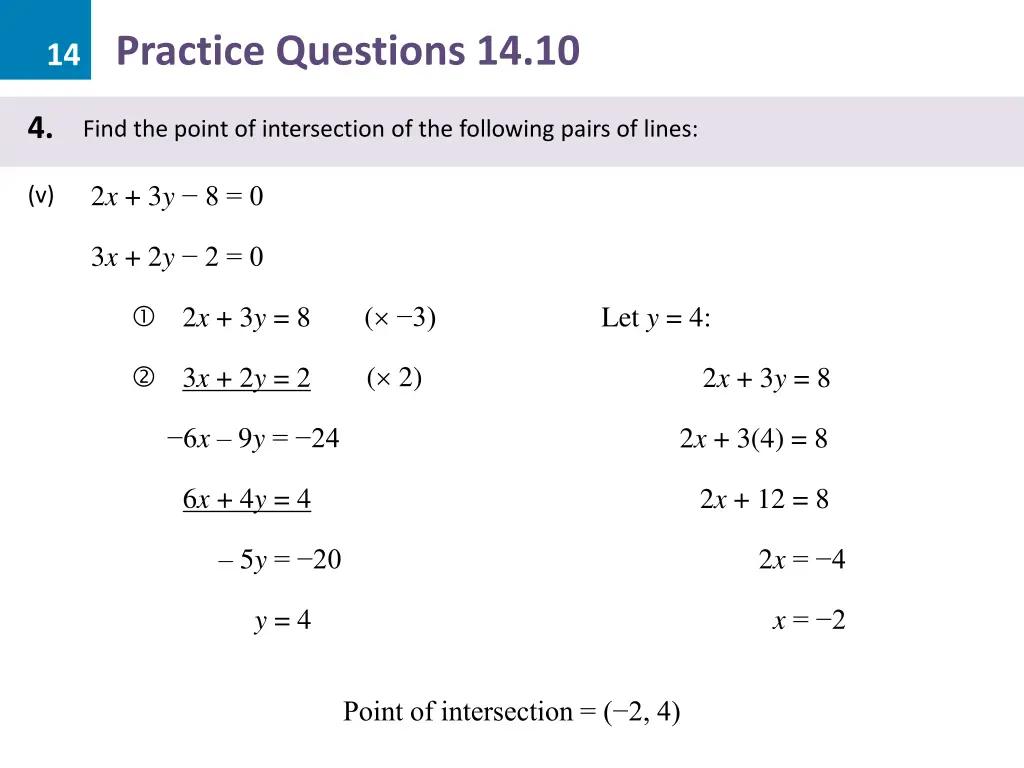
14 Practice Questions 14.10 4. Find the point of intersection of the following pairs of lines: 2x + 3y 8 = 0 (v) 3x + 2y 2 = 0 ( 3) 2x + 3y = 8 Let y = 4: ( 2) 3x + 2y = 2 2x + 3y = 8 6x 9y= 24 2x + 3(4) = 8 6x + 4y = 4 2x + 12 = 8 5y= 20 2x= 4 y = 4 x= 2 Point of intersection = ( 2, 4)
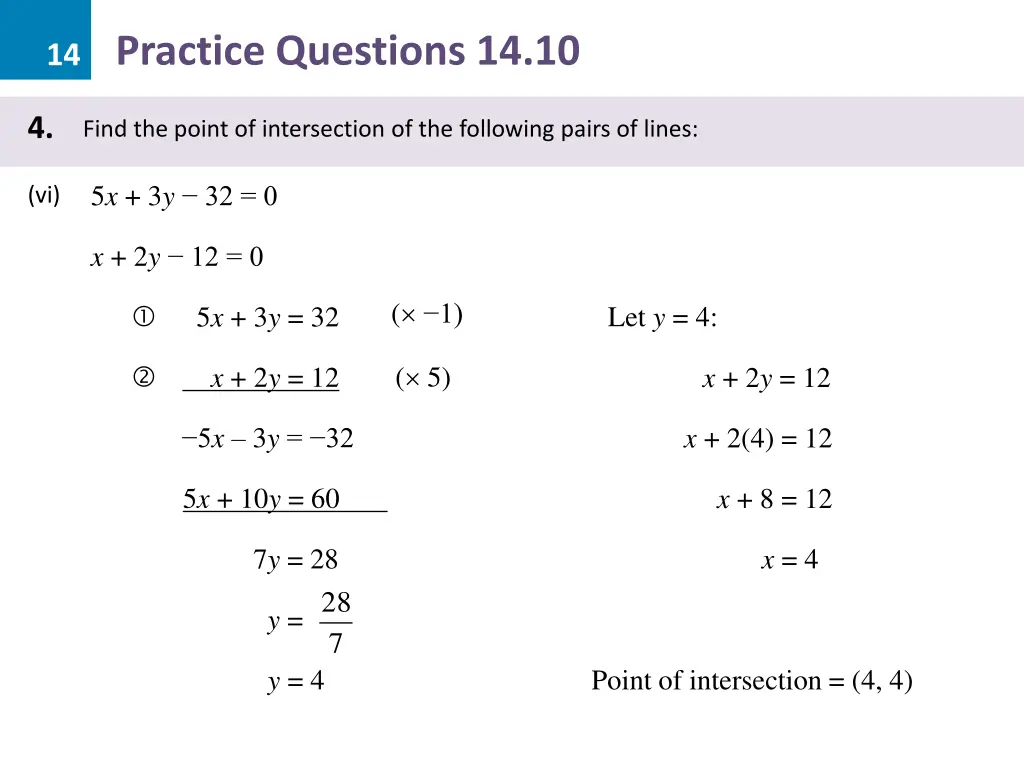
14 Practice Questions 14.10 4. Find the point of intersection of the following pairs of lines: 5x + 3y 32 = 0 (vi) x + 2y 12 = 0 ( 1) Let y = 4: 5x + 3y = 32 ( 5) x + 2y = 12 x + 2y = 12 5x 3y= 32 x + 2(4) = 12 5x + 10y = 60 x + 8 = 12 7y = 28 x = 4 28 7 y = y = 4 Point of intersection = (4, 4)
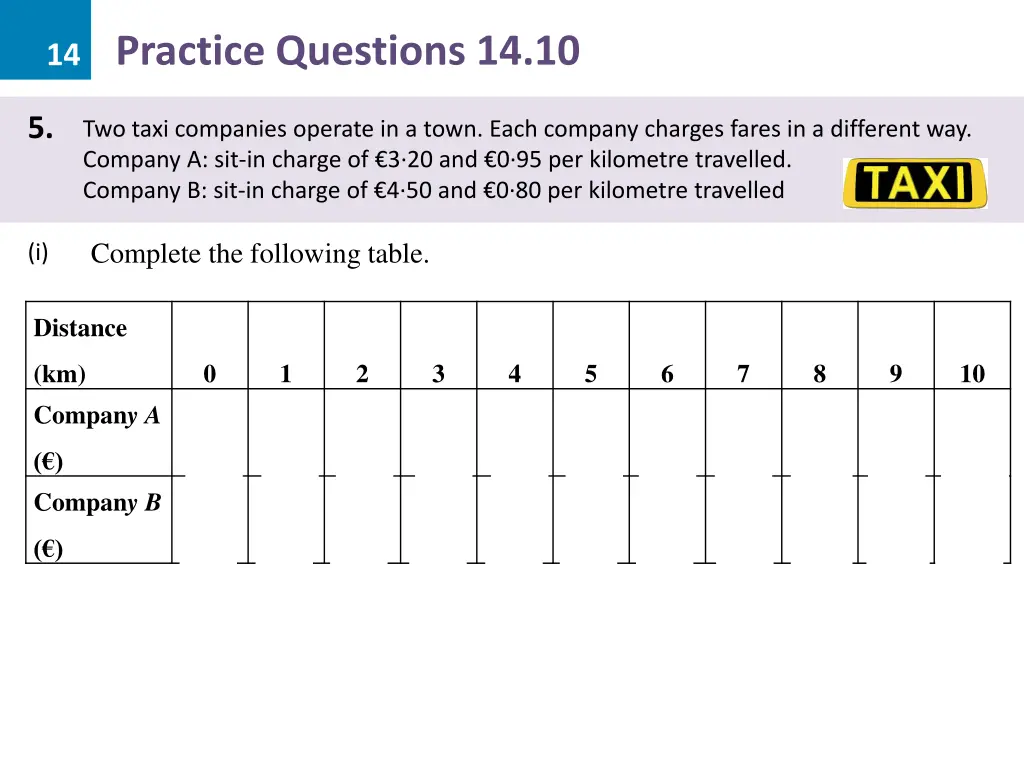
14 Practice Questions 14.10 5. Two taxi companies operate in a town. Each company charges fares in a different way. Company A: sit-in charge of 3 20 and 0 95 per kilometre travelled. Company B: sit-in charge of 4 50 and 0 80 per kilometre travelled Complete the following table. (i) Distance (km) CompanyA 0 1 2 3 4 5 6 7 8 9 10 3 20 4 15 5 10 6 05 7 00 7 95 8 90 9 85 10 80 11 75 12 70 ( ) CompanyB 4 50 5 30 6 10 6 90 7 70 8 50 9 30 10 10 10 90 11 70 12 50 ( )
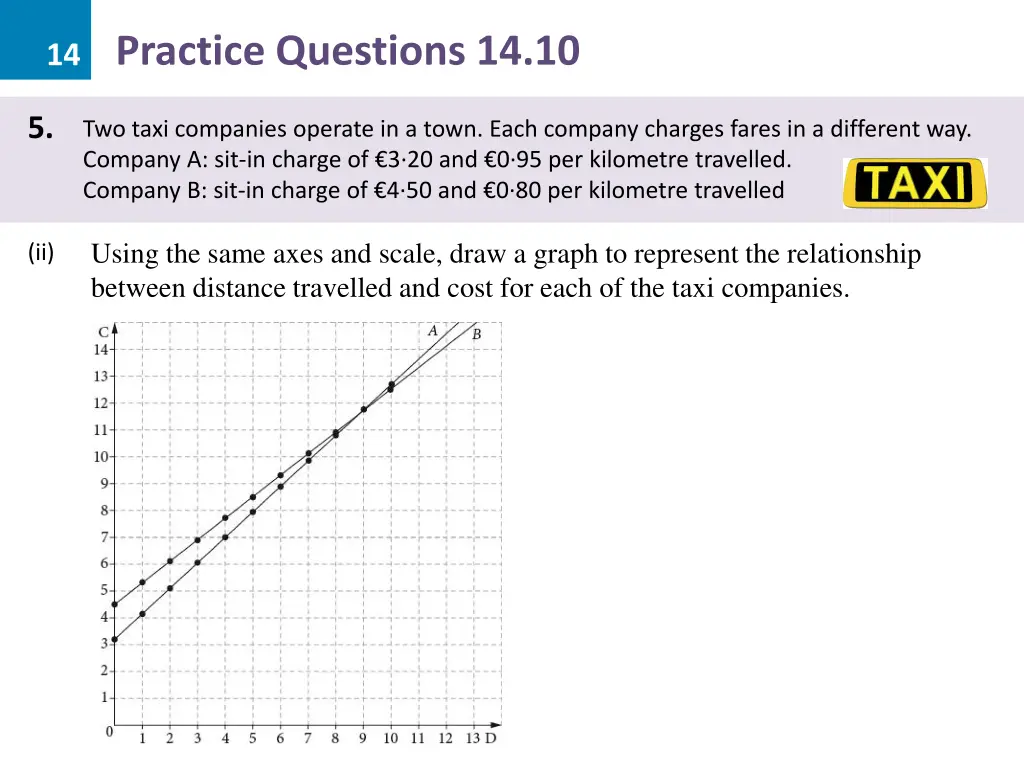
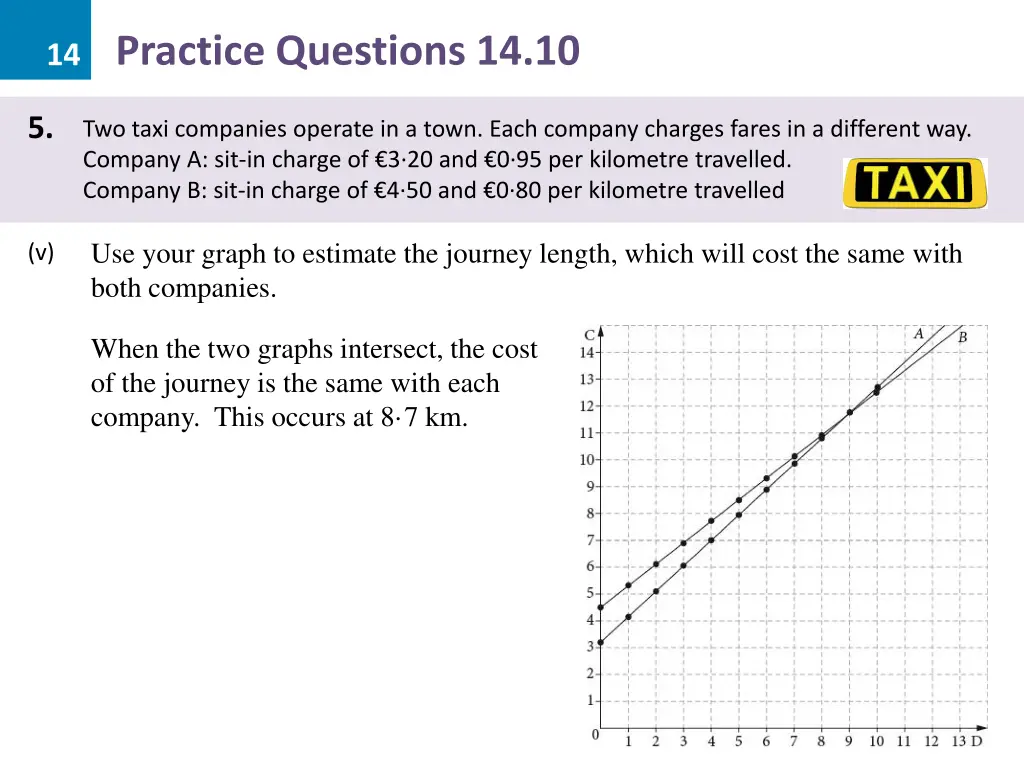
14 Practice Questions 14.10 5. Two taxi companies operate in a town. Each company charges fares in a different way. Company A: sit-in charge of 3 20 and 0 95 per kilometre travelled. Company B: sit-in charge of 4 50 and 0 80 per kilometre travelled Using the same axes and scale, draw a graph to represent the relationship between distance travelled and cost for each of the taxi companies. (ii)
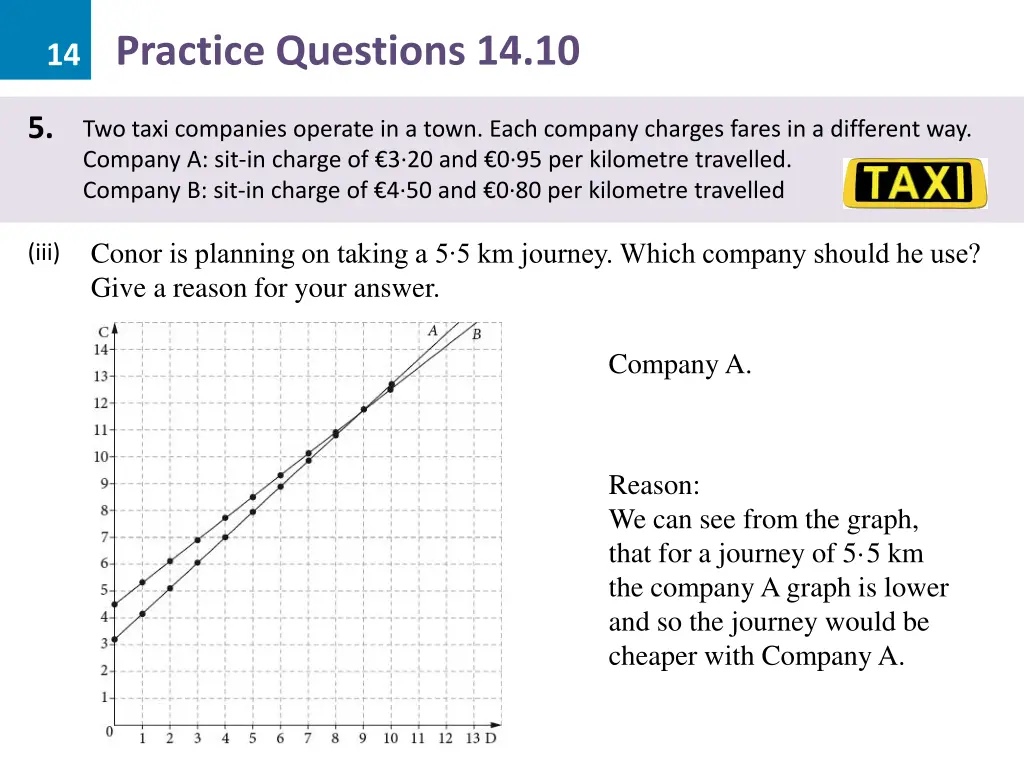
14 Practice Questions 14.10 5. Two taxi companies operate in a town. Each company charges fares in a different way. Company A: sit-in charge of 3 20 and 0 95 per kilometre travelled. Company B: sit-in charge of 4 50 and 0 80 per kilometre travelled Conor is planning on taking a 5 5 km journey. Which company should he use? Give a reason for your answer. (iii) Company A. Reason: We can see from the graph, that for a journey of 5 5 km the company A graph is lower and so the journey would be cheaper with Company A.
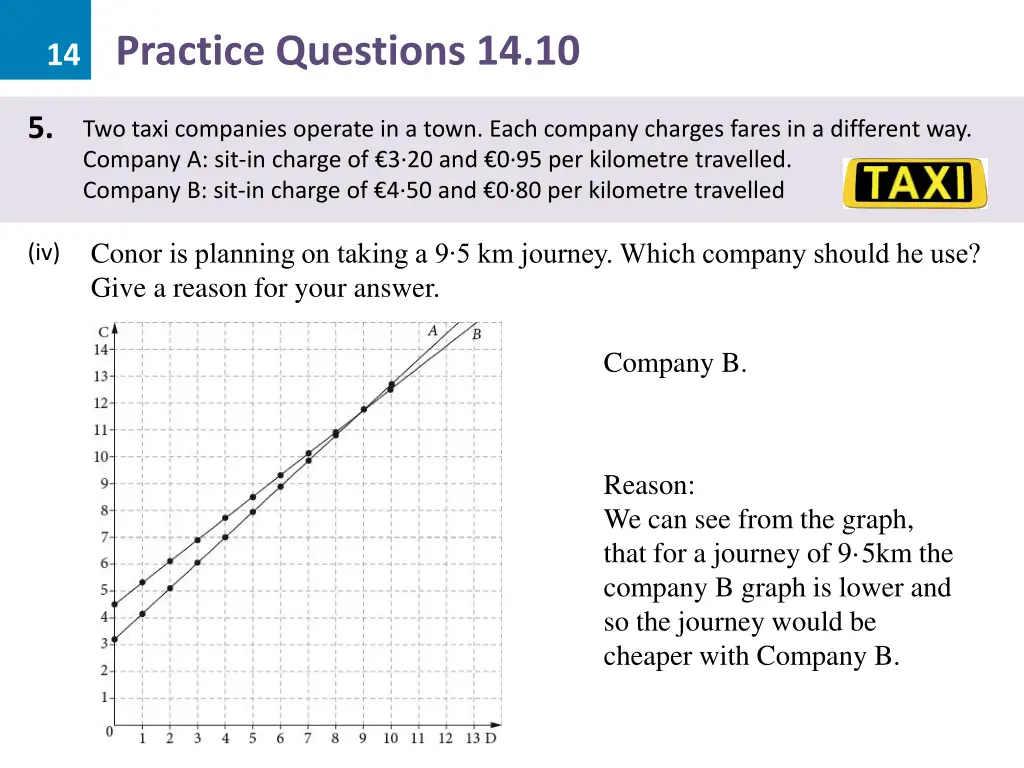
14 Practice Questions 14.10 5. Two taxi companies operate in a town. Each company charges fares in a different way. Company A: sit-in charge of 3 20 and 0 95 per kilometre travelled. Company B: sit-in charge of 4 50 and 0 80 per kilometre travelled Conor is planning on taking a 9 5 km journey. Which company should he use? Give a reason for your answer. (iv) Company B. Reason: We can see from the graph, that for a journey of 9 5km the company B graph is lower and so the journey would be cheaper with Company B.
14 Practice Questions 14.10 5. Two taxi companies operate in a town. Each company charges fares in a different way. Company A: sit-in charge of 3 20 and 0 95 per kilometre travelled. Company B: sit-in charge of 4 50 and 0 80 per kilometre travelled Use your graph to estimate the journey length, which will cost the same with both companies. (v) When the two graphs intersect, the cost of the journey is the same with each company. This occurs at 8 7 km.
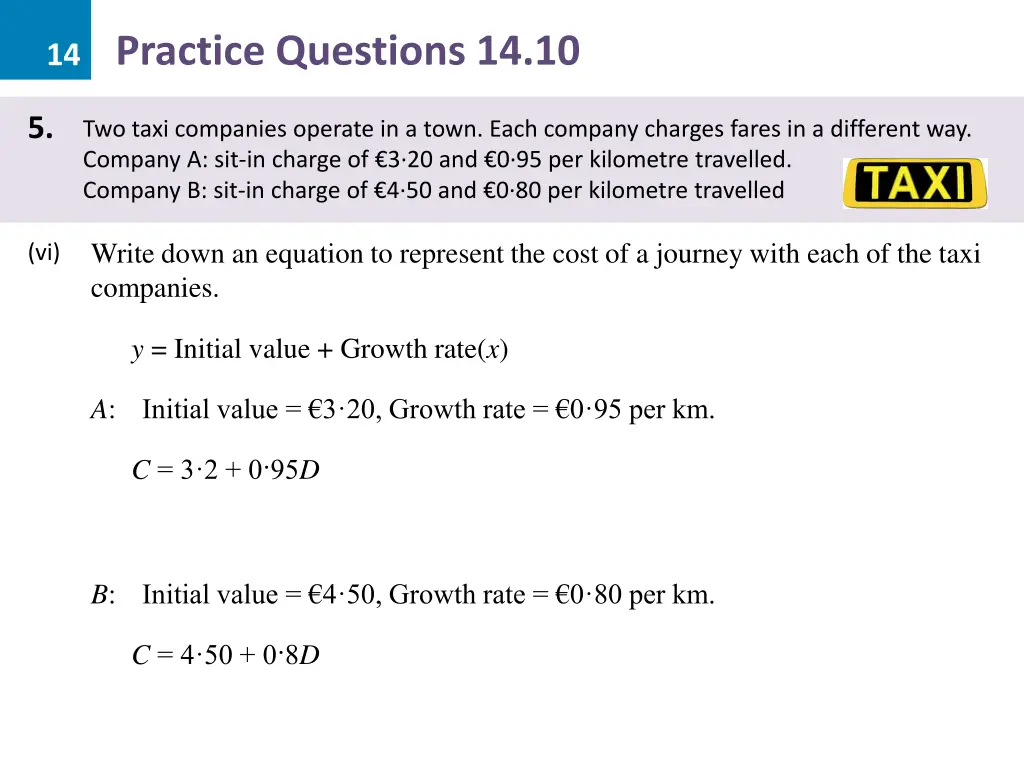
14 Practice Questions 14.10 5. Two taxi companies operate in a town. Each company charges fares in a different way. Company A: sit-in charge of 3 20 and 0 95 per kilometre travelled. Company B: sit-in charge of 4 50 and 0 80 per kilometre travelled Write down an equation to represent the cost of a journey with each of the taxi companies. (vi) y = Initial value + Growth rate(x) A: Initial value = 3 20, Growth rate = 0 95 per km. C= 3 2 + 0 95D B: Initial value = 4 50, Growth rate = 0 80 per km. C= 4 50 + 0 8D
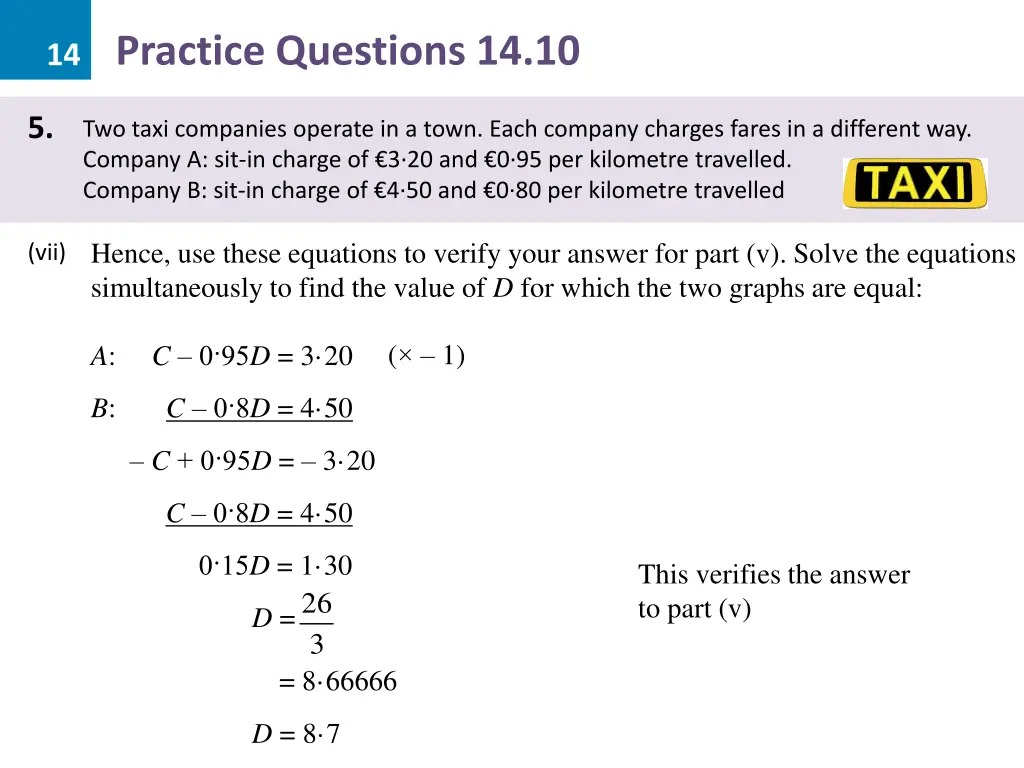
14 Practice Questions 14.10 5. Two taxi companies operate in a town. Each company charges fares in a different way. Company A: sit-in charge of 3 20 and 0 95 per kilometre travelled. Company B: sit-in charge of 4 50 and 0 80 per kilometre travelled (vii) Hence, use these equations to verify your answer for part (v). Solve the equations simultaneously to find the value of D for which the two graphs are equal: ( 1) A: C 0 95D = 3 20 B: C 0 8D = 4 50 C+ 0 95D = 3 20 C 0 8D = 4 50 0 15D = 1 30 D = 26 This verifies the answer to part (v) 3 = 8 66666 D = 8 7