Explore the initiative by Research Team from Makerere University to document the severely endangered So language spoken in Uganda, aiming to empower the marginalized So community through language preservation and cultural revitalization for sustainable development.
Please find below an Image/Link to download the presentation.
The content on the website is provided AS IS for your information and personal use only. It may not be sold, licensed, or shared on other websites without obtaining consent from the author. If you encounter any issues during the download, it is possible that the publisher has removed the file from their server.
You are allowed to download the files provided on this website for personal or commercial use, subject to the condition that they are used lawfully. All files are the property of their respective owners.
The content on the website is provided AS IS for your information and personal use only. It may not be sold, licensed, or shared on other websites without obtaining consent from the author.
E N D
Presentation Transcript
CORPUS DEVELOPMENT OF THE CORPUS DEVELOPMENT OF THE SO LANGUAGE SO LANGUAGE FOR COMMUNITY EMPOWERMENT FOR COMMUNITY EMPOWERMENT Research Team Makerere University: Dr. Celestino Oriikiriza (Principal Investigator), Dr. Fridah Katushemererwe (Co-Investigator), Dr. Deo Kawalya (Co-Investigator), Mr. Michael Wangotta (Co-investigator), and Mr. Luke Francis Kiwanuka (Co- investigator) Partners at SIL, Entebbe: Mr. Richard Nzogi, Mr. Gift Asiku, Mr. Michael Angunda, and Ms. Maria Stolen Partners at Achva Academic College, Israel: Dr. Sigal Uziel-Karl
Introduction Introduction Name and status: So, also known as Tepeth/Soo/Sor is a severely endangered language in Uganda. It is spoken in Moroto, Nakapiripirit, and Napak (in north-eastern in Uganda in Karamoja region). Population: 23,422 (Uganda Bureau of Statistics 2016). The So are a socially marginalised group (Kisembo 2014). The language is on the verge of extinction; 100 can speak it (Heine 1974/75, Ethnologue 2019; Carlin 1993, Beer 2009, < 50 from the findings under this project in 2020). Speakers are old and there is hardly transmission of the language to the young generation (Weatherby 1969, Heine 1976, Carlin 1993, Lokawua 2017). This is attributed to insecurity, existing economically and socially viable languages, lack of curriculum for the language, intermarriages, child mortality due to hunger and disease.
Background The So suffer from linguistic inequality; they can hardly use So in public for fear of being discriminated against. Hardly experience linguistic equality. They need social emancipation (Kisembo 2014). Indigenous lifestyle is potential for protection of the natural environment. Language is one of the defining factors for indigenous lifestyle. Protection of indigenous people such as the So, is advocated in the Republic of Uganda constitution 1995, and United Nations 2015 (read SDGs). For purposes of developing cultural tourism (NDPII 2015), languages such as So are a potential resource if their form and culture are documented. Policy reports (Uganda and UNDP 2014) recommended the use of effective communication of development programmes. How best do you communicate to the So if not in their language? Cf. Childs (2003)
Background (contn.) But So is hardly written to be used as a tool for emancipation, protection, and development of the So community in light of the above. Thus, this project. There is written evidence of So, but it does not have the So speaker in mind, hence this project: - Previous researchers rely on few speakers of So; limits variety - So narratives, history, and culture are written in English (Weatherby 2012, Carlin 1993, Laughlin & Laughlin 1972) - No established orthography (Heine & Carlin 2010: ik head , c diviner ) - No full-fledged dictionaries but glossaries (English to So and So to English) - Limited representation of linguistic variation, e.g. So/Tho/Ng tho - Transient descriptions; no dedicated language and documentation project - No pictorial representation of people, places, and objects
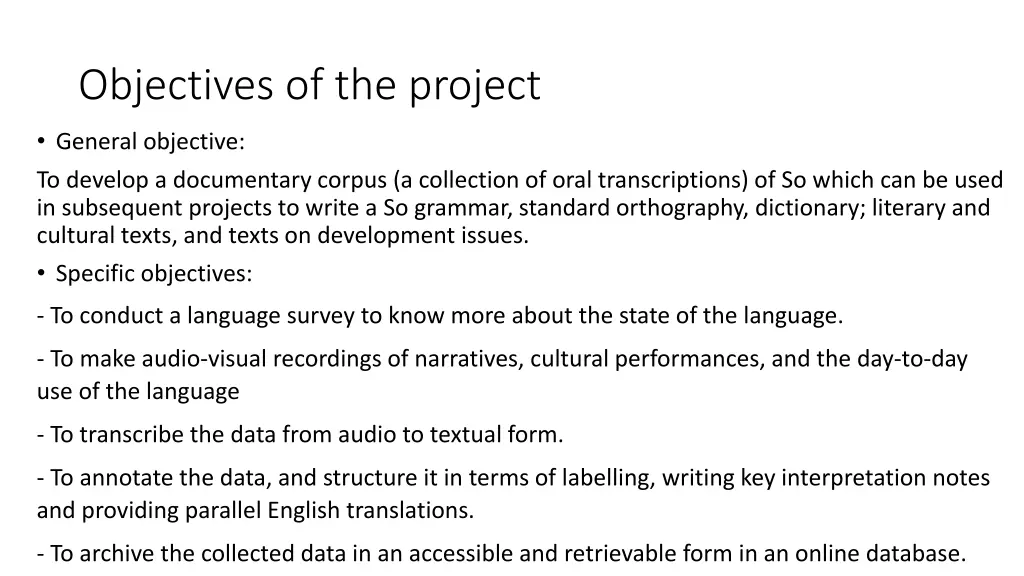
Objectives of the project General objective: To develop a documentary corpus (a collection of oral transcriptions) of So which can be used in subsequent projects to write a So grammar, standard orthography, dictionary; literary and cultural texts, and texts on development issues. Specific objectives: - To conduct a language survey to know more about the state of the language. - To make audio-visual recordings of narratives, cultural performances, and the day-to-day use of the language - To transcribe the data from audio to textual form. - To annotate the data, and structure it in terms of labelling, writing key interpretation notes and providing parallel English translations. - To archive the collected data in an accessible and retrievable form in an online database.
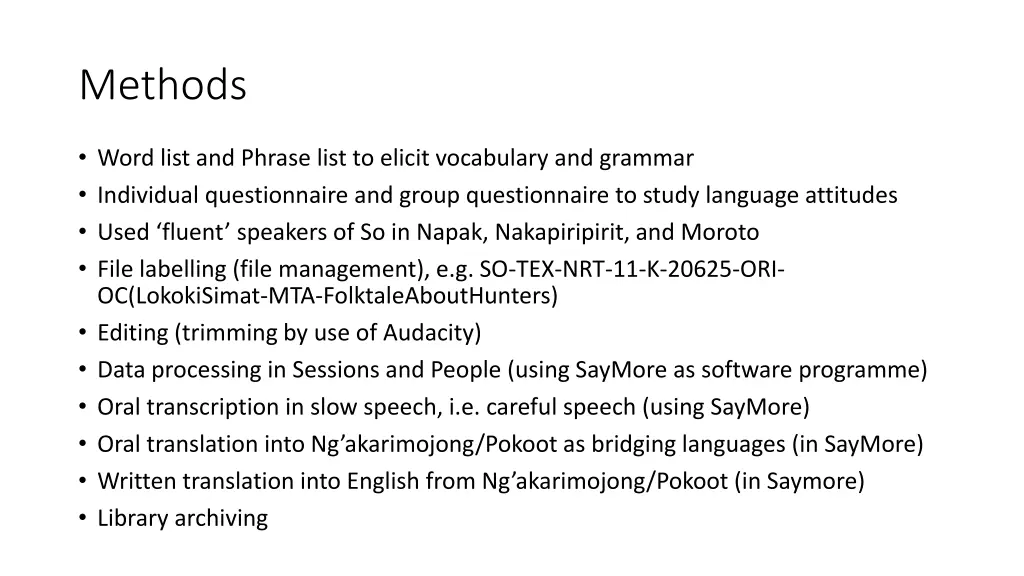
Methods Word list and Phrase list to elicit vocabulary and grammar Individual questionnaire and group questionnaire to study language attitudes Used fluent speakers of So in Napak, Nakapiripirit, and Moroto File labelling (file management), e.g. SO-TEX-NRT-11-K-20625-ORI- OC(LokokiSimat-MTA-FolktaleAboutHunters) Editing (trimming by use of Audacity) Data processing in Sessions and People (using SayMore as software programme) Oral transcription in slow speech, i.e. careful speech (using SayMore) Oral translation into Ng akarimojong/Pokoot as bridging languages (in SayMore) Written translation into English from Ng akarimojong/Pokoot (in Saymore) Library archiving
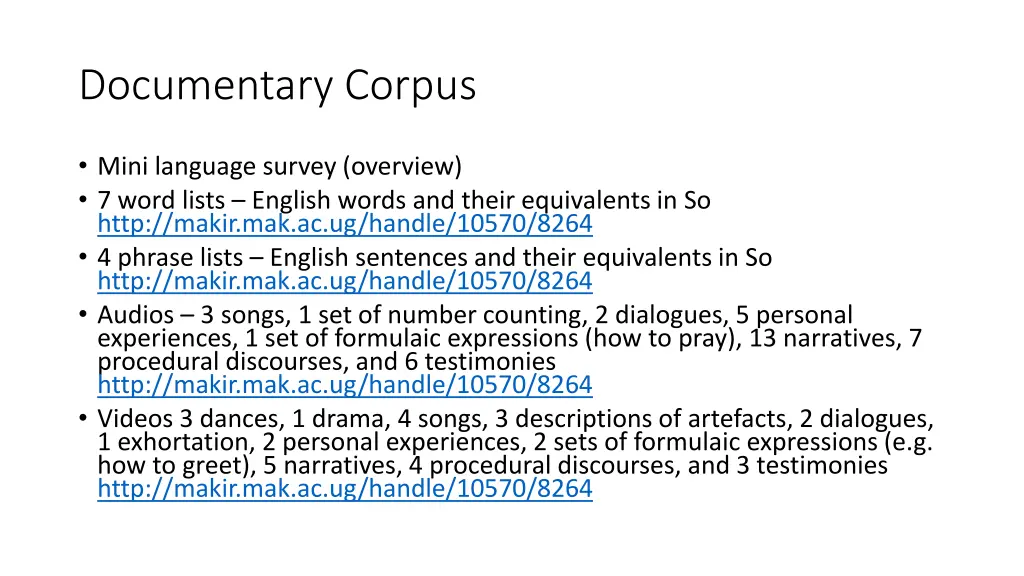
Documentary Corpus Mini language survey (overview) 7 word lists English words and their equivalents in So http://makir.mak.ac.ug/handle/10570/8264 4 phrase lists English sentences and their equivalents in So http://makir.mak.ac.ug/handle/10570/8264 Audios 3 songs, 1 set of number counting, 2 dialogues, 5 personal experiences, 1 set of formulaic expressions (how to pray), 13 narratives, 7 procedural discourses, and 6 testimonies http://makir.mak.ac.ug/handle/10570/8264 Videos 3 dances, 1 drama, 4 songs, 3 descriptions of artefacts, 2 dialogues, 1 exhortation, 2 personal experiences, 2 sets of formulaic expressions (e.g. how to greet), 5 narratives, 4 procedural discourses, and 3 testimonies http://makir.mak.ac.ug/handle/10570/8264
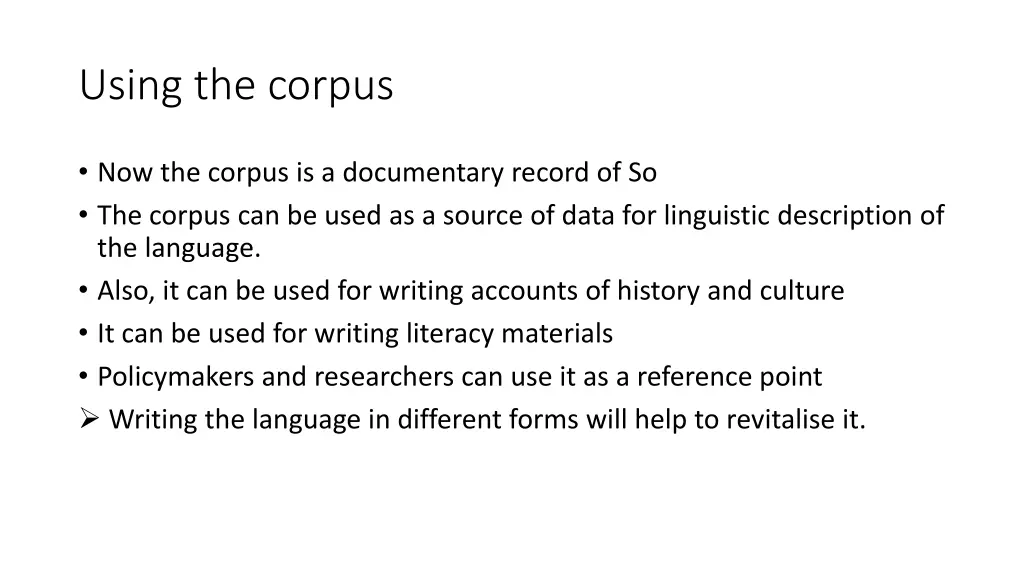
Using the corpus Now the corpus is a documentary record of So The corpus can be used as a source of data for linguistic description of the language. Also, it can be used for writing accounts of history and culture It can be used for writing literacy materials Policymakers and researchers can use it as a reference point Writing the language in different forms will help to revitalise it.
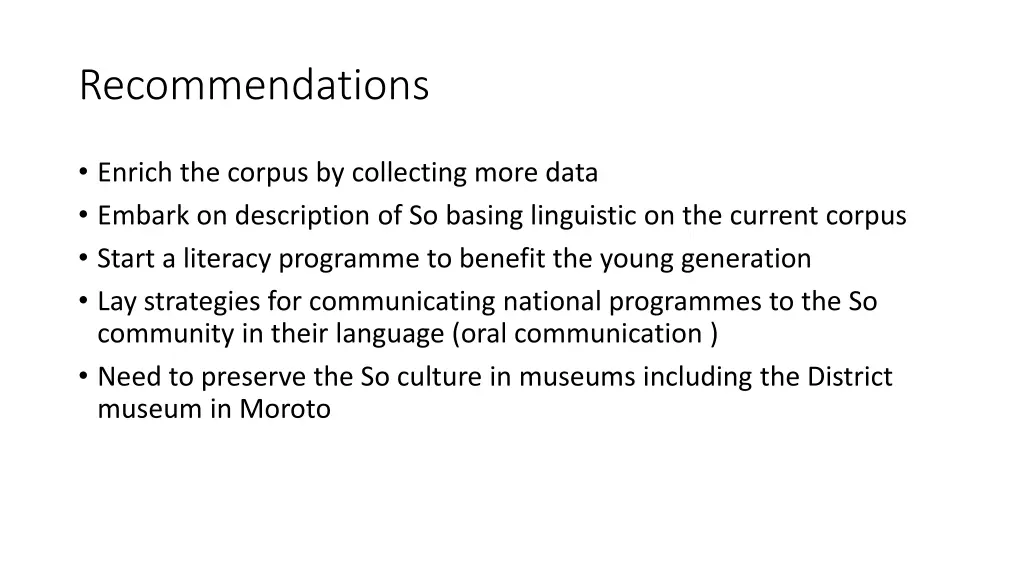
Recommendations Enrich the corpus by collecting more data Embark on description of So basing linguistic on the current corpus Start a literacy programme to benefit the young generation Lay strategies for communicating national programmes to the So community in their language (oral communication ) Need to preserve the So culture in museums including the District museum in Moroto
Acknowledgements Acknowledgements Government of Uganda Makerere University Research and Innovations Fund Achva Academic College, Israel 10