Correspondence Analysis: Unveiling Multidimensional Patterns
Explore Correspondence Analysis, a statistical method for analyzing multidimensional data and patterns of association between qualitative variables. Understand the goal, assumptions, and applications of this multivariate technique with a practical case study on RStudio.

Download Presentation

Please find below an Image/Link to download the presentation.
The content on the website is provided AS IS for your information and personal use only. It may not be sold, licensed, or shared on other websites without obtaining consent from the author. If you encounter any issues during the download, it is possible that the publisher has removed the file from their server.
You are allowed to download the files provided on this website for personal or commercial use, subject to the condition that they are used lawfully. All files are the property of their respective owners.
The content on the website is provided AS IS for your information and personal use only. It may not be sold, licensed, or shared on other websites without obtaining consent from the author.
E N D
Presentation Transcript
datascience-project.eu Correspondence Analysis By [UNISALENTO] The European Commission support for the production of this publication does not constitute endorsement of the contents which reflects the views only of the authors, and the Commission cannot be held responsible for any use which may be made of the information contained therein."
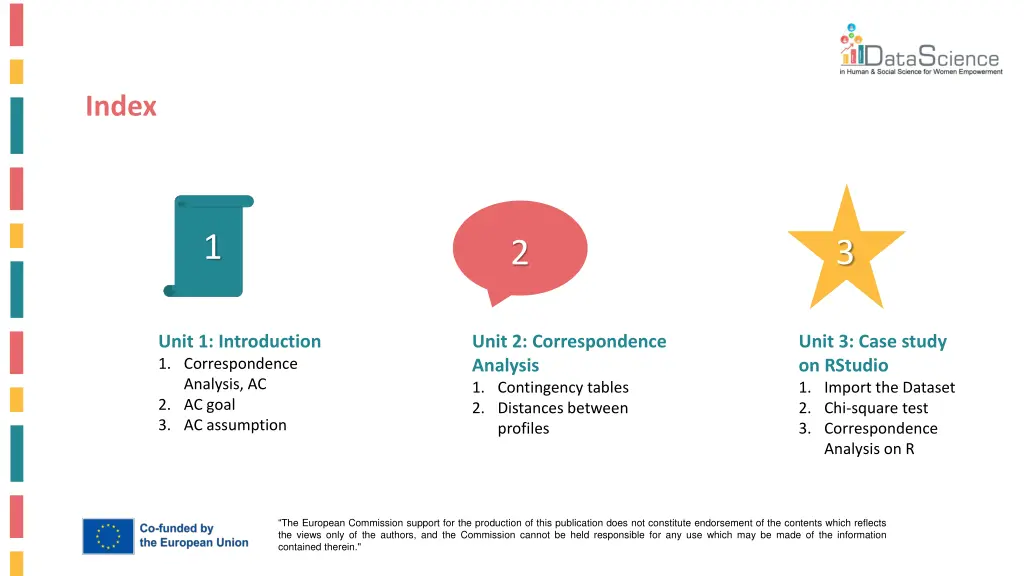
Index 1 3 2 Unit 1: Introduction 1. Correspondence Analysis, AC 2. AC goal 3. AC assumption Unit 2: Correspondence Analysis 1. Contingency tables 2. Distances between profiles Unit 3: Case study on RStudio 1. Import the Dataset 2. Chi-square test 3. Correspondence Analysis on R The European Commission support for the production of this publication does not constitute endorsement of the contents which reflects the views only of the authors, and the Commission cannot be held responsible for any use which may be made of the information contained therein."
Unit 1: Introduction Section 1: Correspondence Analysis, CA Correspondence analysis is a statistical method for the analysis of multidimensional data, it is a multivariate technique that analyzes patterns of association between qualitative variables. The European Commission support for the production of this publication does not constitute endorsement of the contents which reflects the views only of the authors, and the Commission cannot be held responsible for any use which may be made of the information contained therein."
Unit Unit 1: 1: Introduction Introduction Section 1: Correspondence Analysis, CA Qualitative variables are variables that are not represented by numbers, but by modalities, for example: gender, level of education, marital status, etc. The European Commission support for the production of this publication does not constitute endorsement of the contents which reflects the views only of the authors, and the Commission cannot be held responsible for any use which may be made of the information contained therein."
Unit Unit 1: 1: Introduction Introduction Section 1: Correspondence Analysis, CA Since qualitative variables are used in the AC, the object of the analysis are the contingency matrices, whose elements indicate the number of times (the counts) that the characteristics of two different quantities have been detected together. The European Commission support for the production of this publication does not constitute endorsement of the contents which reflects the views only of the authors, and the Commission cannot be held responsible for any use which may be made of the information contained therein."
Unit Unit 1: 1: Introduction Introduction Section 2: Goal of Correspondence Analysis The main goal of AC is to analyze the relationships between a set of qualitative variables observed on a collective of statistical units. This is done through the identification of an "optimal" space, i.e. a small dimension that represents the synthesis of the structural information contained in the original data. The European Commission support for the production of this publication does not constitute endorsement of the contents which reflects the views only of the authors, and the Commission cannot be held responsible for any use which may be made of the information contained therein."
Unit Unit 1: 1: Introduction Introduction Section 2: Goal of Correspondence Analysis In essence, they will build a series of latent variables (or factors), a combination of the original variables, which express some concepts not directly observable in reality, but the result of the measurement of a set of variables. The European Commission support for the production of this publication does not constitute endorsement of the contents which reflects the views only of the authors, and the Commission cannot be held responsible for any use which may be made of the information contained therein."
Unit Unit 1: 1: Introduction Introduction Section 3: The assumption in Correspondence Analysis In Correspondence Analysis, the variables used do not have to be independent, so the modes of one variable must influence the modes of the other. The European Commission support for the production of this publication does not constitute endorsement of the contents which reflects the views only of the authors, and the Commission cannot be held responsible for any use which may be made of the information contained therein."
Unit Unit 1: 1: Introduction Introduction Section 3: The assumption in Correspondence Analysis Before carrying out a correspondence analysis it is necessary to establish the degree of interdependence between the characters considered because, if they are independent, it may not make sense to search for the correspondences between them. For this purpose, it is necessary to apply the Chi-square test, which assesses any interdependence relationships between the qualitative variables The European Commission support for the production of this publication does not constitute endorsement of the contents which reflects the views only of the authors, and the Commission cannot be held responsible for any use which may be made of the information contained therein."
Unit Unit 1: 1: Introduction Introduction Section 3: The assumption in Correspondence Analysis The test starts of the null hypothesis that considers the two independent variables. The alternative hypothesis will be that the two variables have a certain degree of interdependence. If the test results return a p-value < 0.05, the null hypothesis can be rejected and consequently the two variables will be considered interdependent, and you can continue with the analysis. The European Commission support for the production of this publication does not constitute endorsement of the contents which reflects the views only of the authors, and the Commission cannot be held responsible for any use which may be made of the information contained therein."
Unit Unit 2: 2: Correspondence Correspondence Analysis Analysis Section 1: Contingency Tables The contingency tables contain the joint frequencies of the variable modes. Given two qualitative variables X and Y, the relevant contingency table will contain how many times a given mode of variable X occurs with a given mode of variable Y. The European Commission support for the production of this publication does not constitute endorsement of the contents which reflects the views only of the authors, and the Commission cannot be held responsible for any use which may be made of the information contained therein."
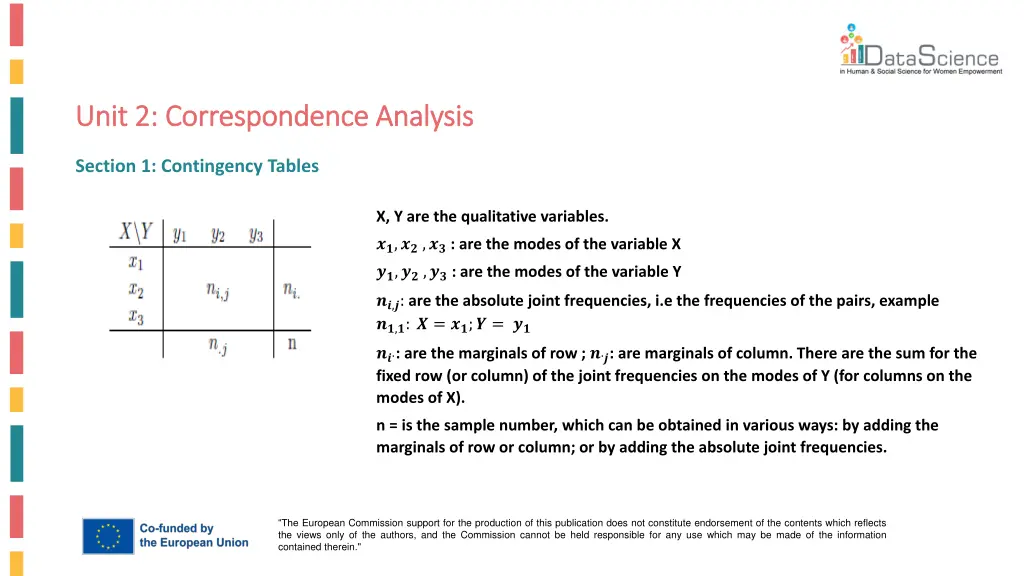
Unit Unit 2: 2: Correspondence Correspondence Analysis Analysis Section 1: Contingency Tables X, Y are the qualitative variables. ??,??,??: are the modes of the variable X ??,??,??: are the modes of the variable Y ??,?: are the absolute joint frequencies, i.e the frequencies of the pairs, example ??,?: ? = ??;? = ?? ?? : are the marginals of row ; ? ?: are marginals of column. There are the sum for the fixed row (or column) of the joint frequencies on the modes of Y (for columns on the modes of X). n = is the sample number, which can be obtained in various ways: by adding the marginals of row or column; or by adding the absolute joint frequencies. The European Commission support for the production of this publication does not constitute endorsement of the contents which reflects the views only of the authors, and the Commission cannot be held responsible for any use which may be made of the information contained therein."
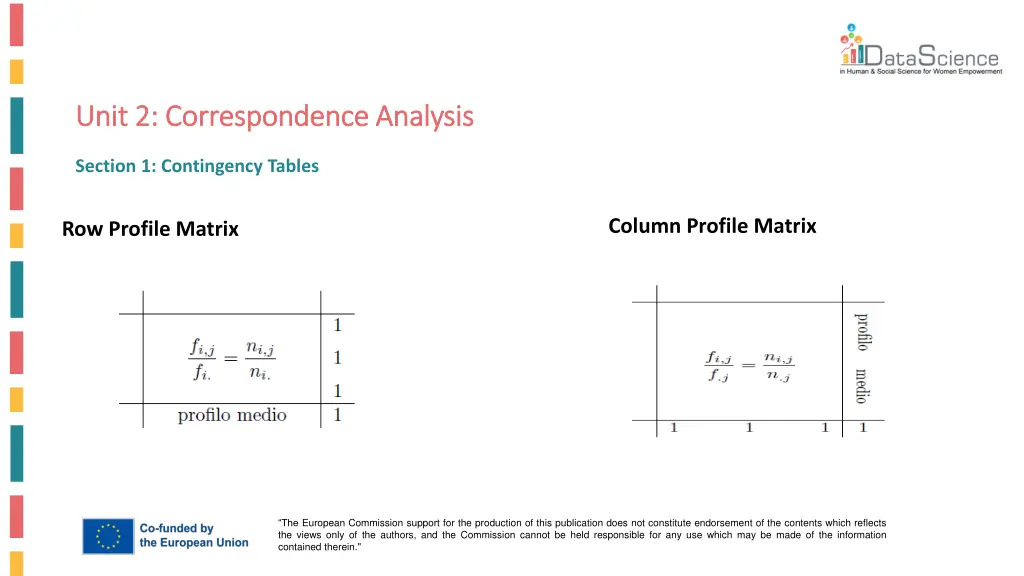
Unit Unit 2: 2: Correspondence Correspondence Analysis Analysis Section 1: Contingency Tables The Correspondence Analysis allows to represent the phenomenon both in the space of the rows and in the space of the columns. To do this, the row and column profile matrices must be constructed: - dividing the absolute frequencies by the corresponding marginal rows (or column); - dividing the relative frequencies (i.e. the absolute frequencies divided by the total number of the sample) by the respective row (or column) margins. The European Commission support for the production of this publication does not constitute endorsement of the contents which reflects the views only of the authors, and the Commission cannot be held responsible for any use which may be made of the information contained therein."
Unit Unit 2: 2: Correspondence Correspondence Analysis Analysis Section 1: Contingency Tables Column Profile Matrix Row Profile Matrix The European Commission support for the production of this publication does not constitute endorsement of the contents which reflects the views only of the authors, and the Commission cannot be held responsible for any use which may be made of the information contained therein."
Unit Unit 2: 2: Correspondence Correspondence Analysis Analysis Section 2: Distances Between Profiles Finally, you have to calculate the distances between the profiles to see if the modalities are similar or not, distant or not, i.e. see if the profiles resemble each other or not. There are two types of distances: the Euclidean distance and the Chi-square distance. The European Commission support for the production of this publication does not constitute endorsement of the contents which reflects the views only of the authors, and the Commission cannot be held responsible for any use which may be made of the information contained therein."
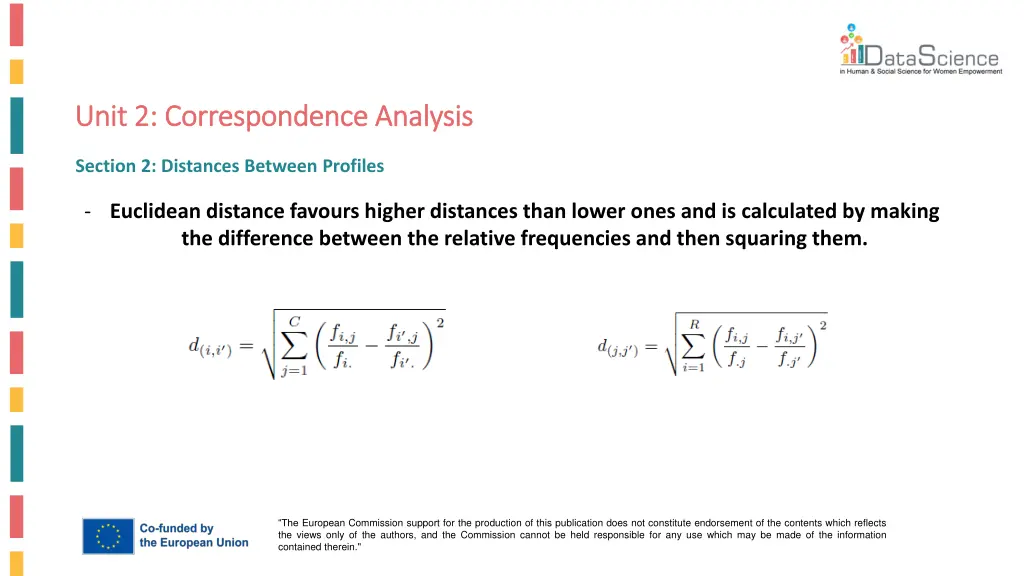
Unit Unit 2: 2: Correspondence Correspondence Analysis Analysis Section 2: Distances Between Profiles - Euclidean distance favours higher distances than lower ones and is calculated by making the difference between the relative frequencies and then squaring them. The European Commission support for the production of this publication does not constitute endorsement of the contents which reflects the views only of the authors, and the Commission cannot be held responsible for any use which may be made of the information contained therein."
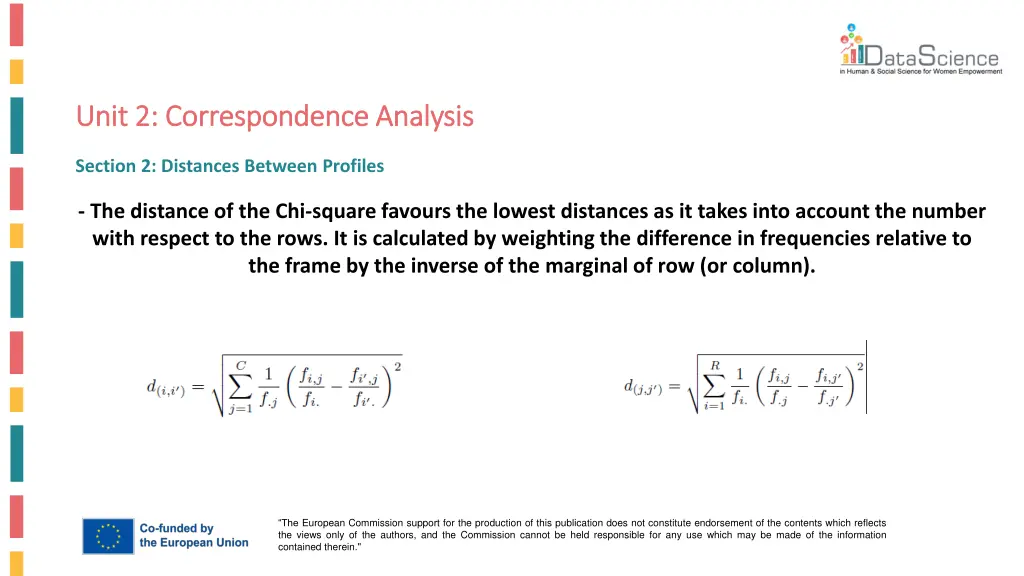
Unit Unit 2: 2: Correspondence Correspondence Analysis Analysis Section 2: Distances Between Profiles - The distance of the Chi-square favours the lowest distances as it takes into account the number with respect to the rows. It is calculated by weighting the difference in frequencies relative to the frame by the inverse of the marginal of row (or column). The European Commission support for the production of this publication does not constitute endorsement of the contents which reflects the views only of the authors, and the Commission cannot be held responsible for any use which may be made of the information contained therein."
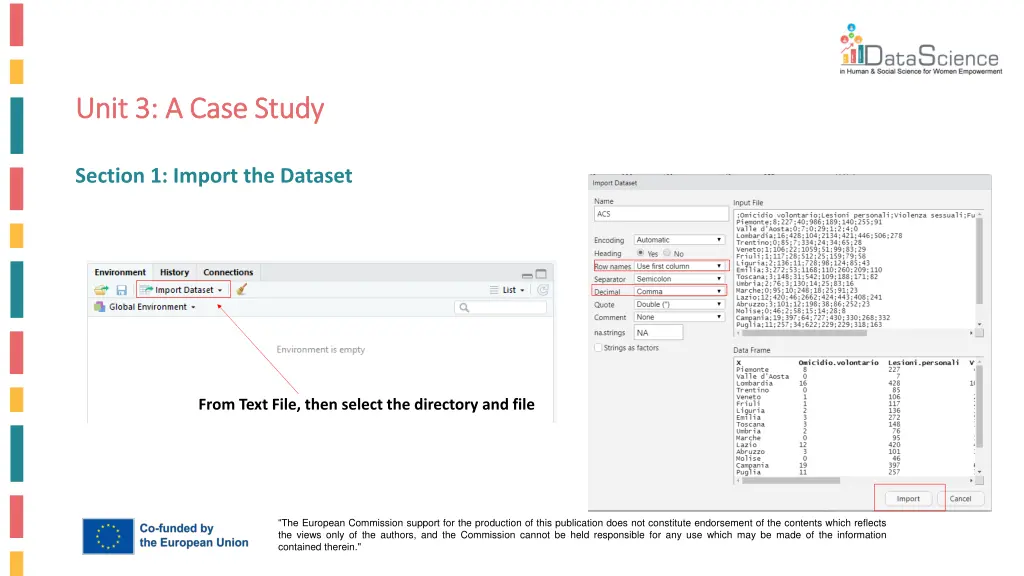
Unit 3: A Case Study Unit 3: A Case Study Section 1: Import the Dataset From Text File, then select the directory and file The European Commission support for the production of this publication does not constitute endorsement of the contents which reflects the views only of the authors, and the Commission cannot be held responsible for any use which may be made of the information contained therein."
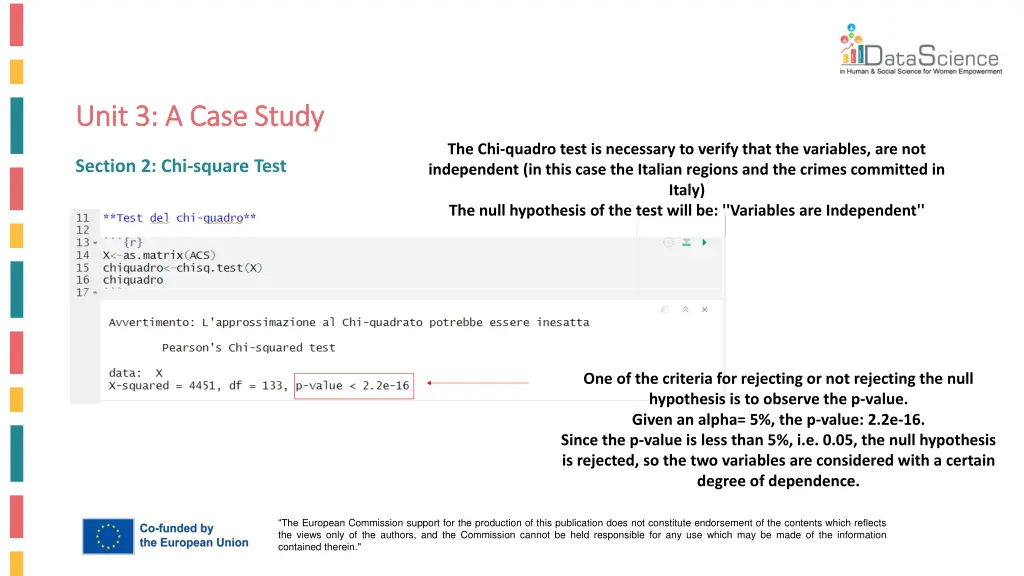
Unit 3: A Case Study Unit 3: A Case Study The Chi-quadro test is necessary to verify that the variables, are not independent (in this case the Italian regions and the crimes committed in Italy) The null hypothesis of the test will be: ''Variables are Independent'' Section 2: Chi-square Test One of the criteria for rejecting or not rejecting the null hypothesis is to observe the p-value. Given an alpha= 5%, the p-value: 2.2e-16. Since the p-value is less than 5%, i.e. 0.05, the null hypothesis is rejected, so the two variables are considered with a certain degree of dependence. The European Commission support for the production of this publication does not constitute endorsement of the contents which reflects the views only of the authors, and the Commission cannot be held responsible for any use which may be made of the information contained therein."
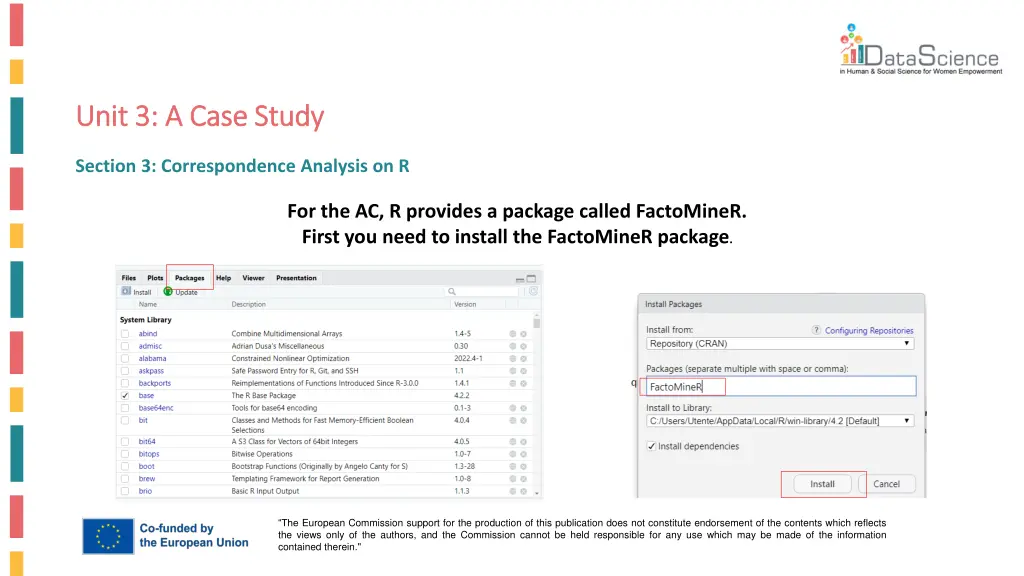
Unit 3: A Case Study Unit 3: A Case Study Section 3: Correspondence Analysis on R For the AC, R provides a package called FactoMineR. First you need to install the FactoMineR package. The European Commission support for the production of this publication does not constitute endorsement of the contents which reflects the views only of the authors, and the Commission cannot be held responsible for any use which may be made of the information contained therein."
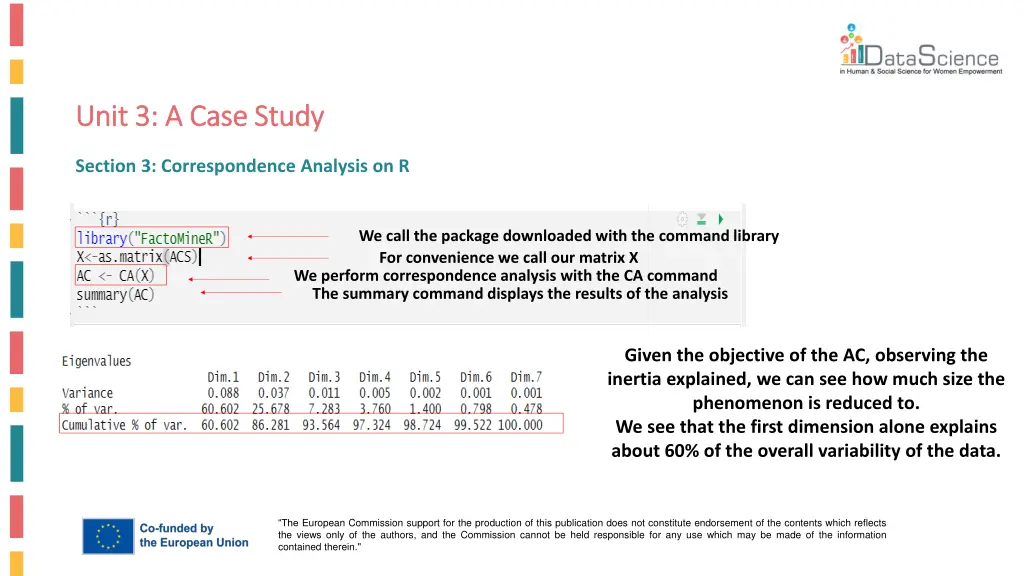
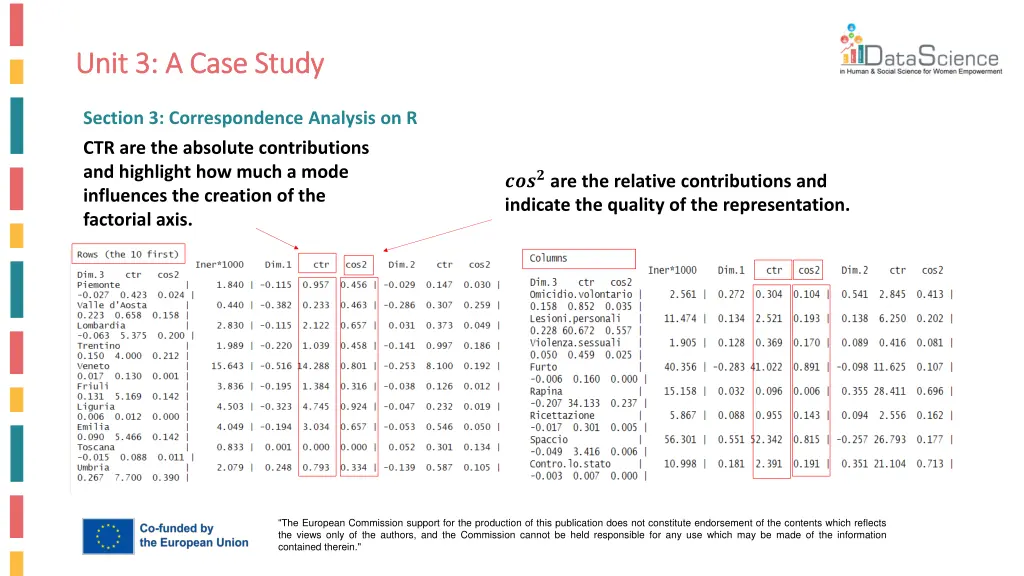
Unit 3: A Case Study Unit 3: A Case Study Section 3: Correspondence Analysis on R We call the package downloaded with the command library For convenience we call our matrix X We perform correspondence analysis with the CA command The summary command displays the results of the analysis Given the objective of the AC, observing the inertia explained, we can see how much size the phenomenon is reduced to. We see that the first dimension alone explains about 60% of the overall variability of the data. The European Commission support for the production of this publication does not constitute endorsement of the contents which reflects the views only of the authors, and the Commission cannot be held responsible for any use which may be made of the information contained therein."
Unit 3: A Case Study Unit 3: A Case Study Section 3: Correspondence Analysis on R CTR are the absolute contributions and highlight how much a mode influences the creation of the factorial axis. ????are the relative contributions and indicate the quality of the representation. The European Commission support for the production of this publication does not constitute endorsement of the contents which reflects the views only of the authors, and the Commission cannot be held responsible for any use which may be made of the information contained therein."
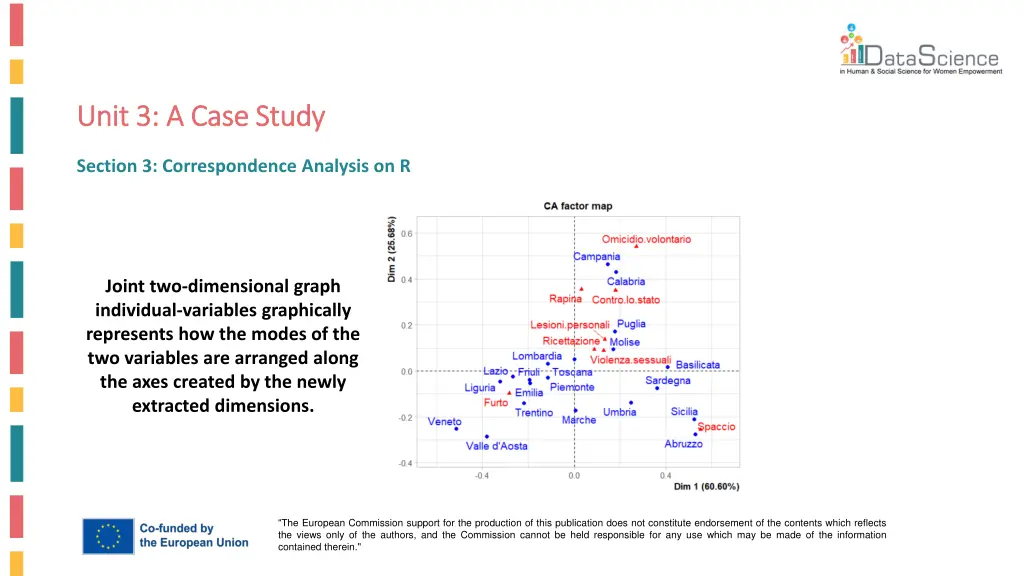
Unit 3: A Case Study Unit 3: A Case Study Section 3: Correspondence Analysis on R Joint two-dimensional graph individual-variables graphically represents how the modes of the two variables are arranged along the axes created by the newly extracted dimensions. The European Commission support for the production of this publication does not constitute endorsement of the contents which reflects the views only of the authors, and the Commission cannot be held responsible for any use which may be made of the information contained therein."
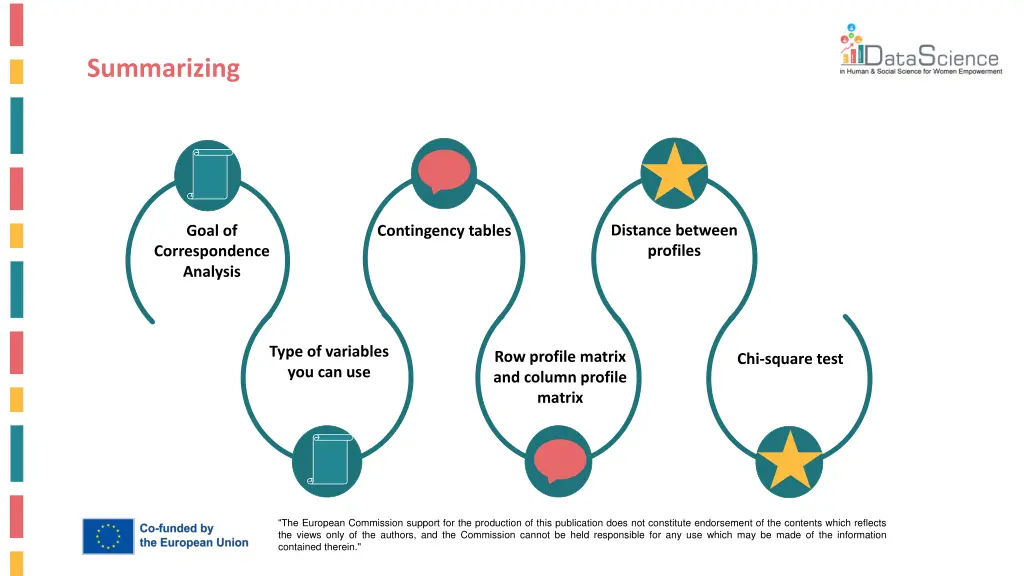
Summarizing Distance between profiles Goal of Contingency tables Correspondence Analysis Type of variables you can use Row profile matrix and column profile matrix Chi-square test The European Commission support for the production of this publication does not constitute endorsement of the contents which reflects the views only of the authors, and the Commission cannot be held responsible for any use which may be made of the information contained therein."
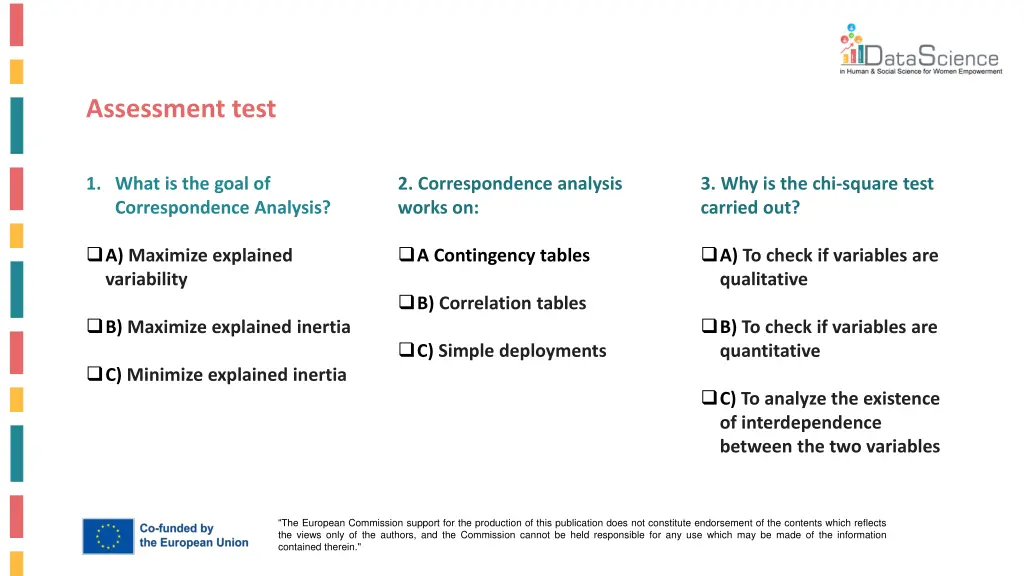
Assessment test 1. What is the goal of Correspondence Analysis? 2. Correspondence analysis works on: 3. Why is the chi-square test carried out? A) Maximize explained variability A Contingency tables A) To check if variables are qualitative B) Correlation tables B) Maximize explained inertia B) To check if variables are quantitative C) Simple deployments C) Minimize explained inertia C) To analyze the existence of interdependence between the two variables The European Commission support for the production of this publication does not constitute endorsement of the contents which reflects the views only of the authors, and the Commission cannot be held responsible for any use which may be made of the information contained therein."
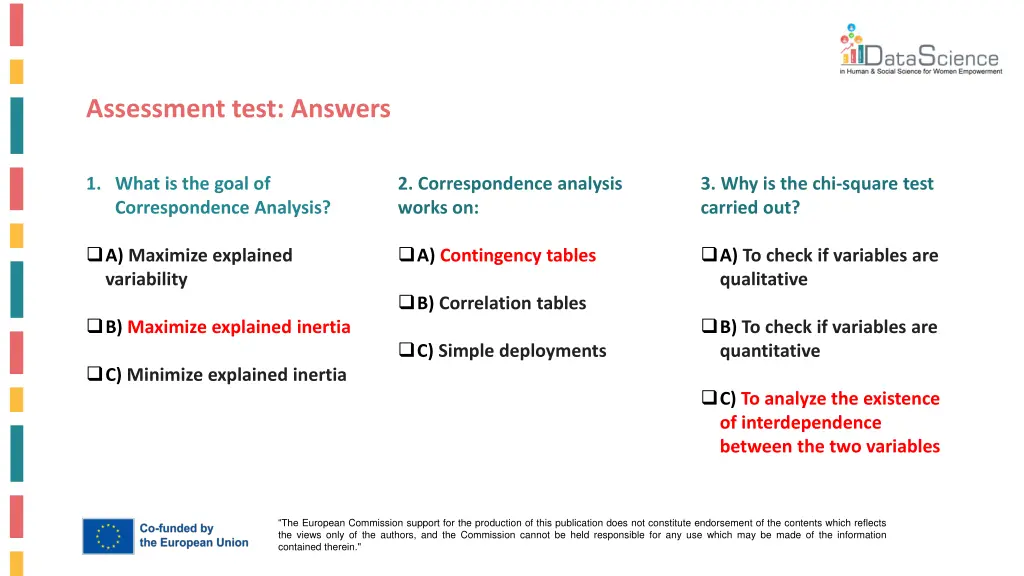
Assessment test: Answers 1. What is the goal of Correspondence Analysis? 2. Correspondence analysis works on: 3. Why is the chi-square test carried out? A) Maximize explained variability A) Contingency tables A) To check if variables are qualitative B) Correlation tables B) Maximize explained inertia B) To check if variables are quantitative C) Simple deployments C) Minimize explained inertia C) To analyze the existence of interdependence between the two variables The European Commission support for the production of this publication does not constitute endorsement of the contents which reflects the views only of the authors, and the Commission cannot be held responsible for any use which may be made of the information contained therein."
datascience-project.eu Thank you! The European Commission support for the production of this publication does not constitute endorsement of the contents which reflects the views only of the authors, and the Commission cannot be held responsible for any use which may be made of the information contained therein."