Corrosion Losses and Costs in Materials Engineering
Learn about the direct and indirect costs associated with corrosion in materials engineering, including economic losses, waste of materials, environmental impact, and more. Discover how corrosion can lead to shutdowns, loss of product, reduced efficiency, and contamination, impacting both operational and economic aspects of various industries.

Download Presentation

Please find below an Image/Link to download the presentation.
The content on the website is provided AS IS for your information and personal use only. It may not be sold, licensed, or shared on other websites without obtaining consent from the author. If you encounter any issues during the download, it is possible that the publisher has removed the file from their server.
You are allowed to download the files provided on this website for personal or commercial use, subject to the condition that they are used lawfully. All files are the property of their respective owners.
The content on the website is provided AS IS for your information and personal use only. It may not be sold, licensed, or shared on other websites without obtaining consent from the author.
E N D
Presentation Transcript
Materials Engineering Dr. Lubna Ghalib
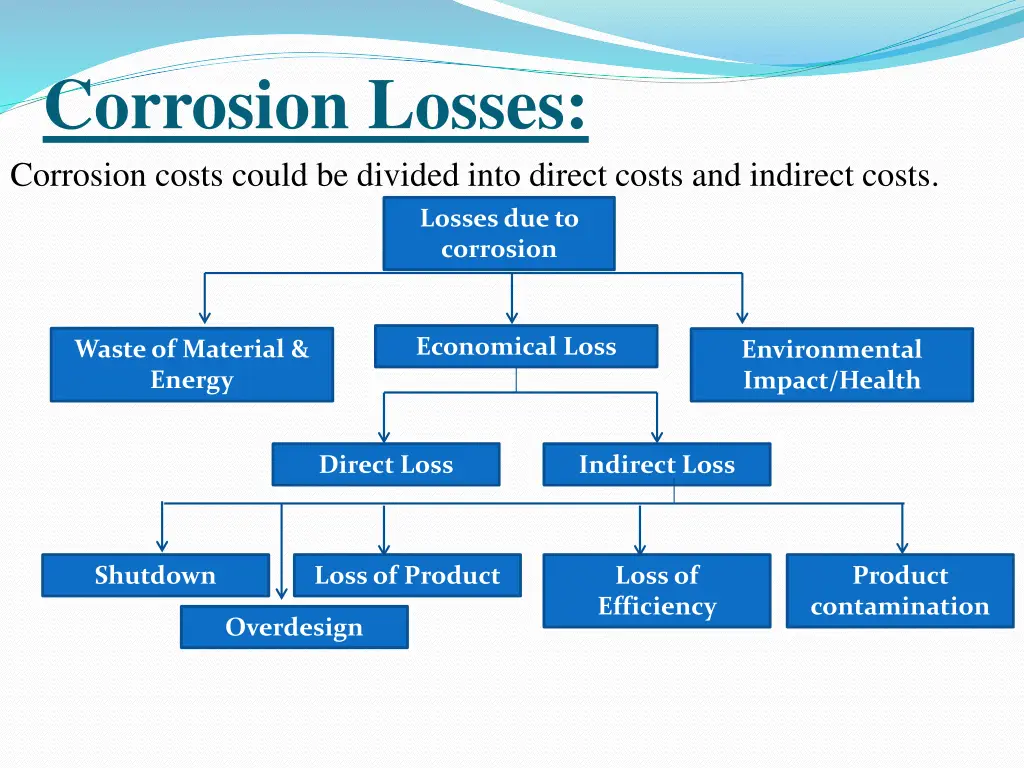
Corrosion Losses: Corrosion costs could be divided into direct costs and indirect costs. Losses due to corrosion Economical Loss Waste of Material & Energy Environmental Impact/Health Direct Loss Indirect Loss Shutdown Loss of Product Loss of Efficiency Product contamination Overdesign
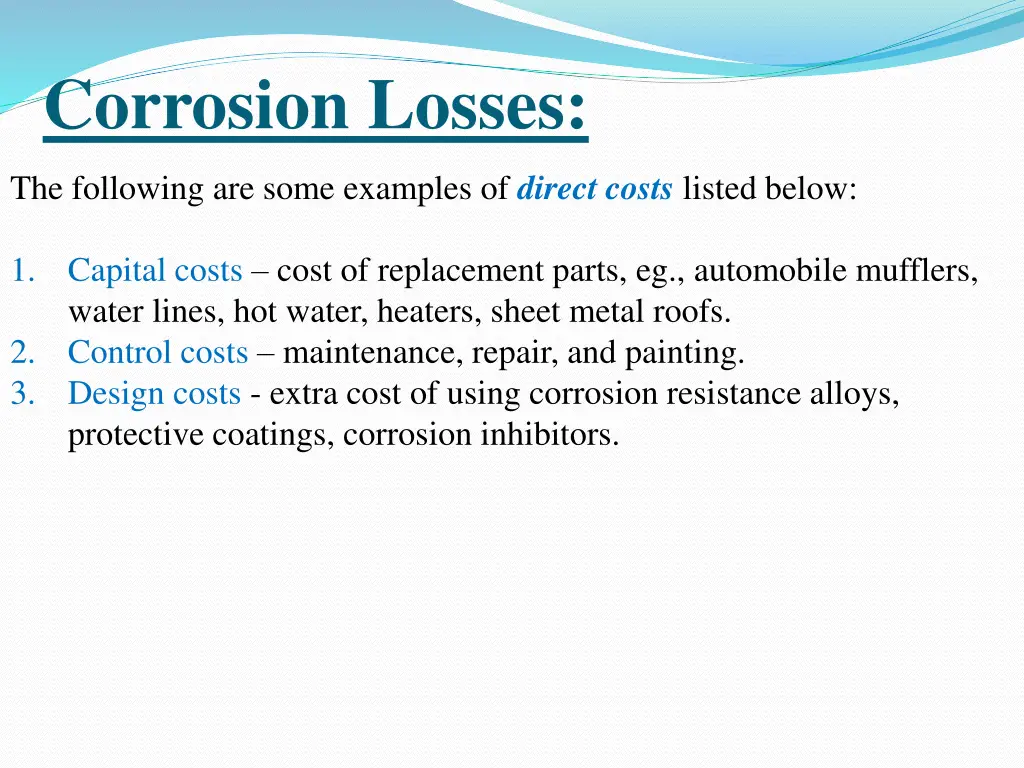
Corrosion Losses: The following are some examples of direct costs listed below: 1. Capital costs cost of replacement parts, eg., automobile mufflers, water lines, hot water, heaters, sheet metal roofs. Control costs maintenance, repair, and painting. Design costs - extra cost of using corrosion resistance alloys, protective coatings, corrosion inhibitors. 2. 3.
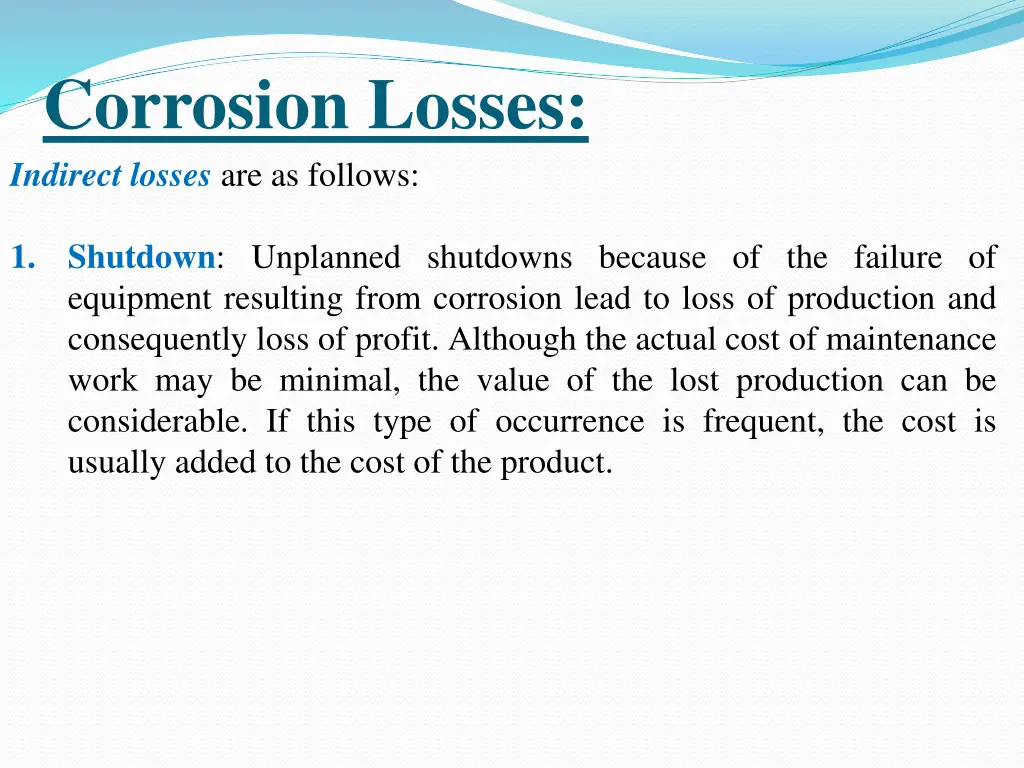
Corrosion Losses: Indirect losses are as follows: 1. Shutdown: Unplanned shutdowns because of the failure of equipment resulting from corrosion lead to loss of production and consequently loss of profit. Although the actual cost of maintenance work may be minimal, the value of the lost production can be considerable. If this type of occurrence is frequent, the cost is usually added to the cost of the product.
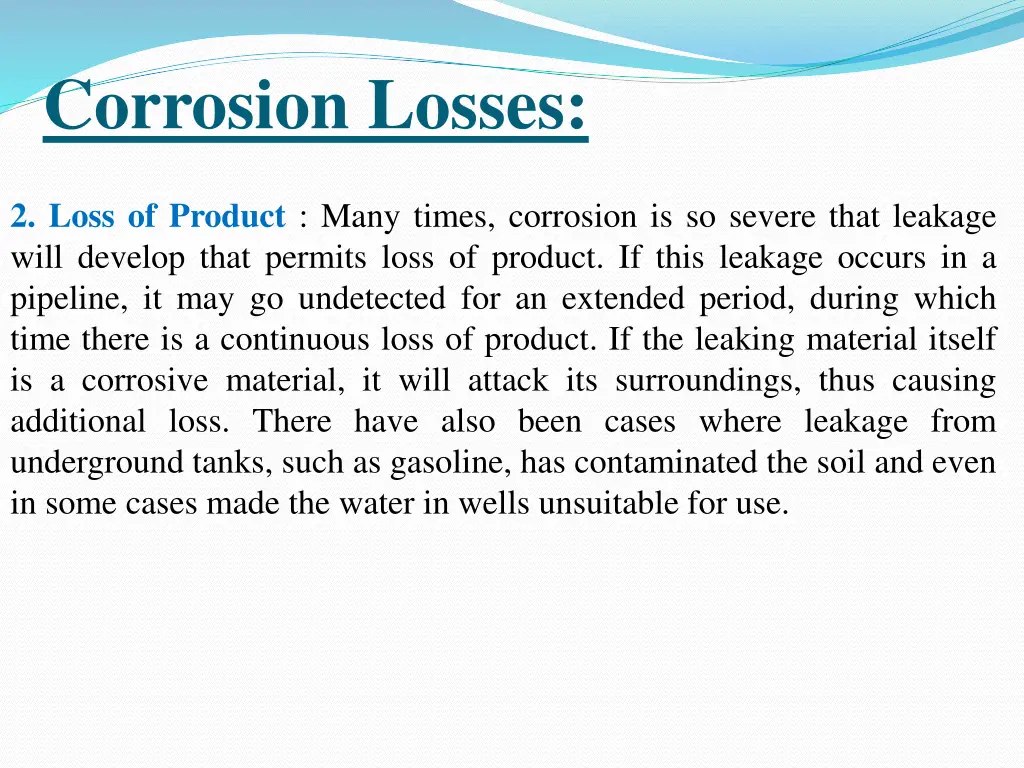
Corrosion Losses: 2. Loss of Product : Many times, corrosion is so severe that leakage will develop that permits loss of product. If this leakage occurs in a pipeline, it may go undetected for an extended period, during which time there is a continuous loss of product. If the leaking material itself is a corrosive material, it will attack its surroundings, thus causing additional loss. There have also been cases where leakage from underground tanks, such as gasoline, has contaminated the soil and even in some cases made the water in wells unsuitable for use.
Corrosion Losses: 3. Loss of Efficiency: Corrosion in a piping system can result in the buildup of a scale. This scale can cause a reduction in heat transfer as well as an increase in the power required to pump the fluid through the system. The efficient operation of other mechanical equipment can also be reduced by corrosion. This reduction in efficiency can cause an increase in operating costs as well as result in increased fuel consumption, lubricant loss, and reduced work output.
Corrosion Losses: 4. Contamination : During the corrosion of a metal, the fluid being transported, stored, processed, or packaged in a metallic component can pick up metallic salts. This metallic pick-up can be detrimental to the product; with soap products a shortened shelf life, with dyes a color alteration, and in some cases of intermediate products the inability to carry out succeeding process steps. For many years, lead pipes were used to transport water until it was determined that the lead pick-up in the water caused lead poisoning in humans.
Corrosion Losses: 5. Overdesign : In many instances when the corrosive effect of the system is known, additional thicknesses of vessel shells will be provided for in the design. This is known as corrosion allowance. Because this thickness is in addition to that required for the design conditions, an extra cost is involved. In some instances, the actual corrosive effect is not known and consequently, for safety reasons, a much thicker shell results.
Corrosion Losses: 6. Environmental Damage : Corrosion of equipment used to control atmospheric pollution operations can result in a decrease in efficiency. Such a decrease permits pollutants from the manufacturing operation to enter the atmosphere. resulting from processing
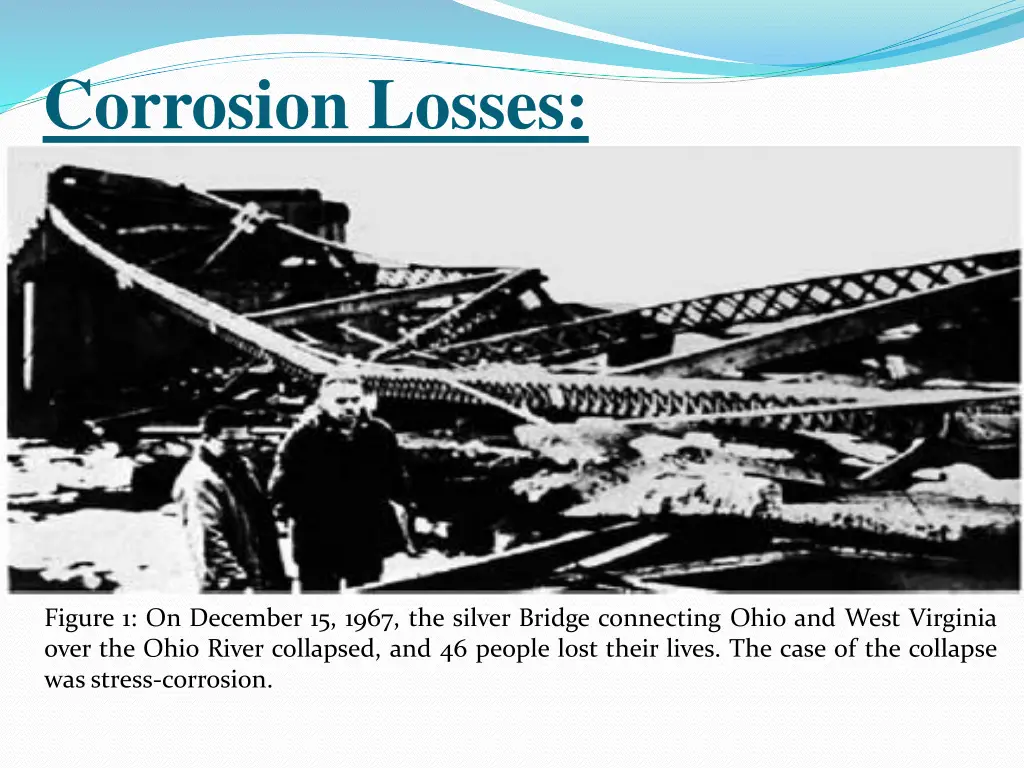
Corrosion Losses: Figure 1: On December 15, 1967, the silver Bridge connecting Ohio and West Virginia over the Ohio River collapsed, and 46 people lost their lives. The case of the collapse was stress-corrosion.
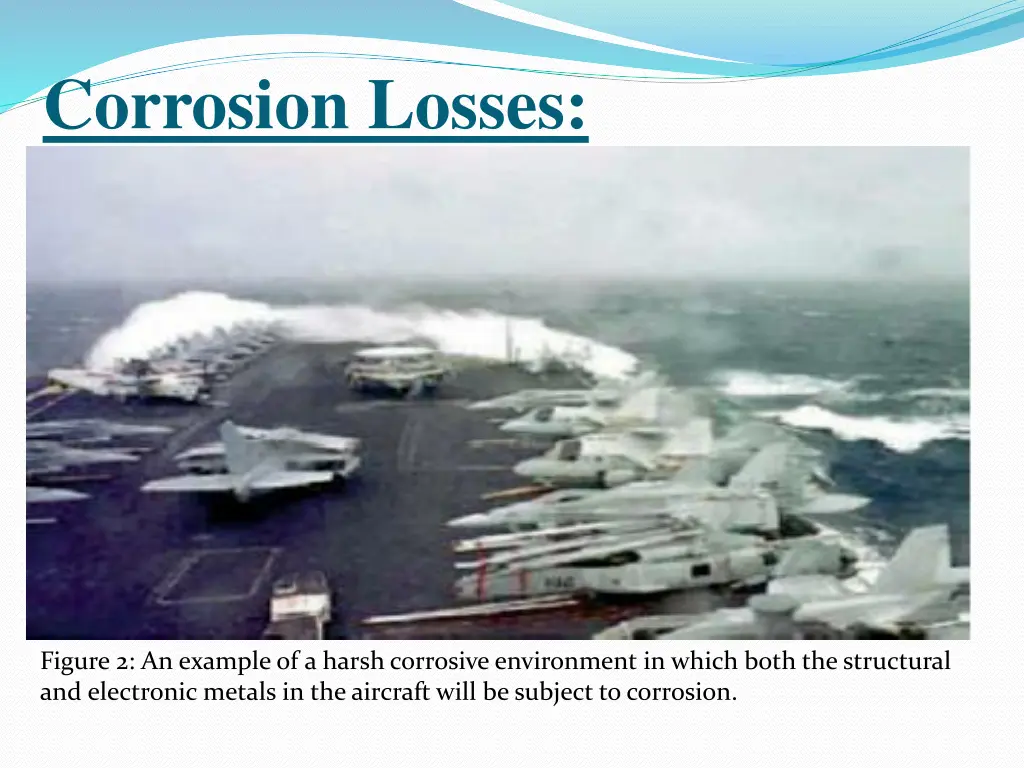
Corrosion Losses: Figure 2: An example of a harsh corrosive environment in which both the structural and electronic metals in the aircraft will be subject to corrosion.
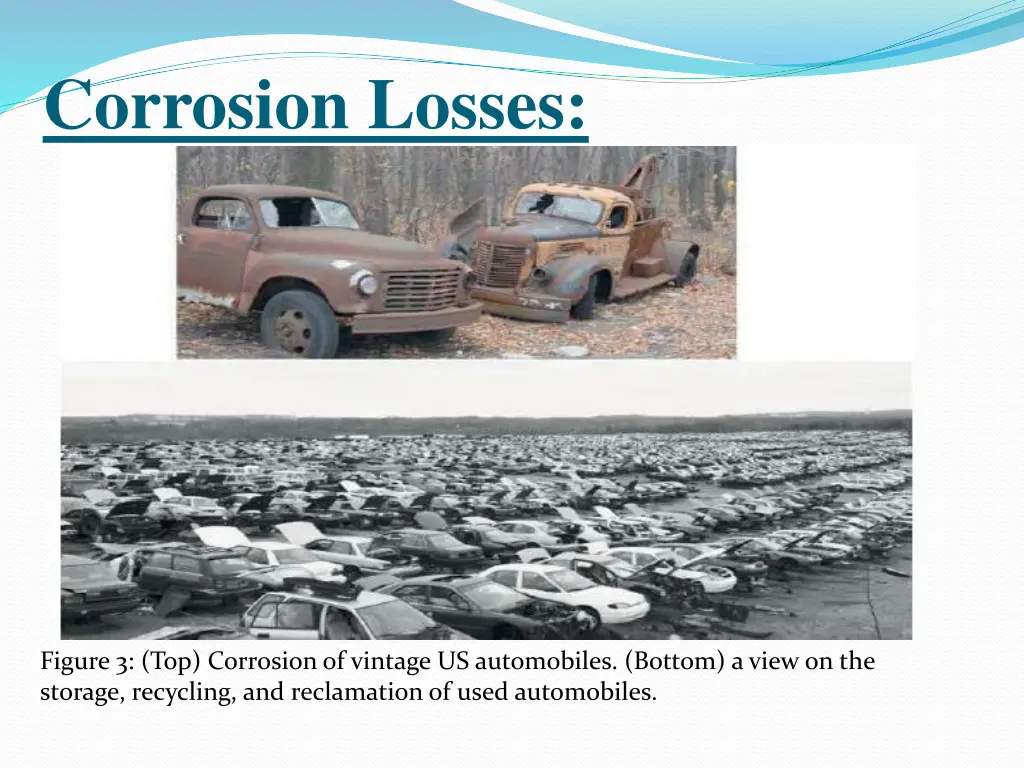
Corrosion Losses: Figure 3: (Top) Corrosion of vintage US automobiles. (Bottom) a view on the storage, recycling, and reclamation of used automobiles.
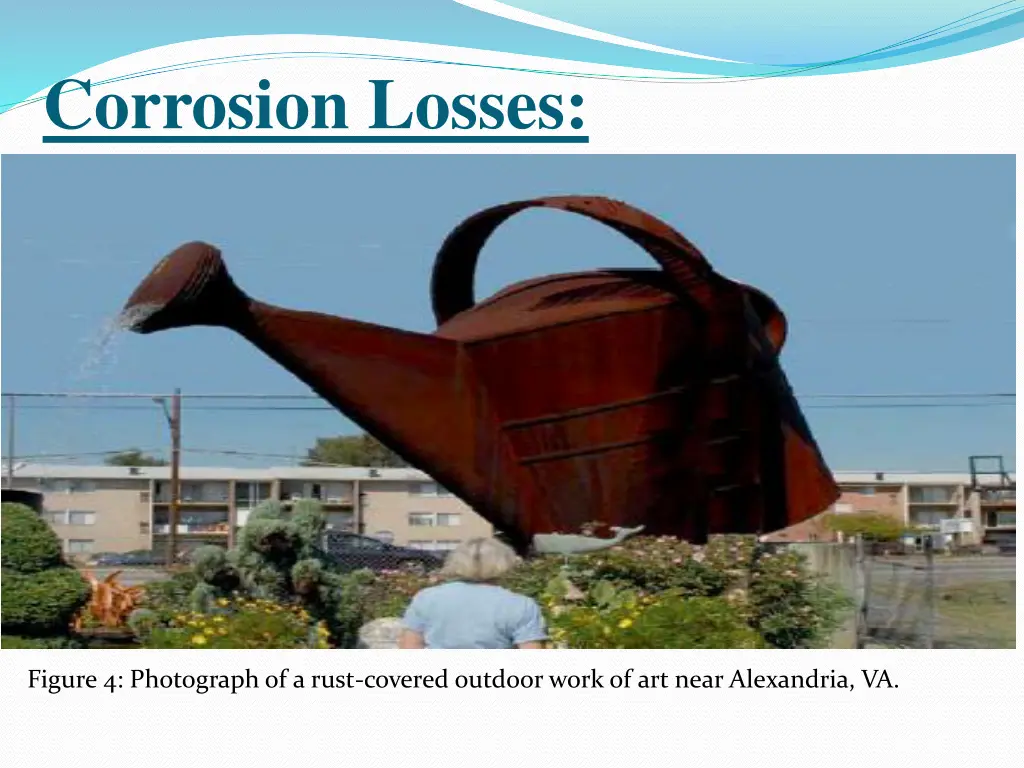
Corrosion Losses: Figure 4: Photograph of a rust-covered outdoor work of art near Alexandria, VA.