Covariance Inflation Methods on Quasi-Geostrophic Model
Implementation of covariance inflation methods on a two-layer quasi-geostrophic model by Yicun (Ethan) Zhen from The Pennsylvania State University. This study includes an overview of the QG model, review of various covariance inflation methods, experimental setup details, numerical results, and analysis. The research explores the impact and effectiveness of different inflation methodologies in improving model performance.

Download Presentation

Please find below an Image/Link to download the presentation.
The content on the website is provided AS IS for your information and personal use only. It may not be sold, licensed, or shared on other websites without obtaining consent from the author.If you encounter any issues during the download, it is possible that the publisher has removed the file from their server.
You are allowed to download the files provided on this website for personal or commercial use, subject to the condition that they are used lawfully. All files are the property of their respective owners.
The content on the website is provided AS IS for your information and personal use only. It may not be sold, licensed, or shared on other websites without obtaining consent from the author.
E N D
Presentation Transcript
Implementation of covariance inflation methods on a two-layer quasi-geostrophic model Yicun (Ethan) Zhen Department of Mathematics The Pennsylvania State University
Overview Introduction of the QG model Review of several covariance inflation methods Experimental Setup Numerical results and analysis Summary and short-term future plan
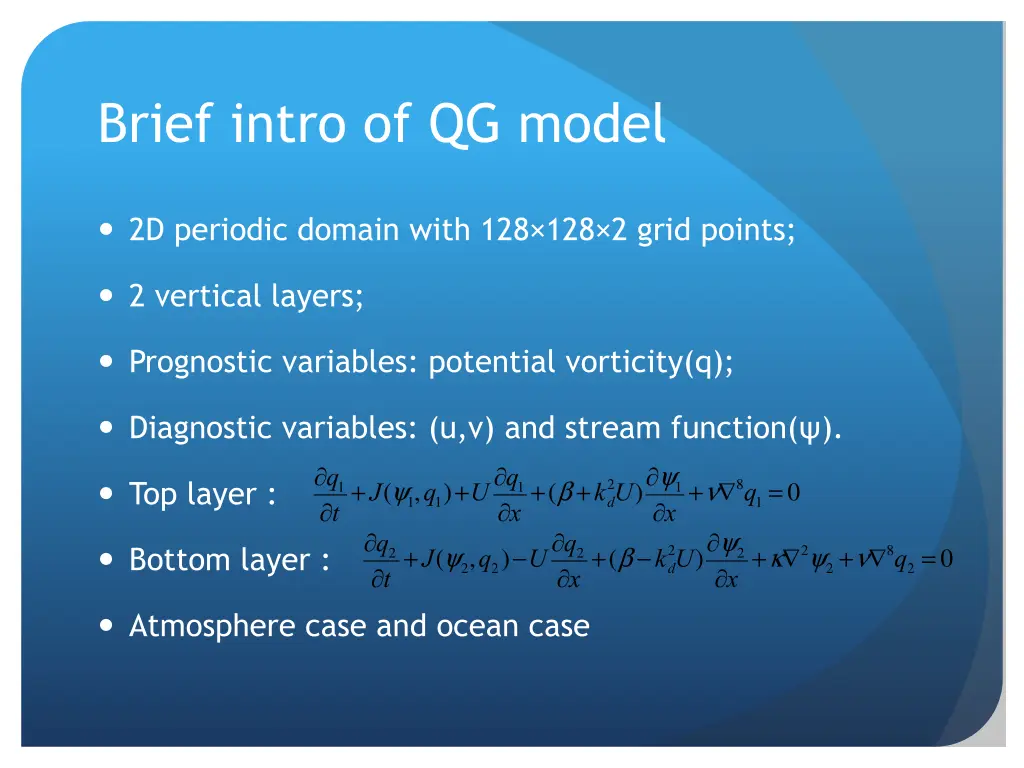
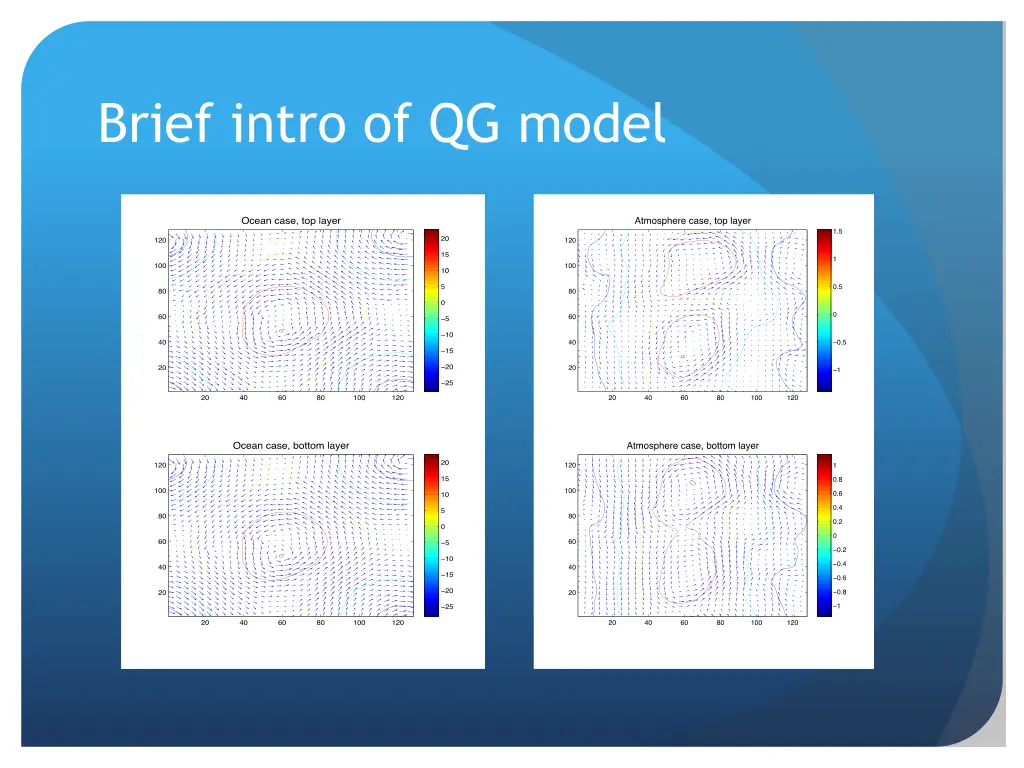
Brief intro of QG model 2D periodic domain with 128 128 2 grid points; 2 vertical layers; Prognostic variables: potential vorticity(q); Diagnostic variables: (u,v) and stream function( ). dU) y1 q1 t +J(y1,q1)+U q1 x+(b +k2 +n 8q1=0 Top layer : x dU) y2 q2 t +J(y2,q2)-U q2 +(b -k2 +k 2y2+n 8q2=0 Bottom layer : x x Atmosphere case and ocean case
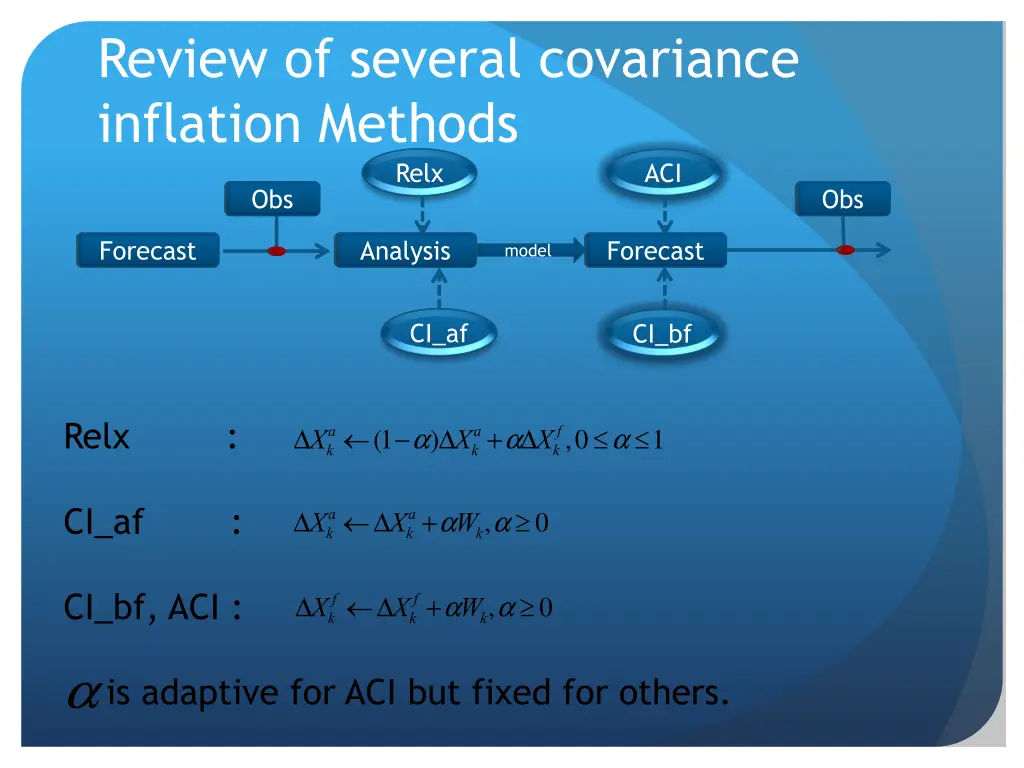
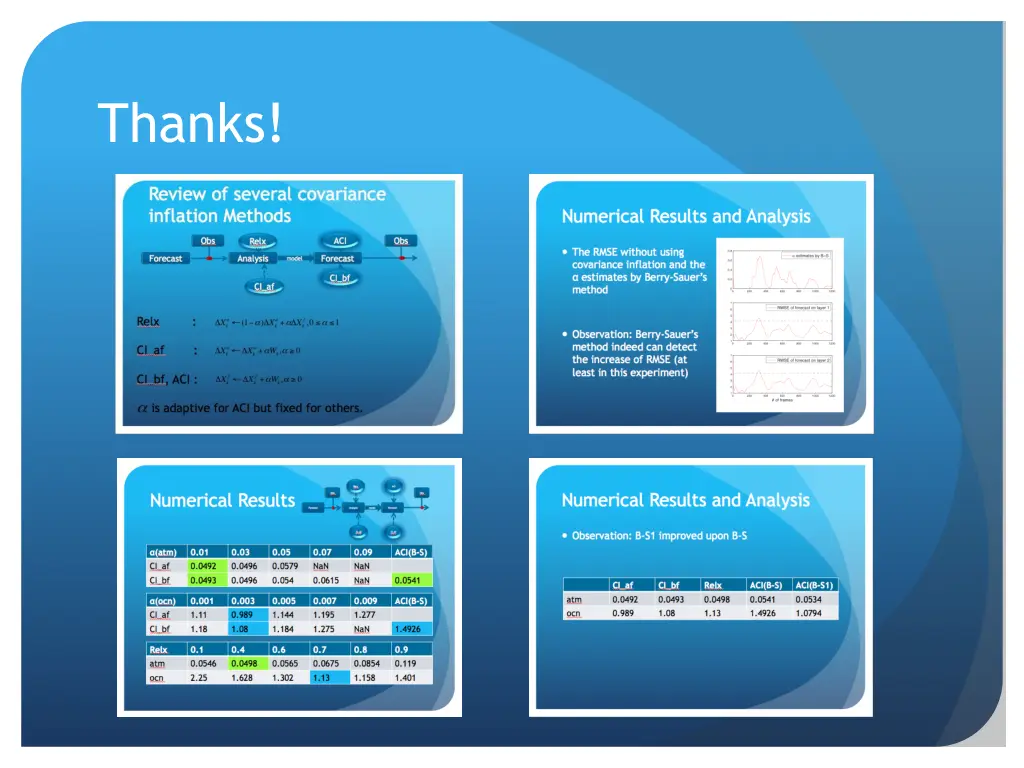
Review of several covariance inflation Methods Relx ACI Obs Obs Forecast Analysis Forecast model CI_af CI_bf Relx : DXk a (1-a)DXk a+aDXk f,0 a 1 CI_af : DXk a DXk a+aWk,a 0 CI_bf, ACI : DXk f DXk f+aWk,a 0 is adaptive for ACI but fixed for others. a
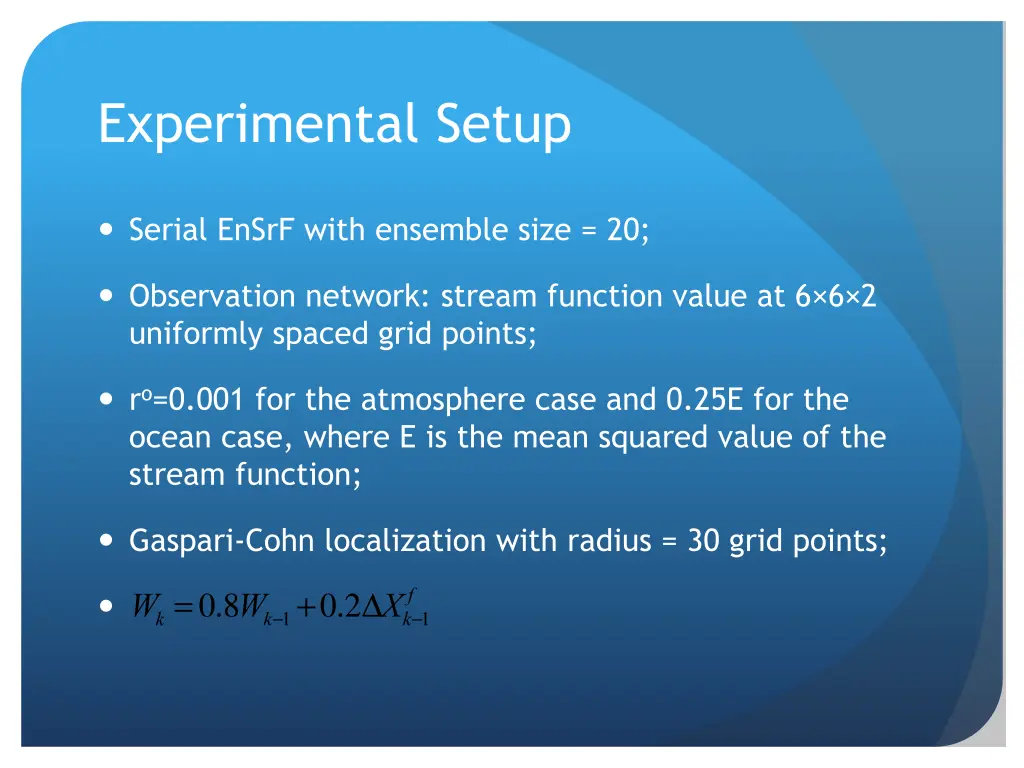
Experimental Setup Serial EnSrF with ensemble size = 20; Observation network: stream function value at 6 6 2 uniformly spaced grid points; ro=0.001 for the atmosphere case and 0.25E for the ocean case, where E is the mean squared value of the stream function; Gaspari-Cohn localization with radius = 30 grid points; Wk=0.8Wk-1+0.2DXk-1 f
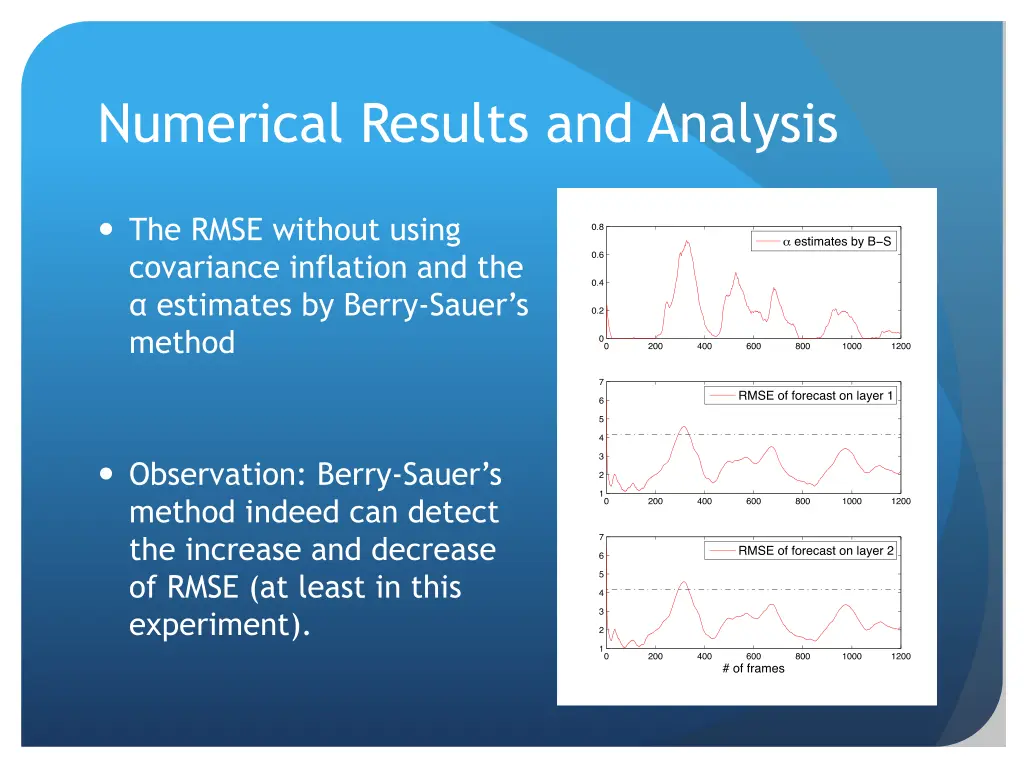
Numerical Results and Analysis The RMSE without using covariance inflation and the estimates by Berry-Sauer s method Observation: Berry-Sauer s method indeed can detect the increase and decrease of RMSE (at least in this experiment).
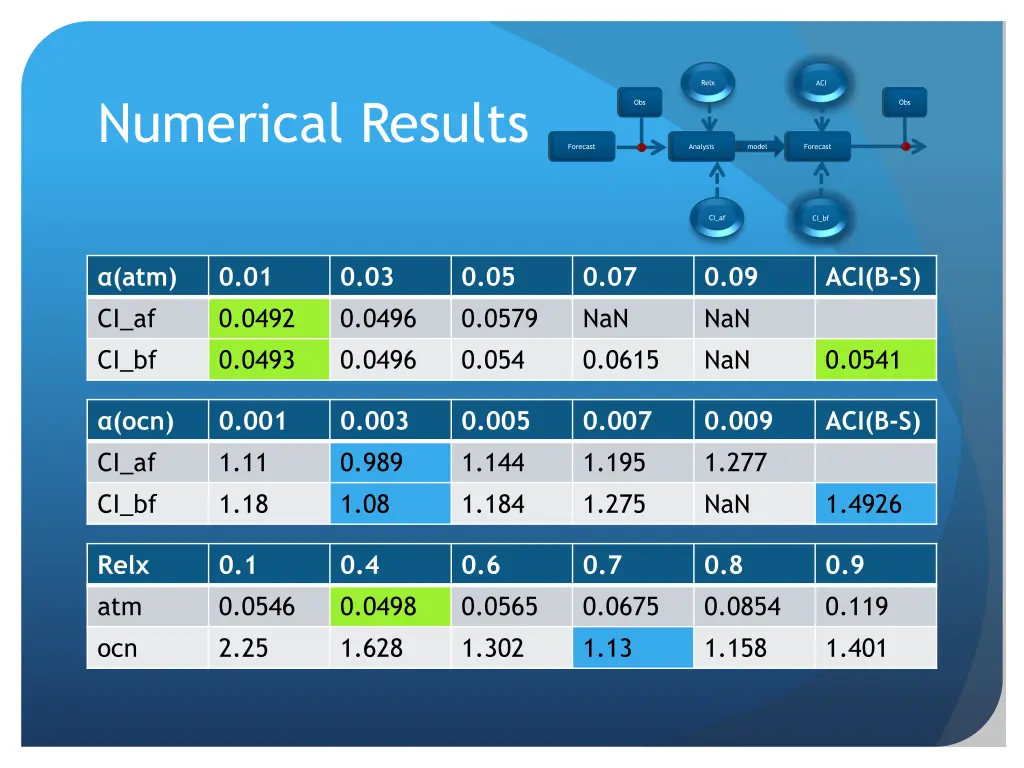
Relx ACI Numerical Results Obs Obs Forecast Analysis model Forecast CI_af CI_bf (atm) CI_af CI_bf 0.01 0.0492 0.0493 0.03 0.0496 0.0496 0.05 0.0579 0.054 0.07 NaN 0.0615 0.09 NaN NaN ACI(B-S) 0.0541 (ocn) CI_af CI_bf 0.001 1.11 1.18 0.003 0.989 1.08 0.005 1.144 1.184 0.007 1.195 1.275 0.009 1.277 NaN ACI(B-S) 1.4926 Relx atm ocn 0.1 0.0546 2.25 0.4 0.0498 1.628 0.6 0.0565 1.302 0.7 0.0675 1.13 0.8 0.0854 1.158 0.9 0.119 1.401
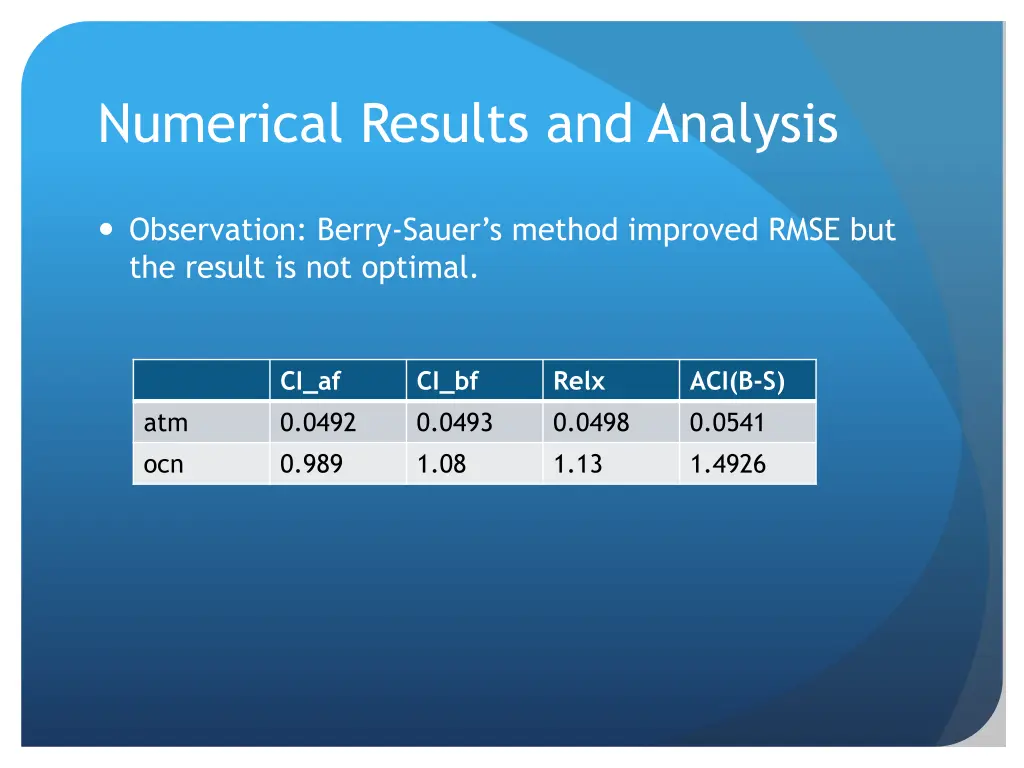
Numerical Results and Analysis Observation: Berry-Sauer s method improved RMSE but the result is not optimal. CI_af 0.0492 0.989 CI_bf 0.0493 1.08 Relx 0.0498 1.13 ACI(B-S) 0.0541 1.4926 atm ocn
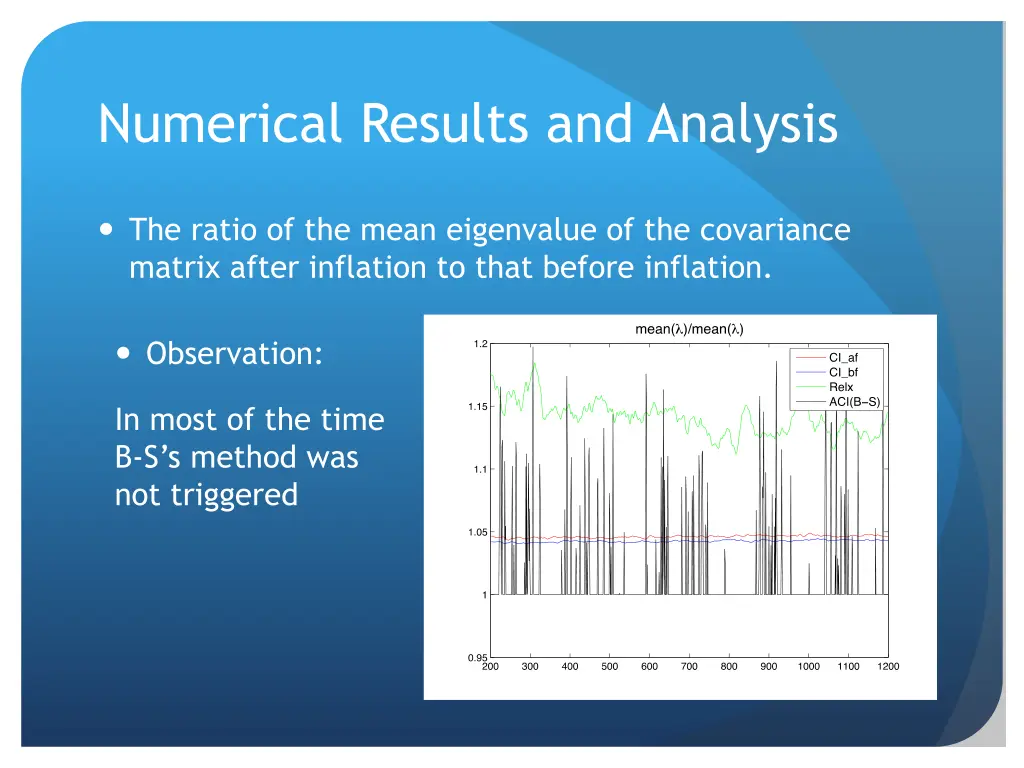
Numerical Results and Analysis The ratio of the mean eigenvalue of the covariance matrix after inflation to that before inflation. Observation: In most of the time B-S s method was not triggered
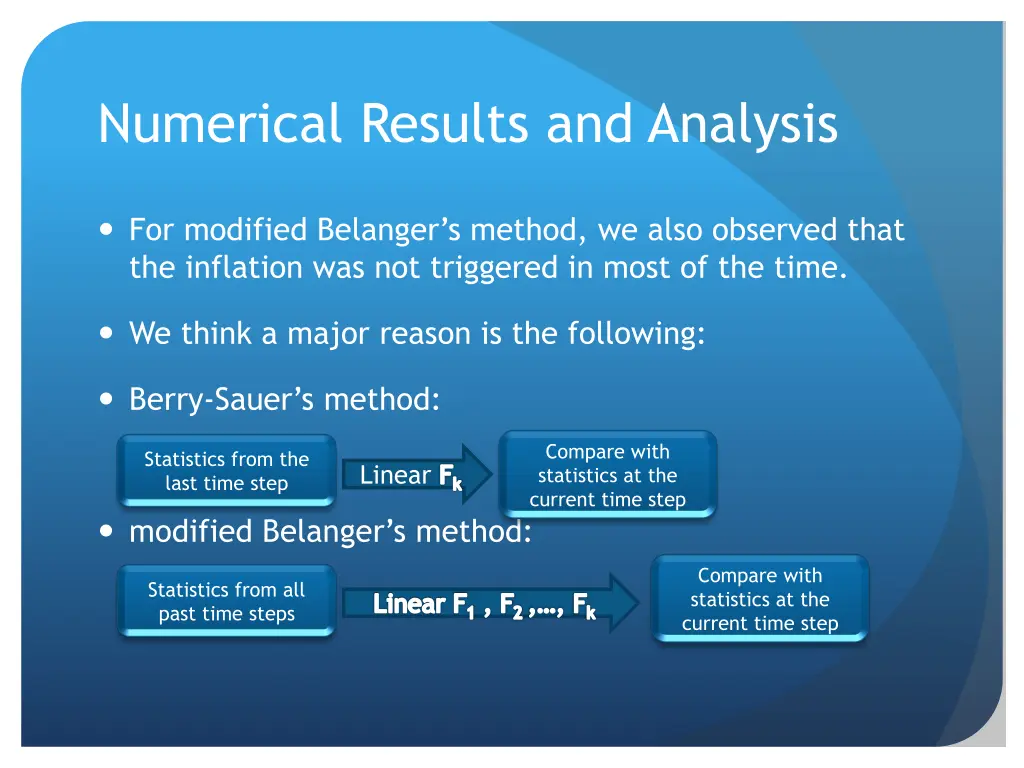
Numerical Results and Analysis For modified Belanger s method, we also observed that the inflation was not triggered in most of the time. We think a major reason is the following: Berry-Sauer s method: Compare with statistics at the current time step Statistics from the last time step Linear Fk modified Belanger s method: Compare with statistics at the current time step Statistics from all past time steps Linear F1, F2 , , Fk
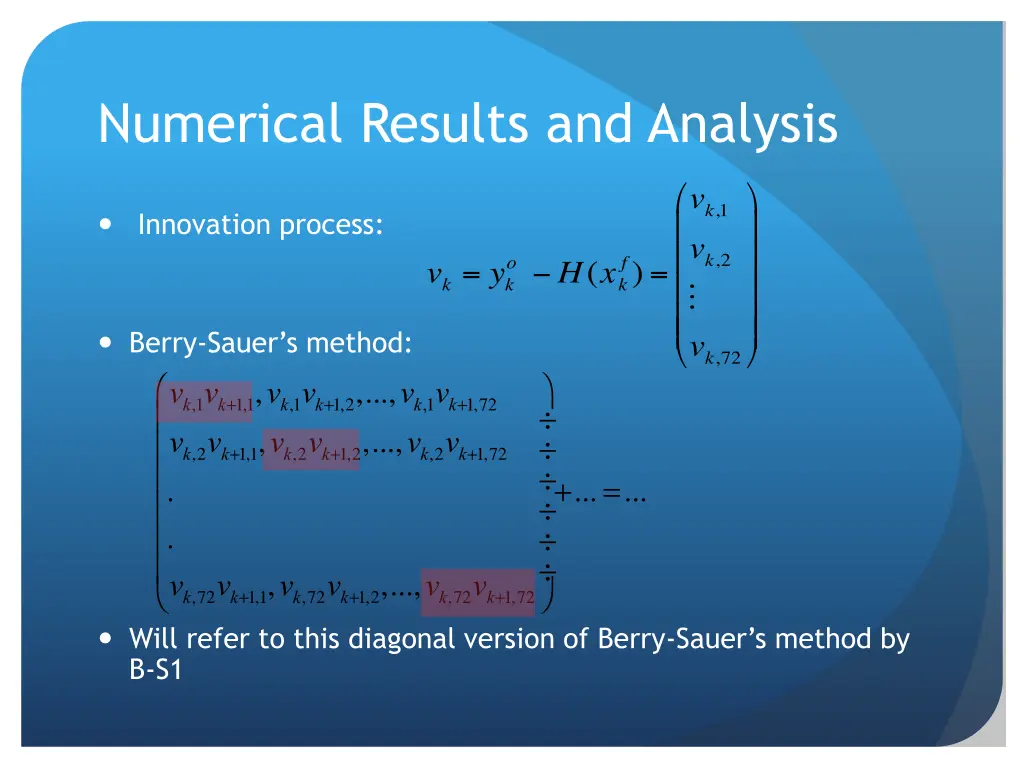
Numerical Results and Analysis Innovation process: Berry-Sauer s method: vk,1vk+1,1,vk,1vk+1,2,...,vk,1vk+1,72 vk,2vk+1,1,vk,2vk+1,2,...,vk,2vk+1,72 . . vk,72vk+1,1,vk,72vk+1,2,...,vk,72vk+1,72 +...=... Will refer to this diagonal version of Berry-Sauer s method by B-S1
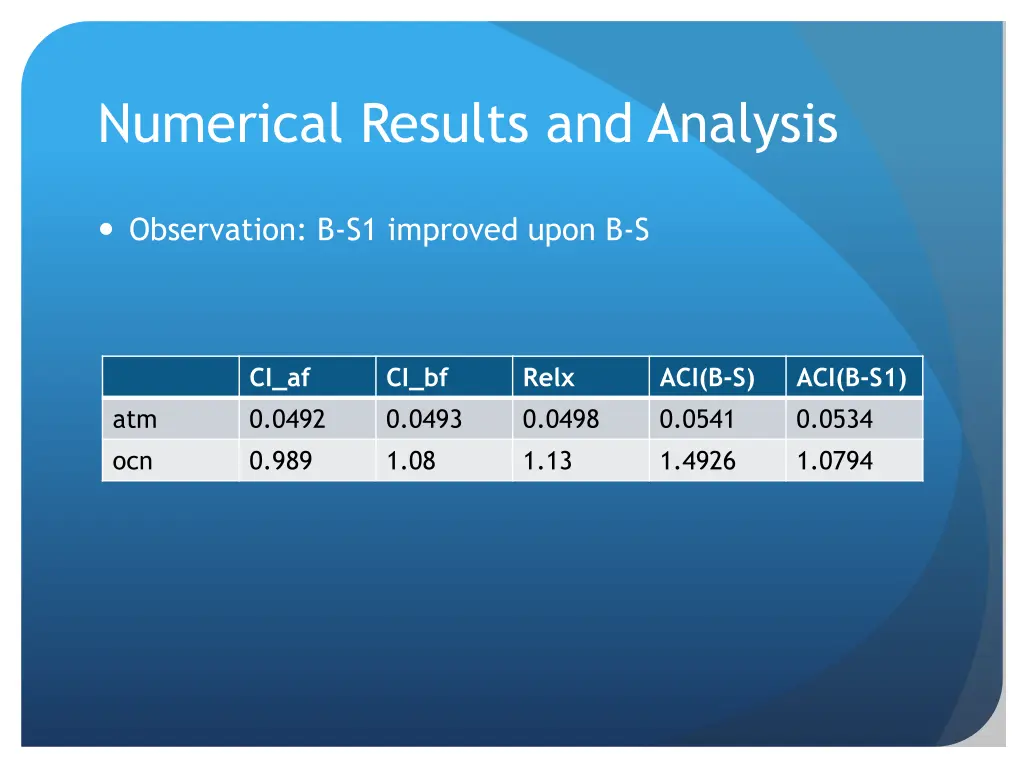
Numerical Results and Analysis Observation: B-S1 improved upon B-S CI_af 0.0492 0.989 CI_bf 0.0493 1.08 Relx 0.0498 1.13 ACI(B-S) 0.0541 1.4926 ACI(B-S1) 0.0534 1.0794 atm ocn
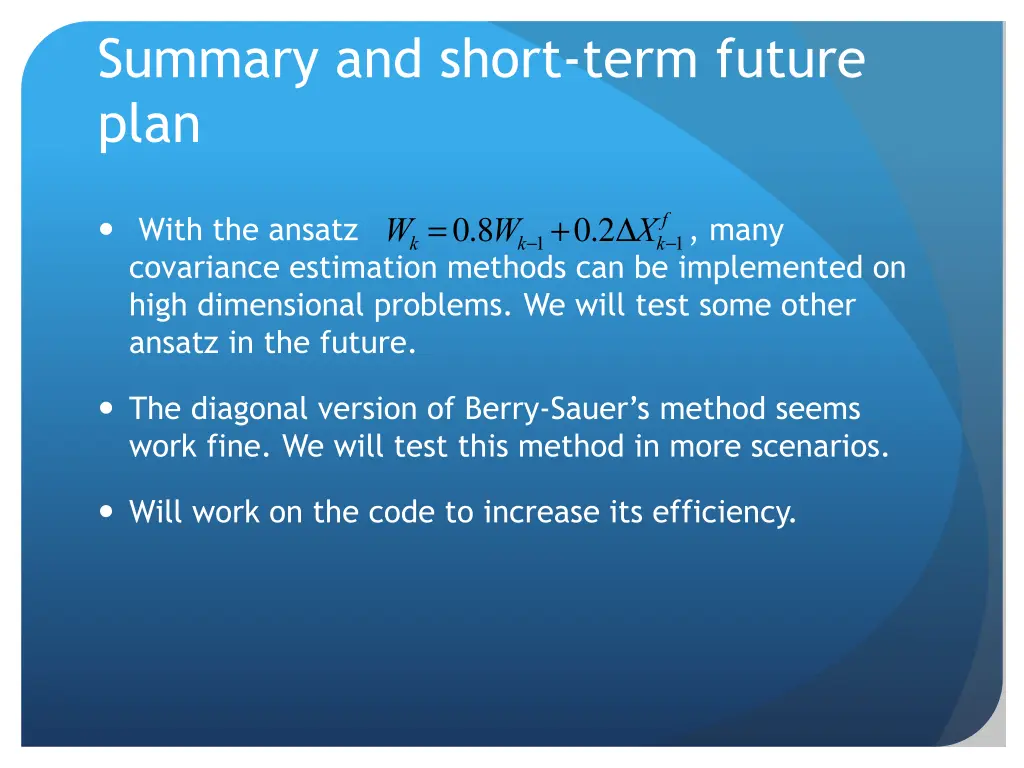
Summary and short-term future plan Wk=0.8Wk-1+0.2DXk-1 f With the ansatz , many covariance estimation methods can be implemented on high dimensional problems. We will test some other ansatz in the future. The diagonal version of Berry-Sauer s method seems work fine. We will test this method in more scenarios. Will work on the code to increase its efficiency.