CoVeRT: CPR Video Review Team at George Washington University
CoVeRT, the CPR Video Review Team at George Washington University's Emergency Medicine department, focuses on monitoring resuscitation bays in the ER, tracking data, and conducting resident quality improvement in resuscitation. The team implements interventions for immediate feedback and systematic improvement, aiming to enhance care during cardiac arrests and post-resuscitation. They also work on decreasing pulse check times and identifying causes for delays. Through collaborations with various departments and nursing leadership, CoVeRT strives to improve outcomes and protocols related to CPR and emergency care.

Download Presentation

Please find below an Image/Link to download the presentation.
The content on the website is provided AS IS for your information and personal use only. It may not be sold, licensed, or shared on other websites without obtaining consent from the author.If you encounter any issues during the download, it is possible that the publisher has removed the file from their server.
You are allowed to download the files provided on this website for personal or commercial use, subject to the condition that they are used lawfully. All files are the property of their respective owners.
The content on the website is provided AS IS for your information and personal use only. It may not be sold, licensed, or shared on other websites without obtaining consent from the author.
E N D
Presentation Transcript
CoVeRT: CPR Video Review Team George Washington University Emergency Medicine C. Robin Lanam, MD, MBA
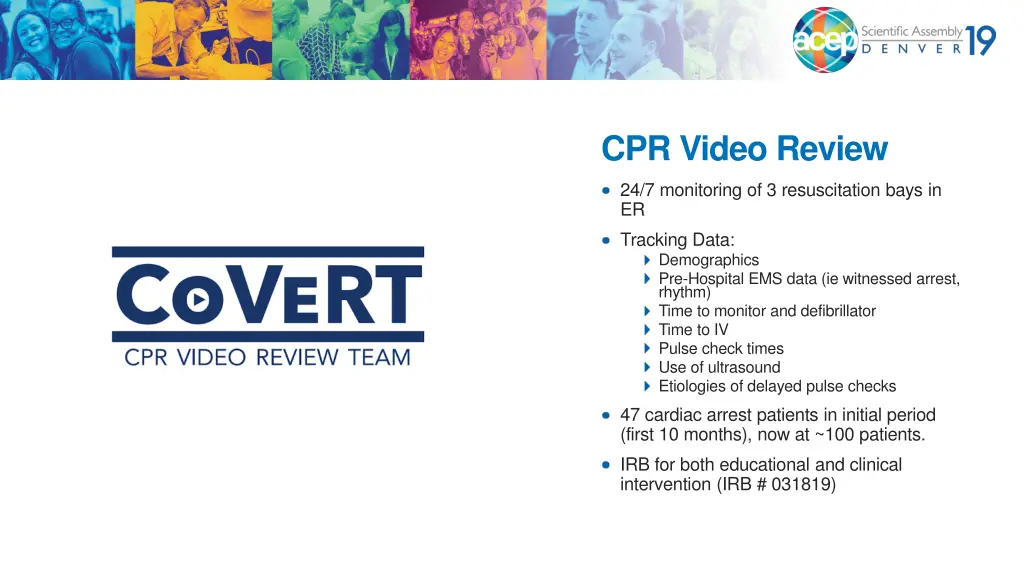
CPR Video Review 24/7 monitoring of 3 resuscitation bays in ER Tracking Data: Demographics Pre-Hospital EMS data (ie witnessed arrest, rhythm) Time to monitor and defibrillator Time to IV Pulse check times Use of ultrasound Etiologies of delayed pulse checks 47 cardiac arrest patients in initial period (first 10 months), now at ~100 patients. IRB for both educational and clinical intervention (IRB # 031819)
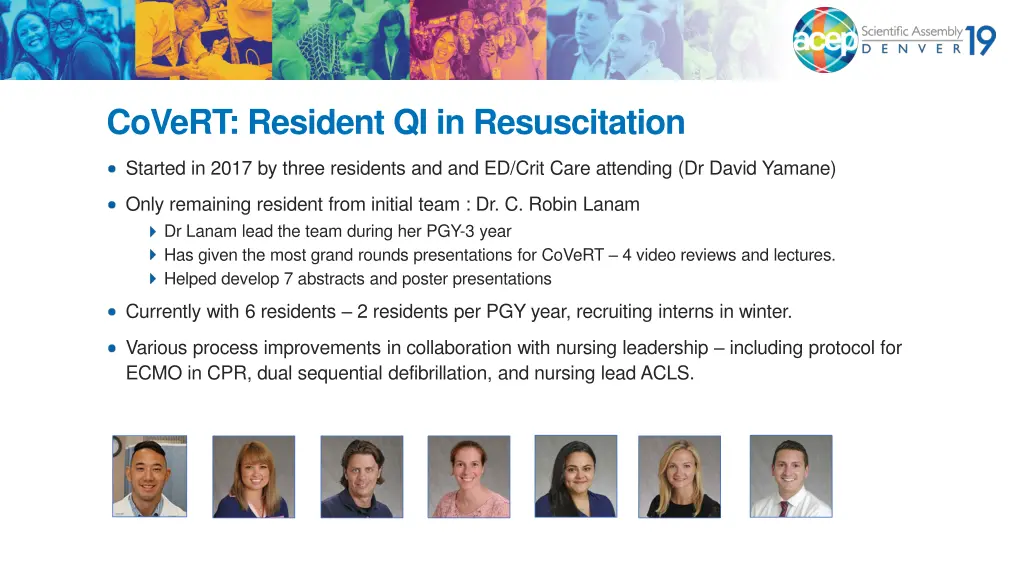
CoVeRT: Resident QI in Resuscitation Started in 2017 by three residents and and ED/Crit Care attending (Dr David Yamane) Only remaining resident from initial team : Dr. C. Robin Lanam Dr Lanam lead the team during her PGY-3 year Has given the most grand rounds presentations for CoVeRT 4 video reviews and lectures. Helped develop 7 abstracts and poster presentations Currently with 6 residents 2 residents per PGY year, recruiting interns in winter. Various process improvements in collaboration with nursing leadership including protocol for ECMO in CPR, dual sequential defibrillation, and nursing lead ACLS.
CoVeRT Interventions Immediate Feedback: Quantitative and qualitative email feedback to physician, nursing, and technicians involved after video reviewed arrests Systematic Improvement: Grand Rounds video reviews identify gaps in care in collaboration with cardiology, cardiothoracic, critical care, and emergency department nursing ECMO guidelines CPR Checklist End Tidal CO2 Doppler pulse checks Post Cardiac Arrest Cath guidelines Ultrasound use in cardiac arrest Nursing guided ACLS documenting RN directs epinephrine and pulse check at MD designated intervals
Abstracts and Cases Data from our pilot year
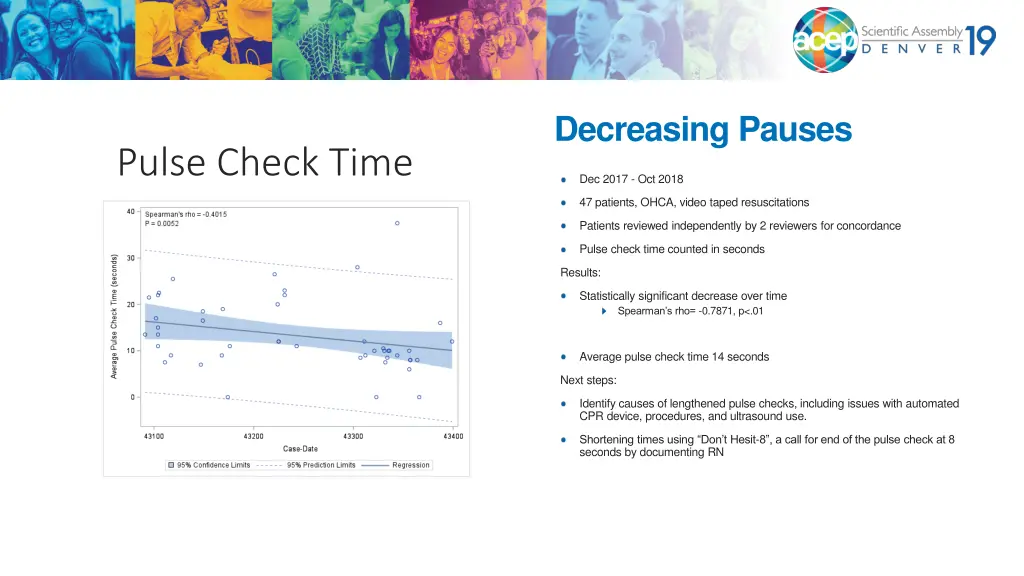
Decreasing Pauses Pulse Check Time Dec 2017 - Oct 2018 47 patients, OHCA, video taped resuscitations Patients reviewed independently by 2 reviewers for concordance Pulse check time counted in seconds Results: Statistically significant decrease over time Spearman s rho= -0.7871, p<.01 Average pulse check time 14 seconds Next steps: Identify causes of lengthened pulse checks, including issues with automated CPR device, procedures, and ultrasound use. Shortening times using Don t Hesit-8 , a call for end of the pulse check at 8 seconds by documenting RN
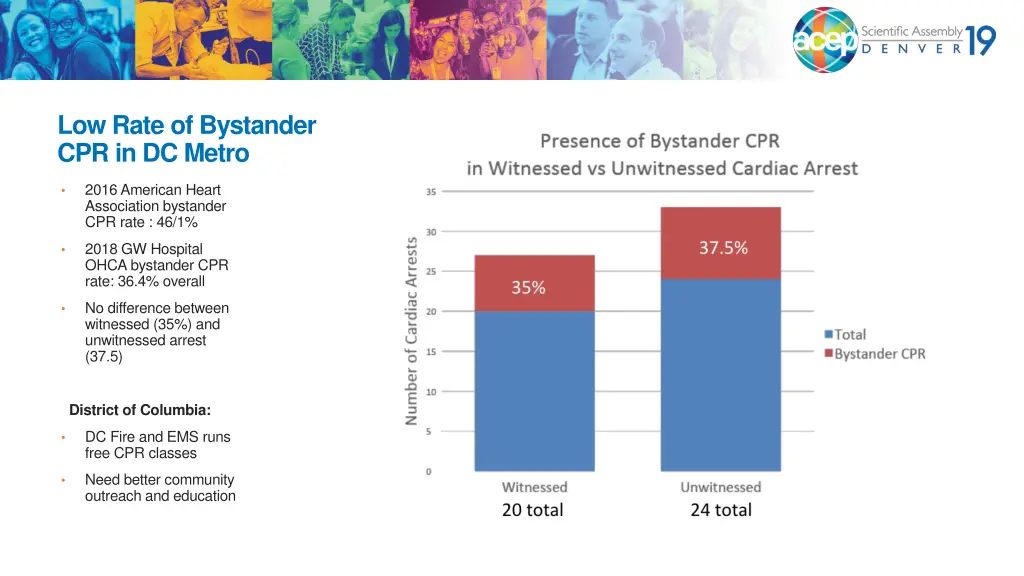
Low Rate of Bystander CPR in DC Metro 2016 American Heart Association bystander CPR rate : 46/1% 2018 GW Hospital OHCA bystander CPR rate: 36.4% overall No difference between witnessed (35%) and unwitnessed arrest (37.5) District of Columbia: DC Fire and EMS runs free CPR classes Need better community outreach and education
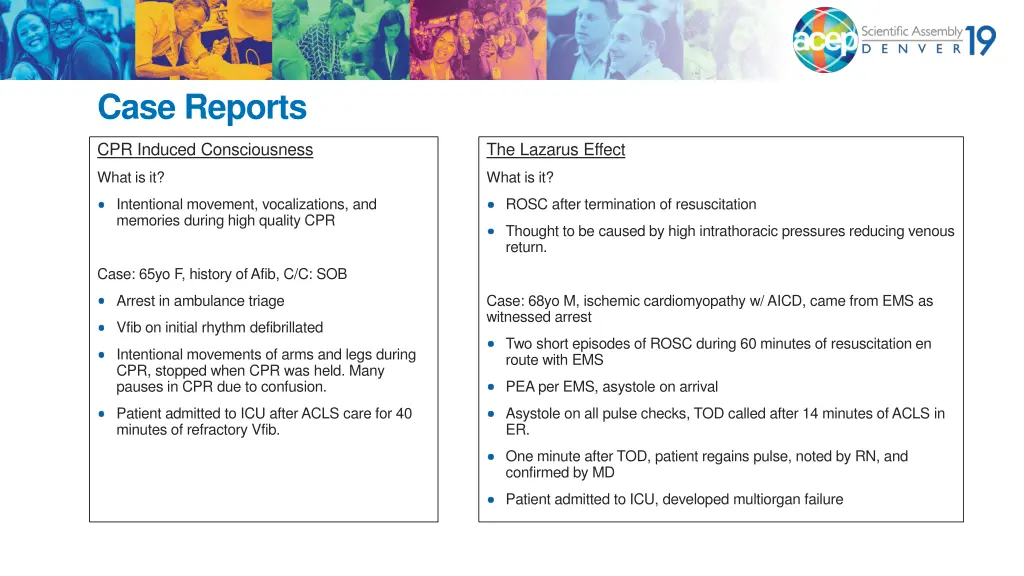
Case Reports CPR Induced Consciousness The Lazarus Effect What is it? What is it? Intentional movement, vocalizations, and memories during high quality CPR ROSC after termination of resuscitation Thought to be caused by high intrathoracic pressures reducing venous return. Case: 65yo F, history of Afib, C/C: SOB Arrest in ambulance triage Case: 68yo M, ischemic cardiomyopathy w/ AICD, came from EMS as witnessed arrest Vfib on initial rhythm defibrillated Two short episodes of ROSC during 60 minutes of resuscitation en route with EMS Intentional movements of arms and legs during CPR, stopped when CPR was held. Many pauses in CPR due to confusion. PEA per EMS, asystole on arrival Patient admitted to ICU after ACLS care for 40 minutes of refractory Vfib. Asystole on all pulse checks, TOD called after 14 minutes of ACLS in ER. One minute after TOD, patient regains pulse, noted by RN, and confirmed by MD Patient admitted to ICU, developed multiorgan failure
Abstracts and Presentations Evan Kuhl, Carolyn Robin Lanam, David Yamane Purposeful movements during CPR masquerading as ROSC Poster presentation, 2018 American Medical Association Research Symposium, National Harbor, Maryland November 9th, 2018 Carolyn Robin Lanam, David Yamane Life After Death, The Lazarus Phenomenon Poster presentation, 2018 American Medical Association Research Symposium, National Harbor, Maryland November 9th, 2018 JLA Rabjohns, E Kuhl, CR Lanam, N Sullivan, P McCarville, D Yamane Adult CPR Video Review Improves Resident Knowledge Poster Presentation, 2019 American Academy of Emergency Medicine Annual Conference, Las Vegas, NV March 11th, 2019 E Kuhl, CR Lanam, JLA Rabjohns, N Sullivan, P McCarville, A Rahimi-Raber, C Payette, D Yamane. A Unique Video-Review Curriculum to Improve Resident Education and Quality Metrics in Cardiac Arrest Poster Presentation, 2019 CORD Academic Assembly, Seattle, WA; April 1st, 2019 JLA Rabjohns, E Kuhl, CR Lanam, N Sullivan, P McCarville, D Yamane Adult CPR Video Review Improves Resident Knowledge Poster Presentation, 2019 GW Research Day; Washington, DC; April 10th, 2019. N Sullivan, C Lanam, D Yamane, E Kuhl, JLA Rabjohns, P McCarville, C Payette, A Rahimi-Saber, Pulse Check Improvement Through Video Analysis and Feedback. In: SAEM; May 14-18, 2019; Las Vegas, NV P McCarville, C Payette, J Rabjohns, CR Lanam, A Sparks, D Yamane The Need for Public Awareness in the Washington D.C. Community for Witnessed Cardiac Arrest. In: Poster presentation SAEM; May 14-18, 2019; Las Vegas, NV
More Questions? Contact crlanam@gwu.edu or dyamane@gwu.edu!!