Creating a Diverse Action Plan
In this presentation by Garcia & Associates, explore the process of developing a successful action plan for diversity, equity, and inclusion at the University of Oregon. Learn about best practices, tools, and strategies to design tactics for lasting change in your unit. Discover the importance of leadership endorsement, integration, and support in fostering an inclusive culture. Embrace the journey towards cultural transformation with commitment, resources, and guidance.

Download Presentation

Please find below an Image/Link to download the presentation.
The content on the website is provided AS IS for your information and personal use only. It may not be sold, licensed, or shared on other websites without obtaining consent from the author.If you encounter any issues during the download, it is possible that the publisher has removed the file from their server.
You are allowed to download the files provided on this website for personal or commercial use, subject to the condition that they are used lawfully. All files are the property of their respective owners.
The content on the website is provided AS IS for your information and personal use only. It may not be sold, licensed, or shared on other websites without obtaining consent from the author.
E N D
Presentation Transcript
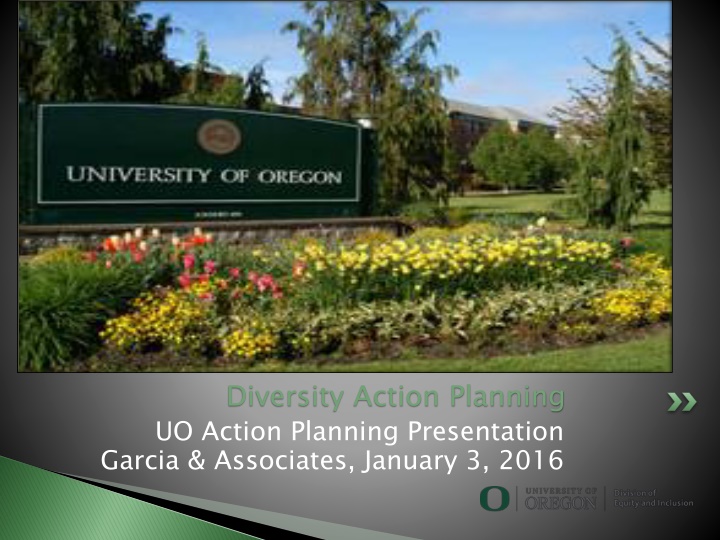
Diversity Action Planning UO Action Planning Presentation Garcia & Associates, January 3, 2016
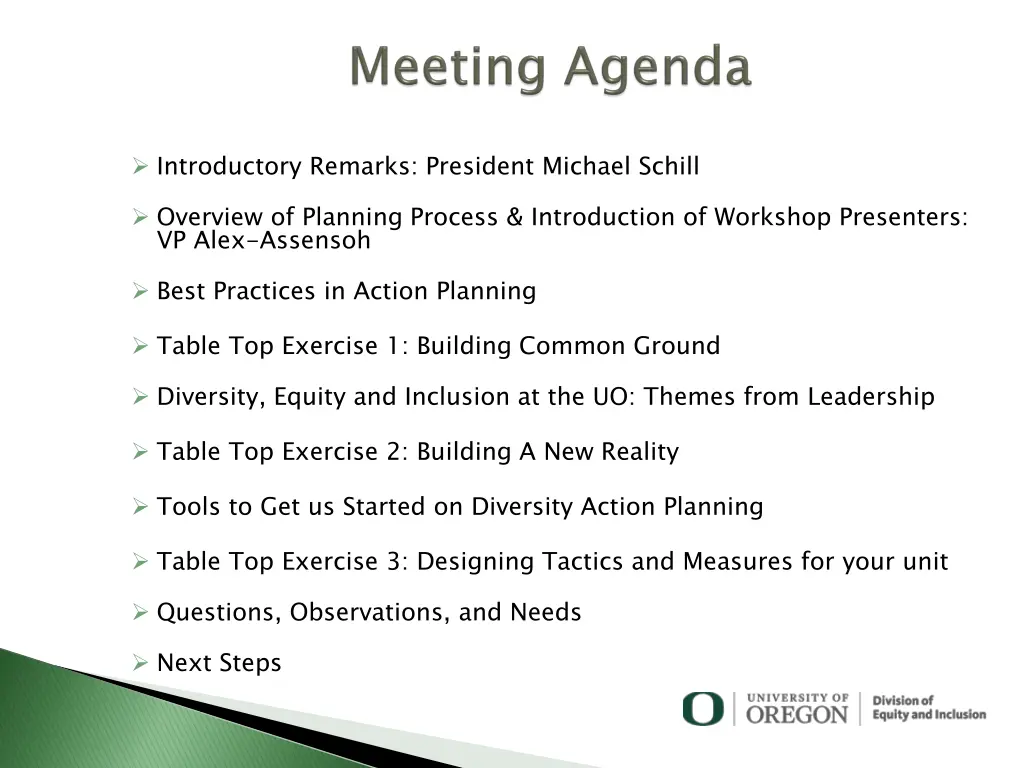
Introductory Remarks: President Michael Schill Overview of Planning Process & Introduction of Workshop Presenters: VP Alex-Assensoh Best Practices in Action Planning Table Top Exercise 1: Building Common Ground Diversity, Equity and Inclusion at the UO: Themes from Leadership Table Top Exercise 2: Building A New Reality Tools to Get us Started on Diversity Action Planning Table Top Exercise 3: Designing Tactics and Measures for your unit Questions, Observations, and Needs Next Steps
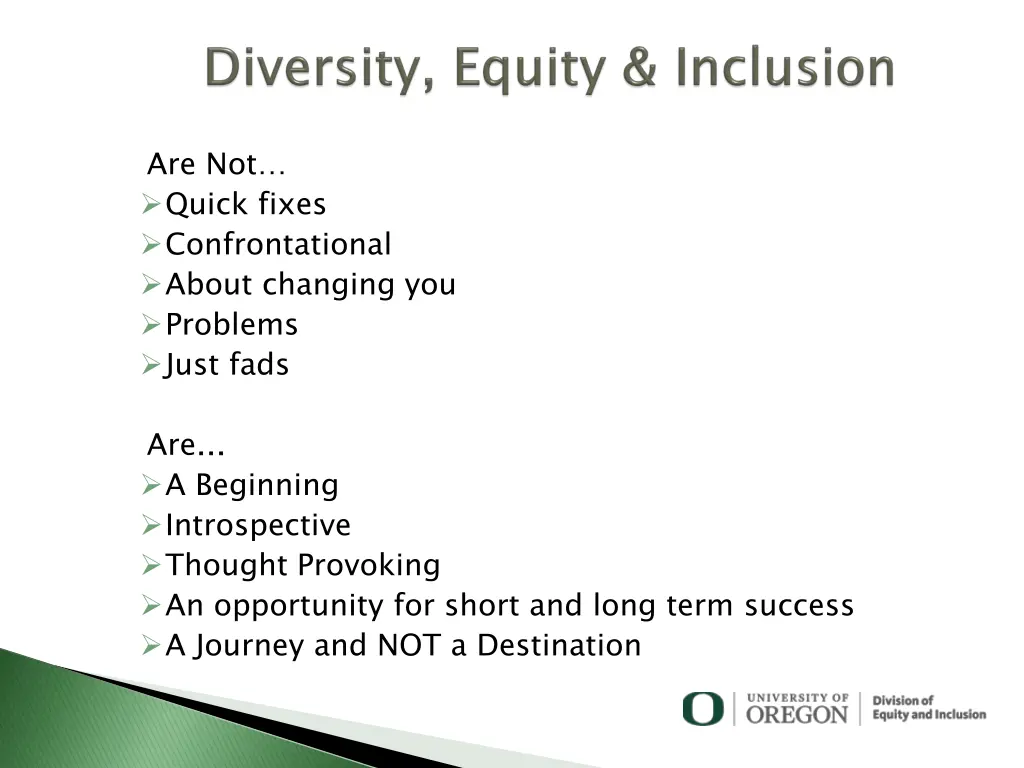
Are Not Quick fixes Confrontational About changing you Problems Just fads Are A Beginning Introspective Thought Provoking An opportunity for short and long term success A Journey and NOT a Destination
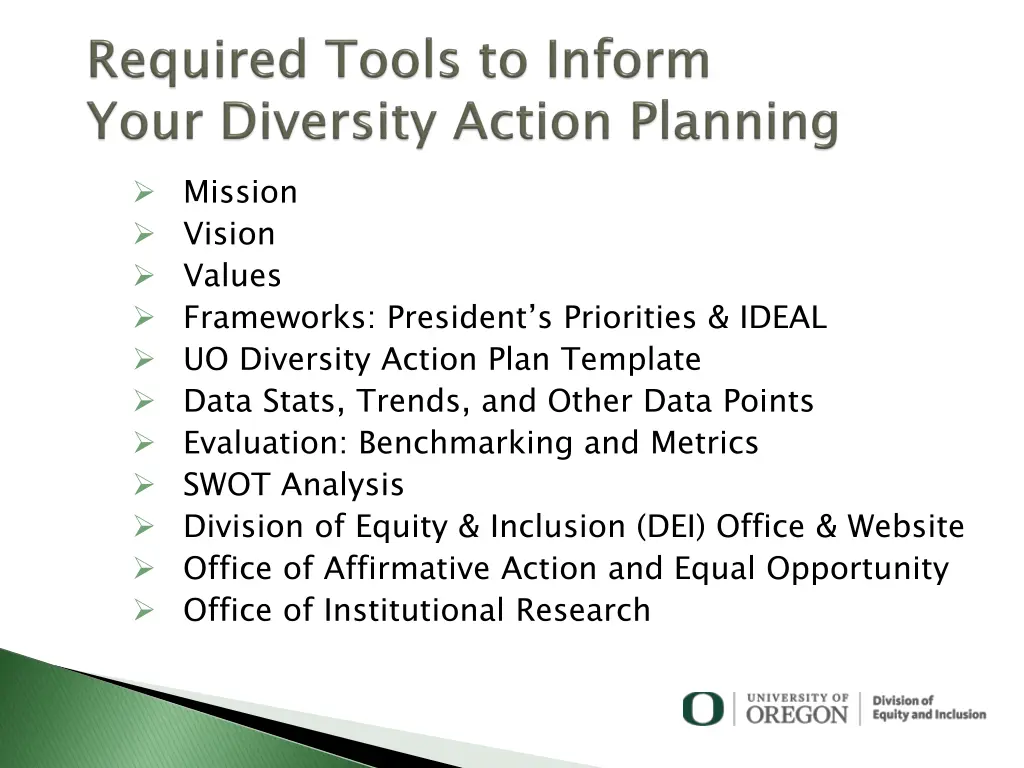
Mission Vision Values Frameworks: President s Priorities & IDEAL UO Diversity Action Plan Template Data Stats, Trends, and Other Data Points Evaluation: Benchmarking and Metrics SWOT Analysis Division of Equity & Inclusion (DEI) Office & Website Office of Affirmative Action and Equal Opportunity Office of Institutional Research
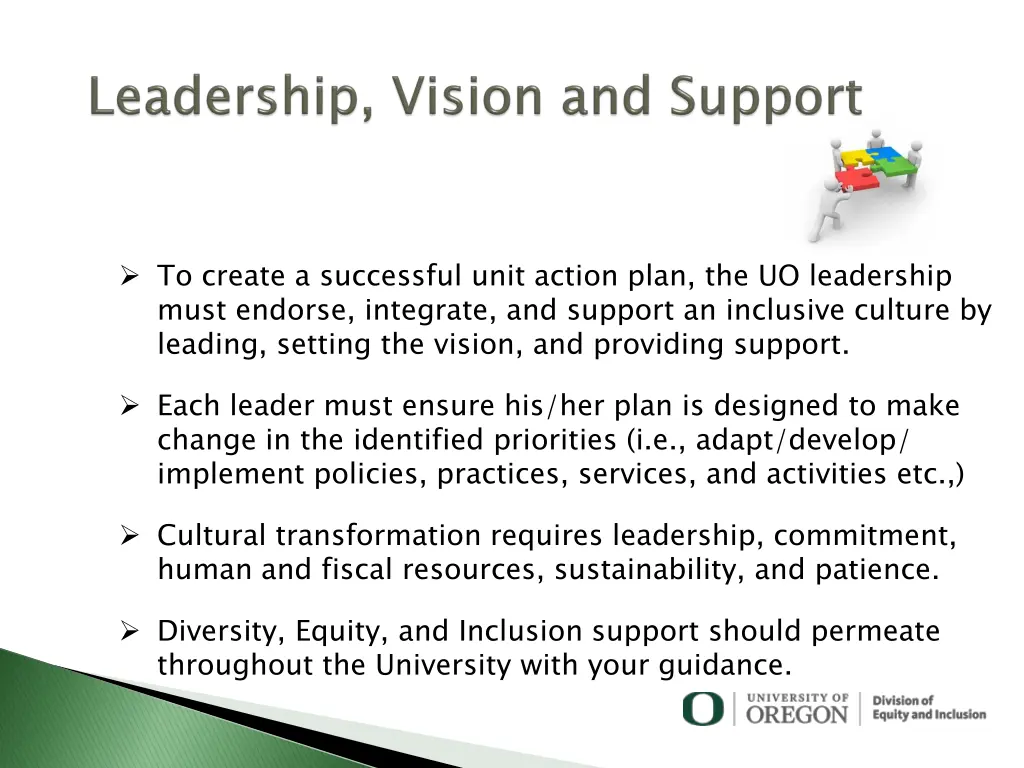
To create a successful unit action plan, the UO leadership must endorse, integrate, and support an inclusive culture by leading, setting the vision, and providing support. Each leader must ensure his/her plan is designed to make change in the identified priorities (i.e., adapt/develop/ implement policies, practices, services, and activities etc.,) Cultural transformation requires leadership, commitment, human and fiscal resources, sustainability, and patience. Diversity, Equity, and Inclusion support should permeate throughout the University with your guidance.
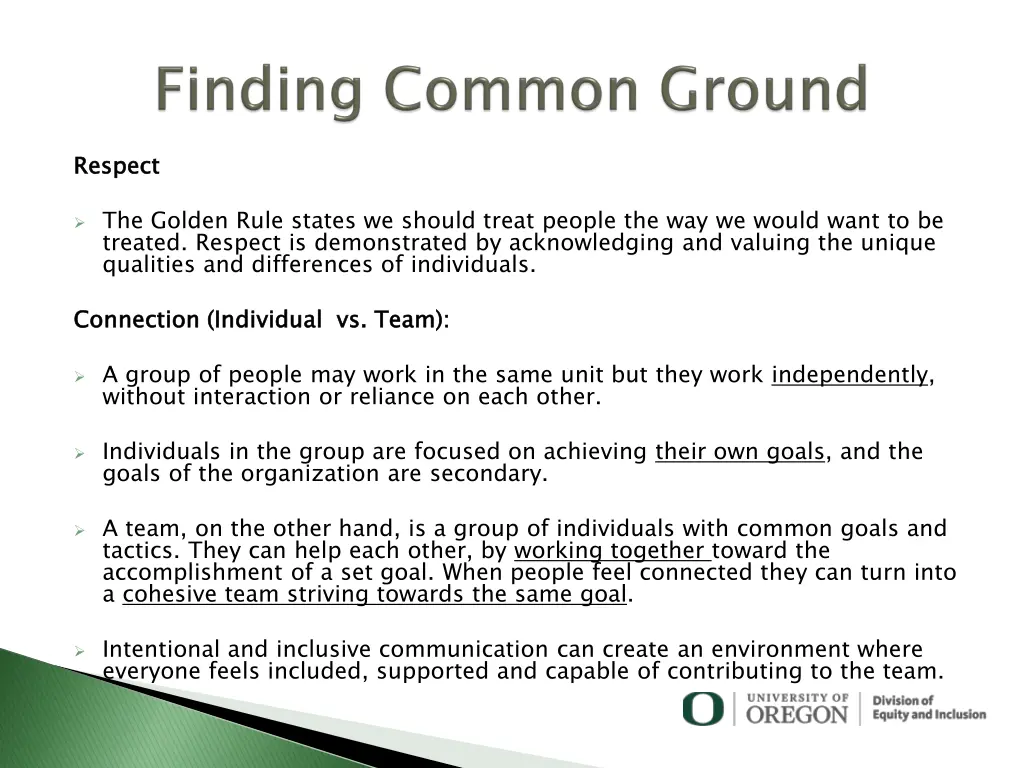
Respect Respect The Golden Rule states we should treat people the way we would want to be treated. Respect is demonstrated by acknowledging and valuing the unique qualities and differences of individuals. Connection (Individual vs. Team): Connection (Individual vs. Team): A group of people may work in the same unit but they work independently, without interaction or reliance on each other. Individuals in the group are focused on achieving their own goals, and the goals of the organization are secondary. A team, on the other hand, is a group of individuals with common goals and tactics. They can help each other, by working together toward the accomplishment of a set goal. When people feel connected they can turn into a cohesive team striving towards the same goal. Intentional and inclusive communication can create an environment where everyone feels included, supported and capable of contributing to the team.
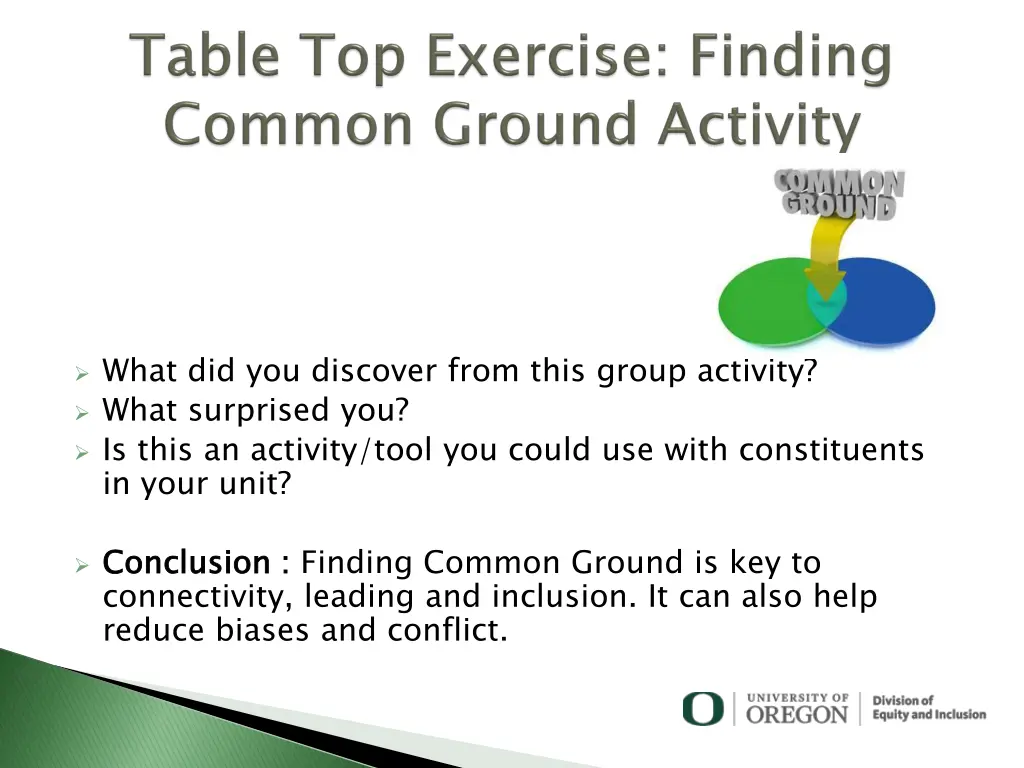
https://tse1.mm.bing.net/th?id=OIP.M46ffe871a4a2bfd4ee745ccff0b6e52eo0w=300h=294c=0pid=1.9rs=0p=0r=0https://tse1.mm.bing.net/th?id=OIP.M46ffe871a4a2bfd4ee745ccff0b6e52eo0w=300h=294c=0pid=1.9rs=0p=0r=0 What did you discover from this group activity? What surprised you? Is this an activity/tool you could use with constituents in your unit? Conclusion connectivity, leading and inclusion. It can also help reduce biases and conflict. Conclusion : : Finding Common Ground is key to
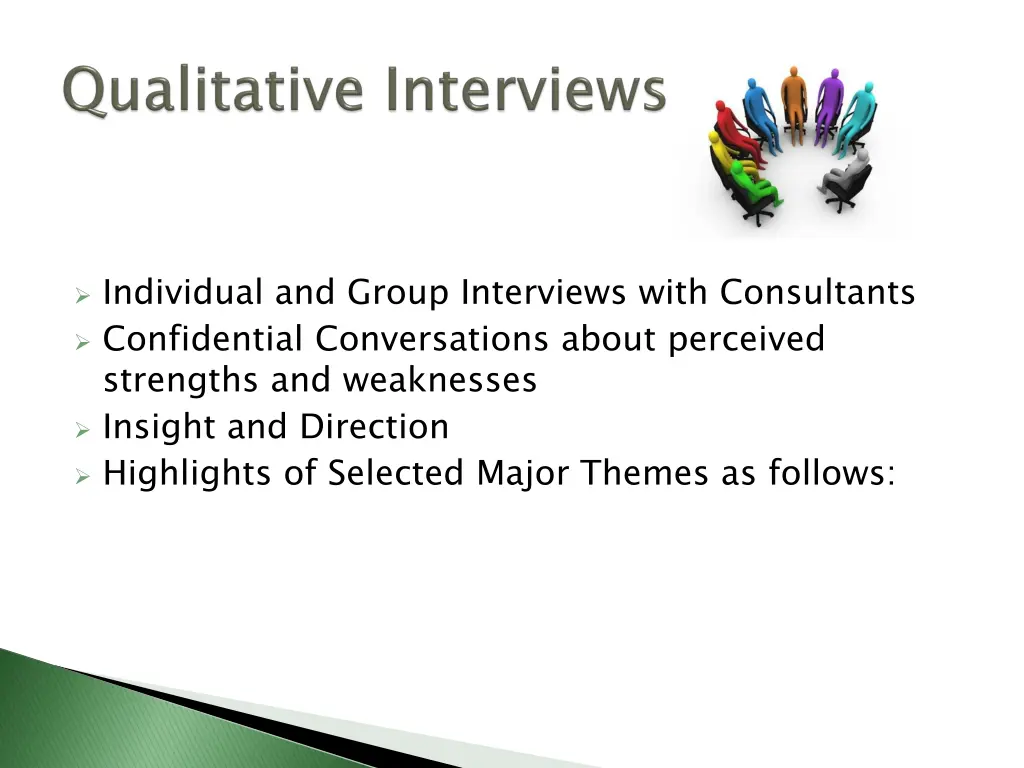
Individual and Group Interviews with Consultants Confidential Conversations about perceived strengths and weaknesses Insight and Direction Highlights of Selected Major Themes as follows:
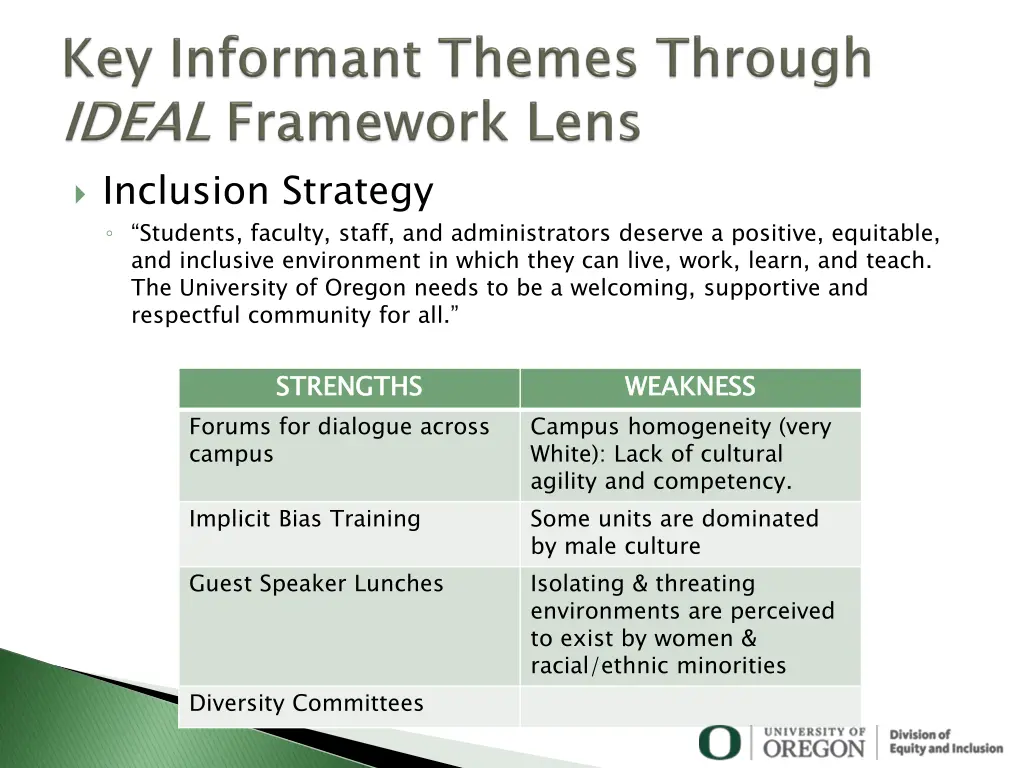
Inclusion Strategy Students, faculty, staff, and administrators deserve a positive, equitable, and inclusive environment in which they can live, work, learn, and teach. The University of Oregon needs to be a welcoming, supportive and respectful community for all. STRENGTHS STRENGTHS WEAKNESS WEAKNESS Forums for dialogue across campus Campus homogeneity (very White): Lack of cultural agility and competency. Some units are dominated by male culture Isolating & threating environments are perceived to exist by women & racial/ethnic minorities Implicit Bias Training Guest Speaker Lunches Diversity Committees
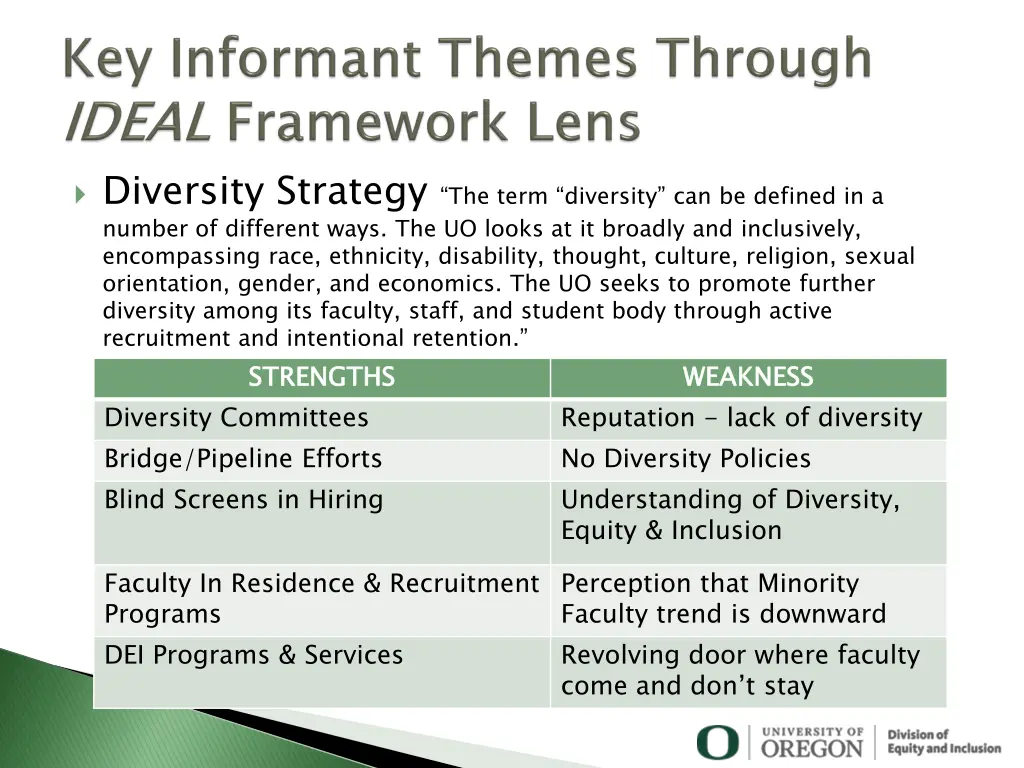
Diversity Strategy The term diversity can be defined in a number of different ways. The UO looks at it broadly and inclusively, encompassing race, ethnicity, disability, thought, culture, religion, sexual orientation, gender, and economics. The UO seeks to promote further diversity among its faculty, staff, and student body through active recruitment and intentional retention. STRENGTHS Diversity Committees Bridge/Pipeline Efforts Blind Screens in Hiring STRENGTHS WEAKNESS WEAKNESS Reputation - lack of diversity No Diversity Policies Understanding of Diversity, Equity & Inclusion Faculty In Residence & Recruitment Programs DEI Programs & Services Perception that Minority Faculty trend is downward Revolving door where faculty come and don t stay
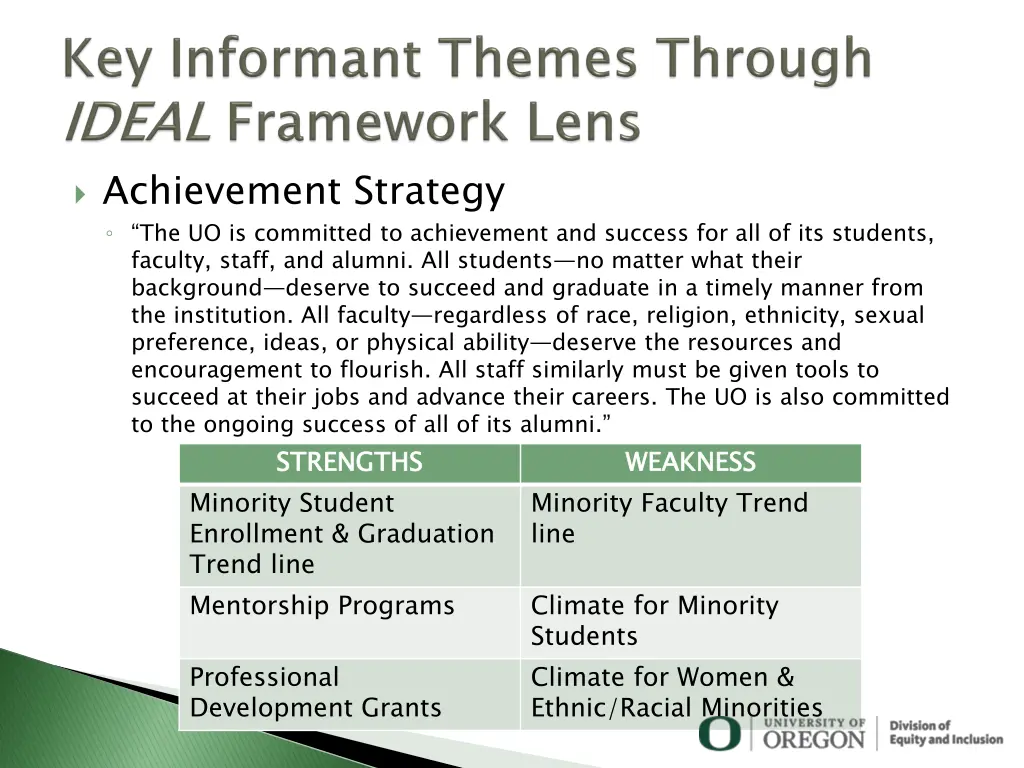
Achievement Strategy The UO is committed to achievement and success for all of its students, faculty, staff, and alumni. All students no matter what their background deserve to succeed and graduate in a timely manner from the institution. All faculty regardless of race, religion, ethnicity, sexual preference, ideas, or physical ability deserve the resources and encouragement to flourish. All staff similarly must be given tools to succeed at their jobs and advance their careers. The UO is also committed to the ongoing success of all of its alumni. STRENGTHS Minority Student Enrollment & Graduation Trend line Mentorship Programs STRENGTHS WEAKNESS WEAKNESS Minority Faculty Trend line Climate for Minority Students Climate for Women & Ethnic/Racial Minorities Professional Development Grants
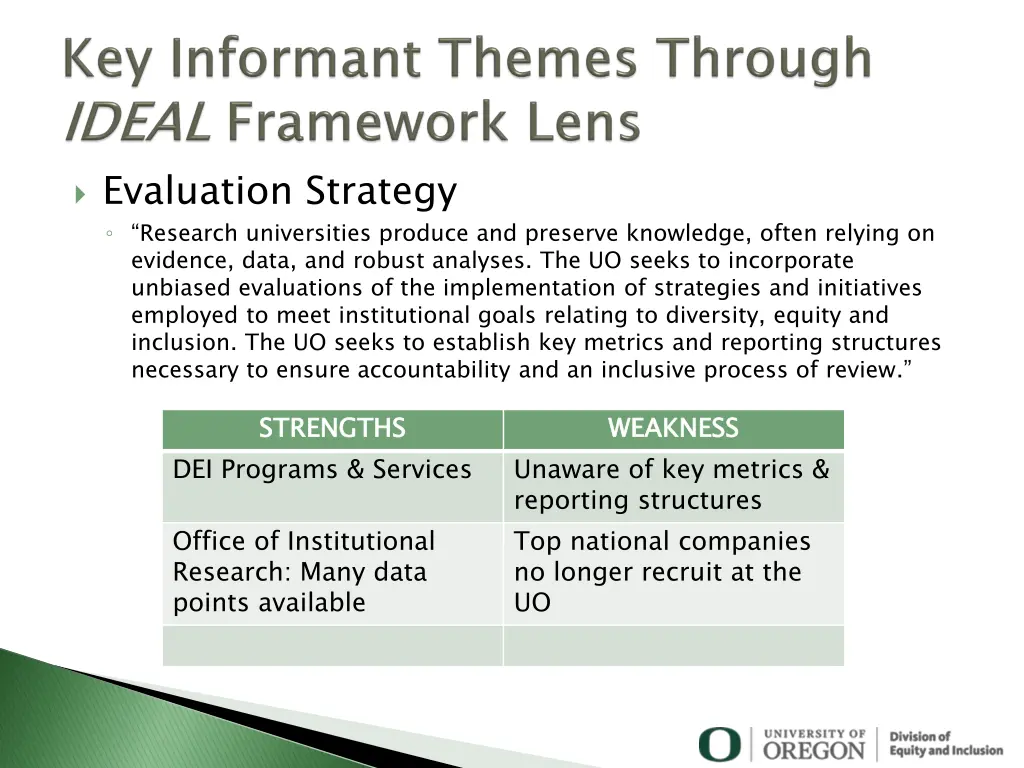
Evaluation Strategy Research universities produce and preserve knowledge, often relying on evidence, data, and robust analyses. The UO seeks to incorporate unbiased evaluations of the implementation of strategies and initiatives employed to meet institutional goals relating to diversity, equity and inclusion. The UO seeks to establish key metrics and reporting structures necessary to ensure accountability and an inclusive process of review. STRENGTHS STRENGTHS WEAKNESS WEAKNESS DEI Programs & Services Unaware of key metrics & reporting structures Top national companies no longer recruit at the UO Office of Institutional Research: Many data points available
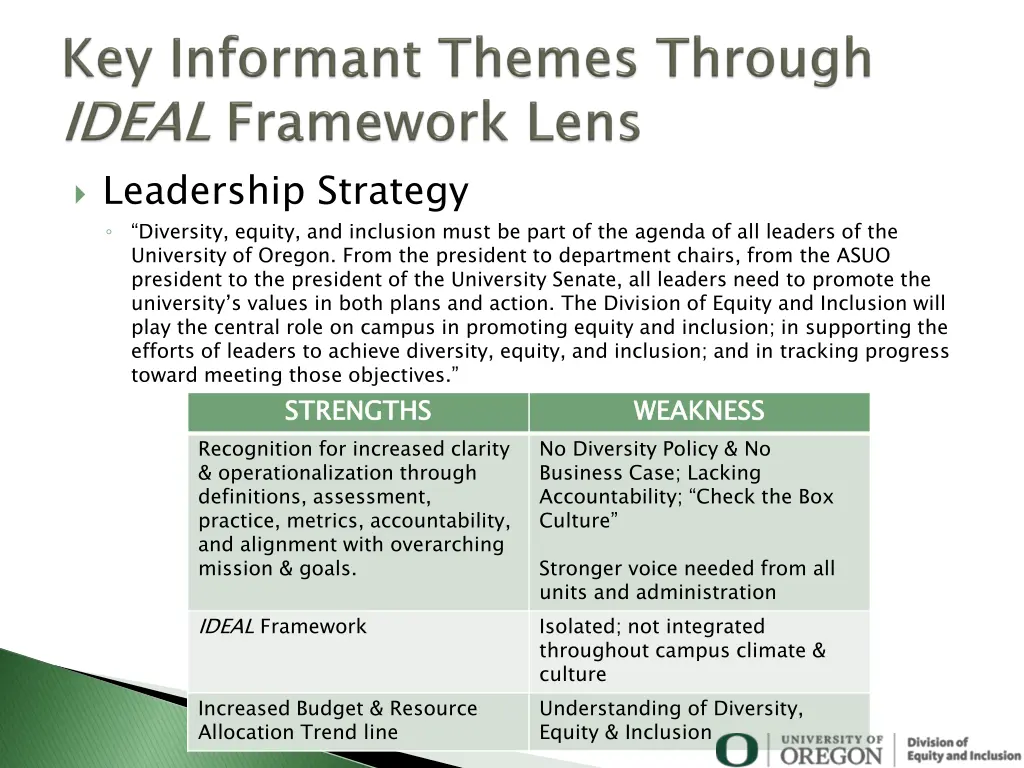
Leadership Strategy Diversity, equity, and inclusion must be part of the agenda of all leaders of the University of Oregon. From the president to department chairs, from the ASUO president to the president of the University Senate, all leaders need to promote the university s values in both plans and action. The Division of Equity and Inclusion will play the central role on campus in promoting equity and inclusion; in supporting the efforts of leaders to achieve diversity, equity, and inclusion; and in tracking progress toward meeting those objectives. STRENGTHS Recognition for increased clarity & operationalization through definitions, assessment, practice, metrics, accountability, and alignment with overarching mission & goals. STRENGTHS WEAKNESS WEAKNESS No Diversity Policy & No Business Case; Lacking Accountability; Check the Box Culture Stronger voice needed from all units and administration Isolated; not integrated throughout campus climate & culture Understanding of Diversity, Equity & Inclusion IDEAL Framework Increased Budget & Resource Allocation Trend line
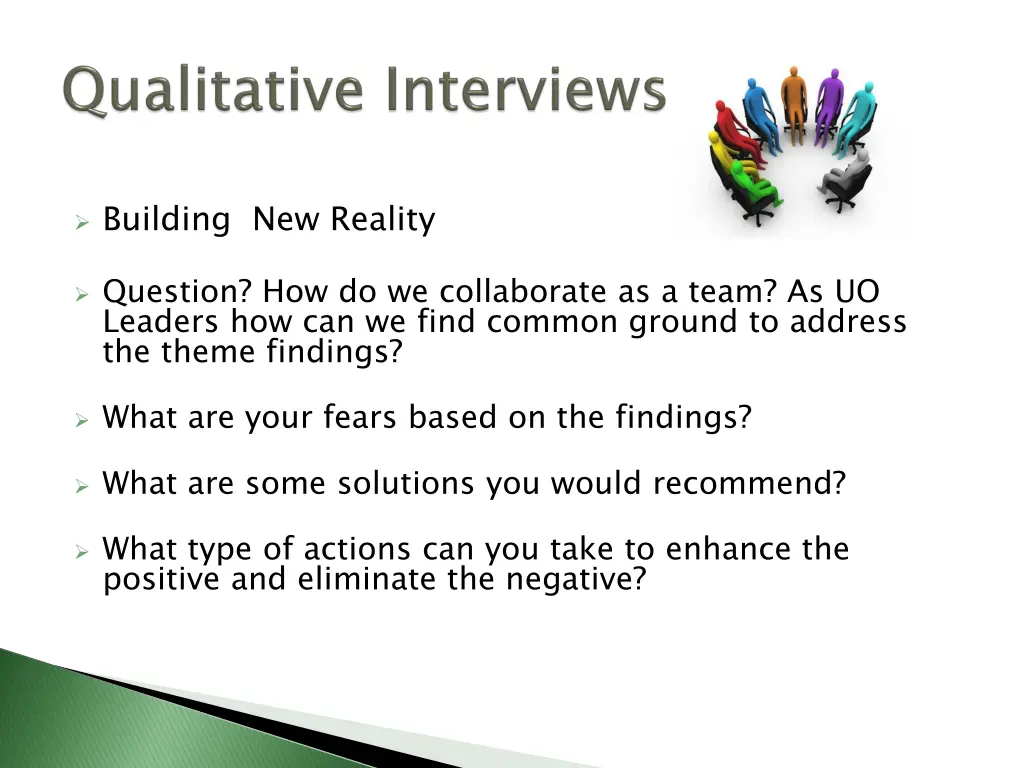
Building New Reality Question? How do we collaborate as a team? As UO Leaders how can we find common ground to address the theme findings? What are your fears based on the findings? What are some solutions you would recommend? What type of actions can you take to enhance the positive and eliminate the negative?
Action planning is a tool for organizing the desired outcomes. In this case, the Action Planning for Diversity, Equity, and Inclusion (APDEI) is a road map to lead your planning and outcomes. Your plan should align with the President s Priorities and IDEAL. The purpose of action planning is to align your unit s work with the UO s mission, values, priorities, and framework to support the identified goals and tactics.
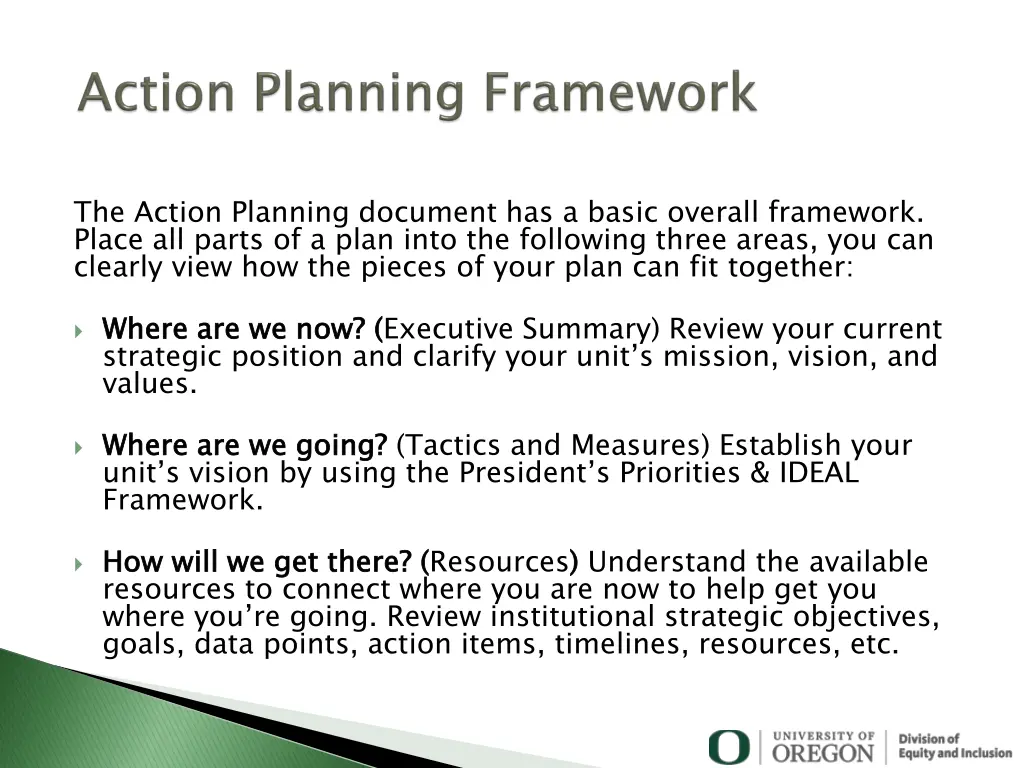
The Action Planning document has a basic overall framework. Place all parts of a plan into the following three areas, you can clearly view how the pieces of your plan can fit together: Where are we strategic position and clarify your unit s mission, vision, and values. Where are we now? ( now? (Executive Summary) Review your current Where are we going? unit s vision by using the President s Priorities & IDEAL Framework. Where are we going? (Tactics and Measures) Establish your How will we get there resources to connect where you are now to help get you where you re going. Review institutional strategic objectives, goals, data points, action items, timelines, resources, etc. How will we get there? ( ? (Resources) ) Understand the available
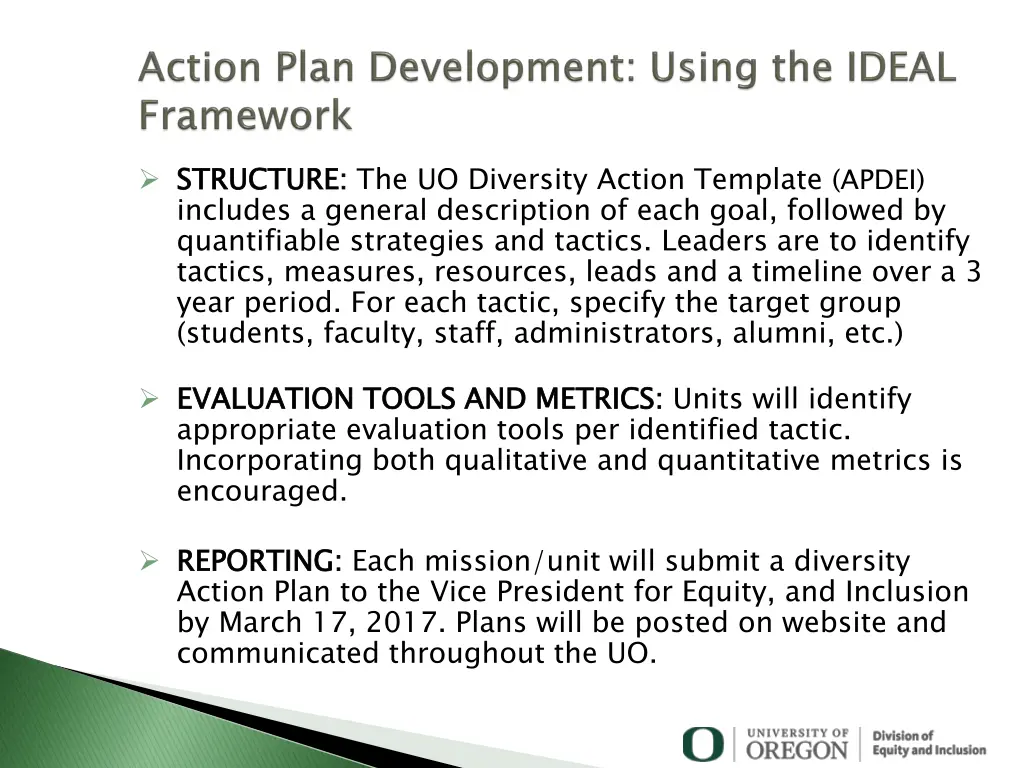
STRUCTURE includes a general description of each goal, followed by quantifiable strategies and tactics. Leaders are to identify tactics, measures, resources, leads and a timeline over a 3 year period. For each tactic, specify the target group (students, faculty, staff, administrators, alumni, etc.) STRUCTURE: : The UO Diversity Action Template (APDEI) EVALUATION appropriate evaluation tools per identified tactic. Incorporating both qualitative and quantitative metrics is encouraged. EVALUATION TOOLS AND METRICS: TOOLS AND METRICS: Units will identify REPORTING: Action Plan to the Vice President for Equity, and Inclusion by March 17, 2017. Plans will be posted on website and communicated throughout the UO. REPORTING: Each mission/unit will submit a diversity
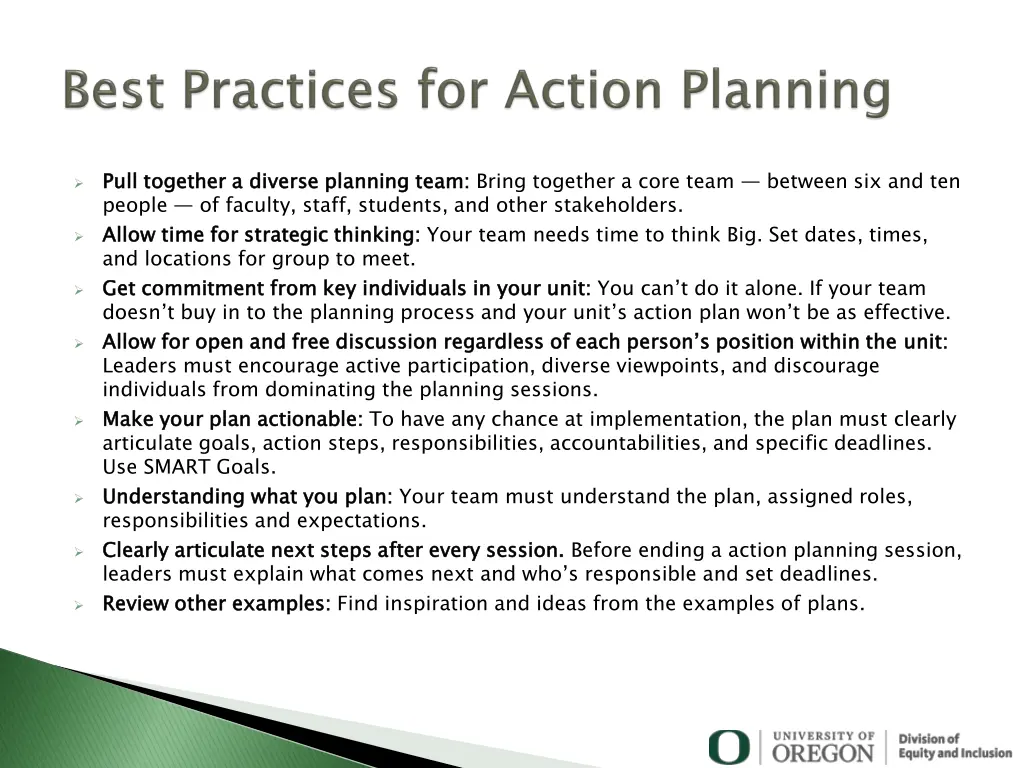
Pull people of faculty, staff, students, and other stakeholders. Allow time and locations for group to meet. Get doesn t buy in to the planning process and your unit s action plan won t be as effective. Allow for open and free discussion regardless of each person s position within the Leaders must encourage active participation, diverse viewpoints, and discourage individuals from dominating the planning sessions. Make articulate goals, action steps, responsibilities, accountabilities, and specific deadlines. Use SMART Goals. Understanding what you plan: responsibilities and expectations. Clearly articulate next steps after every session. leaders must explain what comes next and who s responsible and set deadlines. Review other examples: Pull together a together a diverse planning team: diverse planning team: Bring together a core team between six and ten Allow time for strategic thinking: for strategic thinking: Your team needs time to think Big. Set dates, times, Get commitment commitment from key from key individuals in individuals in your your unit: unit: You can t do it alone. If your team Allow for open and free discussion regardless of each person s position within the unit unit: : Make your plan your plan actionable: actionable: To have any chance at implementation, the plan must clearly Understanding what you plan: Your team must understand the plan, assigned roles, Clearly articulate next steps after every session. Before ending a action planning session, Review other examples: Find inspiration and ideas from the examples of plans.
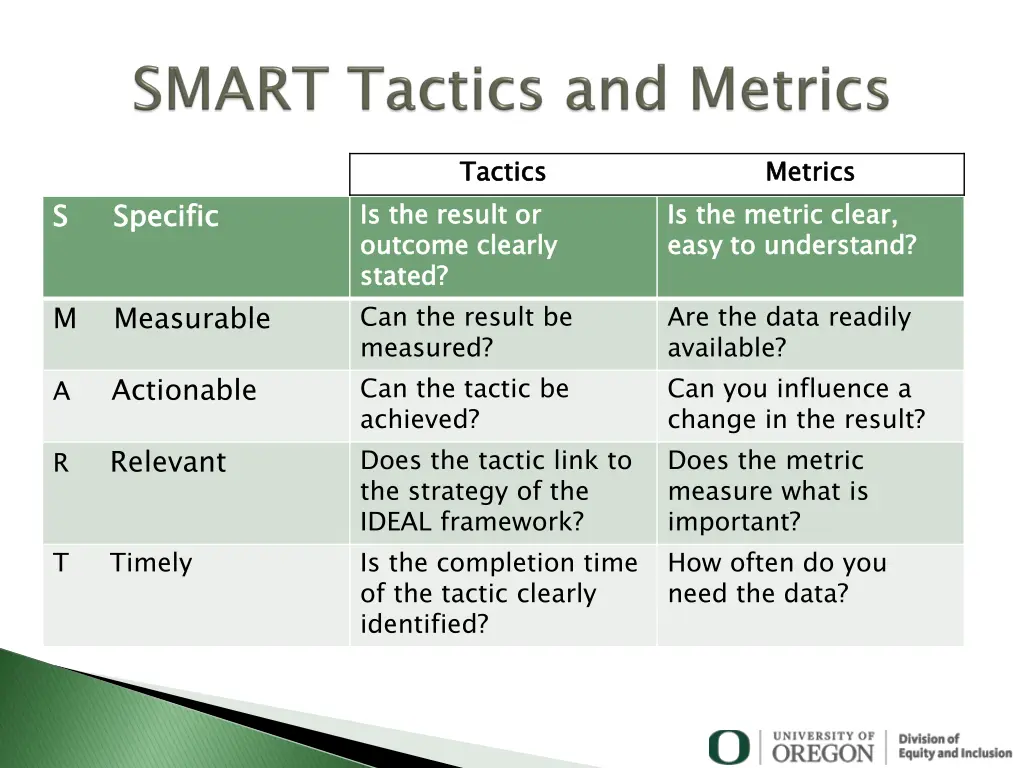
Tactics Tactics Metrics Metrics S S Specific Specific Is Is the result or outcome clearly stated? Can the result be measured? Can the tactic be achieved? Does the tactic link to the strategy of the IDEAL framework? Is the completion time of the tactic clearly identified? the result or outcome clearly stated? Is the metric clear, easy to understand? Is the metric clear, easy to understand? M Measurable Are the data readily available? Can you influence a change in the result? Does the metric measure what is important? How often do you need the data? A Actionable R Relevant T Timely
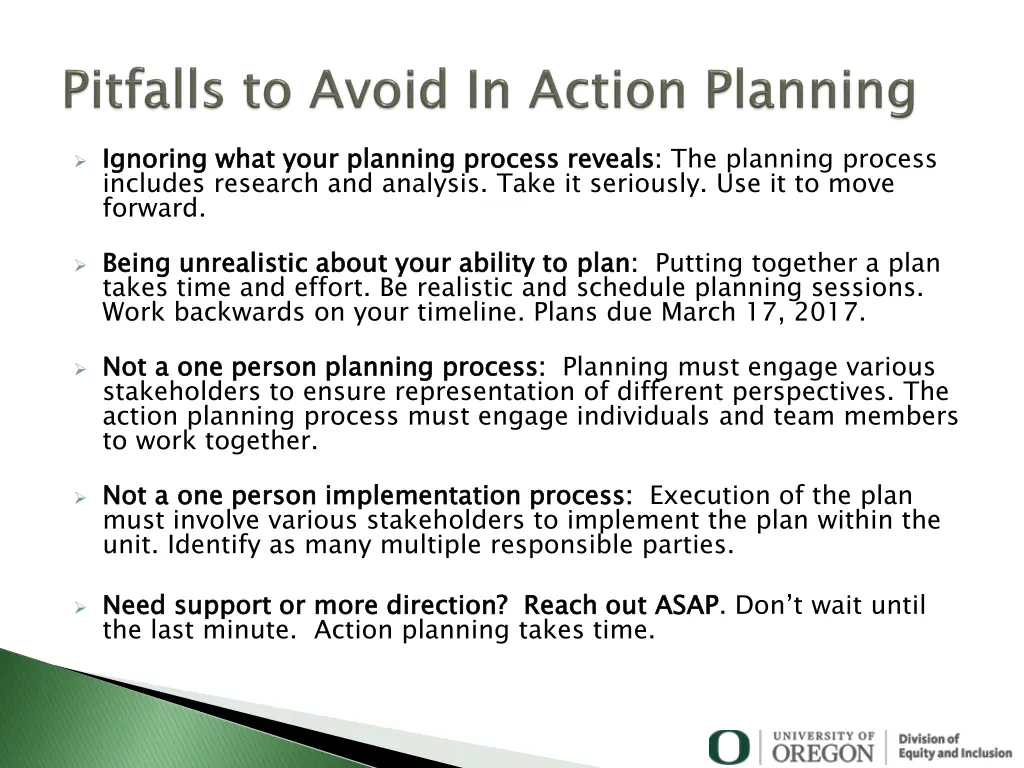
Ignoring includes research and analysis. Take it seriously. Use it to move forward. Ignoring what your planning process reveals: what your planning process reveals: The planning process Being takes time and effort. Be realistic and schedule planning sessions. Work backwards on your timeline. Plans due March 17, 2017. Being unrealistic about your ability to unrealistic about your ability to plan: plan: Putting together a plan Not stakeholders to ensure representation of different perspectives. The action planning process must engage individuals and team members to work together. Not a one person implementation process: must involve various stakeholders to implement the plan within the unit. Identify as many multiple responsible parties. Not a one person planning a one person planning process: process: Planning must engage various Not a one person implementation process: Execution of the plan Need support or more direction? Reach out ASAP the last minute. Action planning takes time. Need support or more direction? Reach out ASAP. Don t wait until
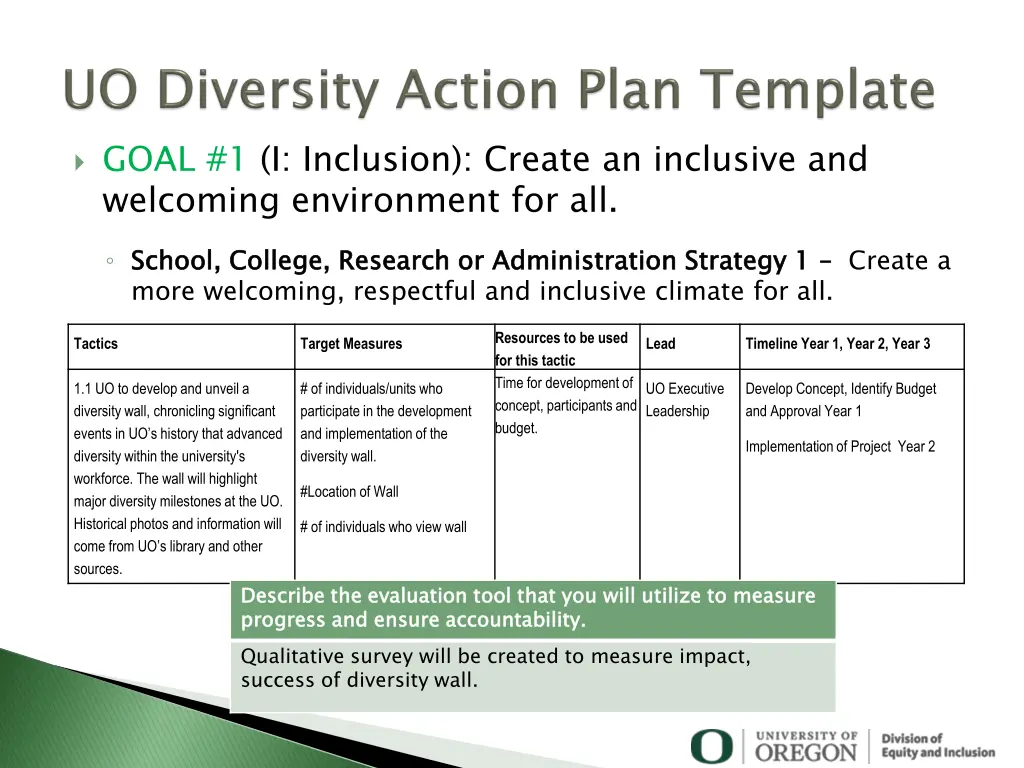
GOAL #1 (I: Inclusion): Create an inclusive and welcoming environment for all. School, College, Research or Administration Strategy 1 more welcoming, respectful and inclusive climate for all. School, College, Research or Administration Strategy 1 Create a Resources to be used for this tactic Time for development of concept, participants and budget. Tactics Target Measures Lead Timeline Year 1, Year 2, Year 3 1.1 UO to develop and unveil a diversity wall, chronicling significant events in UO s history that advanced diversity within the university's workforce. The wall will highlight major diversity milestones at the UO. Historical photos and information will come from UO s library and other sources. # of individuals/units who participate in the development and implementation of the diversity wall. UO Executive Leadership Develop Concept, Identify Budget and Approval Year 1 Implementation of Project Year 2 #Location of Wall # of individuals who view wall Describe the evaluation tool that you will utilize to measure progress and ensure accountability. Qualitative survey will be created to measure impact, success of diversity wall. Describe the evaluation tool that you will utilize to measure progress and ensure accountability.
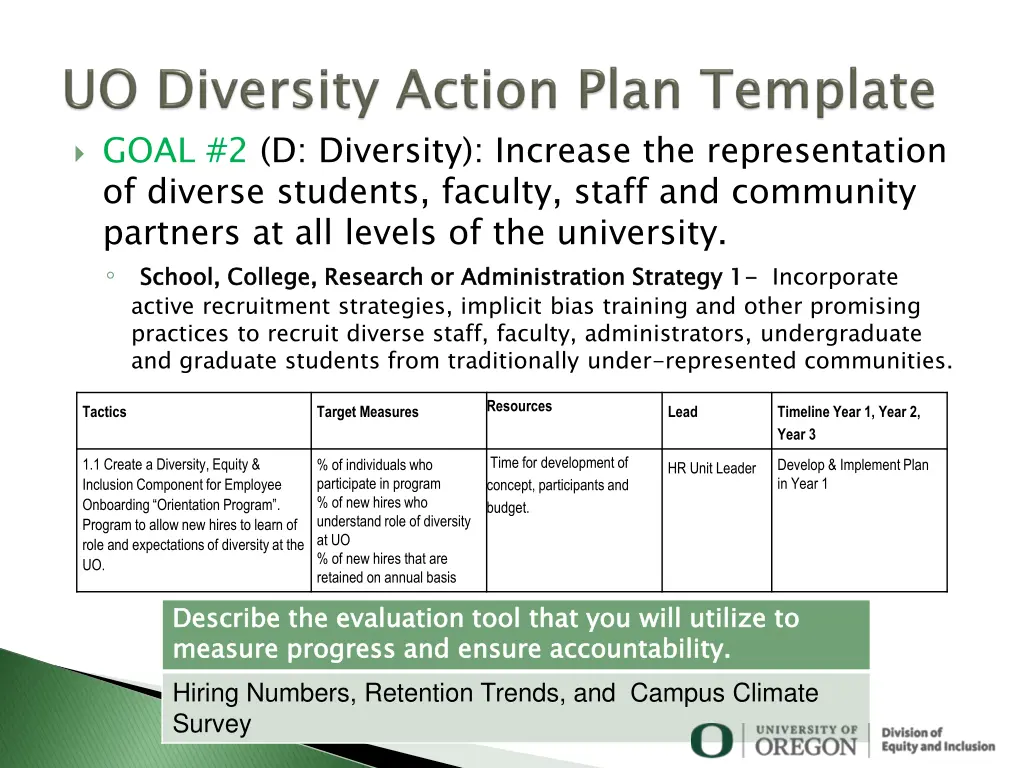
GOAL #2 (D: Diversity): Increase the representation of diverse students, faculty, staff and community partners at all levels of the university. School, College, Research or Administration Strategy 1 active recruitment strategies, implicit bias training and other promising practices to recruit diverse staff, faculty, administrators, undergraduate and graduate students from traditionally under-represented communities. School, College, Research or Administration Strategy 1- - Incorporate Resources Tactics Target Measures Lead Timeline Year 1, Year 2, Year 3 Time for development of concept, participants and budget. 1.1 Create a Diversity, Equity & Inclusion Component for Employee Onboarding Orientation Program . Program to allow new hires to learn of role and expectations of diversity at the UO. % of individuals who participate in program % of new hires who understand role of diversity at UO % of new hires that are retained on annual basis Develop & Implement Plan in Year 1 HR Unit Leader Describe the evaluation tool that you will utilize to measure progress and ensure accountability. Hiring Numbers, Retention Trends, and Campus Climate Survey Describe the evaluation tool that you will utilize to measure progress and ensure accountability.
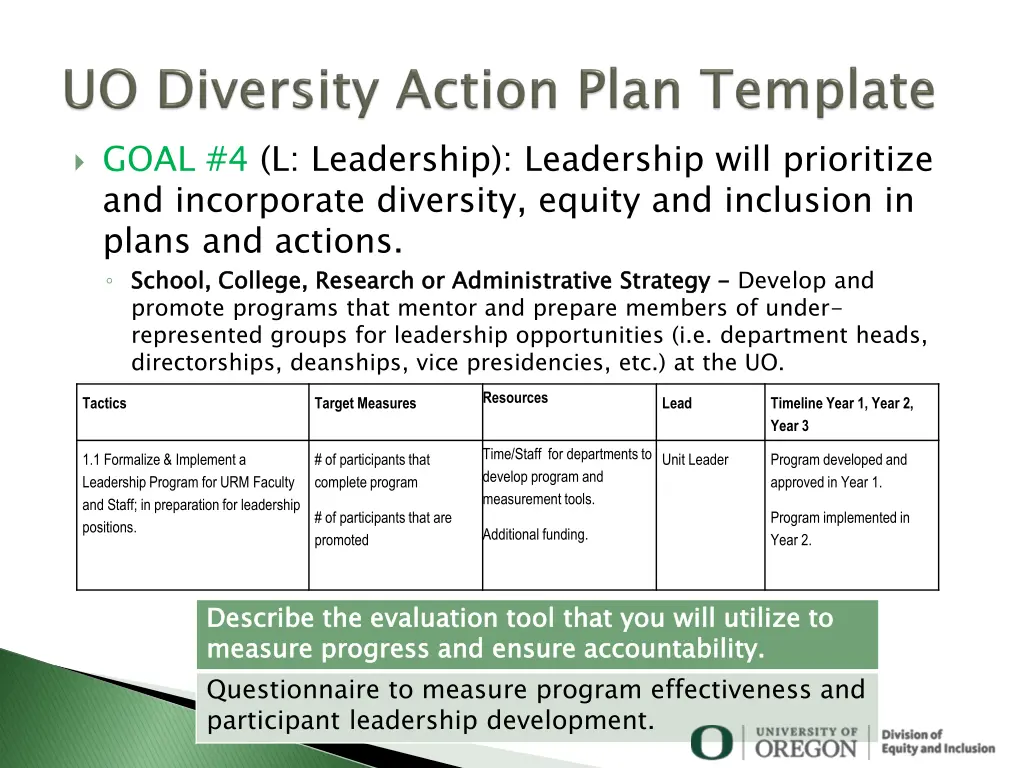
GOAL #4 (L: Leadership): Leadership will prioritize and incorporate diversity, equity and inclusion in plans and actions. School, College, Research or Administrative promote programs that mentor and prepare members of under- represented groups for leadership opportunities (i.e. department heads, directorships, deanships, vice presidencies, etc.) at the UO. School, College, Research or Administrative Strategy Strategy - - Develop and Resources Tactics Target Measures Lead Timeline Year 1, Year 2, Year 3 Time/Staff for departments to develop program and measurement tools. 1.1 Formalize & Implement a Leadership Program for URM Faculty and Staff; in preparation for leadership positions. # of participants that complete program Unit Leader Program developed and approved in Year 1. # of participants that are promoted Program implemented in Year 2. Additional funding. Describe the evaluation tool that you will utilize to measure progress and ensure accountability. Questionnaire to measure program effectiveness and participant leadership development. Describe the evaluation tool that you will utilize to measure progress and ensure accountability.
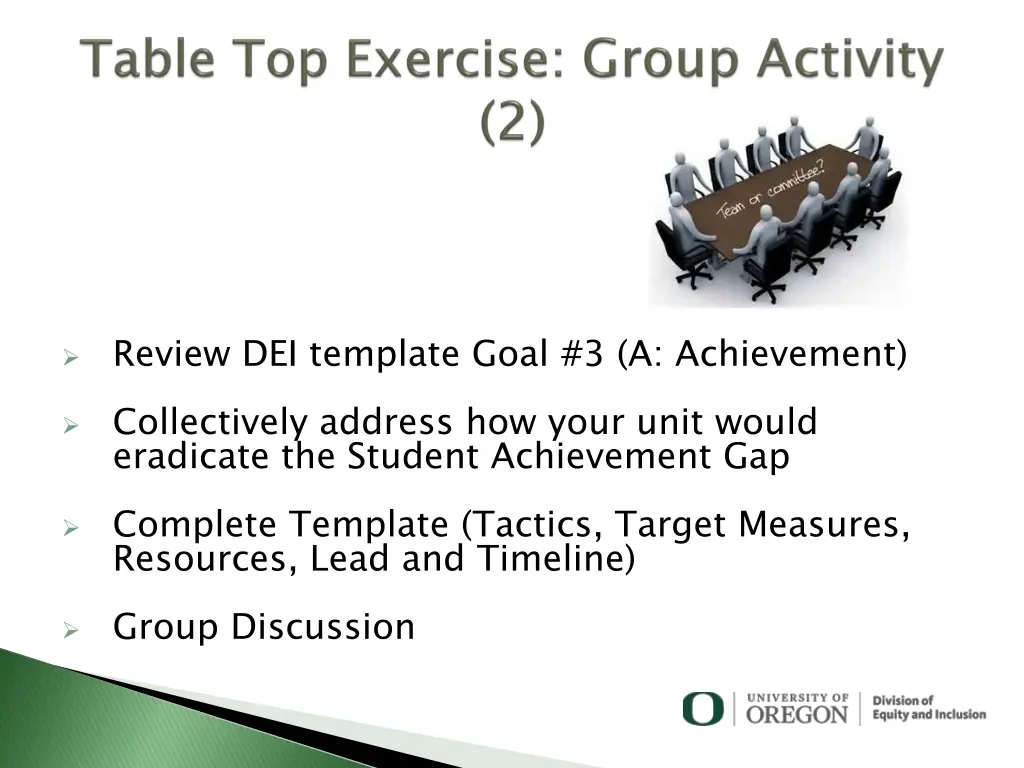
https://tse1.mm.bing.net/th?id=OIP.M3ff359bf097d51728b7d7f328d9d1ceco0w=300h=227c=0pid=1.9rs=0p=0r=0https://tse1.mm.bing.net/th?id=OIP.M3ff359bf097d51728b7d7f328d9d1ceco0w=300h=227c=0pid=1.9rs=0p=0r=0 Review DEI template Goal #3 (A: Achievement) Collectively address how your unit would eradicate the Student Achievement Gap Complete Template (Tactics, Target Measures, Resources, Lead and Timeline) Group Discussion
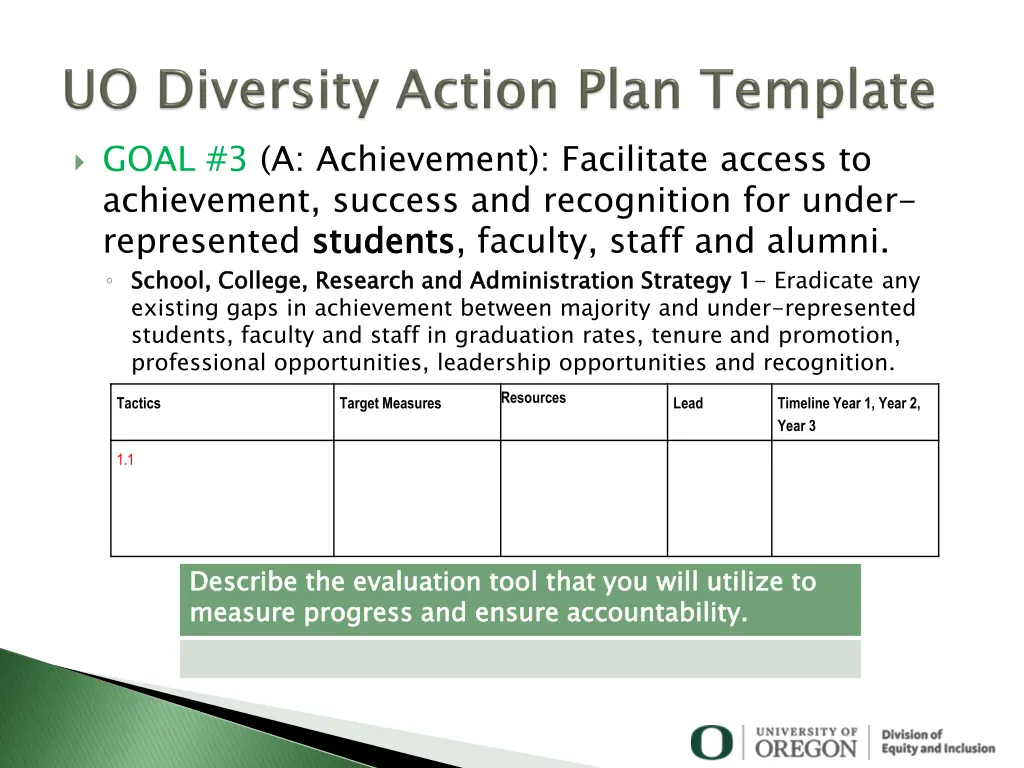
GOAL #3 (A: Achievement): Facilitate access to achievement, success and recognition for under- represented students School, College, Research and Administration Strategy 1 existing gaps in achievement between majority and under-represented students, faculty and staff in graduation rates, tenure and promotion, professional opportunities, leadership opportunities and recognition. students, faculty, staff and alumni. School, College, Research and Administration Strategy 1- Eradicate any Resources Tactics Target Measures Lead Timeline Year 1, Year 2, Year 3 1.1 Describe the evaluation tool that you will utilize to measure progress and ensure accountability. Describe the evaluation tool that you will utilize to measure progress and ensure accountability.
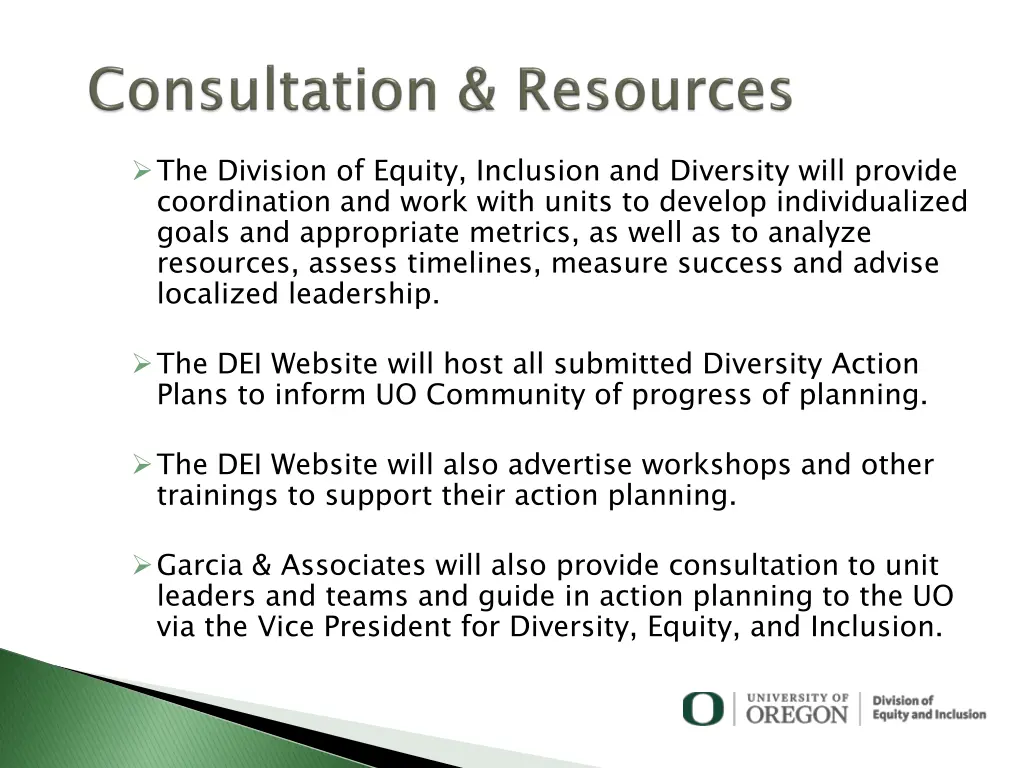
The Division of Equity, Inclusion and Diversity will provide coordination and work with units to develop individualized goals and appropriate metrics, as well as to analyze resources, assess timelines, measure success and advise localized leadership. The DEI Website will host all submitted Diversity Action Plans to inform UO Community of progress of planning. The DEI Website will also advertise workshops and other trainings to support their action planning. Garcia & Associates will also provide consultation to unit leaders and teams and guide in action planning to the UO via the Vice President for Diversity, Equity, and Inclusion.
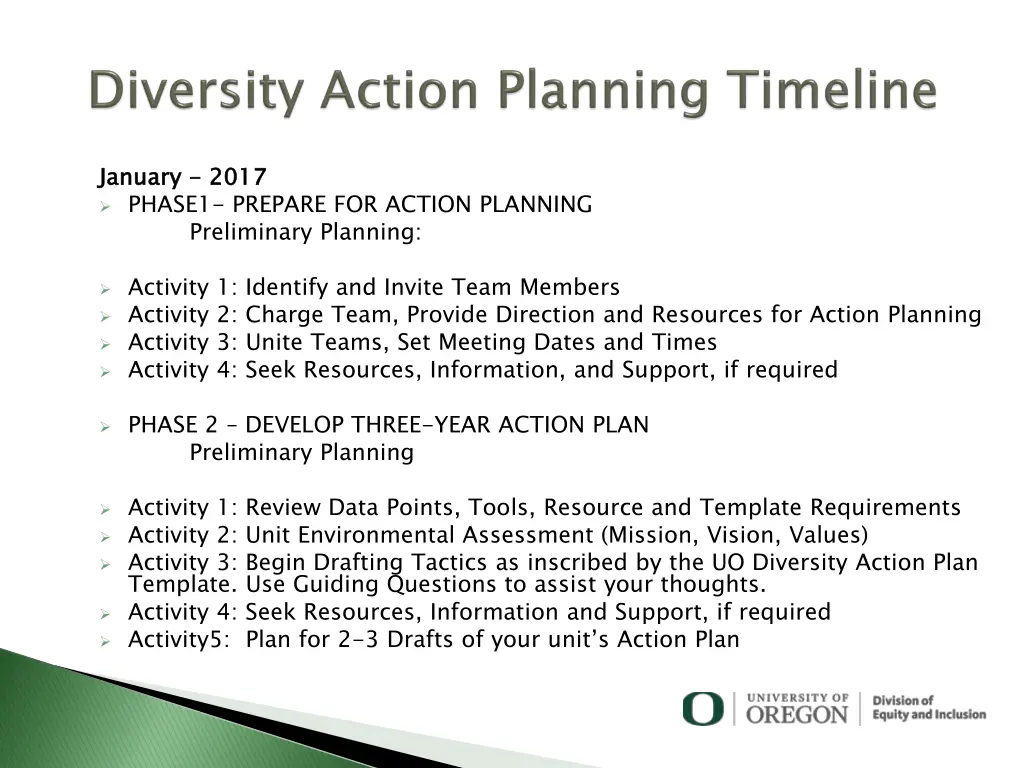
January PHASE1- PREPARE FOR ACTION PLANNING January - - 2017 2017 Preliminary Planning: Activity 1: Identify and Invite Team Members Activity 2: Charge Team, Provide Direction and Resources for Action Planning Activity 3: Unite Teams, Set Meeting Dates and Times Activity 4: Seek Resources, Information, and Support, if required PHASE 2 DEVELOP THREE-YEAR ACTION PLAN Preliminary Planning Activity 1: Review Data Points, Tools, Resource and Template Requirements Activity 2: Unit Environmental Assessment (Mission, Vision, Values) Activity 3: Begin Drafting Tactics as inscribed by the UO Diversity Action Plan Template. Use Guiding Questions to assist your thoughts. Activity 4: Seek Resources, Information and Support, if required Activity5: Plan for 2-3 Drafts of your unit s Action Plan
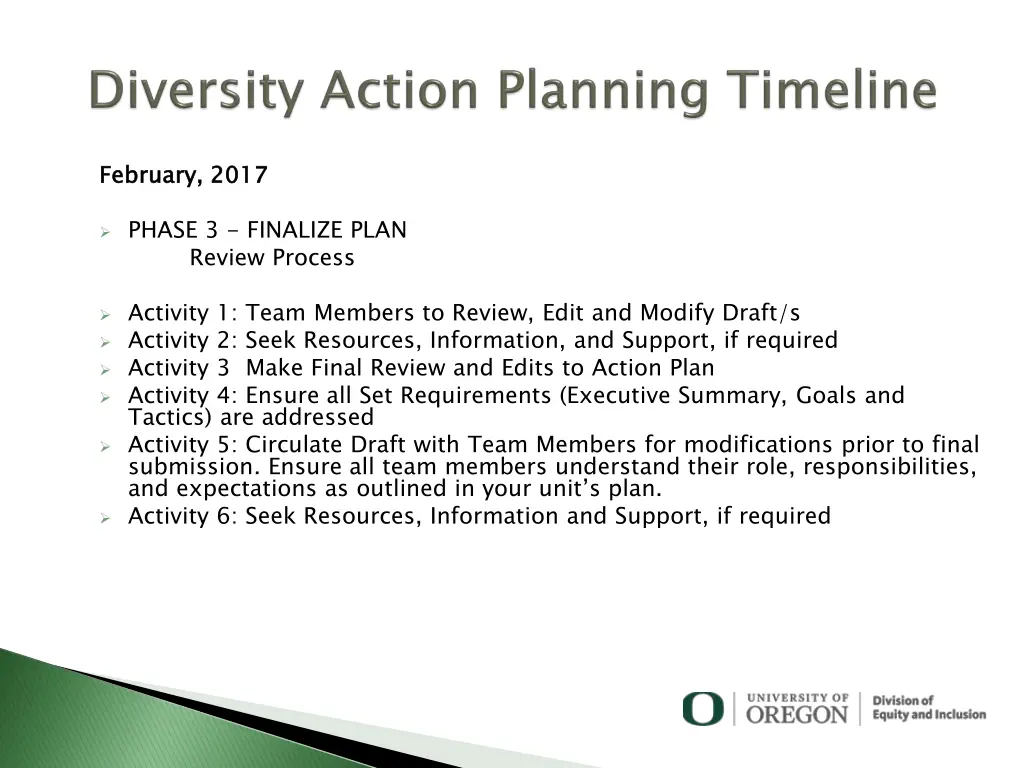
February, 2017 February, 2017 PHASE 3 - FINALIZE PLAN Review Process Activity 1: Team Members to Review, Edit and Modify Draft/s Activity 2: Seek Resources, Information, and Support, if required Activity 3 Make Final Review and Edits to Action Plan Activity 4: Ensure all Set Requirements (Executive Summary, Goals and Tactics) are addressed Activity 5: Circulate Draft with Team Members for modifications prior to final submission. Ensure all team members understand their role, responsibilities, and expectations as outlined in your unit s plan. Activity 6: Seek Resources, Information and Support, if required
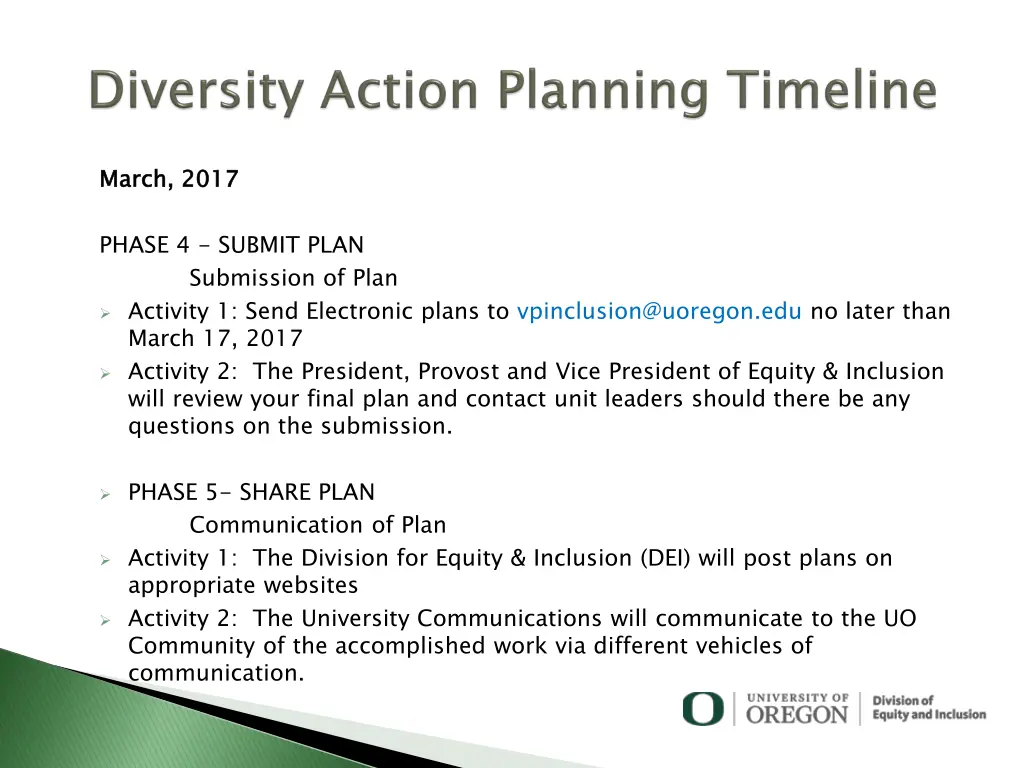
March, 2017 March, 2017 PHASE 4 - SUBMIT PLAN Activity 1: Send Electronic plans to vpinclusion@uoregon.edu no later than March 17, 2017 Activity 2: The President, Provost and Vice President of Equity & Inclusion will review your final plan and contact unit leaders should there be any questions on the submission. Submission of Plan PHASE 5- SHARE PLAN Activity 1: The Division for Equity & Inclusion (DEI) will post plans on appropriate websites Activity 2: The University Communications will communicate to the UO Community of the accomplished work via different vehicles of communication. Communication of Plan
https://tse1.mm.bing.net/th?id=OIP.M75f9e14bcd37f1037a131f3f8a4fdd3bH0w=300h=225c=0pid=1.9rs=0p=0r=0https://tse1.mm.bing.net/th?id=OIP.M75f9e14bcd37f1037a131f3f8a4fdd3bH0w=300h=225c=0pid=1.9rs=0p=0r=0
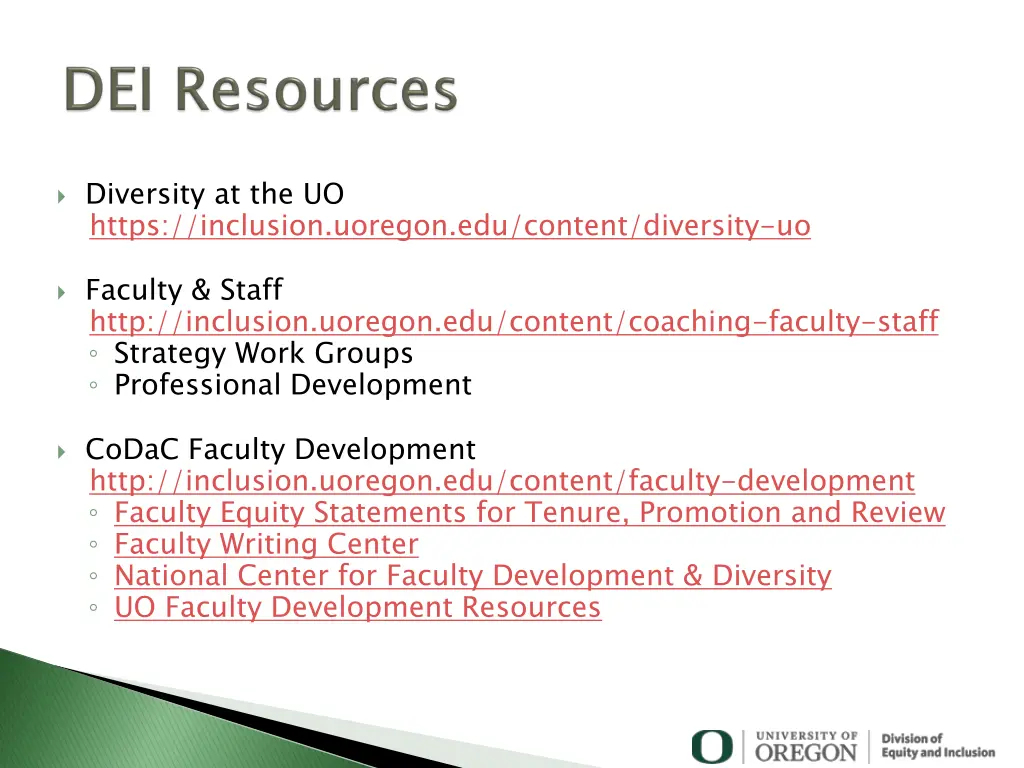
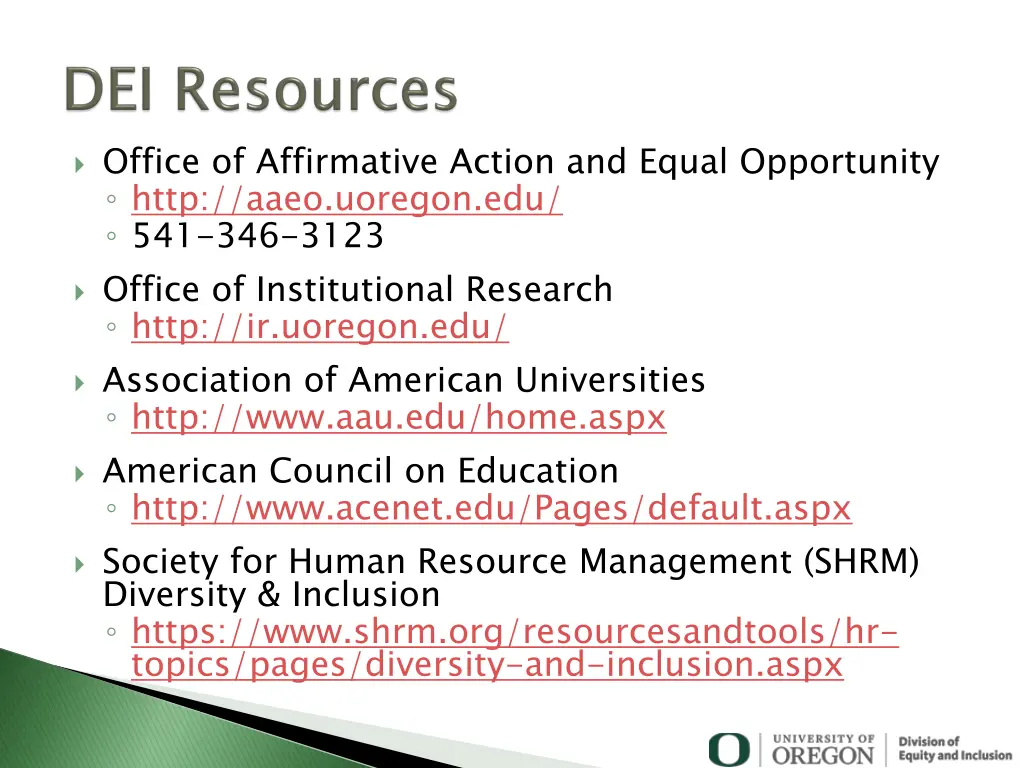
Diversity at the UO https://inclusion.uoregon.edu/content/diversity-uo Faculty & Staff http://inclusion.uoregon.edu/content/coaching-faculty-staff Strategy Work Groups Professional Development CoDaC Faculty Development http://inclusion.uoregon.edu/content/faculty-development Faculty Equity Statements for Tenure, Promotion and Review Faculty Writing Center National Center for Faculty Development & Diversity UO Faculty Development Resources
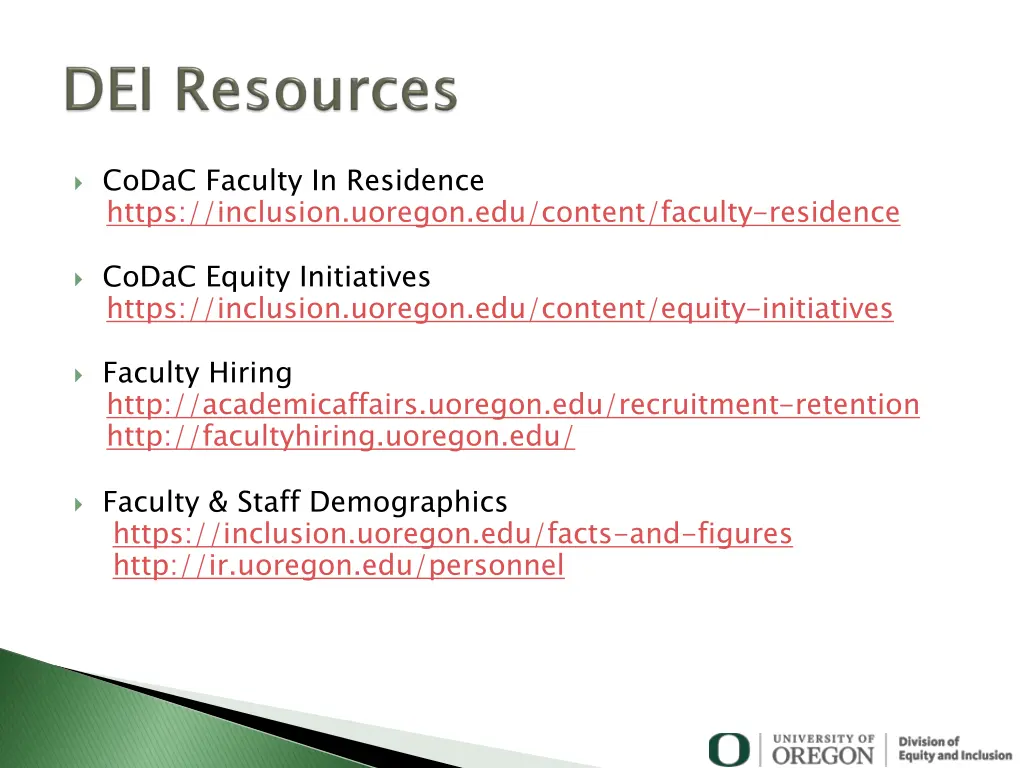
CoDaC Faculty In Residence https://inclusion.uoregon.edu/content/faculty-residence CoDaC Equity Initiatives https://inclusion.uoregon.edu/content/equity-initiatives Faculty Hiring http://academicaffairs.uoregon.edu/recruitment-retention http://facultyhiring.uoregon.edu/ Faculty & Staff Demographics https://inclusion.uoregon.edu/facts-and-figures http://ir.uoregon.edu/personnel
Office of Affirmative Action and Equal Opportunity http://aaeo.uoregon.edu/ 541-346-3123 Office of Institutional Research http://ir.uoregon.edu/ Association of American Universities http://www.aau.edu/home.aspx American Council on Education http://www.acenet.edu/Pages/default.aspx Society for Human Resource Management (SHRM) Diversity & Inclusion https://www.shrm.org/resourcesandtools/hr- topics/pages/diversity-and-inclusion.aspx