Explore a transformative session led by Sherry-Anne McLean on implementing a college-wide integrated approach to math education. Address key questions, roles, and responsibilities to enhance student success. Discover best practices and overcome roadblocks for effective change.
Please find below an Image/Link to download the presentation.
The content on the website is provided AS IS for your information and personal use only. It may not be sold, licensed, or shared on other websites without obtaining consent from the author. If you encounter any issues during the download, it is possible that the publisher has removed the file from their server.
You are allowed to download the files provided on this website for personal or commercial use, subject to the condition that they are used lawfully. All files are the property of their respective owners.
The content on the website is provided AS IS for your information and personal use only. It may not be sold, licensed, or shared on other websites without obtaining consent from the author.
E N D
Presentation Transcript
GETTING EVERYONE IN THE ROOM: Creating a College-Wide Mathematics Experience for Students Sherry-Anne McLean July 24, 2024
SESSION OBJECTIVES During the session we will address the following questions: What would a college-wide integrated approach to math education look like? What steps need to be taken to implement this type of change? What roadblocks should I watch out for? What best practices should I implement? Note: All material licensed under Creative Commons Attribution 4.0 International License.
AUDIENCE QUESTION Who do you consider part of the Mathematics Team at your college? Note: All material licensed under Creative Commons Attribution 4.0 International License.
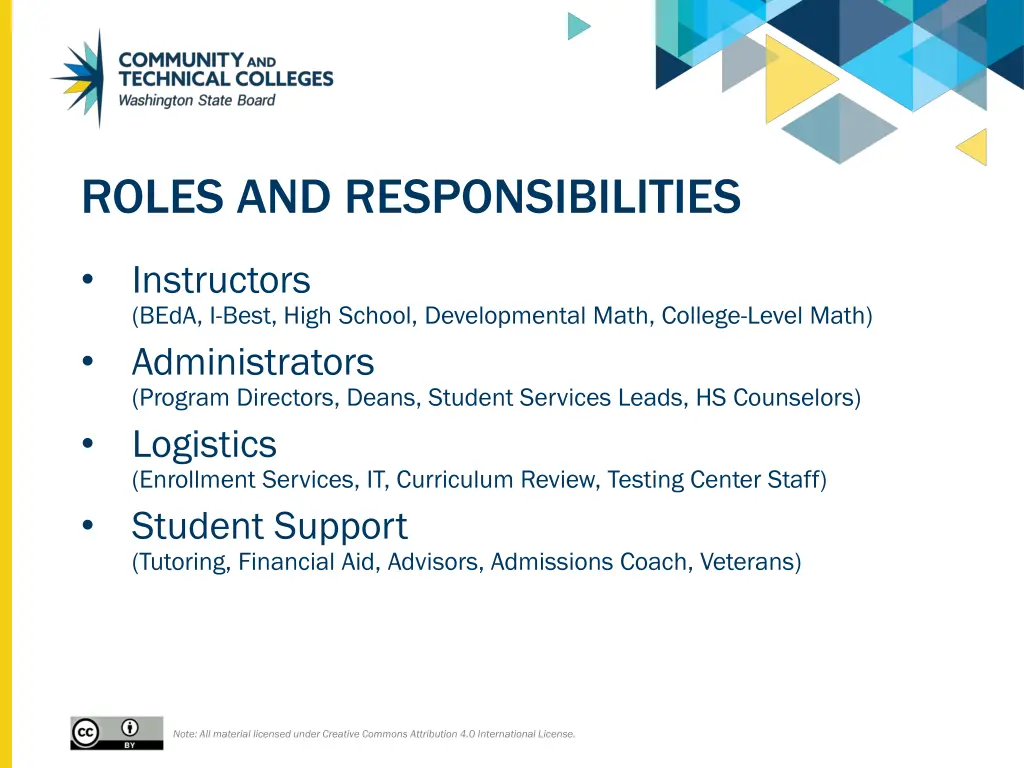
ROLES AND RESPONSIBILITIES Instructors (BEdA, I-Best, High School, Developmental Math, College-Level Math) Administrators (Program Directors, Deans, Student Services Leads, HS Counselors) Logistics (Enrollment Services, IT, Curriculum Review, Testing Center Staff) Student Support (Tutoring, Financial Aid, Advisors, Admissions Coach, Veterans) Note: All material licensed under Creative Commons Attribution 4.0 International License.
AUDIENCE QUESTION What processes do your students go through before registering for a first math class? How different is that intake process for various student populations? Note: All material licensed under Creative Commons Attribution 4.0 International License.
LETS TALK PLACEMENT Single place for all students to start Give credit and recognition for prior learning Guide students to make informed choices Avoid unnecessary math anxiety Plan with the end in mind Keep data analysis in mind when coding placement Note: All material licensed under Creative Commons Attribution 4.0 International License.
SIMPLIFYING THE COURSE MAP Identify (or create) guided pathways (BEdA, high school programs, adult high school, non-STEM pathways, STEM pathways) using existing courses Collect all State/Federal requirements for Funding and Graduation (ELL/CASAS, BEdA, high school diplomas) Match-up length/general skills of pathways Keep paths as short and simple as possible Note: All material licensed under Creative Commons Attribution 4.0 International License.
CONSOLIDATING OBJECTIVES List mandated credits/course outcomes for HS classes to apply to graduation Use Dev-Ed pathways as the compromise course (not as subject to restrictions) Use applications to bridge concepts Geometry is always going to be weird Note: All material licensed under Creative Commons Attribution 4.0 International License.
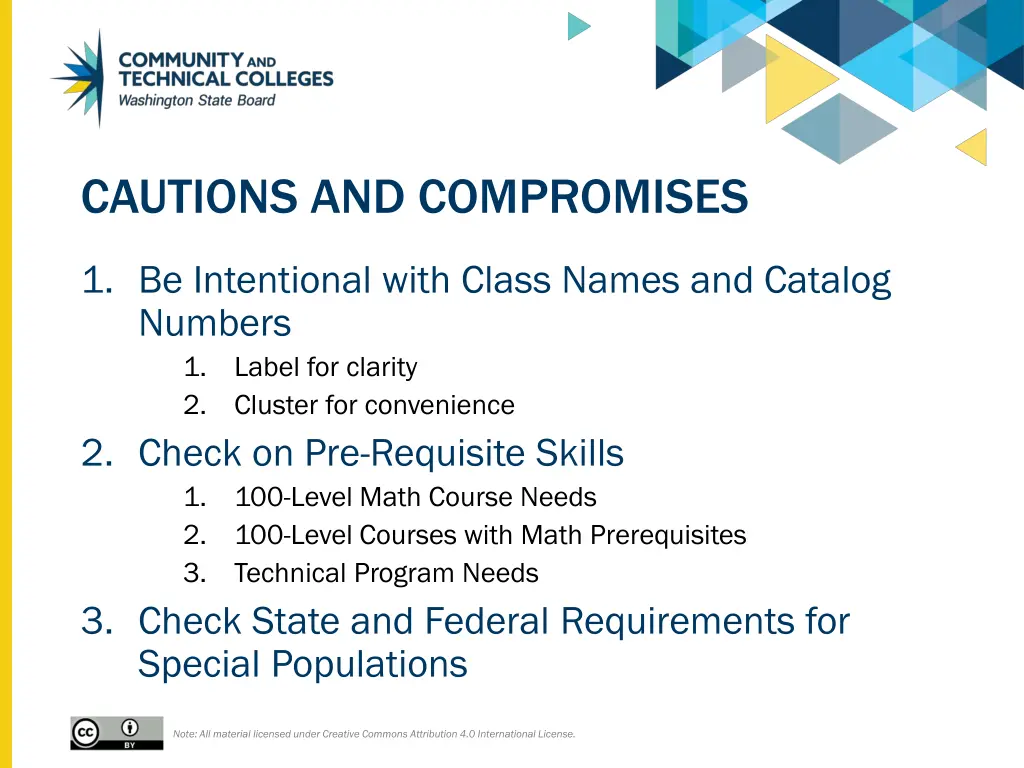
CAUTIONS AND COMPROMISES 1. Be Intentional with Class Names and Catalog Numbers 1. Label for clarity 2. Cluster for convenience 2. Check on Pre-Requisite Skills 1. 100-Level Math Course Needs 2. 100-Level Courses with Math Prerequisites 3. Technical Program Needs 3. Check State and Federal Requirements for Special Populations Note: All material licensed under Creative Commons Attribution 4.0 International License.
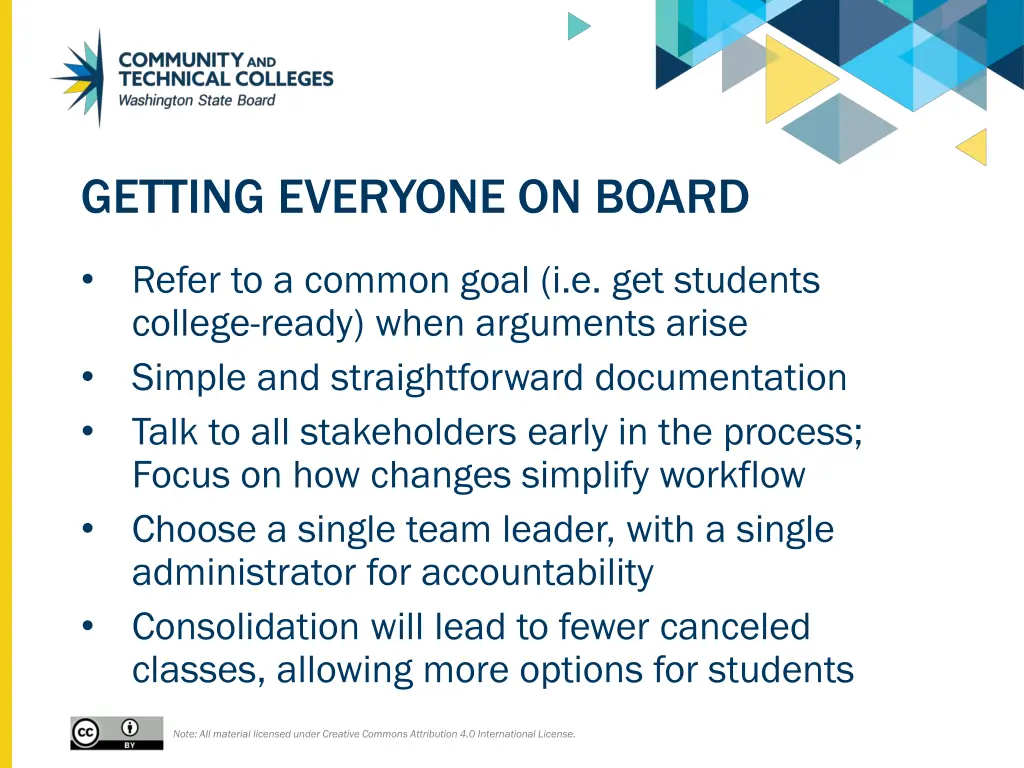
GETTING EVERYONE ON BOARD Refer to a common goal (i.e. get students college-ready) when arguments arise Simple and straightforward documentation Talk to all stakeholders early in the process; Focus on how changes simplify workflow Choose a single team leader, with a single administrator for accountability Consolidation will lead to fewer canceled classes, allowing more options for students Note: All material licensed under Creative Commons Attribution 4.0 International License.
WHAT NOW?!? Chances are you now have a collection of outcomes that don t align with your textbook anymore! This is an opportunity not a nightmare Note: All material licensed under Creative Commons Attribution 4.0 International License.
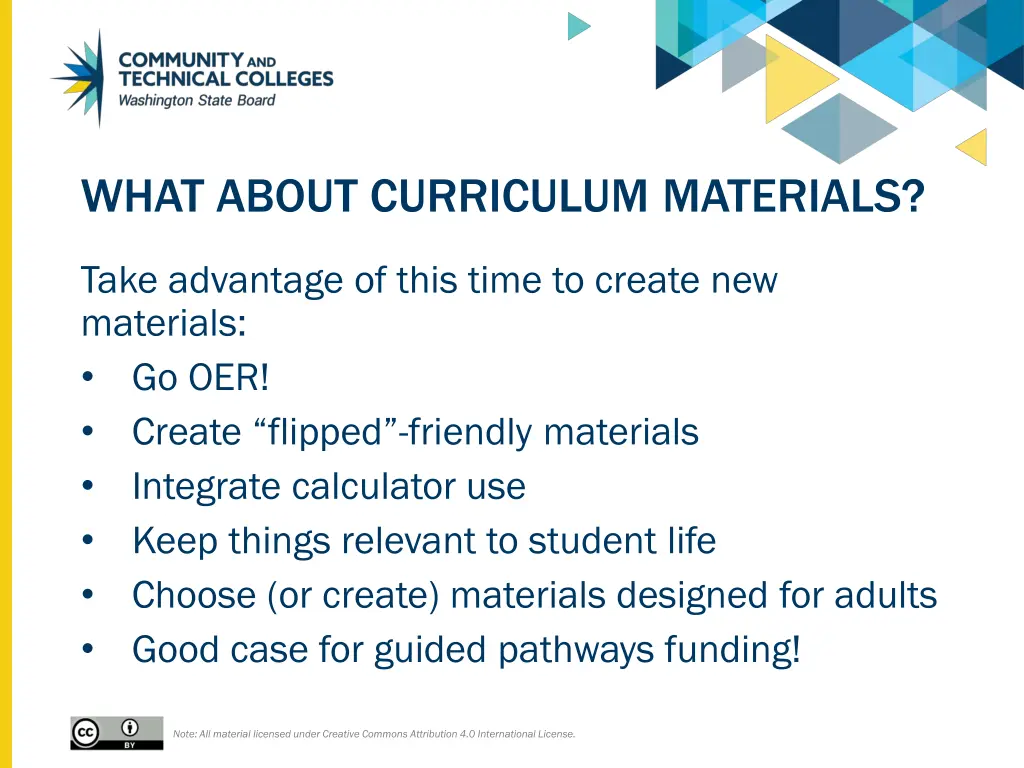
WHAT ABOUT CURRICULUM MATERIALS? Take advantage of this time to create new materials: Go OER! Create flipped -friendly materials Integrate calculator use Keep things relevant to student life Choose (or create) materials designed for adults Good case for guided pathways funding! Note: All material licensed under Creative Commons Attribution 4.0 International License.
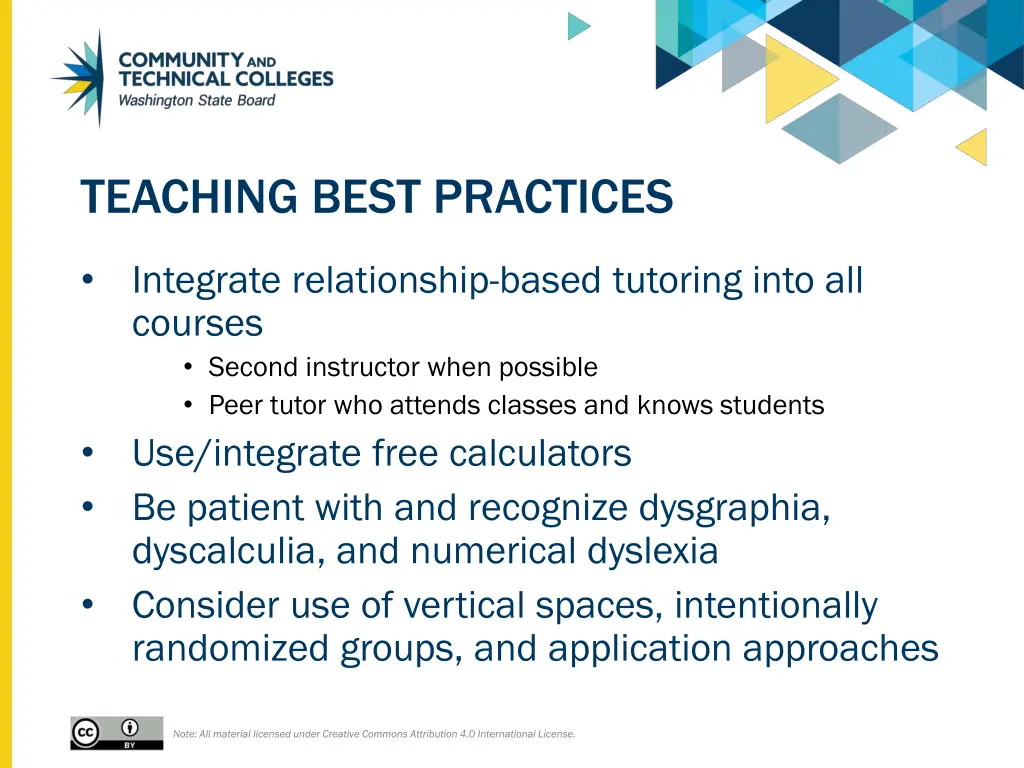
TEACHING BEST PRACTICES Integrate relationship-based tutoring into all courses Second instructor when possible Peer tutor who attends classes and knows students Use/integrate free calculators Be patient with and recognize dysgraphia, dyscalculia, and numerical dyslexia Consider use of vertical spaces, intentionally randomized groups, and application approaches Note: All material licensed under Creative Commons Attribution 4.0 International License.
AUDIENCE QUESTION What other teaching practices, approaches, or techniques have you found to be effective for math students in these populations? Note: All material licensed under Creative Commons Attribution 4.0 International License.
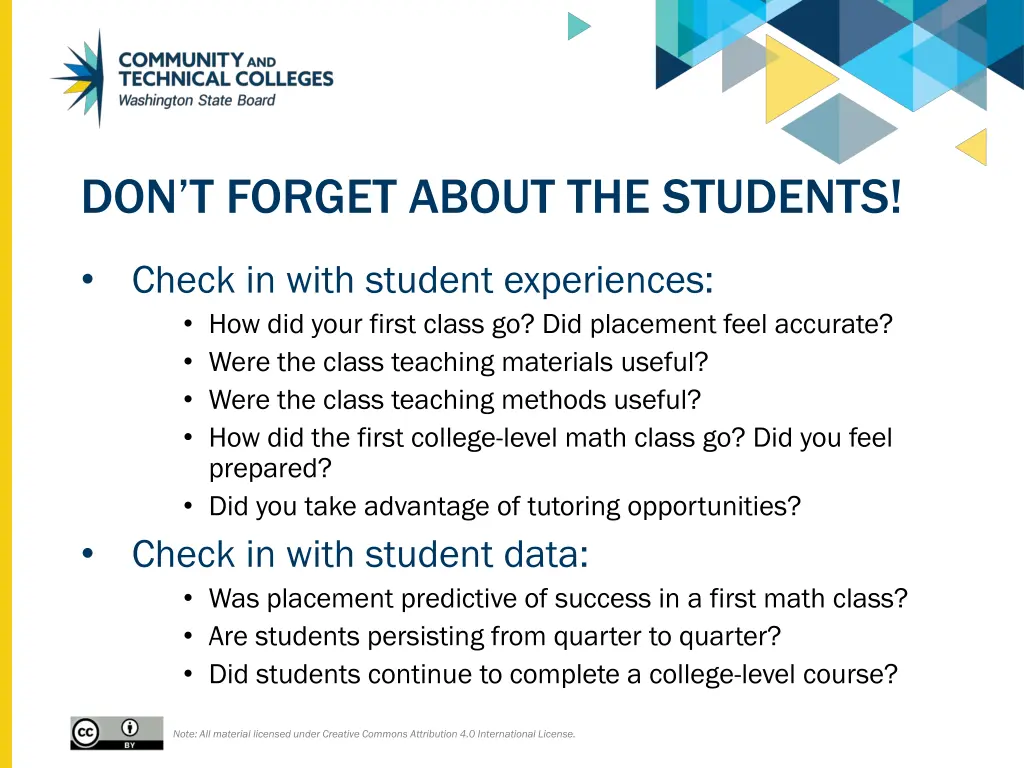
DONT FORGET ABOUT THE STUDENTS! Check in with student experiences: How did your first class go? Did placement feel accurate? Were the class teaching materials useful? Were the class teaching methods useful? How did the first college-level math class go? Did you feel prepared? Did you take advantage of tutoring opportunities? Check in with student data: Was placement predictive of success in a first math class? Are students persisting from quarter to quarter? Did students continue to complete a college-level course? Note: All material licensed under Creative Commons Attribution 4.0 International License.
CONTACT INFORMATION Thank you for attending! Please contact me with any questions. I m always happy to continue the conversation! Sherry-Anne McLean Lake Washington Institute of Technology Mathematics Professor/Faculty Director sherry.mclean@lwtech.edu Note: All material licensed under Creative Commons Attribution 4.0 International License.