Explore the definition, enforcement, independent functions, and models of criminal procedure, delving into the balance between law enforcement and fairness principles. Discover the Crime Control Model and the dual purposes of the Criminal Justice System.
Please find below an Image/Link to download the presentation.
The content on the website is provided AS IS for your information and personal use only. It may not be sold, licensed, or shared on other websites without obtaining consent from the author. If you encounter any issues during the download, it is possible that the publisher has removed the file from their server.
You are allowed to download the files provided on this website for personal or commercial use, subject to the condition that they are used lawfully. All files are the property of their respective owners.
The content on the website is provided AS IS for your information and personal use only. It may not be sold, licensed, or shared on other websites without obtaining consent from the author.
E N D
Presentation Transcript
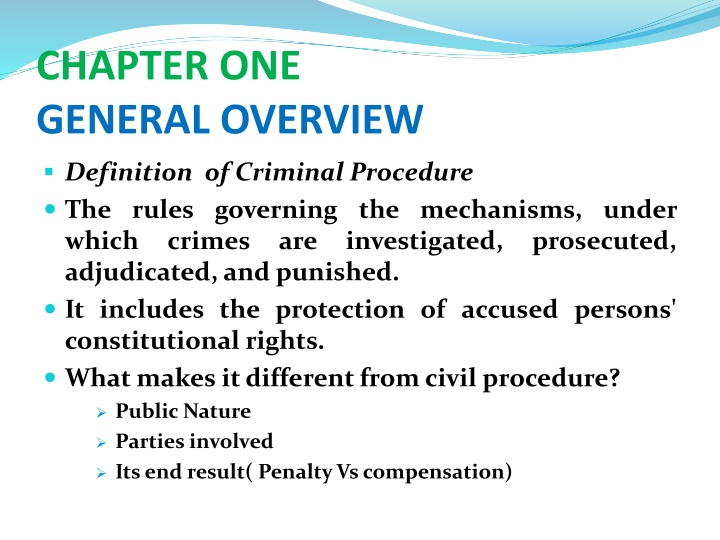
CHAPTER ONE GENERAL OVERVIEW Definition of Criminal Procedure The rules governing the mechanisms, under which crimes are investigated, adjudicated, and punished. It includes the protection of accused persons' constitutional rights. What makes itdifferentfrom civil procedure? prosecuted, Public Nature Parties involved Itsend result( PenaltyVscompensation)
Functions of Criminal procedure 1.Enforcement of the Criminal Law The purpose of the Criminal law is to protect peace, orderand securityof thestate. In order to achieve this, the criminal law prescribeactswhicharepunishable. These punishable acts are meaningless if they are notenforced. Cr. Pr., therefore, Serves asa means to suchends.
2. Independent Functions Allocating poweramong theactors Thepolice The judge The Prosecutor Limiting the Statepower( fairprocess) It also prescribes the rights of the Suspect and thedutiesof theactors. By doing so, it protects the helpless suspect from the mighty forceof thestate.
The Question is? Are the two functions Complementary? For which we should give priority, if not? The enforcement of the substantive law may neglect the fairness process. The fairness principle may harm enforcement of the substantive law. So What? Which must be prioritized? What is the way out?
Models of Criminal Justice Systems Criminal justicesystem hasdual purposes. Protectionof thepublicagainstcriminal harm. Protecting theaccused against unfair treatment. It is not easy to reconcile theses two competing and, at times, conflicting values. A state is expected to strike the balance between the two. But, it is unthinkable toachieveabsolute balance. The balancecould tilt towardsoneovertheother. Depending upon the approach of the state towards the two interests, two models of criminal justice system have been developed. due process model and
The Crime Control Model According to the crime control model priority must be given to the lawenforcementpurposeoverthe fairnesspurpose. Repressionof thecriminal conduct isvery important. The investigation isconducted togetpleaof guilty. Thepoliceshould strivetoextractconfession. Thepoliceplaysacentral role in investigationdueto, Resourcearevery limited. Therearechallenges to the Governmentscase. According to the model Mistake may becommitted while identifying theguilt. Convictionof the innocentperson is notseenasaproblem. It would be better to convict one innocent rather than letting free tenguilty individuals
The due process model The Due process model give priority to the fairness of the proceeding.( independent function) The due process model is distinguished for its emphasis on theavoidanceof convicting innocent. It tolerates the escape of criminals for the sake of not harming innocents. This may affect the public interest as offenders are sent free. Ten guilty men should escape rather than one innocent man should suffer.
Comparing the Two Crime Control Model Due Proceeds Model More repression. Less efficient in repression. efficient in Poorly protect rights Better to protect rights. Poorly bring equality conviction innocent Better to bring equality. More Less conviction of innocent. of Less likely to let the guilty free More likely to let the guilty free.
So What? Herbert Packer The Polarity between the two models is not absolute and that the ideology of one is not the converse of the other and, therefore, it would be wrong tosupportone to theexclusion to theother. Smith Crime control model is concerned with the fundamental goal of the criminal justice system, where as due process is concerned with setting limitto the pursuit of this goal. Therefore due process is not a goal in itself. Awtosh The two models can be reconciled in such manner that crime control is the underlining purpose of the system. But the pursuit of this purpose should bequalified byrespecting thedueprocess.
Systems of Criminal procedure Every state wants to apprehend and adjudicate those who violated thecriminal law. There are two major criminal procedure systems: adversarial and inquisitorial. Their difference lies in the selection of the appropriate procedures and processes prosecutingcriminals. Generally, common law adversarial(accusatorial) and civil law countries inquisitorial approach. Advocates of the adversarial systems of justice believe that the competition between the two parties is the best process for obtaining truth. Advocates of the non-adversarial system believe that judicial control of the investigative process is the best way to uncover the truth. for effectively detecting and systems follow the follow the
Their differences Adversarial Emphasize thescreening phase & Judgesare referee Thedefendantis notexpected to be cooperative. There iswritten and codified evidencelaw They focusonoral evidenceand heavilyallowcrossexamination Onecan beawitness for hiscase Allow hearsay evidence Inquisitorial Emphasize the trial phase, & The Judgesdirectly involve. Thedefendantisexpected ( though notrequired) to cooperate. That cooperation includes supplying information to investigators and answering questionsat trial. Theirevidencerulesarescattered indifferent laws They focusondocumentaryevidence Onecannotawitness forhiscase.
The reality? In reality it is not possible to find a purely adversarial orapurely inquisitorial system. The U.S system a purely adversarial system required the accused to assist the government in the truth finding process No jurisdiction with an inquestoral system expressly authorize compulsoryself incrimination. In practice, therefore, the question is not whether the criminal justice system inquisitorial rather it is whether it is more of one of theother. is an adversarial or
The reality.. John Merryman. In a sense, it can be said that the evaluation of criminal procedure in the last two centuries in the civil law world has been away from the extremes and abuses of the inquisitorial system, and that the evolution in the common law world during the same period has been away from the abuses and excesses of the adversarial system. The two systems, in other words, are converging from different directions equivalent mixed systems of criminal procedure. toward roughly
The reality Besides, it is mistaken to conclude that one is apt to favorsuspectsoraccused and theothersociety. Each system has mechanisms to strike a balance between the interestof individuals and the public. The efficiency and effectiveness of a system has to be seenonacase bycase basis. Ascertaining the system opted by a country is not simple. The laws and practices of the justice sectors have to be explored. It also depends on the resource we allocate for investigation.
What about Ethiopia? Ethiopia seems also to follow the mix of both Our substantive laws seems to derived from the continental legal system The procedural laws are mainly from the common law legal system. So we can say that Ethiopia criminal system is the mix of both criminal justice systems.
Fundamental Principles of Criminal Procedure. The fundamental principles encountered in a modern criminal justice presumption of innocence, freedom from self- incrimination, fair trial, speedy trial, public trial, the right to defense counsel, equality, legality, ruleof law, dueprocessof law, etc. These are universal values to be incorporated in any modern criminal justice system. They are also partof the UDHR and ICCPR. system include
Presumption of innocence It requires agents of the state to treat a suspect or defendant in the criminal process as if he were in fact innocent. It applies only to agents of the state, and only during thecriminal process. It does not determine the amount of evidence necessary to find adefendantguilty. It protects suspects and defendants from specific dangers inherent in thecriminal process.
Freedom from self-incrimination The privilege against self-incrimination confers immunity from an information tending toproveone sownguilt. A person is not bound to answer any question or produce any document or thing if that material would have a tendency to expose that person to conviction foracrime. obligation to provide
Fair Trial This principle dictates that criminal trails be fair to both contesting parties. Both parties must have theopportunityto Be heard in thecriminal Proceeding Presenttheirevidence, Cross examine theiropposing parties. Especially this principle dictates that the suspect rights must be respected from the mighty force of the government in using the rights stated here in above.
Speedy trial Once a person is suspected to have committed a certain crime, there is a public interest in ascertaining the validity of the suspicion with out an necessary delay. This is commonly referred to as the right to speedy trail. The speedy completion of a criminal proceeding is justified bysubstantiveand procedural grounds. The completion of the unnecessary delay serves both the public as well as the individual suspected interest. Speedy trail allows the convicted to be punished promptly proceeding without
Public Trial This principle calls for the trail to be conducted publicly in thepresenceof all the interested groups. Publicity gives an opportunity to the public to check whether the court is satisfied judgesand functions impartiallyand independently. It makes the judges conduct their business carefully. Publicity of the hearing ensures the transparency of the proceeding and thus provides an important safeguard for the interest of the individual and of the societyat large. with the competent
The right to defense counsel This consulta lawyerto theaccused. Where the interest of justice so requires accused has theright toassigned legal assistance. If he find a lawyer himself and covers the expense, he isalways free todoso But when the accused is not in the position even to find a lawyer, the state has a duty to find one of him where the interestof the justiceso requires. principle facilitate the opportunity to the
Equality & legality Criminal discrimination based on persons, social conditions, race, nation, nationality, social origin, colour, sex, language, religion, political property, birthorotherstatus. Criminal law specifies the various crimes, and the penaltiesand measures applicable tocriminals. The Court cannot treat as a crime and punish any act oromission which is not prohibited by law. The Court cannot impose penalties or measures other than thoseprescribed by law. The Courtcannotcreatecrimes byanalogy. law applies to all alike without or other opinion,
Due process of law Pursuant to this principle every thing must be conducted according to the established laws and procedures. Substantive due process refers to the content or subject matter of a law. It protects people against unreasonable and arbitrary laws or acts of government. Procedural due process is concerned with the procedures that are required before the life, liberty, or property of a person may be taken by the government. Procedural due process requires the following: Notice of the proceedings A hearing Opportunity to present defense An impartial tribunal An atmosphere of fairness
CHAPTER TWO Setting Justice in Motion: Starting Investigation and Prosecution. Setting Justice in Motion in the Criminal procedure refers to making the justice machinery start operating with respect toaparticularoffence.( Art 11, 13,19,20,21 Cr. Pr.) So the justice will be set in motion when citizens report a criminal acts to the police. Sucha reportcould bearightorduty.(Art 11) Under normal circumstance reporting isaright. There are times when reporting following provisionsof the Criminal Code. Art. 254( crimesagainsttheconstitutionalorder) Art. 335 ( Crimeof mutiny) Art.443(Any crime punishable impressments for life.) is a duty as per the by death or rigorous
The question is Art. 11 of the Cr. Pr. impose a duty to report while Art. 446& 447 of the Cr.co. criminalize falseaccusation. Then Howsuch conflictwill besolved? Art. 446& 447 of the Cr. Co. punishable foronly intentional falseaccusations. Therefore, if citizens report to the police in the absence of intended false accusations, they will not be punished. The Justicewill beset in motion in threeways Formal Complaint Accusation Flagrantoffences And Art.18 Cr. Pr. are
Formal Complaint(Art13) These are offences punishable only when the victim or his relatives lodgecomplaint to the police. Such offences are considered not against the wider public interest( Defamation, intimidation, Insulting and etc.) For such provisions the Cr. Co. itself says that they are punishable upon formal complaint. Can the parties stop once the investigation started by their agreement? The period of limitations for such offences is Three month and in noway thevictim lodgecomplaint aftertwoyears.
Accusations For all cases which are out of the Private interests the justice is set in motion when the accusation is logged before a police officer or when the police officer or any other individual witnessed a flagrantoffences. Art 11.accusation in general Art.12. anonymousaccusation Art 15. accusationagainstunknownoffender
Flagrant Offences( Art.19 & 20) 1. Flagrant offences.( Art.19(1) The normal case of flagrant offence will happen when the offender is found Committing Attempting to commit the offence or Has just committed the offence. 2. Quasi-flagrant Art (2) The offender who has escaped is being chased by witnesses or When a hue and cry has been raised. 3. Assimilated cases.( Art. 20) The police are immediately called to the place where the offence has been committed; or A cry for help has been raised from the place where the offence is being or has been committed.
Accusation unnecessary( Art 21) When the offence is flagrant accusation is not necessary toset the justice in motion. But when the flagrant offence is punishable upon formal complaint the victim must first lodge the complaint. Even any individual witnessing the commission of the offence could arrest the suspect with out warrant in thecaseof flagrantoffence.
Duty to Investigate Whenever the police know or suspect that an offence has been committed, they shall proceed to investigate .( Art. 22) Investigating police officers shall carry out their duties notwithstanding that they are of opinion that the accusation, complaint or information they may have received isopen todoubt. (Art. 23)
Recording of Statement (Art. 24.) After having recorded an accusation or complaint in the manner laid down in Art. 14,the investigating police officer shall elicit from the person making the accusation or complaint all relevant facts and dates, the nameordescription of theoffender. The names and addresses of principal witnesses and all other evidence which may be available and be recorded. Where the investigating police officer has reason to believe that a person has committed an offence, be may by written-summons require such person to appear before him. (Art. 25.)
Procedure after arrest( Art 29& 30) The police shall bring him before the nearest court within forty-eight hoursof hisarrest. The time taken in the journey to the court shall not be included. Thecourt may makeanyorderit thinks fit. The investigating police officer may, where necessary, summon and examine any person likely to give information. Such a person shall be bound to answer truthfully all questions put to him. He may refuse to answer any question the answer to which would have a tendency to expose him to a criminal charge
Diary& report of investigation Investigation diaryshall have( Art 36) Thedayonwhich hestarted and closed his investigation All thesteps taken in thecourseof the investigation Thecircumstances which the investigation disclosed All the meansof evidencewhich may have beencollected. Anyorderreceived fromacourtorthepublic prosecutor. The investigation shall be completed without unnecessary delay. The investigating report shall have( Art37) The nameof the parties; The natureof the information; The names of all persons who appear to be acquainted with the case; All evidencewhich have beencollected.
Arrest ( Art.26 & 49) Where the accused or the suspect has not been arrested and the offence is such as to justify arrest or where the person summoned under Art. 25 fails to appear, the investigating police officer shall take such steps as are necessary to effect his arrest. Where the arrest cannot be made without warrant, the investigating police officer shall apply to the court for a warrant of arrest in accordancewith the provisionsof Art. 53.
Substantive requirement for Arrest For the liberty of a person to be restricted there is certain level of suspicion that the Cr. Pr. Co and otherrelevant laws require. The central requirement for all arrest with or with out warrant is the existence of reasonable suspicion or having a reason to believe that a person to be arrested commissionof acrime to be investigated. has evolved in the
Objective or Subjective criteria? UnderArt.51(1)a of the cr.prand Art. 19 of the Anti- terrorism proclamation officer must believe that the person to be arrested hascommitted acrime. This issubjectivecriteria. In Art. 25 and 51(1) e, g &h of the Cr. Pr. Co. and Art 6(1) of the Vagrancy control proclamation the suspicion or believe that a person has committed a crime must be reasonable. This is an objective criteria. the arresting police
Procedural requirements Arrestcould be madeeitherwith orwithoutwarrant. Under normal circumstances a suspect is to be arrested with priorauthorization bycourt. (Art. 49) Arrestasarestriction to the right to liberty. Arrestas theexception to theright to liberty Arrestwithoutwarrantasexception to theexception. No one will be deprived of his or her liberty except. (Art 17 FDRE constitution) On procedureas established by law. Achargeorconvictionagainst him.
Arrest With Warrant Arrest with warrant is required when two conditions are fulfilled( Art 54) Theattendanceof aperson isabsolutely necessary There is no anotheroption. Itwould be absolutely necessary for Interrogation Physical examination Forensic investigation There is no other options if the available options are exhausted such as arresting through summon and other peace full submissions. The problem of Article 54 is that it takes the attendance of the accused before the court rather than before the Investigative police.
Arrest Without Warrant A police may arrest a suspect in two ways without warrant By issuing a summon(Art.25) By going directly to the place where the suspect is found.( art.56) Arrest with summon( Art. 25 & 54) The police may by written-summons require the suspect toappear before him. Thereason forsummon is toarrest thesuspect. appears he his treated as an arrested person. Once a person
Arrest without summon Flagrant offences( Art 21(2) and Art. 50 The two requirement that must be fulfilled in addition to flagrancy are: Non complaint offences Punishable for not less than three months Non- Flagrant cases when the police has a reason to believe that the offender has committed an offence stated in Art.51(1) Cr. Pr. Art.19(1) of the anti terrorism proclamation Art.6(1) of the Vagrancy Control Proclamation.
Effecting Arrest( Art 56) The police officer making an arrest shall first establish the identityof theperson to bearrested. Where the arrest is made with a warrant the officer shall, Read out thewarranttotheperson to bearrested and Show it tothepersonarrested if hesorequests. Actually touch or confine the body of the suspect if there nosubmission. Use proportionate forcetoeffectthearrest if resisted. The problem of this article is that it assumes that the police is theonlypersonempowered toarrest.
Release on bond by the investigating police(Art.28) The investigating police officer can relies the suspect on bond if The offence is not punishable with rigorous imprisonment as a soleoralternativepunishment. It isdoubtful thatanoffence has been committed or It is doubtful that the summoned or arrested person has committed theoffence. The same conditions are laid in Art.4(2) Of Anti corruption special rules of evidence proclamation( pro 434/ 235. If not thesuspectcanapply to thecourt asper Art. 64. But what if the police officer is fully convinced that the suspect did not commit the said offence? Can he release unconditionally?
Right of Persons Arrested The Rights of Arrested Person( Art.19 of the FDRE Co.) The right to be informed the reasons for their arrest. The right to remain silent and to be informed that. The right to be brought before a court within 48 hrs. The right to petition to order their physical release Not be compelled to make confessions. Be released on bail except some case . This rights have also been recognized in ICCPR Art. 9(1)
Interrogation A person is arrested when he is reasonably suspected to havecommitted acrime. One of the reason for arresting a suspect is to obtainevidence from him. The most common means of obtaining evidence from thesuspect is interrogation. After that the police is directed to extracting confession. Confession is considered the queen of evidence if givenvoluntarilyand Legally.
Interrogation by the police( Art.27) Any person summoned will be asked to answer theaccusationorcomplaint. He has the right. Not becompelled toanswer Be informed that he has theright not toanswer the statement evidence. Be informed that will be used as besupplied withacompetentinterpreter. Anystatement will berecorded.
Confession or statement in court ( Art.35) Anycourt mayrecord aconfession madeto it Such record mustonly be madevoluntarily. A noteto thiseffectshall be madeon it. It must be recorded, read ,signed and dated. Itshall besigned by the presidentof thecourt.
The Question is? What is the suspect deny before a court what he admitted in interrogation? Then can we only use the confession of the suspectasevidence? What is the experience of different states in this regard? Whatabout thedraftevidencerule?
The supreme court cases P/Prosecutor Vs Tamratlayne et al(F.N 001/1989) In this case the accused persons were charged with corruption and otherrelated crimes. Among the evidence presented there existed a statement of confession made to thepolice. The defense lawyers raised that confession made to the police is not admissible under the Ethiopian law. The court rejected the objection saying that there is no clear cut law that prohibit the confession made to police and there is procedural as well as constitutional provisions which support the
P/Prosecutor Vs Leykun (A.N.6359/1994 The Suspect denied before the court what he confessed to the police but the p/prosecutor corroborated byotherevidence. The supreme court convicted the accused saying The accused simply changed his mind and there is also additional evidence.













![Briefing on the Criminal Procedure Amendment Bill [B12-2021] to the Portfolio Committee on Justice and Correctional Services](/thumb/157093/briefing-on-the-criminal-procedure-amendment-bill-b12-2021-to-the-portfolio-committee-on-justice-and-correctional-services.jpg)