Disaster management involves delineating roles and responsibilities to avoid duplication and contradictions among stakeholders. This includes addressing natural and man-made disasters in Nigeria, such as flooding, terrorism, and accidents. Dr. Daramola is a key consultant specializing in behavioral medicine at Karu District Hospital in Abuja, contributing to disaster response efforts. The text also covers definitions, models, and local situations relevant to effective disaster management.
Please find below an Image/Link to download the presentation.
The content on the website is provided AS IS for your information and personal use only. It may not be sold, licensed, or shared on other websites without obtaining consent from the author. If you encounter any issues during the download, it is possible that the publisher has removed the file from their server.
You are allowed to download the files provided on this website for personal or commercial use, subject to the condition that they are used lawfully. All files are the property of their respective owners.
The content on the website is provided AS IS for your information and personal use only. It may not be sold, licensed, or shared on other websites without obtaining consent from the author.
E N D
Presentation Transcript
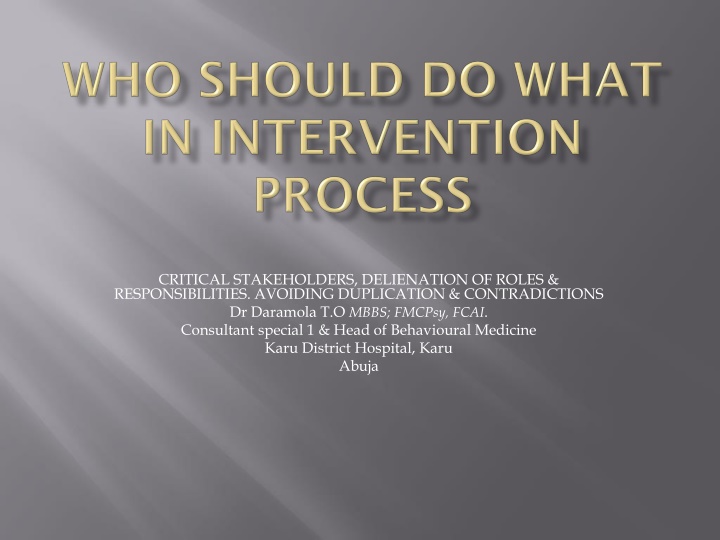
CRITICAL STAKEHOLDERS, DELIENATION OF ROLES & RESPONSIBILITIES. AVOIDING DUPLICATION & CONTRADICTIONS Dr Daramola T.O MBBS; FMCPsy, FCAI. Consultant special 1 & Head of Behavioural Medicine Karu District Hospital, Karu Abuja
INTRODUCTION DEFINITIONS DISASTERS MANAGEMENT MODELS LOCAL SITUATION WORKABLE MODEL DESIRABLES
Disaster is a worldwide occurence Could be natural or man-made In Nigeria = Flooding, drought (natural). Terrorism, pipeline transportation structural fires. Includes Ogunpa flood- Aug 31,1980 about 300 csualties (Tomori N.D); Maitatsine riot Dec 18, 1980, about 4000 casualties (Danjibo 2009); Bagauda dam break in Kano, Aug 1988 with about 148 casualties (Etuonovbe 2011); Jesse oil pipeline explosion of Oct 17, 1998 with about 1000 deaths (ERA 1998, Onuoha 2009) explosions, Ethno-religious road & air accidents, conflicts,
Oviri court fire of July 10, 2000 due to pipeline vandalisation in Delta with about 300 deaths (Onuoah 2009). Military cantonment bomb explosions of Jan 27, 2002 in Ikeja with over 800 deaths (Akpabio & Alao 2002) Bellview airline Boeing 737 crash in Lisa village Ogun state with 117 deaths in 2005 Sosoliso airlines DC 9 crash of Dec 10, 2005 in PH killing all 103 people on board. Others include Abule-Egba fire 2006, Abeokuta flood 2007 Boko Haram riots of July 25-30,2009 with over 700 deaths (Nwankwo & Falola 2009) Boko Haram bombings of UN headquarters, North-East, Nyanya motor park, EMAB plaza, & more recently Kuje market & Nyanya bombings
Disaster- noun, an unexpected event such as a very bad accident , a flood or a fire that kills a lot of people or causes a lot of damage. Syn catastrophe. Also air disaster, environmental disaster. (Oxford Dictionary, International New 8thedition) Disaster n,1 a great or sudden misfortune, 2 a complete failure (Illustrated Oxford Dictionary Revised & updated 2003) Advanced student s Learner s edition,
Medical specialisation serving dual areas of healthcare to disaster survivors & providing medically related disaster preparation, disaster planning, disaster response & disaster recovery leadership throughout the disaster life cycle. In the USA, there s specialist training in Disaster medicine with Board certification. National Disaster Medical Systems was formed in the 1980s.
Provision of healthcare services by healthcare professionals to disaster survivors & responders both in disaster impact area & healthcare receiving facilities. Disaster Behavioural capability of disaster optimally & survivors to maintain or rapidly restore functions during threat or actual impact of disaster or extreme events. Medical contingency planning act of devising methodology of meeting medical requirements of affected population Health responders Deals to with perform
Disaster planning Devising methodology of dealing with disaster Disaster preparation Practicing & implementation of disaster programmes before occurrence . Disaster response Ability to answer to intense challenge of disaster. Disaster recovery Restoration or return to former or better pre disaster condition Disaster law Legal aspect of disaster management from planning to recovery. Disaster life cycle Interphase to recovery wikipedia
Disaster mgt roles & responsibilities saddled with council primarily to coordinate & manage disaster emergency events within the region with support from state government Responsibilities Establish local disaster management group Develop & approve local disaster management plan Ensure capability to respond if event occur Develop thorough approach to disaster mgt via Prevention/Preparation/Response/Recovery. Lead & enable local recovery
3 levels To ensure safety of community & To preserve lives, livelihood & environment. Local Disaster Management Group (LMDG) reviews plan annually. Local District State Attorney General department & Federal Government crisis coordination centre coordinates at Federal level
Consistency of disaster mgt/ operations with state s policy framework. Develop effective disaster mgt with regular review & assessment of disaster mgt. Help to draw local disaster management plan for local government. Identify & provide advice to relevant district group about support services required to enhance disaster mgt & operations. Ensure community awareness adverse effects of events, prepare for, respond to & recover from an event for mitigating
Manage policies Report to & make recommendations to relevant authourities, Identify & coordinate disaster mgt resources in area. Establish & review communication systems in group & with relevant agencies / collaborators. Prompt communication of information to relevant district group Function incidental to function mentioned above disaster operations under stipulated
Includes Mayor (Chair), Dep mayor, council members, key personnel from council emergency operations team, advisers/ reps from key agencies such as emergency mgt of Queensland, Police, Ambulance services, Fire & rescue services, Dept of main roads, Community services, Dept of main roads, Community services, /Wildlife, Energex, Live Telestra, Water cooperation, Radio, Airport. LDMG meets 4ice / year timed with cognisance of higher risk period. Health, Parks savers association,
Provides whole of govt planning. Coordinates resources to support local govts. Chaired by Senior Police Officer (District Disaster Coordinator). FUNCTIONS Develop district disaster mgt plan Identify usable resources Plan allocation & coordination of identified resources
Disaster management in Nigeria is defined as the coordination & integration of all activities necessary to build, sustain, capability to prepare for, protect against, respond to & recover from threatening or actual natural or human induced disasters (NDMF 2010 p1) Organised disaster mgt in Nigeria dates back to 1906 when Fire Brigade was charged with the responsibility of battling protecting properties & responding to disasters (NDMF 2010) & improve the fires, saving lives,
Function initially ad-hoc & housed in offices of Head of State & State Governors (NDMF 2010) 1976 National Emergency Relief Agency (NERA) in response to drought b/w 1972-1973 1990 Inter-ministerial body to develop ways to reduce natural disaster risks in line with UN international decade for Natural Disaster Reduction (NMDF 2010). 1993 Decree 119 hence scope of NERA expanded to all types of disaster & independence of NERA under the office of the president. (NMDF 2010)
Developed in 2010 to offer holistic approach to managing disasters Participation from wide array of players including Federal, State, & Local govt, CSOs, Private sector organisation. Ensures efficient & effective disaster mgt for govt officials, community leaders, private organisations, CSOs & practitioners. Defines roles & responsibilities management stakeholders. Clear indication of paradigm shift from response & recovery to other phases of disaster mgt (NDMF 2010) of disaster
NEMA Lead agency for disaster management at Federal level with 6 zonal offices (Fagbemi 2011). Established in March 1999 via act 50 SEMA & LEMA at respectively. All 3 charged with responsibility of developing capabilities to prepare, prevent, respond to, & recover from disasters. Others include but not limited to Military, Police, Para-military, & CSOs also disaster response units (NDMF 2010) state and local levels
1stresponders are community institutions such as CBOs, FBOs, NGOs complemented by Emergency Management Volunteers (EMV). More resources from SEMA & NEMA. Challenges include inadequate disaster education, difference in EM structure at state level, lack of collaboration among different levels of govt, corruption. Currently, only 22 states have SEMA backed by law. About 6 Nigerian Universities have dev curricula in risk reduction with Masters in risk mgt. Fagbemi 2011) inadequate funding,
Emergency mechanism of Federal response assistance. 12 in number. Each ESF headed by a primary agency selected based on its authorities, resources & capabilities Other agencies designated as support agencies for 1 or more ESF based on their resources & capabilities Assistance to states via Federal Coordinating officer appointed by FEMA director on behalf of the president who assistance programmes. support functions form primary coordinates all federal
Transportation (Civilian & Military) Dept of Transp Communications National comm systems Public works & engineering Army Engineering corp Fire fighting US Forest service Information & planning - FEMA Mass care resource support Red Cross / NGOs Resource support equipmt,mate, ss,personnel (GAS) Health & Medical services - HHS Urban search and rescue - FEMA Hazardous materials EPA Food =food needs & supply Dept Agric, Food & Nutrition service Energy Dept of Energy
Large agencies Material relief / rescue ops Reconstruction & medical / financial aid Small & localised NGOs Rescue / material relief with support organisations & international aid agencies. Minimal involvement in mitigation activities by NGOs Smaller NGOs revert to their pre-disaster programmes from large relief
More coordinated & just distribution of relief materials Capacity to involve larger no of volunteers esp from community More effective disaster & post disaster medical relief & health services Large participation of community in planning / implementation of relief & reconstruction activities ( people s participation)
Deliberate effort at disaster risk reduction strategies. Reinvigoration of collaborative efforts with important & relevant stakeholders as a priority. Registration of NGOs, CSOs, FBOs, CBOs interested in disaster risk reduction. Adequate education programmes Adequate leverage on available resources human, financial, expertise & collaborations & poverty reduction
Integration of risk reduction measures into National plan Increased collaboration with developed nations in areas of training of personnel and other required assistance in disaster prevention, planning, & management Leadership by Disaster Management Expert preferably a Specialist in Disaster Medicine.