Explore the origins and key thinkers of Critical Theory, its pivotal texts, the breakaway from early theories, and central arguments emphasizing the critique of authoritarianism and mass culture. Discover how Critical Theory challenges societal norms and beliefs, paving the way for a deeper understanding of power dynamics and social structures in today's world.
Please find below an Image/Link to download the presentation.
The content on the website is provided AS IS for your information and personal use only. It may not be sold, licensed, or shared on other websites without obtaining consent from the author. If you encounter any issues during the download, it is possible that the publisher has removed the file from their server.
You are allowed to download the files provided on this website for personal or commercial use, subject to the condition that they are used lawfully. All files are the property of their respective owners.
The content on the website is provided AS IS for your information and personal use only. It may not be sold, licensed, or shared on other websites without obtaining consent from the author.
E N D
Presentation Transcript
CRITICAL THEORY ( FOR SEM 5CBCS) NIBEDITA BAYEN ASSISTANT PROFESSOR P.R.THAKUR GOVT. COLLEGE
HISTORY OF GENESIS 1923 Established Political and intellectual origin Russian Revolution and other Revolutions occurred during the first half of the twentieth century took refuge in USA crisis in theory based on the political failures of socialist movements and a need to reformulate the practical political aspect of working-class movements
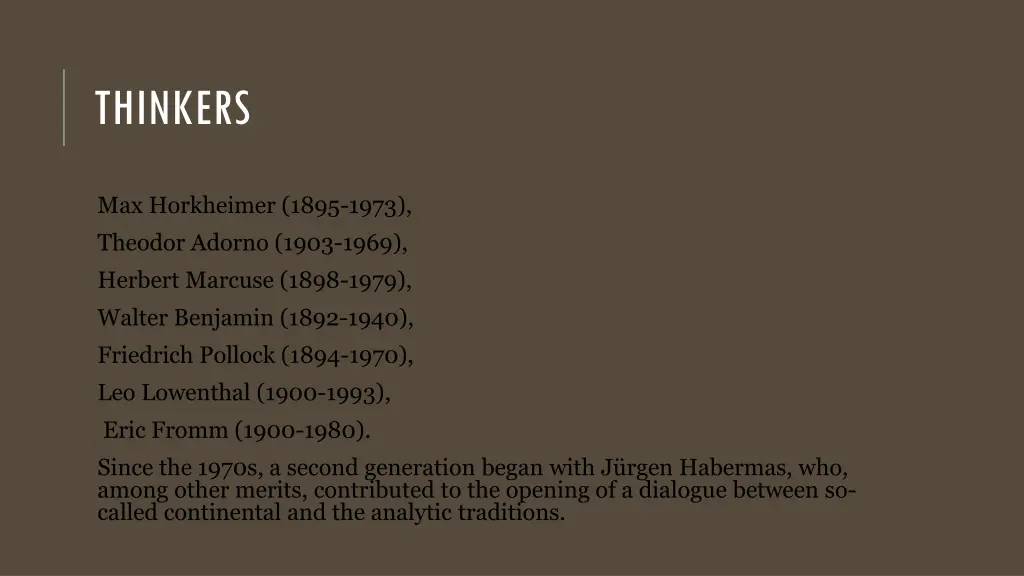
THINKERS Max Horkheimer (1895-1973), Theodor Adorno (1903-1969), Herbert Marcuse (1898-1979), Walter Benjamin (1892-1940), Friedrich Pollock (1894-1970), Leo Lowenthal (1900-1993), Eric Fromm (1900-1980). Since the 1970s, a second generation began with J rgen Habermas, who, among other merits, contributed to the opening of a dialogue between so- called continental and the analytic traditions.
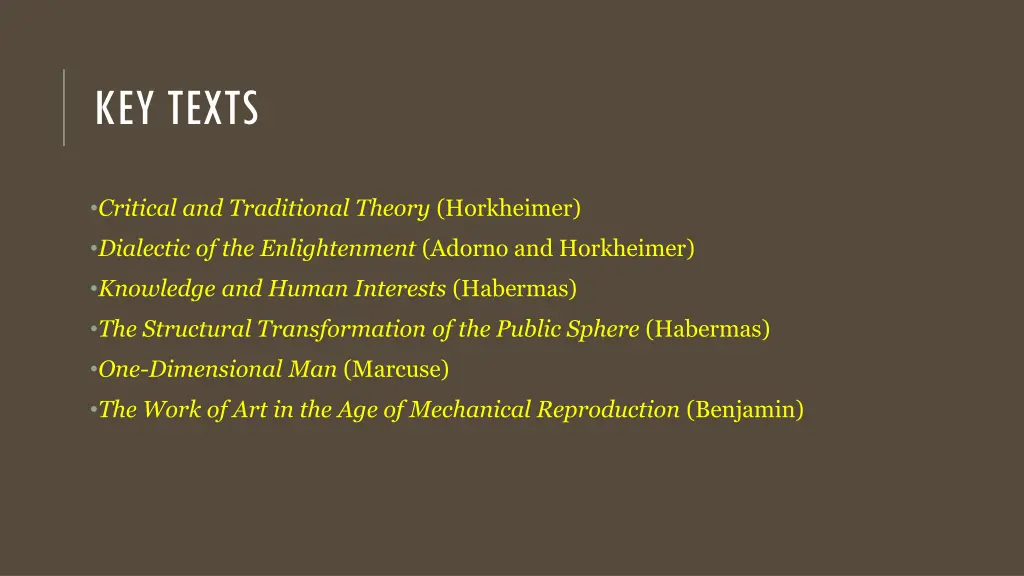
KEY TEXTS Critical and Traditional Theory (Horkheimer) Dialectic of the Enlightenment (Adorno and Horkheimer) Knowledge and Human Interests (Habermas) The Structural Transformation of the Public Sphere (Habermas) One-Dimensional Man (Marcuse) The Work of Art in the Age of Mechanical Reproduction (Benjamin)
WHAT IS CRITICAL THEORY Breakaway from early theory ? Macro theory Borrowed from early theories ? Rest upon certain part of theories that are dominant part of modern societies from 18thcentury to twentieth century , different situation/context Critical of ideas of economic determinism Role of workers Totalitarianism and its manifestation in Nazism and communism Capitalist mass culture
CENTRAL ARGUMENTS OF CRITICAL THINKERS Theories in a particular manner Political-social cultural background What prompt common people accept authoritarian regime Readily accept totalitarianism Not just question of power and coercion force and fear but people believe these are good for society This engagement with large section of people with such practices Freudian psychoanalysis
CENTRAL TO CRITICAL THINKERS Development in western Europe and great deal of affluence in USA Will people be more free in such society People have all good thinks in terms of consumption, livelihood , lifestyle Broader question of what is freedom , individual autonomy, individual choice , individual sovereignty Not delving in more critical question or philosophy Involved in understanding coercion and consent Culture industry developed to create culture of consent People did not find any reason to rebel, question and dissect
RELEVANCE OF MARXIAN THEORY IN CRITICAL SCHOOL Critical school tried to explain affluent society of twentieth century but not the society with poverty and question of freedom Need to go back to the concepts of consciousness and ideology Idealist Perspective : consciousness which is given Materialist understanding of consciousness which is constructed in society in different social setting and in different time = historical constitution of theory Adorno and Horkheimer there is no pure thought , theory is historical, social activity in different society in different historical period Example of competition
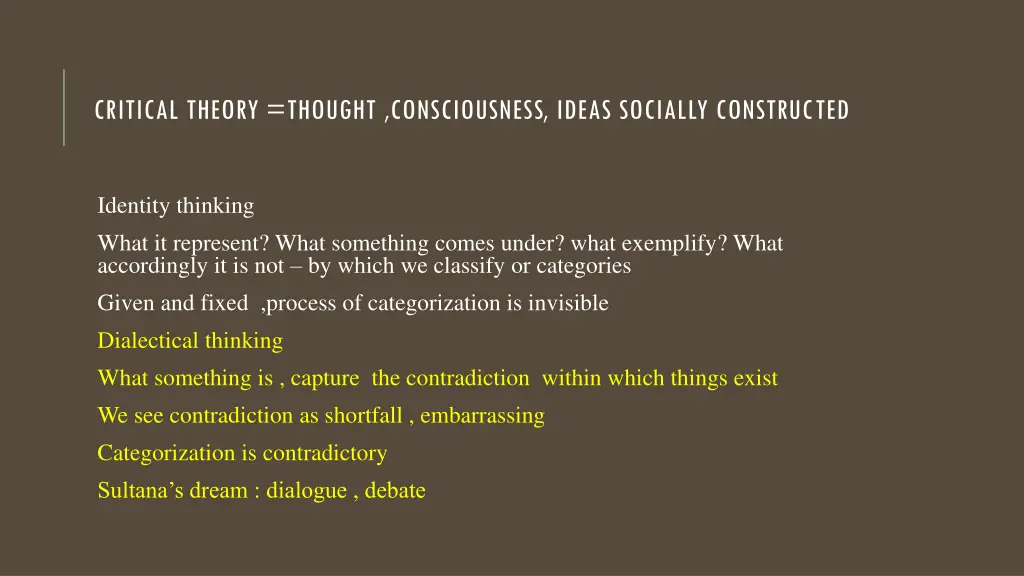
CRITICAL THEORY =THOUGHT ,CONSCIOUSNESS, IDEAS SOCIALLY CONSTRUCTED Identity thinking What it represent? What something comes under? what exemplify? What accordingly it is not by which we classify or categories Given and fixed ,process of categorization is invisible Dialectical thinking What something is , capture the contradiction within which things exist We see contradiction as shortfall , embarrassing Categorization is contradictory Sultana s dream : dialogue , debate
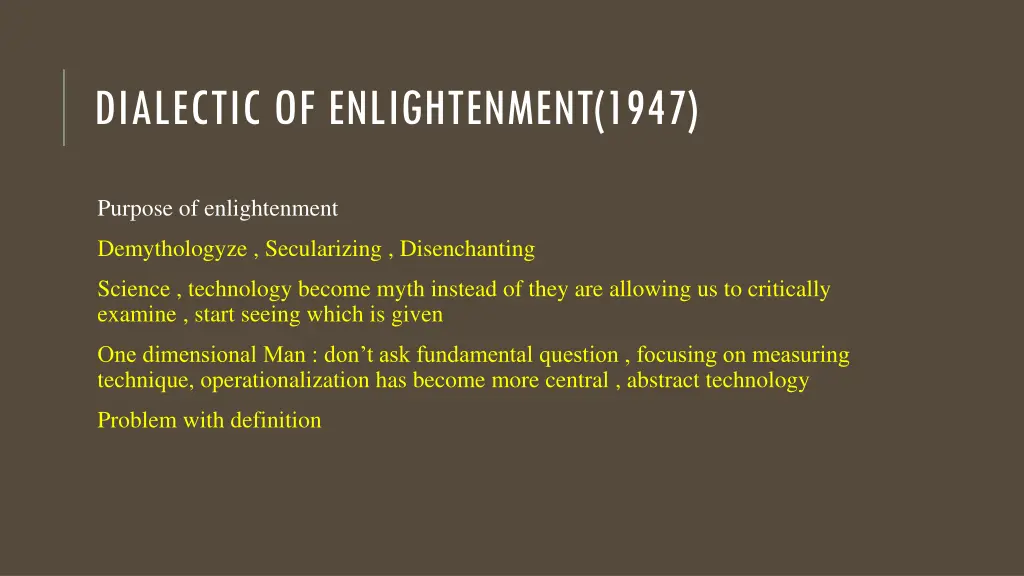
DIALECTIC OF ENLIGHTENMENT(1947) Purpose of enlightenment Demythologyze , Secularizing , Disenchanting Science , technology become myth instead of they are allowing us to critically examine , start seeing which is given One dimensional Man : don t ask fundamental question , focusing on measuring technique, operationalization has become more central , abstract technology Problem with definition
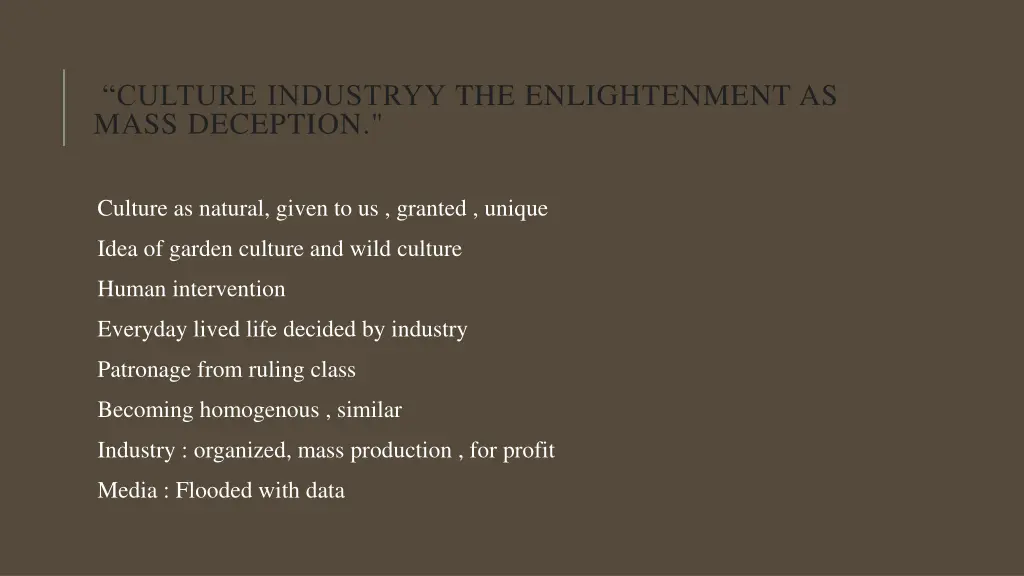
CULTURE INDUSTRYY THE ENLIGHTENMENT AS MASS DECEPTION." Culture as natural, given to us , granted , unique Idea of garden culture and wild culture Human intervention Everyday lived life decided by industry Patronage from ruling class Becoming homogenous , similar Industry : organized, mass production , for profit Media : Flooded with data
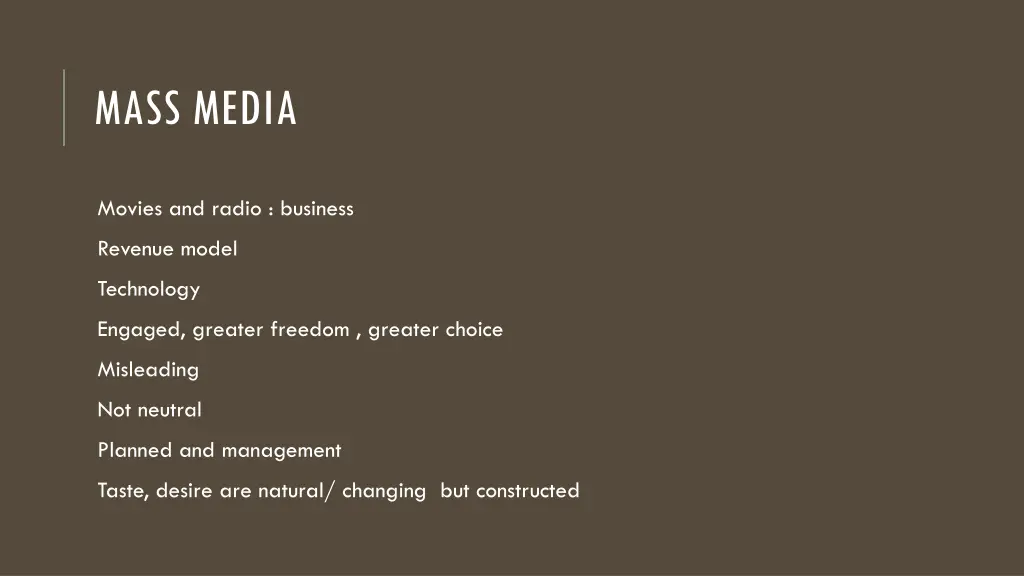
MASS MEDIA Movies and radio : business Revenue model Technology Engaged, greater freedom , greater choice Misleading Not neutral Planned and management Taste, desire are natural/ changing but constructed
HOMOGENEITY VS DIFFERENTIATION Homogeneity and differentiation Certain contradictions are generated to feel unique but creating homogeneity Rhetoric of great choice , individual , freedom Turning your freedom more restricted Question outside paradigm /framework New myths: question of chance : talent scouts Playing with aspiration Rarely get opportunity use our language