Cultural Crisis and Evolution of Values
Explore the societal implications of the current cultural crisis, the evolution of traditions over millennia, and the impacts of modern influences on lifestyle and values. Delve into how cultural refinement is reflected in ethical perceptions and aesthetic sensibilities.

Download Presentation

Please find below an Image/Link to download the presentation.
The content on the website is provided AS IS for your information and personal use only. It may not be sold, licensed, or shared on other websites without obtaining consent from the author. If you encounter any issues during the download, it is possible that the publisher has removed the file from their server.
You are allowed to download the files provided on this website for personal or commercial use, subject to the condition that they are used lawfully. All files are the property of their respective owners.
The content on the website is provided AS IS for your information and personal use only. It may not be sold, licensed, or shared on other websites without obtaining consent from the author.
E N D
Presentation Transcript
All values pursued by man are understandable under terms culture and civilization The current value crisis in the society can therefore be best understood as a cultural cultural crisis crisis. . This crisis is reflected in the confusing, undecided attitude of the educated citizens towards their culture.
The culture is an unbroken living tradition spanning several millennia. In its evolution over this long span, with many ups and downs, it has generated a variety of ideas, philosophies, religious beliefs and social customs. One of the peculiar characteristics of this cultural tradition is its tolerance of these varieties. The newer strands of ideas over-layer the older ones without smothering them. Some have seen this tolerance as a virtue, constituting a unity in diversity .
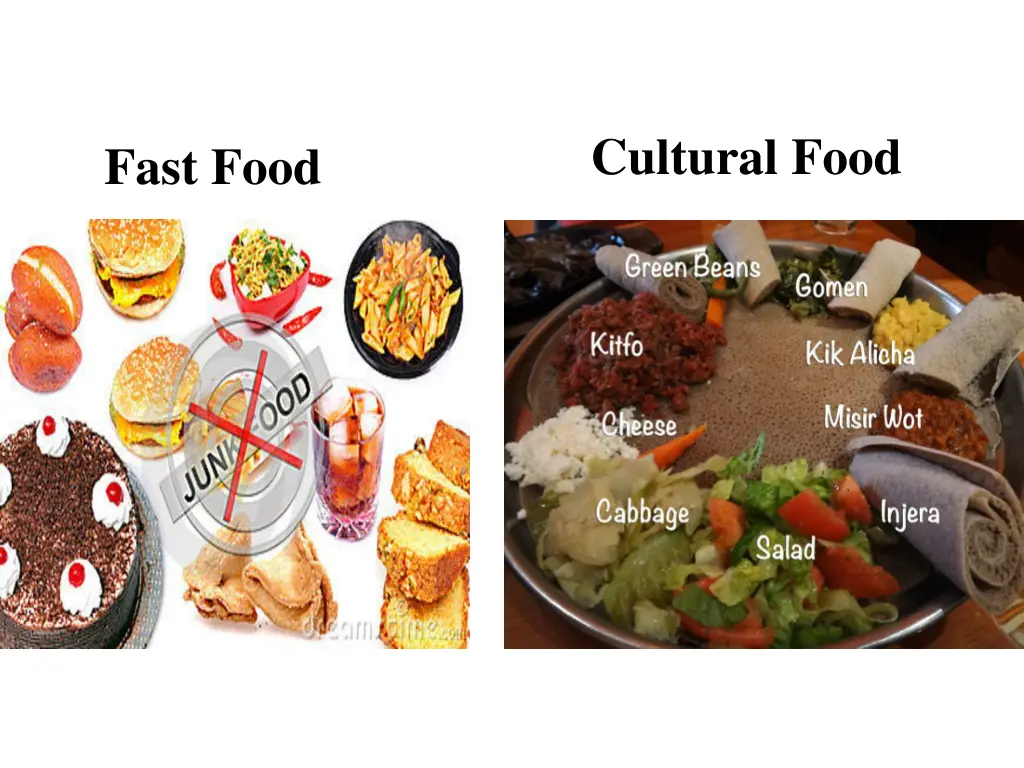
At the popular level the most talked about point of current cultural crisis is the fast change in lifestyles, particularly amongst the urban middle class. Food habits, dress, forms of greetings, common courtesies, modes of entertainment, particularly between members of opposite sex have all changed. interpersonal relationships Some of these changes are due to changing socioeconomic conditions but many are the result of copying Western modes. The media are constantly prodding us to accept these modern lifestyles. The youth belonging to the economically well-off class are particularly in love with the glamour, the fun and freedom promised by the modern culture.
Cultural Food Fast Food
They reject traditional restraints on pursuit of sensuous pleasures as unnecessarily restrictive of their individual freedom. old fashioned and At a deeper level cultural values are expressed through aesthetic sensibilities and their external expressions. They are reflected in the lifestyles also but more directly in music, art and literature. The cultural refinement of a society is best reflected in its ethical perceptions. They lead to formulation of moral codes for individual and social life, and articulation of general ethical principles on which these behavioral codes are based.
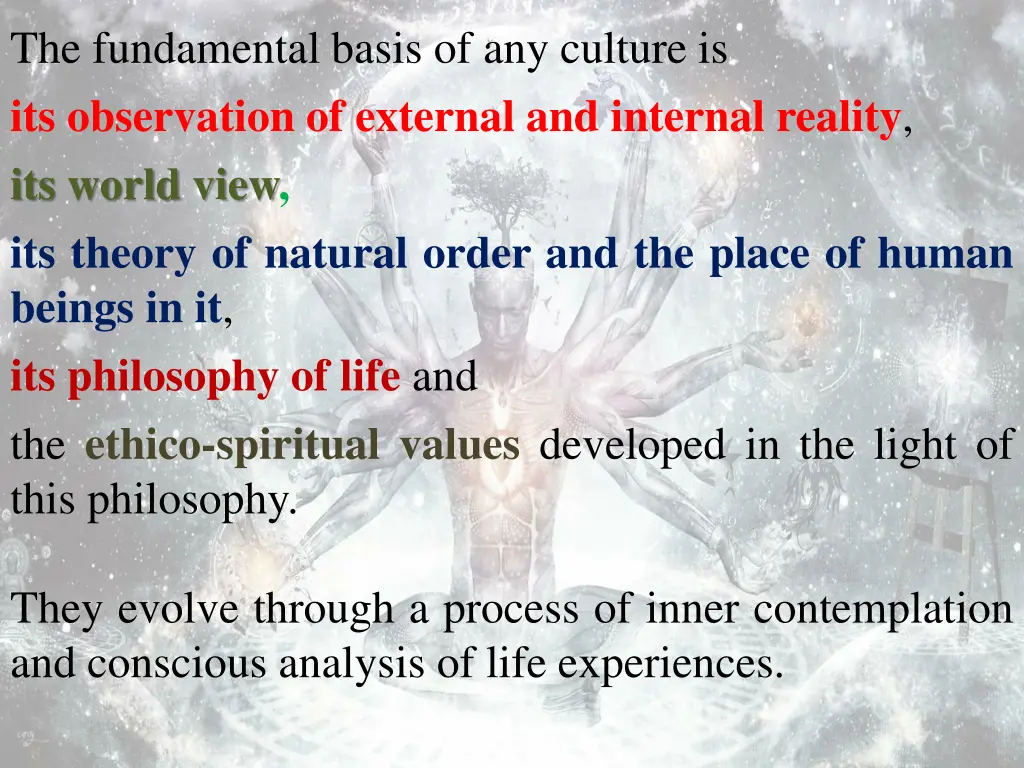
The fundamental basis of any culture is its observation of external and internal reality, its world view, its theory of natural order and the place of human beings in it, its philosophy of life and the ethico-spiritual values developed in the light of this philosophy. They evolve through a process of inner contemplation and conscious analysis of life experiences.
A state of society characterized by the breakdown of effective social control resulting in a lack of functional integration between groups, conflicting social attitudes, and personal maladjustment.
Life is a process of continuous adjustment and readjustment. The social life form is always undergoing a change necessitating adjustment of its different parts. When the various parts of society are properly adjusted, we have social order and a well organized society, but when they fail to adjust themselves to the changing conditions, the result is social disorganization leading to social problems.
Since social disorganization puts the society out of gear, it has been an important subject of study in sociology. However, before we study social disorganization, it would be fruitful to study social order as its study is helpful in understanding the nature of social disorganization.
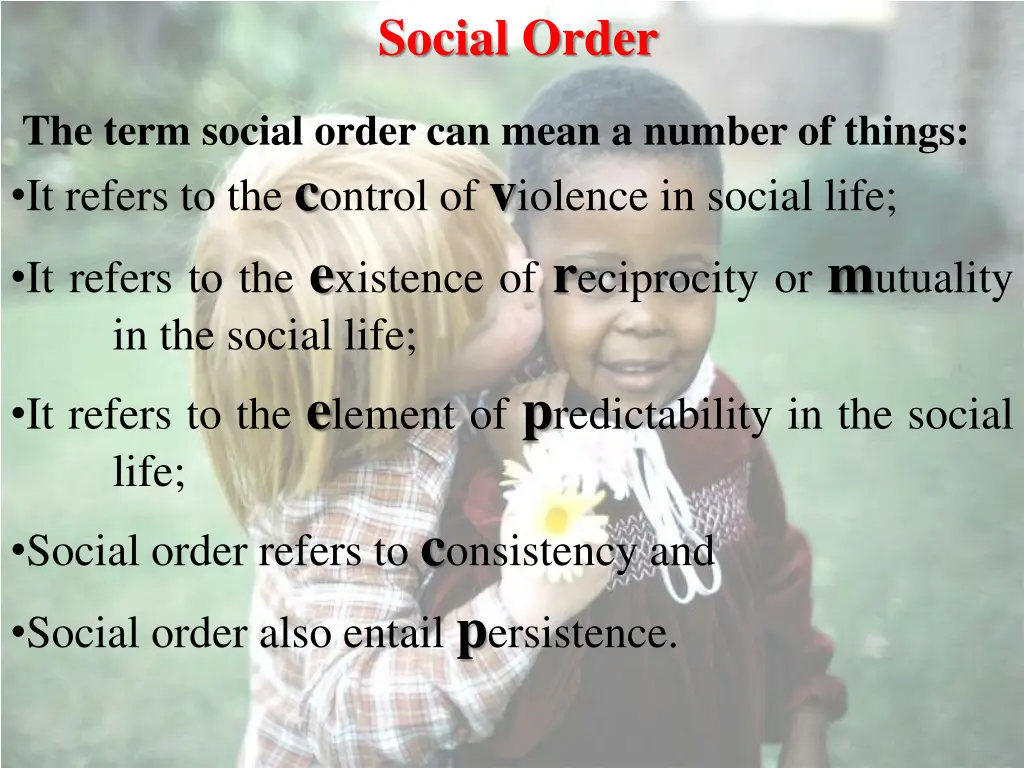
Social Order The term social order can mean a number of things: It refers to the control of violence in social life; It refers to the existence of reciprocity or mutuality in the social life; It refers to the element of predictability in the social life; Social order refers to consistency and Social order also entail persistence.
The Meaning of Social Disorganization: Social disorganization is the process opposed to social organization. Social organization, Some Fundamental Concepts , is an orderly relationship of parts. The significance of this orderly arrangement lies in what it does. When the parts of social structure do not perform their functions efficiently and effectively or perform them badly, there occurs an imbalance in society.
The social equilibrium is disturbed and society gets out of gear. Emile Durkheim defined social disorganization as a state of disequilibrium and a lack of social solidarity or consensus among the members of a society. W.I. Thomas and Florien Znaniecki conceived of social disorganization as a decrease of the influence of existing rules of behavior upon individual members of the groups.
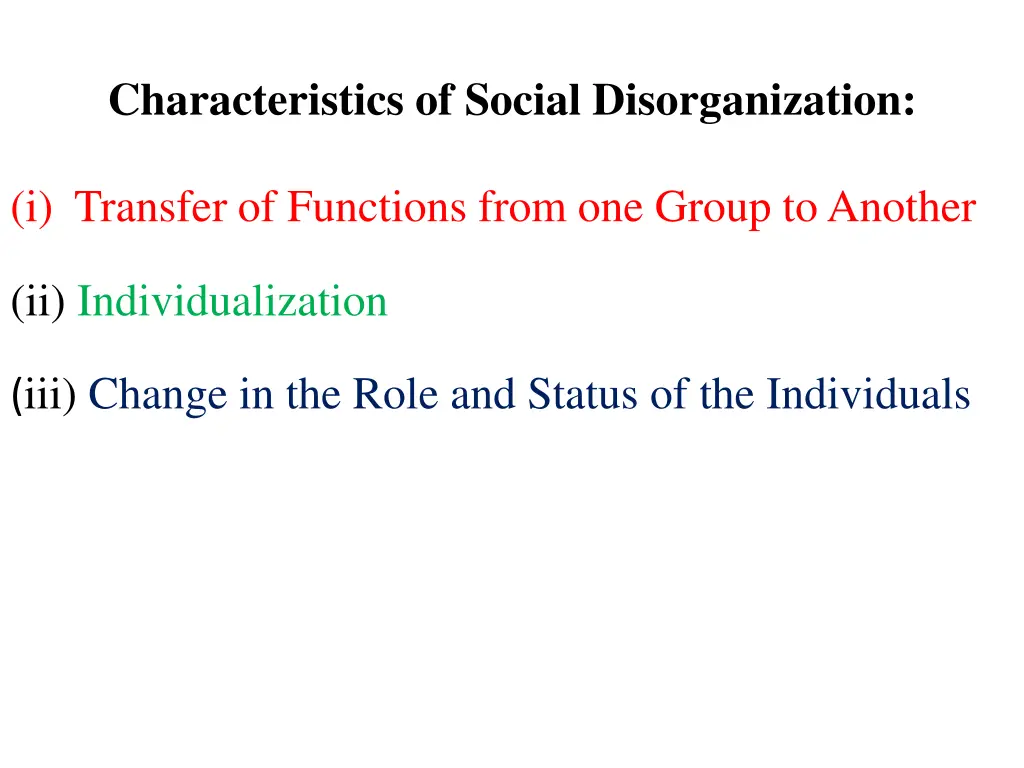
Characteristics of Social Disorganization: (i) Transfer of Functions from one Group to Another (ii) Individualization (iii) Change in the Role and Status of the Individuals
Transfer of Functions from one Group to Another: In an organized society the functions of different groups are defined and predetermined. But as society is dynamic, the functions of one group are transferred to another. Thus most of the functions once performed by the family stand transferred today to nurseries, schools and clubs. This has caused family disorganization. Thus transfer of functions from one group to another is characteristic of social disorganization.
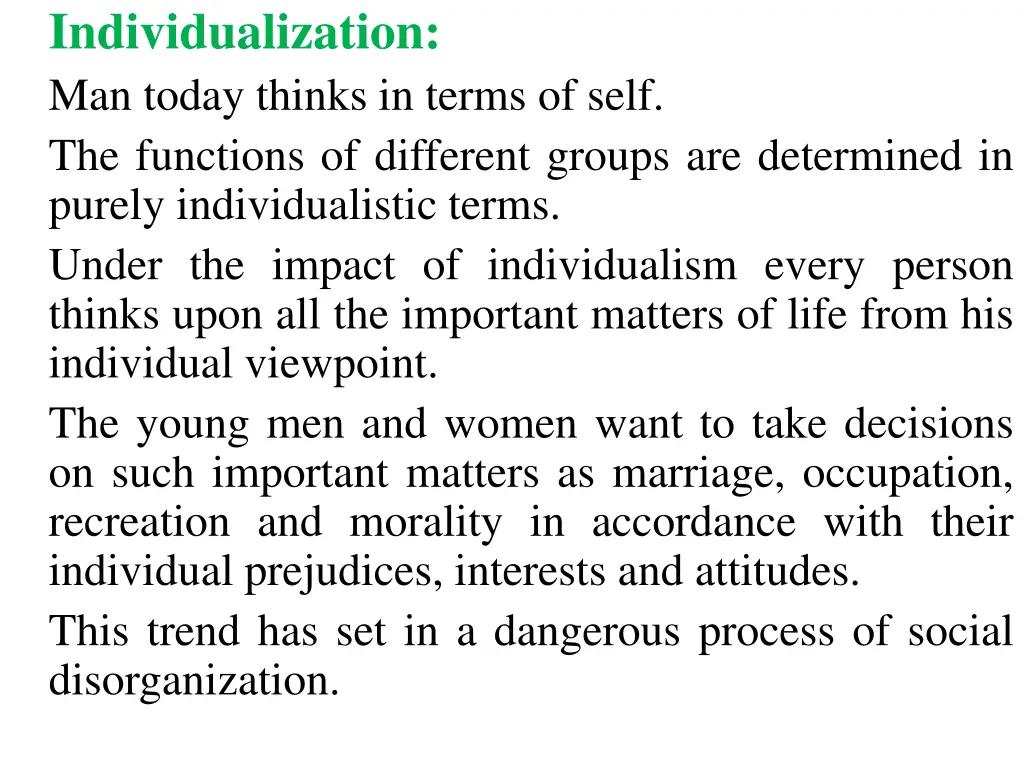
Individualization: Man today thinks in terms of self. The functions of different groups are determined in purely individualistic terms. Under the impact of individualism every person thinks upon all the important matters of life from his individual viewpoint. The young men and women want to take decisions on such important matters as marriage, occupation, recreation and morality in accordance with their individual prejudices, interests and attitudes. This trend has set in a dangerous process of social disorganization.
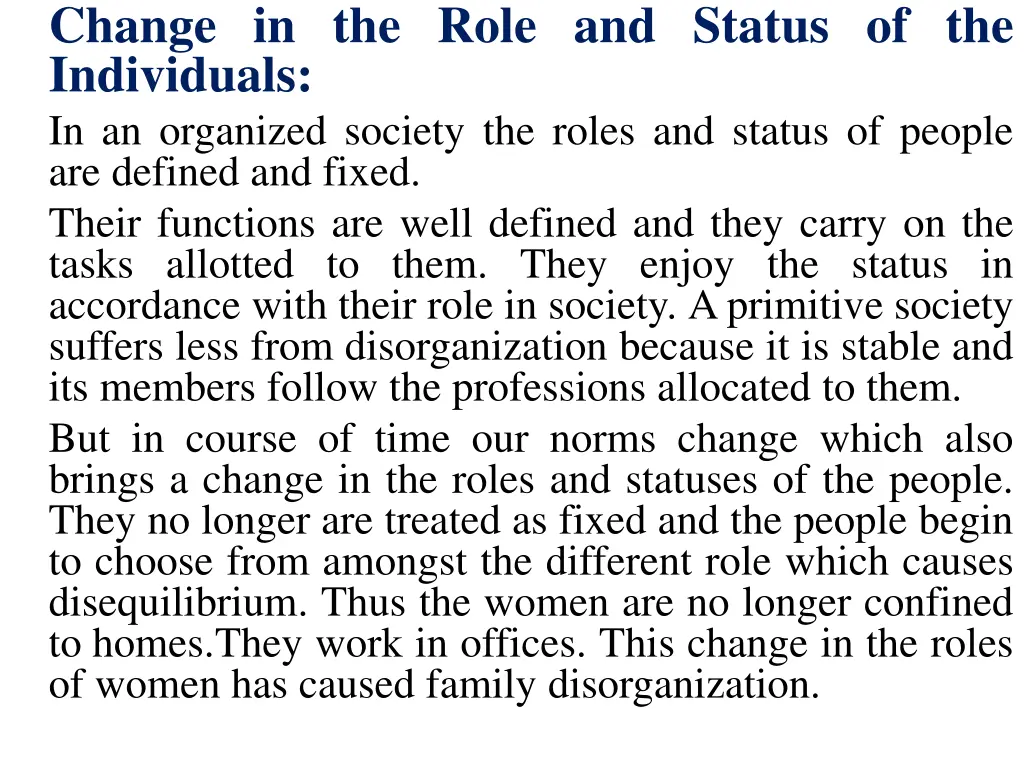
Change in the Role and Status of the Individuals: In an organized society the roles and status of people are defined and fixed. Their functions are well defined and they carry on the tasks allotted to them. They enjoy the status in accordance with their role in society. A primitive society suffers less from disorganization because it is stable and its members follow the professions allocated to them. But in course of time our norms change which also brings a change in the roles and statuses of the people. They no longer are treated as fixed and the people begin to choose from amongst the different role which causes disequilibrium. Thus the women are no longer confined to homes. They work in offices. This change in the roles of women has caused family disorganization.
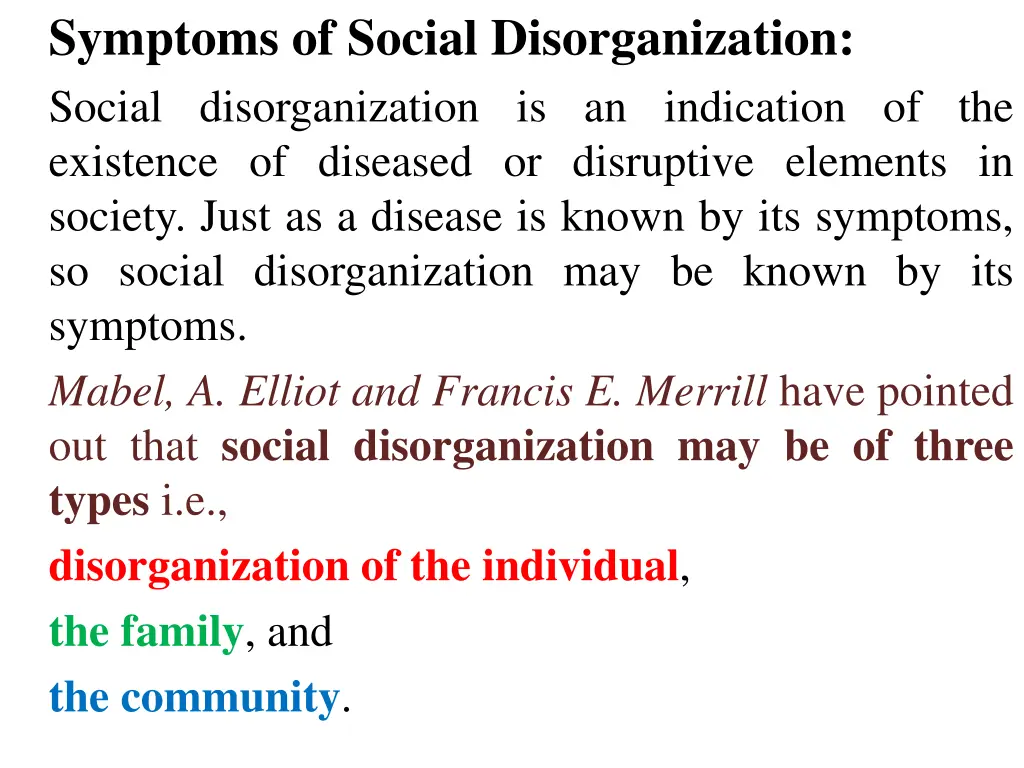
Symptoms of Social Disorganization: Social disorganization is an indication of the existence of diseased or disruptive elements in society. Just as a disease is known by its symptoms, so social disorganization may be known by its symptoms. Mabel, A. Elliot and Francis E. Merrill have pointed out that social disorganization may be of three types i.e., disorganization of the individual, the family, and the community.
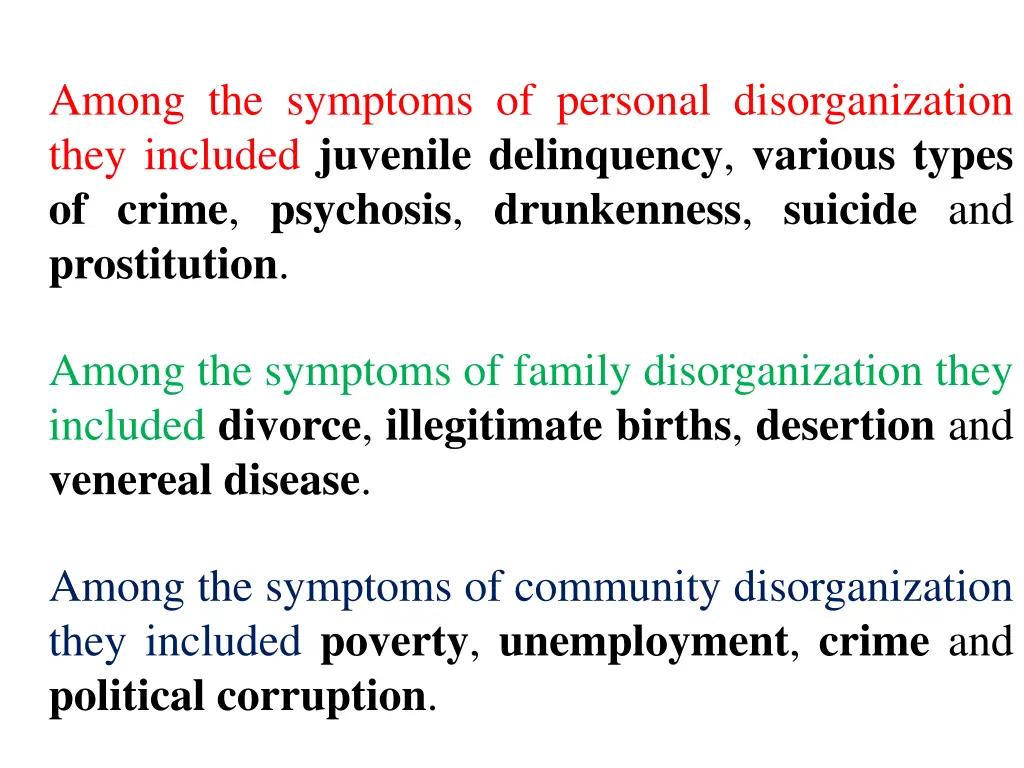
Among the symptoms of personal disorganization they included juvenile delinquency, various types of crime, psychosis, drunkenness, suicide and prostitution. Among the symptoms of family disorganization they included divorce, illegitimate births, desertion and venereal disease. Among the symptoms of community disorganization they included poverty, unemployment, crime and political corruption.
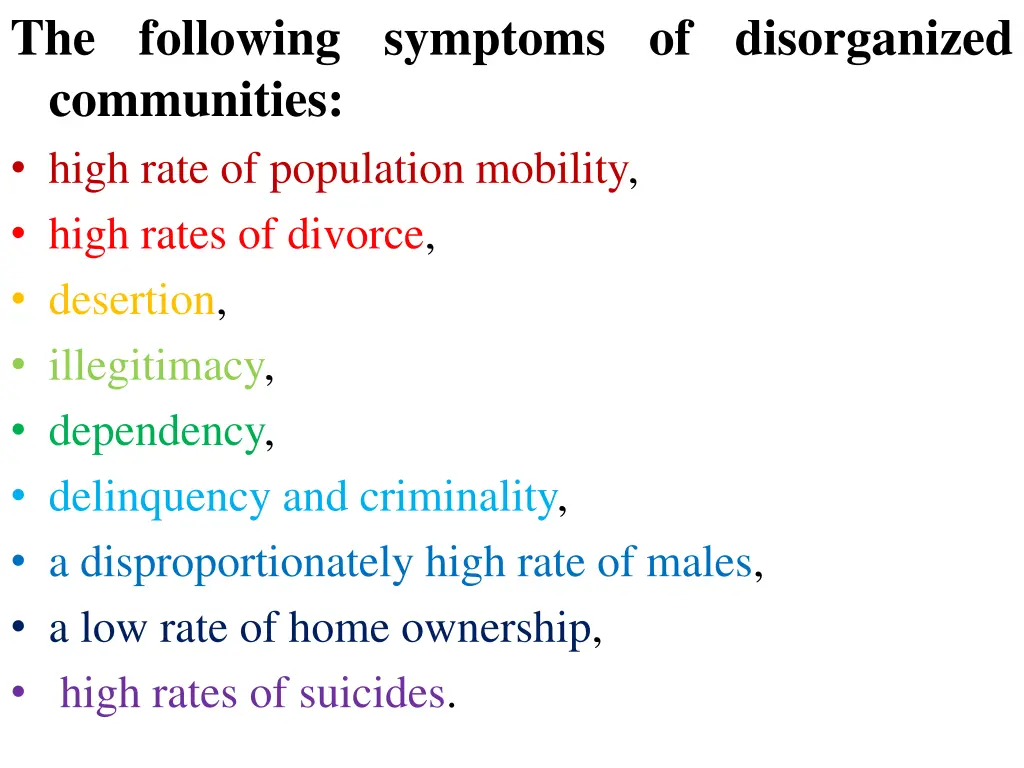
The following symptoms of disorganized communities: high rate of population mobility, high rates of divorce, desertion, illegitimacy, dependency, delinquency and criminality, a disproportionately high rate of males, a low rate of home ownership, high rates of suicides.
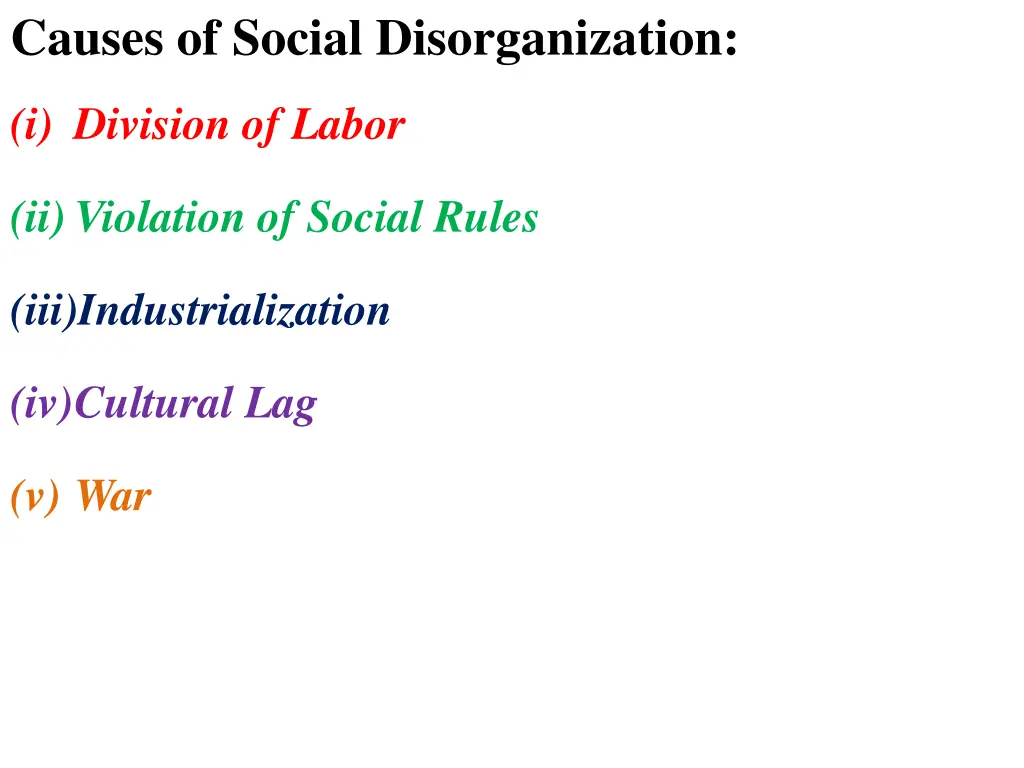
Causes of Social Disorganization: (i) Division of Labor (ii)Violation of Social Rules (iii)Industrialization (iv)Cultural Lag (v) War
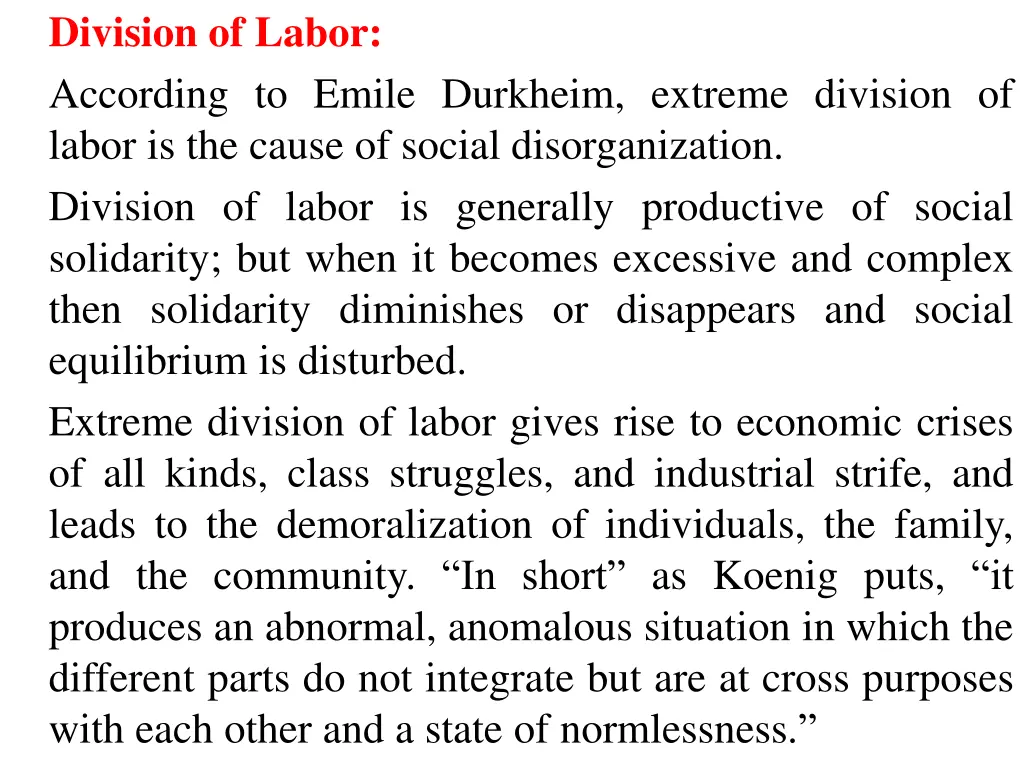
Division of Labor: According to Emile Durkheim, extreme division of labor is the cause of social disorganization. Division of labor is generally productive of social solidarity; but when it becomes excessive and complex then solidarity diminishes or disappears and social equilibrium is disturbed. Extreme division of labor gives rise to economic crises of all kinds, class struggles, and industrial strife, and leads to the demoralization of individuals, the family, and the community. Inshort as Koenig puts, it produces an abnormal, anomalous situation in which the different parts do not integrate but are at cross purposes with each other and a state of normlessness.
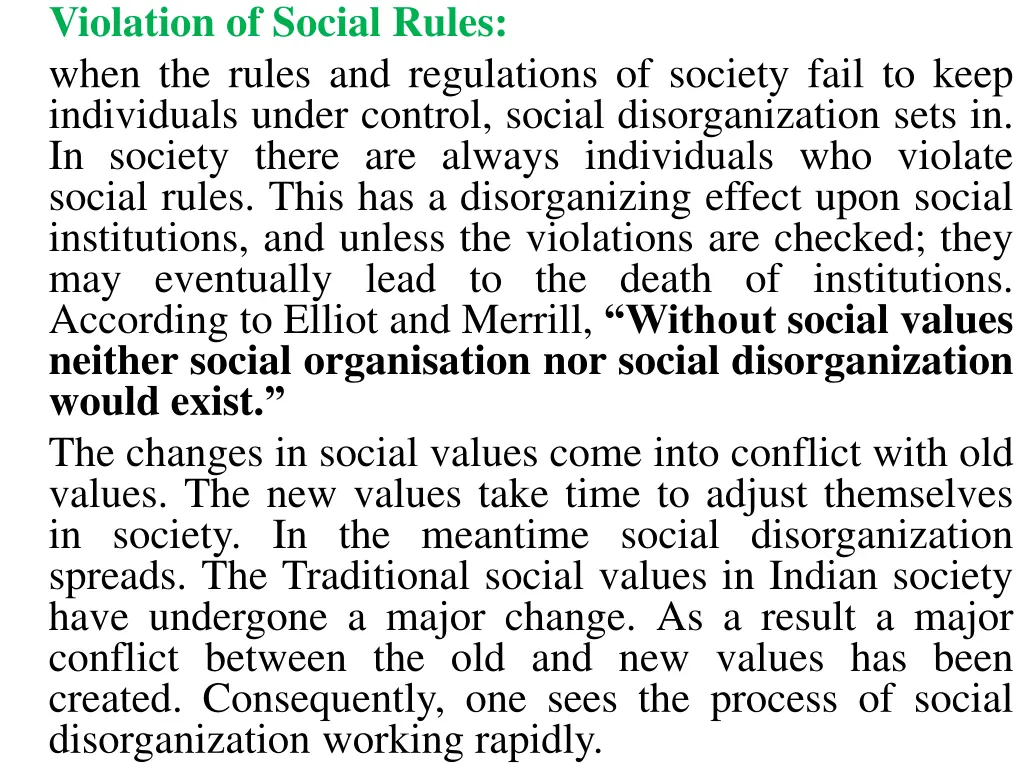
Violation of Social Rules: when the rules and regulations of society fail to keep individuals under control, social disorganization sets in. In society there are always individuals who violate social rules. This has a disorganizing effect upon social institutions, and unless the violations are checked; they may eventually lead to the death of institutions. According to Elliot and Merrill, Without social values neither social organisation nor social disorganization would exist. The changes in social values come into conflict with old values. The new values take time to adjust themselves in society. In the meantime social disorganization spreads. The Traditional social values in Indian society have undergone a major change. As a result a major conflict between the old and new values has been created. Consequently, one sees the process of social disorganization working rapidly.
Industrialization: Industrialization creates conditions leading to social disorganization. The effects of industrialization on family structure and relationships. Industrialization as seen in system had led to capitalism, exploitation and class conflicts. It has also contributed to unemployment, crime, immorality, family disorganization, urbanization and its evils.
Cultural Lag: Disorganization is caused primarily by the unequal rates of change in the different parts of culture, resulting in a conflict between them. The disproportionate rates of change in various elements of the functionally interdependent component system of a changing social structure produce a condition of disequilibrium. This uneven change is due to the fact that inventions and discoveries are made more frequently in certain parts of culture, usually the material parts, than in others. Science and technology, while bringing a more efficient material culture, more knowledge, and a higher standard of living, produce social disorganization as well
War: While war is the result of social disorganization, it is also its cause. War disturbs the economy of a country and introduces confusion and disorder in society. War leads to scarcity. There is economic crisis during the war period. It inflates the prices and the people resort to hoarding and black-marketing. Further, war consumes the young men of the country. As a result young women are widowed. They are left with none to support them. That tends to weaken the sexual ties. War also affects the male- female ratio. Social values are also injured.
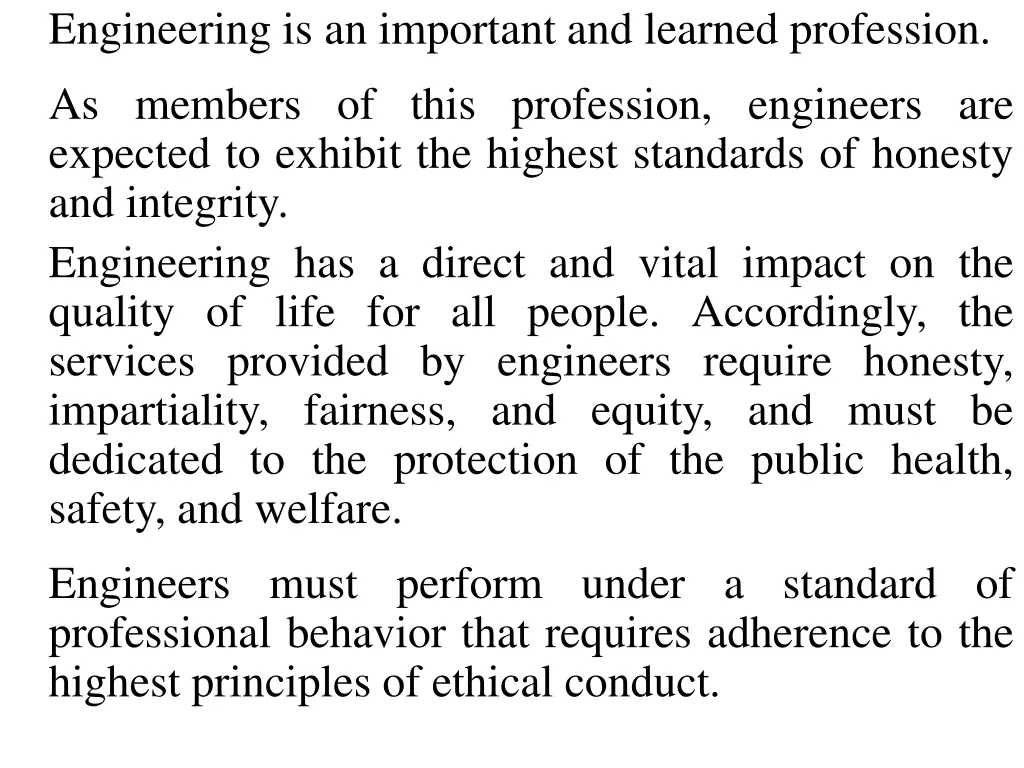
Engineering is an important and learned profession. As members of this profession, engineers are expected to exhibit the highest standards of honesty and integrity. Engineering has a direct and vital impact on the quality of life for all people. Accordingly, the services provided by engineers require honesty, impartiality, fairness, and equity, and must be dedicated to the protection of the public health, safety, and welfare. Engineers must perform under a standard of professional behavior that requires adherence to the highest principles of ethical conduct.
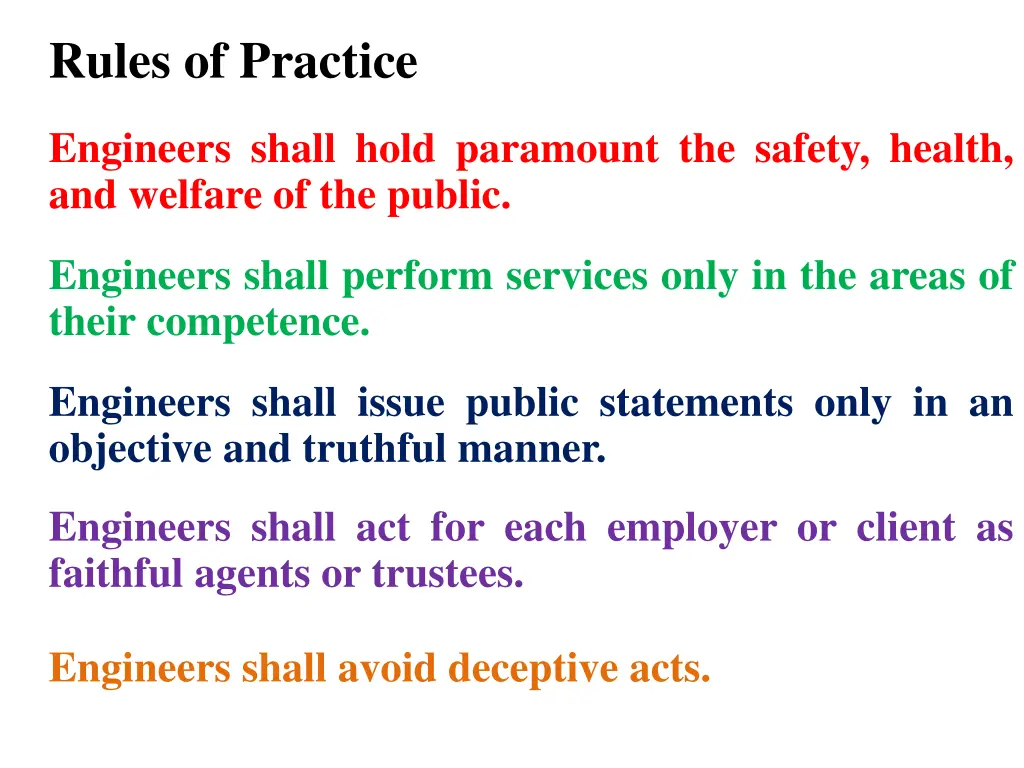
Rules of Practice Engineers shall hold paramount the safety, health, and welfare of the public. Engineers shall perform services only in the areas of their competence. Engineers shall issue public statements only in an objective and truthful manner. Engineers shall act for each employer or client as faithful agents or trustees. Engineers shall avoid deceptive acts.
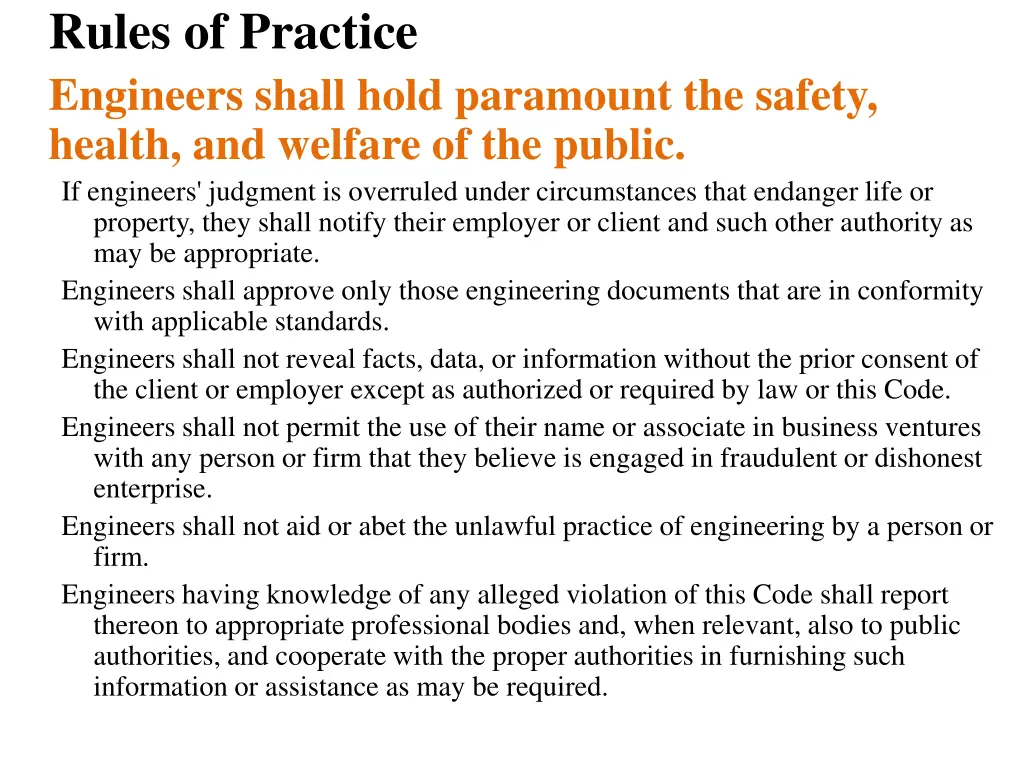
Rules of Practice Engineers shall hold paramount the safety, health, and welfare of the public. If engineers' judgment is overruled under circumstances that endanger life or property, they shall notify their employer or client and such other authority as may be appropriate. Engineers shall approve only those engineering documents that are in conformity with applicable standards. Engineers shall not reveal facts, data, or information without the prior consent of the client or employer except as authorized or required by law or this Code. Engineers shall not permit the use of their name or associate in business ventures with any person or firm that they believe is engaged in fraudulent or dishonest enterprise. Engineers shall not aid or abet the unlawful practice of engineering by a person or firm. Engineers having knowledge of any alleged violation of this Code shall report thereon to appropriate professional bodies and, when relevant, also to public authorities, and cooperate with the proper authorities in furnishing such information or assistance as may be required.
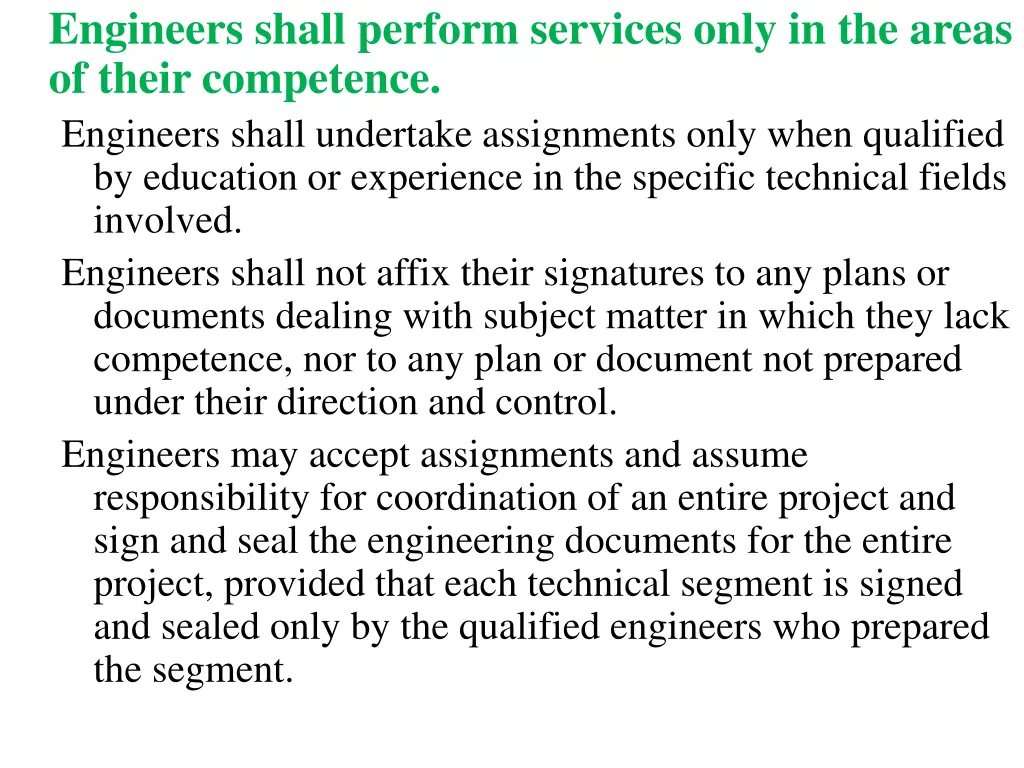
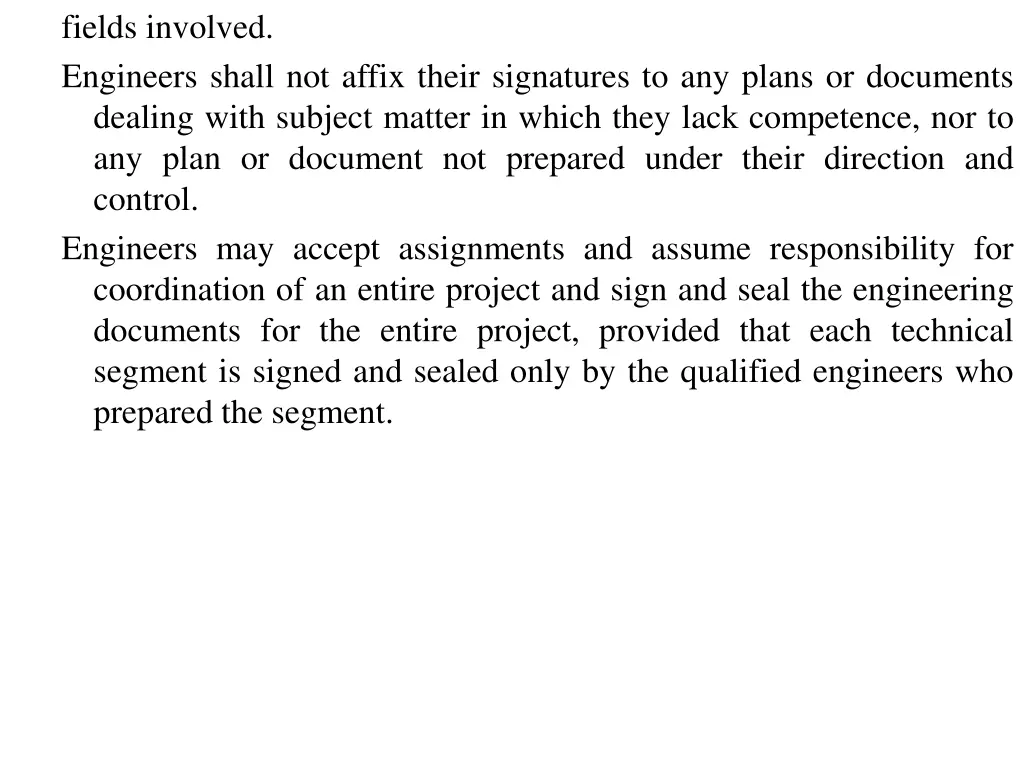
Engineers shall perform services only in the areas of their competence. Engineers shall undertake assignments only when qualified by education or experience in the specific technical fields involved. Engineers shall not affix their signatures to any plans or documents dealing with subject matter in which they lack competence, nor to any plan or document not prepared under their direction and control. Engineers may accept assignments and assume responsibility for coordination of an entire project and sign and seal the engineering documents for the entire project, provided that each technical segment is signed and sealed only by the qualified engineers who prepared the segment.
fields involved. Engineers shall not affix their signatures to any plans or documents dealing with subject matter in which they lack competence, nor to any plan or document not prepared under their direction and control. Engineers may accept assignments and assume responsibility for coordination of an entire project and sign and seal the engineering documents for the entire project, provided that each technical segment is signed and sealed only by the qualified engineers who prepared the segment.
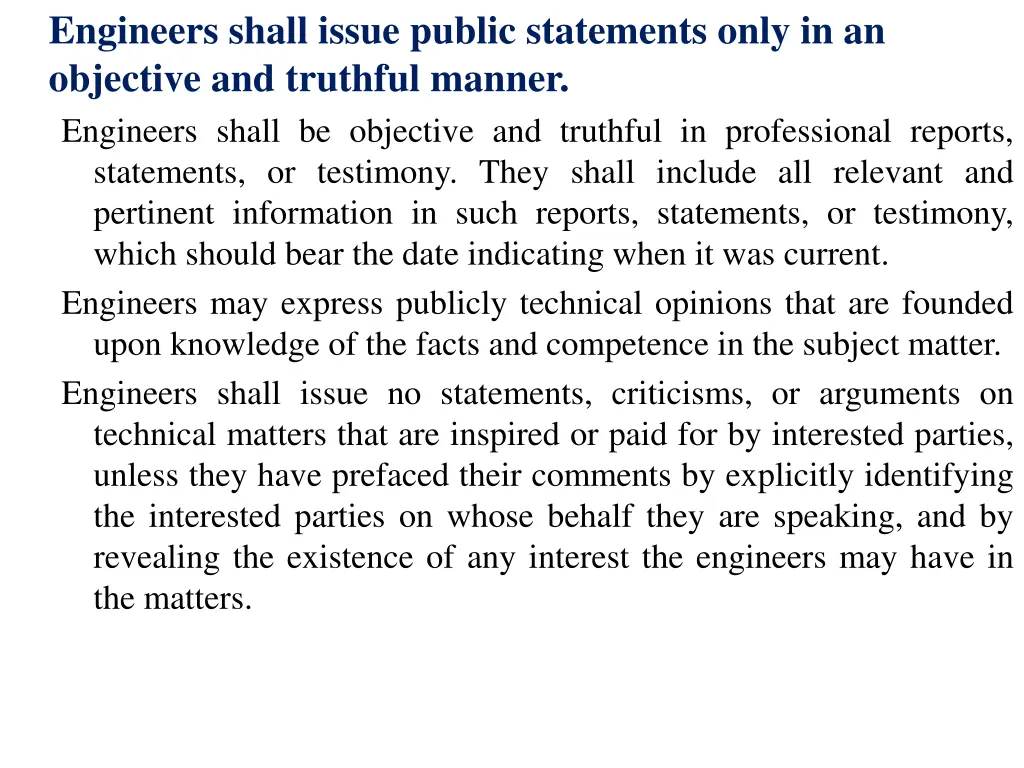
Engineers shall issue public statements only in an objective and truthful manner. Engineers shall be objective and truthful in professional reports, statements, or testimony. They shall include all relevant and pertinent information in such reports, statements, or testimony, which should bear the date indicating when it was current. Engineers may express publicly technical opinions that are founded upon knowledge of the facts and competence in the subject matter. Engineers shall issue no statements, criticisms, or arguments on technical matters that are inspired or paid for by interested parties, unless they have prefaced their comments by explicitly identifying the interested parties on whose behalf they are speaking, and by revealing the existence of any interest the engineers may have in the matters.
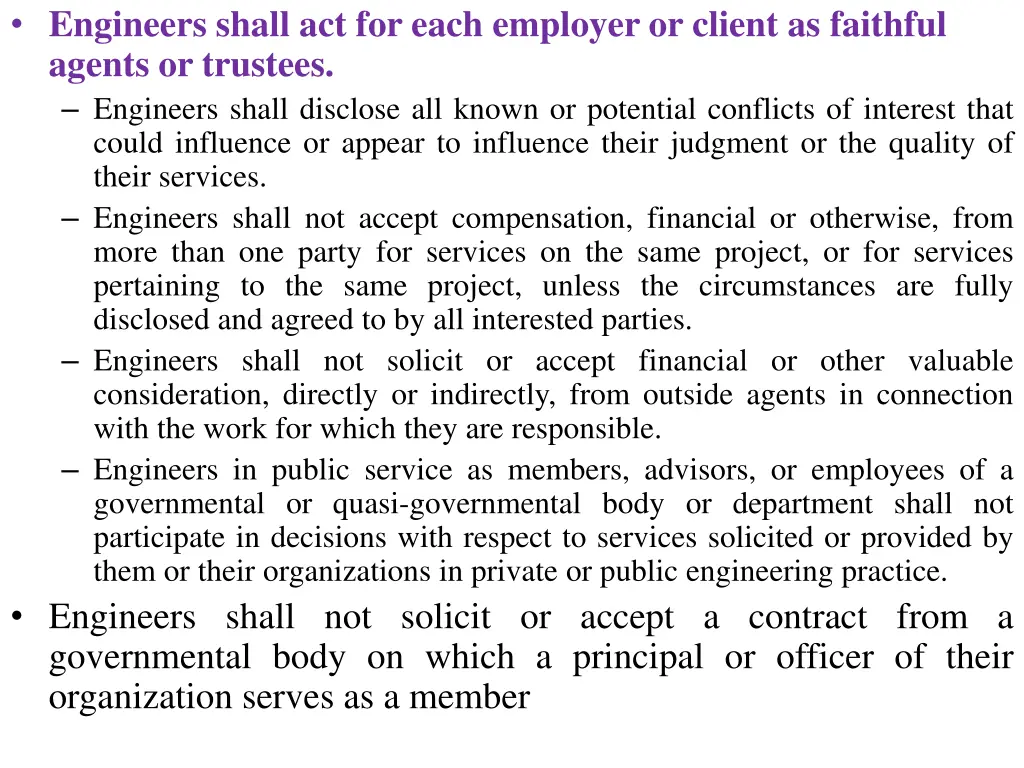
Engineers shall act for each employer or client as faithful agents or trustees. Engineers shall disclose all known or potential conflicts of interest that could influence or appear to influence their judgment or the quality of their services. Engineers shall not accept compensation, financial or otherwise, from more than one party for services on the same project, or for services pertaining to the same project, unless the circumstances are fully disclosed and agreed to by all interested parties. Engineers shall not solicit or accept financial or other valuable consideration, directly or indirectly, from outside agents in connection with the work for which they are responsible. Engineers in public service as members, advisors, or employees of a governmental or quasi-governmental body or department shall not participate in decisions with respect to services solicited or provided by them or their organizations in private or public engineering practice. Engineers shall not solicit or accept a contract from a governmental body on which a principal or officer of their organization serves as a member
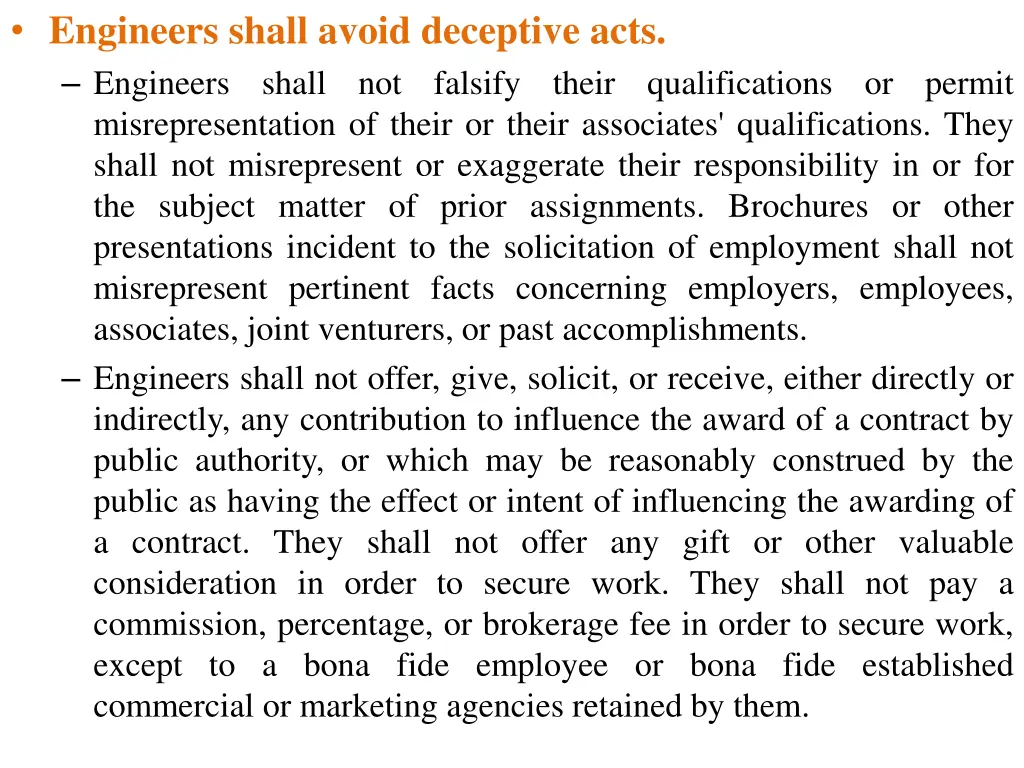
Engineers shall avoid deceptive acts. Engineers shall not falsify their qualifications or permit misrepresentation of their or their associates' qualifications. They shall not misrepresent or exaggerate their responsibility in or for the subject matter of prior assignments. Brochures or other presentations incident to the solicitation of employment shall not misrepresent pertinent facts concerning employers, employees, associates, joint venturers, or past accomplishments. Engineers shall not offer, give, solicit, or receive, either directly or indirectly, any contribution to influence the award of a contract by public authority, or which may be reasonably construed by the public as having the effect or intent of influencing the awarding of a contract. They shall not offer any gift or other valuable consideration in order to secure work. They shall not pay a commission, percentage, or brokerage fee in order to secure work, except to a bona fide employee or bona fide established commercial or marketing agencies retained by them.
Last Five Minutes of Exam Thank You Your Text Here