Data Analysis and Correlation: Understanding Relationships in Statistics
Explore correlations between variables, conditional probabilities, and dependent events in the realm of statistics and data analysis. Learn about inherited color blindness rates, correlation agendas, joint probabilities, and more to enhance your understanding of data relationships.

Uploaded on | 1 Views
Download Presentation

Please find below an Image/Link to download the presentation.
The content on the website is provided AS IS for your information and personal use only. It may not be sold, licensed, or shared on other websites without obtaining consent from the author. If you encounter any issues during the download, it is possible that the publisher has removed the file from their server.
You are allowed to download the files provided on this website for personal or commercial use, subject to the condition that they are used lawfully. All files are the property of their respective owners.
The content on the website is provided AS IS for your information and personal use only. It may not be sold, licensed, or shared on other websites without obtaining consent from the author.
E N D
Presentation Transcript
Statistics and Data Analysis Professor William Greene Stern School of Business IOMS Department Department of Economics 6-1/49 Part 6: Correlation
Statistics and Data Analysis Part 6 Correlation 6-2/49 Part 6: Correlation
Correlated Variables 6-3/49 Part 6: Correlation
Correlated Variables 6-4/49 Part 6: Correlation
Correlation Agenda Two Related Random Variables Dependence and Independence Conditional Distributions We re interested in correlation We have to look at covariance first Regression is correlation Correlated Asset Returns 6-5/49 Part 6: Correlation
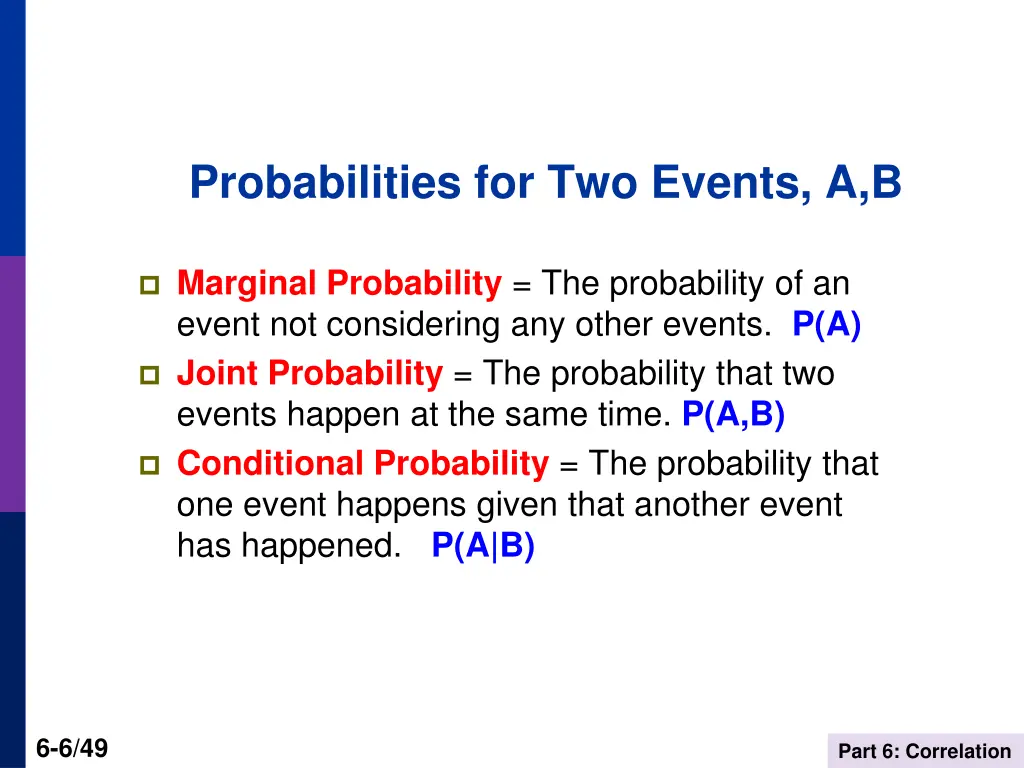
Probabilities for Two Events, A,B Marginal Probability = The probability of an event not considering any other events. P(A) Joint Probability = The probability that two events happen at the same time. P(A,B) Conditional Probability = The probability that one event happens given that another event has happened. P(A|B) 6-6/49 Part 6: Correlation
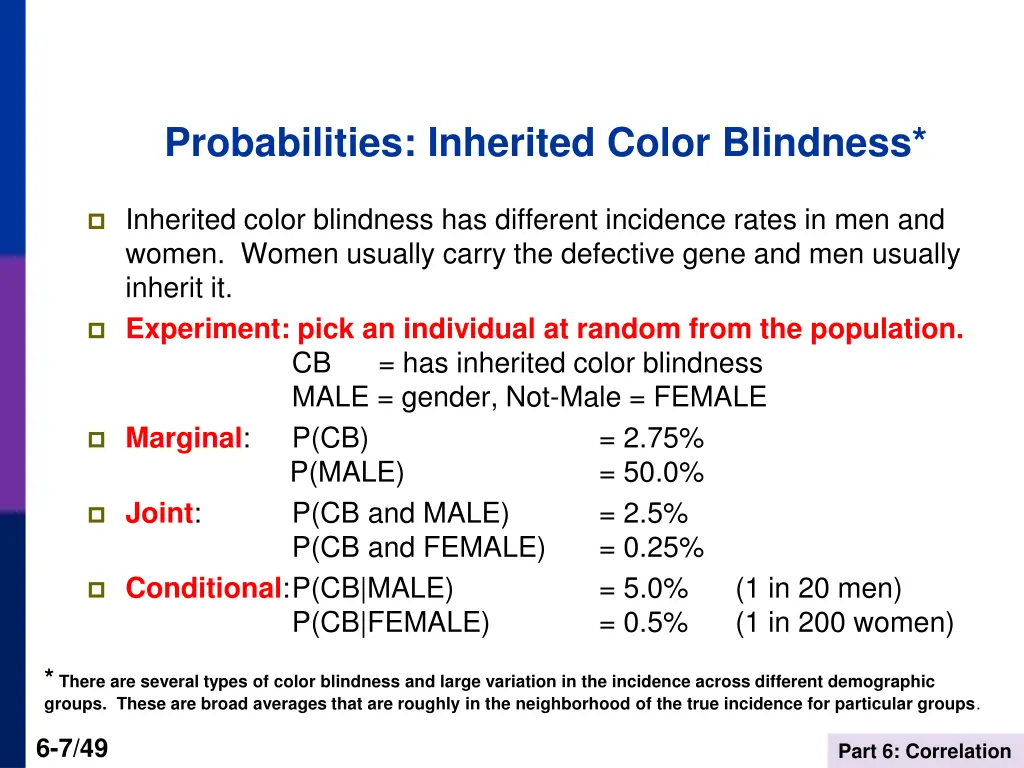
Probabilities: Inherited Color Blindness* Inherited color blindness has different incidence rates in men and women. Women usually carry the defective gene and men usually inherit it. Experiment: pick an individual at random from the population. CB = has inherited color blindness MALE = gender, Not-Male = FEMALE Marginal: P(CB) P(MALE) Joint: P(CB and MALE) P(CB and FEMALE) Conditional: P(CB|MALE) P(CB|FEMALE) = 2.75% = 50.0% = 2.5% = 0.25% = 5.0% (1 in 20 men) = 0.5% (1 in 200 women) * There are several types of color blindness and large variation in the incidence across different demographic groups. These are broad averages that are roughly in the neighborhood of the true incidence for particular groups. 6-7/49 Part 6: Correlation
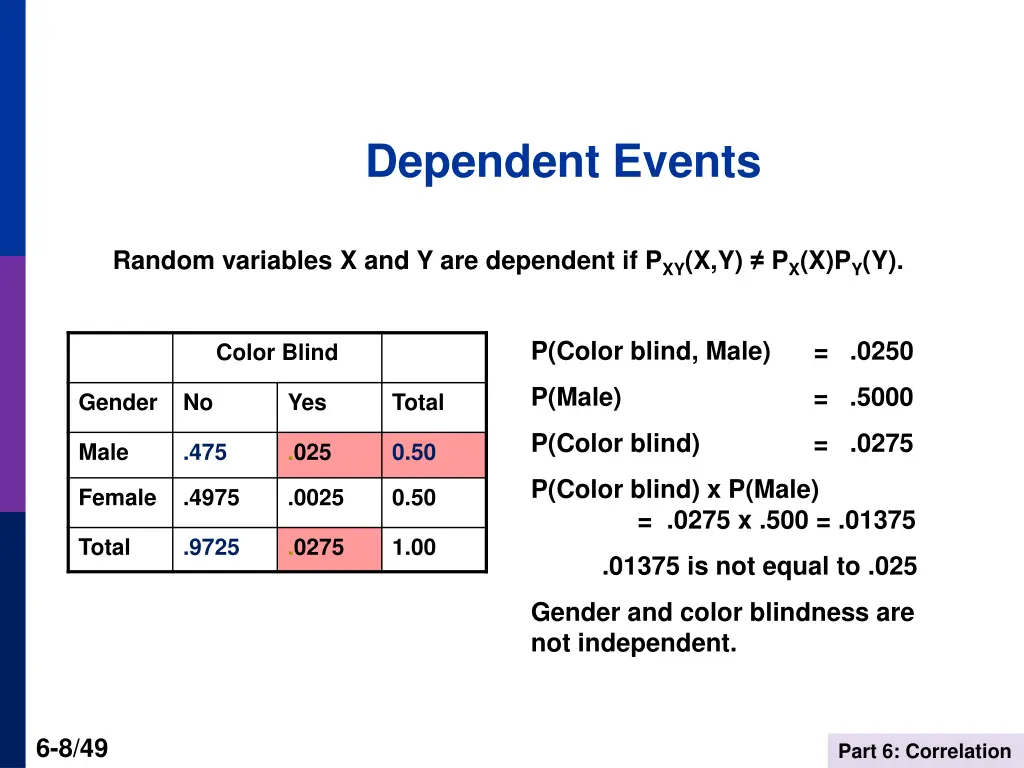
Dependent Events Random variables X and Y are dependent if PXY(X,Y) PX(X)PY(Y). P(Color blind, Male) = .0250 Color Blind P(Male) = .5000 Gender No Yes Total P(Color blind) = .0275 Male .475 .025 0.50 P(Color blind) x P(Male) = .0275 x .500 = .01375 Female .4975 .0025 0.50 Total .97255 .0275 1.00 .01375 is not equal to .025 Gender and color blindness are not independent. 6-8/49 Part 6: Correlation
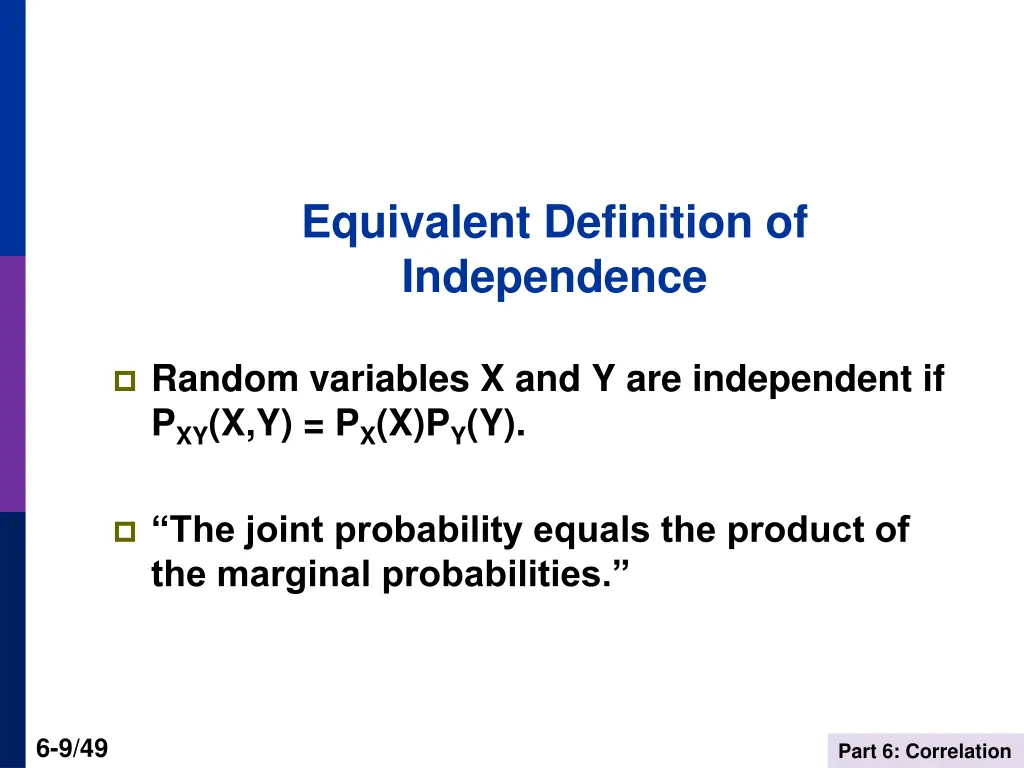
Equivalent Definition of Independence Random variables X and Y are independent if PXY(X,Y) = PX(X)PY(Y). The joint probability equals the product of the marginal probabilities. 6-9/49 Part 6: Correlation
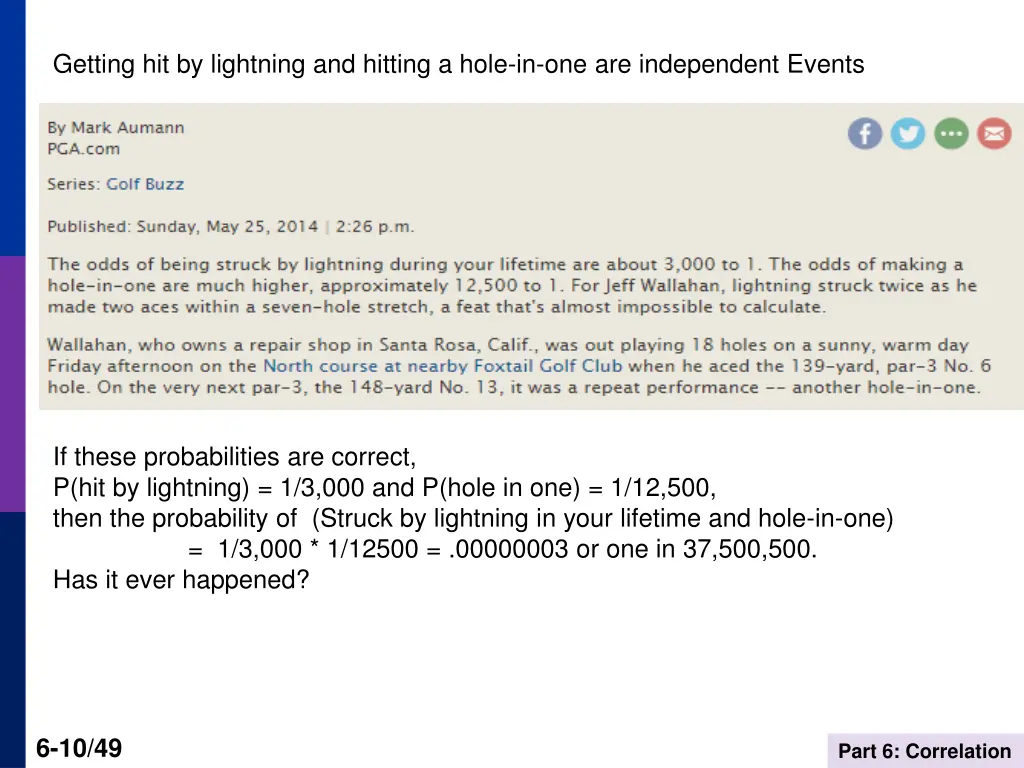
Getting hit by lightning and hitting a hole-in-one are independent Events If these probabilities are correct, P(hit by lightning) = 1/3,000 and P(hole in one) = 1/12,500, then the probability of (Struck by lightning in your lifetime and hole-in-one) = 1/3,000 * 1/12500 = .00000003 or one in 37,500,500. Has it ever happened? 6-10/49 Part 6: Correlation
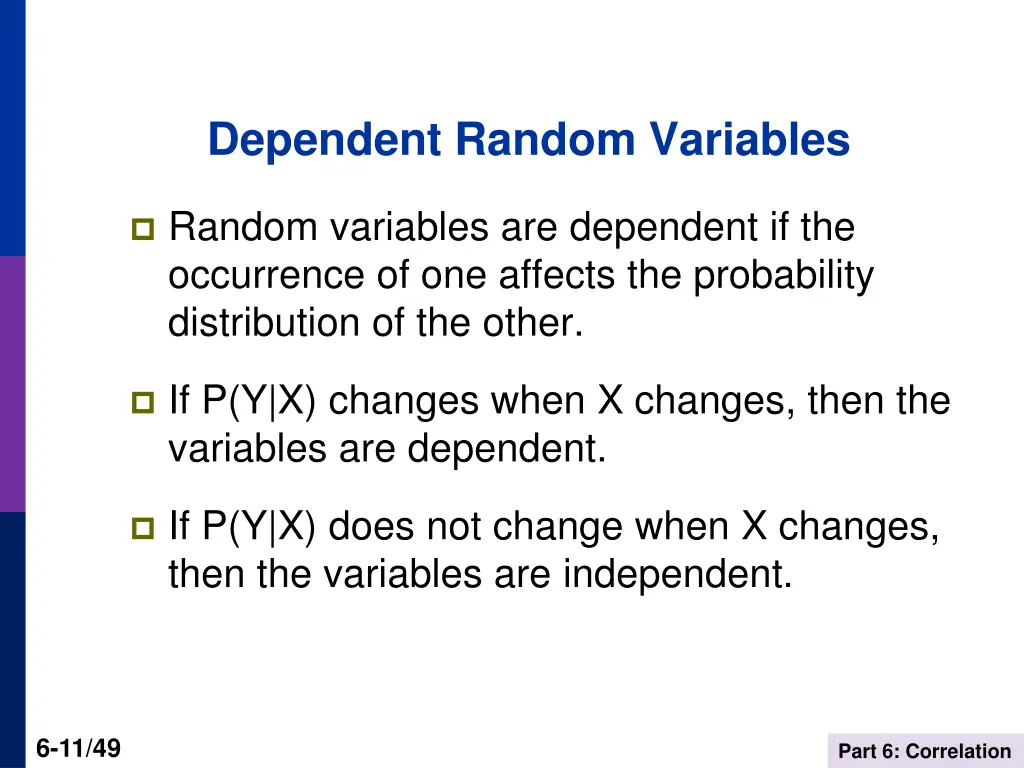
Dependent Random Variables Random variables are dependent if the occurrence of one affects the probability distribution of the other. If P(Y|X) changes when X changes, then the variables are dependent. If P(Y|X) does not change when X changes, then the variables are independent. 6-11/49 Part 6: Correlation
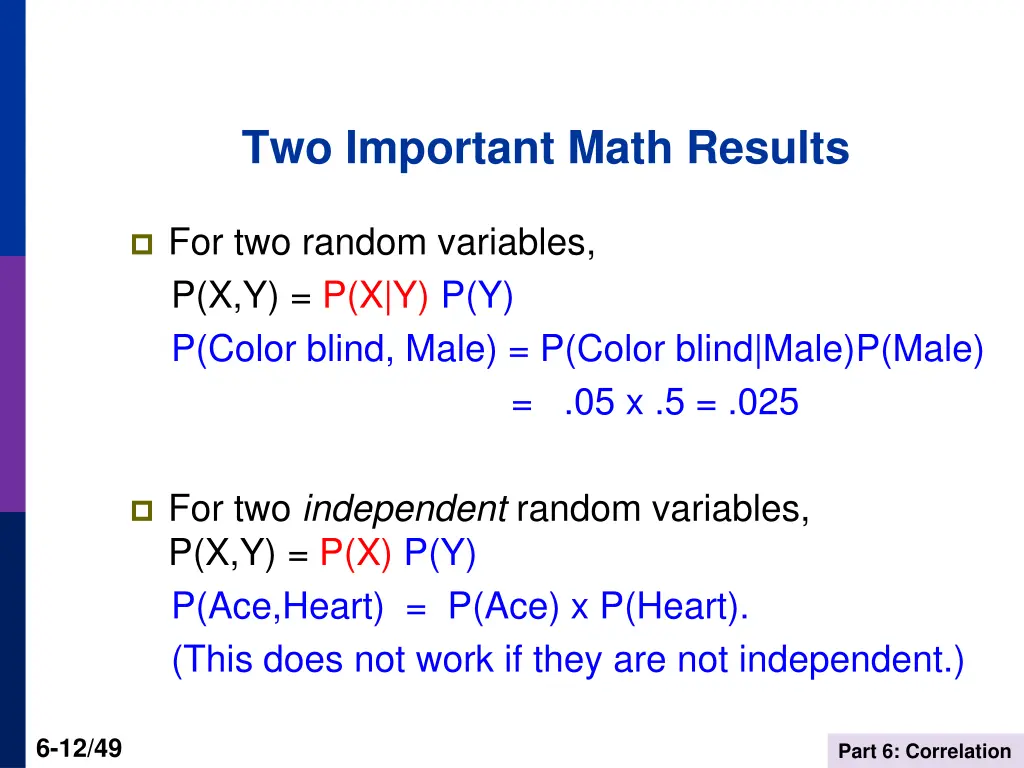
Two Important Math Results For two random variables, P(X,Y) = P(X|Y) P(Y) P(Color blind, Male) = P(Color blind|Male)P(Male) = .05 x .5 = .025 For two independent random variables, P(X,Y) = P(X) P(Y) P(Ace,Heart) = P(Ace) x P(Heart). (This does not work if they are not independent.) 6-12/49 Part 6: Correlation
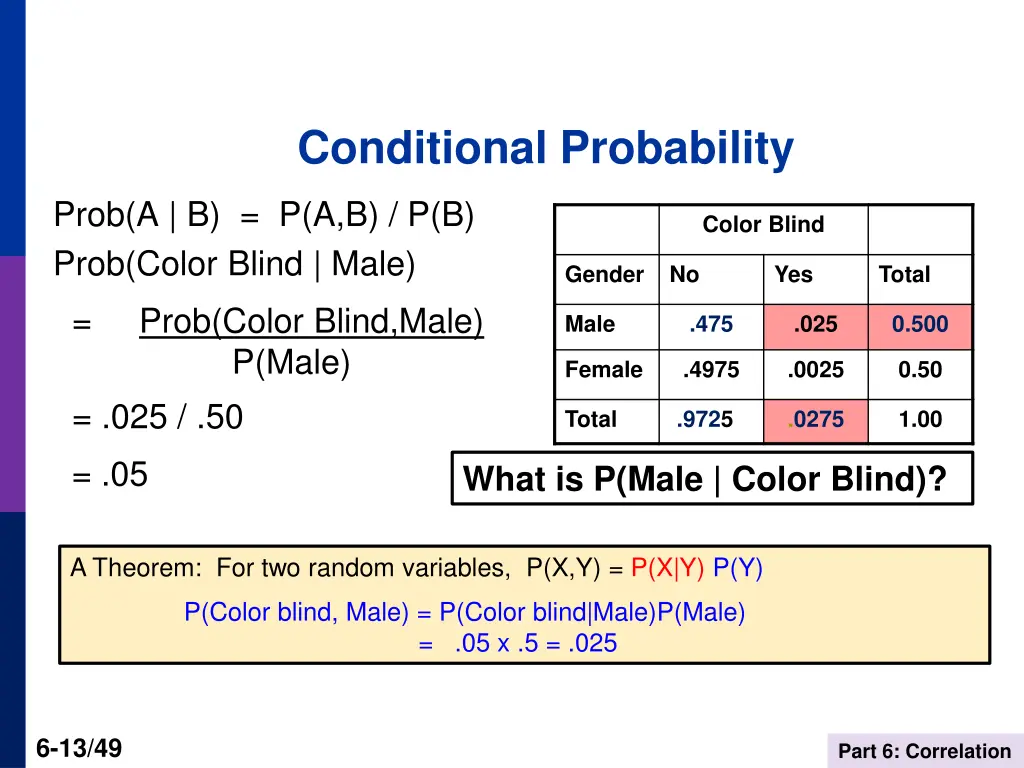
Conditional Probability Prob(A | B) = P(A,B) / P(B) Prob(Color Blind | Male) Color Blind Gender No Yes Total = Prob(Color Blind,Male) P(Male) Male .475 .025 0.500 Female .4975 .0025 0.50 = .025 / .50 Total .97255 .0275 1.00 = .05 What is P(Male | Color Blind)? A Theorem: For two random variables, P(X,Y) = P(X|Y) P(Y) P(Color blind, Male) = P(Color blind|Male)P(Male) = .05 x .5 = .025 6-13/49 Part 6: Correlation
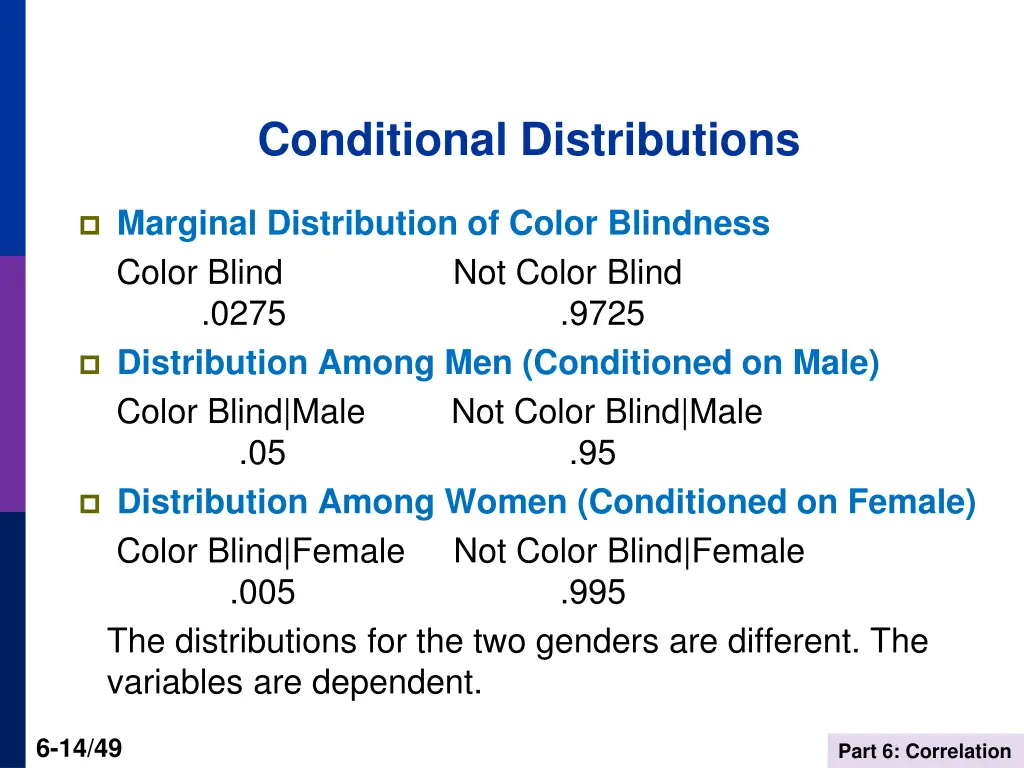
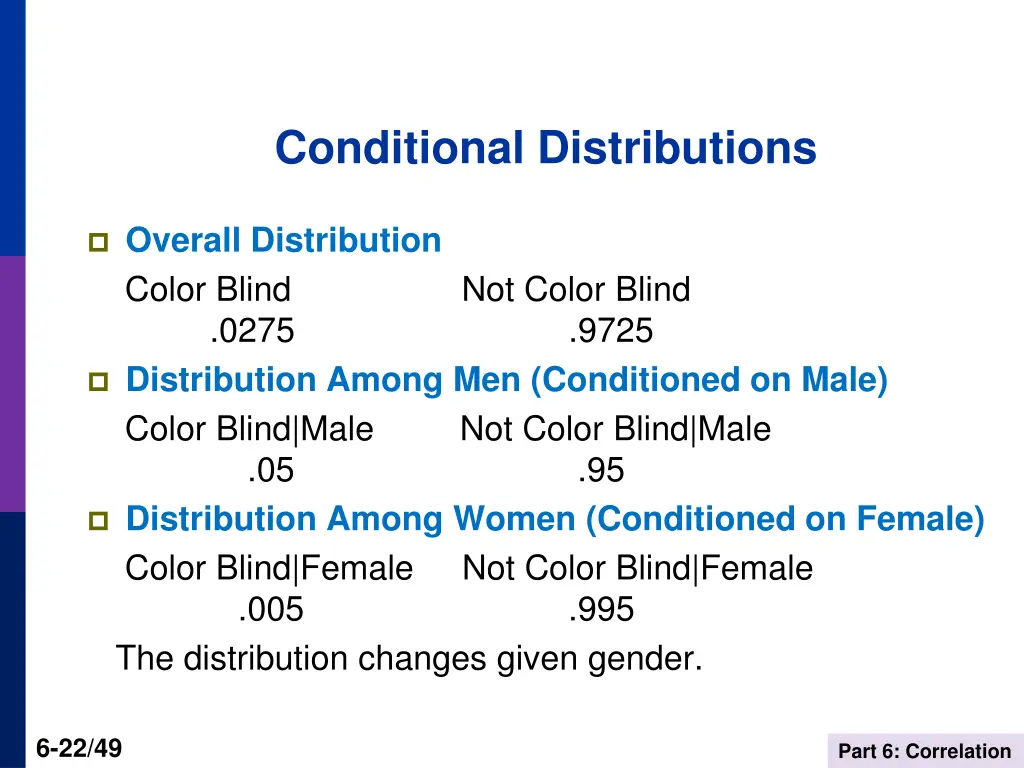
Conditional Distributions Marginal Distribution of Color Blindness Color Blind Not Color Blind .0275 .9725 Distribution Among Men (Conditioned on Male) Color Blind|Male Not Color Blind|Male .05 .95 Distribution Among Women (Conditioned on Female) Color Blind|Female Not Color Blind|Female .005 .995 The distributions for the two genders are different. The variables are dependent. 6-14/49 Part 6: Correlation
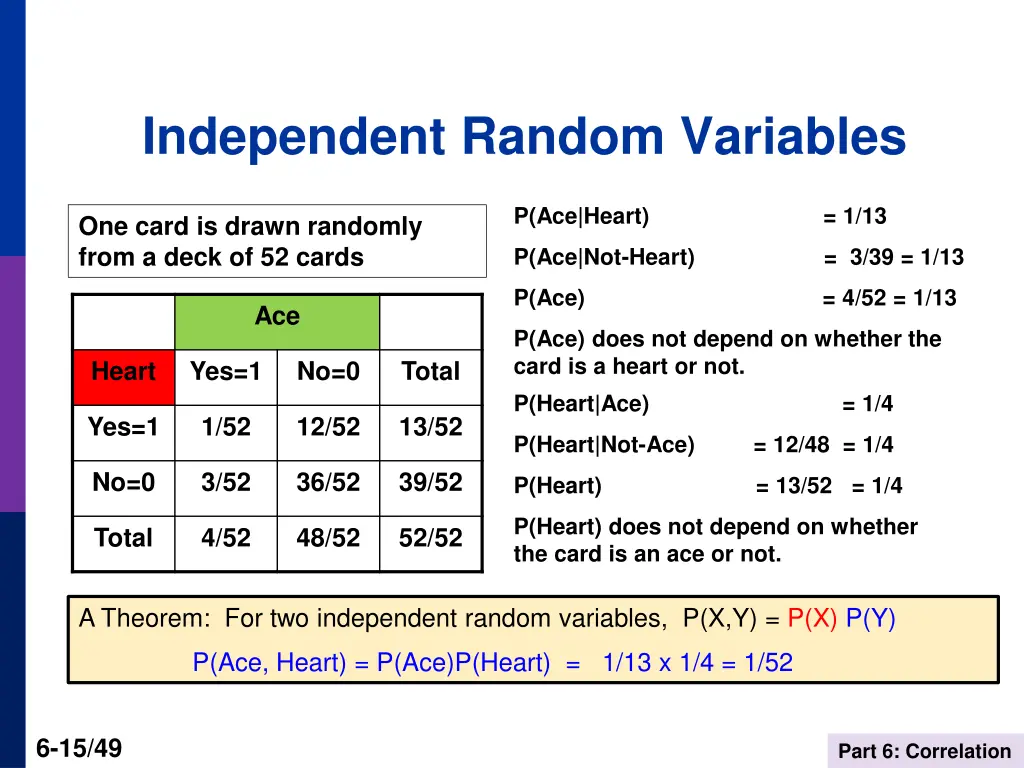
Independent Random Variables P(Ace|Heart) = 1/13 One card is drawn randomly from a deck of 52 cards P(Ace|Not-Heart) = 3/39 = 1/13 P(Ace) = 4/52 = 1/13 Ace P(Ace) does not depend on whether the card is a heart or not. P(Heart|Ace) Heart Yes=1 No=0 Total = 1/4 Yes=1 1/52 12/52 13/52 P(Heart|Not-Ace) = 12/48 = 1/4 No=0 3/52 36/52 39/52 P(Heart) = 13/52 = 1/4 P(Heart) does not depend on whether the card is an ace or not. Total 4/52 48/52 52/52 A Theorem: For two independent random variables, P(X,Y) = P(X) P(Y) P(Ace, Heart) = P(Ace)P(Heart) = 1/13 x 1/4 = 1/52 6-15/49 Part 6: Correlation
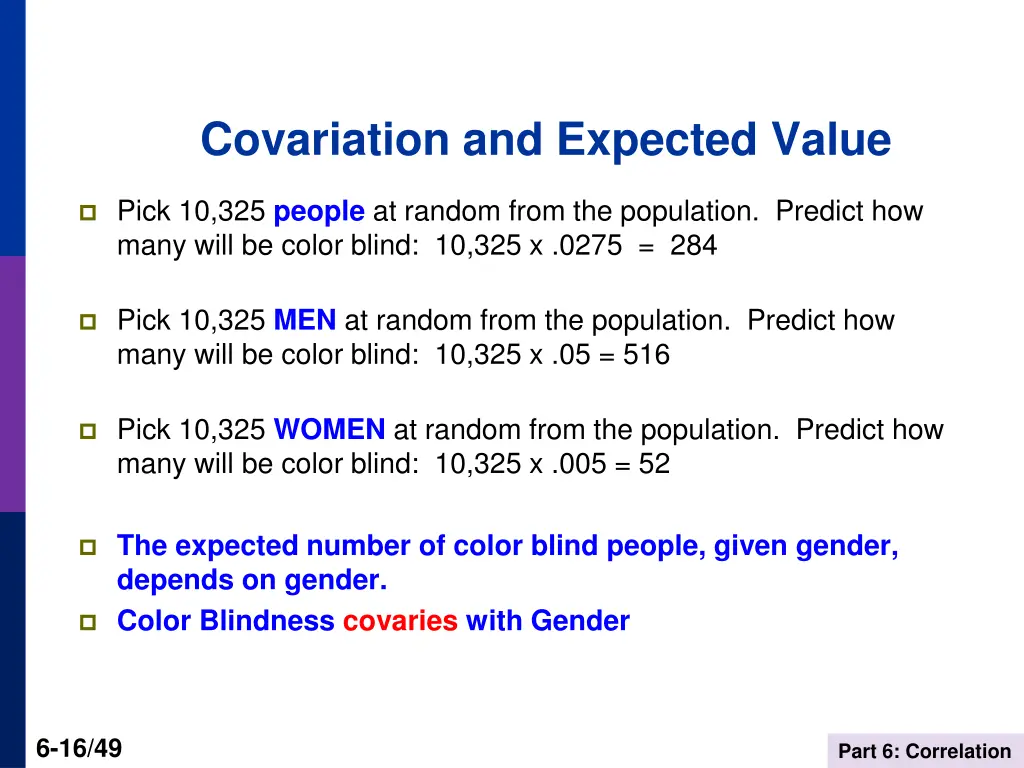
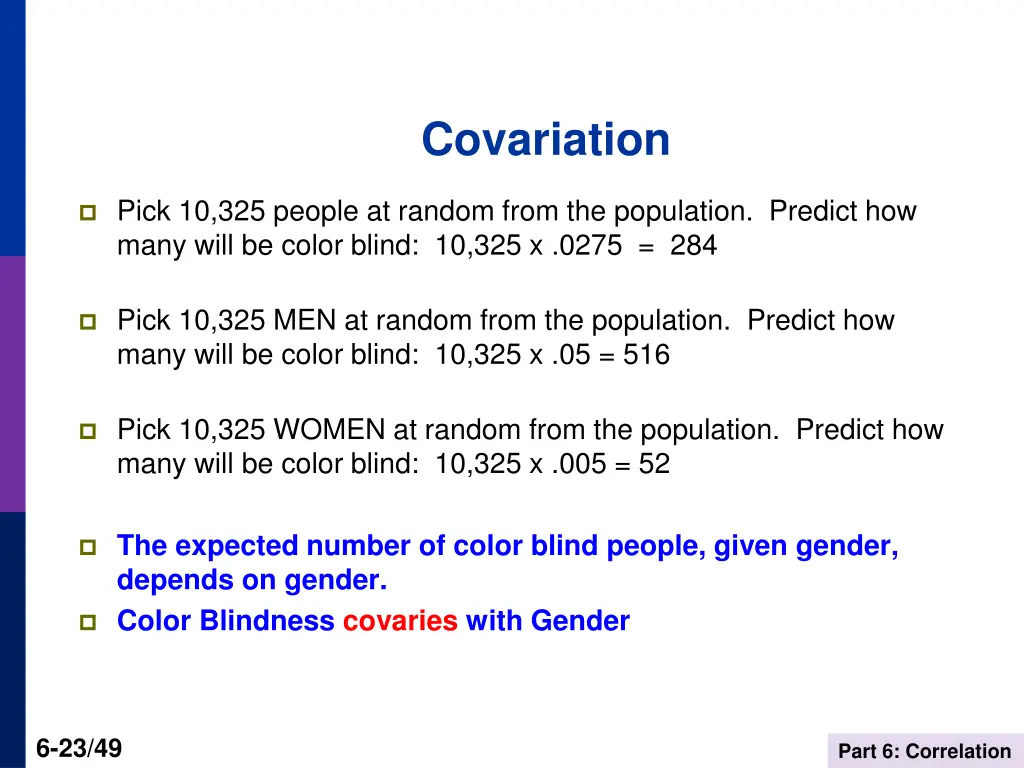
Covariation and Expected Value Pick 10,325 people at random from the population. Predict how many will be color blind: 10,325 x .0275 = 284 Pick 10,325 MEN at random from the population. Predict how many will be color blind: 10,325 x .05 = 516 Pick 10,325 WOMEN at random from the population. Predict how many will be color blind: 10,325 x .005 = 52 The expected number of color blind people, given gender, depends on gender. Color Blindness covaries with Gender 6-16/49 Part 6: Correlation
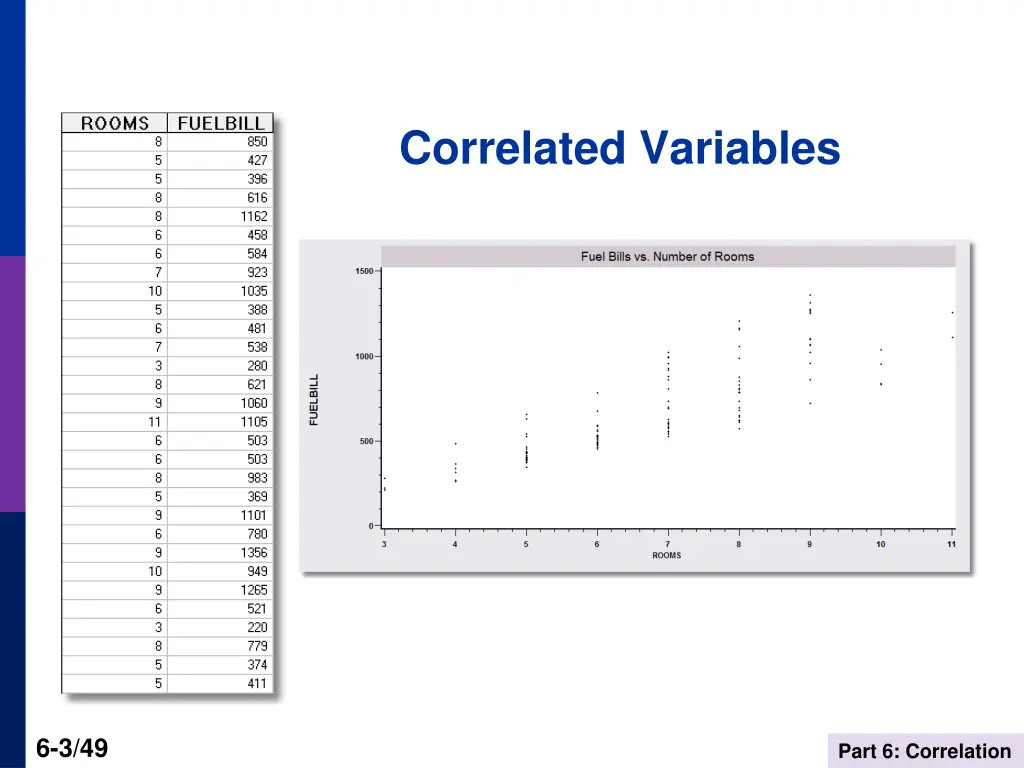
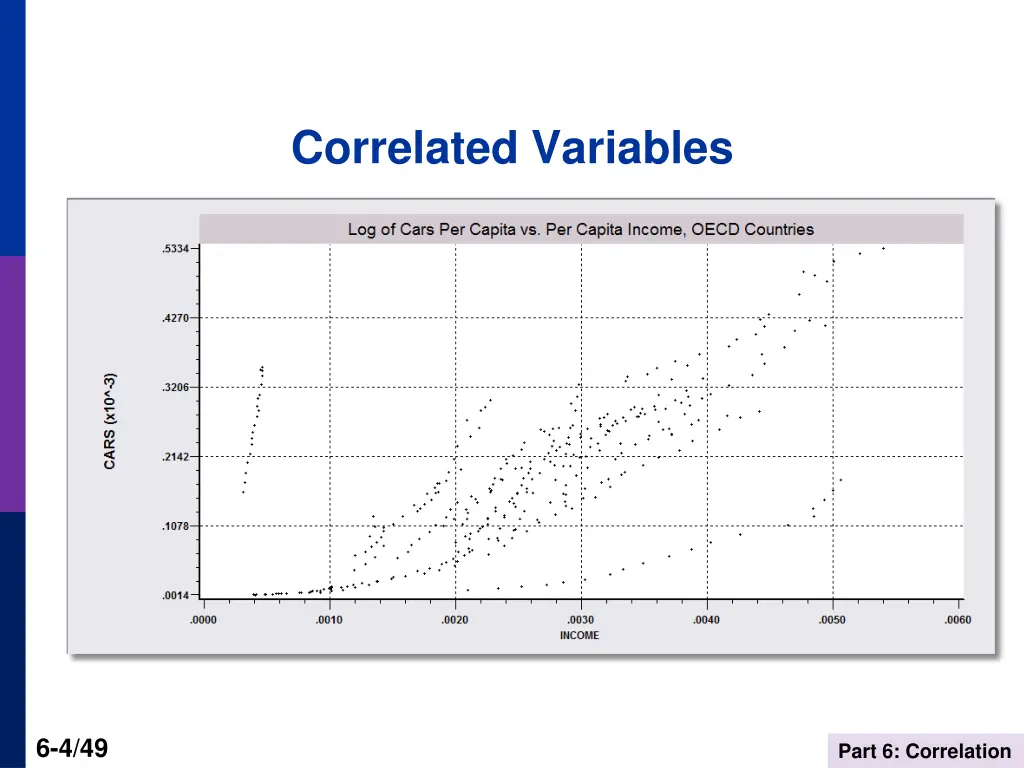
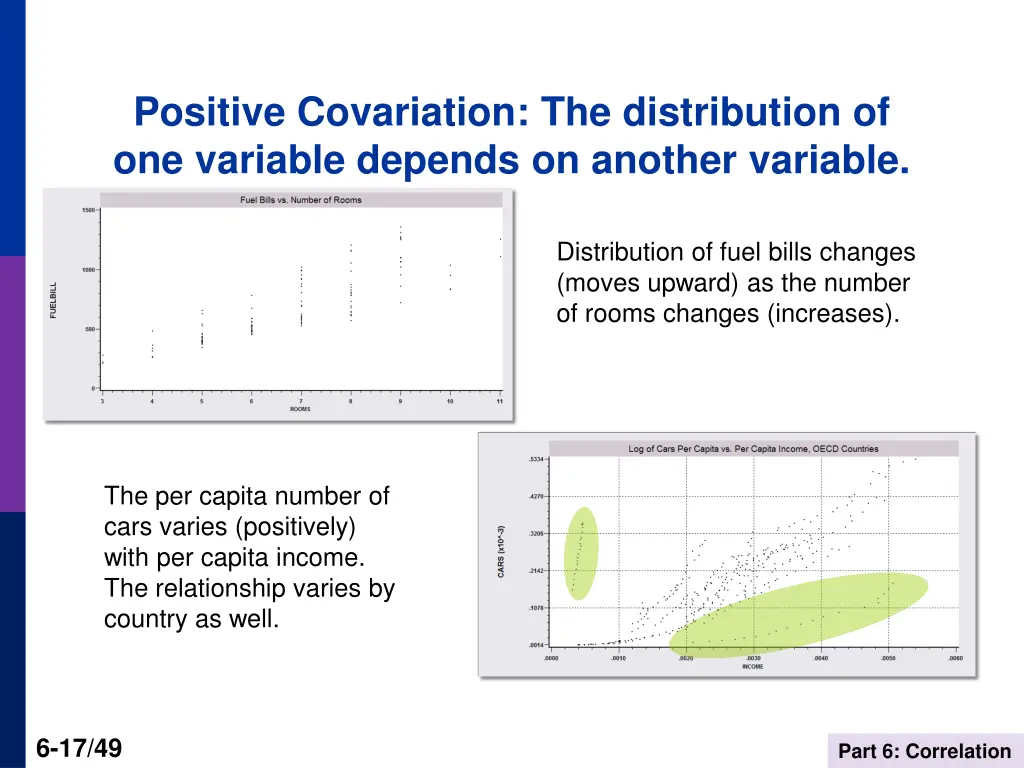
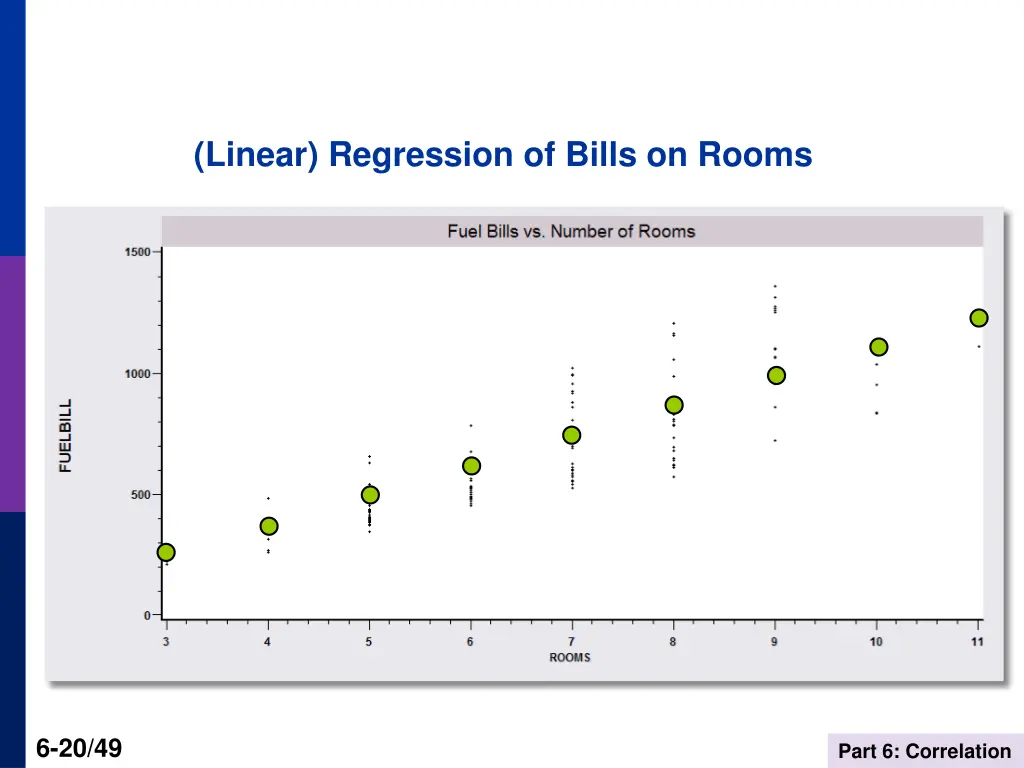
Positive Covariation: The distribution of one variable depends on another variable. Distribution of fuel bills changes (moves upward) as the number of rooms changes (increases). The per capita number of cars varies (positively) with per capita income. The relationship varies by country as well. 6-17/49 Part 6: Correlation
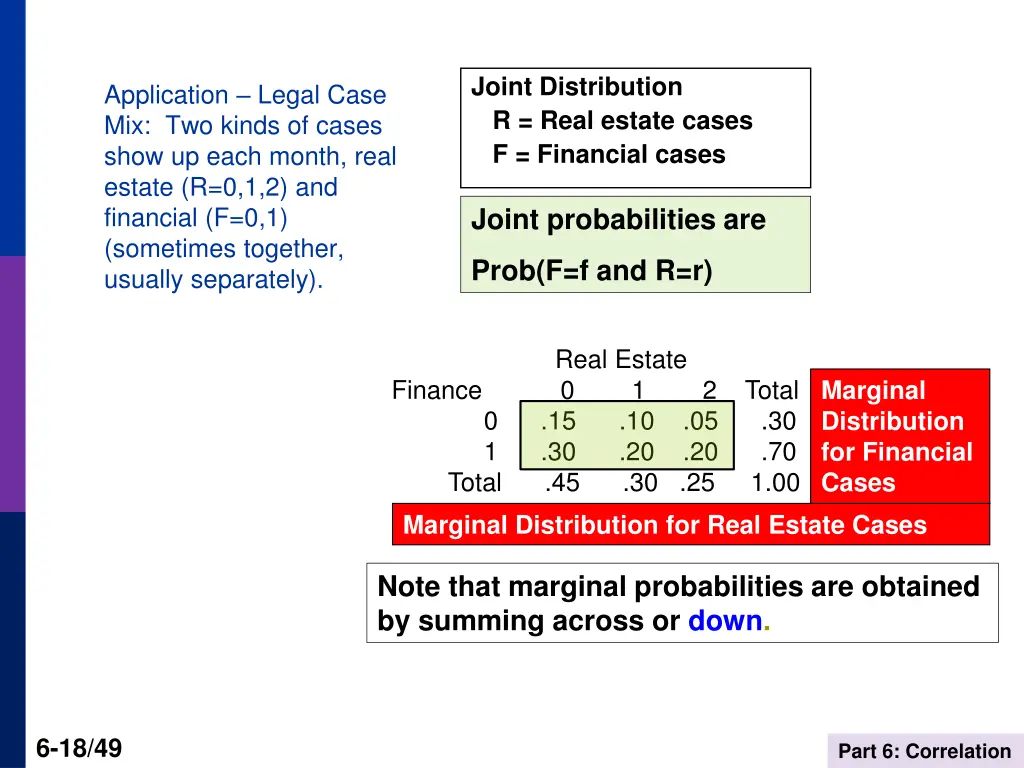
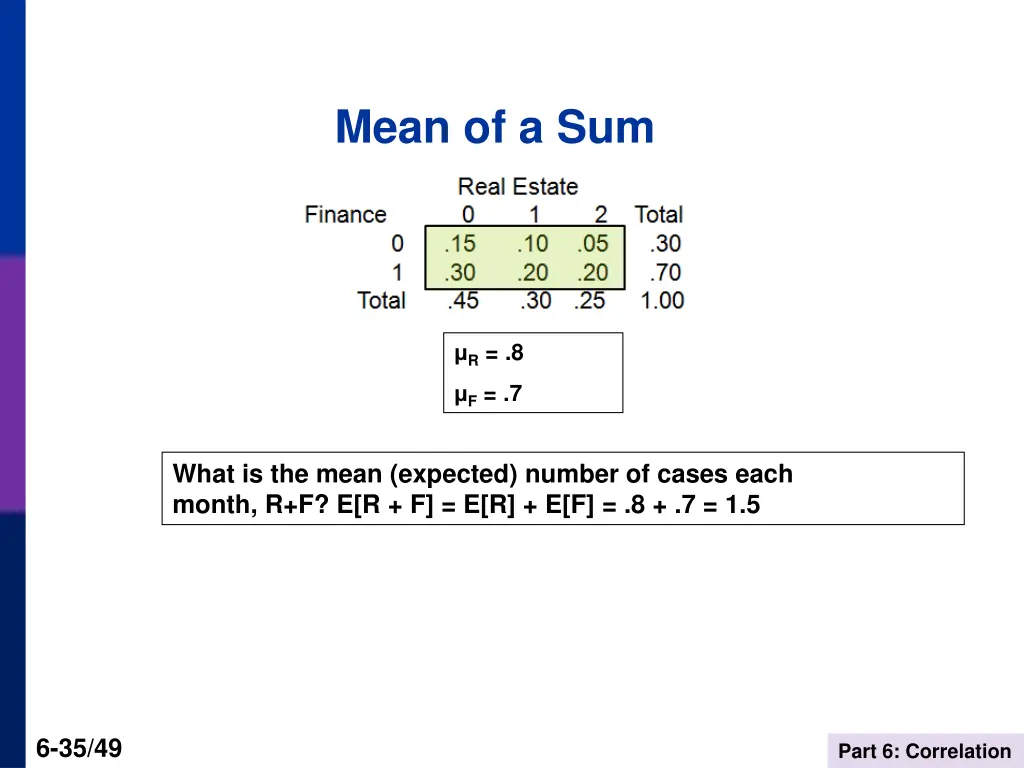
Joint Distribution R = Real estate cases F = Financial cases Application Legal Case Mix: Two kinds of cases show up each month, real estate (R=0,1,2) and financial (F=0,1) (sometimes together, usually separately). Joint probabilities are Prob(F=f and R=r) Real Estate Finance 0 1 2 Total 0 .15 .10 .05 .30 1 .30 .20 .20 .70 Total .45 .30 .25 1.00 Marginal Distribution for Financial Cases Marginal Distribution for Real Estate Cases Note that marginal probabilities are obtained by summing across or down. 6-18/49 Part 6: Correlation
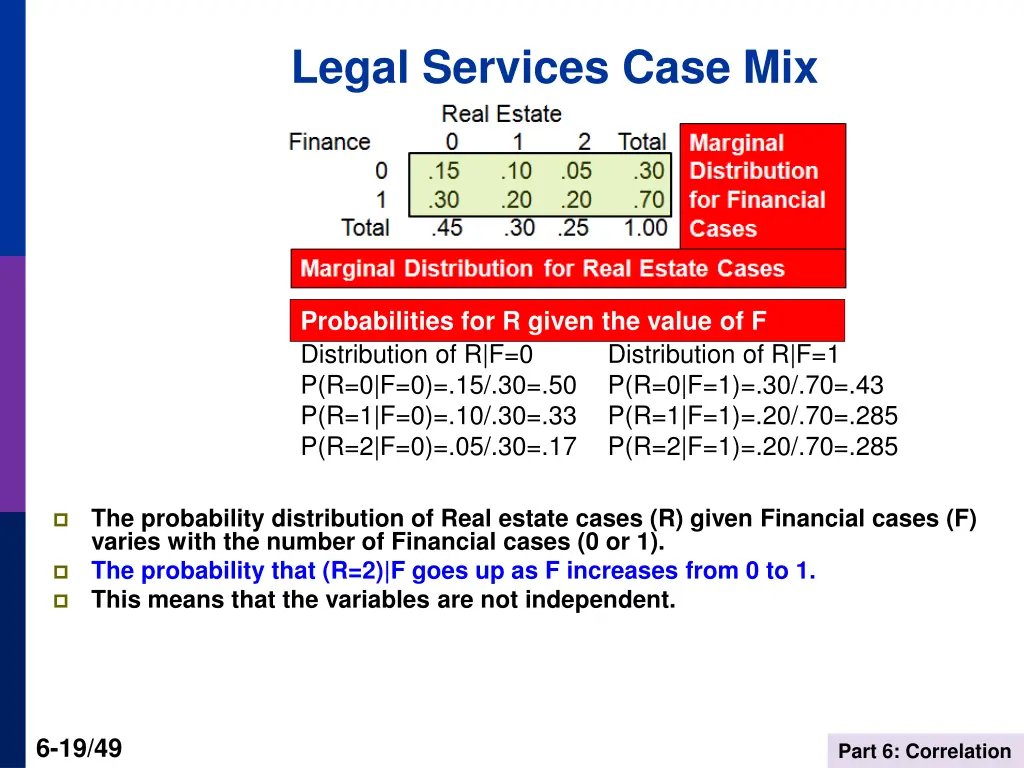
Legal Services Case Mix Probabilities for R given the value of F Distribution of R|F=0 P(R=0|F=0)=.15/.30=.50 P(R=1|F=0)=.10/.30=.33 P(R=2|F=0)=.05/.30=.17 Distribution of R|F=1 P(R=0|F=1)=.30/.70=.43 P(R=1|F=1)=.20/.70=.285 P(R=2|F=1)=.20/.70=.285 The probability distribution of Real estate cases (R) given Financial cases (F) varies with the number of Financial cases (0 or 1). The probability that (R=2)|F goes up as F increases from 0 to 1. This means that the variables are not independent. 6-19/49 Part 6: Correlation
(Linear) Regression of Bills on Rooms 6-20/49 Part 6: Correlation
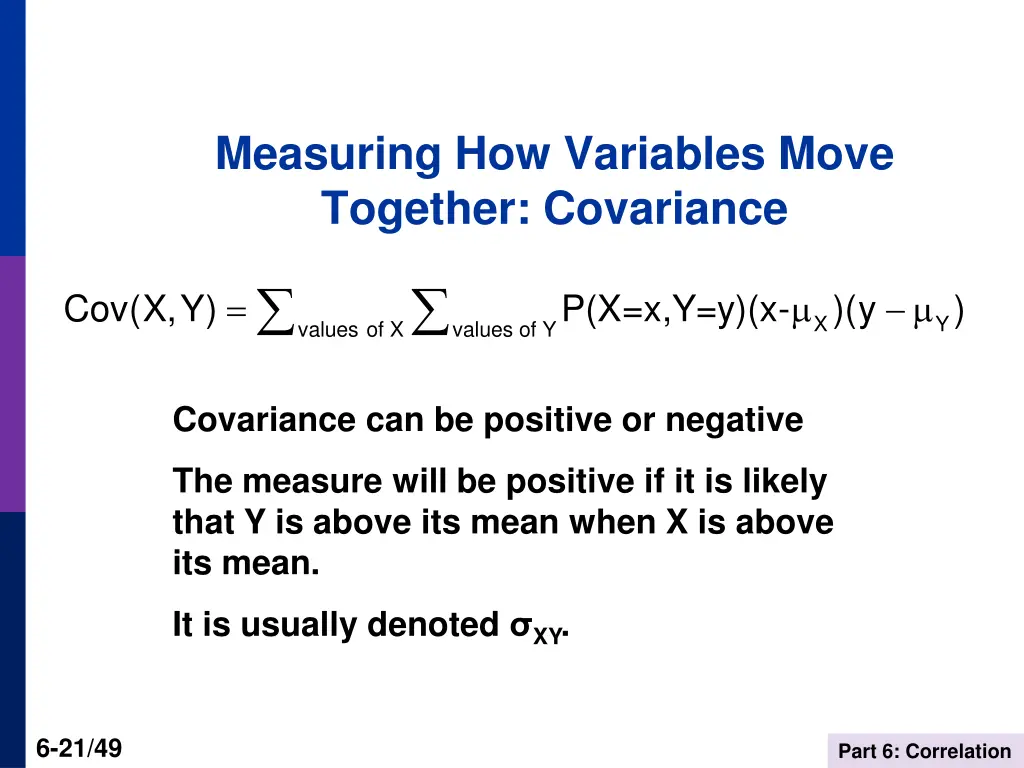
Measuring How Variables Move Together: Covariance = Cov(X,Y) P(X=x,Y=y)(x- )(y ) X Y values of X values of Y Covariance can be positive or negative The measure will be positive if it is likely that Y is above its mean when X is above its mean. It is usually denoted XY. 6-21/49 Part 6: Correlation
Conditional Distributions Overall Distribution Color Blind Not Color Blind .0275 .9725 Distribution Among Men (Conditioned on Male) Color Blind|Male Not Color Blind|Male .05 .95 Distribution Among Women (Conditioned on Female) Color Blind|Female Not Color Blind|Female .005 .995 The distribution changes given gender. 6-22/49 Part 6: Correlation
Covariation Pick 10,325 people at random from the population. Predict how many will be color blind: 10,325 x .0275 = 284 Pick 10,325 MEN at random from the population. Predict how many will be color blind: 10,325 x .05 = 516 Pick 10,325 WOMEN at random from the population. Predict how many will be color blind: 10,325 x .005 = 52 The expected number of color blind people, given gender, depends on gender. Color Blindness covaries with Gender 6-23/49 Part 6: Correlation
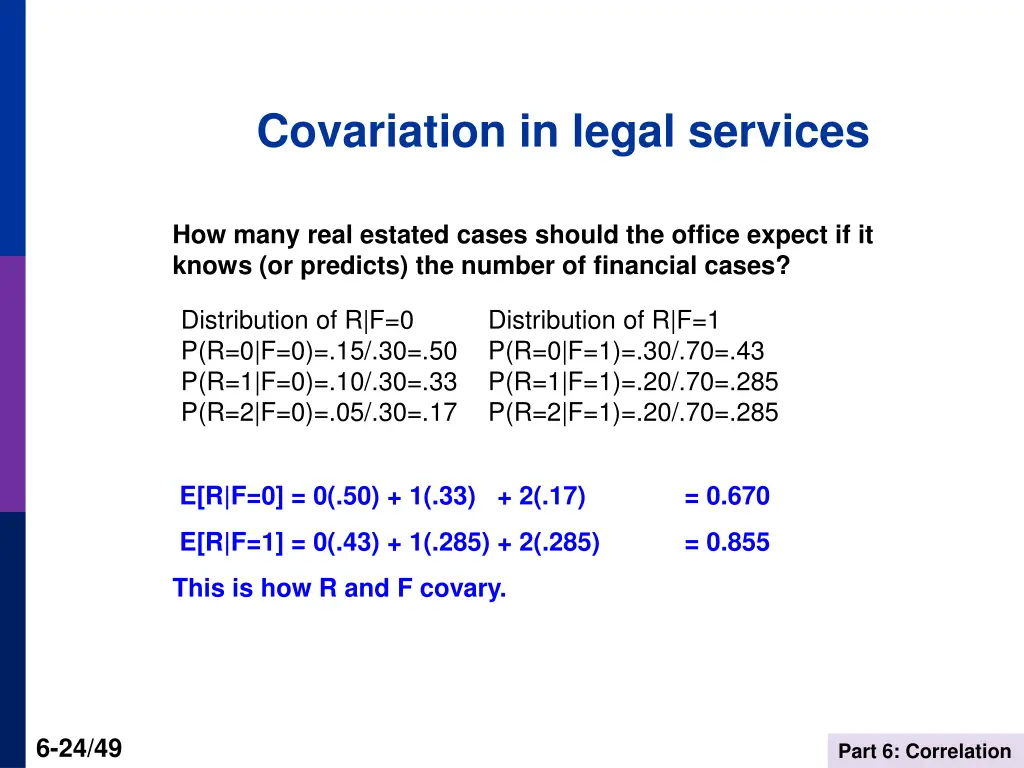
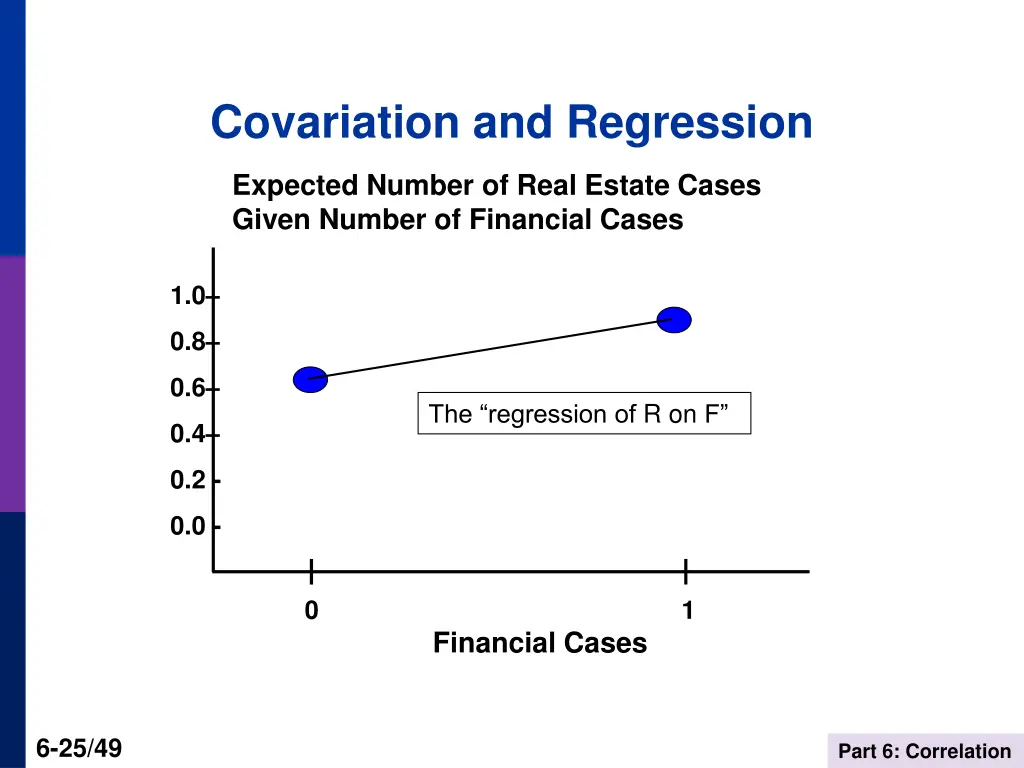
Covariation in legal services How many real estated cases should the office expect if it knows (or predicts) the number of financial cases? Distribution of R|F=0 P(R=0|F=0)=.15/.30=.50 P(R=1|F=0)=.10/.30=.33 P(R=2|F=0)=.05/.30=.17 Distribution of R|F=1 P(R=0|F=1)=.30/.70=.43 P(R=1|F=1)=.20/.70=.285 P(R=2|F=1)=.20/.70=.285 E[R|F=0] = 0(.50) + 1(.33) + 2(.17) = 0.670 E[R|F=1] = 0(.43) + 1(.285) + 2(.285) = 0.855 This is how R and F covary. 6-24/49 Part 6: Correlation
Covariation and Regression Expected Number of Real Estate Cases Given Number of Financial Cases 1.0 0.8 0.6 The regression of R on F 0.4 0.2 - 0.0 - 0 Financial Cases 1 6-25/49 Part 6: Correlation
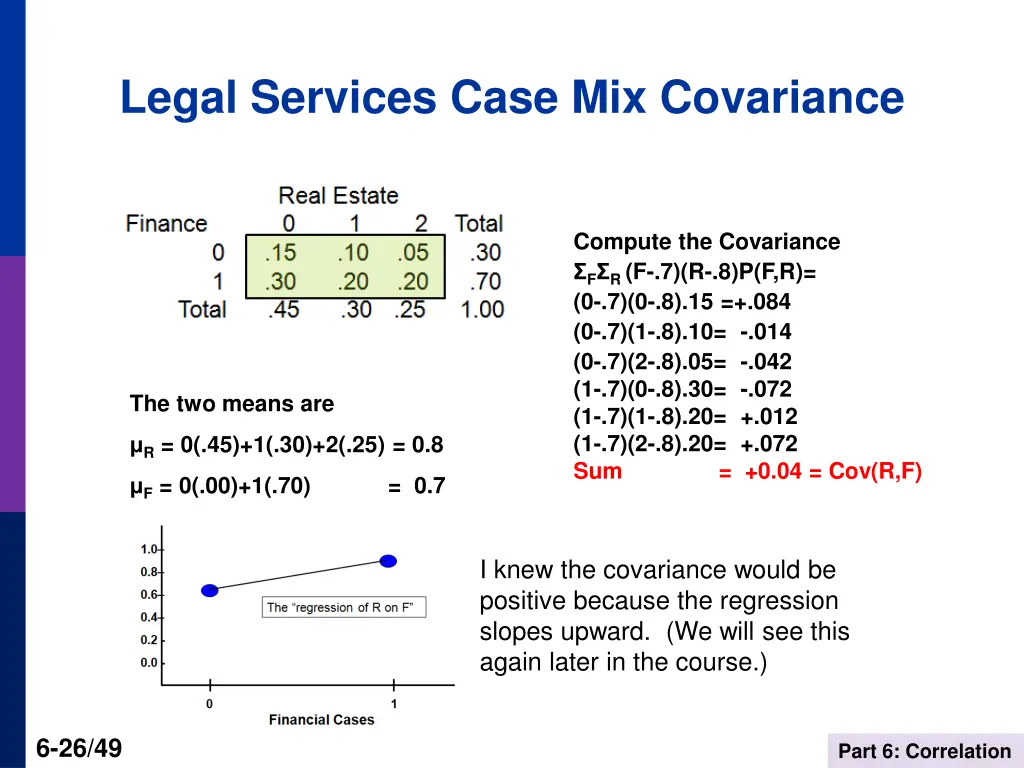
Legal Services Case Mix Covariance Compute the Covariance F R (F-.7)(R-.8)P(F,R)= (0-.7)(0-.8).15 =+.084 (0-.7)(1-.8).10= -.014 (0-.7)(2-.8).05= -.042 (1-.7)(0-.8).30= -.072 (1-.7)(1-.8).20= +.012 (1-.7)(2-.8).20= +.072 Sum = +0.04 = Cov(R,F) The two means are R = 0(.45)+1(.30)+2(.25) = 0.8 F = 0(.00)+1(.70) = 0.7 I knew the covariance would be positive because the regression slopes upward. (We will see this again later in the course.) 6-26/49 Part 6: Correlation
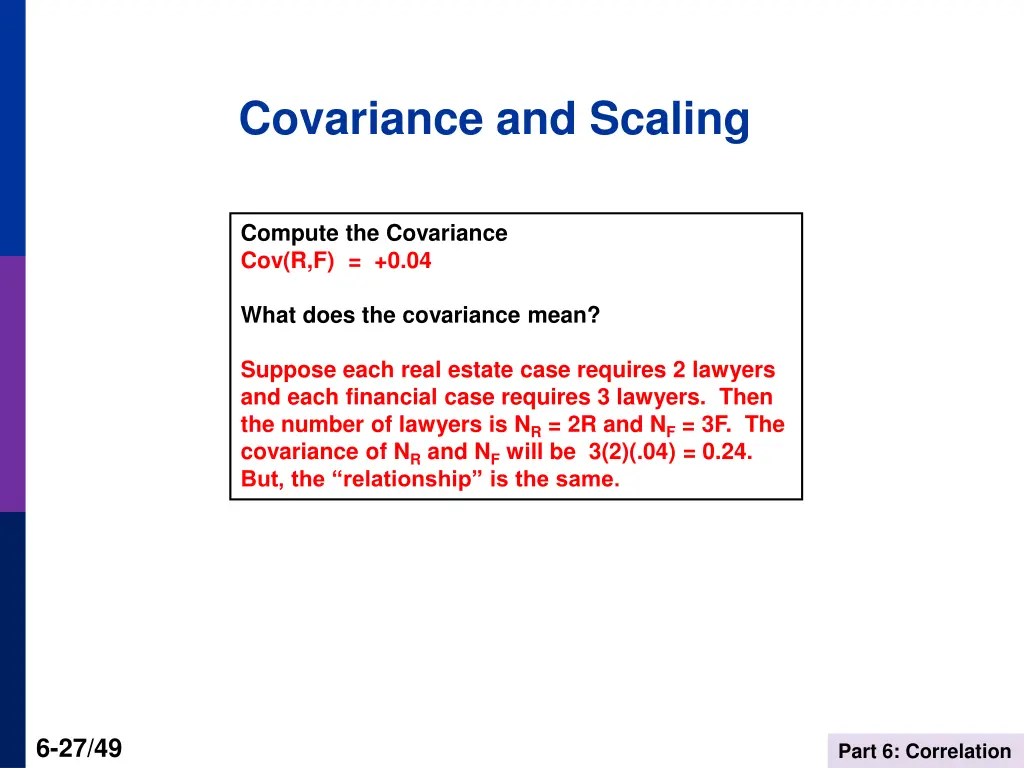
Covariance and Scaling Compute the Covariance Cov(R,F) = +0.04 What does the covariance mean? Suppose each real estate case requires 2 lawyers and each financial case requires 3 lawyers. Then the number of lawyers is NR = 2R and NF = 3F. The covariance of NR and NF will be 3(2)(.04) = 0.24. But, the relationship is the same. 6-27/49 Part 6: Correlation
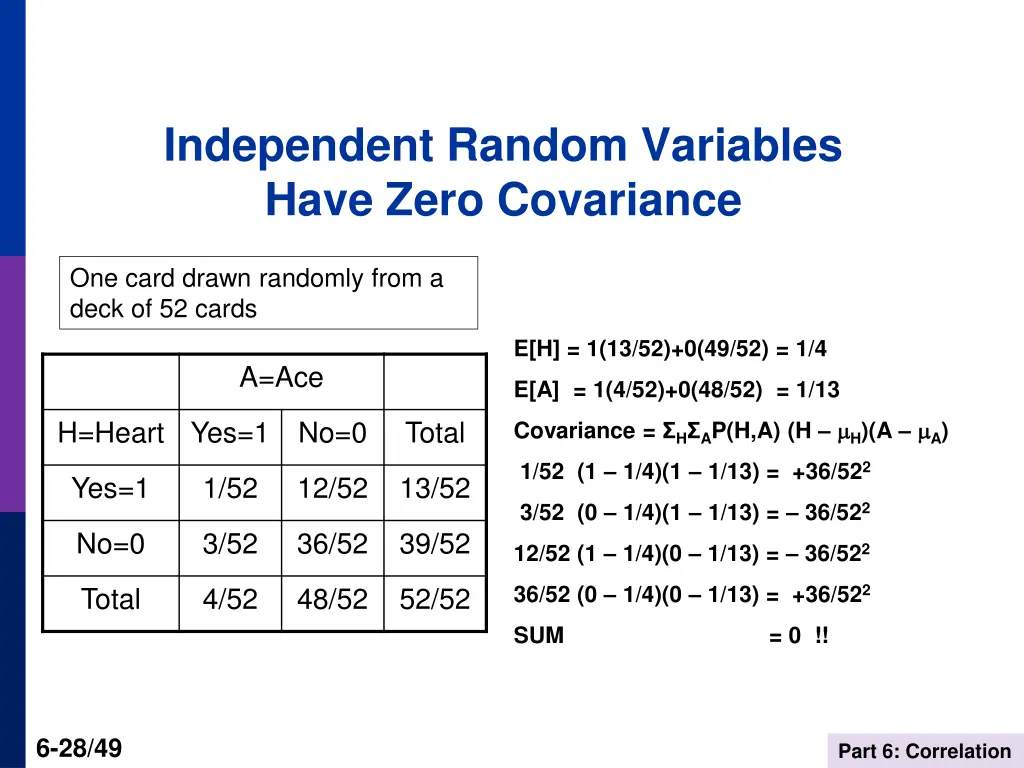
Independent Random Variables Have Zero Covariance One card drawn randomly from a deck of 52 cards E[H] = 1(13/52)+0(49/52) = 1/4 A=Ace E[A] = 1(4/52)+0(48/52) = 1/13 H=Heart Yes=1 No=0 Total Covariance = H AP(H,A) (H H)(A A) 1/52 (1 1/4)(1 1/13) = +36/522 Yes=1 1/52 12/52 13/52 3/52 (0 1/4)(1 1/13) = 36/522 No=0 3/52 36/52 39/52 12/52 (1 1/4)(0 1/13) = 36/522 36/52 (0 1/4)(0 1/13) = +36/522 Total 4/52 48/52 52/52 SUM = 0 !! 6-28/49 Part 6: Correlation
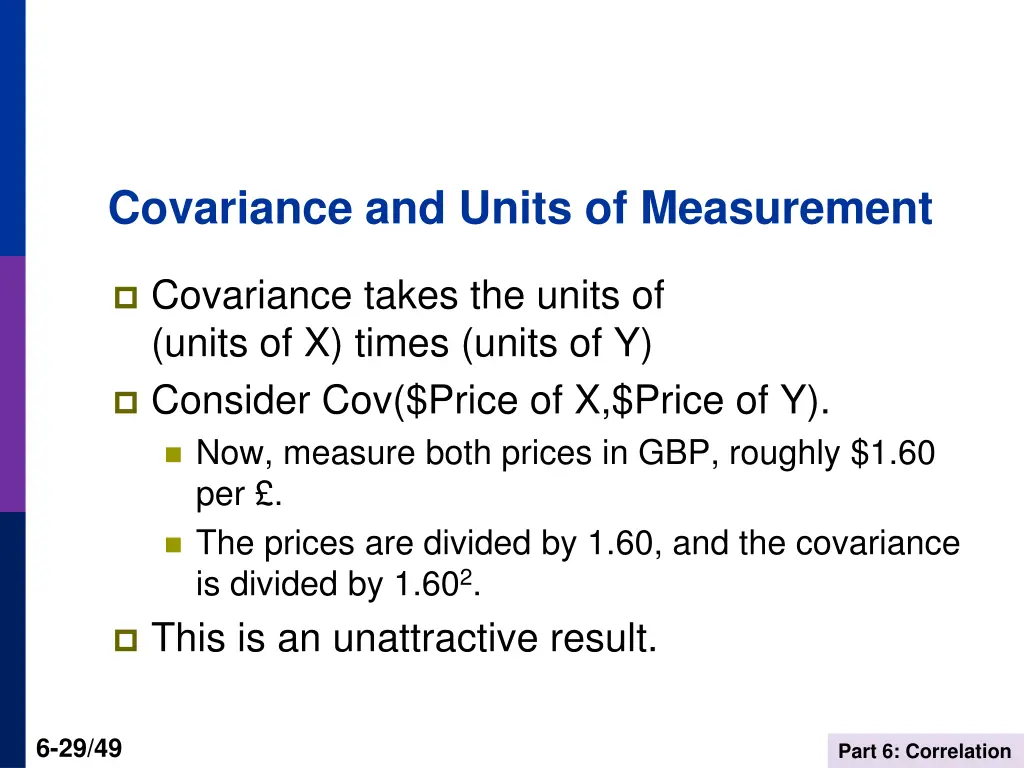
Covariance and Units of Measurement Covariance takes the units of (units of X) times (units of Y) Consider Cov($Price of X,$Price of Y). Now, measure both prices in GBP, roughly $1.60 per . The prices are divided by 1.60, and the covariance is divided by 1.602. This is an unattractive result. 6-29/49 Part 6: Correlation
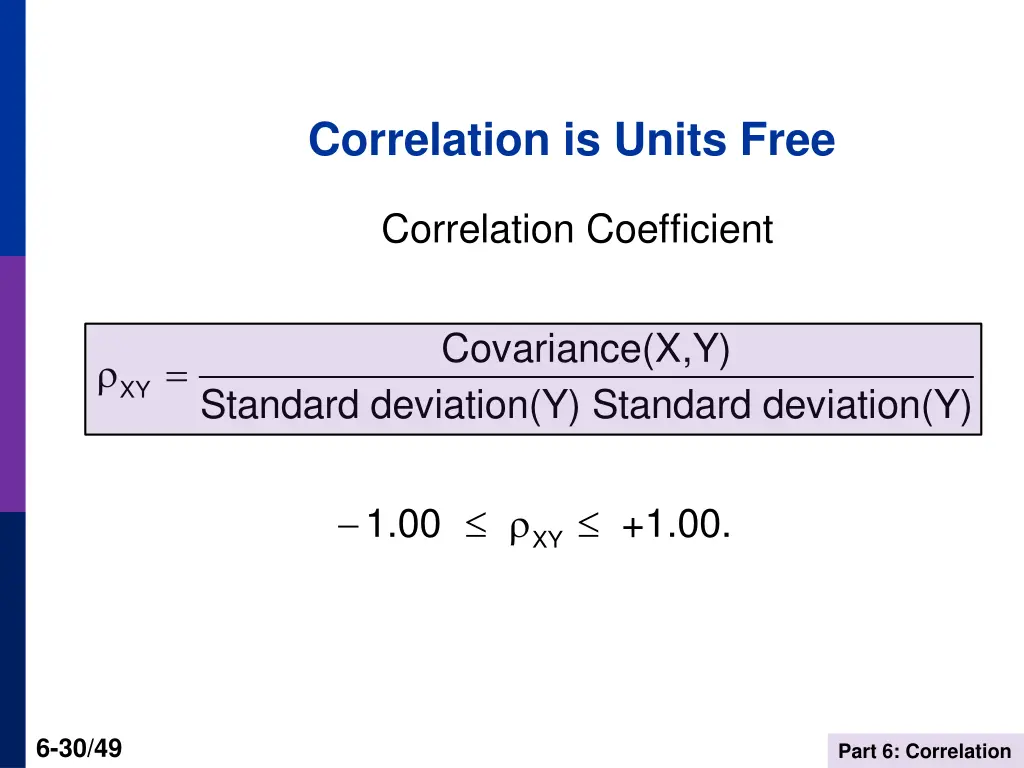
Correlation is Units Free Correlation Coefficient Covariance(X,Y) = XY Standard deviation(Y) Standard deviation(Y) 1.00 +1.00. XY 6-30/49 Part 6: Correlation
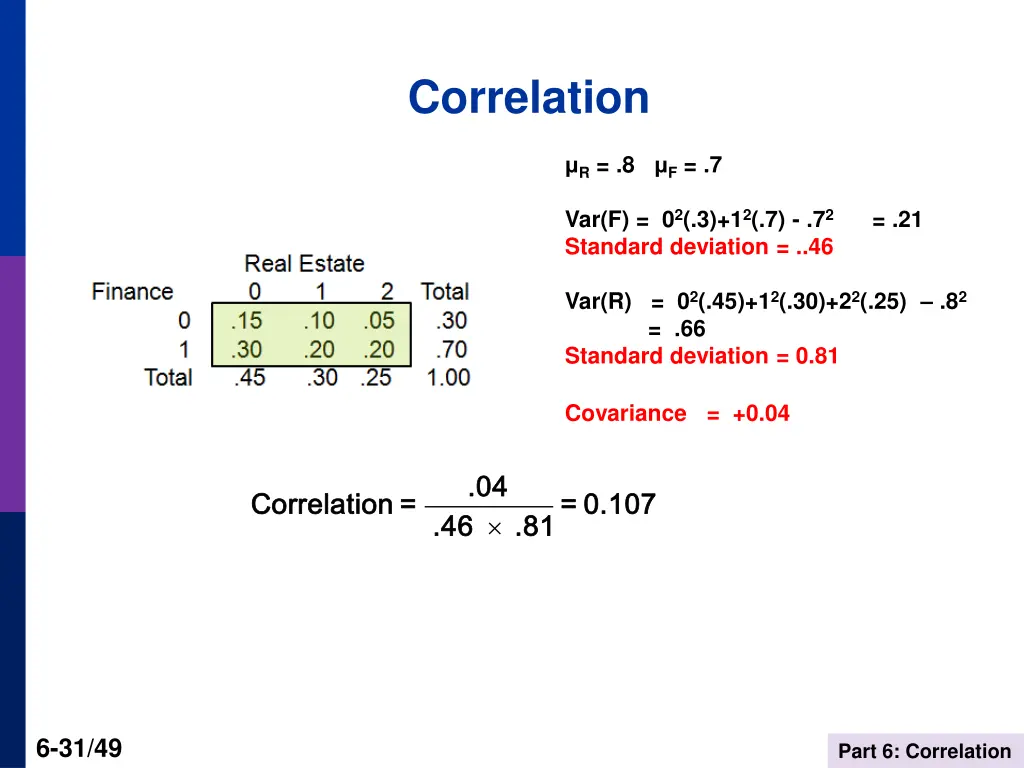
Correlation R = .8 F = .7 Var(F) = 02(.3)+12(.7) - .72 = .21 Standard deviation = ..46 Var(R) = 02(.45)+12(.30)+22(.25) .82 = .66 Standard deviation = 0.81 Covariance = +0.04 .04 .04 Correlation = Correlation = = 0.107 = 0.107 .46 .81 .46 .81 6-31/49 Part 6: Correlation
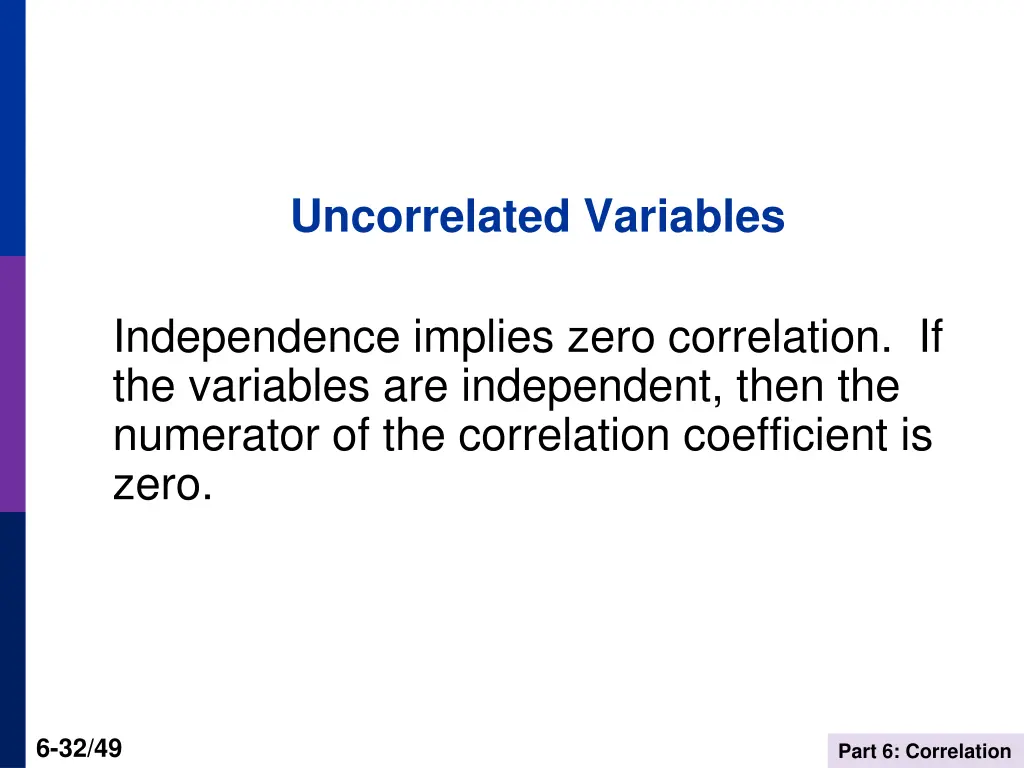
Uncorrelated Variables Independence implies zero correlation. If the variables are independent, then the numerator of the correlation coefficient is zero. 6-32/49 Part 6: Correlation
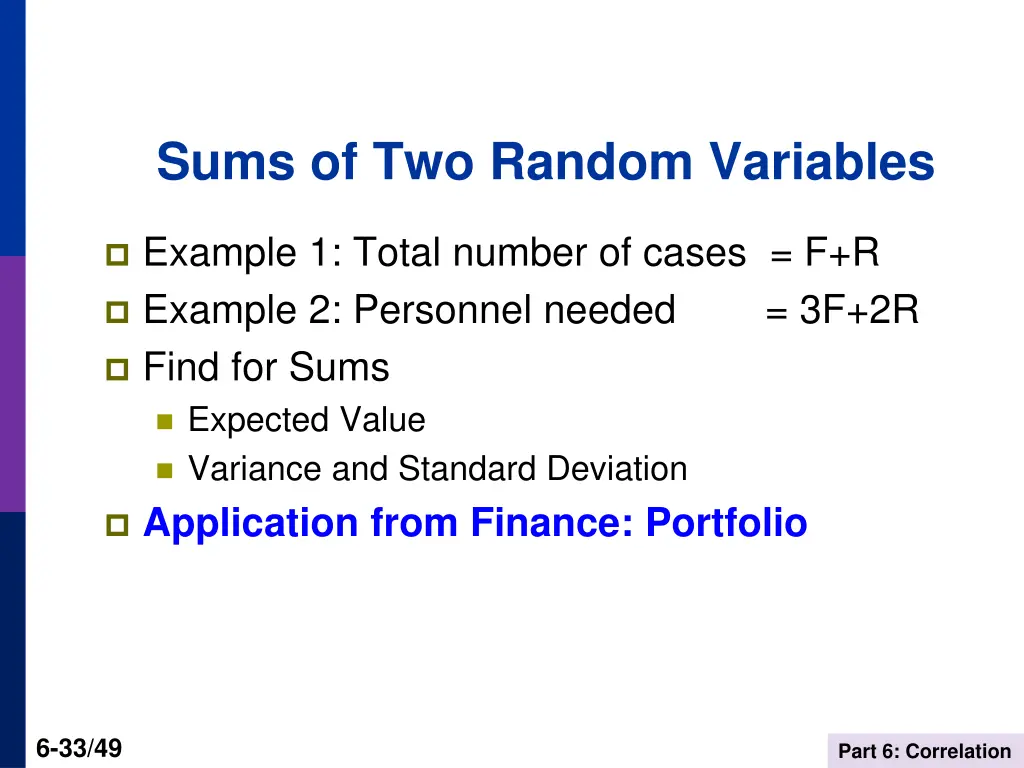
Sums of Two Random Variables Example 1: Total number of cases = F+R Example 2: Personnel needed Find for Sums Expected Value Variance and Standard Deviation Application from Finance: Portfolio = 3F+2R 6-33/49 Part 6: Correlation
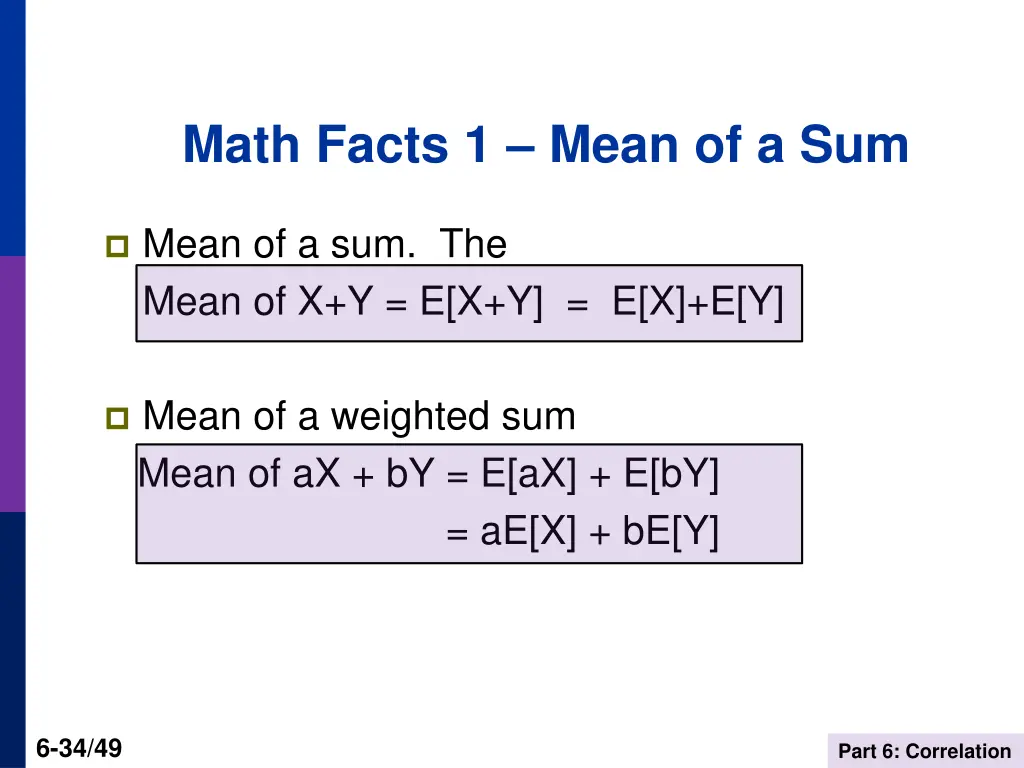
Math Facts 1 Mean of a Sum Mean of a sum. The Mean of X+Y = E[X+Y] = E[X]+E[Y] Mean of a weighted sum Mean of aX + bY = E[aX] + E[bY] = aE[X] + bE[Y] 6-34/49 Part 6: Correlation
Mean of a Sum R = .8 F = .7 What is the mean (expected) number of cases each month, R+F? E[R + F] = E[R] + E[F] = .8 + .7 = 1.5 6-35/49 Part 6: Correlation
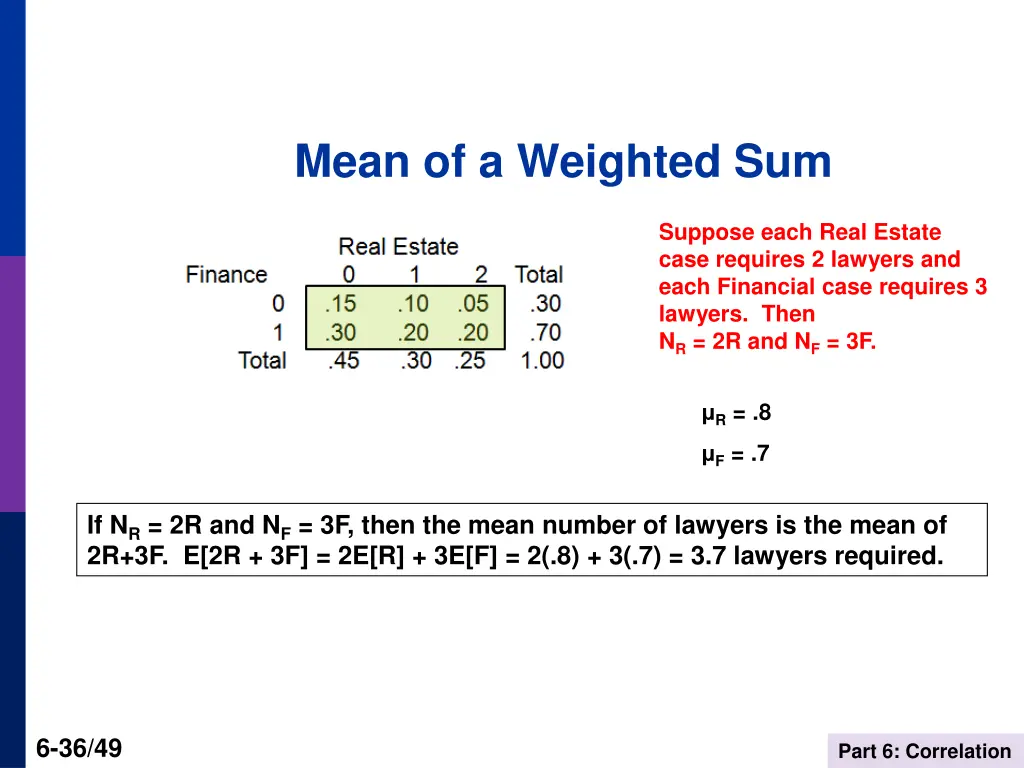
Mean of a Weighted Sum Suppose each Real Estate case requires 2 lawyers and each Financial case requires 3 lawyers. Then NR = 2R and NF = 3F. R = .8 F = .7 If NR = 2R and NF = 3F, then the mean number of lawyers is the mean of 2R+3F. E[2R + 3F] = 2E[R] + 3E[F] = 2(.8) + 3(.7) = 3.7 lawyers required. 6-36/49 Part 6: Correlation
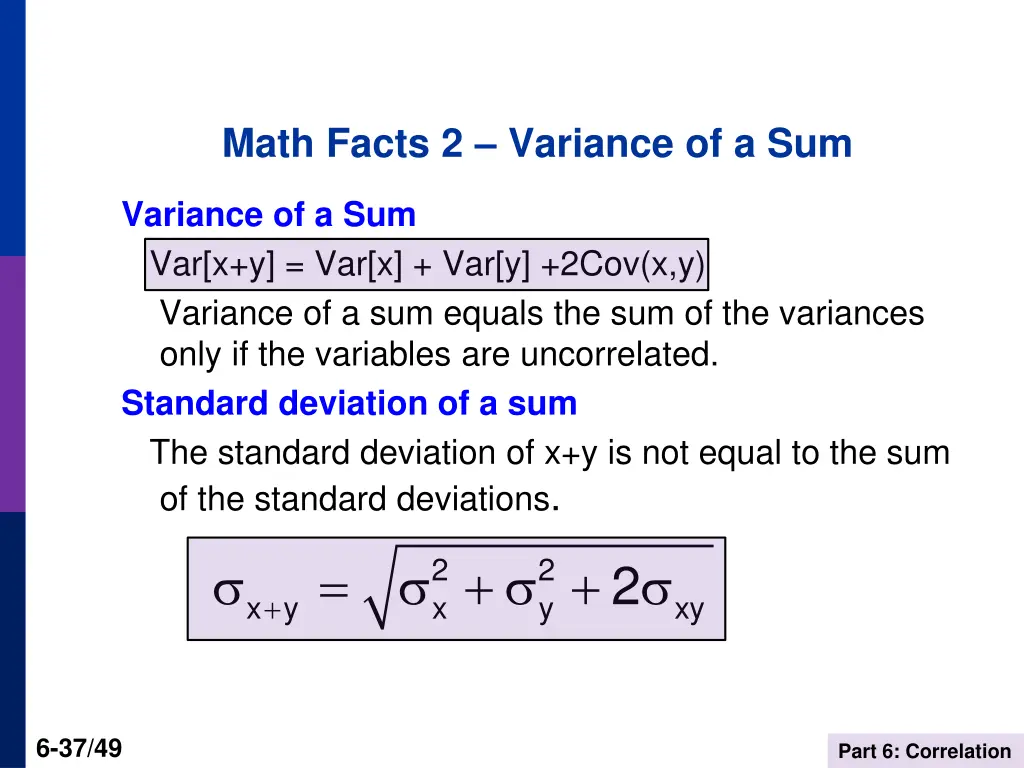
Math Facts 2 Variance of a Sum Variance of a Sum Var[x+y] = Var[x] + Var[y] +2Cov(x,y) Variance of a sum equals the sum of the variances only if the variables are uncorrelated. Standard deviation of a sum The standard deviation of x+y is not equal to the sum of the standard deviations. 2 2 x y x y + = + + 2 xy 6-37/49 Part 6: Correlation
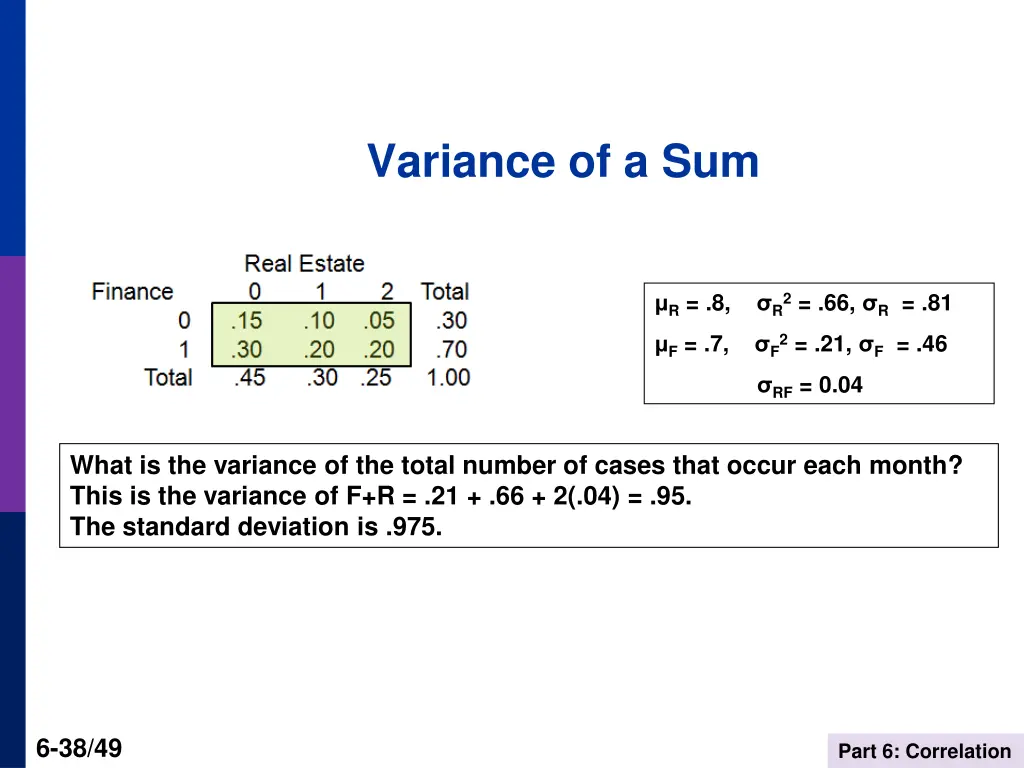
Variance of a Sum R = .8, R2 = .66, R = .81 F = .7, F2 = .21, F = .46 RF = 0.04 What is the variance of the total number of cases that occur each month? This is the variance of F+R = .21 + .66 + 2(.04) = .95. The standard deviation is .975. 6-38/49 Part 6: Correlation
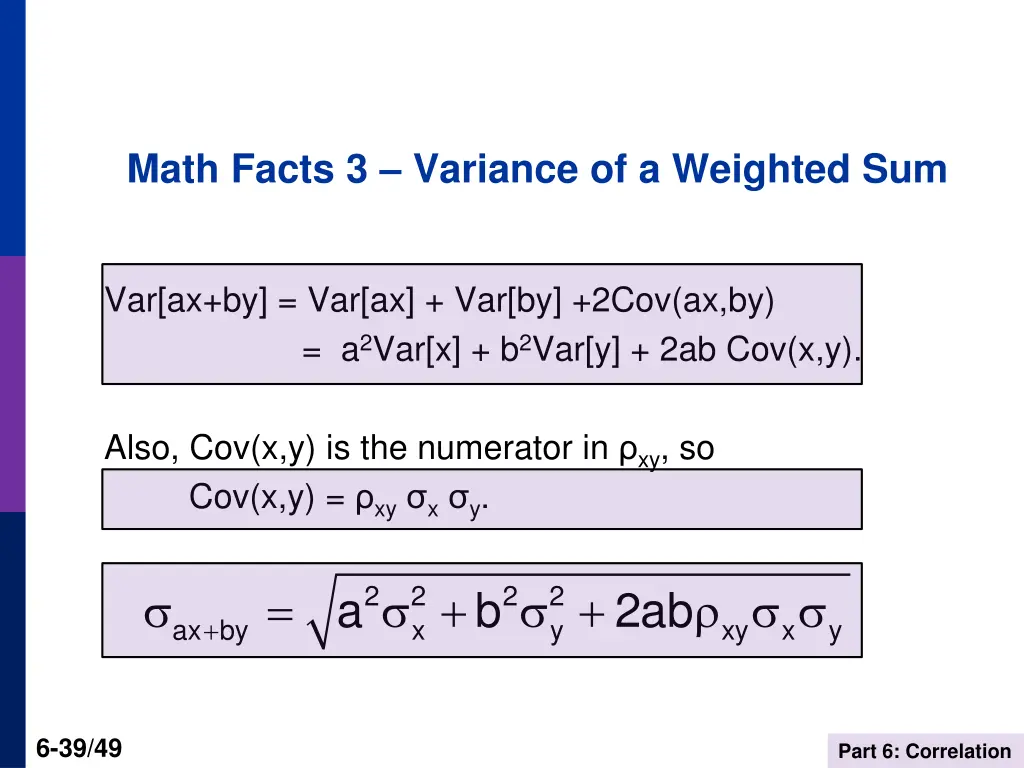
Math Facts 3 Variance of a Weighted Sum Var[ax+by] = Var[ax] + Var[by] +2Cov(ax,by) = a2Var[x] + b2Var[y] + 2ab Cov(x,y). Also, Cov(x,y) is the numerator in xy, so Cov(x,y) = xy x y. = + + 2 2 x 2 2 y a b 2ab ax by + xy x y 6-39/49 Part 6: Correlation
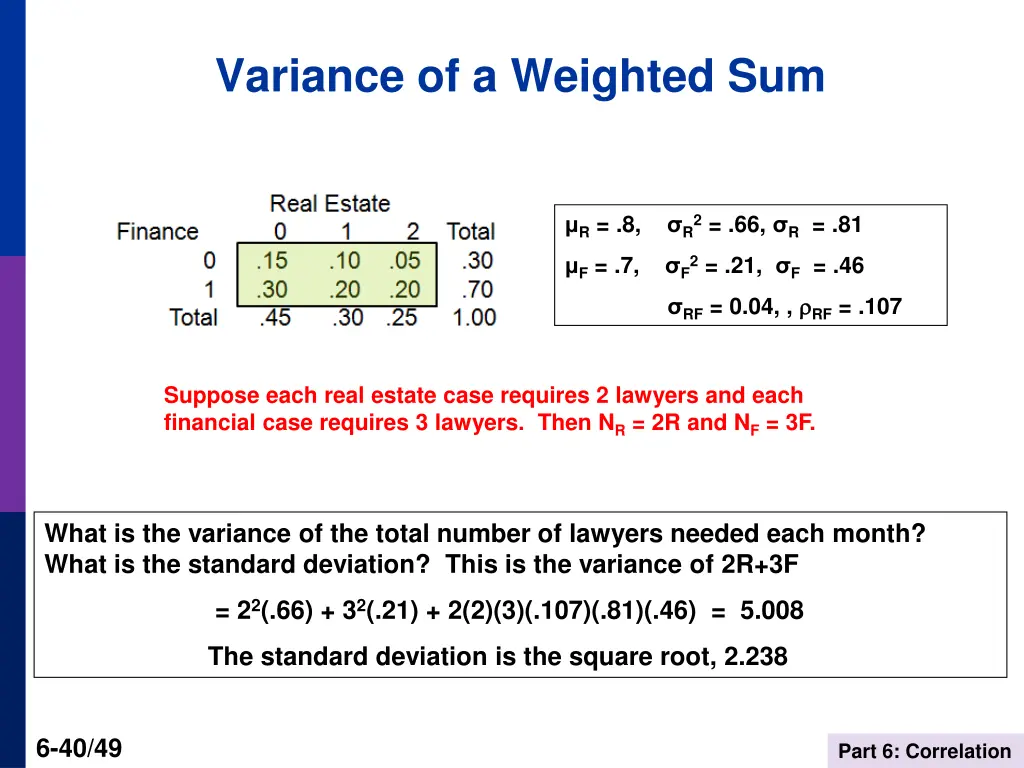
Variance of a Weighted Sum R = .8, R2 = .66, R = .81 F = .7, F2 = .21, F = .46 RF = 0.04, , RF = .107 Suppose each real estate case requires 2 lawyers and each financial case requires 3 lawyers. Then NR = 2R and NF = 3F. What is the variance of the total number of lawyers needed each month? What is the standard deviation? This is the variance of 2R+3F = 22(.66) + 32(.21) + 2(2)(3)(.107)(.81)(.46) = 5.008 The standard deviation is the square root, 2.238 6-40/49 Part 6: Correlation
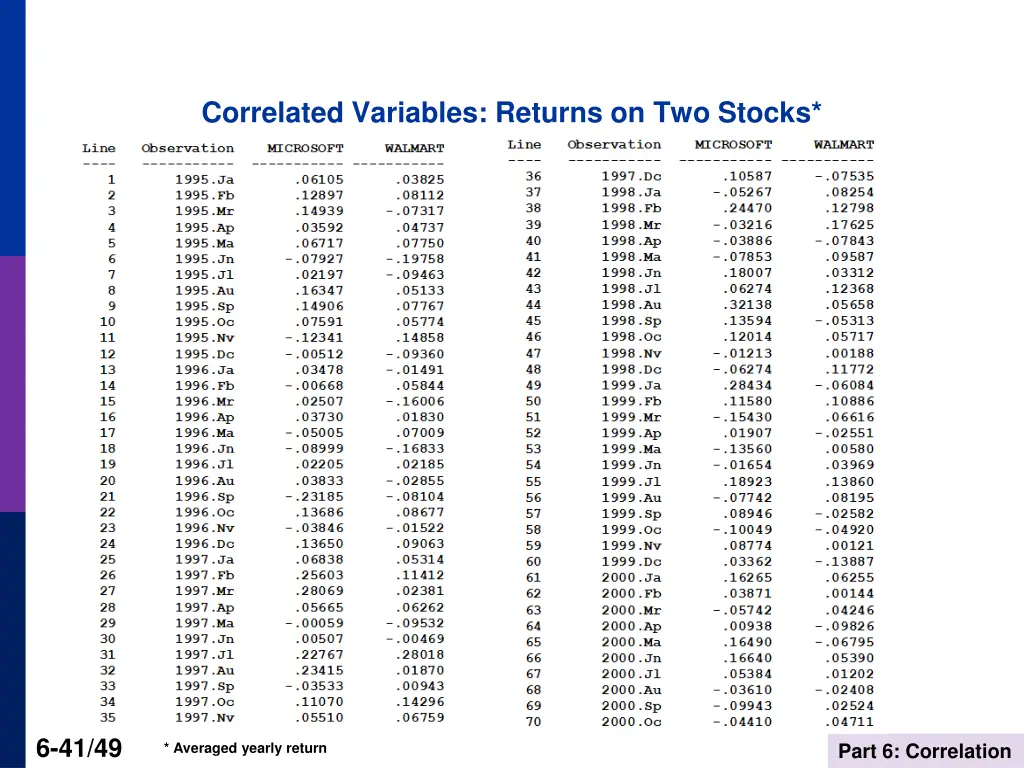
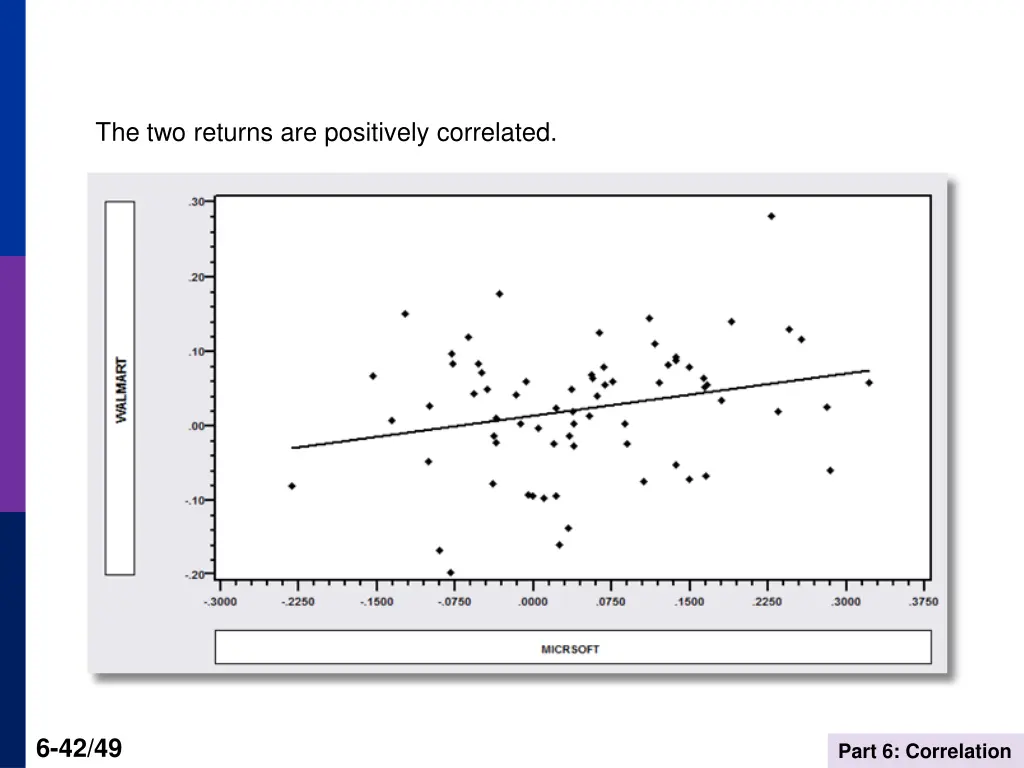
Correlated Variables: Returns on Two Stocks* 6-41/49 Part 6: Correlation * Averaged yearly return
The two returns are positively correlated. 6-42/49 Part 6: Correlation
6-43/49 Part 6: Correlation
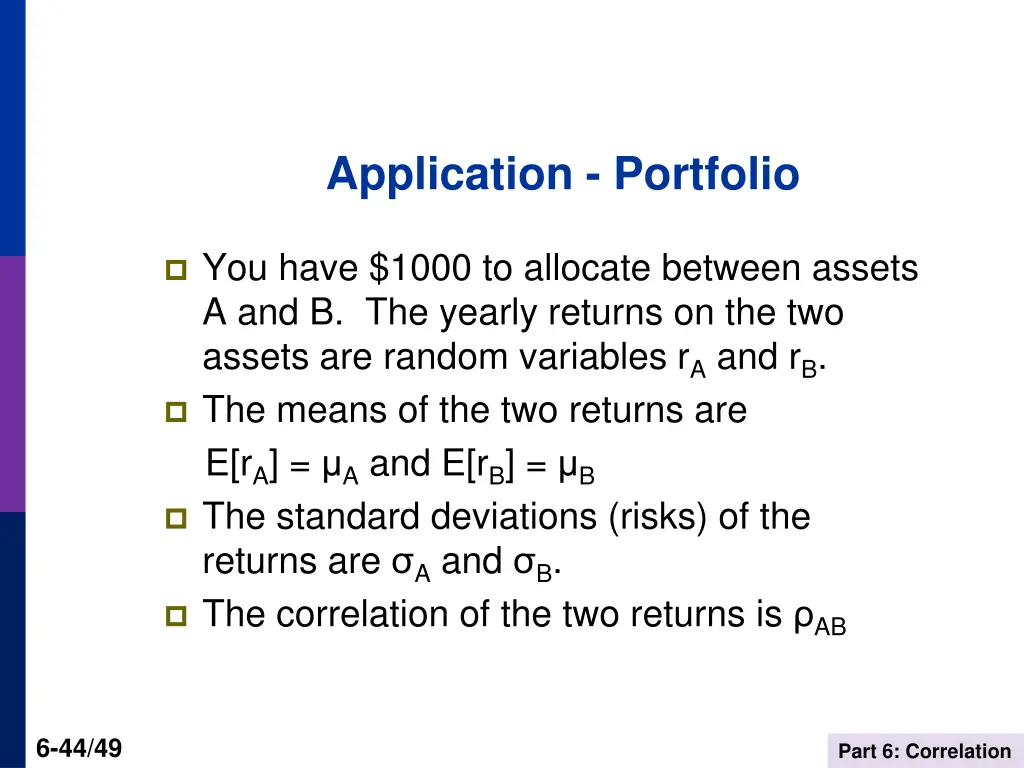
Application - Portfolio You have $1000 to allocate between assets A and B. The yearly returns on the two assets are random variables rA and rB. The means of the two returns are E[rA] = A and E[rB] = B The standard deviations (risks) of the returns are A and B. The correlation of the two returns is AB 6-44/49 Part 6: Correlation
Portfolio You have $1000 to allocate to A and B. You will allocate proportions w of your $1000 to A and (1-w) to B. 6-45/49 Part 6: Correlation
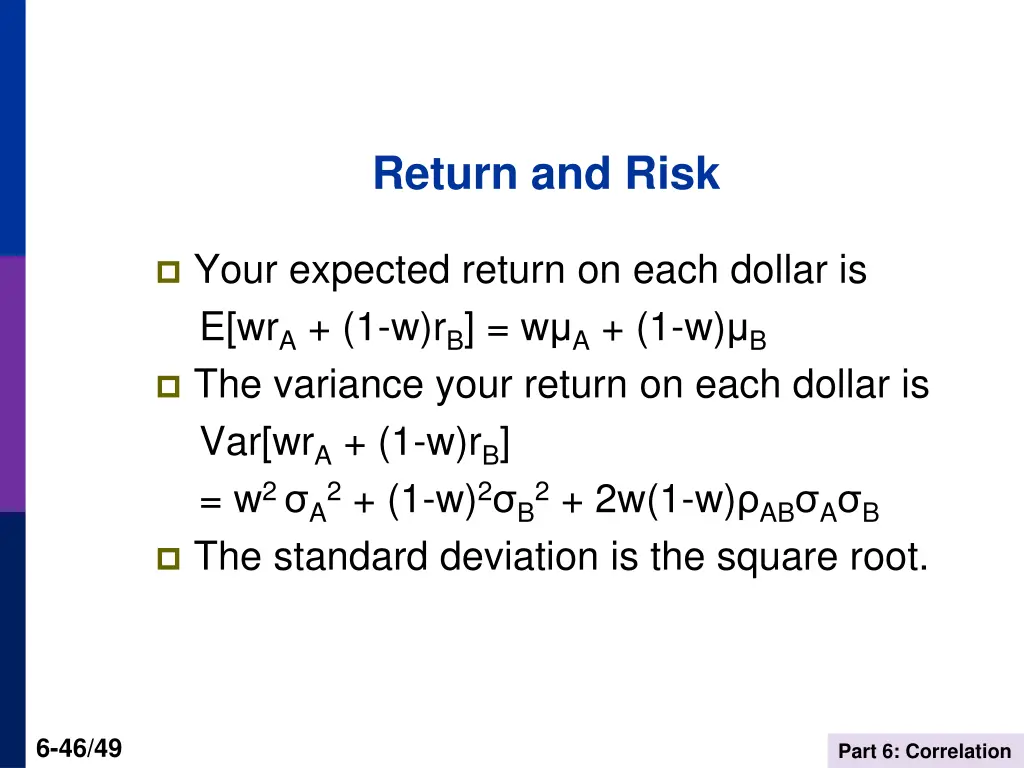
Return and Risk Your expected return on each dollar is E[wrA + (1-w)rB] = w A + (1-w) B The variance your return on each dollar is Var[wrA + (1-w)rB] = w2 A2 + (1-w)2 B2 + 2w(1-w) AB A B The standard deviation is the square root. 6-46/49 Part 6: Correlation
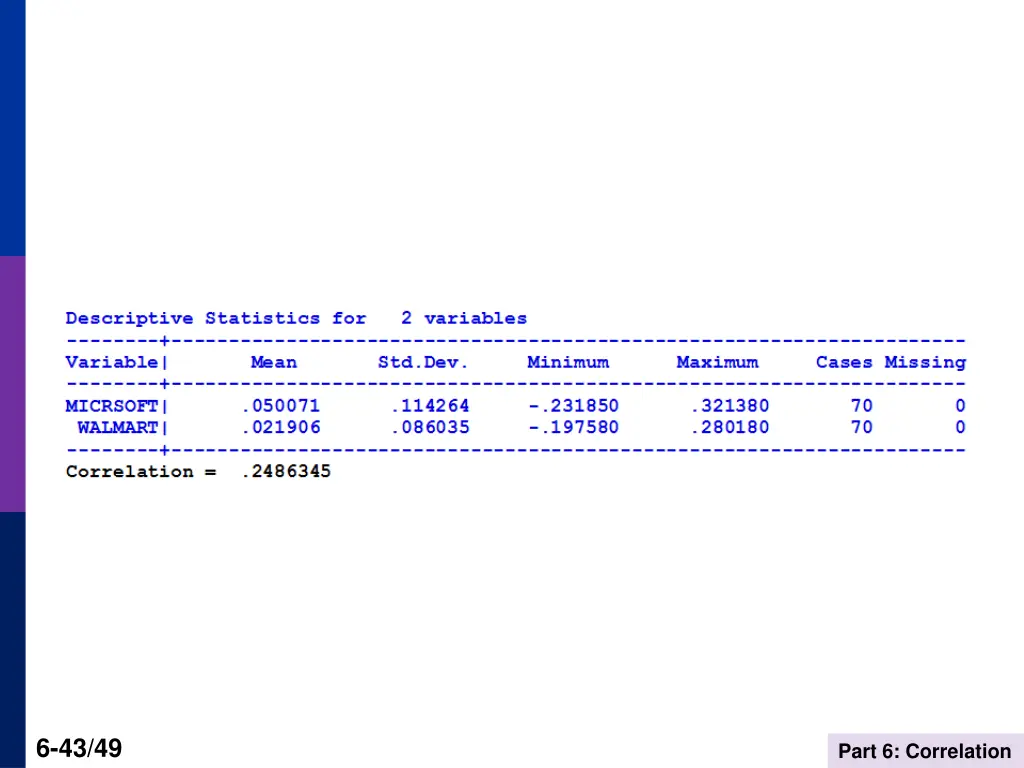
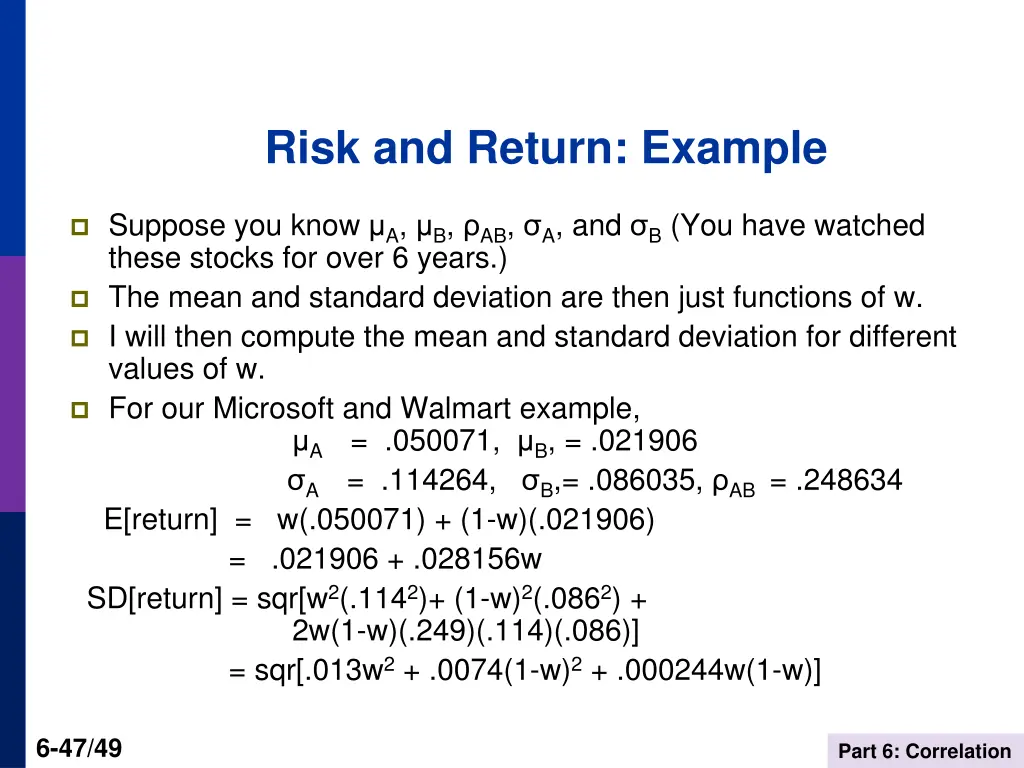
Risk and Return: Example Suppose you know A, B, AB, A, and B (You have watched these stocks for over 6 years.) The mean and standard deviation are then just functions of w. I will then compute the mean and standard deviation for different values of w. For our Microsoft and Walmart example, A = .050071, B, = .021906 A = .114264, B,= .086035, AB = .248634 E[return] = w(.050071) + (1-w)(.021906) = .021906 + .028156w SD[return] = sqr[w2(.1142)+ (1-w)2(.0862) + 2w(1-w)(.249)(.114)(.086)] = sqr[.013w2 + .0074(1-w)2 + .000244w(1-w)] 6-47/49 Part 6: Correlation
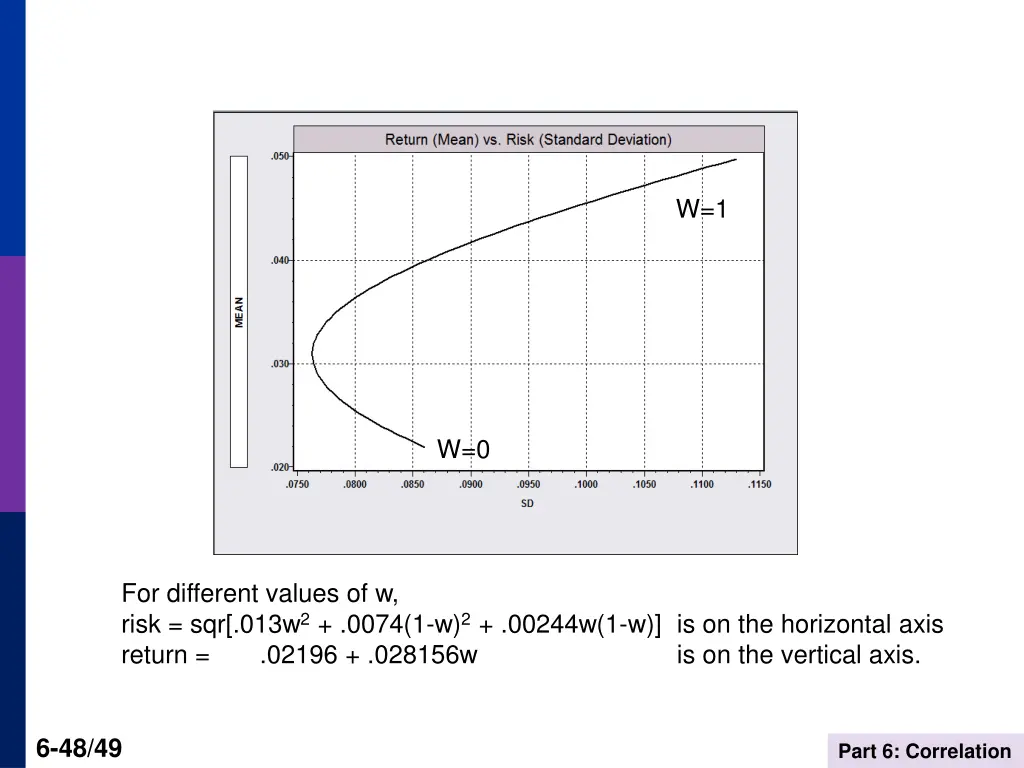
W=1 W=0 For different values of w, risk = sqr[.013w2 + .0074(1-w)2 + .00244w(1-w)] is on the horizontal axis return = .02196 + .028156w is on the vertical axis. 6-48/49 Part 6: Correlation
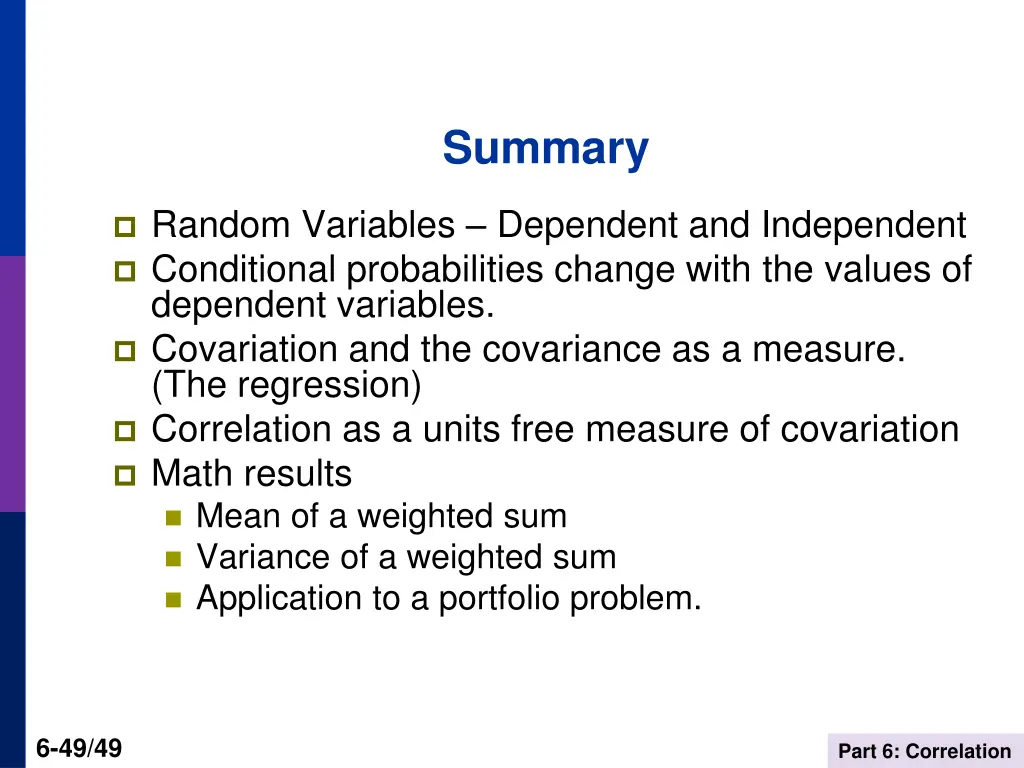
Summary Random Variables Dependent and Independent Conditional probabilities change with the values of dependent variables. Covariation and the covariance as a measure. (The regression) Correlation as a units free measure of covariation Math results Mean of a weighted sum Variance of a weighted sum Application to a portfolio problem. 6-49/49 Part 6: Correlation