Explore common elements and shared issues in data discovery paradigms, engage stakeholders to make recommendations, report accomplishments to date, and plan for future progress within the group. No modifications required to the outcome, schedules, or scope. Coordinate with other working groups and interest groups to align efforts with the RDA mission of facilitating data sharing for researchers.
Please find below an Image/Link to download the presentation.
The content on the website is provided AS IS for your information and personal use only. It may not be sold, licensed, or shared on other websites without obtaining consent from the author. If you encounter any issues during the download, it is possible that the publisher has removed the file from their server.
You are allowed to download the files provided on this website for personal or commercial use, subject to the condition that they are used lawfully. All files are the property of their respective owners.
The content on the website is provided AS IS for your information and personal use only. It may not be sold, licensed, or shared on other websites without obtaining consent from the author.
Purpose and planned outcomes/aims Explore common elements and shared issues faced by those who search for data, and who build systems supporting search Engage with broadest possible spectrum of stakeholders to investigate, report, and make recommendations regarding these issues
Accomplishments to date Four Task Forces formed Use Cases, Prototyping Tools and Test Collections Best Practices for Making Data Findable Relevancy Ranking Metadata Enrichment Three manuscripts generated, intended for publication One submitted, one ready, one in progress
Issues, challenges, problems Members: 100; Doers: 8 10 3 6 doers per task force Interactions with other groups minimal
Plan for completion/progress for the coming 6-12 months Metadata enrichment TF reinvigorated Recent CFP elicited encouraging responses Plan to develop survey on current practices and tools in use Spinning up TF on optimizing discoverability by commercial search engines
Relation to/coordination with other WG/IGs Although there are obvious connections with metadata, research data collections, domain focused interoperability, etc. we have had little direct interactions Participating in joint session at P11 w/ IG Agricultural Data IG ELIXIR Bridging Force WG BioSharing Registry IG Repository Platforms for Research Data
Fit with the RDA mission Discovery is central to mission of making it easier for researchers to share data Data producers, data repositories, infrastructure developers all have roles
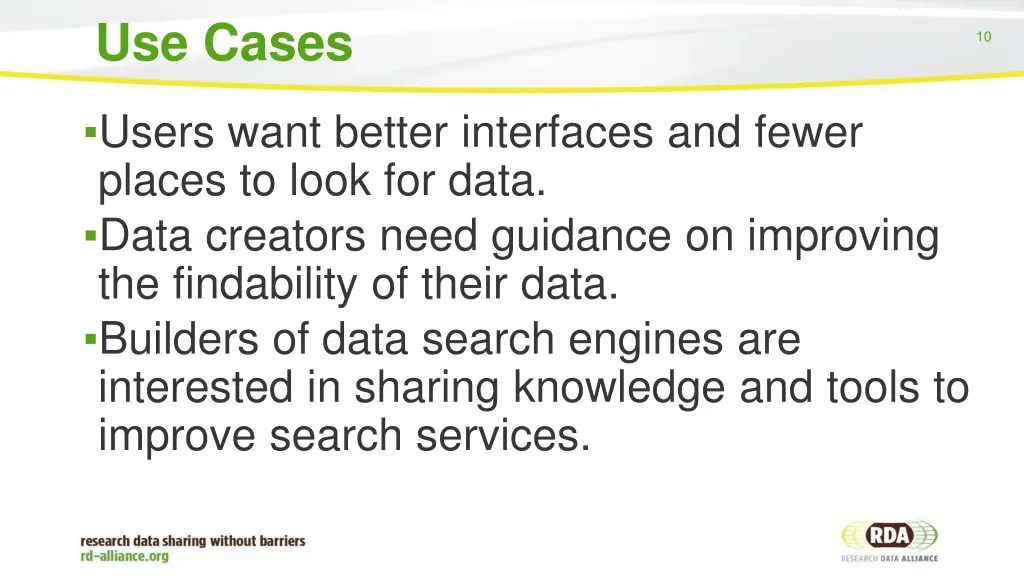
Use Cases 10 Users want better interfaces and fewer places to look for data. Data creators need guidance on improving the findability of their data. Builders of data search engines are interested in sharing knowledge and tools to improve search services.
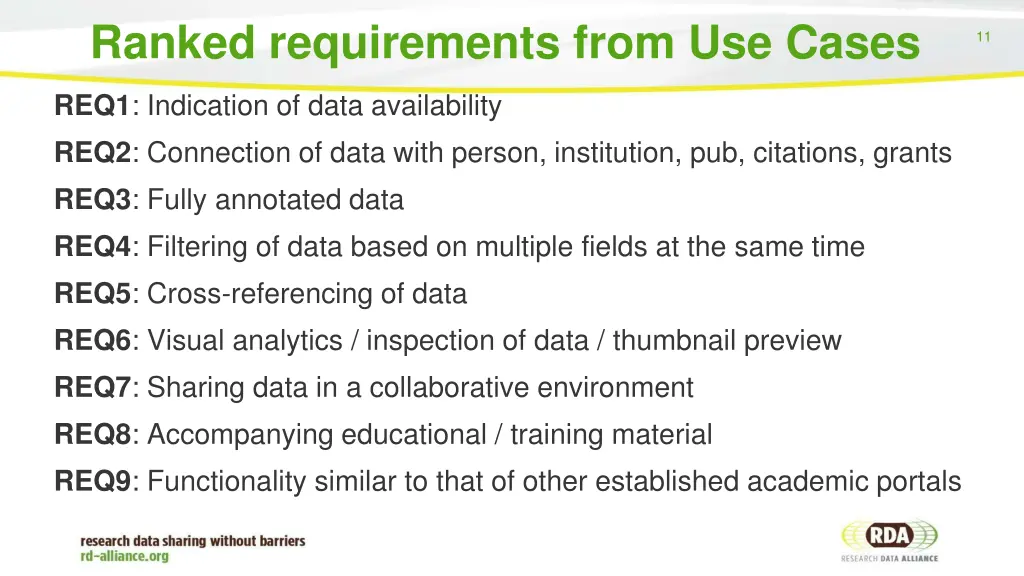
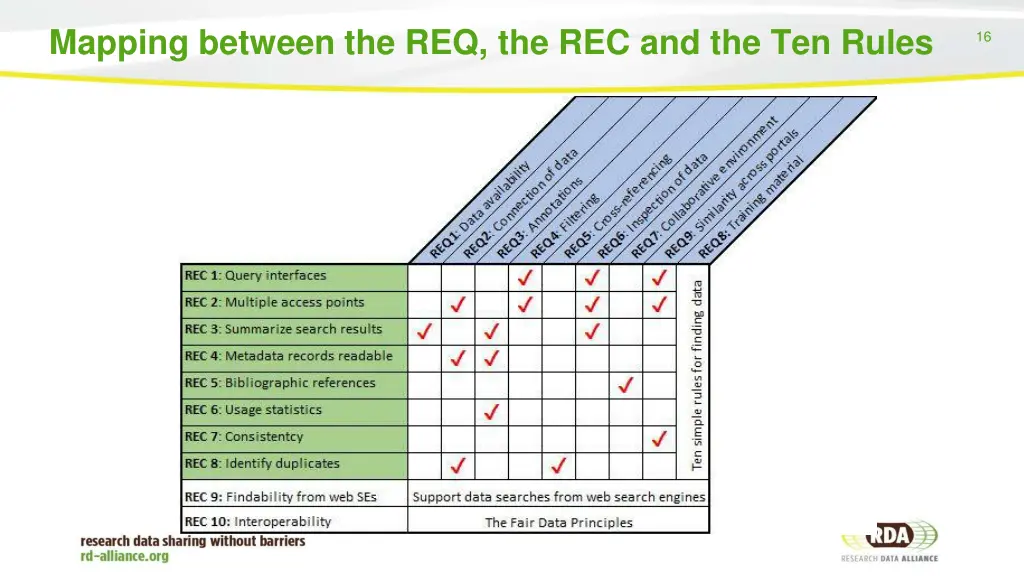
Ranked requirements from Use Cases 11 REQ1: Indication of data availability REQ2: Connection of data with person, institution, pub, citations, grants REQ3: Fully annotated data REQ4: Filtering of data based on multiple fields at the same time REQ5: Cross-referencing of data REQ6: Visual analytics / inspection of data / thumbnail preview REQ7: Sharing data in a collaborative environment REQ8: Accompanying educational / training material REQ9: Functionality similar to that of other established academic portals
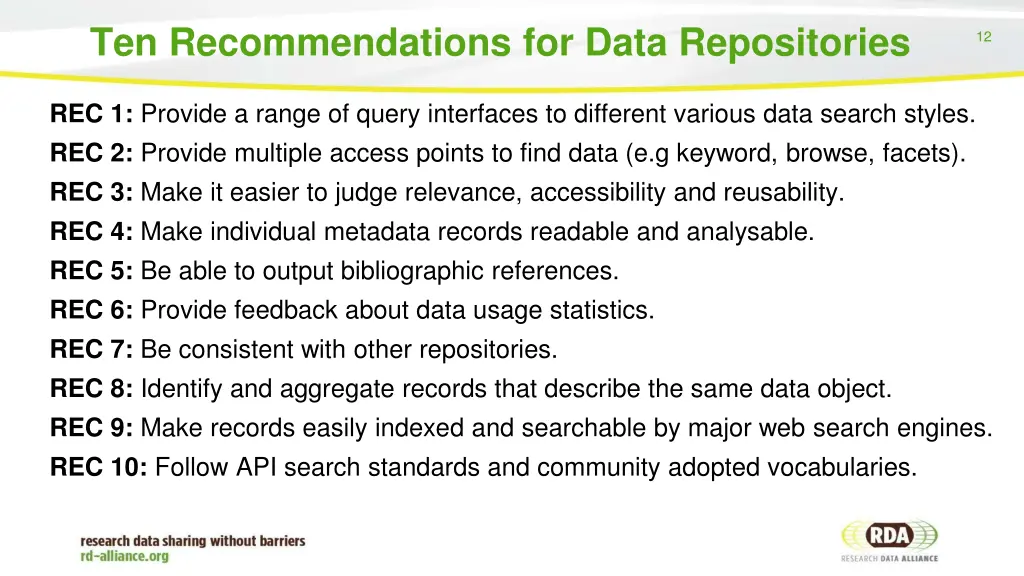
Ten Recommendations for Data Repositories 12 REC 1: Provide a range of query interfaces to different various data search styles. REC 2: Provide multiple access points to find data (e.g keyword, browse, facets). REC 3: Make it easier to judge relevance, accessibility and reusability. REC 4: Make individual metadata records readable and analysable. REC 5: Be able to output bibliographic references. REC 6: Provide feedback about data usage statistics. REC 7: Be consistent with other repositories. REC 8: Identify and aggregate records that describe the same data object. REC 9: Make records easily indexed and searchable by major web search engines. REC 10: Follow API search standards and community adopted vocabularies.
Combined outputs 13 Requirements derived from use cases Recommendations for data repositories Combined into manuscript submitted to Library & Information Science Research
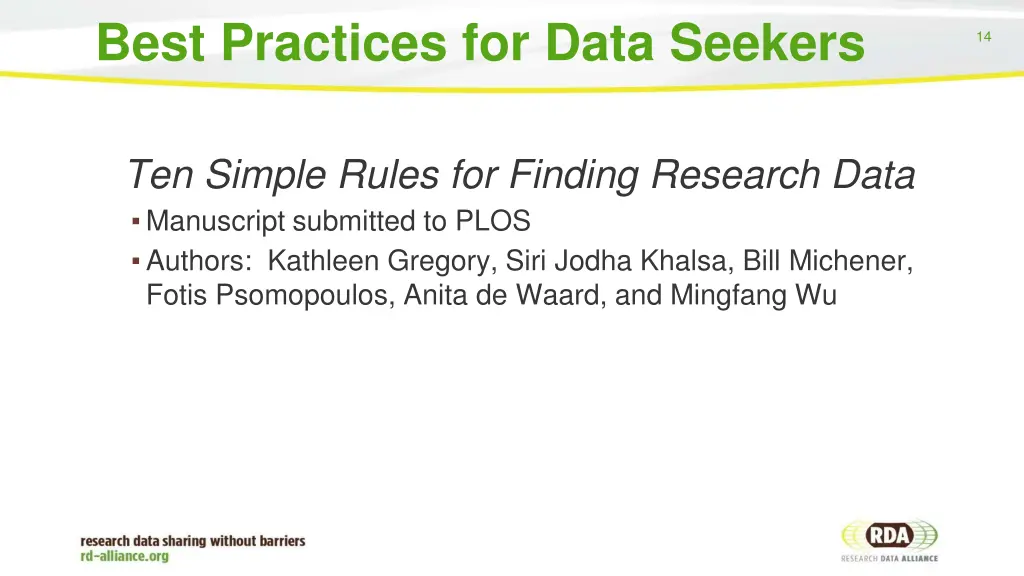
Best Practices for Data Seekers 14 Ten Simple Rules for Finding Research Data Manuscript submitted to PLOS Authors: Kathleen Gregory, Siri Jodha Khalsa, Bill Michener, Fotis Psomopoulos, Anita de Waard, and Mingfang Wu
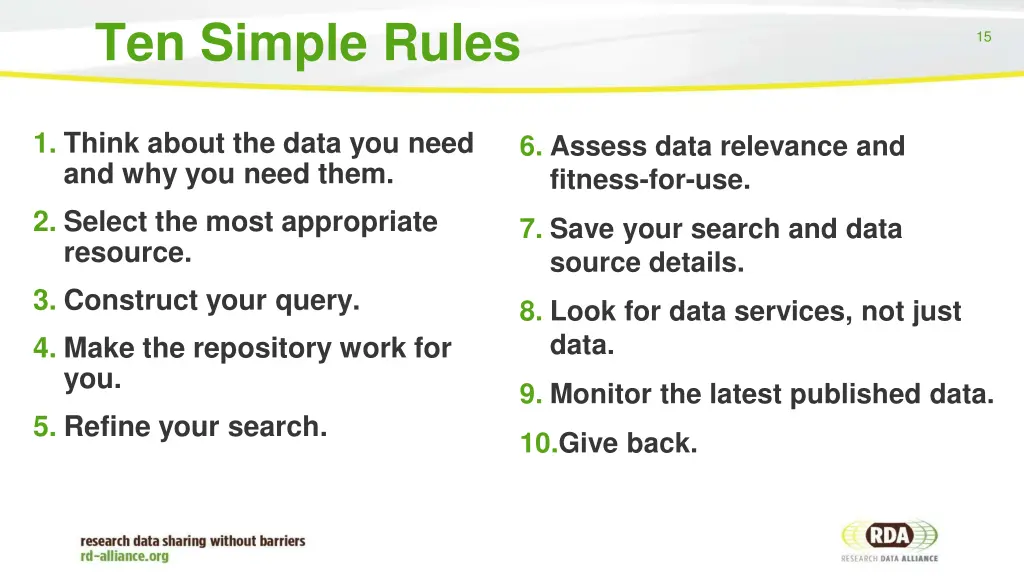
Ten Simple Rules 15 1. Think about the data you need and why you need them. 2. Select the most appropriate resource. 3. Construct your query. 4. Make the repository work for you. 5. Refine your search. 6. Assess data relevance and fitness-for-use. 7. Save your search and data source details. 8. Look for data services, not just data. 9. Monitor the latest published data. 10.Give back.
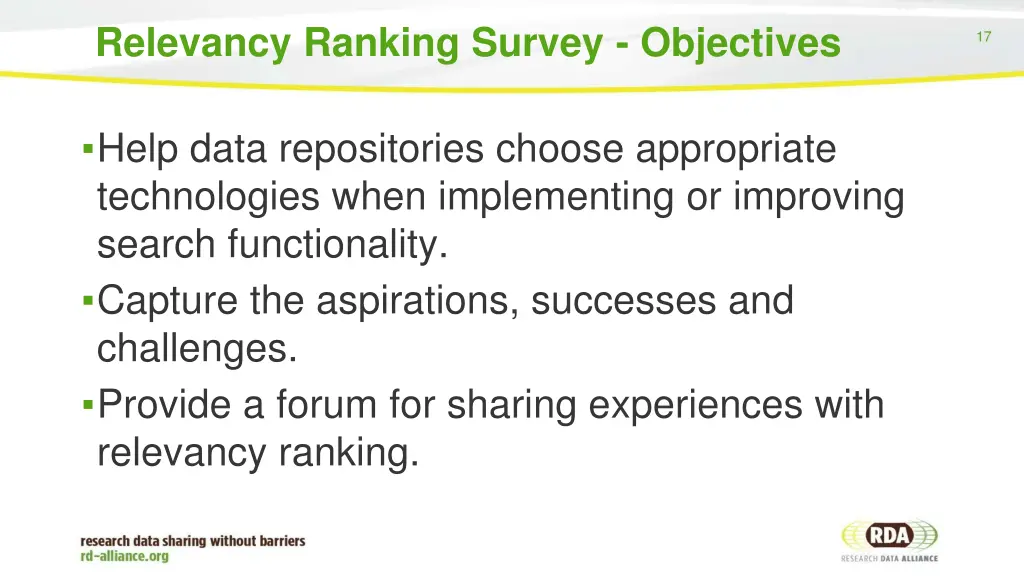
Relevancy Ranking Survey - Objectives 17 Help data repositories choose appropriate technologies when implementing or improving search functionality. Capture the aspirations, successes and challenges. Provide a forum for sharing experiences with relevancy ranking.
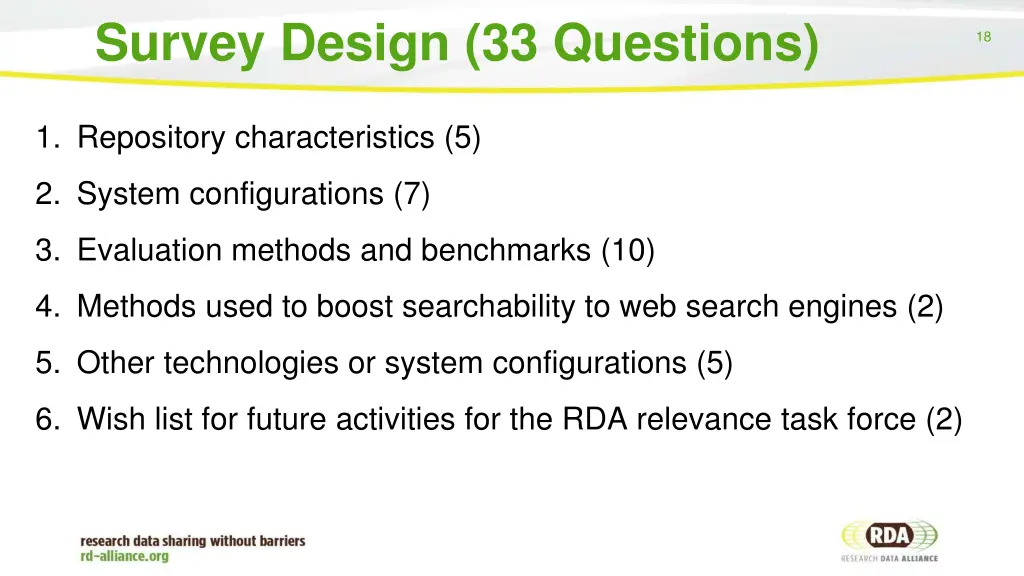
Survey Design (33 Questions) 18 1. Repository characteristics (5) 2. System configurations (7) 3. Evaluation methods and benchmarks (10) 4. Methods used to boost searchability to web search engines (2) 5. Other technologies or system configurations (5) 6. Wish list for future activities for the RDA relevance task force (2)
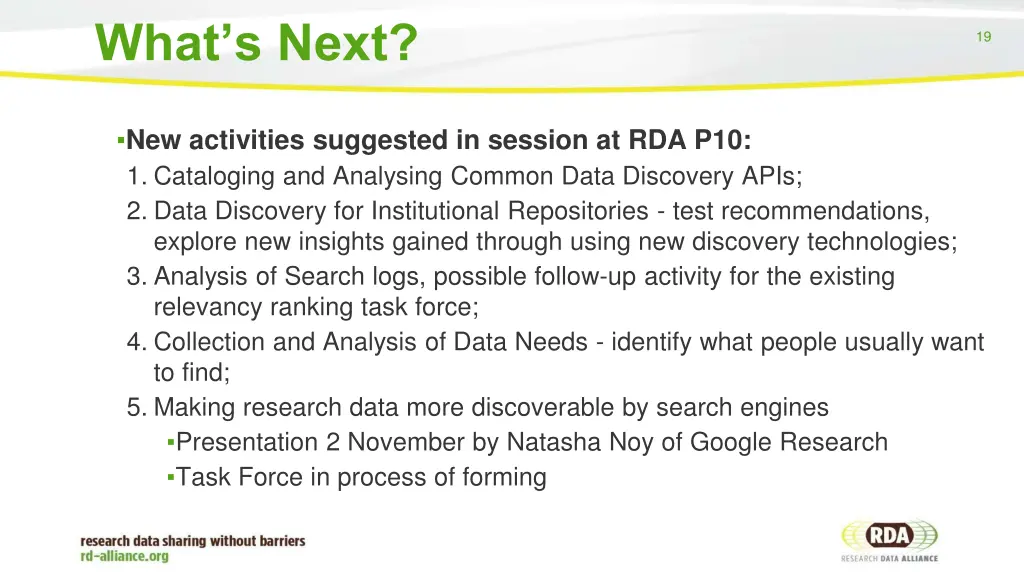
Whats Next? 19 New activities suggested in session at RDA P10: 1. Cataloging and Analysing Common Data Discovery APIs; 2. Data Discovery for Institutional Repositories - test recommendations, explore new insights gained through using new discovery technologies; 3. Analysis of Search logs, possible follow-up activity for the existing relevancy ranking task force; 4. Collection and Analysis of Data Needs - identify what people usually want to find; 5. Making research data more discoverable by search engines Presentation 2 November by Natasha Noy of Google Research Task Force in process of forming